
Life, 1912-07-04 · page 8 of 44
Life — July 4, 1912 — page 8: what you’re looking at
What you’re looking at
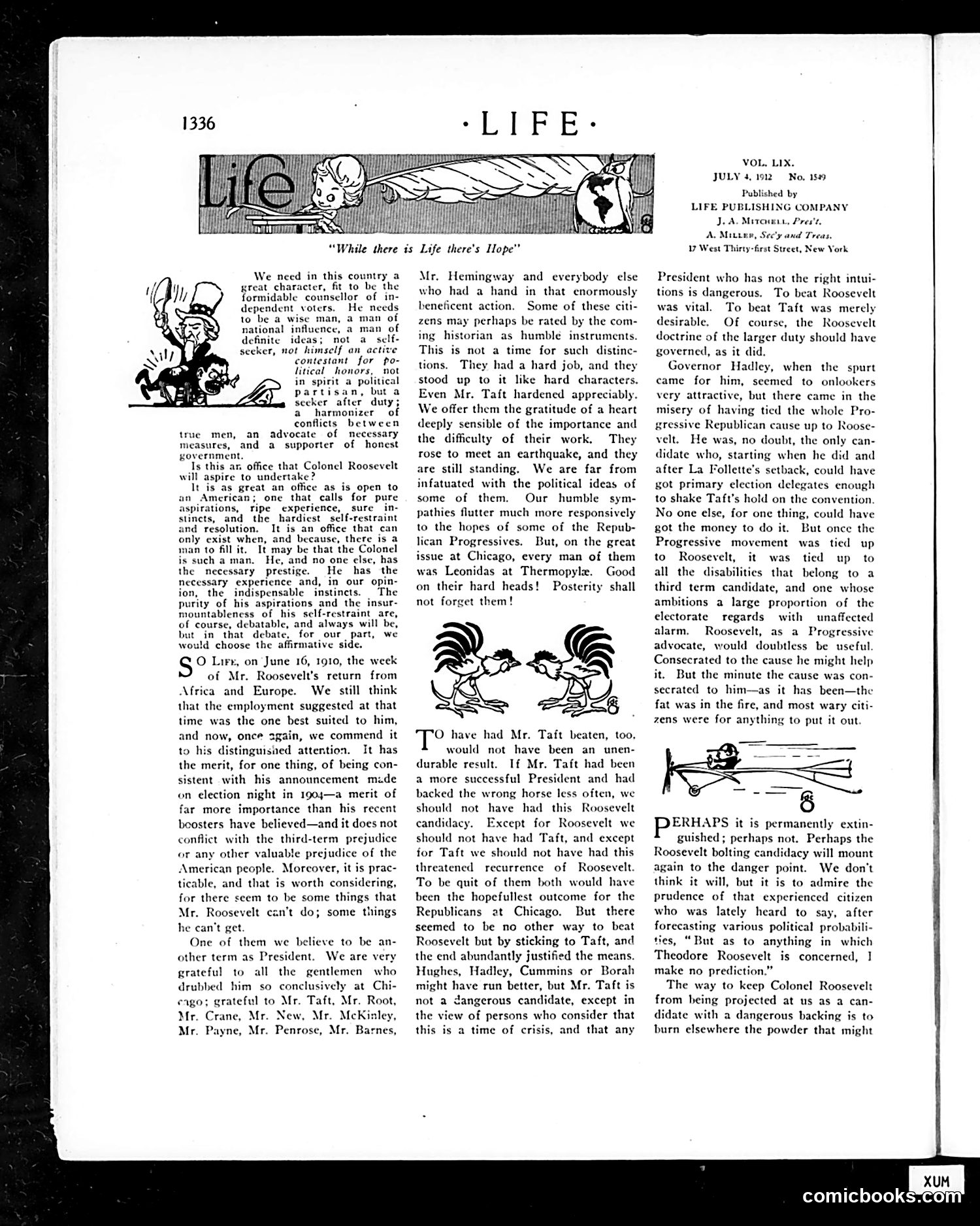
This editorial page discusses the 1912 Presidential election aftermath. The text debates whether Theodore Roosevelt's third-term candidacy was justified, suggesting that while Roosevelt had merit, supporting him created conflict with Republican party loyalty. The two cartoon illustrations show **roosters fighting** — likely representing the Republican party split. In 1912, Roosevelt's Progressive "Bull Moose" party candidacy divided the GOP, allowing Democrat Woodrow Wilson to win. The rooster imagery suggests fratricidal conflict within the Republican ranks. The text acknowledges Roosevelt's leadership qualities but criticizes his third-term ambitions as dangerous precedent, arguing the party should have stuck with Taft to maintain unity rather than fracturing over personality-driven politics.
📄 Transcribed text from this page (OCR, searchable)
Machine-transcribed from the original scan — historical spelling and the odd misread are preserved.
“While there is Life there's Hope” We need in this country a great character, fit to be the formidable counsellor of in- dependent voters. He needs to be a wise man, a man of national influence, a man of definite ideas; not a self- seeker, not himself an active contestant for po- litical honors, not in spirit a political partisan, but a secker after duty; a harmonizer of conflicts between an advocate of neces true men, ry and a supporter of honest measure government. Is this an office that Colonel Roosevelt will aspire to undertake? . It is as great an office as is open to an American; one that calls for pure ispirations, ripe experience, sure in- stincts, and the hardicst self-restraint and resolution. It is an office that can only exist when, and because, there is a nto fill it. It may be that the Colonel is such a man. He, and no one else, has the necessary prestige. He has’ the necessary experience and, in our opin- ion, the indispensable instincts. The purity of his aspirations and the insur- mountableness of his sclf. raint are, of course, debatable, and always will be but in that debate, for our part, we would choose the affirmative side. O Lire, on June 16, 1910, the week of Mr. Roosevelt’s return from -\frica and Europe. We still think that the employment suggested at that time was the one best suited to him, and now, once again, we commend it to his distinguished attention. It has the merit, for one thing, of being con- sistent with his announcement mide on election night in 1904—a merit of far more importance than his recent boosters have believed—and it does not conflict with the third-term prejudice or any other valuable prejudice of the American people. Moreover, it is prac- ticable, and that is worth considering, for there seem to be some things that Mr. Roosevelt can't do; some things he can’t get. One of them we believe to be an- other term as President. We are very grateful to all the gentlemen who drubbed him so conclusively at Chi- cago; grateful to Mr. Taft, Mr. Root, Mr. Crane, Mr. New, Mr. McKinley, Mr. Payne, Mr. Penrose, Mr. Barnes, Mr. Hemingway and everybody else who had a hand in that enormously beneficent action. Some of these ci zens may perhaps be rated by the com- ing historian as humble instruments. This is not a time for such distinc- tions. They had a hard job, and they stood up to it like hard characters. Even Mr. Taft hardened appreciably. We offer them the gratitude of a heart deeply sensible of the importance and the difficulty of their work, They rose to meet an earthquake, and they are still standing. We are far from infatuated with the political ideas of some of them. Our humble sym- pathies flutter much more responsively to the hopes of some of the Repub- lican Progressives. But, on the great issue at Chicago, every man of them was Leonidas at Thermopylez. Good on their hard heads! Posterity shall not forget them! a \ S 'O have had Mr. Taft beaten, too, would not have been an unen- durable result. If Mr. Taft had been a more successful President and had backed the wrong horse less often, we should not have had this Roosevelt candidacy. Except for Roosevelt we should not have had Taft, and except for Taft we should not have had this threatened recurrence of Roosevelt. To be quit of them both would have been the hopefullest outcome for the Republicans at Chicago. But there seemed to be no other way to beat Roosevelt but by sticking to Taft, and the end abundantly justified the means. Hughes, Hadley, Cummins or Borah might have run better, but Mr. Taft is not a dangerous candidate, except in the view of persons who consider that is a time of crisis, and that any VOL. LIX. JULY 4,192 Ni Published by LIFE PUBLISHING COMPANY J. A. Mitonnit, Pres't. A. Mitta, Sec'y and Treas. 7 West Thirty-first Street, New York President who has not the right intui- tions is dangerous. To beat Roosevelt was vital. To beat Taft was merely desirable. Of course, the Roosevelt doctrine of the larger duty should have governed, as it did. Governor Hadley, when the spurt came for him, seemed to onlookers very attractive, but there came in the misery of having tied the whole Pro- gressive Republican cause up to Roose- velt. He was, no doubt, the onl didate who, starting when he did and after La Follette’s setback, could have got primary election delegates enough to shake Taft's hold on the convention. No one else, for one thing, could have got the money to do it. But once the Progressive movement was tied up to Roosevelt, it was tied up to all the disabilities that belong to a third term candidate, and one whose ambitions a large proportion of the electorate regards with unaffected alarm. Roosevelt, as a Progressive advocate, would doubtless be useful. Consecrated to the cause he might help it. But the minute the cause was con- secrated to him—as it has been—the fat was in the fire, and most wary citi- zens were for anything to put it out PERHAES it is permanently extin- guished; perhaps not. Perhaps the Roosevelt bolting candidacy will mount again to the danger point. We don't think it will, but it is to admire the prudence of that experienced citizen who was lately heard to say, after forecasting various political probabili- ties, “But as to anything in which Theodore Roosevelt is concerned, J make no prediction.” The way to keep Colonel Roosevelt from being projected at us as a can- didate with a dangerous backing is to burn elsewhere the powder that might comicbook $.COl