
A complete issue · 50 pages · 1912
Life — March 28, 1912
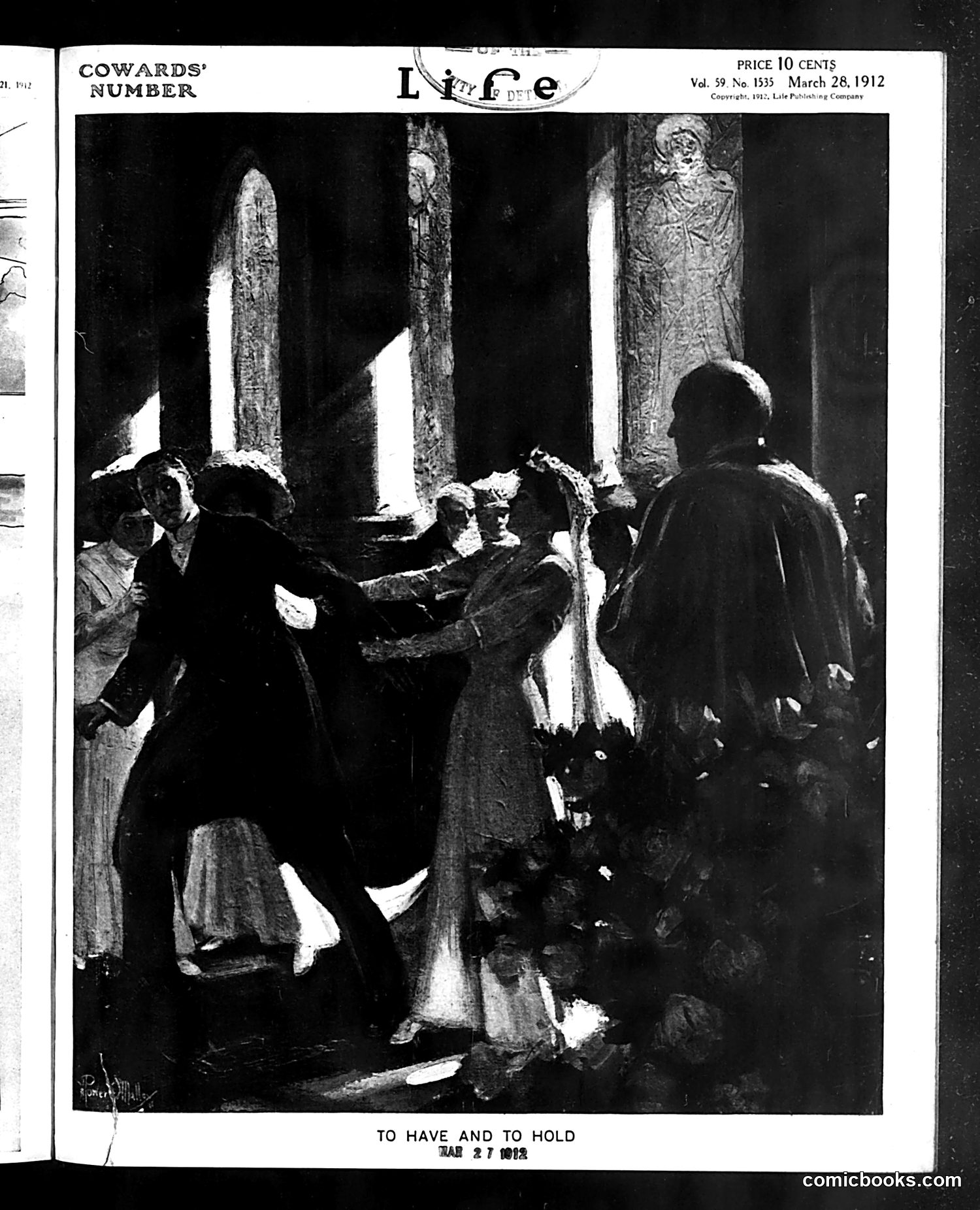
This is a satirical illustration titled "TO HAVE AND TO HOLD" from Life magazine's March 28, 1912 issue. The cartoon depicts a wedding ceremony scene set in what appears to be a church with classical columns and statuary in the background. The image appears to be social satire about marriage, though the specific couple referenced is unclear from the image alone. The dramatic lighting and formal religious setting emphasize the solemnity of marriage vows. The title "To Have and To Hold" references traditional wedding vow language, suggesting the cartoon may be commenting on the gap between romantic ideals of marriage and matrimonial reality—a common satirical theme in early 20th-century American magazines. The specific political or social context requires additional information beyond what's visible here.
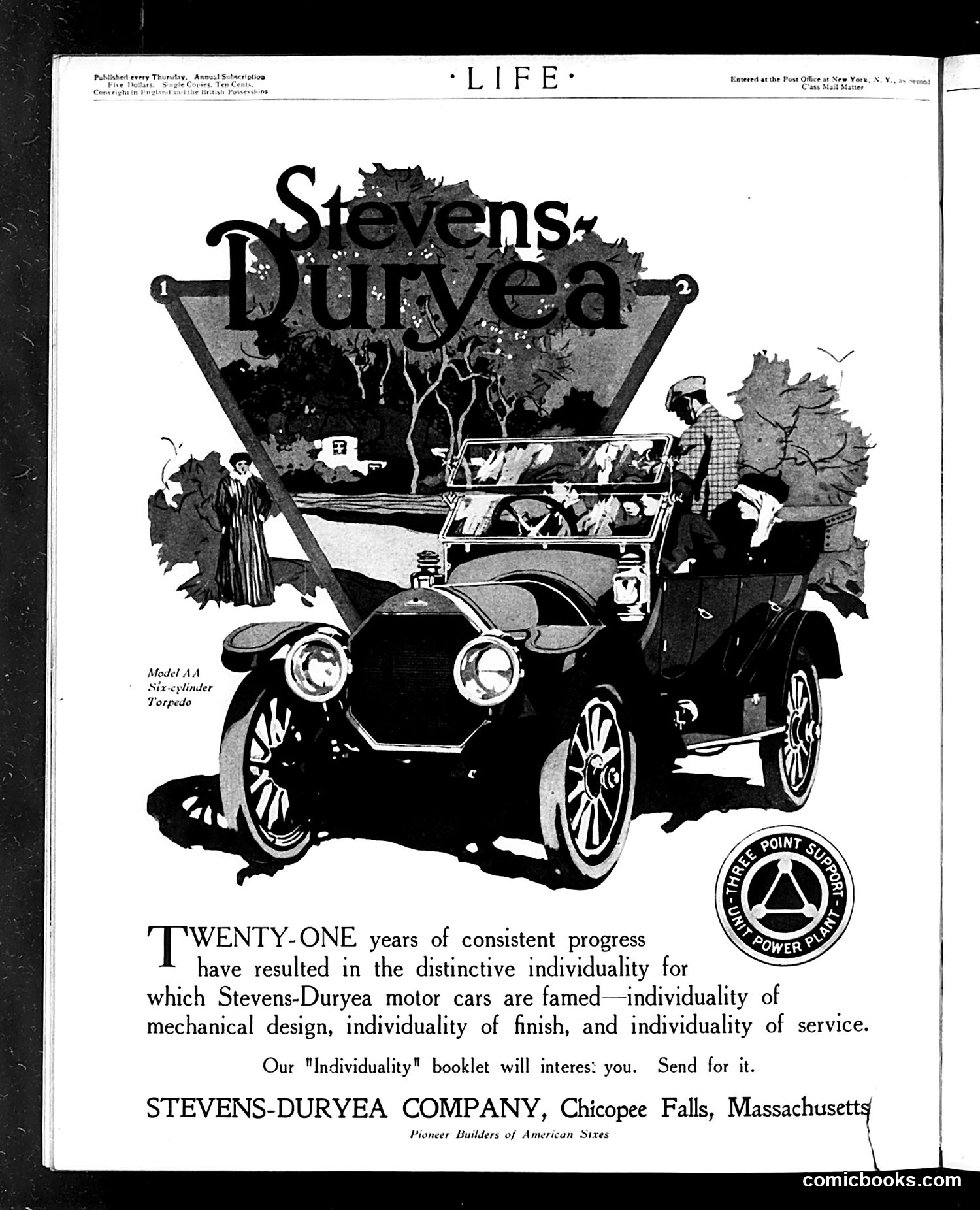
This page is primarily **advertising, not satire or political commentary**. It's a car advertisement for the Stevens-Duryea Company of Chicopee Falls, Massachusetts, promoting their Model AA Six-cylinder Torpedo automobile. The illustration shows a well-dressed couple with their touring car, surrounded by decorative foliage and what appears to be a large decorative urn or planter. The text emphasizes the company's "twenty-one years of consistent progress" and highlights three selling points: mechanical design individuality, finish quality, and service reliability. The "Three Point Support" logo appears in the lower right. This is straightforward commercial messaging typical of early 20th-century automotive advertising, with no apparent political or social satire intended.
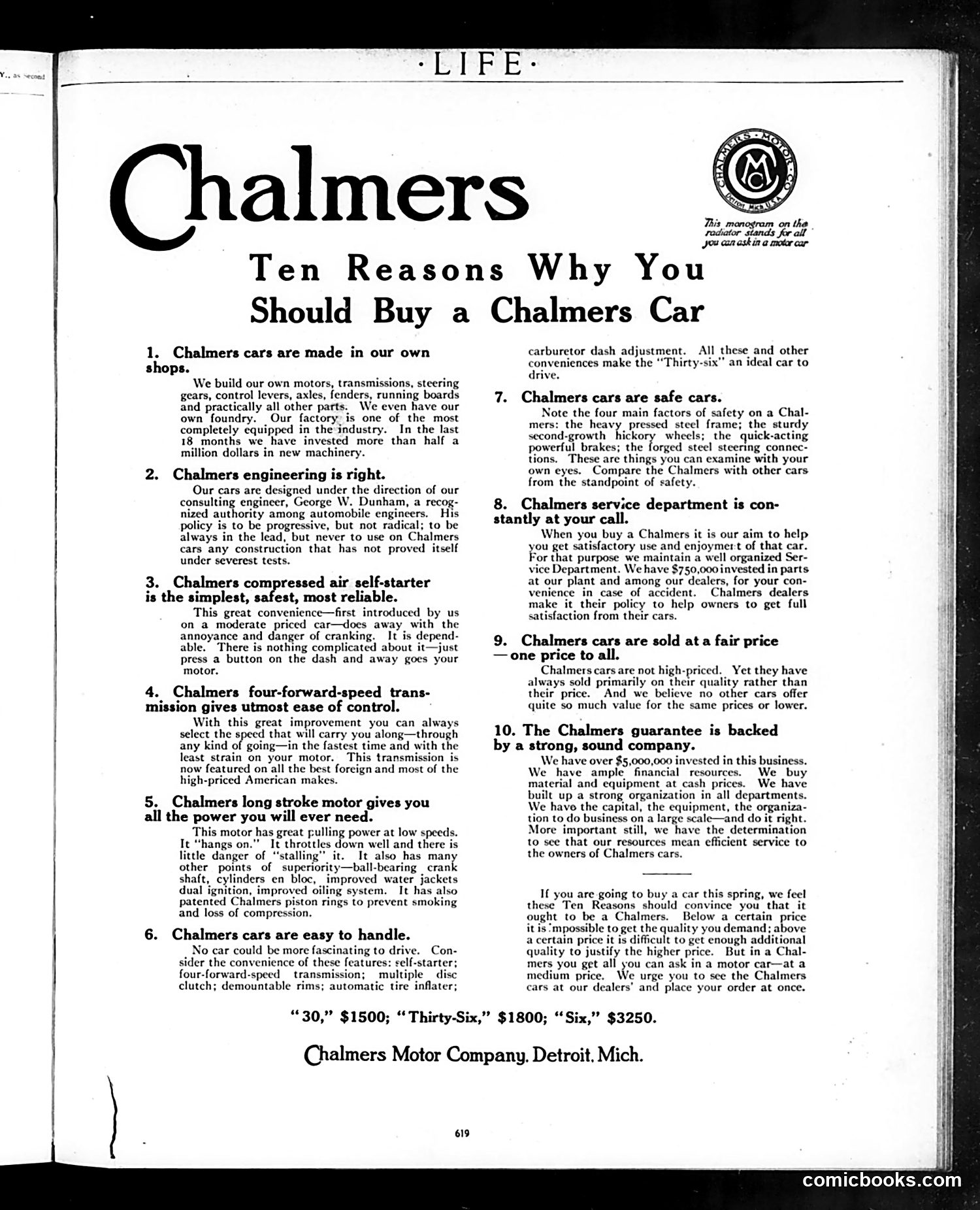
This page is **not a cartoon or satire** — it's a straightforward **automobile advertisement** for Chalmers cars, published in *Life* magazine (which ran both humor and ads). The ad presents "Ten Reasons Why You Should Buy a Chalmers Car," highlighting manufacturing quality, engineering credentials, technical features (compressed air self-starter, four-speed transmission, long-stroke motor), safety, dealer service, fair pricing, and company financial stability. The pricing listed ("30," $1500; "Thirty-Six," $1800; "Six," $3250) and manufacturing location (Detroit, Michigan) establish this as early-20th-century automotive marketing — a period when car features and manufacturer credibility were key sales pitches to a still-skeptical consumer base. This is historical advertising, not satire.
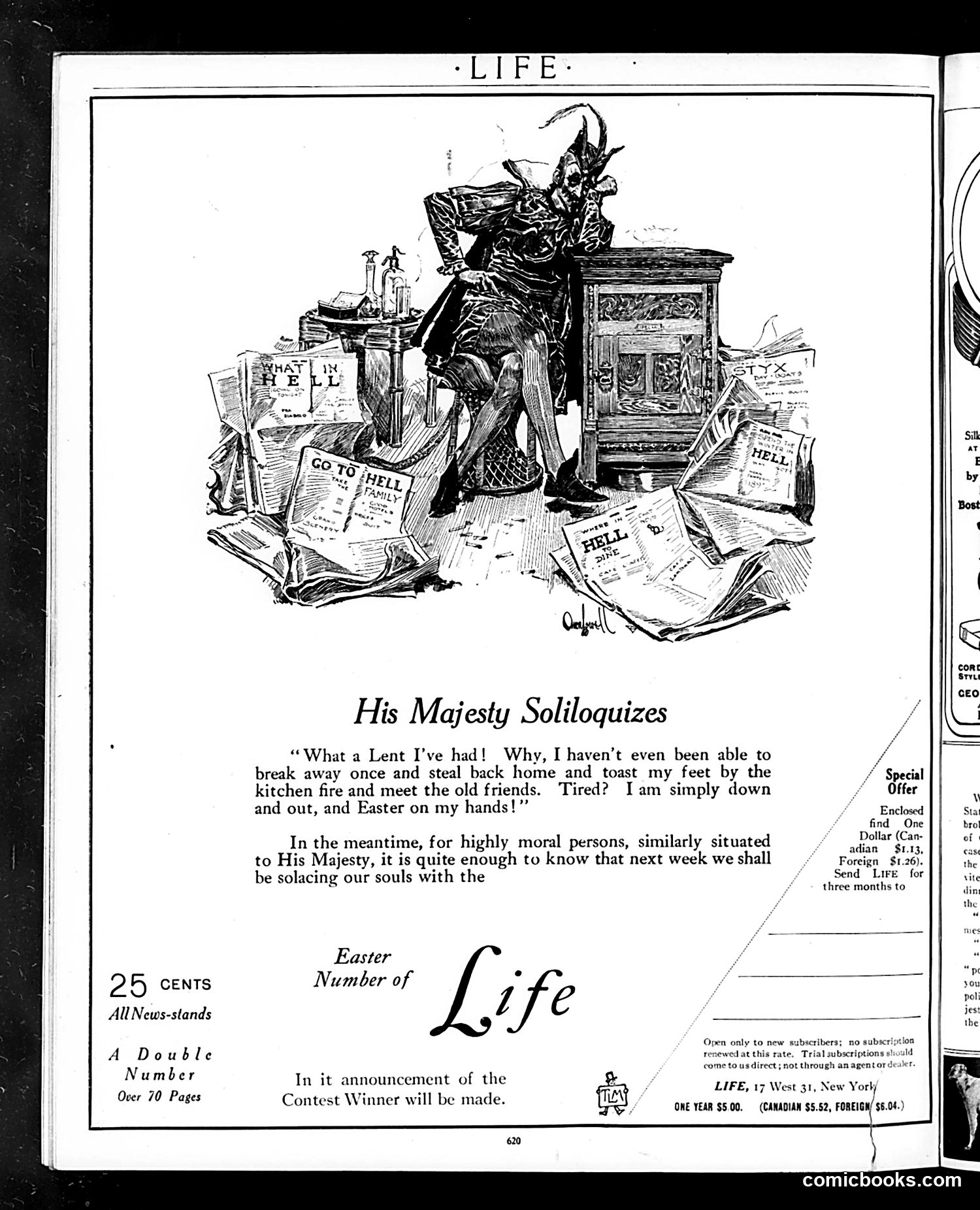
This page advertises Life magazine's Easter double issue (25 cents, 70+ pages). The central cartoon depicts a demonic or devil-like figure surrounded by religious pamphlets labeled "Hell" and "Go to Hell," alongside domestic items like a stove and furniture. The satire targets "His Majesty" (likely a political or social figure) who complains about an exhausting Lent—unable to leave home, visit friends, or enjoy comforts. The joke invokes religious solemnity: even morally questionable people should acknowledge Easter's spiritual significance. The cartoon's hellish imagery and scattered "Hell" literature suggest mockery of either religious hypocrisy or someone infamous enough to merit damnation imagery. Without additional context, the specific target remains unclear, though the satire likely addressed contemporary public figures or social attitudes toward Lenten observance.
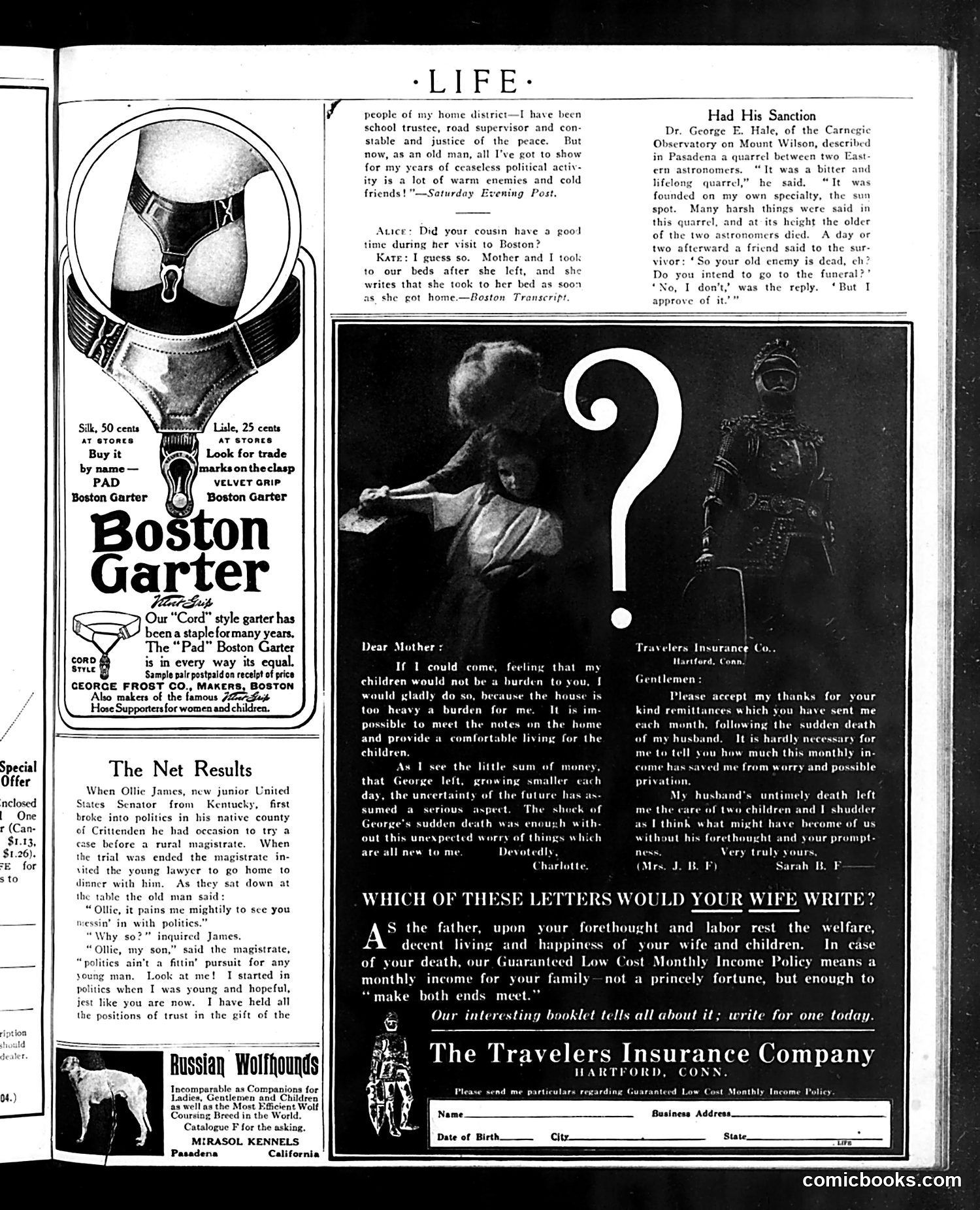
This page is primarily **advertising and personal correspondence**, not political satire. The main content includes: - A **Boston Garter advertisement** (hosiery/garters for women and children) - A **Russian Wolfhounds breeding advertisement** from Mirasol Kennels, Pasadena - Personal letters to Life's editor about political activities and family matters - A **Travelers Insurance Company advertisement** featuring an insurance pitch for families The only satirical element is "The Net Results," a brief anecdote about Olie James, a junior U.S. Senator from Kentucky, entering politics. The humor derives from his naive assumption that politics represents honest work—his mentor suggests he'll find it's actually just "politics in a fun' pursuit." The page reflects early 20th-century concerns: women's economic security, pet breeding enthusiasm, and political cynicism—but contains no identifiable caricatures or major historical references requiring explanation.
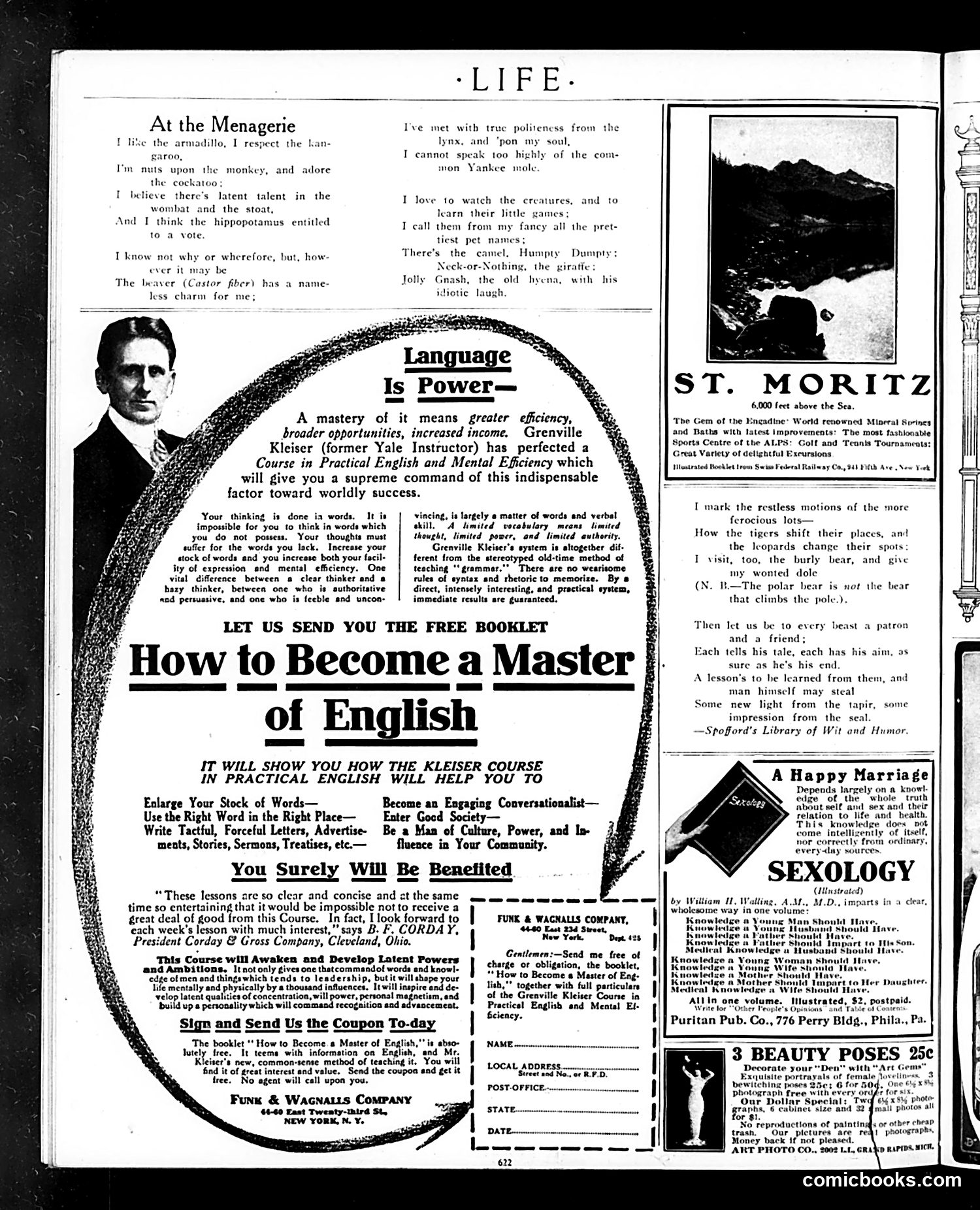
This page is **primarily advertising** rather than satire or political commentary. The dominant feature is a large advertisement for the Kleiser Course in "Practical English and Mental Efficiency," promoting language mastery as a path to professional success and social advancement. The upper left contains a poem titled "At the Menagerie" offering lighthearted observations about zoo animals, with no apparent political satire. The right side features travel and self-help advertisements, including one for "St. Moritz" and another titled "A Happy Marriage" promoting a book on "Sexology." The page reflects early 20th-century American consumer culture, emphasizing self-improvement through education and purchased expertise—common Life magazine themes of the era.
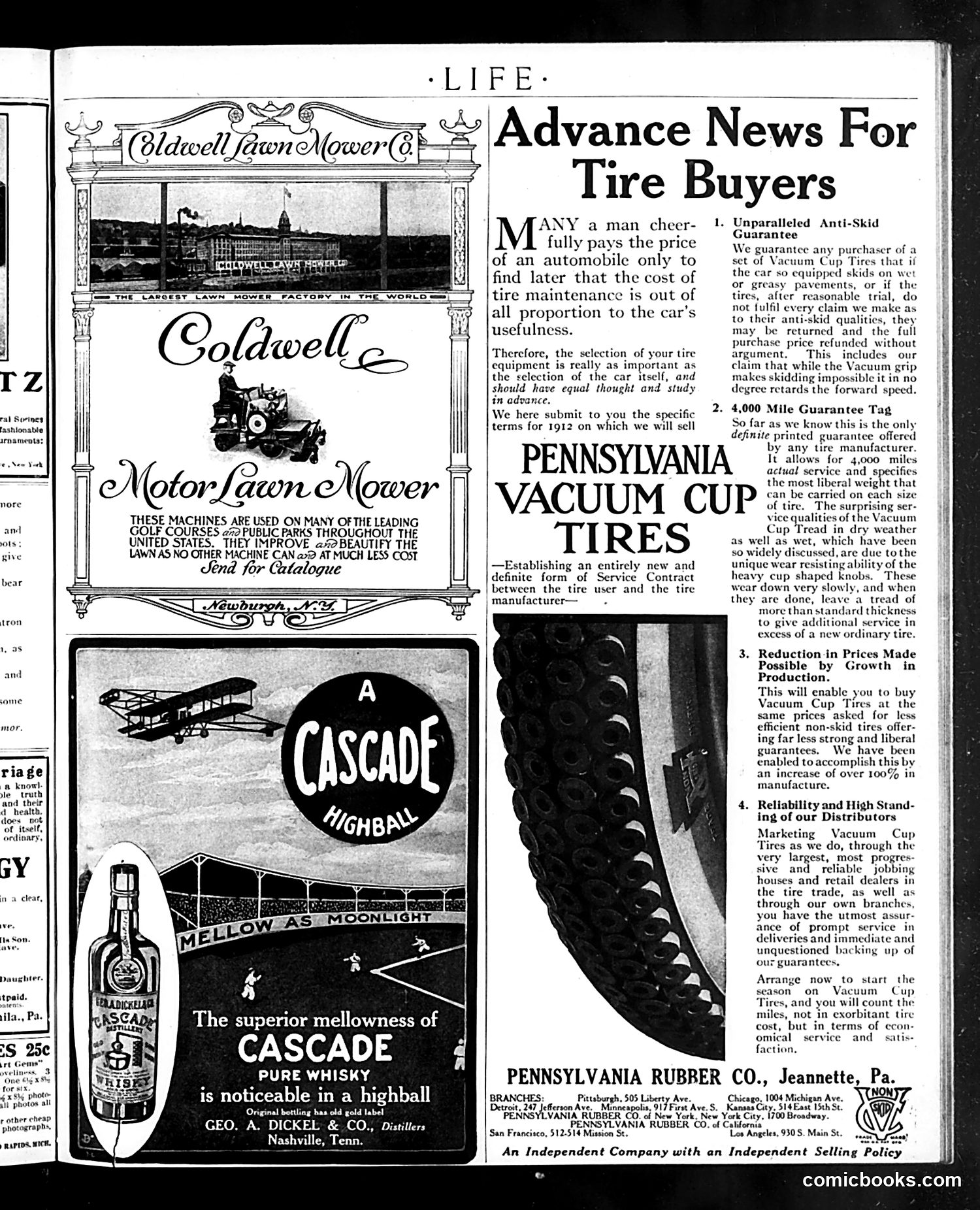
This page contains **commercial advertisements**, not political cartoons or satire. The visible ads include: 1. **Coldwell Motor Lawn Mower** — promoting lawn mowers as "the largest lawn mower factory in the world," with a factory image 2. **Cascade Highball** — a whiskey advertisement featuring a baseball/nightball scene, emphasizing the drink's "superior mellowness" 3. **Pennsylvania Vacuum Tires** — the dominant ad, detailing tire guarantees and pricing benefits The content reflects early 1910s consumer culture, targeting middle-class homeowners (lawn care), leisure consumers (whiskey), and automobile owners (tires). There is no political commentary or satirical content visible—this appears to be a standard advertising section from *Life* magazine's commercial pages.
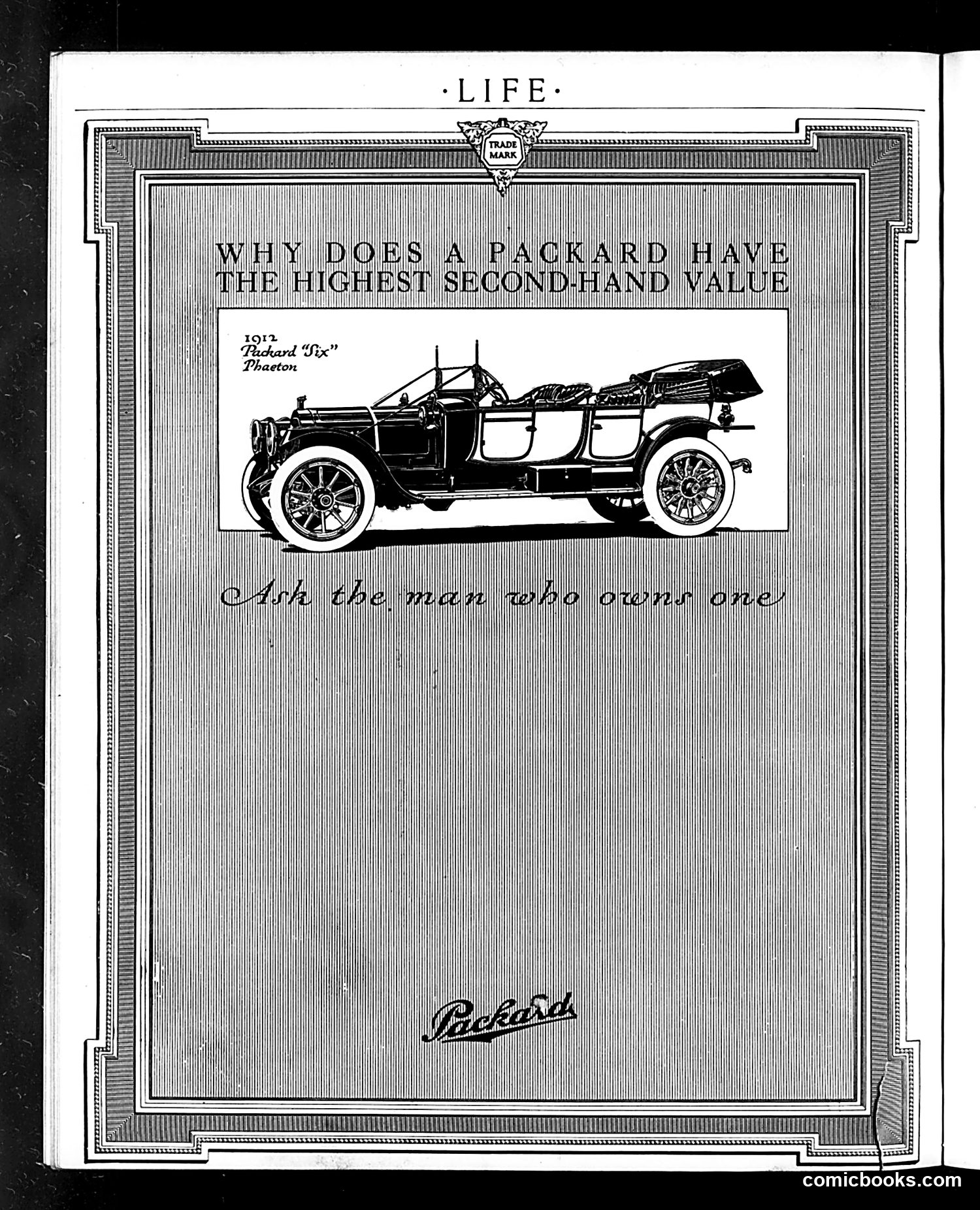
This is a Packard automobile advertisement masquerading as editorial content in *Life* magazine. The headline asks "WHY DOES A PACKARD HAVE THE HIGHEST SECOND-HAND VALUE," and the subheading answers with "Ask the man who owns one." The image shows a 1912 Packard "Six" Phaeton—a luxury open-air automobile. The ad's satire lies in its rhetorical framing: rather than directly claiming superiority, it relies on owner testimonials, implying that Packard's resale value speaks for itself among wealthy buyers. This reflects early 1910s automobile marketing, when owning a luxury car was a status symbol. The implication is that discerning wealthy men recognize Packard's quality, making used models highly desirable—a form of social proof advertising targeting the aspirational upper class.
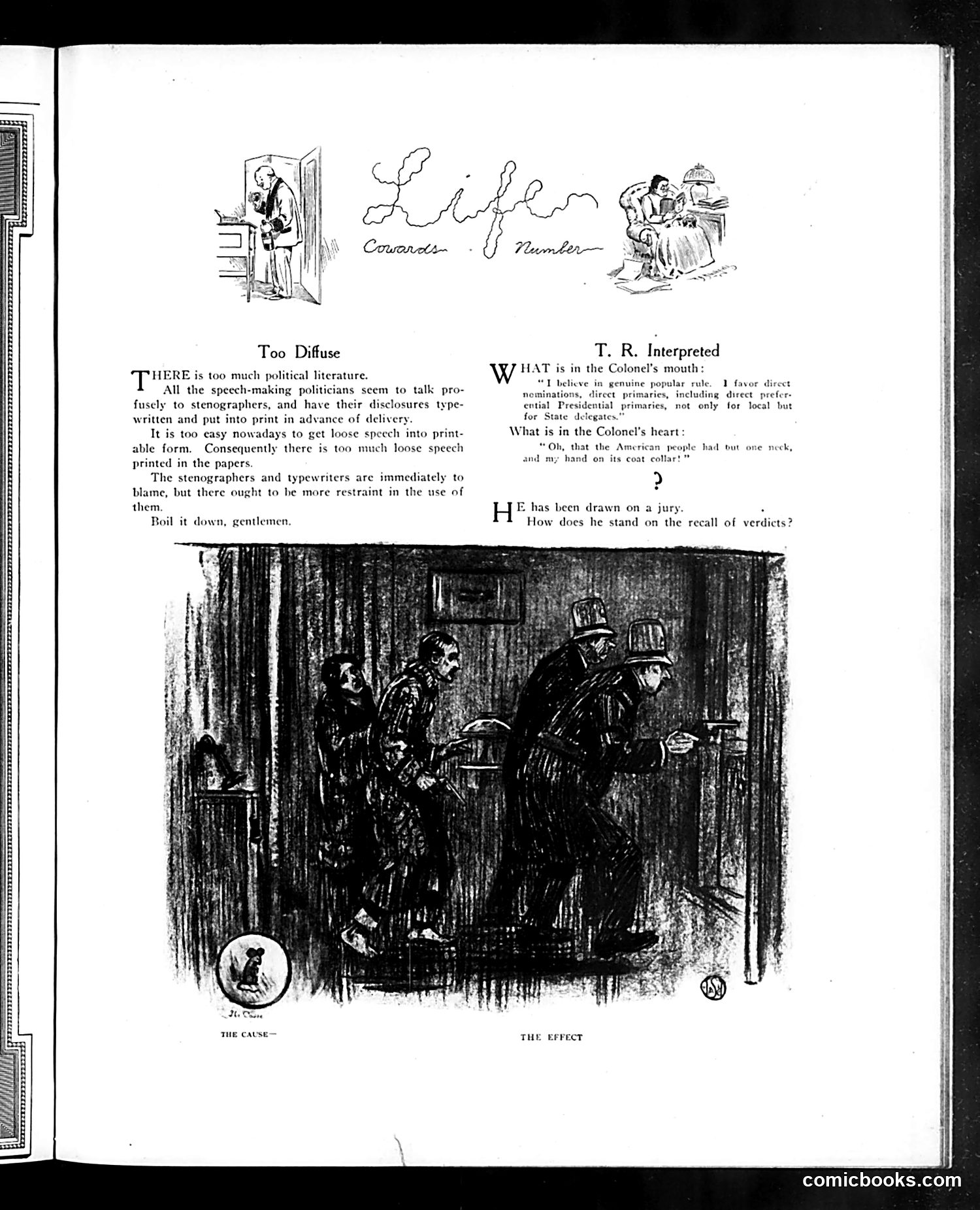
This page critiques excessive political speechmaking and stenography. The top section titled "Too Diffuse" complains that politicians produce too much written speech material distributed in advance, resulting in loose, unprintable language that stenographers and typesetters must manage. The "T.R. Interpreted" section references Theodore Roosevelt, quoting his belief in "direct nominations" and "direct primaries" while joking about his hand being "on his coat collar"—likely alluding to Roosevelt's characteristic gestures. The large cartoon below shows "The Cause" (small inset) and "The Effect" (main image): what appears to be political figures or police confronting citizens, visualizing consequences of the political discourse discussed above. The satire targets both verbose politicians and the practical problems their output creates for press workers.
This page contains editorial commentary on the 1912 presidential campaign, specifically critiquing candidates' public personas versus private character. The text discusses Governor Wilson, President [Taft], Mr. Bryan, Governor Harmon, Mr. Underwood, and Mr. Clark—all figures in the 1912 race. The main argument: the magazine values character and spiritual integrity over rhetoric. They praise the Colonel (likely Roosevelt) for his "considerable force" and "definite" personality, despite his flaws. The piece criticizes a political writer's misrepresentation in the *Evening Post*, suggesting politicians' words often obscure truth. The cartoon appears to show a small figure observing larger political figures—likely satirizing how candidates present themselves versus reality. The overall tone is moralistic, emphasizing that voters should judge candidates by deed and character, not eloquent words.
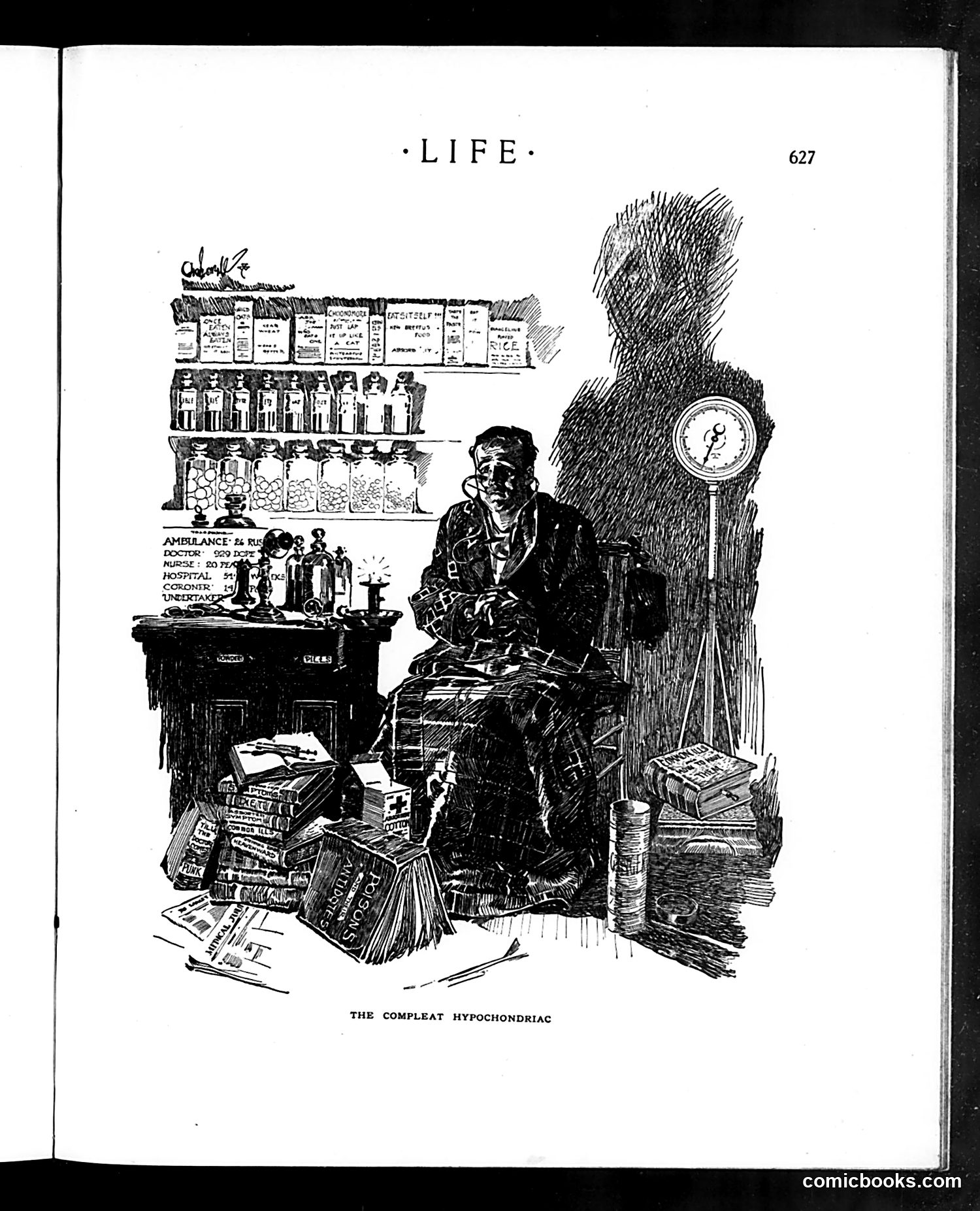
This satirical illustration depicts a man surrounded by medical paraphernalia—bottles of patent medicines on shelves, medical texts scattered about, and a large standing scale—suggesting obsessive health anxiety. The figure appears to be a wealthy hypochondriac, as indicated by the affluent furnishings and extensive collection of remedies. The title references a "compleat" (complete) person, parodying the phrase "The Compleat Angler." The satire mocks those who are excessively preoccupied with minor ailments and self-diagnosis, collecting numerous medicines and remedies despite having no serious illness. The enormous clock suggests time wasted on health worries. This reflects early 20th-century American concerns about patent medicine abuse and the growing phenomenon of medical anxiety among the wealthy.
This page contains "Ode to Cowardice" by Arthur Guiterman, a satirical poem attacking pacifism and anti-war sentiment during what appears to be the World War I era. The poem mocks peace advocates by addressing "Cowardice" directly, sarcastically praising figures like Flaccus (a historical Roman), Augustus Caesar, and references to modern figures including Roosevelt, Taft, and Skibo's laird (likely Andrew Carnegie). The satire targets pacifists by suggesting that those advocating peace are cowardly rather than principled. It specifically ridicules modern "singers" and "poets" who write pacifist verses (referencing Horatian poetry), implying their anti-war positions are cowardly and self-serving rather than genuinely moral. The poem defends military courage and sacrifice as superior values.
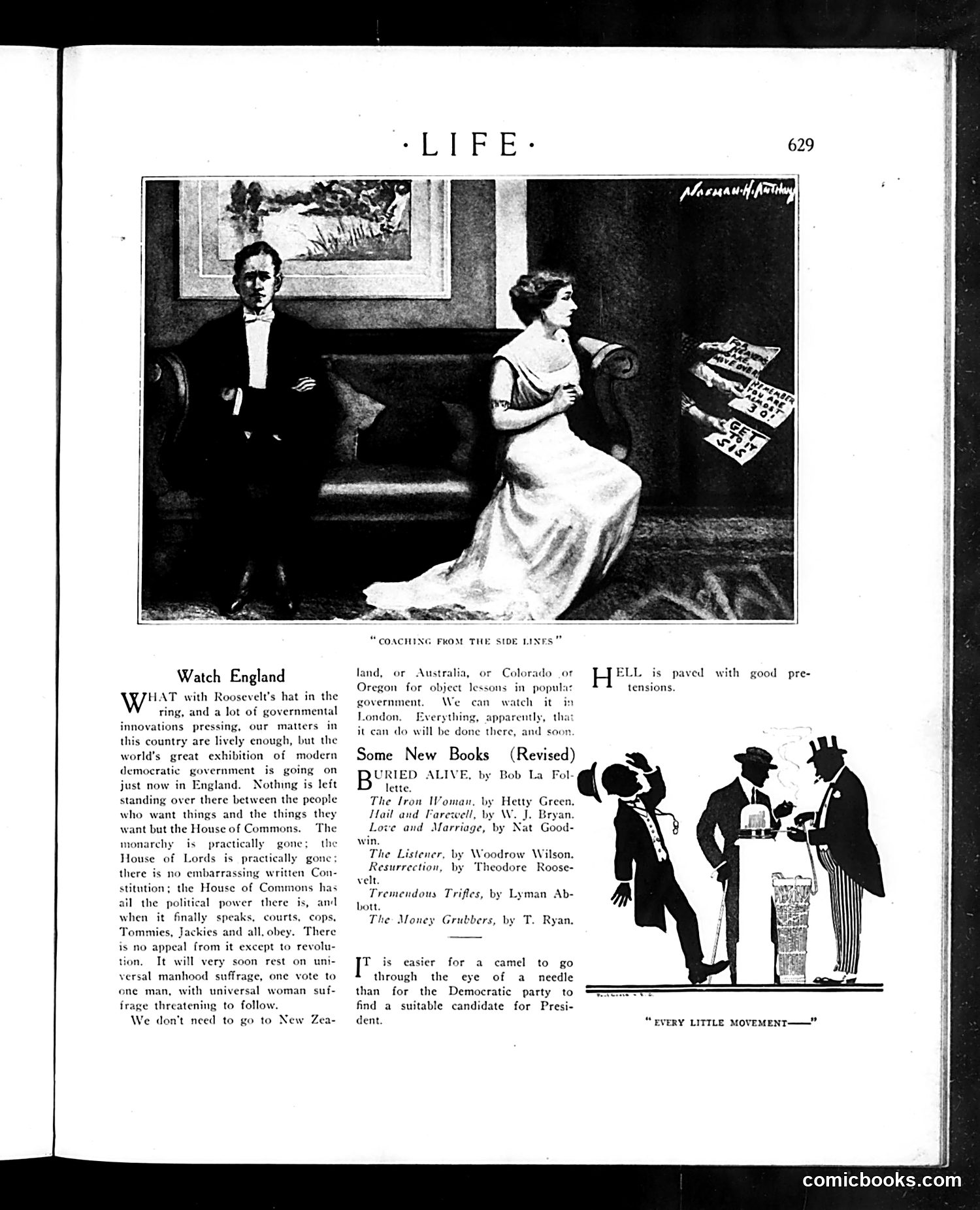
This page contains a political commentary section titled "Watch England" discussing British governance and the House of Commons, alongside book reviews and a satirical cartoon labeled "Every Little Movement." The top photograph shows a theatrical scene captioned "Coaching from the Side Lines" - depicting a man in formal dress seated while a woman in an elegant gown stands, apparently receiving instruction, with papers visible on a table. This appears to be satirizing domestic or political influence. The lower cartoon "Every Little Movement" shows stylized figures in formal attire, likely satirizing social dancing or courtship rituals, though the specific political reference remains unclear without additional context. The page dates to an era when Life magazine combined political satire with social commentary, targeting contemporary American and British political issues.
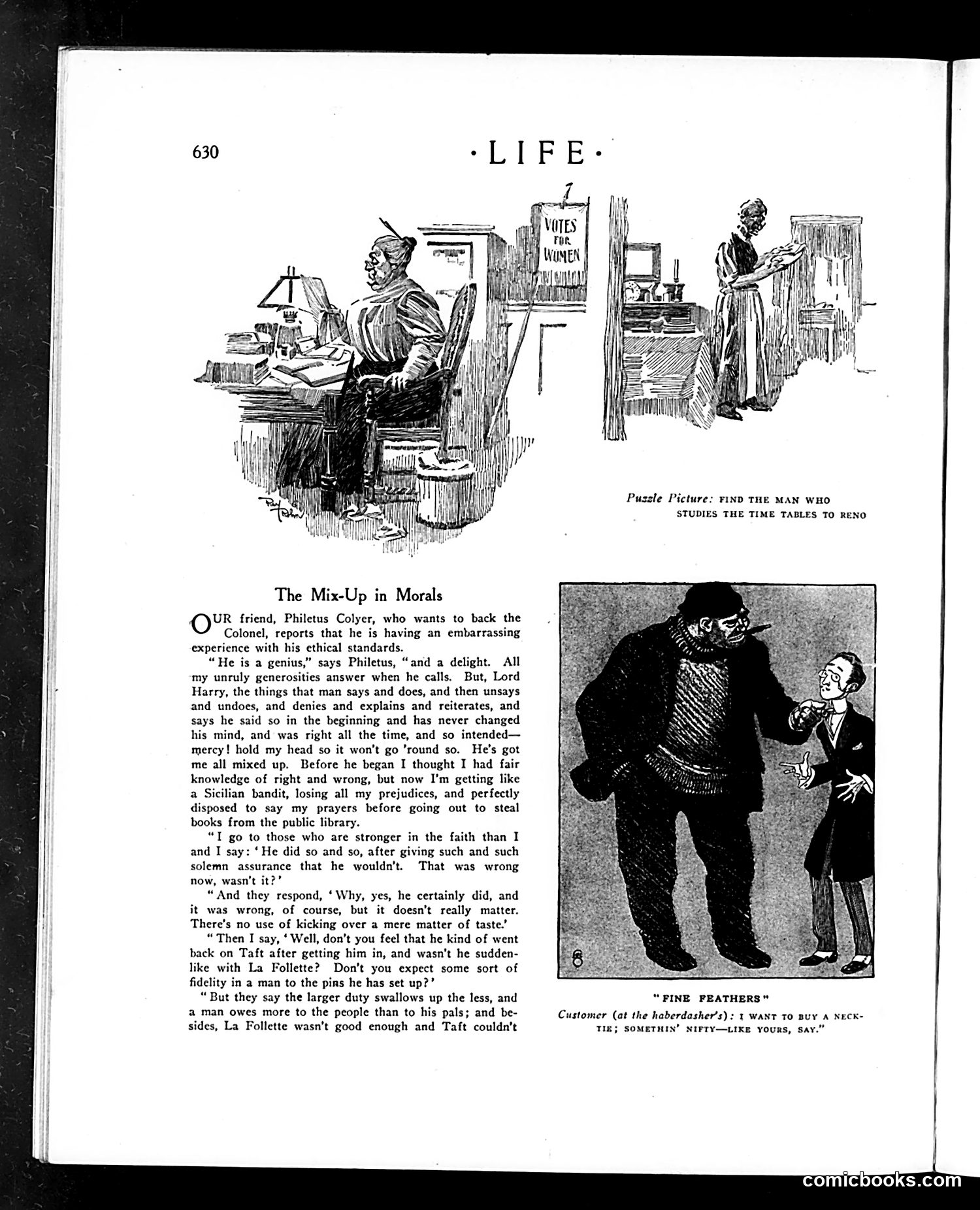
This satirical piece critiques **Philetus Colyer**, who wants to support a Colonel despite ethical concerns. The narrator describes Colyer as inconsistent: he claims high moral standards yet supports someone engaged in questionable conduct. The satire illustrates how Colyer rationalizes contradictions—he initially opposed the Colonel on principle, then flip-flopped after reassurance. The piece mocks moral relativism and hypocrisy, suggesting Colyer prioritizes loyalty to allies over consistent ethical principles. The comparison to "a Sicilian bandit" and references to "La Follette" indicate this addresses real political figures and factional disputes. The cartoon shows a man at a desk (left) and a domestic scene (right), illustrating the contrast between public moral claims and private compromises—the "mix-up" being the gap between stated and actual values.
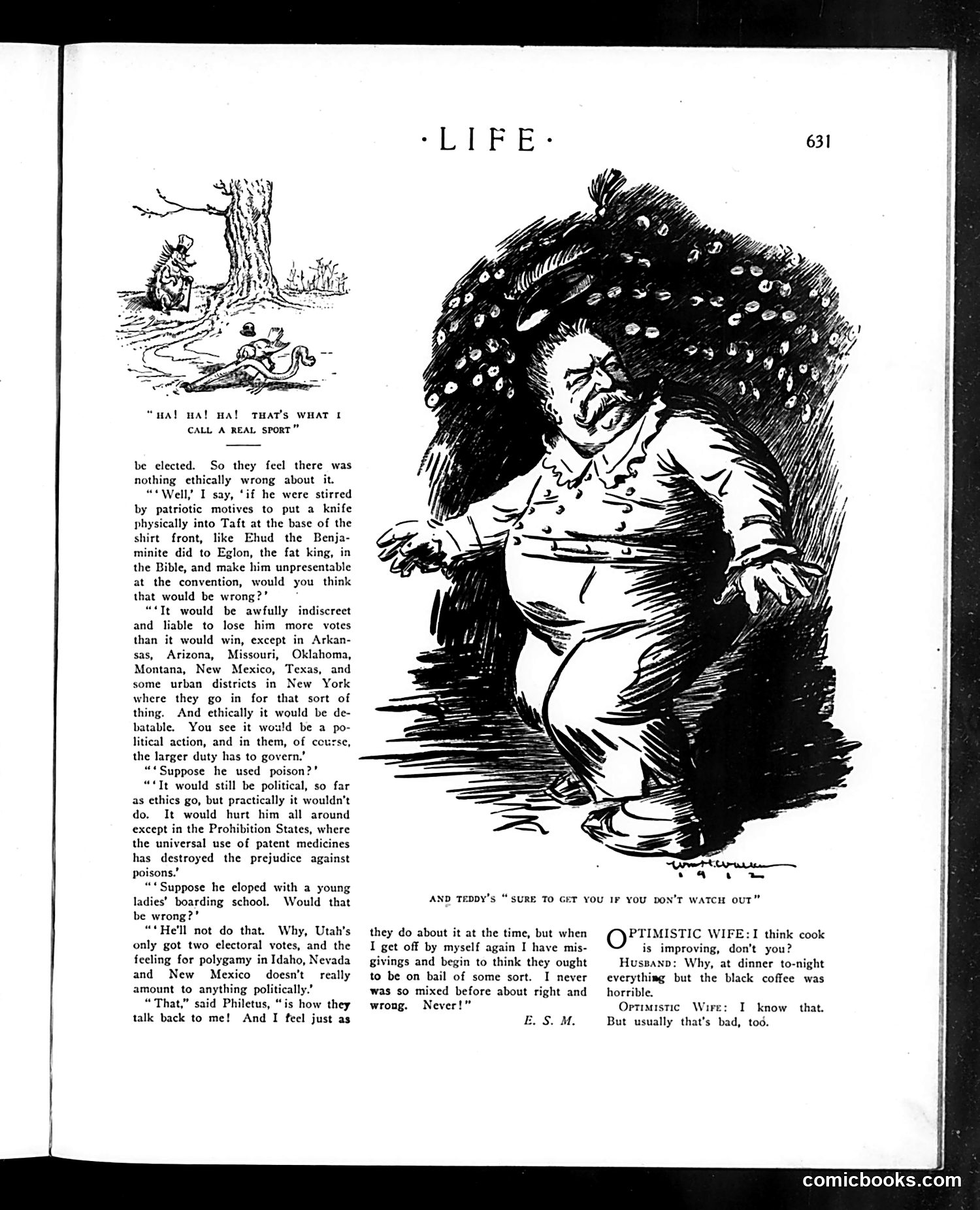
This page contains political satire about early 20th-century electoral ethics, likely referencing the 1912 presidential split between Taft and Roosevelt (suggested by "Teddy's" caption and the Taft references). The main text mockingly presents a dialogue where a character justifies increasingly unethical political actions—from assassination to poisoning to polygamy—based on regional political considerations. The satire argues that politicians rationalize corrupt behavior as mere "political actions" where "the larger duty has to govern," treating moral principles as negotiable based on electoral utility. The cartoon (top left) shows figures near a tree with the caption "Ha! Ha! Ha! That's what I call a real sport"—likely satirizing casual acceptance of political dirty tricks. The bottom illustration captioned "And Teddy's Sure to Get You If You Don't Watch Out" appears to show a menacing figure, referencing Theodore Roosevelt's political aggression. A separate brief humor piece about an optimistic wife concludes the page.
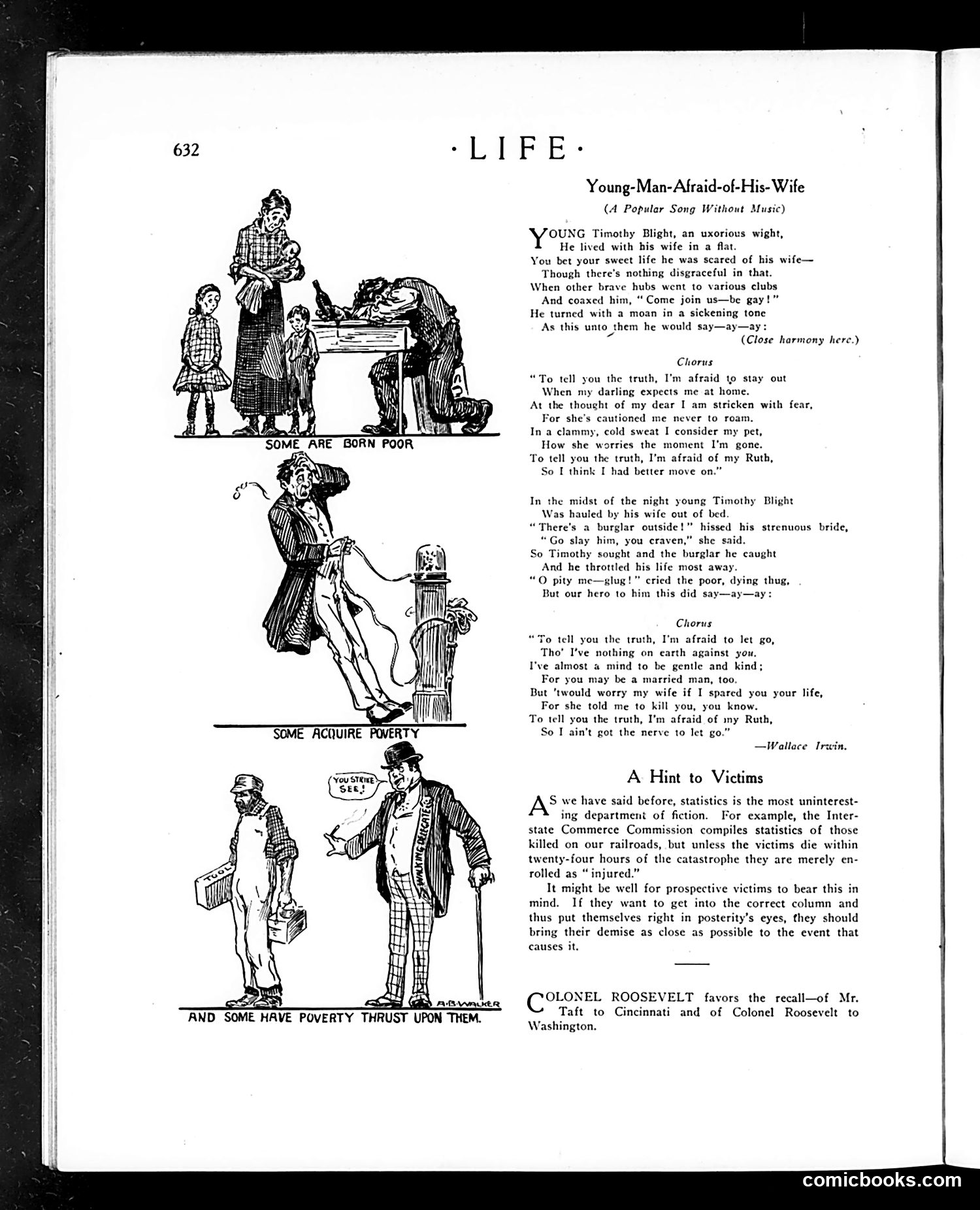
This page satirizes a popular song about marital dynamics through exaggerated gender roles. Timothy Blight is a henpecked husband so terrified of his domineering wife Ruth that he refuses to socialize with other men. The joke escalates absurdly: when Ruth orders him to kill a burglar, he does so—then can't stop because he fears disappointing her more than committing murder. The accompanying illustrations depict poverty and social class struggles ("Some Are Born Poor," "Some Acquire Poverty," "And Some Have Poverty Thrust Upon Them"), contrasting with the middle-class domestic anxiety of the main story. The "Hint to Victims" section mockingly advises accident victims to die *within* 24 hours to be counted as "killed" rather than merely "injured" in Interstate Commerce Commission statistics—satirizing how bureaucratic definitions miss human reality. A brief note favors Theodore Roosevelt's political return, likely from 1912 when he challenged Taft for the presidency.
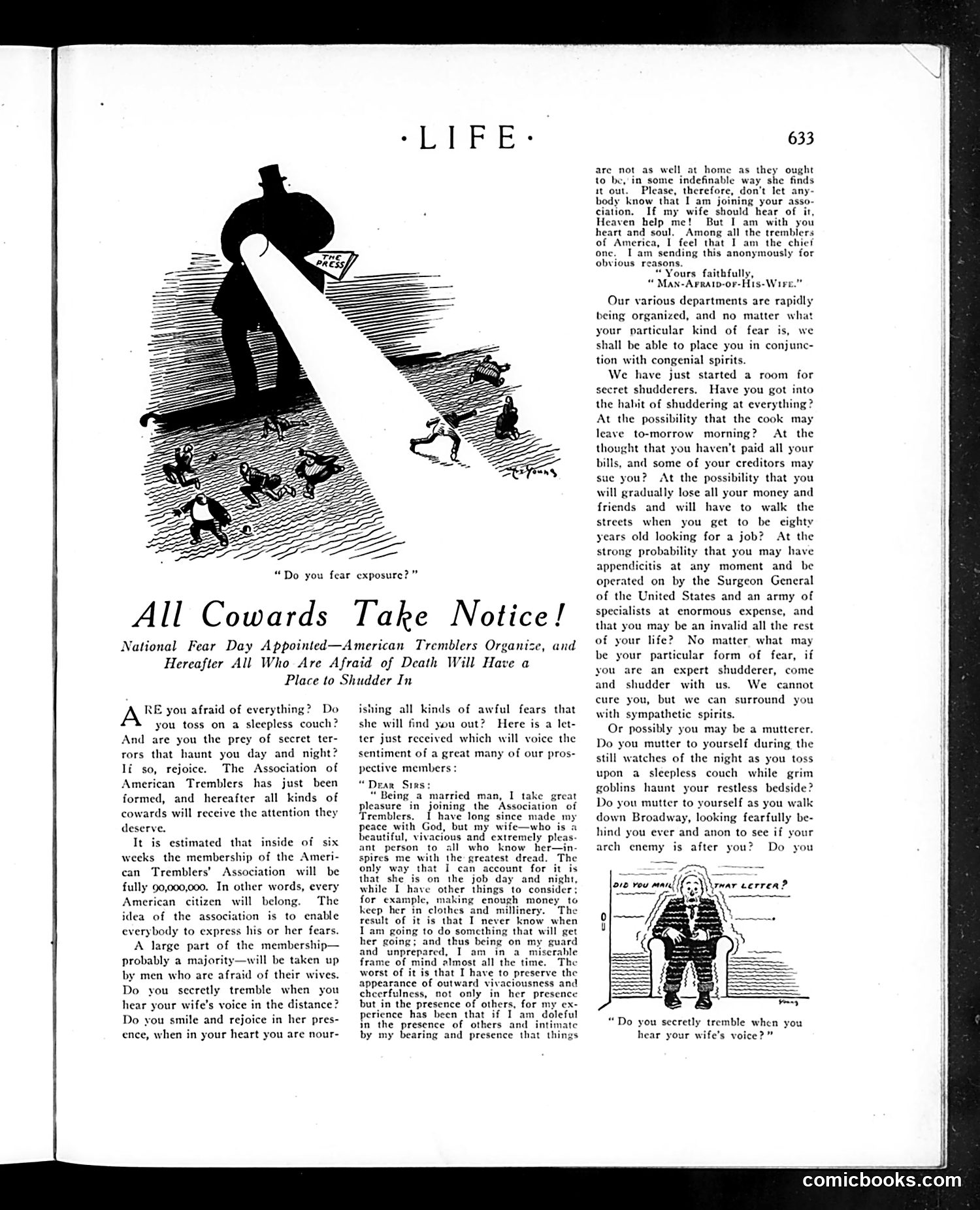
This page satirizes widespread anxiety in early 20th-century America through a fictional "Association of American Tremblers." The cartoon depicts a giant figure casting a shadow over tiny people below, illustrating the pervasive nature of fear. The satire targets multiple anxieties: financial instability, health crises, marital discord, and social uncertainty. The featured letter exemplifies the primary joke—husbands' fear of their wives. The anonymous writer claims his beautiful, vivacious wife terrifies him despite his material efforts to support her, capturing a common domestic tension of the era. The organization promises to unite people by their specific fears—secret shudderers, those afraid of destitution, illness, job loss at old age. The satire's point: fear is so universal and varied that nearly every American (estimated 90 million members) could join. By treating neurosis as a legitimate social club, Life mocks both contemporary anxiety culture and the era's emerging focus on psychological "conditions."
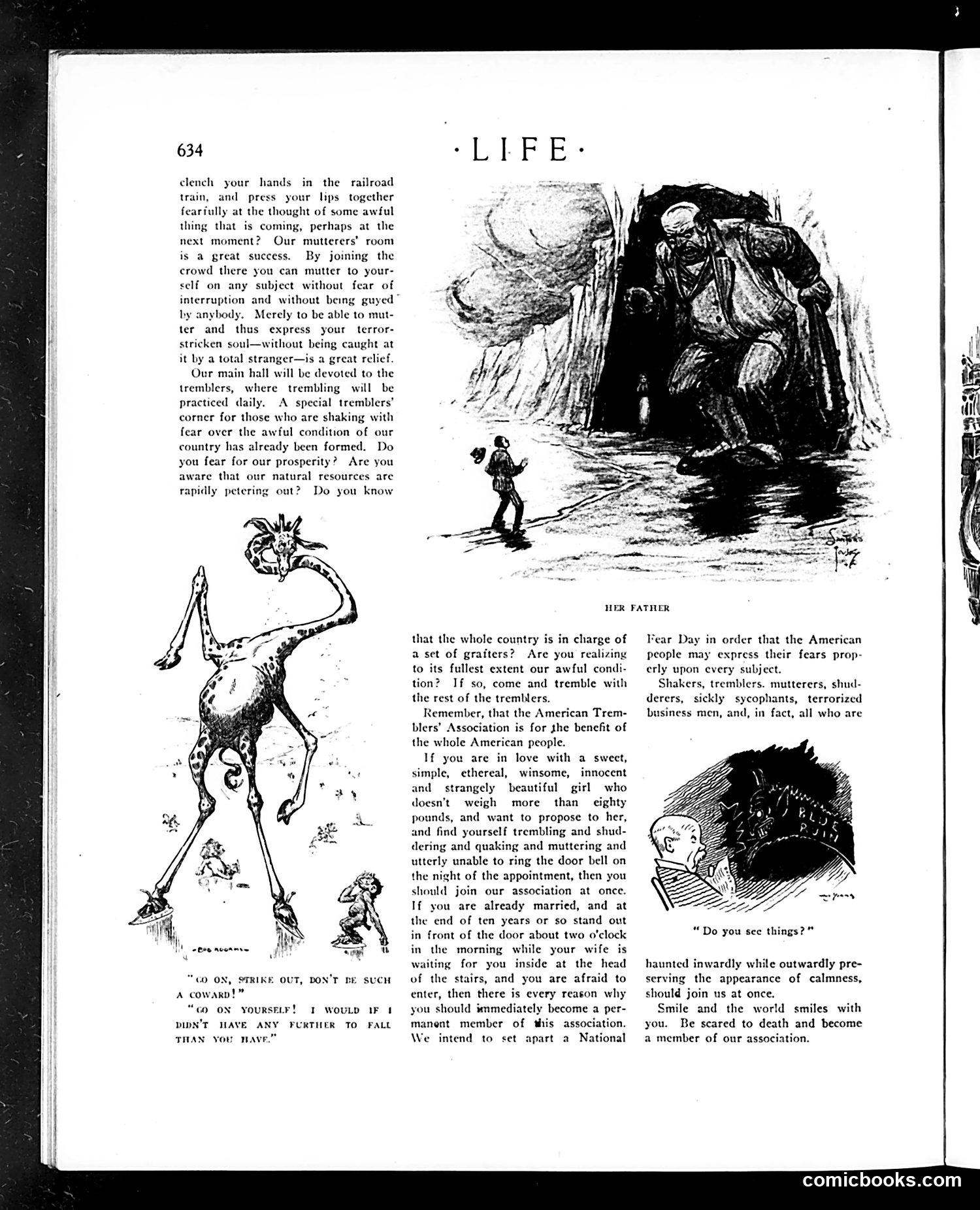
This page satirizes American anxiety and economic pessimism, likely from the early 1900s. The text proposes a mock organization for citizens experiencing fear—of economic collapse, natural resource depletion, and corruption ("graiters," or grafters). The cartoons illustrate the absurdity: a skeletal, trembling figure embodies existential dread; a cowardly man refuses to "strike out," claiming he has "further to fall"; a nervous suitor cannot ring his fiancée's doorbell; a frightened husband dreads entering his own home at dawn. The satire mocks both the widespread anxiety gripping America and the emotional paralysis it causes—people so consumed by worry about national conditions and personal embarrassments that they become physically incapable of action. By creating a bureaucratic "association" for trembling, Life ridicules both collective anxiety and organized responses to it, suggesting fear has become almost institutional.
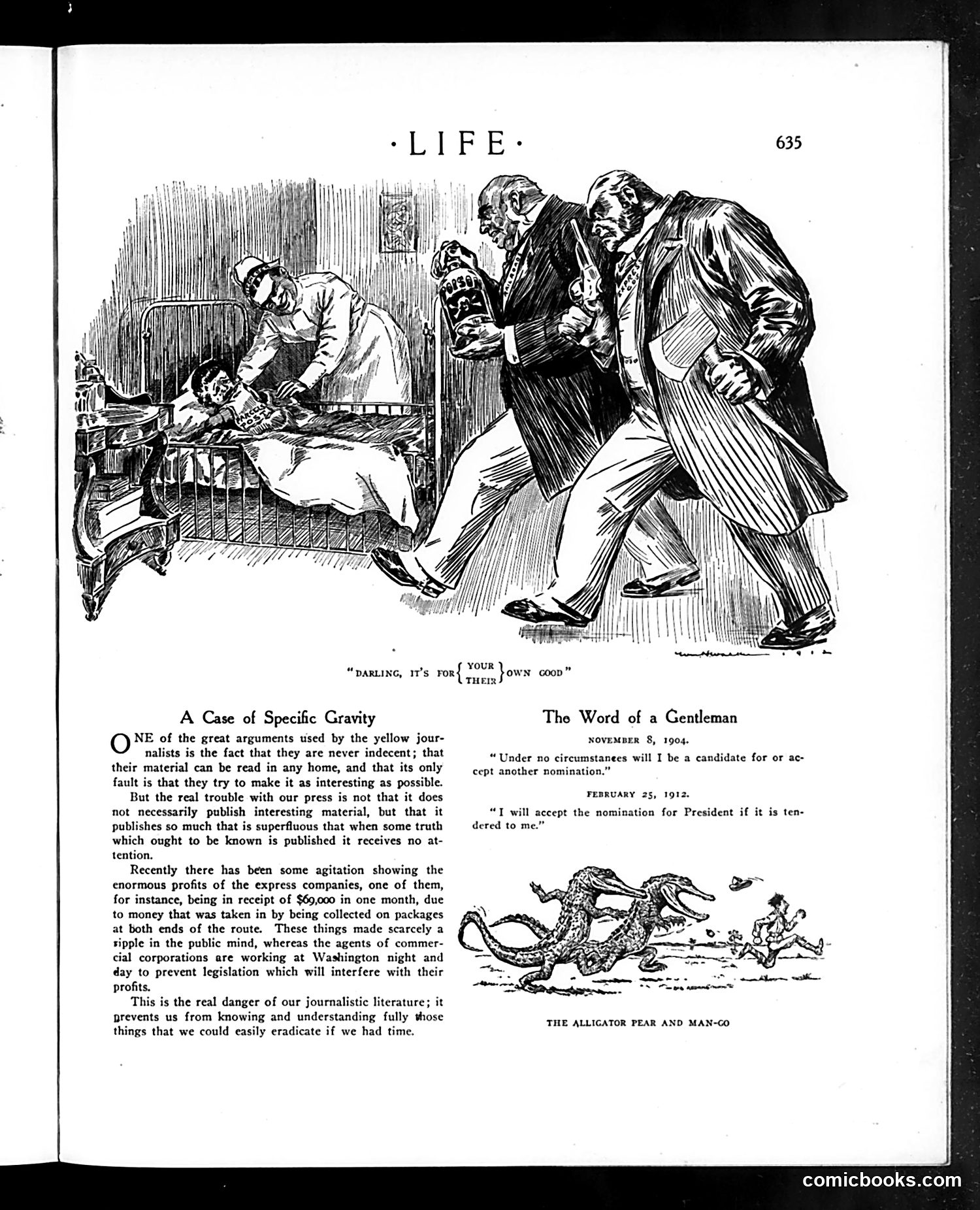
**Top Cartoon:** Shows a man in bed being attended to by a woman, while three men in formal dress observe. The caption reads "Darling, it's for your own good"—likely satirizing medical or business exploitation masked as concern. **Main Article "A Case of Specific Gravity":** Criticizes yellow journalism and the press for publishing sensational trivia while ignoring important stories about corporate malfeasance. The author notes that express companies' enormous profits (like $69,000/month from double-collection schemes) barely registered publicly, while corporate lobbyists successfully blocked reform legislation in Washington. The piece argues this editorial negligence prevents citizens from addressing corruption they could easily eliminate. **"The Word of a Gentleman":** Contrasts two presidential quotes—one from November 1904 denying candidacy, another from February 1912 accepting nomination. This likely references Theodore Roosevelt's flip-flopping on running for president, satirizing broken promises as hypocrisy. **Bottom illustration:** "The Alligator Pear and Man-Go" appears to be a separate satirical cartoon, though its specific reference is unclear.
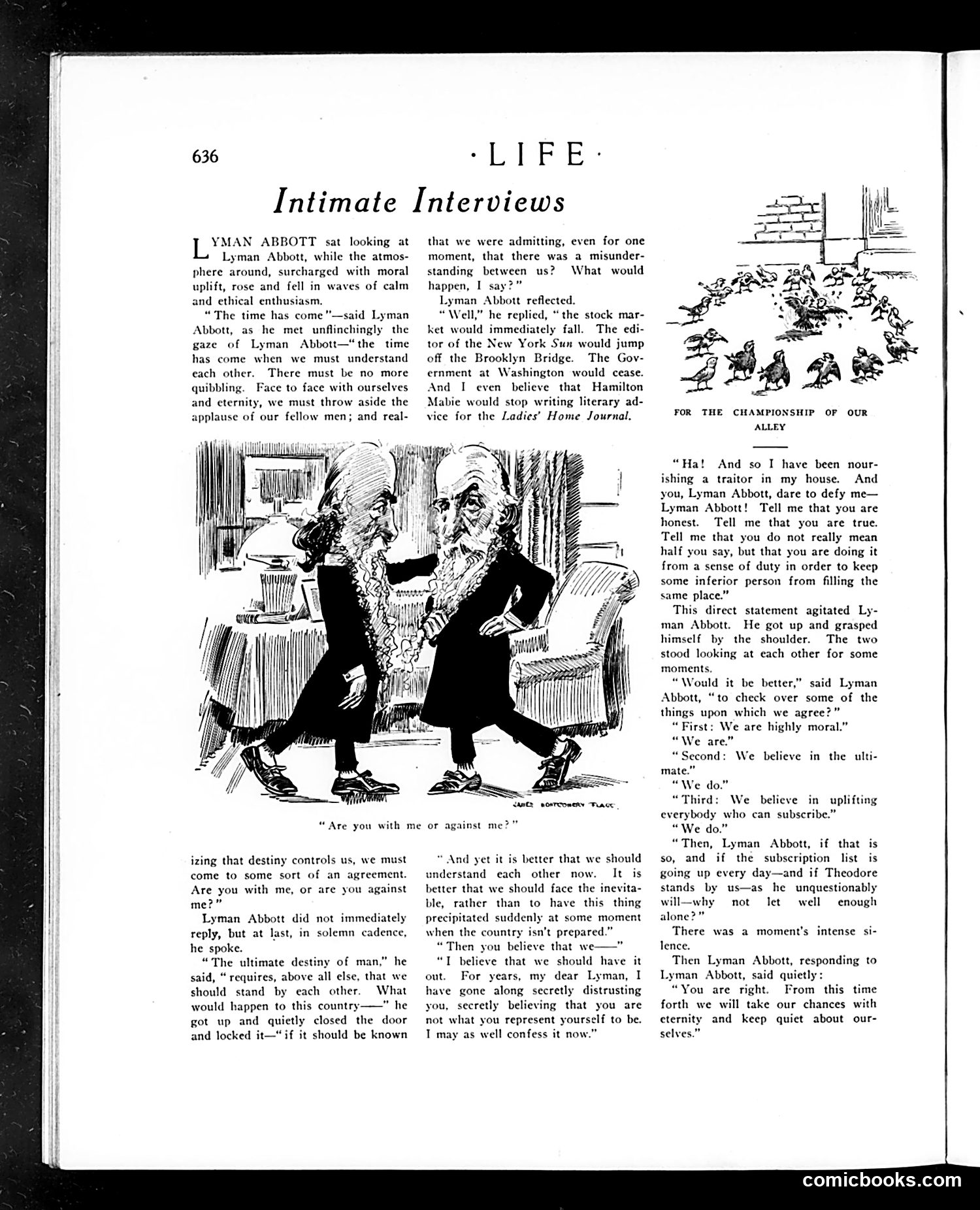
This is a satirical piece mocking **Lyman Abbott**, a real prominent 19th-century clergyman, editor, and moral reformer. The joke is absurdist: Abbott interviews *himself*, with both versions speaking in grandiose, self-righteous language about morality, duty, and the country's fate. The satire targets Abbott's characteristic style—his overwrought moral pronouncements and tendency to present himself as society's ethical arbiter. The exaggerated dialogue mocks how reformers like Abbott would invoke apocalyptic consequences ("the stock market would fall," "the Government would cease") to justify their positions. The cartoon caption "Are you with me or against me?" underscores the satirical point: Abbott's self-important binary thinking and inability to tolerate disagreement. The absurdist premise of self-interview suggests Life's skepticism toward Abbott's moral certainty and his influence on publications like the *Ladies' Home Journal*. This targets America's late-19th-century reform movement and prominent moralists who wielded disproportionate cultural influence.
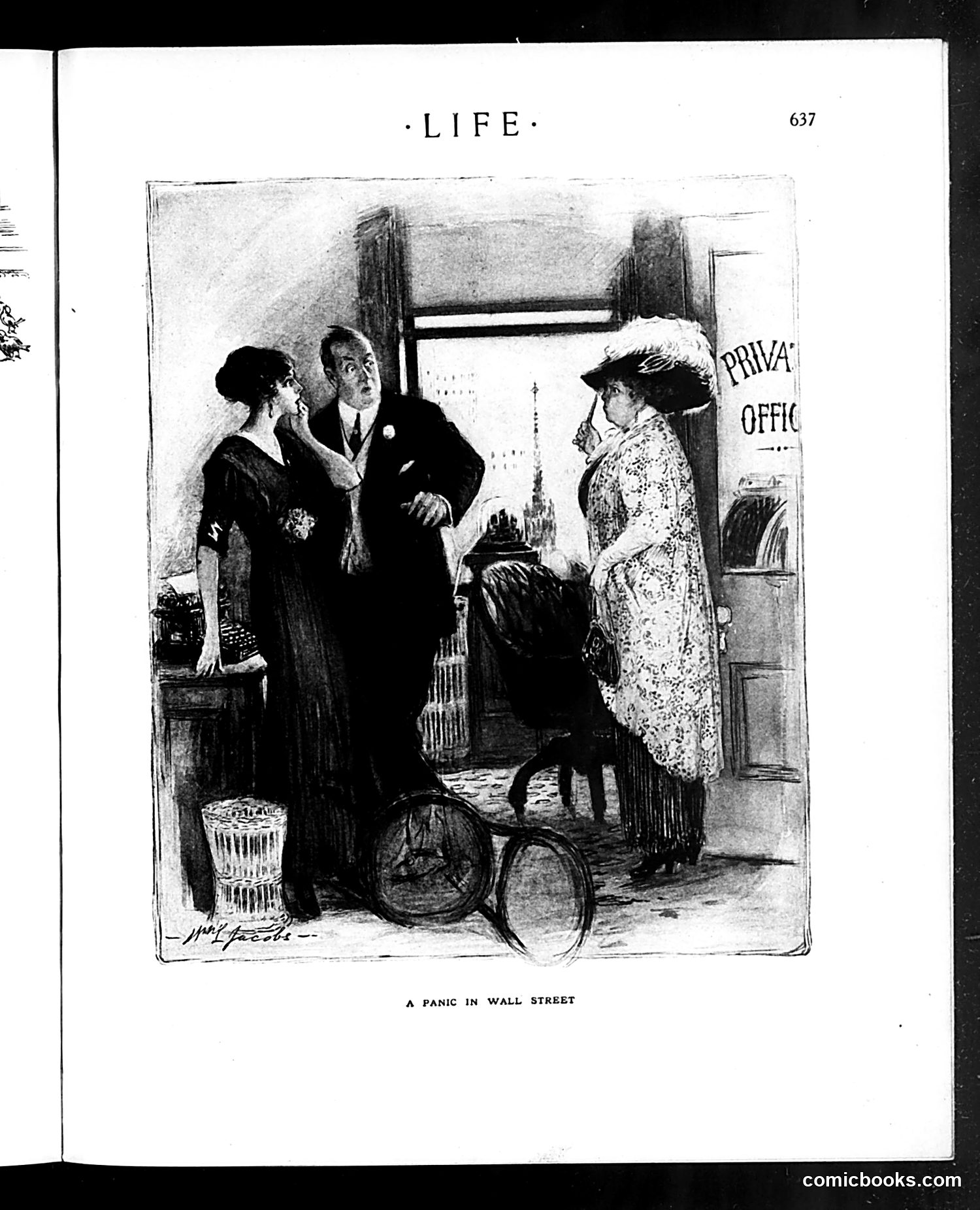
This cartoon depicts a financial crisis scene outside a "Private Office" on Wall Street. A well-dressed businessman stands anxiously with hand to face, while a woman beside him appears distressed. A child and another woman with a baby carriage occupy the street. The drawing style and composition suggest chaos and alarm. The title references a "panic"—a term for sudden financial collapse causing public fear. The ordinary people (woman, child, baby carriage) juxtaposed with the businessman suggests the cartoon critiques how Wall Street crises affect everyday citizens beyond wealthy financiers. The man's anxious gesture and crowded scene convey urgency and disorder. Without dating information visible, the specific panic referenced remains unclear, though financial panics were recurring American crises throughout the early 20th century.
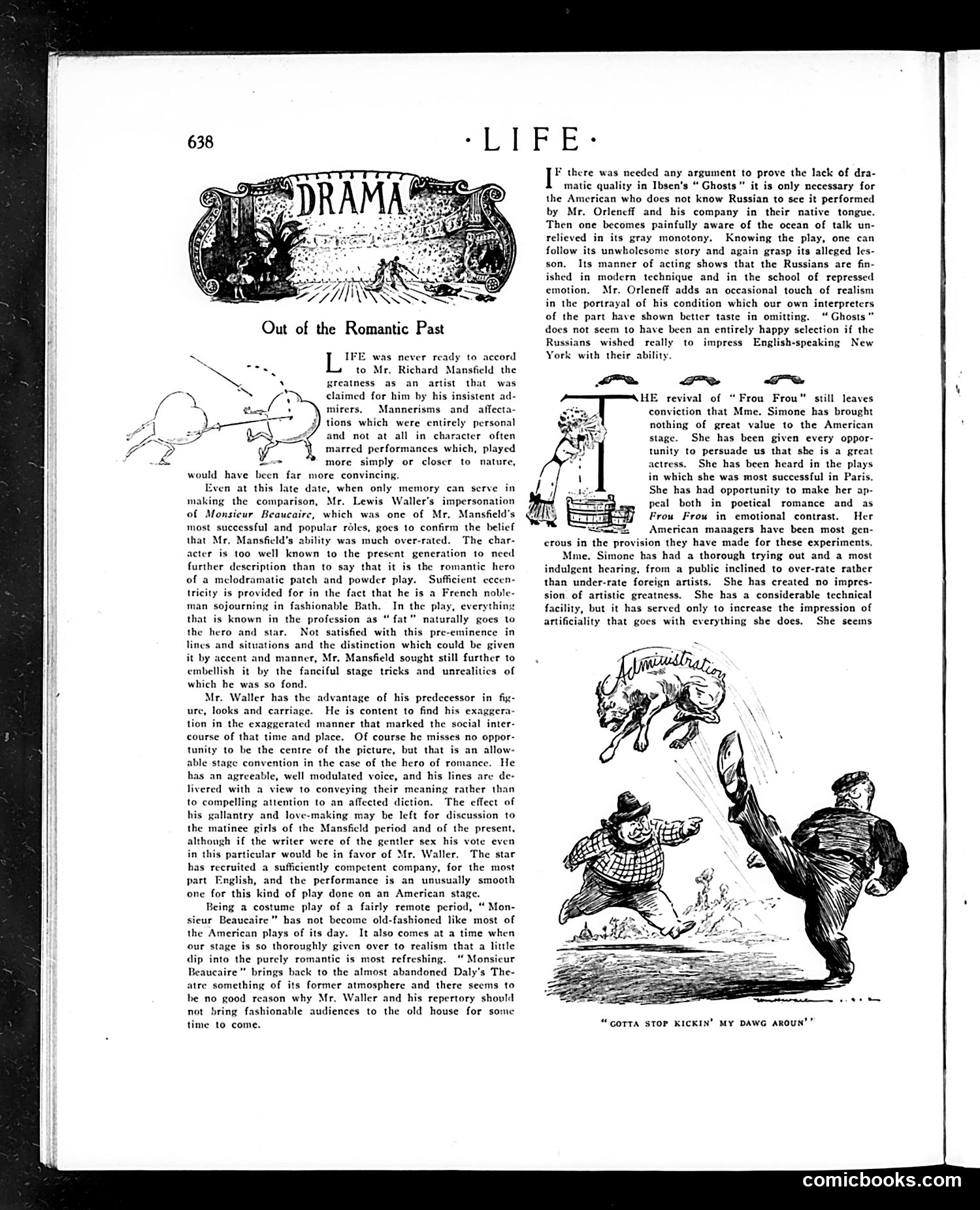
This page critiques theatrical performances of the era. The main content discusses: **"Out of the Romantic Past"**: A review comparing actor Richard Mansfield's interpretation of *Monsieur Beaucaire* (a romantic melodrama) unfavorably to Lewis Waller's version. The critic argues Mansfield over-acted with excessive "stage tricks," while Waller's more restrained approach better serves the character. **Russian Company Performance**: A negative review of Mr. Orleneff's Russian company performing Ibsen's *Ghosts* in their native language, finding it tedious and emotionally repressed compared to American interpretations. **Mme. Simone's Revival of "Frou Frou"**: The critic dismisses French actress Simone as technically competent but artificially cold, unable to move American audiences despite optimal theatrical conditions. The **cartoon below** (captioned "Gotta Stop Kickin' My Dawg About") shows comedic vignettes of slapstick violence—unrelated to the drama reviews above. The page represents early 20th-century theatrical criticism emphasizing naturalism over melodramatic excess.
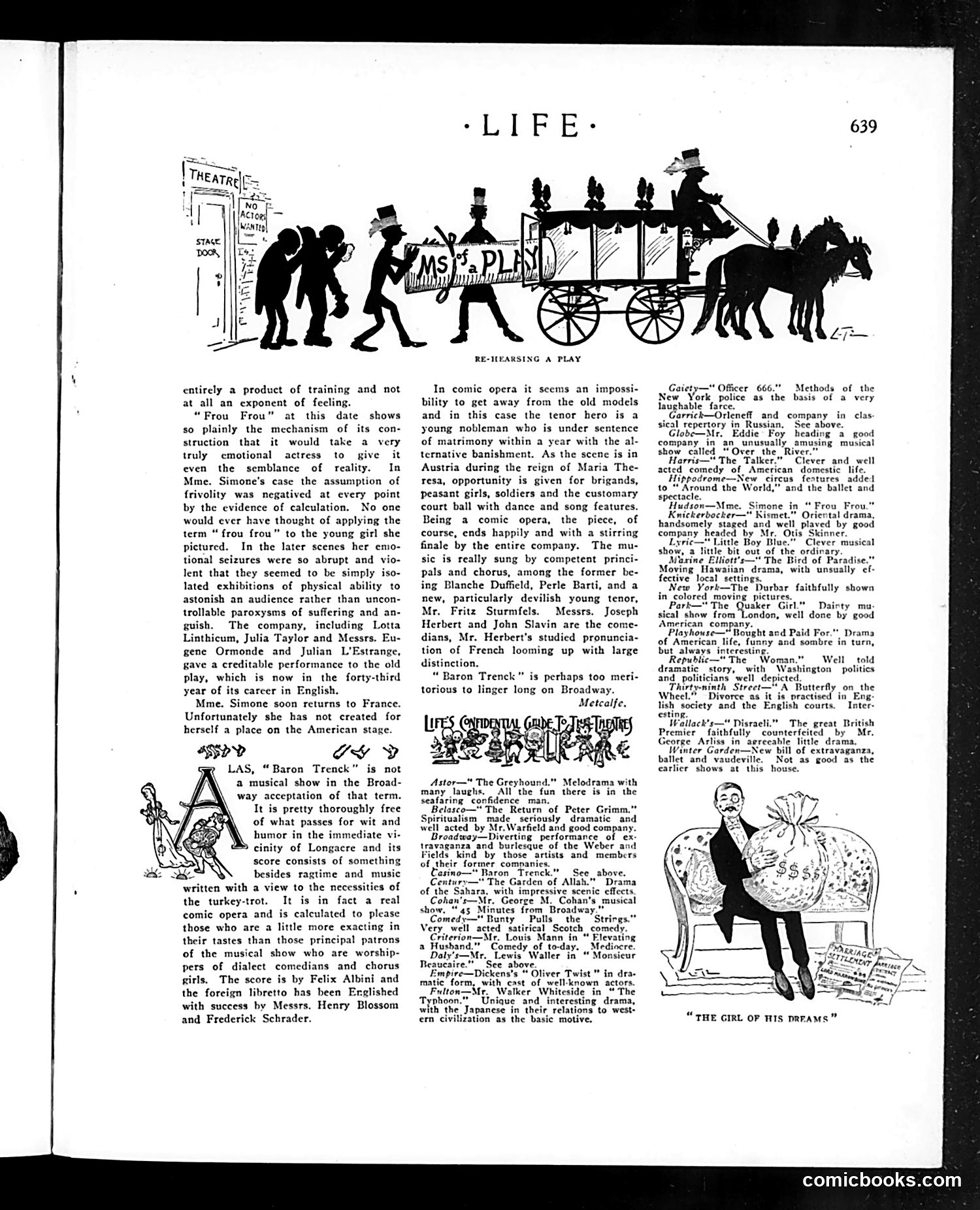
This page from *Life* magazine contains theater reviews and satirical commentary on Broadway productions circa 1910s. The top cartoon titled "RE-HEARSING A PLAY" depicts a chaotic theatrical rehearsal—actors in top hats and formal dress tumble awkwardly around a horse-drawn wagon labeled "PLAY," with a theater door visible on the left. The satire mocks the mechanical, unpolished nature of theatrical productions and the physical comedy involved in stage work. The text reviews several shows, notably criticizing "Frou Frou" (performed by Mme. Simone) as overly calculated and emotionally hollow—the actress's performance relies too heavily on technical skill rather than genuine feeling. The review of "Baron Trenck," a comic opera, praises it as more sophisticated than typical Broadway fare, suggesting the critic believes genuine artistic merit may prevent its commercial success on Broadway. The bottom right cartoon titled "THE GIRL OF HIS DREAMS" (partially visible) appears to satirize romantic theatrical tropes. The page primarily offers theatrical criticism lampooning both performers and the commercialized nature of Broadway entertainment.
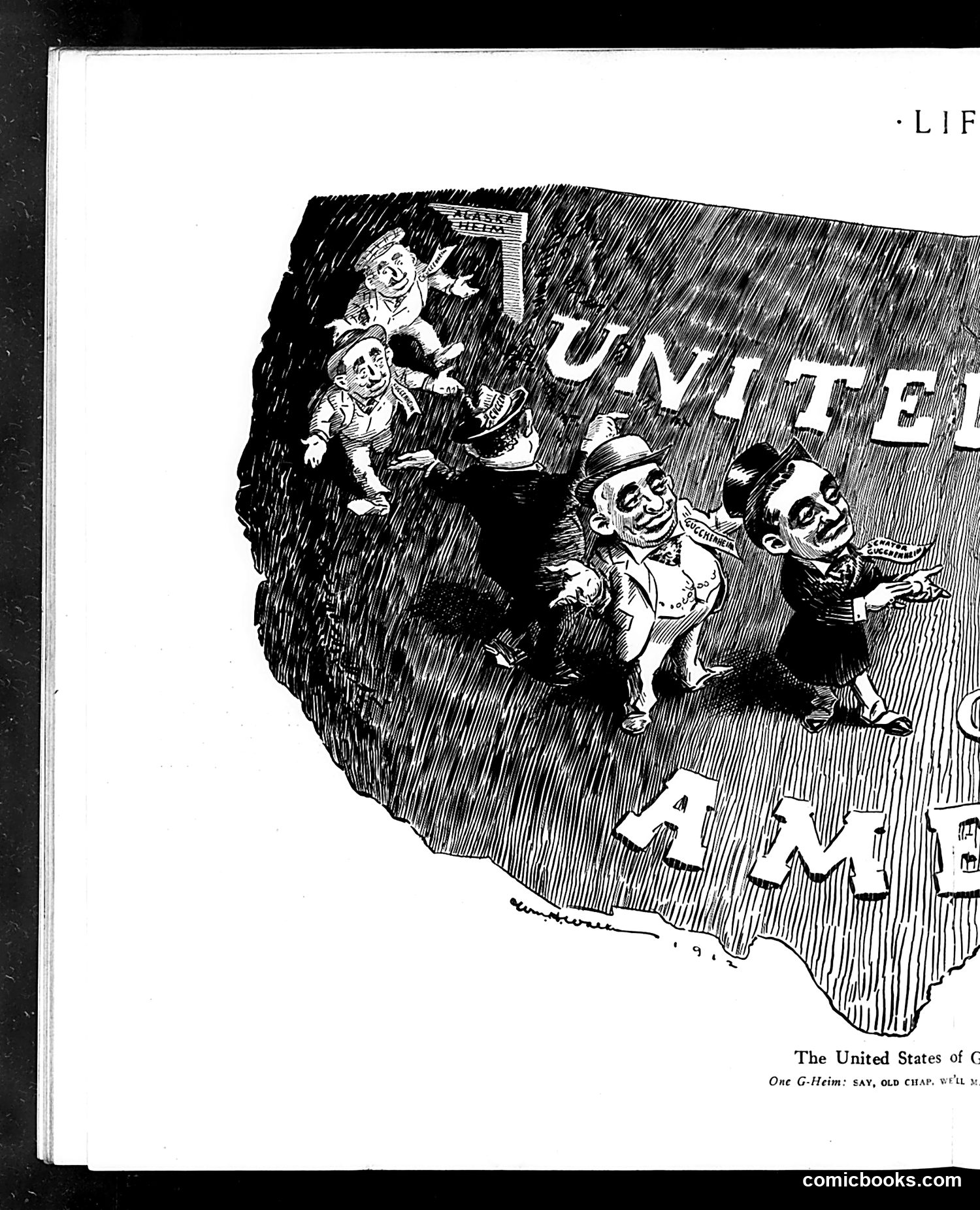
This appears to be a satirical map of the United States with caricatured figures emerging from or clustered around it. The visible text references "The United States of C[...]" and mentions "One G-Heim," likely referring to a political figure or stereotype of the era. The cartoon uses exaggerated facial features characteristic of early 20th-century satirical art. Several figures in formal dress (hats and suits) appear to be depicted as emerging from or controlling the nation, suggesting commentary on political leadership or influence. Without complete OCR text and unable to identify specific individuals with certainty, the cartoon likely satirizes American political figures or ethnic stereotypes common to Life magazine's satirical tradition, though the exact target and message remain unclear from this partial image.
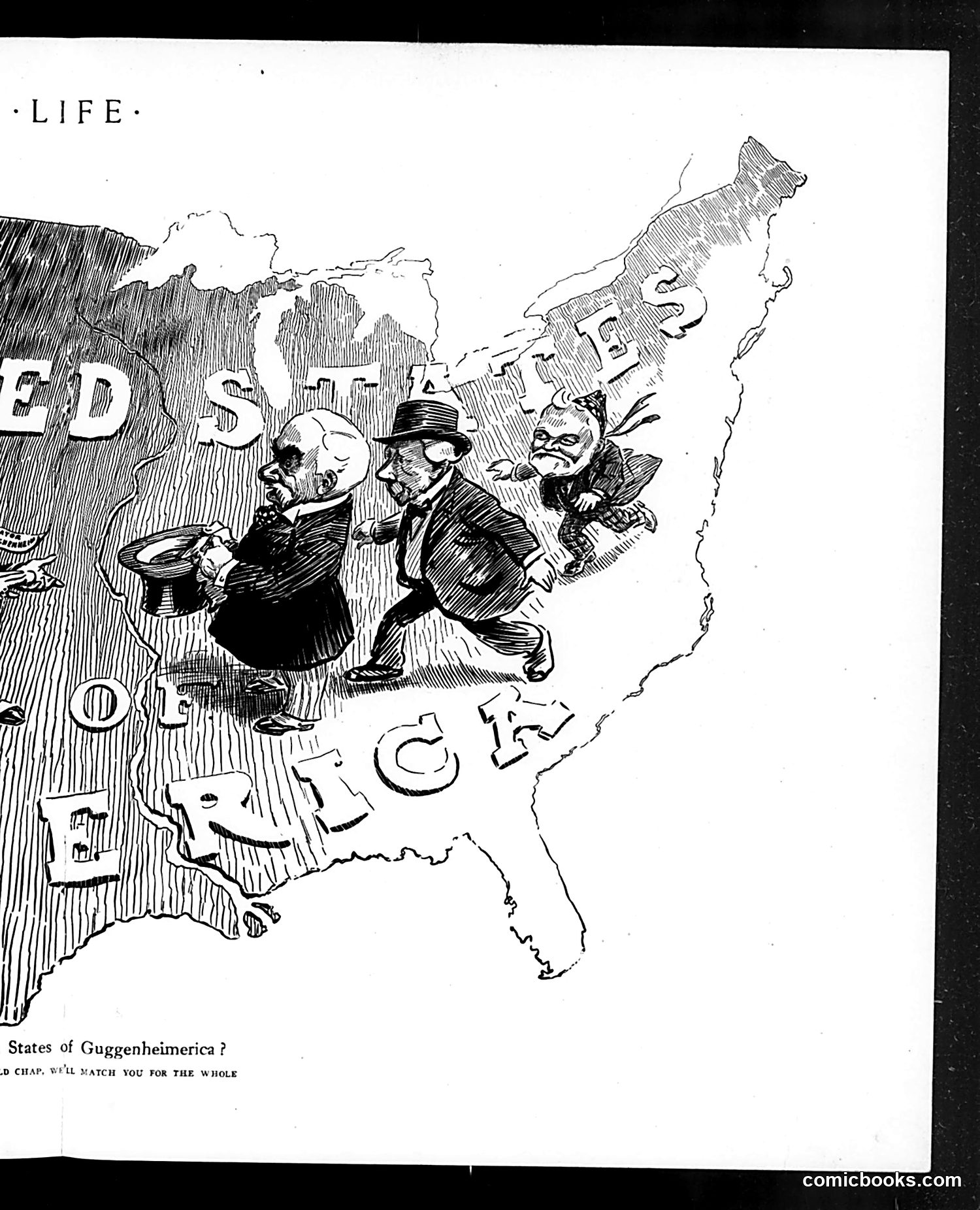
This Life magazine cartoon satirizes the wealth and political influence of the Guggenheim family, prominent industrialists and art collectors. The caricatured figures appear to represent Guggenheim family members dividing or controlling America like colonial powers, depicted on an outline map of the United States with text reading "States of Guggenheimerica." The cartoon's title asks "States of Guggenheimerica?" — suggesting the family's fortune gave them power equivalent to governing entire states. The visible text fragment "We'll match you for the whole" implies they're gambling or negotiating over territorial control. This reflects early-20th-century American anxiety about wealthy industrial families wielding disproportionate political and economic power, threatening democratic governance. The exaggerated caricatures and map format emphasize the perceived threat to national sovereignty from concentrated private wealth.
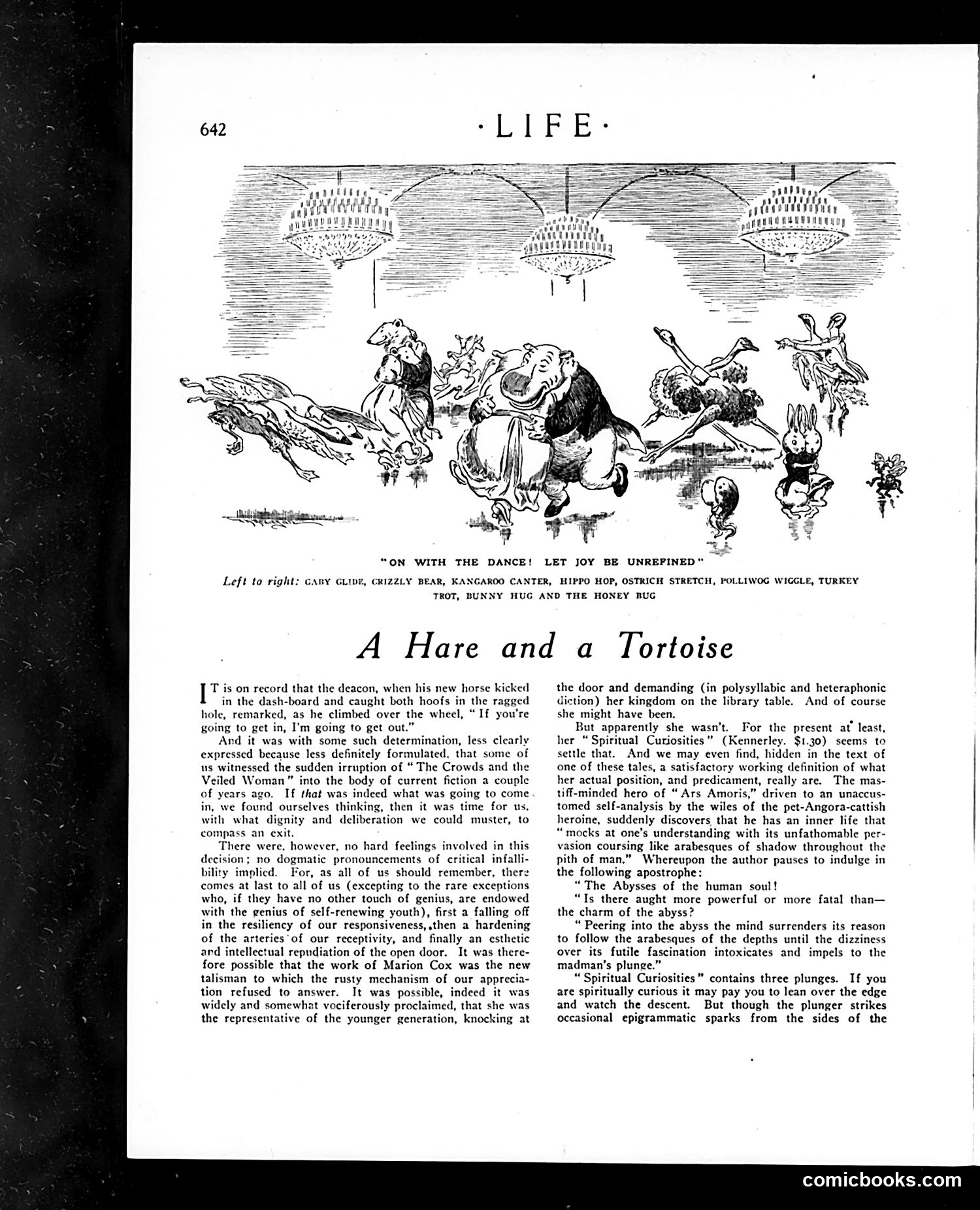
This page contains two distinct elements: **Top Illustration:** A satirical cartoon mocking popular dance crazes of the early 1900s. The caption lists fashionable dances—Turkey Trot, Bunny Hug, Kangaroo Canter, etc.—depicted as animals performing ridiculous movements. This ridicules the widespread social obsession with these new, energetic dances that scandalized conservative society. The quote "On with the dance! Let joy be unrefined" mockingly celebrates their uninhibited nature. **Main Article:** A book review of Marion Cox's *Spiritual Curiosities*. The critic dismisses Cox as a "representative of the younger generation" whose work failed to impress. The review sarcastically suggests her pretentious prose—about "abysses of the human soul" and "arabesques of shadow"—amounts to overwrought melodrama. The opening anecdote about a deacon leaving a situation signals the critic's own exit from taking her seriously. The satire targets both contemporary dance culture and pretentious modernist literary trends simultaneously.
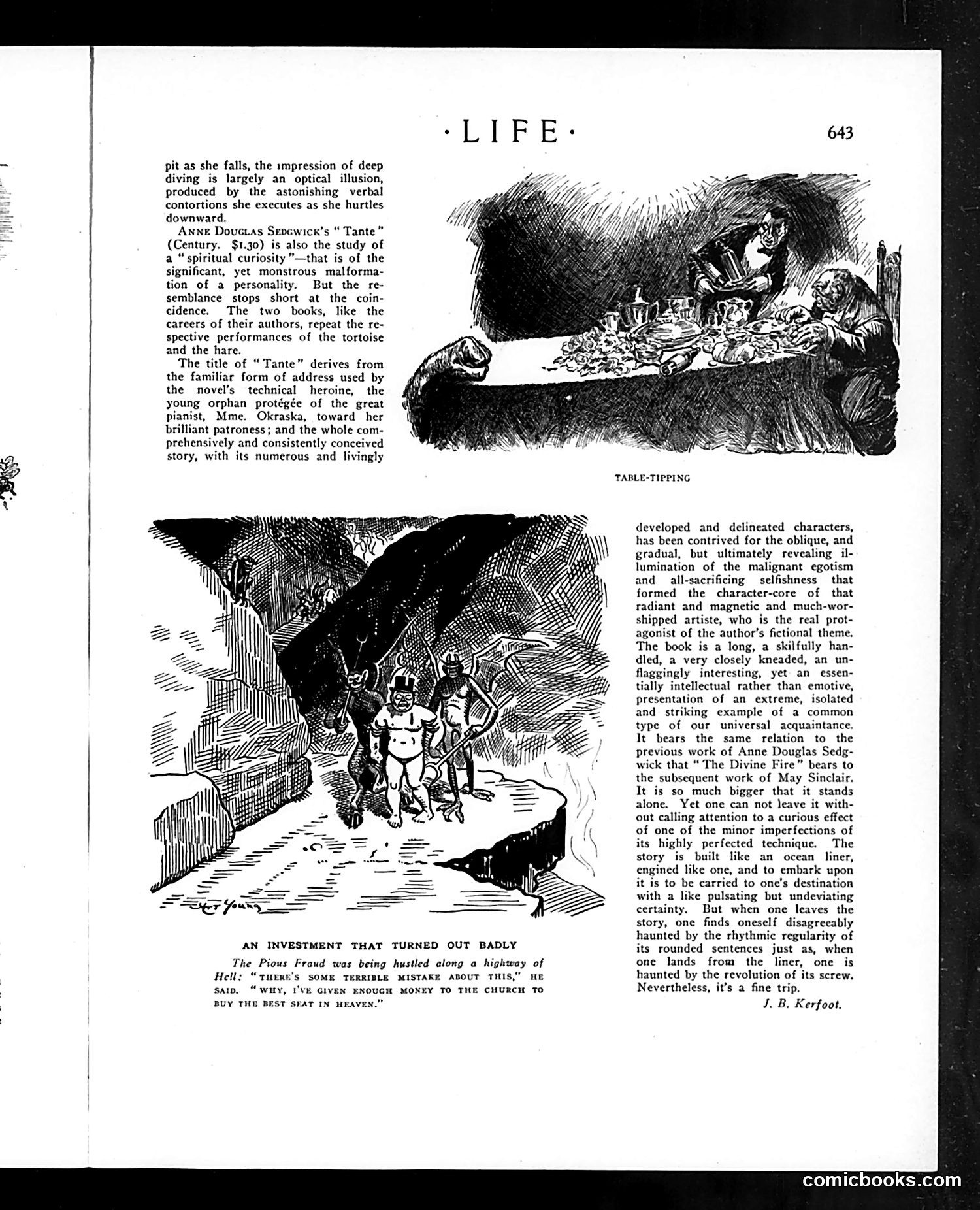
This page contains two cartoon-and-caption pairs satirizing human folly and misplaced priorities. **"Table-Tipping"** (top): The illustration shows a séance or spiritualist gathering—a popular parlor activity in early 20th-century America. The satire likely mocks the credulity of people seeking supernatural contact, a widespread phenomenon that Life magazine frequently ridiculed as pseudoscientific nonsense. **"An Investment That Turned Out Badly"** (bottom): A man who donated generously to his church, expecting spiritual reward ("the best seat in heaven"), discovers his money was misused—the image suggests clergy or church officials squandering donations. The satire targets both naive donors and corrupt religious institutions, criticizing misplaced faith in organized religion's integrity. Both cartoons mock gullibility: one toward spiritualism, one toward institutional religion. The page also contains a lengthy book review by J.B. Kerfoot of Anne Douglas Sedgwick's novel "Tante."
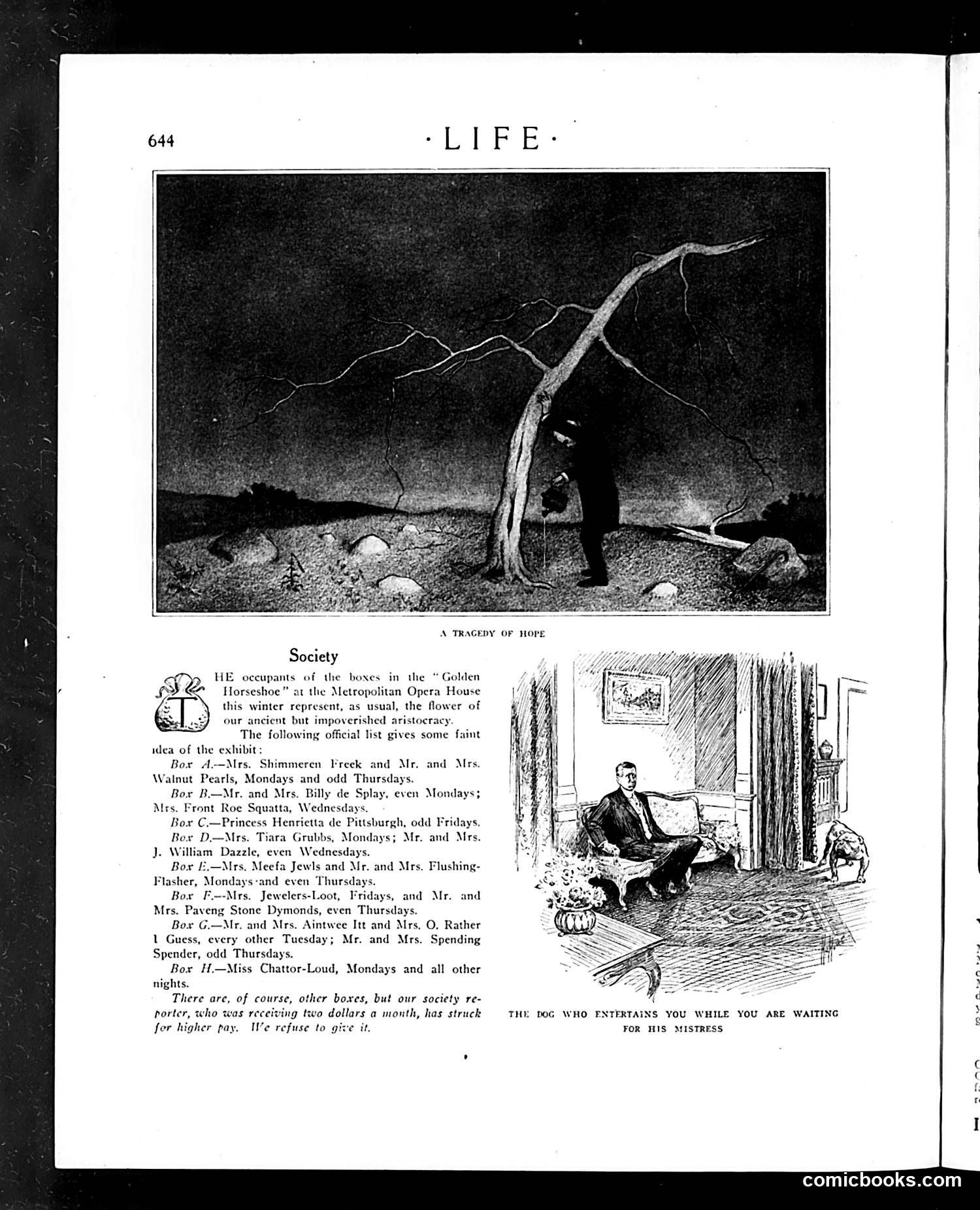
This page satirizes the American social elite's pretensions at the Metropolitan Opera House's prestigious "Golden Horseshoe" boxes. The humor operates on two levels: **The Names:** The wealthy patrons have transparently invented aristocratic names that are actually puns on their nouveau-riche status—"Shimmeren Freek," "Walnut Pearls," "Billy de Splay," "Tiara Grubbs," "Jewelers-Loot," "Paveng Stone Dymonds." These mock names expose the artificiality of their social climbing. **The Social Critique:** Life ridicules both the pretense of these social climbers and the magazine's own society reporter, who "struck for higher pay" while earning only two dollars monthly—suggesting the absurdity of covering such frivolous society news. **The Illustration** shows a gentleman entertaining his dog while awaiting his mistress, reinforcing themes of idle wealth and superficiality. The satire targets the contradiction between America's "ancient but impoverished aristocracy" (an oxymoron) and actual democratic values.
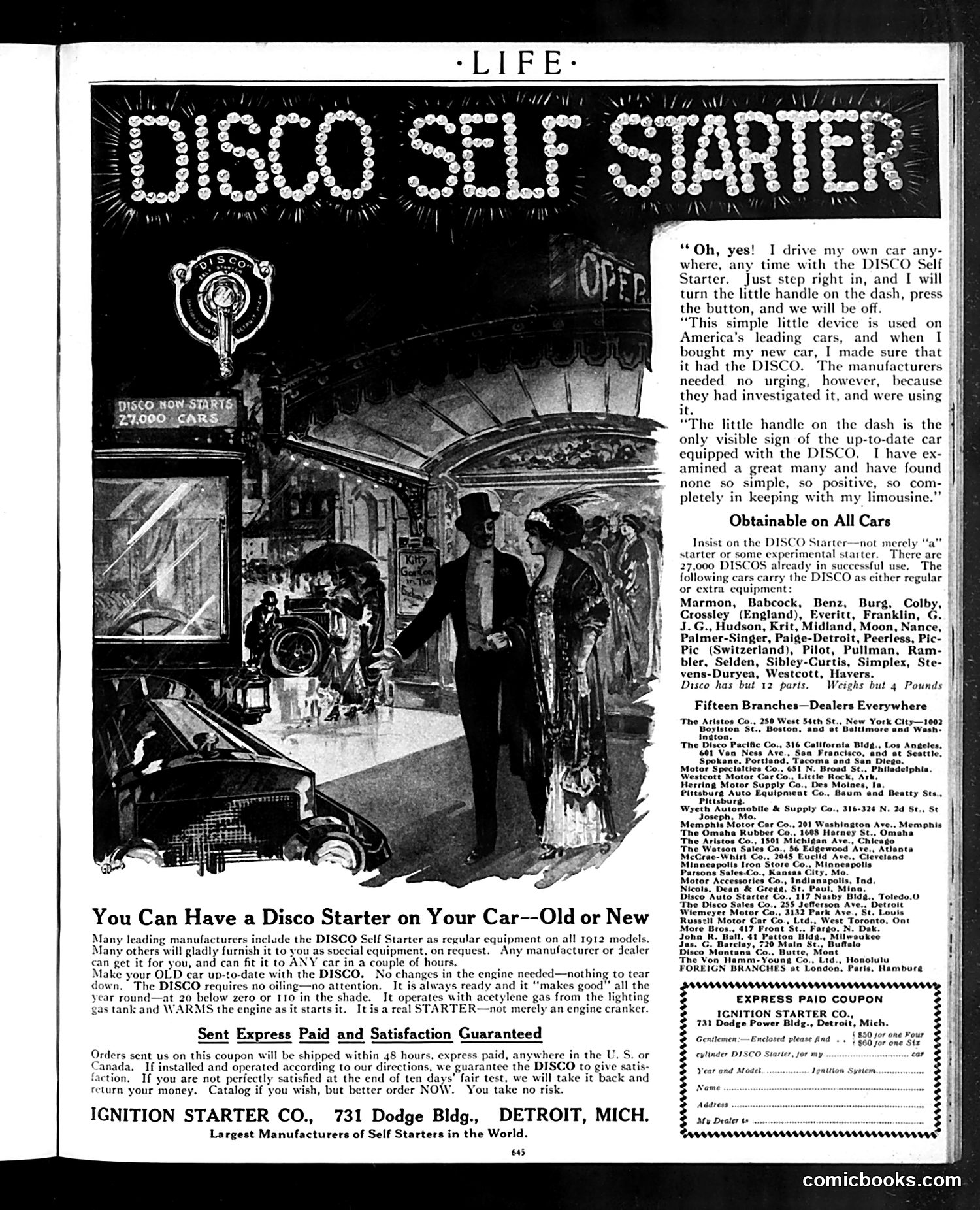
This is primarily a **product advertisement**, not satire or editorial cartoon. It promotes the DISCO Self Starter—an early automobile electric starter device—to a readership still accustomed to hand-cranking engines. The image shows a well-dressed couple in what appears to be a showroom or garage, with the woman speaking enthusiastically about the product's convenience. This reflects the era when **self-starters were luxury novelties** that made car operation dramatically easier and safer (hand-cranking could cause serious injury). The advertisement emphasizes modernity: the device is "simple," requires "no oiling," works in extreme temperatures, and is already standard on 27,000 vehicles and numerous prestigious car brands (Hudson, Franklin, etc.). The coupon at bottom allowed mail-order purchase with a ten-day satisfaction guarantee. **Context for modern readers**: This represents the early automotive industry's rapid technological adoption (circa 1912), when self-starters were still novel enough to be heavily marketed as status symbols and selling points.
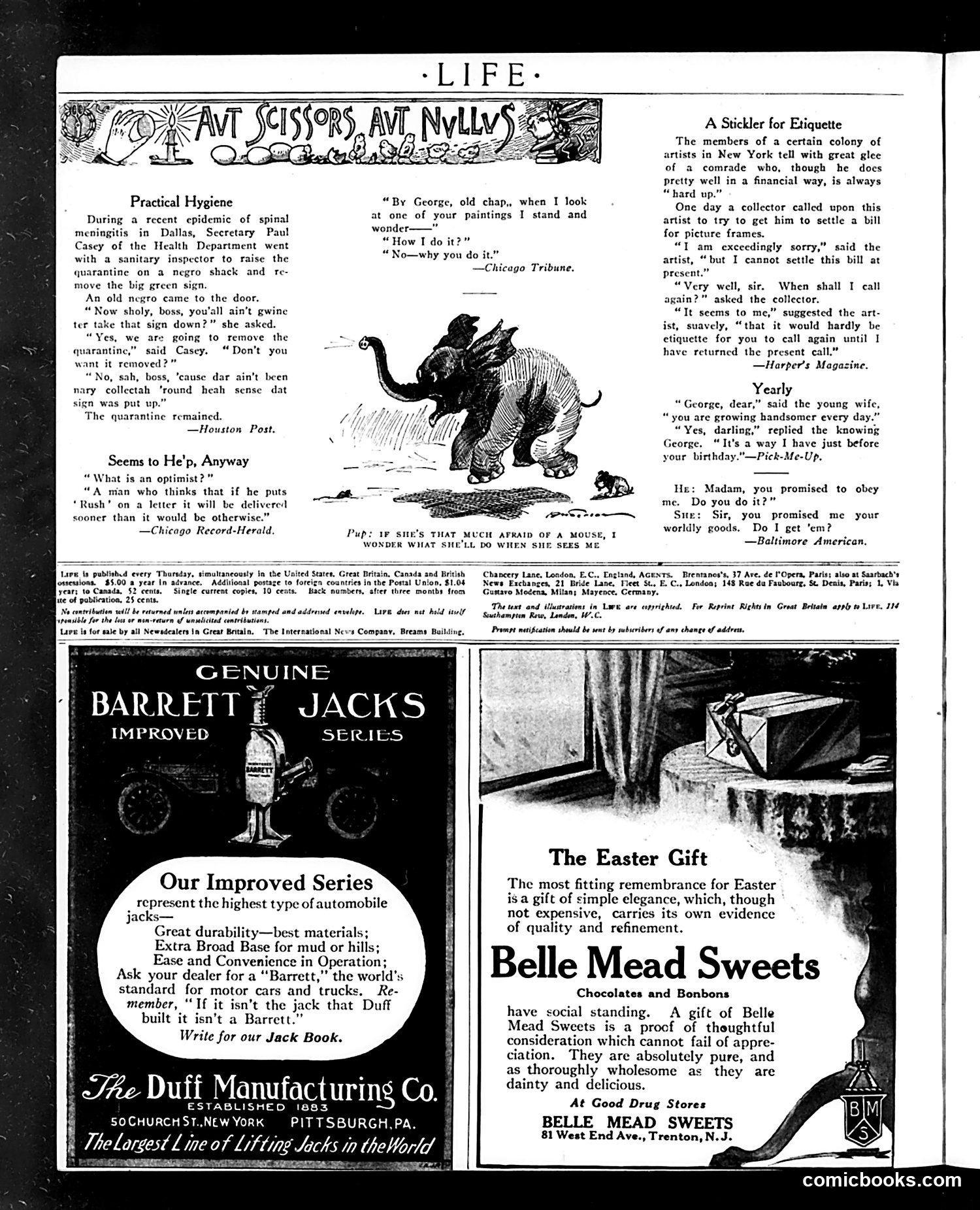
This page from *Life* magazine contains several brief humorous anecdotes and advertisements typical of early 20th-century American humor. **Main content:** The cartoons and jokes satirize everyday social situations. One depicts a woman terrified of a mouse, with the caption suggesting ironic contrast. The "Stickler for Etiquette" story mocks an impoverished artist who, unable to pay a bill, uses social convention as excuse—claiming it would be improper for the collector to call again until the artist returns the courtesy call. This satirizes how financial desperation gets masked in polite society language. Other jokes target optimism, artistic pretension, marriage dynamics, and gender relations, using racial dialect in one story (reflecting the period's problematic conventions). **Advertisements** dominate the lower half, promoting Barrett jacks and Belle Mead Sweets chocolates as Easter gifts. The overall tone is light, satirical commentary on middle-class American life, manners, and consumerism of the era.
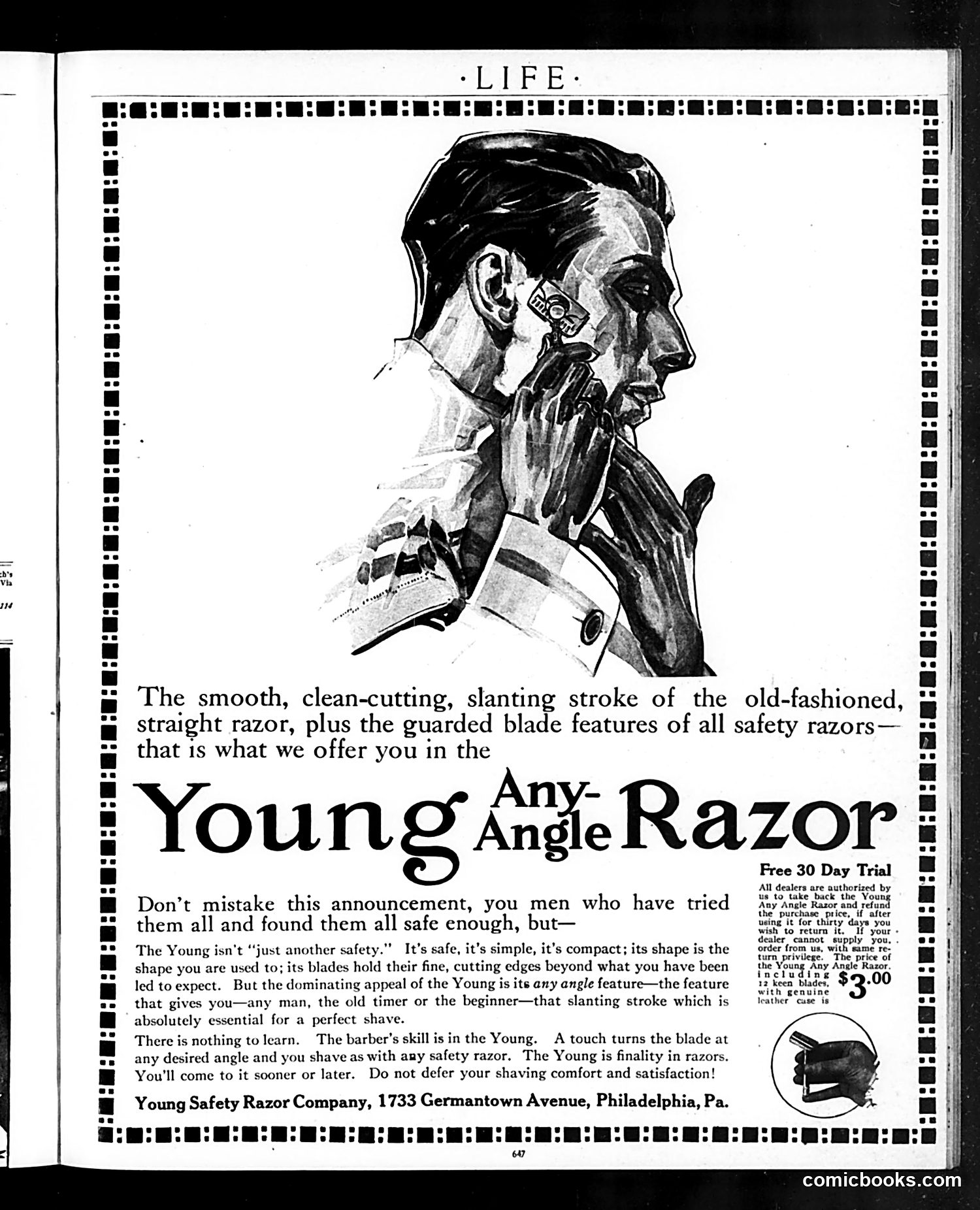
This is a **straight advertisement**, not satire or political commentary. It promotes the "Young Any-Angle Razor," a safety razor manufactured by the Young Safety Razor Company of Philadelphia. The page features a detailed illustration of a man's face in profile, demonstrating the product's shaving results. The ad's pitch combines traditional and modern appeals: it promises the "smooth, clean-cutting, slanting stroke of the old-fashioned, straight razor" while offering "guarded blade features of all safety razors"—positioning the Young razor as a hybrid that bridges old and new shaving methods. Key selling points highlighted: the razor's adjustable angle feature (allowing any user, "old timer or beginner," to achieve proper technique), its durability, simplicity, and compact design. The ad emphasizes there's "nothing to learn" since the razor's design compensates for barber skill. A free 30-day trial and $3.00 price point are offered. This represents typical early 20th-century product advertising in *Life* magazine.
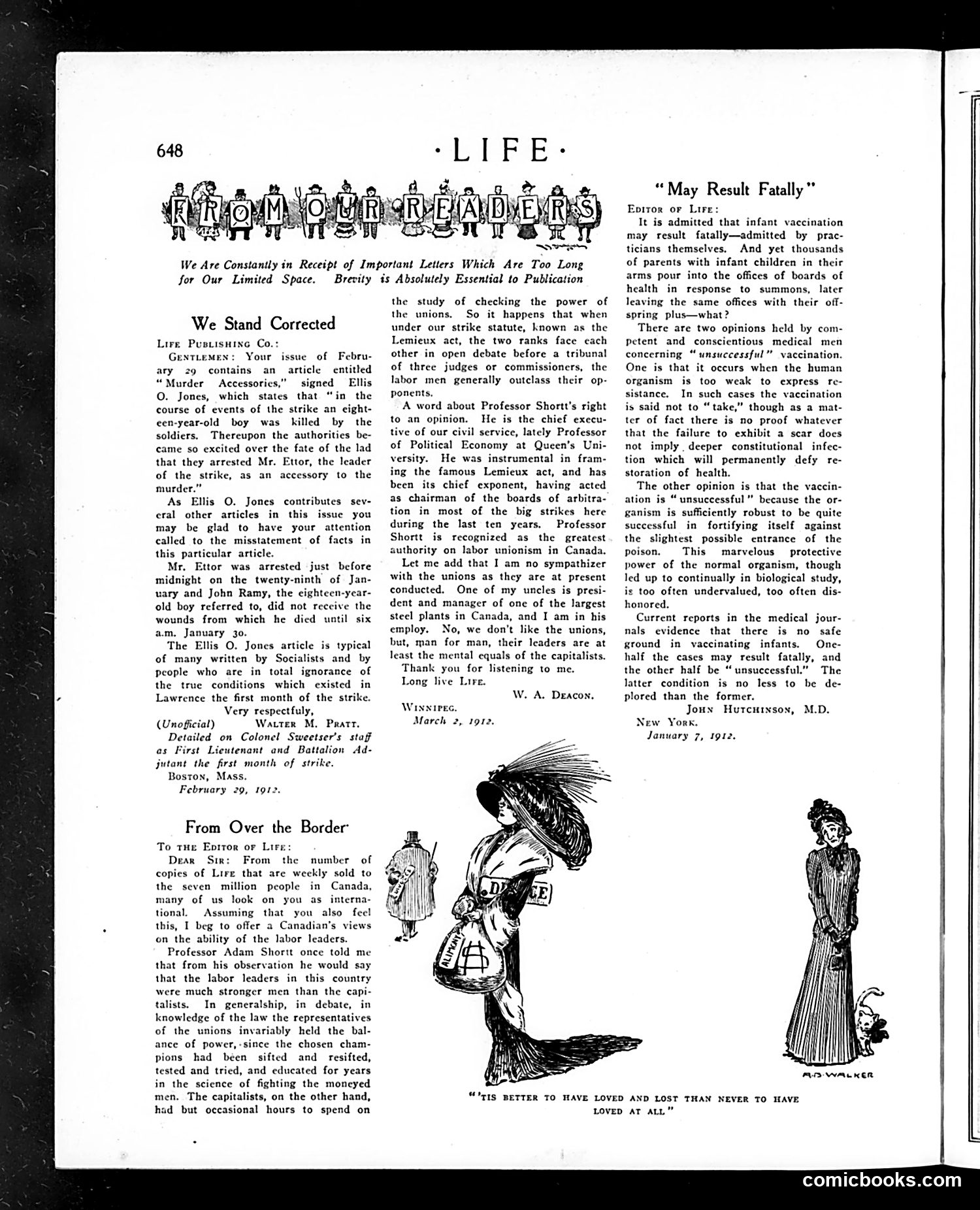
This page contains reader letters debating two contemporary issues: **The Lawrence Textile Strike (1912):** A correction letter challenges an earlier Life article's account of events during the Lawrence, Massachusetts strike. The dispute concerns timing: whether labor leader Joseph Ettor was arrested before or after an eighteen-year-old boy's death. The letter writer, a military official, argues the article misrepresented facts and was biased toward Socialists. **Labor Leadership Debate:** A Canadian reader argues that union leaders are intellectually superior to capitalists—better educated in law, strategy, and debate—citing Canadian Professor Adam Shortt's authority on labor matters and the Lemieux arbitration law. **Vaccination Safety:** An incomplete letter questions mandatory infant vaccination, noting it can be fatal. The page also includes an illustration by "Ad Walker" showing a fashionable woman with the caption "'Tis Better to Have Loved and Lost Than Never to Have Loved at All," likely commenting on romantic/social matters. These letters reflect early 20th-century concerns: labor unionism, class conflict, and public health debates.
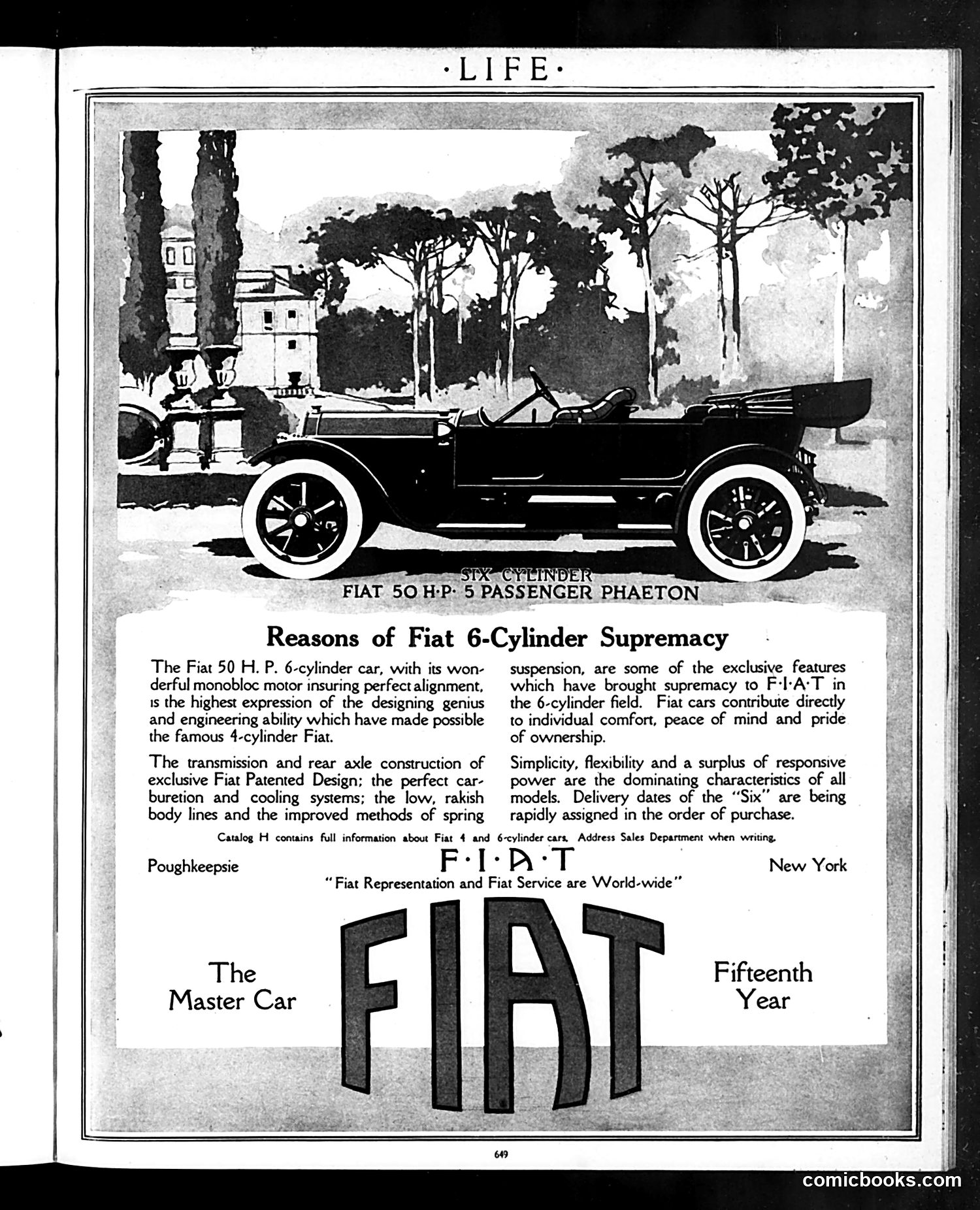
This is a **straightforward automobile advertisement**, not political satire or a cartoon. It promotes the Fiat 50 H.P., a 6-cylinder luxury car, emphasizing its engineering superiority over the company's earlier 4-cylinder models. **Key points for modern readers:** - The Italian car manufacturer Fiat was competing in the American luxury automobile market during what appears to be the 1910s-1920s (referenced as "Fifteenth Year") - Marketing emphasized mechanical features—monoblock motors, patented transmission design, cooling systems—that were genuine innovations then - The elegant phaeton (open-air passenger car) shown represents premium automobiles of this era - Taglines like "The Master Car" and "World-wide" service reflect early automotive industry's global ambitions - The formal, detailed technical language reflects how cars were marketed as engineering marvels rather than lifestyle products This is period automotive marketing with no satire or hidden political meaning—simply an Italian company advertising its flagship model to American consumers.
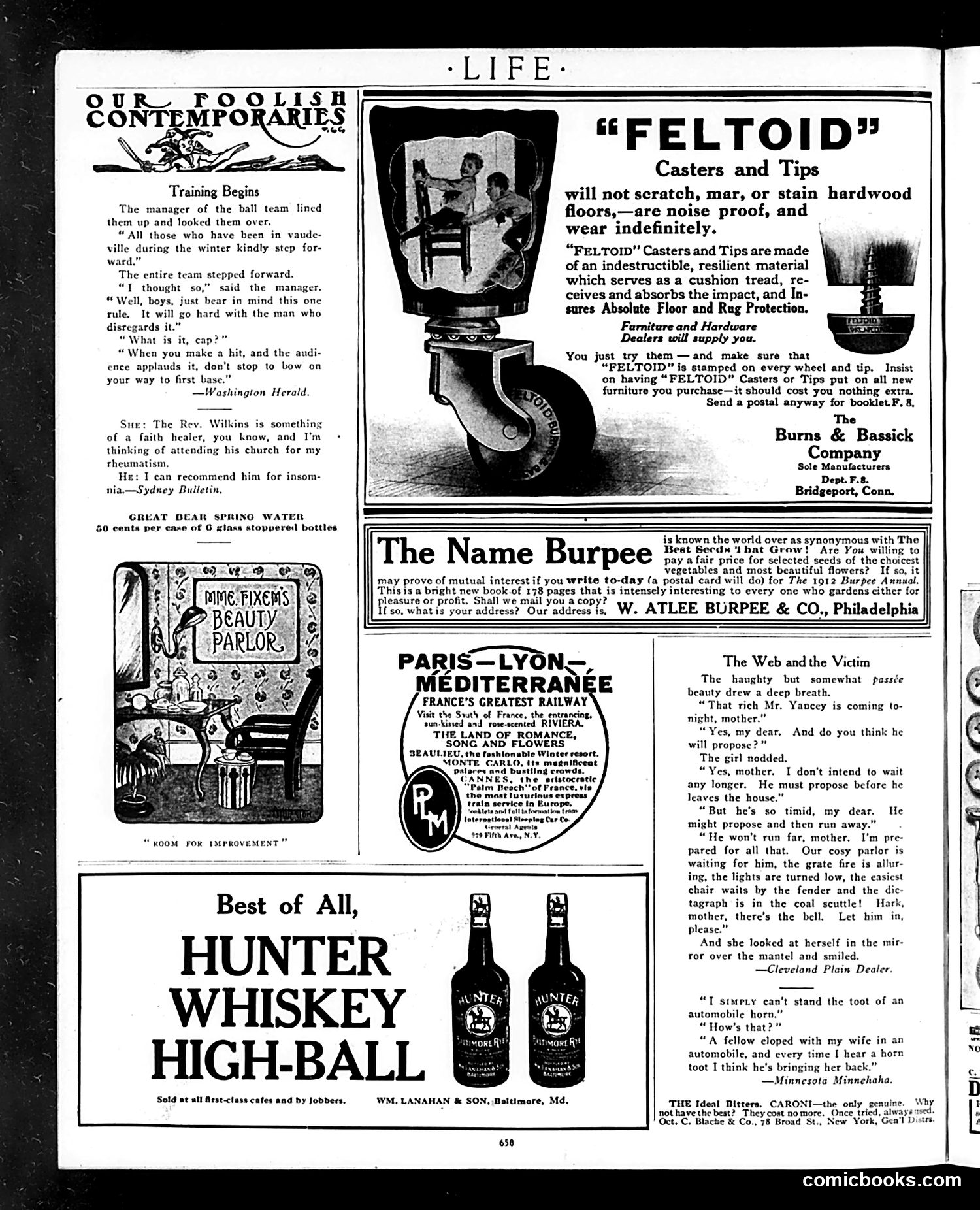
This page contains several satirical pieces typical of early 1900s Life magazine: **"Training Begins"** mocks baseball players who performed in vaudeville during off-season. The joke: when they hit successfully, they instinctively take stage bows instead of running bases—conflating theatrical performance with athletic competition. **"The Web and the Victim"** is a romantic short story satirizing manipulative courtship tactics. A woman plots to trap a wealthy suitor (Mr. Yancey) into proposing by creating an intimate parlor setting, even hiding a dictaphone in the coal scuttle to record evidence. It mocks both the woman's scheming and the man's timidity. **Minor jokes** include: a pastor who cures rheumatism but causes insomnia, and a man hearing car horns assumes his wife's elopement partner is returning. The remainder is period advertising (Feltoid casters, Burpee seeds, Hunter Whiskey, Paris-Lyon railway). The satire reflects 1910s anxieties about theatrical artificiality in daily life, gender manipulation in courtship, and emerging technology (automobiles, dictaphones).
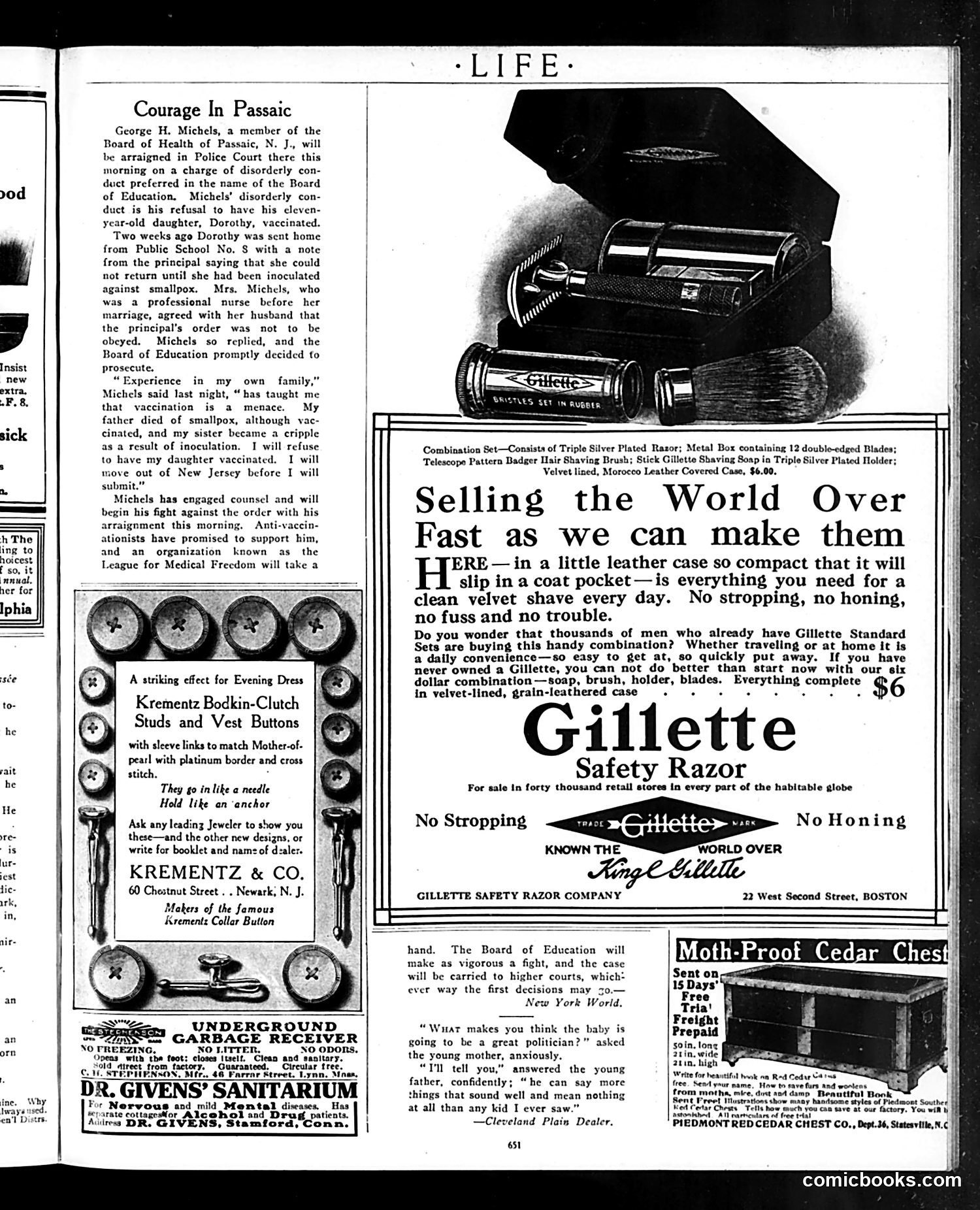
This page features a news story about **George H. Michels of Passaic, New Jersey, refusing to vaccinate his 11-year-old daughter Dorothy against smallpox**. Michels, a Board of Health member, defies the school board's vaccination requirement, claiming his family suffered harm from inoculation (his father died of smallpox despite vaccination; his sister became disabled). He faces prosecution and has secured legal counsel, backed by anti-vaccination activists and the "League for Medical Freedom." The article presents Michels as heroically resisting government overreach, framing him as having "Courage" (the headline). However, modern readers should recognize this reflects an anti-vaccination position that public health authorities rejected—vaccination protects communities, not just individuals. The remainder of the page contains period advertisements (Gillette razors, jewelry, furniture) unrelated to the story.
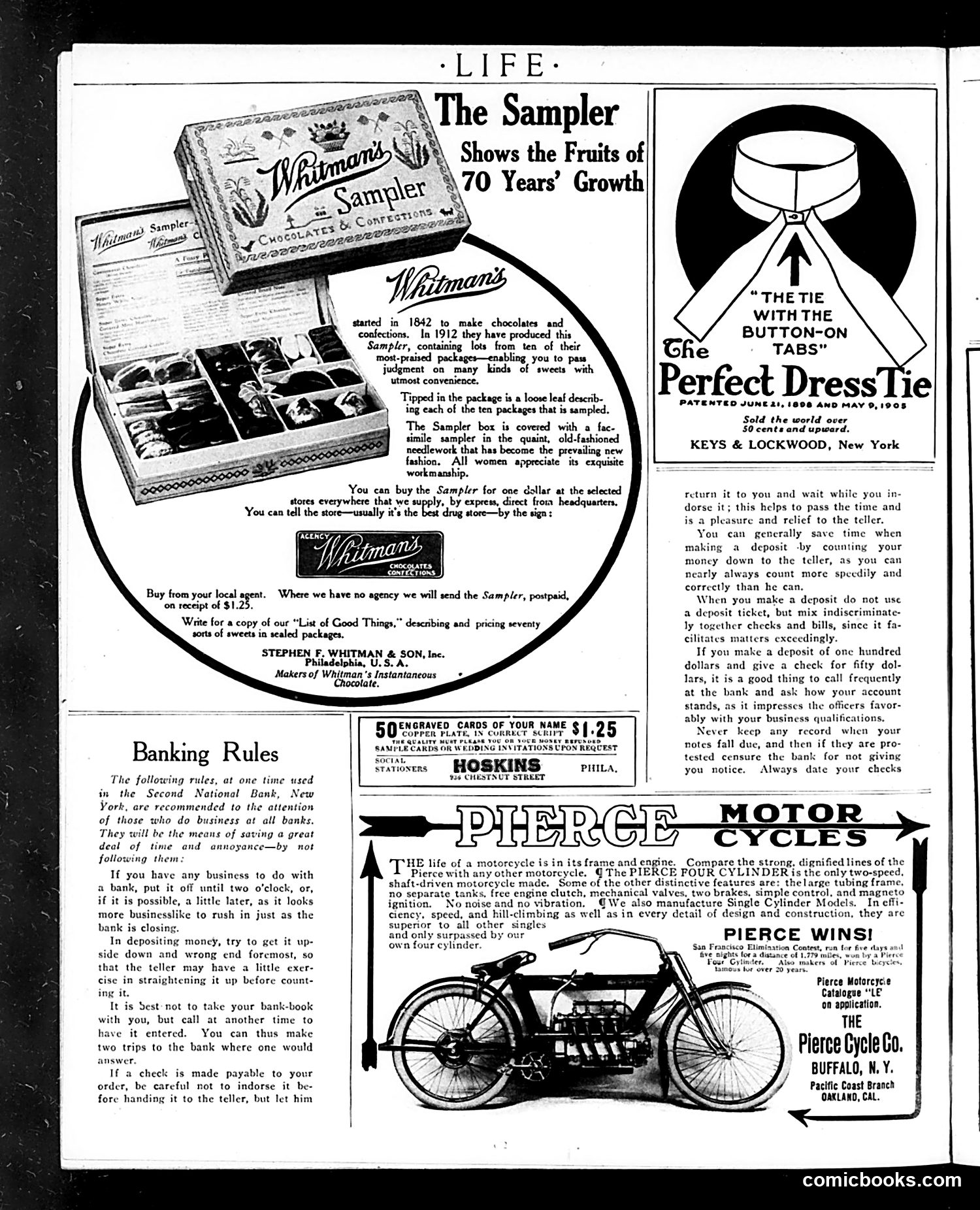
This page mixes satirical advice with early 1900s advertising. The "Banking Rules" section is satirical humor—a mock-guide that recommends deliberately terrible banking practices: depositing money upside-down, visiting at closing time, not bringing your bankbook, and failing to endorse checks. The satire mocks careless customers and inefficient banking habits of the era. The advertisements are straightforward: Whitman's chocolate sampler (celebrating 70 years of business since 1842), a dress-tie with button-on tabs by Keys & Lockwood, and Pierce motorcycles. These ads target affluent readers with luxury goods—expensive chocolates, fashionable accessories, and motorcycles. The satire assumes readers will recognize the opposite of proper banking behavior, while the ads reflect early 1900s consumer culture priorities: confections, fashion innovations, and automobiles as status symbols.
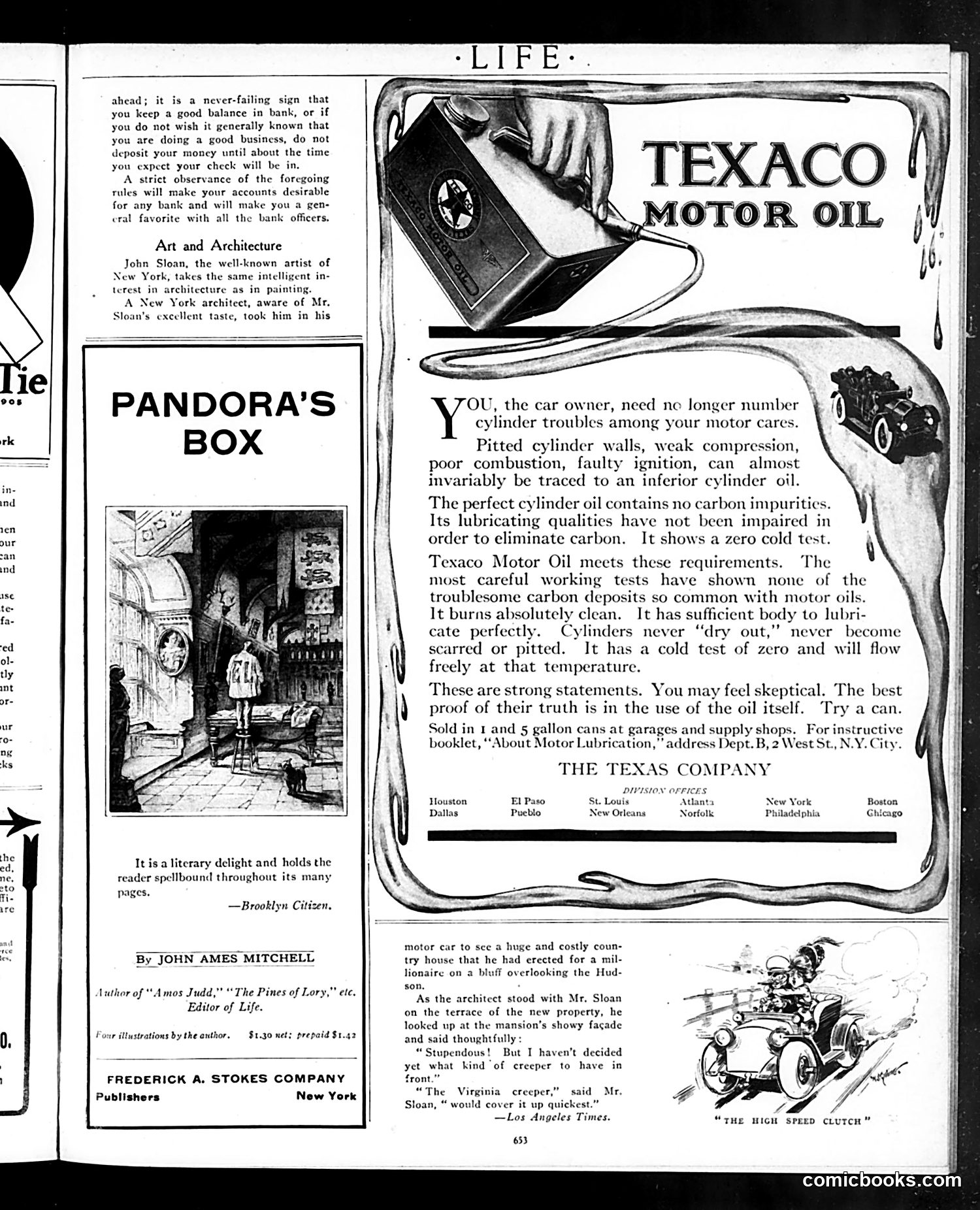
This page is primarily **advertising and literary promotion** rather than political satire. The left side advertises John Ames Mitchell's book *Pandora's Box* with an illustration showing a domestic interior scene—likely depicting a story moment rather than satire. The right side is a **Texaco Motor Oil advertisement** addressing early 1900s automotive concerns: carbon buildup in engine cylinders causing performance problems. The ad uses technical language to convince skeptical car owners that Texaco's product prevents these issues through superior lubrication properties. The small embedded anecdote (credited to *Los Angeles Times*) about artist John Sloan visiting a mansion is a **gentle joke about pretension**: when shown an elaborate new country house, Sloan suggests covering its showy facade with Virginia creeper vines—implying the architecture is so bad it should be hidden. This plays on artistic taste versus gaudy wealth, typical of *Life* magazine's upper-class satirical humor. The page reflects early automotive advertising targeting affluent readers concerned with machinery performance.
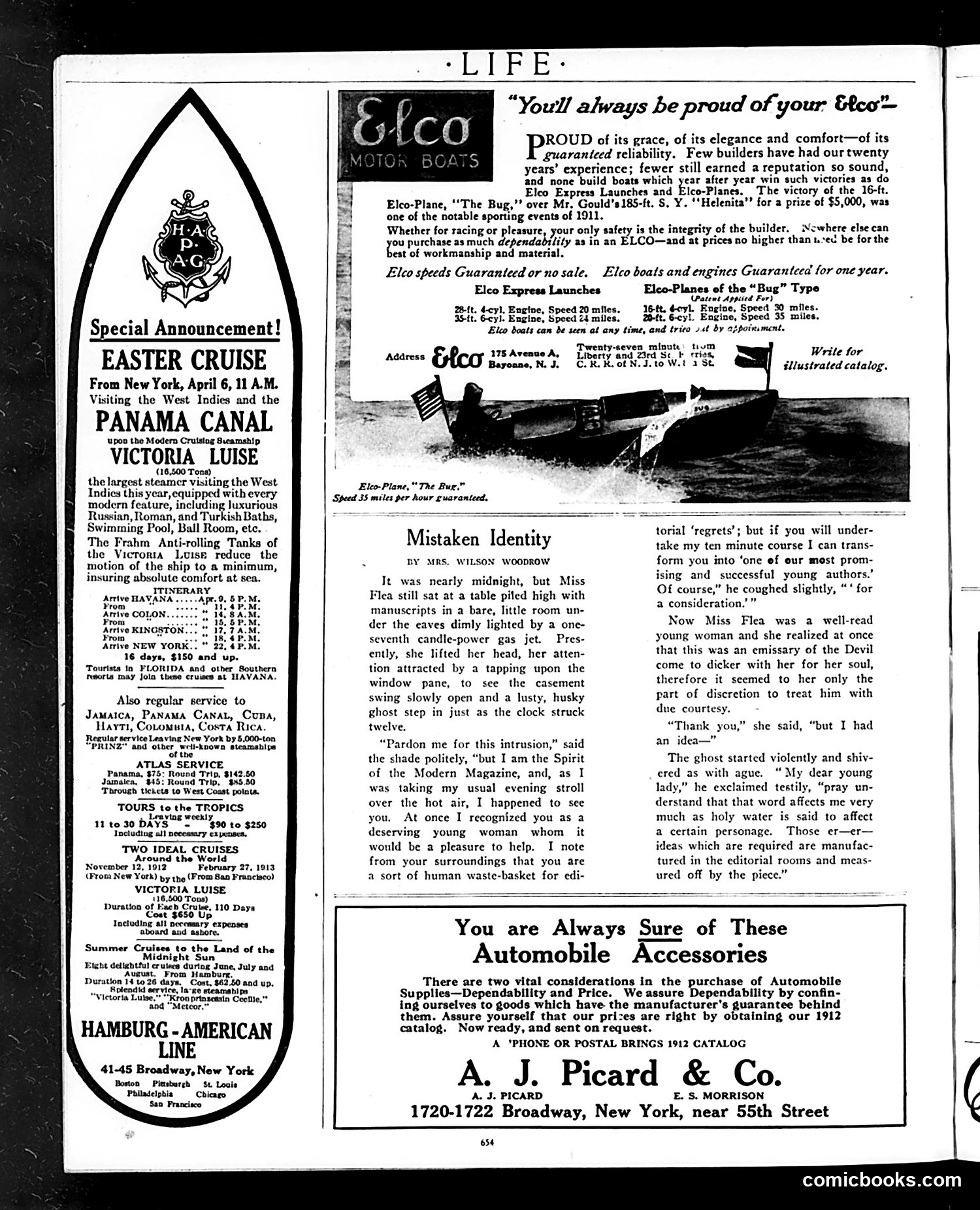
This page is primarily **advertising**, dominated by cruise line promotions (Hamburg-American Line) and product advertisements (Elco boats/planes, A.J. Picard automobile accessories). The only editorial content is a short story titled **"Mistaken Identity" by Mrs. Wilson Woodrow**—a humorous supernatural tale about Miss Flea, a struggling writer working late into the night on manuscripts. A mysterious visitor appears at her window, claiming to be a literary agent who can transform her into "one of our most promising and successful young authors" for a consideration. The narrator suggests this mysterious figure is "an emissary of the Devil come to dicker with her for her soul." The satire targets **struggling writers and predatory literary agents** of the era—mocking both the desperation of aspiring authors and the dubious "agents" who exploit them with false promises of success in exchange for money. The Devil comparison humorously emphasizes how corrupt or fraudulent such dealings seemed to contemporary readers.
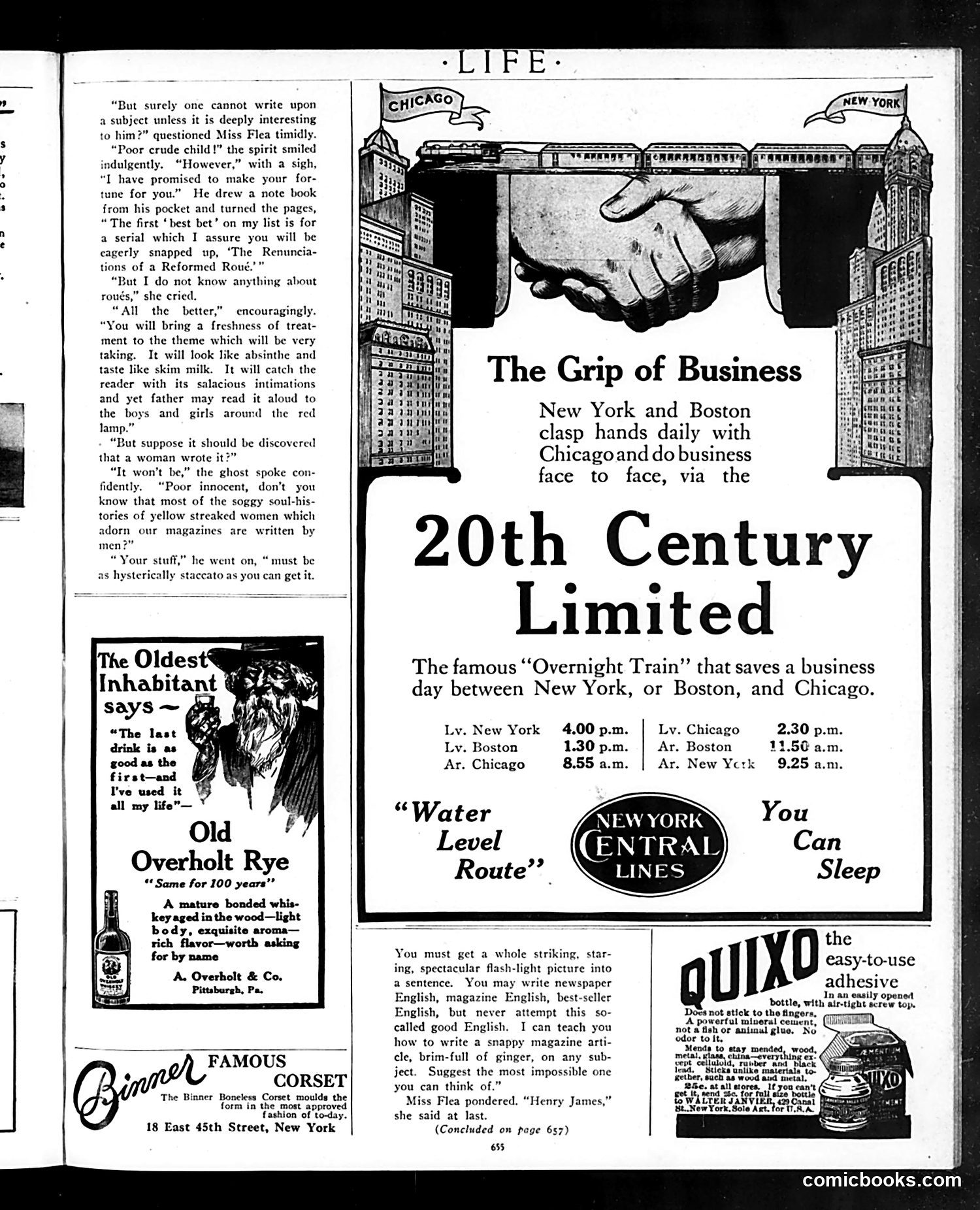
This page contains satirical commentary on magazine writing conventions and gender in early 20th-century publishing. The main narrative (left side) features "Miss Flea," an aspiring female writer, receiving cynical advice from a ghostly mentor figure. The satire targets several points: **The Satire's Points:** - Female writers were expected to write about subjects they knew nothing about ("roués") - Magazine editors valued sensationalism over authenticity ("taste like skim milk") - There was an open secret that many supposedly male-authored sentimental magazine stories were actually written by women - Writers needed to adopt artificial, "staccato" styles rather than genuine prose The humor culminates in Miss Flea's suggestion that she write about Henry James—presumably absurd for a magazine context requiring "ginger" and sensationalism. The surrounding advertisements (Old Overholt Rye, Binner Corset, 20th Century Limited train, Quixo adhesive) represent standard commercial content of the era, with no satirical connection to the main article visible.
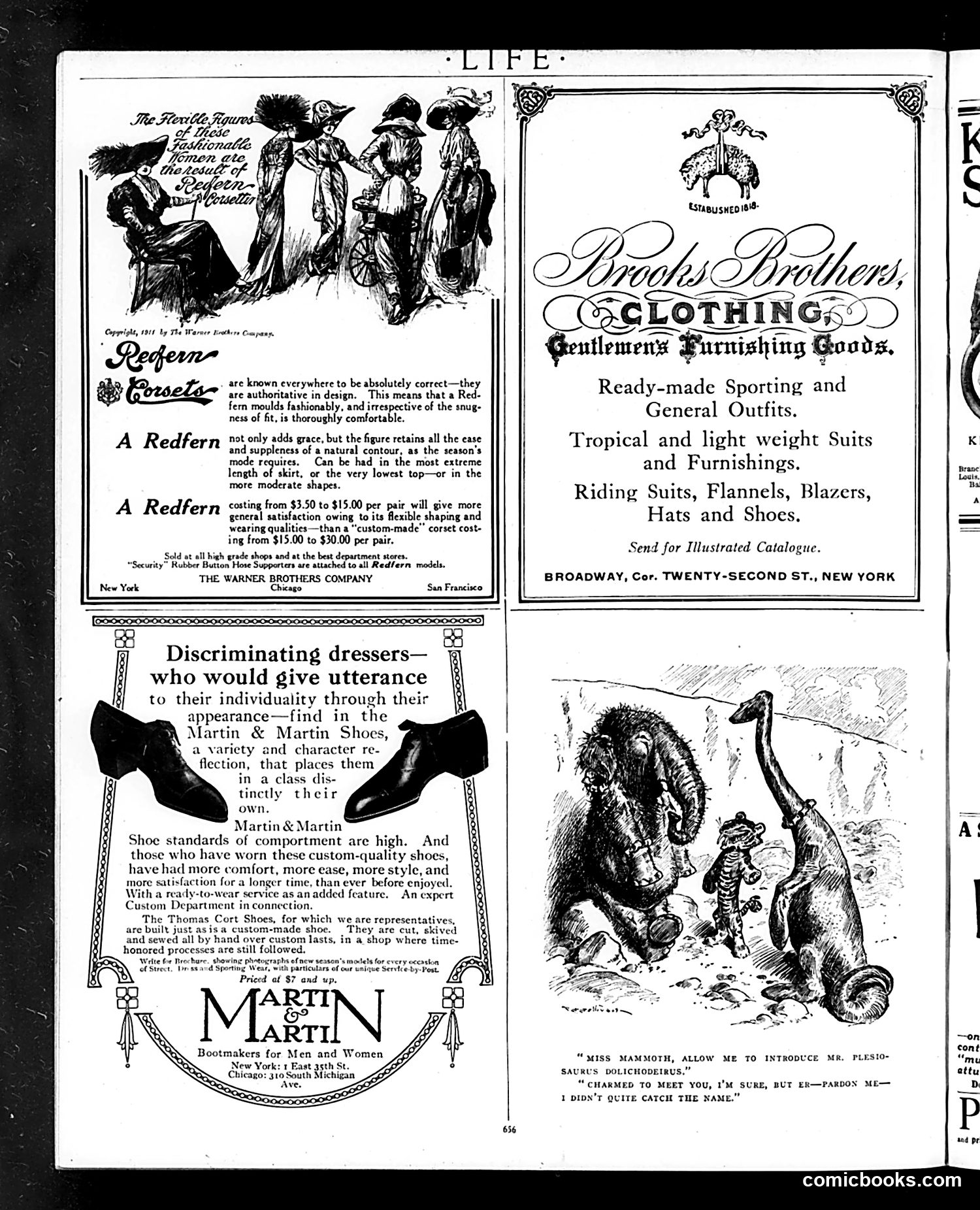
This page is primarily **advertising** for women's fashion and footwear (Redfern Corsets, Brooks Brothers, Martin & Martin Shoes, etc.), typical of early 20th-century magazines. The single cartoon at bottom depicts a humorous social situation: a woman ("Miss Mammoth") is being introduced to a prehistoric creature (a Plesiosaur—a long-extinct marine reptile). The joke relies on **size contrast satire**: the woman is implicitly compared to the extinct dinosaur in bulk or stature, mocking an overweight woman by suggesting she resembles a massive prehistoric beast. Her polite but confused response ("I didn't quite catch the name") plays on the absurdity of meeting such a creature at what appears to be a social gathering. This reflects the era's common satirical humor about women's bodies and appearance, though the specific insult would be immediately offensive by modern standards.
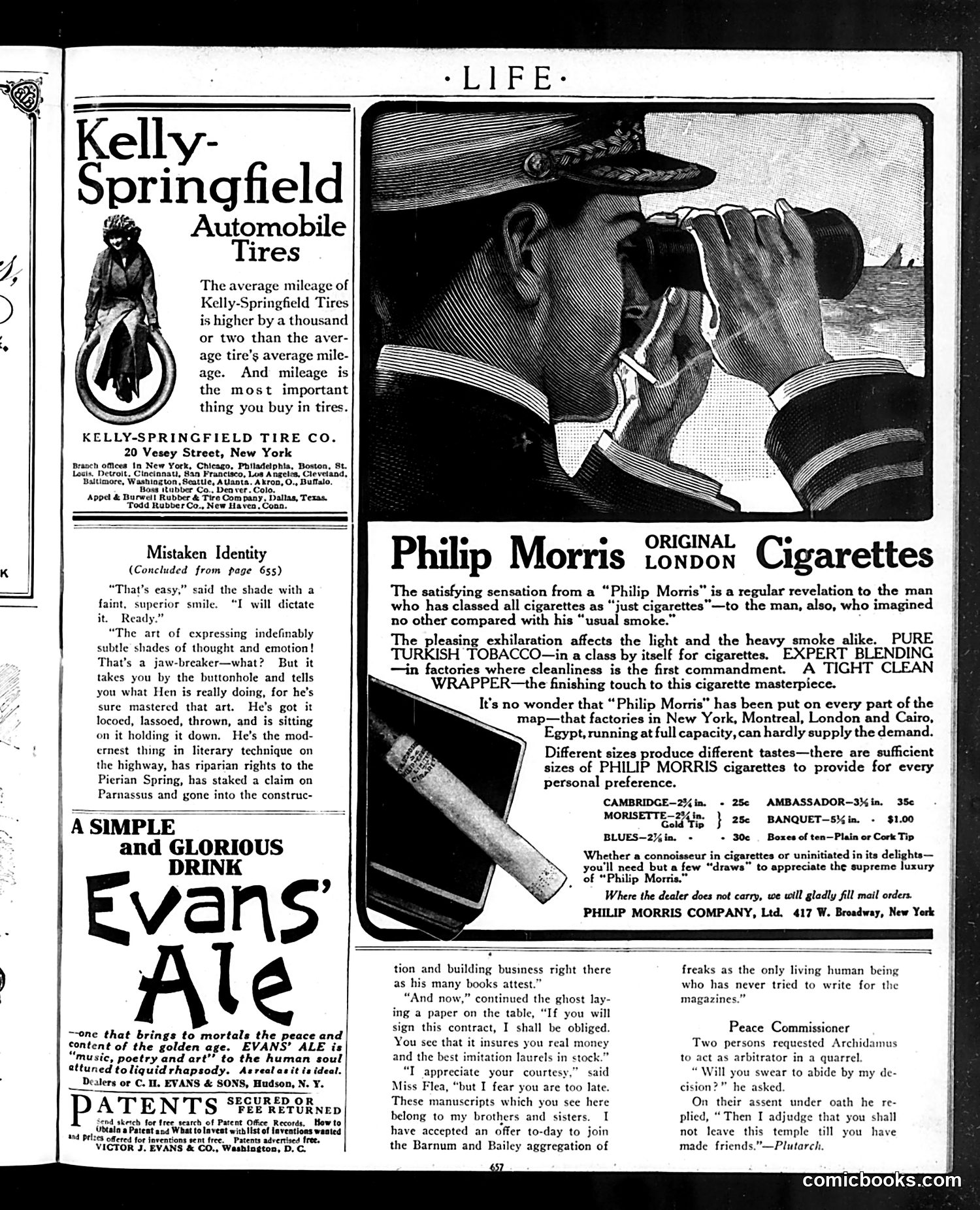
This page is primarily **advertising**, not satire or political commentary. It contains four distinct ads: 1. **Kelly-Springfield Tires**: Claims superior mileage compared to competitors 2. **Evans' Ale**: A beverage ad using flowery, poetic language about refreshment 3. **Philip Morris Cigarettes**: Emphasizes pure Turkish tobacco and international manufacturing 4. **Patent services**: Victor J. Evans & Co. offering patent searches The only narrative content is "Mistaken Identity" (concluded from page 655), a story fragment about a ghost dictating literary advice to a character named Miss Flea, who ultimately rejects a publishing contract to join the Barnum and Bailey circus—the joke being she's the only human who never wrote for magazines. The page reflects early 20th-century consumer culture and advertising conventions. No political or social satire is evident.
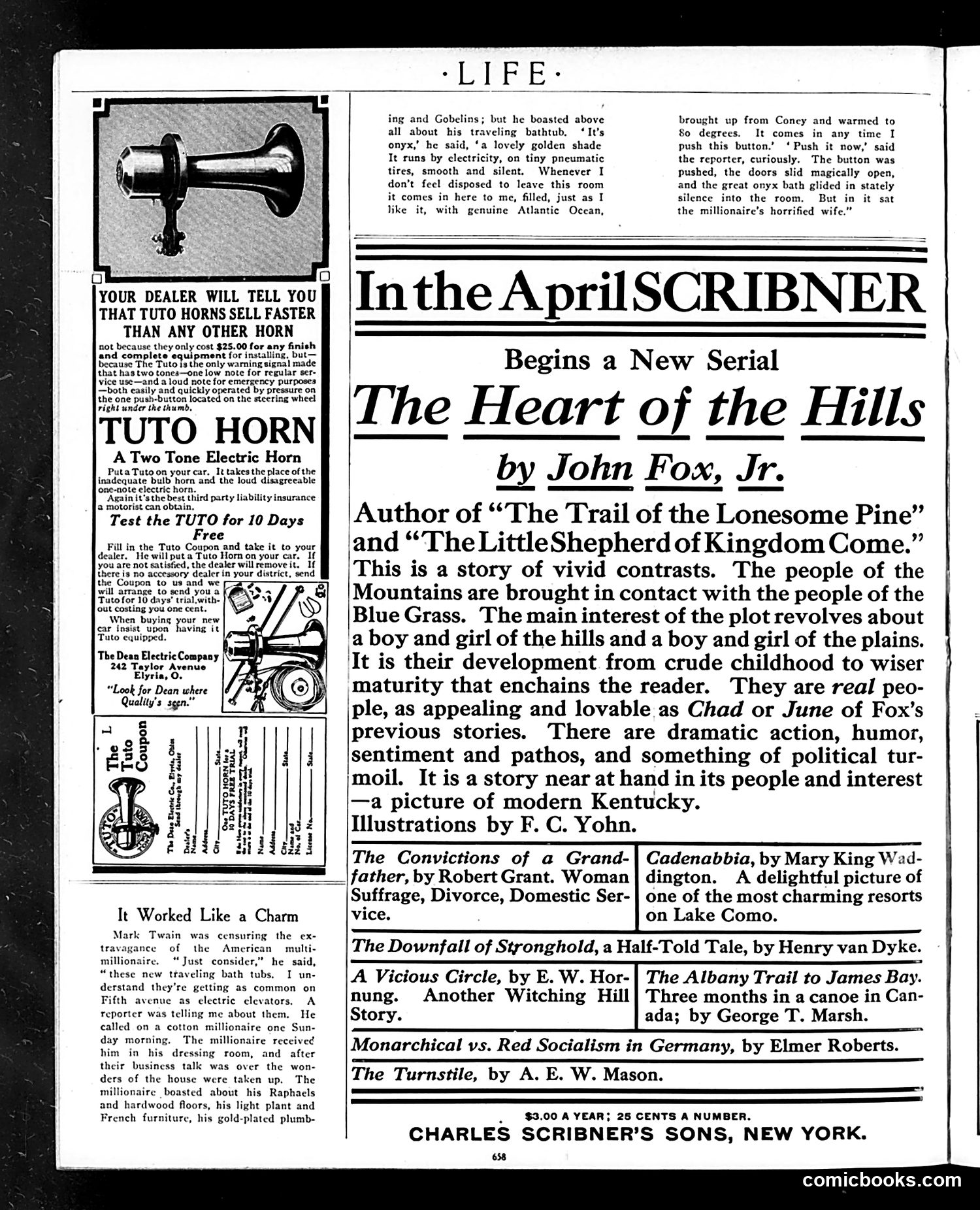
This page is primarily **advertising and literary promotion** for Scribner's magazine (April issue). The left sidebar contains ads for the **Tuto Horn** (a two-tone car horn) and includes a **Mark Twain anecdote** satirizing American millionaire excess. The story mocks wealthy Fifth Avenue men who accumulate ostentatious luxuries—including a traveling bathtub made of onyx that runs on electricity and pneumatic tires, filled with heated Atlantic Ocean water. The joke's punchline: when the reporter asks the millionaire to demonstrate this marvel, his wife is discovered sitting in the tub, implying he'd forgotten she was there. The satire targets Gilded Age conspicuous consumption and the absurdity of wealthy industrialists prioritizing gadgetry over basic awareness of their own households. The right side **announces a new serial by John Fox, Jr.** ("The Heart of the Hills"), described as contrasting mountain and prairie people—typical popular fiction of the era.
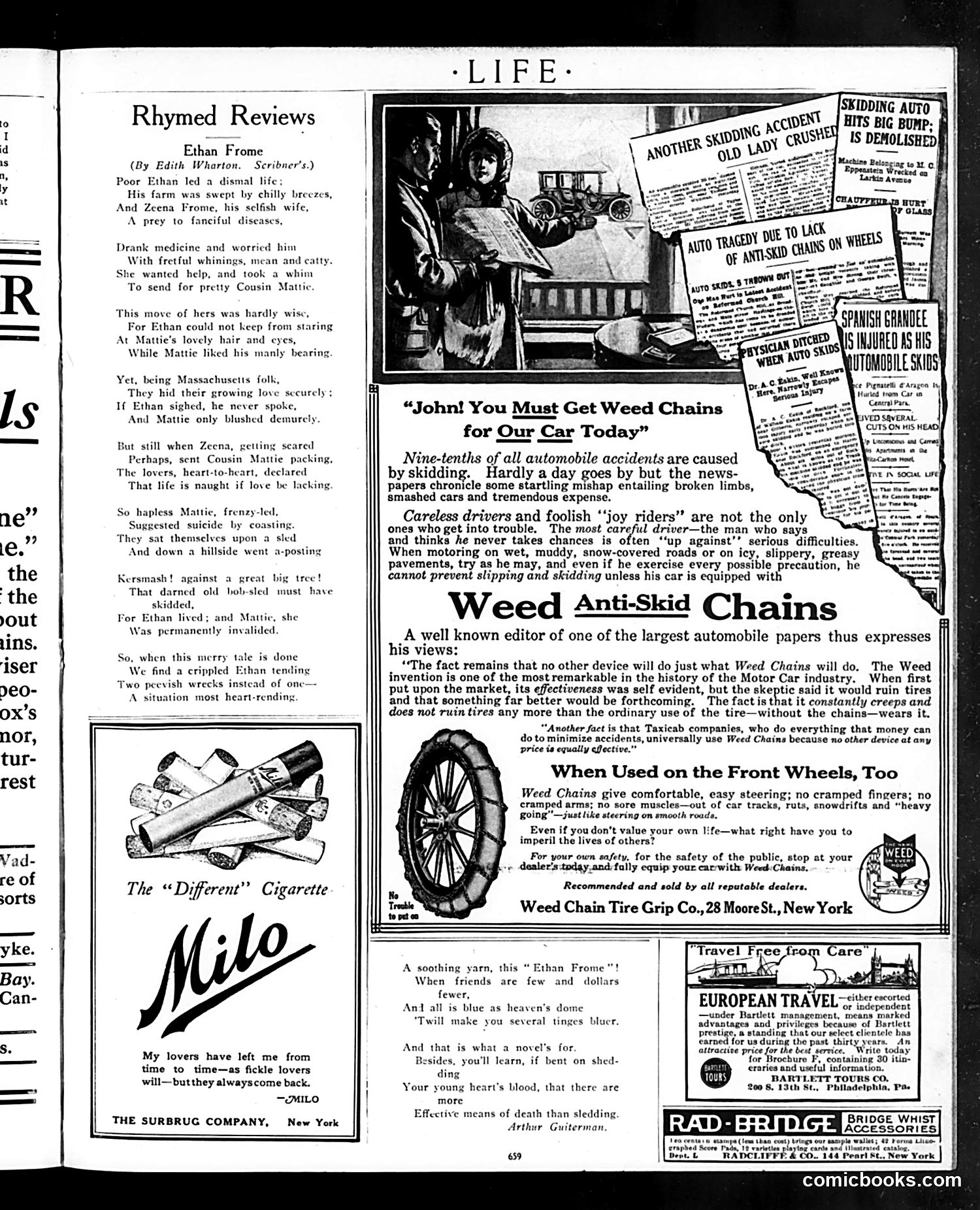
This page contains a literary satire and automobile advertising. The **"Rhymed Reviews"** section mocks Edith Wharton's 1911 novel *Ethan Frome* by summarizing its tragic plot in doggerel verse. The satire emphasizes the melodrama: a poor farmer trapped in a loveless marriage, a beautiful cousin who tempts him, a suicide pact that fails, leaving him permanently caring for two disabled women. The crude rhyming ("tree/skidded," "scared/packing") undercuts the novel's literary seriousness—Life is joking that despite Wharton's reputation, the story is actually overwrought melodrama. The dominant **"Weed Anti-Skid Chains"** advertisement is a major feature, warning that nine-tenths of automobile accidents result from skidding. It appeals to both safety-conscious drivers and those showing off ("joy riders"), using an editor's endorsement to claim Weed Chains are industry-standard. This reflects genuine 1910s-era concerns about motor vehicle safety before modern traction control existed. The **"Milo" cigarette ad** uses a flippant, romantic tone to suggest the product's superiority.
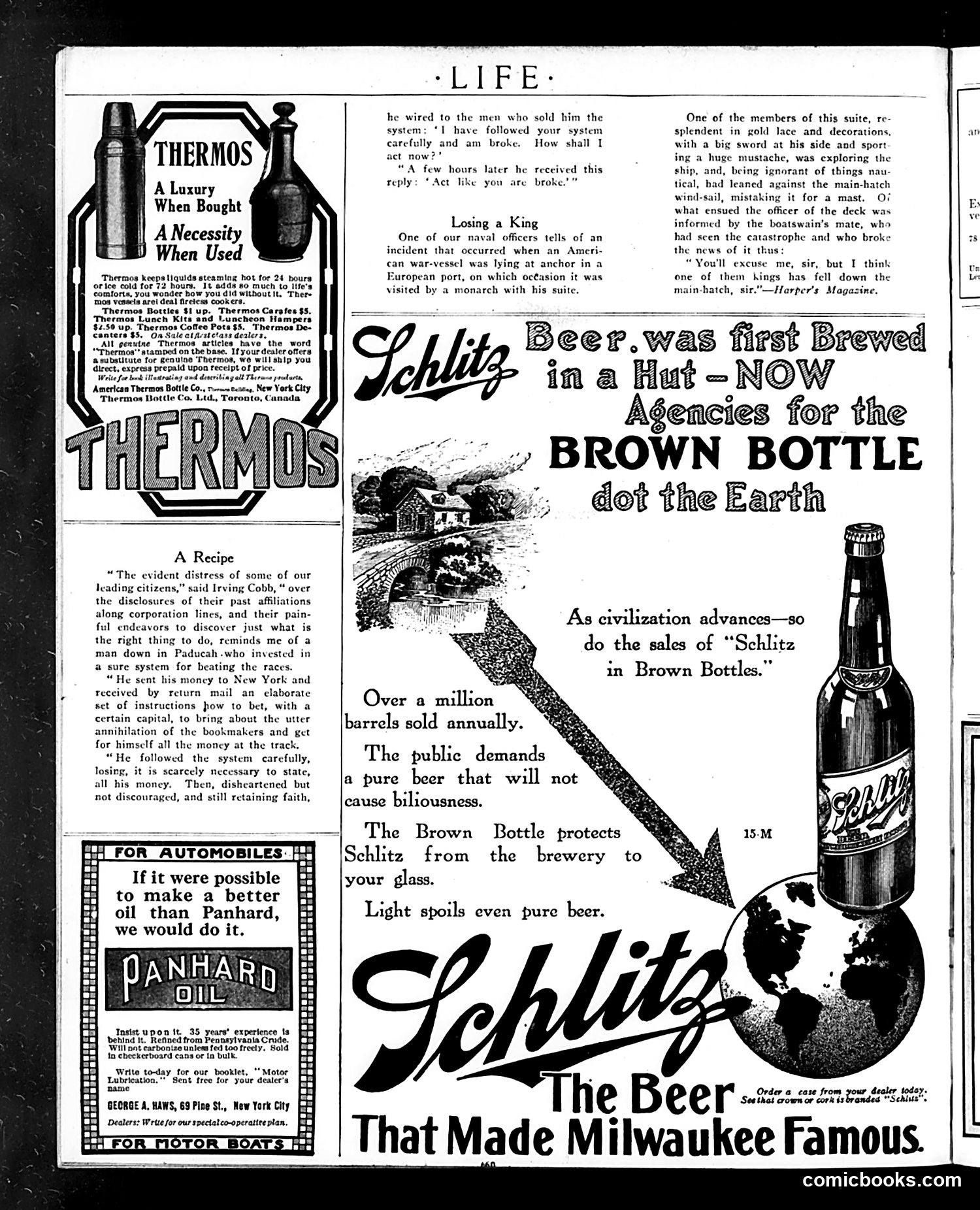
This page contains three distinct elements: two humorous anecdotes and period advertisements. **The Anecdotes:** "Losing a King" presents a satirical naval story by Irving Cobb, a prominent humorist. A European monarch visiting an American warship leans against a wind-sail, mistaking it for a mast, and falls down a hatch. The joke relies on the monarch's ignorance of nautical matters and the sailor's deadpan delivery reporting that "one of them kings has fell down the main-hatch." The racing-system anecdote mocks gullible investors who follow elaborate schemes promising wealth but lose everything. Both stories satirize foolish faith in systems and the absurdity of their consequences. **The Advertisements:** The page features ads for Thermos bottles, Panhard oil, and prominently, Schlitz beer in brown bottles—emphasizing that brown glass protects beer from light damage, preventing biliousness. These are period product endorsements typical of early-20th-century Life magazine content.
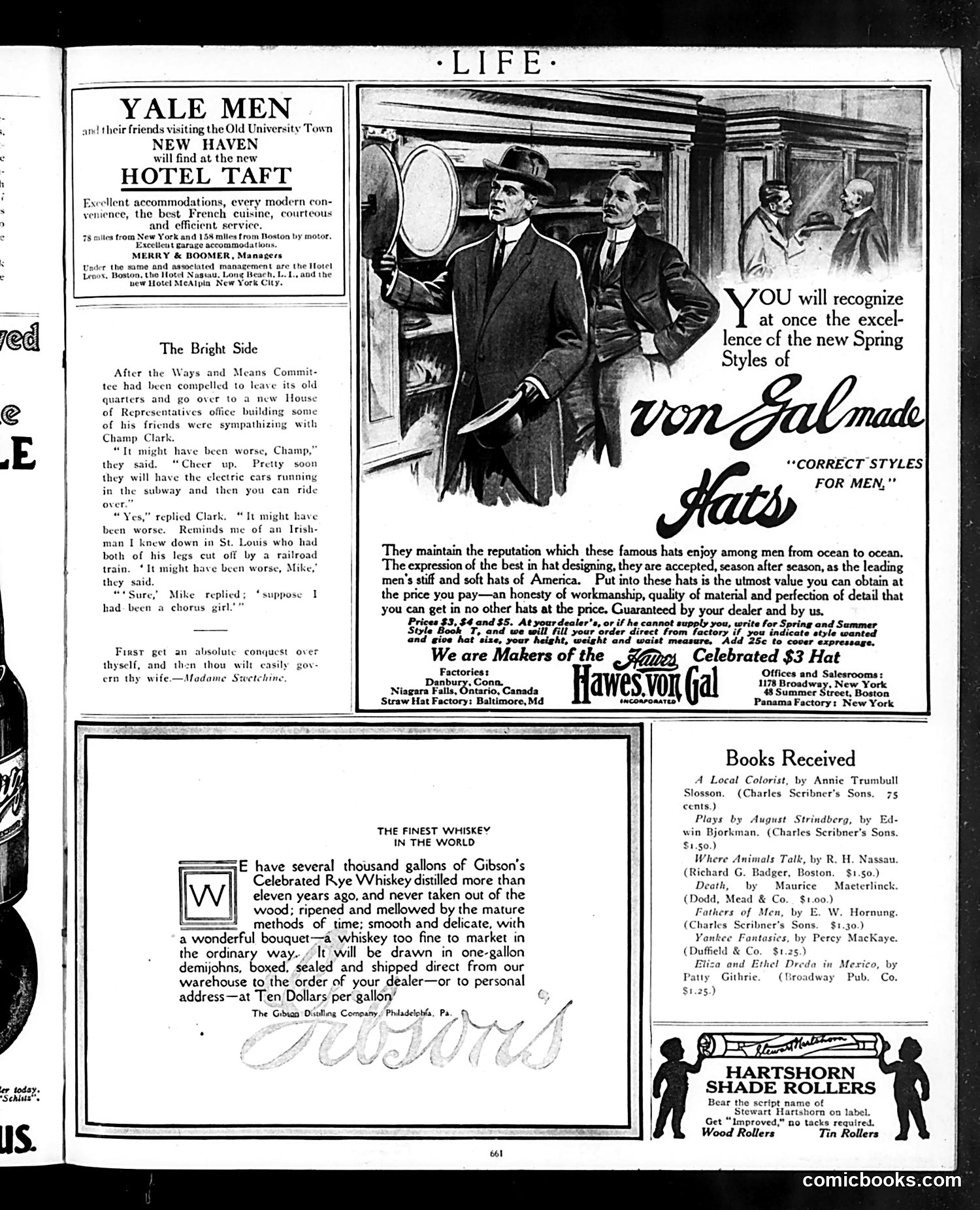
This page is primarily advertisements with one brief satirical story titled "The Bright Side." The cartoon itself is not a visual image but a written anecdote about **Champ Clark**, a prominent Democratic congressman (later Speaker of the House). The joke: When Clark's committee is forced to relocate to a new office building, friends sympathize with the inconvenience. Clark responds by telling a story about an Irishman who lost both legs to a train and was told "it might have been worse"—implying he could have been a chorus girl instead. The dark humor suggests acceptance of hardship with sardonic resignation. The satire mocks the minor complaints of politicians while using an Irish ethnic stereotype (common in early 20th-century American humor). It's gentle political ribbing rather than sharp commentary, emphasizing that congressmen should maintain perspective about their troubles. The rest of the page contains ads for hotels, hats, and whiskey—typical Life magazine content of this era.
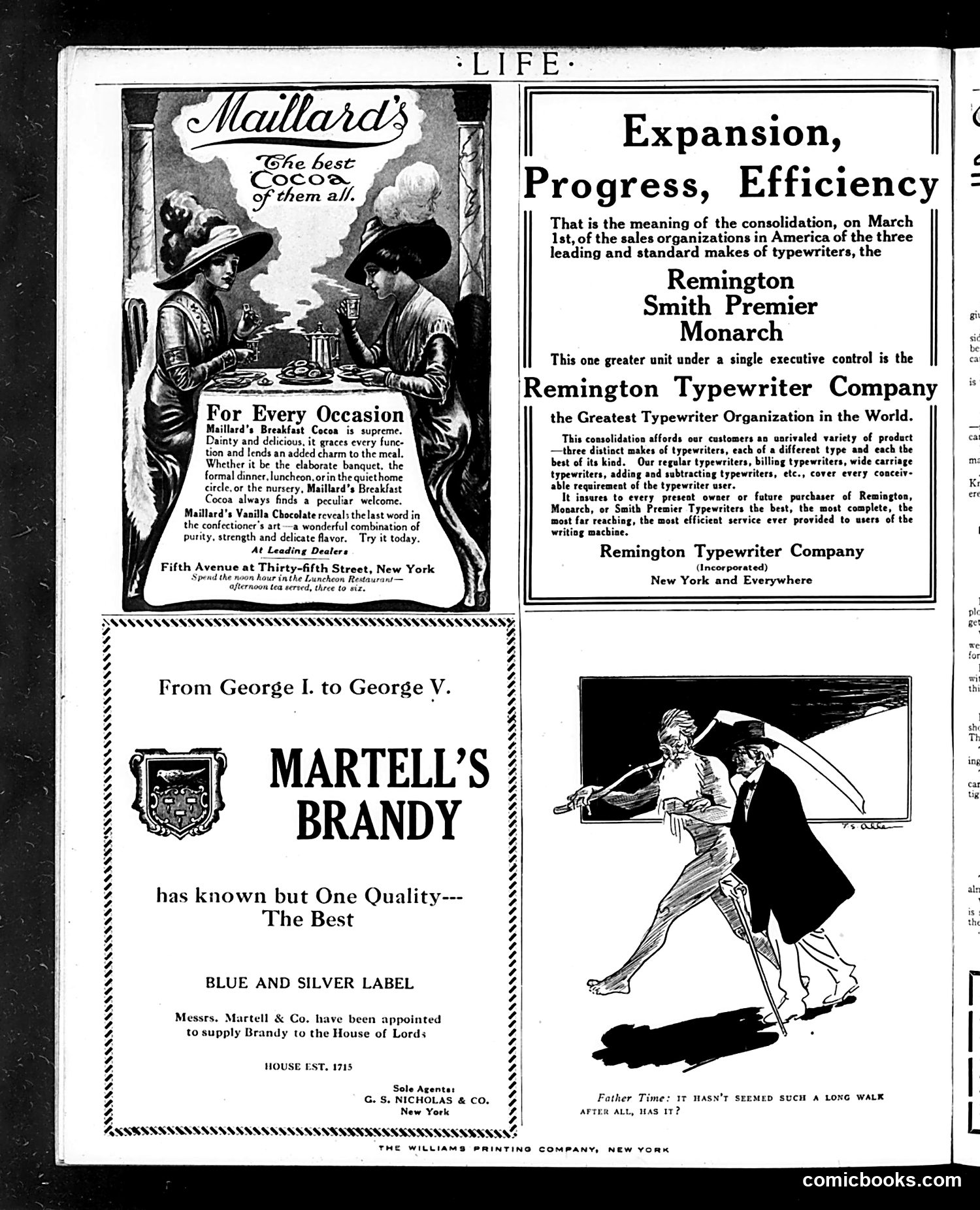
This page is primarily **advertising**, featuring four distinct ads with minimal editorial content. The main editorial item is a brief announcement of a **corporate consolidation on March 1st** merging three typewriter manufacturers—Remington, Smith Premier, and Monarch—under single executive control. The copy frames this as "Expansion, Progress, Efficiency," reflecting early-20th-century corporate consolidation rhetoric. The other advertisements are: - **Maillard's Cocoa and Chocolate** (with period-appropriate dining scene illustration) - **Martell's Brandy** (claiming royal appointment since 1715) - An untitled cartoon showing **Father Time with a woman**, captioned "It hasn't seemed such a long walk after all, has it?"—likely a humorous reflection on time's passage in relationships. The cartoon's satire is unclear without fuller context, but appears to play on romantic or marital duration. The page reflects early-20th-century consumer culture and industrial consolidation trends.
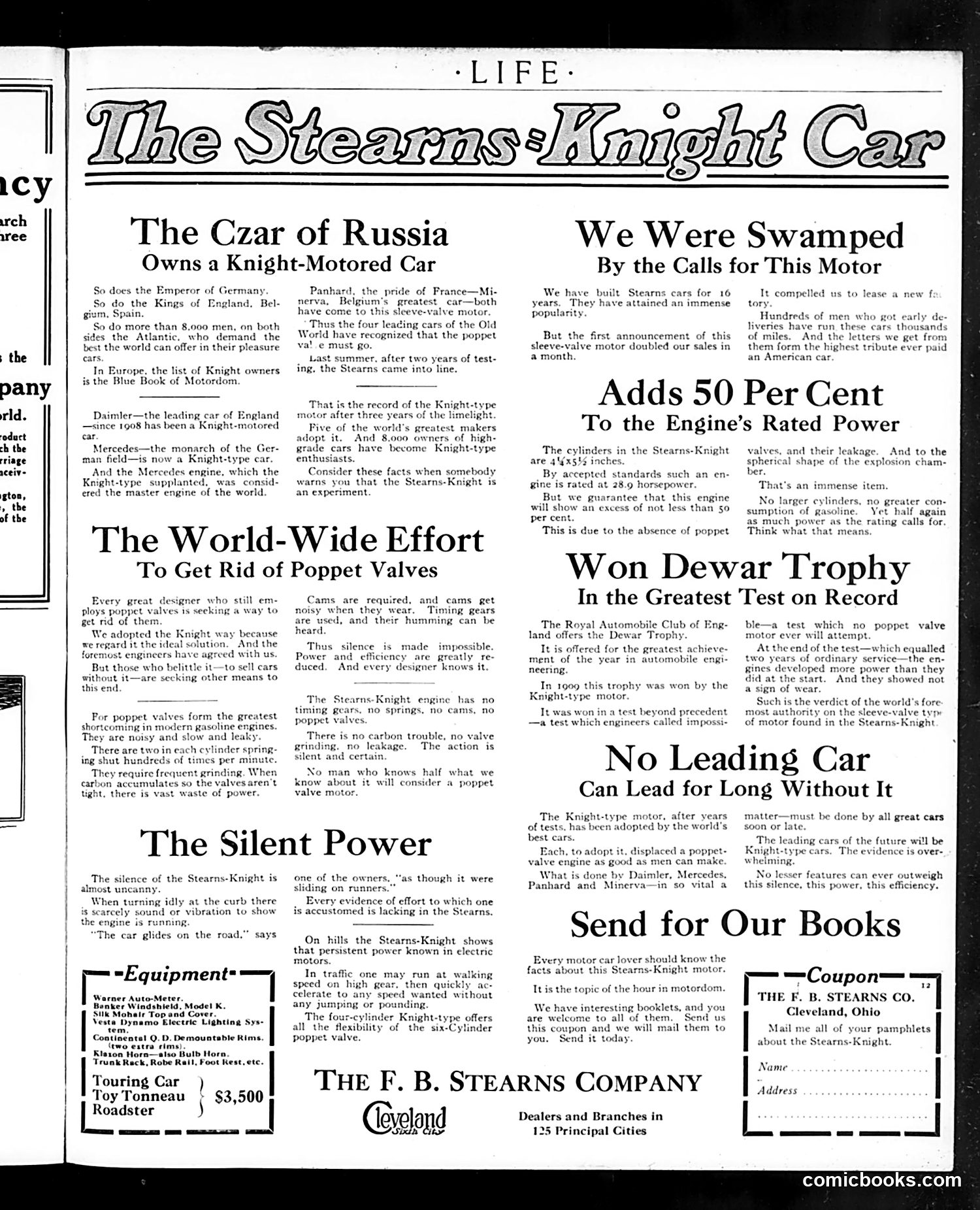
This page is primarily **advertising copy** for the F. B. Stearns Company's Knight-type motor vehicle, not political satire. The opening mentions that the Czar of Russia, the German Emperor, and European royalty own Knight-motored cars—a marketing tactic using prestigious international figures to establish the car's elite status and reliability. The bulk of the content addresses a genuine automotive engineering debate of the era: **poppet valves versus sleeve valves**. The Stearns company championed their "silent" sleeve-valve engine as superior to competitors' noisier, less efficient poppet-valve designs. The advertisements claim 50% more power and reference winning the Royal Automobile Club's Dewar Trophy. This reflects early 20th-century motordom's genuine technical competitions and the engineering pride manufacturers took in mechanical innovation—before standardization made sleeve valves obsolete.
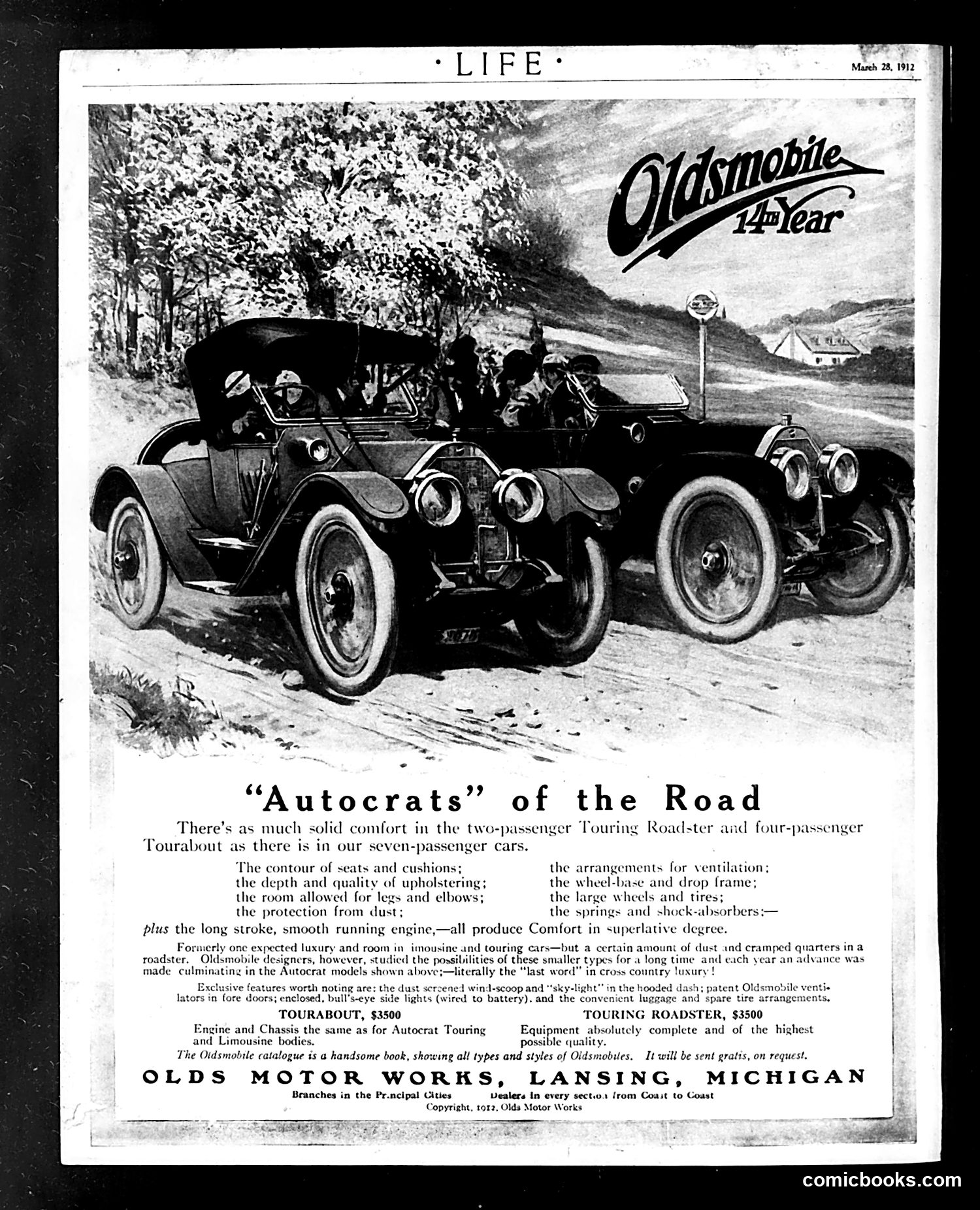
This is primarily **automobile advertising**, not political satire. Oldsmobile uses the term "Autocrats" as a marketing metaphor—the headline plays on the word's dual meaning: both "supreme rulers" and the brand name "Autocrat" for their touring car models. The image shows three early automobiles parked together on a country road, illustrating Oldsmobile's product line. The ad's actual message: smaller, cheaper models (the two-passenger Touring Roadster and four-passenger Tourabout at $3,500) offer the same comfort and luxury features as their larger seven-passenger cars. This was a significant sales pitch in 1912, when automotive comfort was still a novel luxury feature. The "autocrats" joke suggests these vehicles give ordinary drivers the comfort and control ("autocratic" authority) previously available only in expensive limousines—democratizing luxury through engineering innovation.
I can see this is a page from Life magazine (dated 1912 based on the visible marking), but the image is almost entirely black or severely degraded, making it impossible to discern any cartoon illustrations, text content, or satirical details. Only the left margin shows some faint lighter areas suggesting there may have been printed content, and the watermark "comicbooks.com" is visible in the lower right corner. Without being able to see the actual cartoon(s), figures, or readable text on the page itself, I cannot accurately identify the subjects, references, or satirical points the cartoonist intended. The page would need to be rescanned or a clearer image provided to analyze its historical and political context.
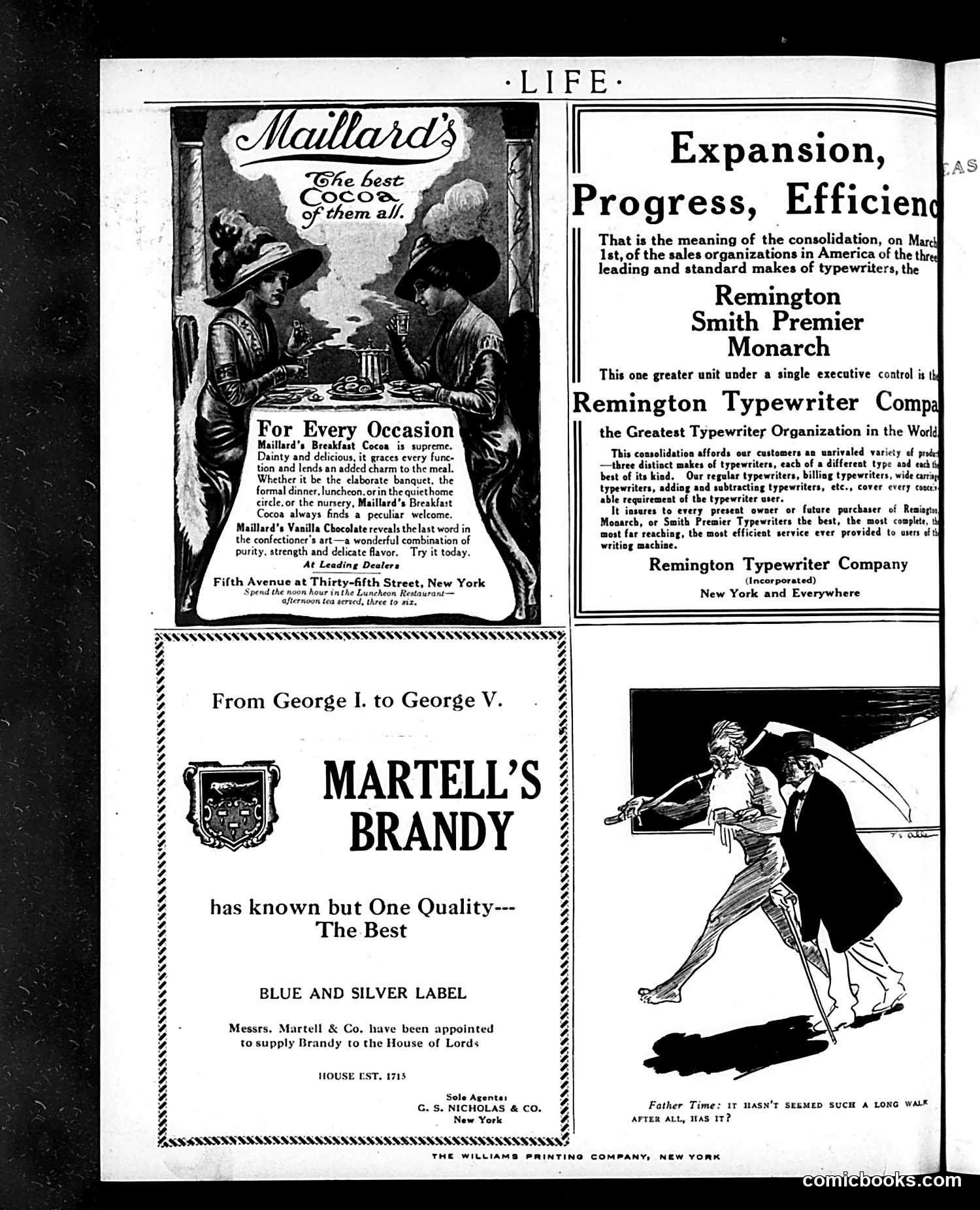
This is primarily an **advertising page** from Life magazine, not a political cartoon. The page contains four distinct ads: 1. **Maillard's Cocoa** - shows two elegantly dressed women dining, emphasizing the product's versatility "for every occasion" 2. **Remington Typewriter consolidation** - announces a March 1st merger of three major typewriter manufacturers (Remington, Smith Premier, Monarch) into a single company, touted as "the Greatest Typewriter Organization in the World" 3. **Martell's Brandy** - emphasizes its royal pedigree, claiming continuous quality since 1715 and appointment as the official brandy supplier to the British House of Lords 4. **Small cartoon** (bottom right) - depicts Father Time with a young woman, with Father Time remarking the walk "hasn't seemed such a long walk after all, has it?" — likely a flirtation joke playing on time passing pleasantly. The page reflects early 20th-century consumer culture and corporate consolidation trends.