
Life, 1912-03-28 · page 23 of 50
Life — March 28, 1912 — page 23: what you’re looking at
What you’re looking at
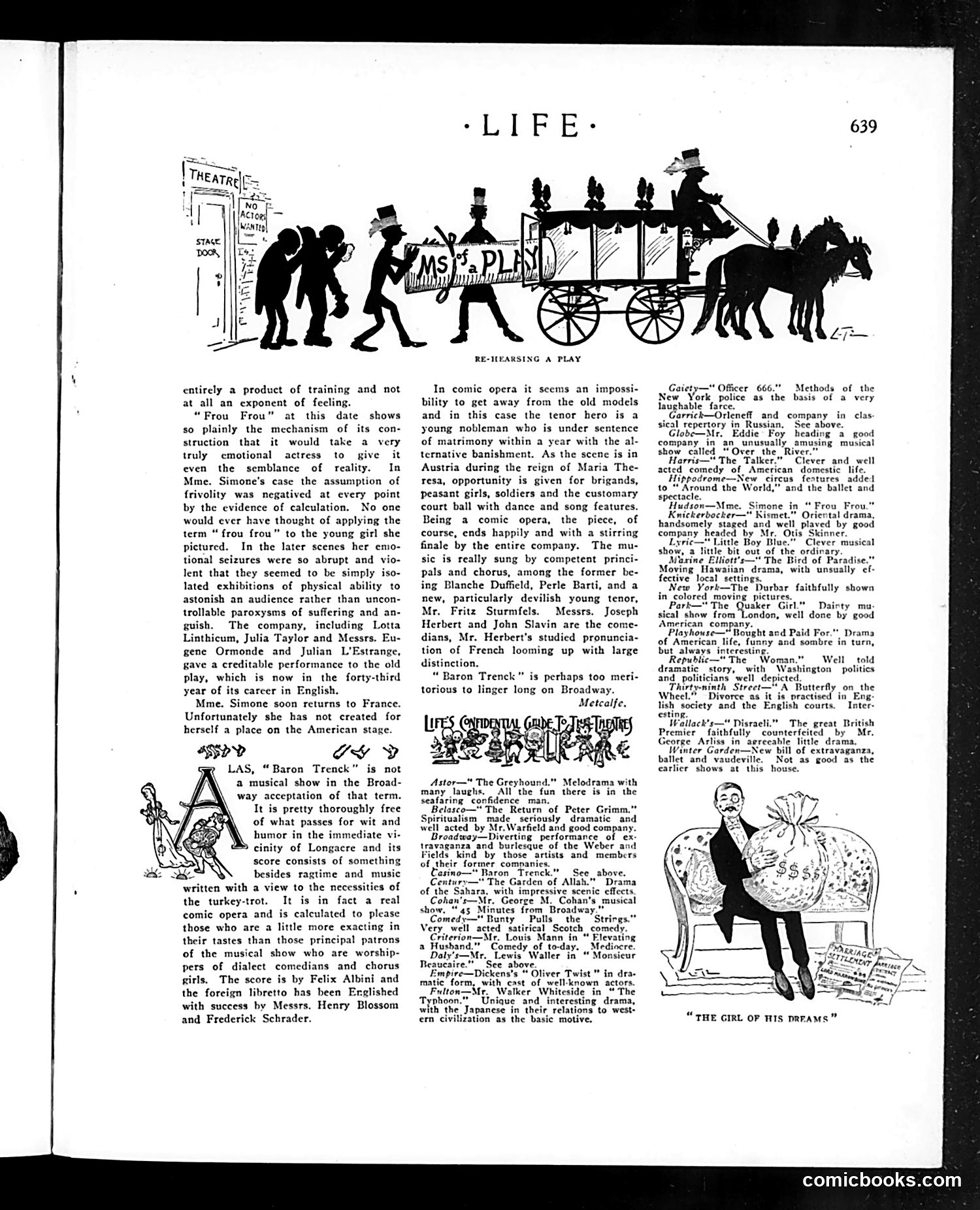
This page from *Life* magazine contains theater reviews and satirical commentary on Broadway productions circa 1910s. The top cartoon titled "RE-HEARSING A PLAY" depicts a chaotic theatrical rehearsal—actors in top hats and formal dress tumble awkwardly around a horse-drawn wagon labeled "PLAY," with a theater door visible on the left. The satire mocks the mechanical, unpolished nature of theatrical productions and the physical comedy involved in stage work. The text reviews several shows, notably criticizing "Frou Frou" (performed by Mme. Simone) as overly calculated and emotionally hollow—the actress's performance relies too heavily on technical skill rather than genuine feeling. The review of "Baron Trenck," a comic opera, praises it as more sophisticated than typical Broadway fare, suggesting the critic believes genuine artistic merit may prevent its commercial success on Broadway. The bottom right cartoon titled "THE GIRL OF HIS DREAMS" (partially visible) appears to satirize romantic theatrical tropes. The page primarily offers theatrical criticism lampooning both performers and the commercialized nature of Broadway entertainment.
📄 Transcribed text from this page (OCR, searchable)
Machine-transcribed from the original scan — historical spelling and the odd misread are preserved.
entirely a product of training and not at all an exponent of feeling. Frou Frou” at this date shows so plainly the mechanism of its con- struction that it would take a very truly emotional actress to give it even the semblance of reality. In Mme. Simone’s case the assumption of frivolity was negatived at every point by the evidence of calculation. No one would ever have thought of applying the term “frou frou” to the young girl she pictured. In the later scenes her emio- tional seizures were so abrupt and vio- lent that they seemed to be simply iso- lated exhibitions of physical ability to astonish an audience rather than uncon- trollable paroxysms of suffering and an- guish. The company, including Lotta Linthicum, Julia Taylor and Messrs. Eu- gene Ormonde and Julian L’Estrange, gave a creditable performance to the old play, which is now in the forty-third year of its carcer in English, Mme. Simone soon returns to France. Unfortunately she has not created for herself a place on the American stage. Sov Gy v LAS, “Baron Trenck” is not a musical show in the Broad- way acceptation of that term. It is pretty thoroughly free of what passes for wit and humor in the immediate v as cinity of Longacre and its score consists of something besides ragtime and music written with a view to the necessities of the turkey-trot. It is in fact a real comic opera and is calculated to please those who are a little more exacting in their tastes than those principal patrons of the musical show who are worship- pers of dialect comedians and chorus girls, The score is by Felix Albini and the foreign libretto has been Erglished with success by Messrs. Henry Blossom and Frederick Schrader. RE-HEARSING A PLAY In comic opera it seems an impossi- bility to get away from the old models and in this case the tenor hero is a young nobleman who is under sentence of matrimony within a year with the al- ternative banishment. As the scene is in Austria during the reign of Maria The- resa, opportunity is given for brigands, peasant girls, soldiers and the customary court ball with dance and song features. Being a comic opera, the piece, of course, ends happily and with a stirring finale by the entire company. The mu- sic is really sung by competent princi- pals and chorus, among the former be- ing Blanche Duffield, Perle Barti, and a new, particularly devilish young tenor, Mr. Fritz Sturmfels. Messrs. Joseph Herbert and John Slavin are the come- dians, Mr. Herbert's studied pronuncia- tion of French looming up with large distinction. “Baron Trenck” is perhaps too meri- torious to linger long on Broadway. Metcalfe, Astor— The Greyhound.” Melodrama with many laughs. All the fun there is in the seafaring confidence man. Belasco—* The Return of Peter Grimm.” Spiritualism made seriously dramatic and well acted by Mr.Warfield and good company. Broadway—Diverting performance of ex- travaganza and burlesque of the Weber and Fields kind by those artists and members of their former companies. ‘asino—" Baron Trenck.” See, above. Century—" The Garden of Allah.” Drama of the Sahara, with impressive scenic effects. Cohan’s—Mr. George M. Cohan’s musical show. “45 Minutes from Broadway.” Comedy—" Bunty Pulls the Strings.” Very. well acted satirical Scotch comedy. Criterion —Me. Louis Mann in “ Elevating a Husband.” Comedy of to-day. | Mediocre. Daly's—Mr._Lewis Waller in’ “ Monsieur Reaueaire."” ‘See above. Empire—Dickens's “ Oliver Twist matic form, with cast of well-known Fulton—Me. Walker Whiteside in Typhoon.” Unique and interesting drama, with the Japanese in their relations to west ern civilization as the basic motive. in dra- Gaiety—" Officer 666." Methods of the New York police as the basis of a very laughable farce. _Garrick—Orleneff_ and company in clas sical repertory in Russian, See above. Globe—Mr. Eddie Foy heading a good company in an unusually amusing musical show called “Over the, River.” Horris—" The Talker.” Clever and well acted comedy of American domestic life. Hippodrome—New circus features added to “Around the World,” and the ballet and spectacle. Hudson—Mme. Simone in Frou Knickerbocker—" Kismet.” Ori handsomely staged and well pla company headed by Mr. Otis Si Lyric—" Little Boy Blue.” Clever musical show, a little bit out of the ordinary. Muxine Elliott’s—" The Bird of Paradise. Moving Hawaiian drama, with unsually ef- fective local settings. New York—The Durbar £ in colored moving pictures Park—"The Quaker Girl” Dainty mu sical show from London, well done by good American company. Playhouse—" Bought acd Paid For.”” Drama of American life, funny and sombre in turn, but always interesting. Republic—" The Woman.” — Well told dramatic story, with Washington politics and politicians ‘well depicted. Thirtwninth Street—" A Butterfly on the Wheel.” Divorce as it is practised in Eng- lish society and the English courts. Inter- esting. Wailack's— Disraeli.” The great British Premier faithfully counterfeited by Mr. George Arliss in agreeable little drama, Winter Garden—New bill of extravaganza, ballet and vaudeville. Not as good as the earlier shows at this house. fully shown comicbooks.com