
Life, 1912-03-28 · page 27 of 50
Life — March 28, 1912 — page 27: what you’re looking at
What you’re looking at
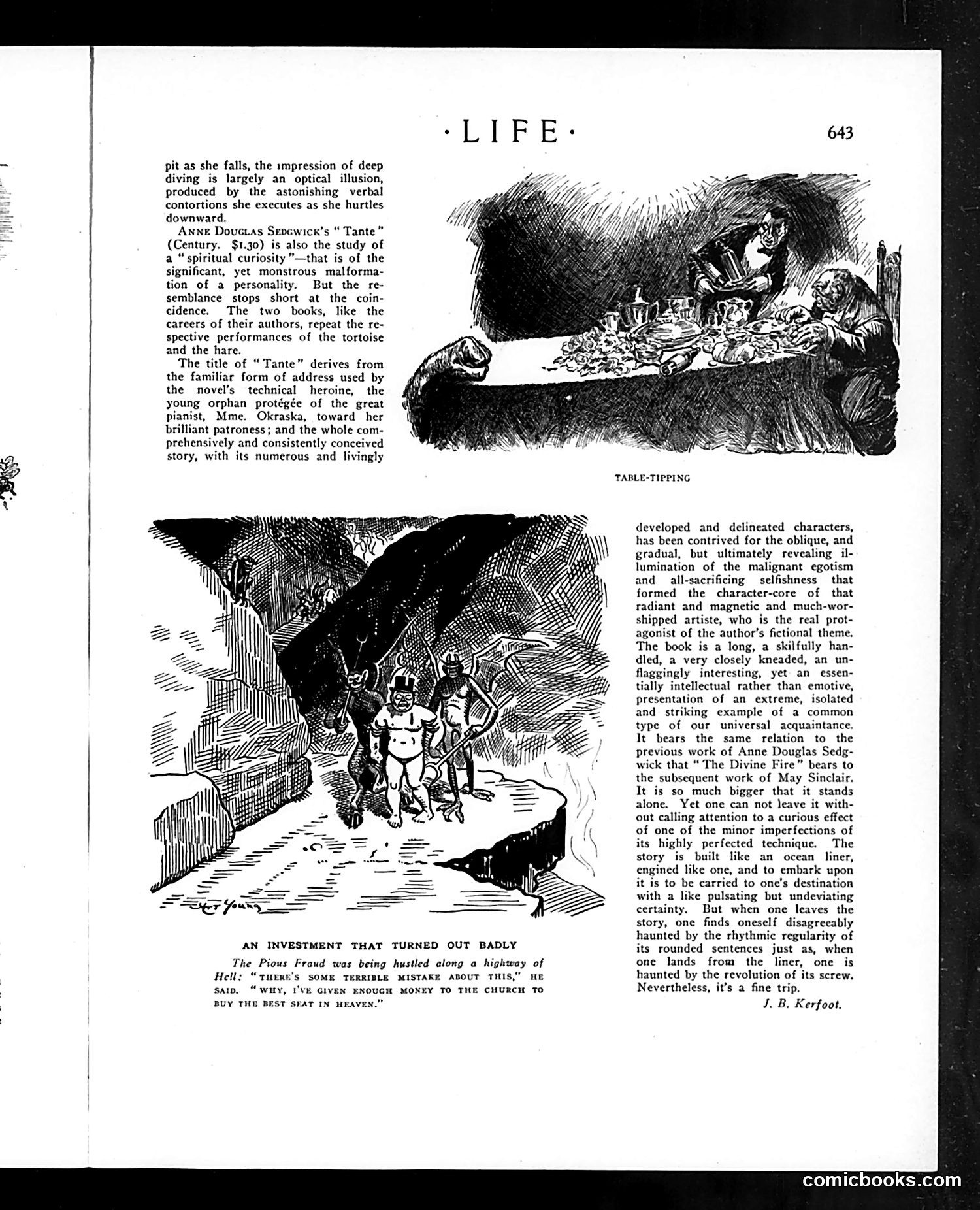
This page contains two cartoon-and-caption pairs satirizing human folly and misplaced priorities. **"Table-Tipping"** (top): The illustration shows a séance or spiritualist gathering—a popular parlor activity in early 20th-century America. The satire likely mocks the credulity of people seeking supernatural contact, a widespread phenomenon that Life magazine frequently ridiculed as pseudoscientific nonsense. **"An Investment That Turned Out Badly"** (bottom): A man who donated generously to his church, expecting spiritual reward ("the best seat in heaven"), discovers his money was misused—the image suggests clergy or church officials squandering donations. The satire targets both naive donors and corrupt religious institutions, criticizing misplaced faith in organized religion's integrity. Both cartoons mock gullibility: one toward spiritualism, one toward institutional religion. The page also contains a lengthy book review by J.B. Kerfoot of Anne Douglas Sedgwick's novel "Tante."
📄 Transcribed text from this page (OCR, searchable)
Machine-transcribed from the original scan — historical spelling and the odd misread are preserved.
pit as she falls, the impression of deep diving is largely an optical illusion, produced by the astonishing verbal contortions she executes as she hurtles downward. Anne Douctas Sevewick’s “ Tante” (Century. $1.30) is also the study of a “spiritual curiosity "—that is of the significant, yet monstrous malforma- tion of a personality. But the re- semblance stops short at the coin- cidence. The two books, like the careers of their authors, repeat the re- spective performances of the tortoise and the hare. The title of “Tante” derives from the familiar form of address used by the novel's technical heroine, the young orphan protégée of the great pianist, Mme. Okraska, toward her brilliant patroness ; and the whole com- prehensively and consistently conceived story, with its numerous and livingly | TABLE-TIPPING developed and delineated characters, has been contrived for the oblique, and gradual, but ultimately revealing il- lumination of the malignant egotism and all-sacrificing selfishness that formed the character-core of that radiant and magnetic and much-wor- shipped artiste, who is the real prot- agonist of the author’s fictional theme. The book is a long, a skilfully han- dled, a very closely kneaded, an un- flaggingly interesting, yet an essen- tially intellectual rather than emotive, presentation of an extreme, isolated and striking example of a common type of our universal acquaintance. It bears the same relation to the previous work of Anne Douglas Sedg- wick that “ The Divine Fire” bears to the subsequent work of May Sinclair. It is so much bigger that it stands alone. Yet one can not leave it with- out calling attention to a curious effect of one of the minor imperfections of its highly perfected technique. The story is built like an ocean liner, engined like one, and to embark upon it is to be carried to one’s destination with a like pulsating but undeviating certainty. But when one leaves the story, one finds oneself disagreeably haunted by the rhythmic regularity of AN INVESTMENT THAT TURNED OUT BADLY its rounded sentences just as, when The Pious Fraud was being hustled along a highway of one lands from the liner, one is SOME TERRIBLE MISTAKE ABOUT TIS,” HE haunted by the revolution of its screw. SAID, “WHY, I'VE GIVEN ENOUGH MONEY TO THE CHURCH TO Nevertheless, it’s a fine trip. BUY THE BEST SHAT IN HEAVE! J. B. Kerfoot. comicbooks.com