
Life, 1912-03-28 · page 26 of 50
Life — March 28, 1912 — page 26: what you’re looking at
What you’re looking at
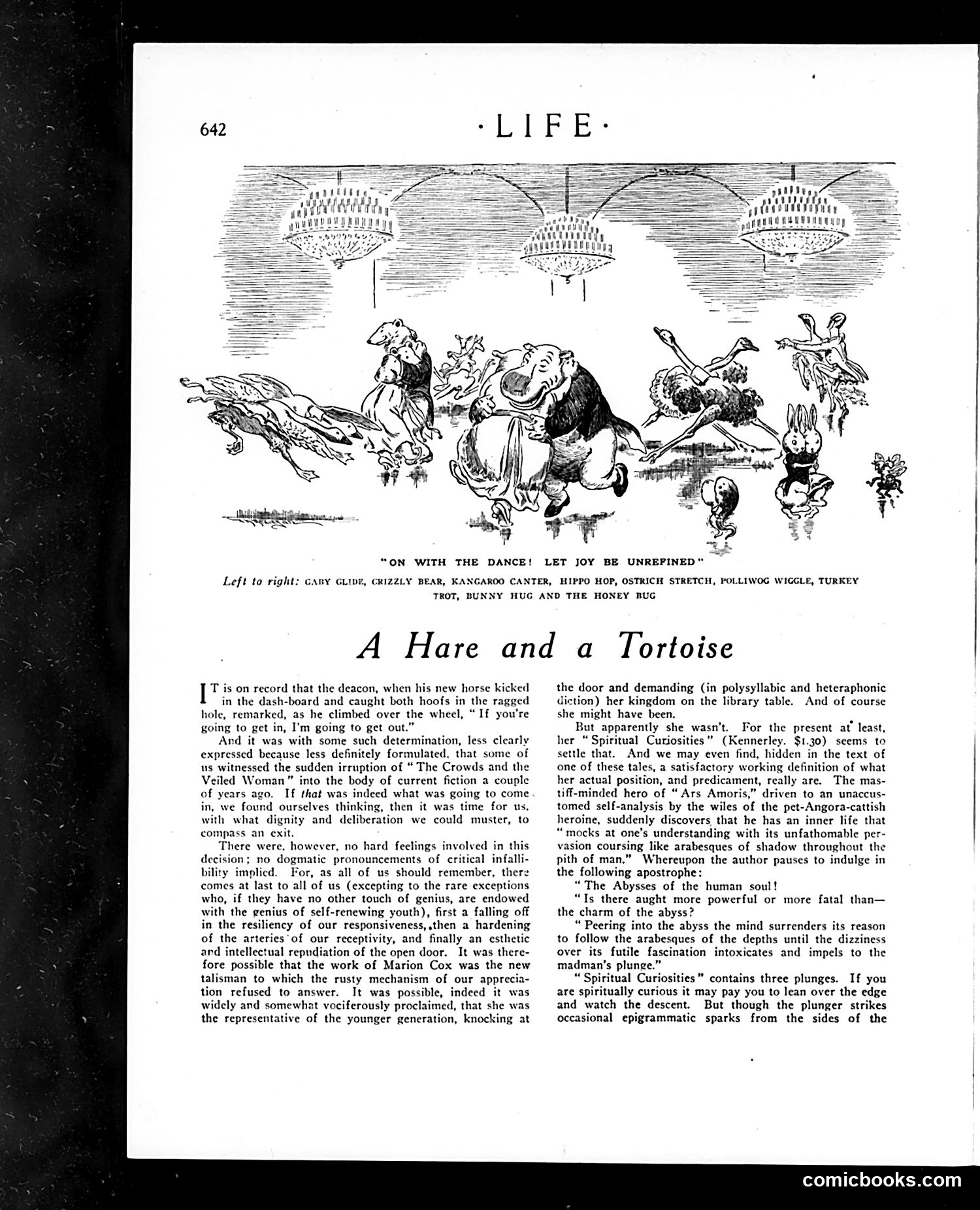
This page contains two distinct elements: **Top Illustration:** A satirical cartoon mocking popular dance crazes of the early 1900s. The caption lists fashionable dances—Turkey Trot, Bunny Hug, Kangaroo Canter, etc.—depicted as animals performing ridiculous movements. This ridicules the widespread social obsession with these new, energetic dances that scandalized conservative society. The quote "On with the dance! Let joy be unrefined" mockingly celebrates their uninhibited nature. **Main Article:** A book review of Marion Cox's *Spiritual Curiosities*. The critic dismisses Cox as a "representative of the younger generation" whose work failed to impress. The review sarcastically suggests her pretentious prose—about "abysses of the human soul" and "arabesques of shadow"—amounts to overwrought melodrama. The opening anecdote about a deacon leaving a situation signals the critic's own exit from taking her seriously. The satire targets both contemporary dance culture and pretentious modernist literary trends simultaneously.
📄 Transcribed text from this page (OCR, searchable)
Machine-transcribed from the original scan — historical spelling and the odd misread are preserved.
“ON WITH THE DANCE! LET JOY BE UNREFINED" Left to right: GAny Give, GRIZZLY BEAR, KANGAROO CANTER, HIPPO HOP, OSTRICH STRETCH, POLLIWOG WIGGLE, TURKEY TROT, BUNNY HUG AND THE HONEY BUG A Hare and a Tortoise T is on record that the deacon, when his new horse kicked in the dash-board and caught both hoofs in the ragged hole, remarked, as he climbed over the wheel, “If you're going to get in, I'm going to get out.” And it was with some such determination, less clearly expressed because less definitely formulated, that some of us witnessed the sudden irruption of “ The Crowds and the Veiled Woman” into the body of current fiction a couple of years ago. If that was indeed what was going to come in, we found ourselves thinking, then it was time for us, with what dignity and deliberation we could muster, to compass an exit. There were, however, no hard feelings involved in this decision; no dogmatic pronouncements of critical infalli- bility implied. For, as all of us should remember, there comes at last to all of us (excepting to the rare exceptions who, if they have no other touch of genius, are endowed with the genius of self-renewing youth), first a falling off in the resiliency of our responsiveness, ,then a hardening of the arteries’of our receptivity, and finally an esthetic and intellectual repudiation of the open door. It was there- fore possible that the work of Marion Cox was the new talisman to which the rusty mechanism of our apprecia- tion refused to answer. It was possible, indeed it was widely and somewhat vociferously proclaimed, that she was the representative of the younger generation, knocking at the door and demanding (in polysyllabic and heteraphonic diction) her kingdom on the library table. And of course she might have been. But apparently she wasn’t. For the present at’ least, her “Spiritual Curiosities” (Kennerley. $1.30) seems to settle that. And we may even find, hidden in the text of one of these tales, a satisfactory working definition of what her actual position, and predicament, really are. The mas- tiff-minded hero of “Ars Amoris,” driven to an unaccus- tomed self-analysis by the wiles of the pet-Angora-cattish heroine, suddenly discovers that he has an inner life that “mocks at one’s understanding with its unfathomable per- vasion coursing like arabesques of shadow throughout the pith of man.” Whereupon the author pauses to indulge in the following apostrophe: “The Abysses of the human soul! “Ts there aught more powerful or more fatal than— the charm of the abyss? “Peering into the abyss the mind surrenders its reason to follow the arabesques of the depths until the dizziness over its futile fascination intoxicates and impels to the madman’s plunge.” “Spiritual Curiosities” contains three plunges. If you are spiritually curious it may pay you to lean over the edge and watch the descent. But though the plunger strikes occasional epigrammatic sparks from the sides of the comicbooks.com