
Life, 1912-03-28 · page 12 of 50
Life — March 28, 1912 — page 12: what you’re looking at
What you’re looking at
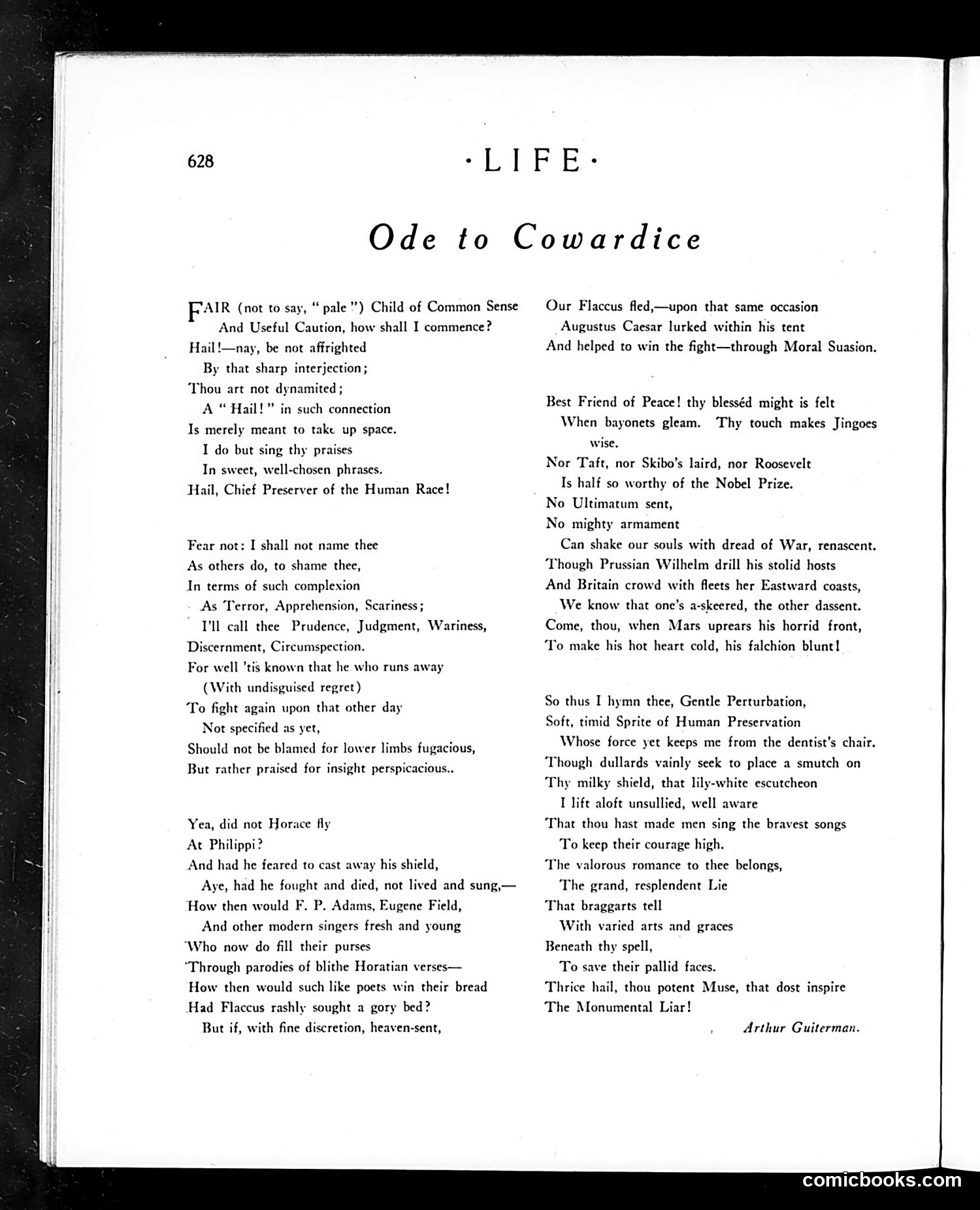
This page contains "Ode to Cowardice" by Arthur Guiterman, a satirical poem attacking pacifism and anti-war sentiment during what appears to be the World War I era. The poem mocks peace advocates by addressing "Cowardice" directly, sarcastically praising figures like Flaccus (a historical Roman), Augustus Caesar, and references to modern figures including Roosevelt, Taft, and Skibo's laird (likely Andrew Carnegie). The satire targets pacifists by suggesting that those advocating peace are cowardly rather than principled. It specifically ridicules modern "singers" and "poets" who write pacifist verses (referencing Horatian poetry), implying their anti-war positions are cowardly and self-serving rather than genuinely moral. The poem defends military courage and sacrifice as superior values.
📄 Transcribed text from this page (OCR, searchable)
Machine-transcribed from the original scan — historical spelling and the odd misread are preserved.
*LIPE - Ode to Cowardice AIR (not to say, “ pale”) Child of Common Sense And Useful Caution, how shall I commence? Hail!—nay, be not affrighted By that sharp interjection; ‘Thou art not dynamited ; A “Hail!” in such connection Is merely meant to take up space. I do but sing thy praises In sweet, well-chosen phrases. Hail, Chief Preserver of the Human Race! Fear not: I shall not name thee As others do, to shame thee, In terms of such complexion As Terror, Apprehension, Scariness; I'll call thee Prudence, Judgment, Wariness, Discernment, Circumspection. For well ’tis known that he who runs away (With undisguised regret) To fight again upon that other day Not specified as yet, Should not be blamed for lower limbs fugacious, But rather praised for insight perspicacious.. Yea, did not Horace fly At Philippi? And had he feared to cast away his shield, Aye, had he fought and died, not lived and sung,— How then would F. P. Adams, Eugene Field, And other modern singers fresh and young “Who now do fill their purses ‘Through parodies of blithe Horatian verses— How then would such like poets win their bread Had Flaccus rashly sought a gory bed? But if, with fine discretion, heaven-sent, Our Flaccus fled,—upon that same occasion Augustus Caesar lurked within his tent And helped to win the fight—through Moral Suasion. Best Friend of Peace! thy blesséd might is felt When bayonets gleam. Thy touch makes Jingoes wise. Nor Taft, nor Skibo’s laird, nor Roosevelt Is half so worthy of the Nobel Prize. No Ultimatum sent, No mighty armament Can shake our souls with dread of War, renascent. ‘Though Prussian Wilhelm drill his stolid hosts And Britain crowd with fleets her Eastward coasts, We know that one’s a-skeered, the other dassent. Come, thou, when Mars uprears his horrid front, ‘To make his hot heart cold, his falchion blunt! So thus I hymn thee, Gentle Perturbation, Soft, timid Sprite of Human Preservation Whose force yet keeps me from the dentist’s chair. ‘Though dullards vainly seek to place a smutch on Thy milky shield, that lily-white escutcheon lift aloft unsullied, well aware ‘That thou hast made men sing the bravest songs To keep their courage high. The valorous romance to thee belongs, The grand, resplendent Lie That braggarts tell With varied arts and graces Beneath thy spell, To save their pallid faces. Thrice hail, thou potent Muse, that dost inspire The Monumental Liar! Arthur Guiterman. comicbooks.com