
Life, 1912-03-28 · page 22 of 50
Life — March 28, 1912 — page 22: what you’re looking at
What you’re looking at
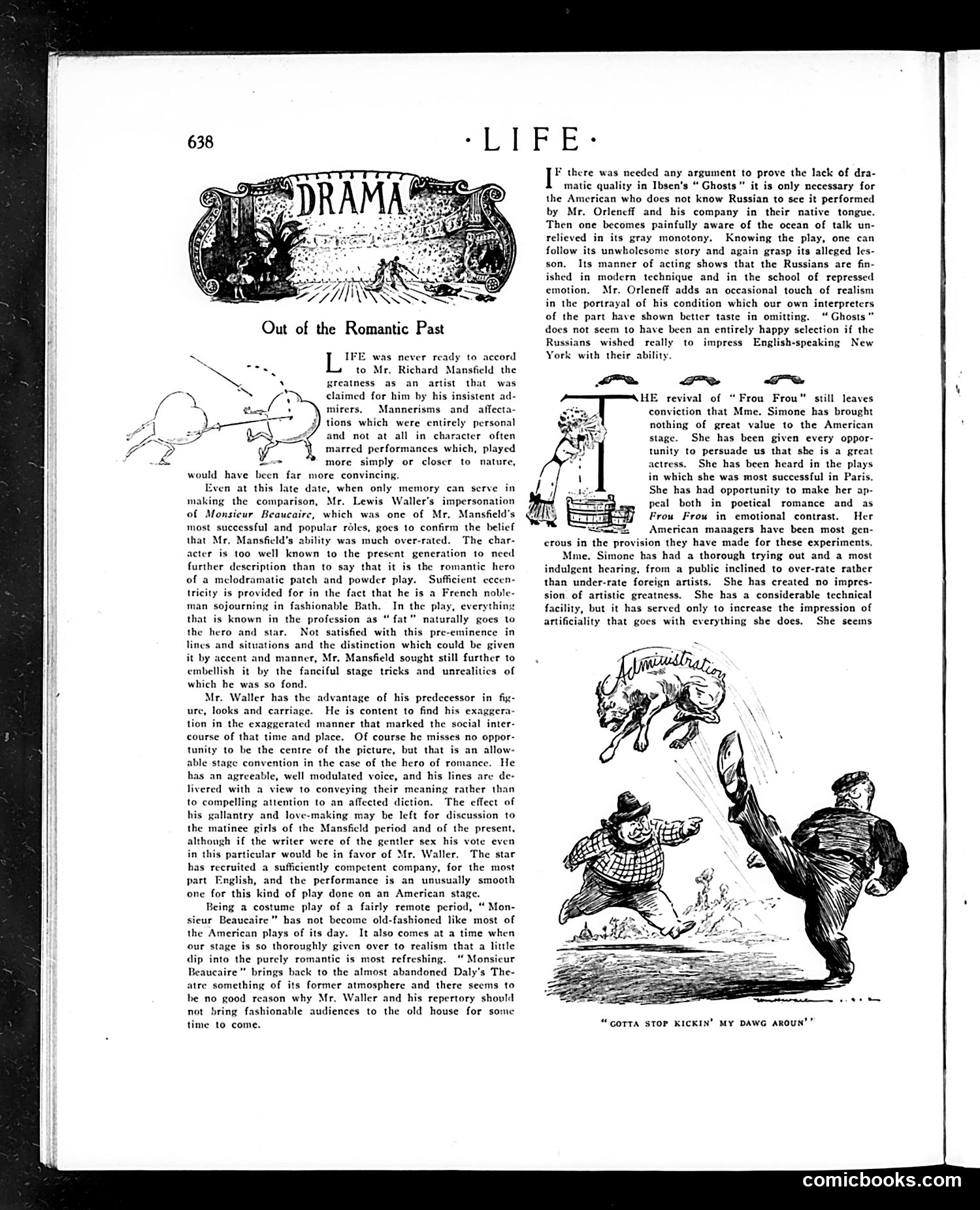
This page critiques theatrical performances of the era. The main content discusses: **"Out of the Romantic Past"**: A review comparing actor Richard Mansfield's interpretation of *Monsieur Beaucaire* (a romantic melodrama) unfavorably to Lewis Waller's version. The critic argues Mansfield over-acted with excessive "stage tricks," while Waller's more restrained approach better serves the character. **Russian Company Performance**: A negative review of Mr. Orleneff's Russian company performing Ibsen's *Ghosts* in their native language, finding it tedious and emotionally repressed compared to American interpretations. **Mme. Simone's Revival of "Frou Frou"**: The critic dismisses French actress Simone as technically competent but artificially cold, unable to move American audiences despite optimal theatrical conditions. The **cartoon below** (captioned "Gotta Stop Kickin' My Dawg About") shows comedic vignettes of slapstick violence—unrelated to the drama reviews above. The page represents early 20th-century theatrical criticism emphasizing naturalism over melodramatic excess.
📄 Transcribed text from this page (OCR, searchable)
Machine-transcribed from the original scan — historical spelling and the odd misread are preserved.
"ELT PE : F there was needed any argument to prove the lack of dra- matic quality in Ibsen's “ Ghosts” it is only necessary for the American who does not know Russian to sce it performed by Mr. Orleneff and his company in their native tongue. Then one becomes painfully aware of the ocean of talk un- relieved in its gray monotony. Knowing the play, one can follow its unwholesome story and again grasp its alleged les- son. Its manner of acting shows that the Russians are fin- ished in modern technique and in the school of repressed emotion. Mr. Orleneff adds an occasional touch of realism in the portrayal of his condition which our own interpreters of the part have shown better taste in omitting. “Ghosts” Out of the Romantic Past does not seem to have been an entirely happy selection if the Russians wished really to impress English-speaking New L! E was never ready to accord York with their ability. to Mr. Richard Mansfield the greatness as an artist that was ro Fw id claimed for him by his insistent ad- HE revival of “Frou Frou” still leaves mirers. Mannerisms and affecta- y conviction that Mme. Simone has brought tions which were entirely personal nothing of great value to the American and not at all in character often se stage: She has beew given every ‘oppor- marred performances which, played é tunity to persuade us that she is a great more simply or closer to nature, . actress. She has been heard in the plays would have been far more convincing. in which she was most successful in Paris. cn at this late date, when only memory can serve in agi She has had opportunity to make her ap- making the comparison, Mr. Lewis Waller's impersonation z peal both in poetical romance and as of Monsieur Beaucairc, which was one of Mr. Mansfield’s 3 5 Frou Frou: in ‘emotional contrast. Her most successful and popular rdles, goes to confirm the belief American managers have been most gen- that Mr, Mansfield’s ability was much over-rated. The char- fous in the provision they have made for these experiments. acter is too well known to the present generation 10 need Mme. Simone has had a thorough trying out and a most further description than to say that it is the romantic hero indulgent hearing, from a public inclined to over-rate rather of a melodramatic patch and powder play. Sufficient eccen- than under-rate foreign artists, She has created no impres- y is provided for in the fact that he is a French nob sion of artistic greatness. She has a considerable technical n sojourning in fashionable Bath. In the play, everything facility, but it has served only to increase the impression of that is known in the profession as “fat” naturally goes to artificiality that gocs with everything she does. She seems the hero and star, Not satisfied with this pre-eminence in lines and situations and the distinction which could be given it by accent and manner, Mr. Mansfield sought still further to embellish it by the fanciful stage tricks and unrealitics of which he was so fond. Mr. Waller has the advantage of his predecessor in fix- ure, looks and carriage. He is content to find his exaggera- tion in the exaggerated manner that marked the social inter- course of that time and place. Of course he misses no oppor- tunity to be the centre of the picture, but that is an allow- able stage convention in the case of the hero of romance. He has an agreeable, well modulated voice, and his lines are de- livered with a view to conveying their meaning rather than to compelling attention to an affected diction. The effect of his gallantry and love-making may be left for discussion to the matinee girls of the Mansficld period and of the present, although if the writer were of the gentler sex his vote even in this particular would be in favor of Mr. Waller. The star has recruited a sufficiently competent company, for the most part English, and the performance is an unusually smooth one for this kind of play done on an American stage. Being a costume play of a fairly remote period, “ Mon- sicur Beaucaire” bas not become old-fashioned like most of the American plays of its day. It also comes at a time when our stage is so thoroughly given over to realism that a little dip into the purcly romantic is most refreshing. “ Monsieur Beaucaire” brings back to the almost abandoned Daly's The- atre something of its former atmosphere and there seems to be no good reason why Mr. Waller and his repertory should 4 oor Eo not bring fashionable audiences to the old house for some time to come. “GOTTA STOP KICKIN’ MY DAWG AROUN’’ comicbooks.com