
Life, 1912-03-28 · page 10 of 50
Life — March 28, 1912 — page 10: what you’re looking at
What you’re looking at
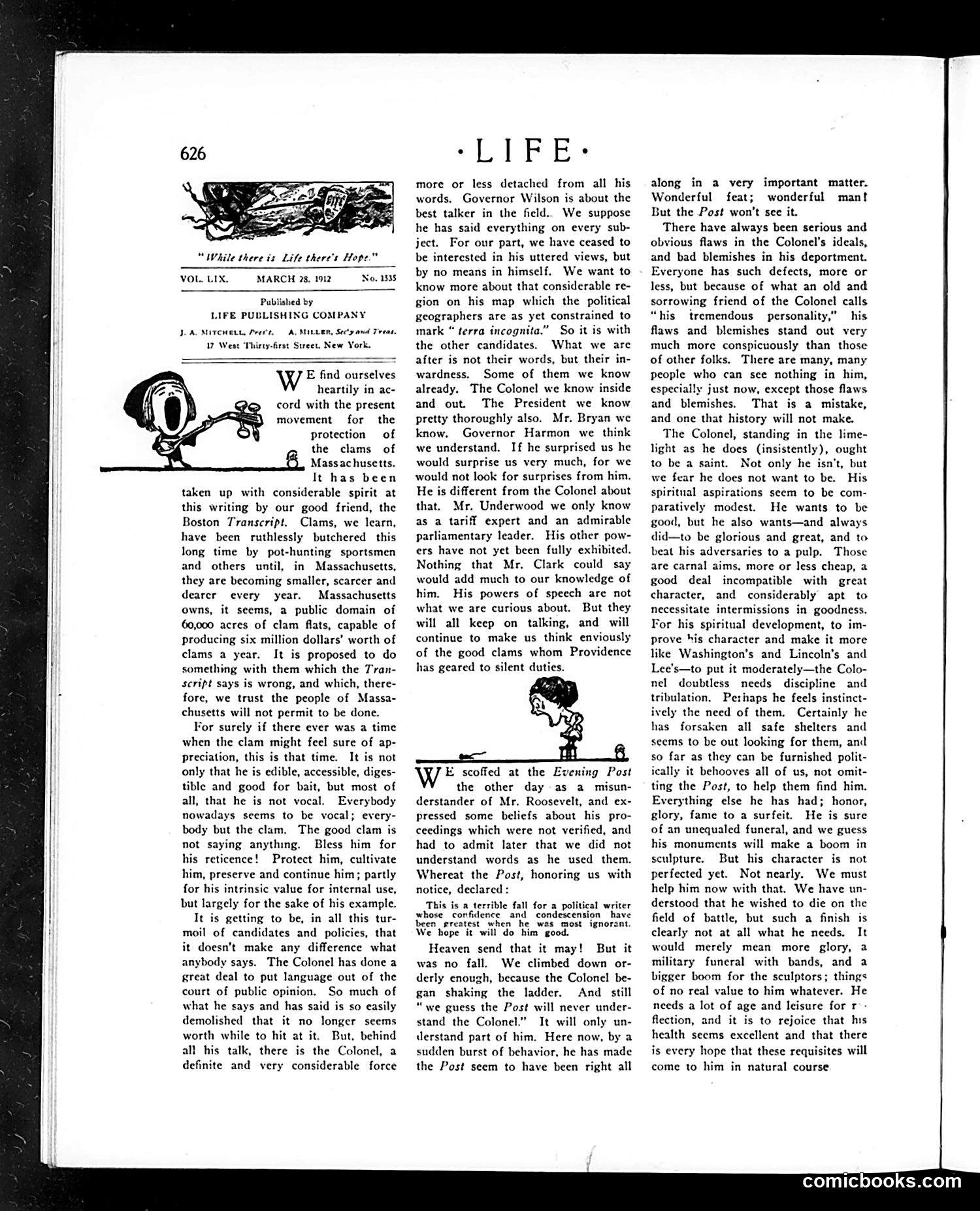
This page contains editorial commentary on the 1912 presidential campaign, specifically critiquing candidates' public personas versus private character. The text discusses Governor Wilson, President [Taft], Mr. Bryan, Governor Harmon, Mr. Underwood, and Mr. Clark—all figures in the 1912 race. The main argument: the magazine values character and spiritual integrity over rhetoric. They praise the Colonel (likely Roosevelt) for his "considerable force" and "definite" personality, despite his flaws. The piece criticizes a political writer's misrepresentation in the *Evening Post*, suggesting politicians' words often obscure truth. The cartoon appears to show a small figure observing larger political figures—likely satirizing how candidates present themselves versus reality. The overall tone is moralistic, emphasizing that voters should judge candidates by deed and character, not eloquent words.
📄 Transcribed text from this page (OCR, searchable)
Machine-transcribed from the original scan — historical spelling and the odd misread are preserved.
“While there is Life there's Hope.” VOL. LIX. MARCH 28, 1912 No. 1535 Published by LIFE PUBLISHING COMPANY A. MILLER, See’y and Treas, JA. MuTOweLL, Prere, V7 West ‘Thirty-first Street, New York. E find ourselves heartily in ac- cord with the present movement for the protection of the clams of It has been taken up with considerable this writing by our good friend, the Boston Transcript. Clams, we learn, have been ruthlessly butchered this long time by pot-hunting sportsmen and others until, in Massachusetts, they are becoming smaller, scarcer and dearer every year. Massachusetts owns, it seems, a public domain of 60,000 acres of clam flats, capable of producing six million dollars’ worth of clams a year. It is proposed to do something with them which the Tran- script says is wrong, and which, there- fore, we trust the people of Massa- chusetts will not permit to be done. For surely if there ever was a time when the clam might feel sure of ap- preciation, this is that time. It is not only that he is edible, accessible, diges- tible and good for bait, but most of all, that he is not vocal. Everybody nowadays seems to be vocal; every- body but the clam. The good clam is not saying anything. Bless him for his reticence! Protect him, cultivate him, preserve and continue him; partly for his intrinsic value for internal use, but largely for the sake of his example. It is getting to be, in all this tur- moil of candidates and policies, that it doesn’t make any difference what anybody says. The Colonel has done a great deal to put language out of the court of public opinion. So much of what he says and has said is so easily demolished that it no longer seems worth while to hit at it. But, behind all his talk, there is the Colonel, a definite and very considerable force =LIPE: more or less detached from all his words. Governor Wilson is about the best talker in the field. We suppose he has said everything on every sub- ject. For our part, we have ceased to be interested in his uttered views, but by no means in himself. We want to know more about that considerable re- gion on his map which the political geographers are as yet constrained to mark “ terra incognita.” So it is with the other candidates. What we are after is not their words, but their wardness. Some of them we know already. The Colonel we know inside and out. The President we know pretty thoroughly also. Mr. Bryan we know. Governor Harmon we think we understand. If he surprised us he would surprise us very much, for we would not look for surprises from him. He is different from the Colonel about that. Mr. Underwood we only know as a tariff expert and an admirable parliamentary leader. His other pow- ers have not yet been fully exhibited. Nothing that Mr. Clark could say would add much to our knowledge of him. His powers of speech are not what we are curious about. But they will all keep on talking, and _ will continue to make us think enviously of the good clams whom Providence has geared to silent duties. E scoffed at the Evening Post the other day as a misun- derstander of Mr. Roosevelt, and ex- pressed some beliefs about his pro- ceedings which were not verified, and had to admit later that we did not understand words as he used them. Whereat the Post, honoring us with notice, declared : is a terrible fall for a political writer whose confidence and condescension have been greatest when he was most ignorent We hope it will do him good. Heaven send that it may! But it was no fall. We climbed down or- derly enough, because the Colonel be- gan shaking the ladder. And still “we guess the Post will never under- stand the Colonel.” It will only un- derstand part of him. Here now, by a sudden burst of behavior, he has made the Post seem to have been right all along in a very important matter. Wonderful feat; wonderful mant But the Post won't see it. There have always been serious and obvious flaws in the Colonel’s ideals, and bad blemishes in his deportment. Everyone has such defects, more or less, but because of what an old and sorrowing friend of the Colonel calls “his tremendous personality,” his flaws and blemishes stand out very much more conspicuously than those of other folks. There are many, many people who can see nothing in him, especially just now, except those flaws and blemishes. That is a mistake, and one that history will not make. The Colonel, standing in the lime- light as he does (insistently), ought to be a saint. Not only he isn't, but we fear he does not want to be. His spiritual aspirations seem to be com- paratively modest. He wants to be good, but he also wants—and always did—to be glorious and great, and to beat his adversaries to a pulp. Those are carnal aims, more or less cheap, a good deal incompatible with great character, and considerably apt to necessitate intermissions in goodness. For his spiritual development, to im- prove his character and make it more like Washington’s and Lincoln’s and Lee’s—to put it moderately—the Colo- nel doubtless needs discipline and tribulation. Perhaps he feels instinct- ively the need of them. Certainly he has forsaken all safe shelters and seems to be out looking for them, and so far as they can be furnished polit- ically it behooves all of us, not omit- ting the Post, to help them find him. Everything else he has had; honor, glory, fame to a surfeit. He is sure of an unequaled funeral, and we guess his monuments will make a boom in sculpture. But his character is not perfected yet. Not nearly. We must help him now with that. We have un- derstood that he wished to die on the field of battle, but such a finish is clearly not at all what he needs. It would merely mean more glory, 2 military funeral with bands, and a bigger boom for the sculptors; things of no real value to him whatever. He needs a lot of age and leisure for r - flection, and it is to rejoice that his health seems excellent and that there is every hope that these requisites will come to him in natural course comicbooks.com