
Life, 1912-03-28 · page 16 of 50
Life — March 28, 1912 — page 16: what you’re looking at
What you’re looking at
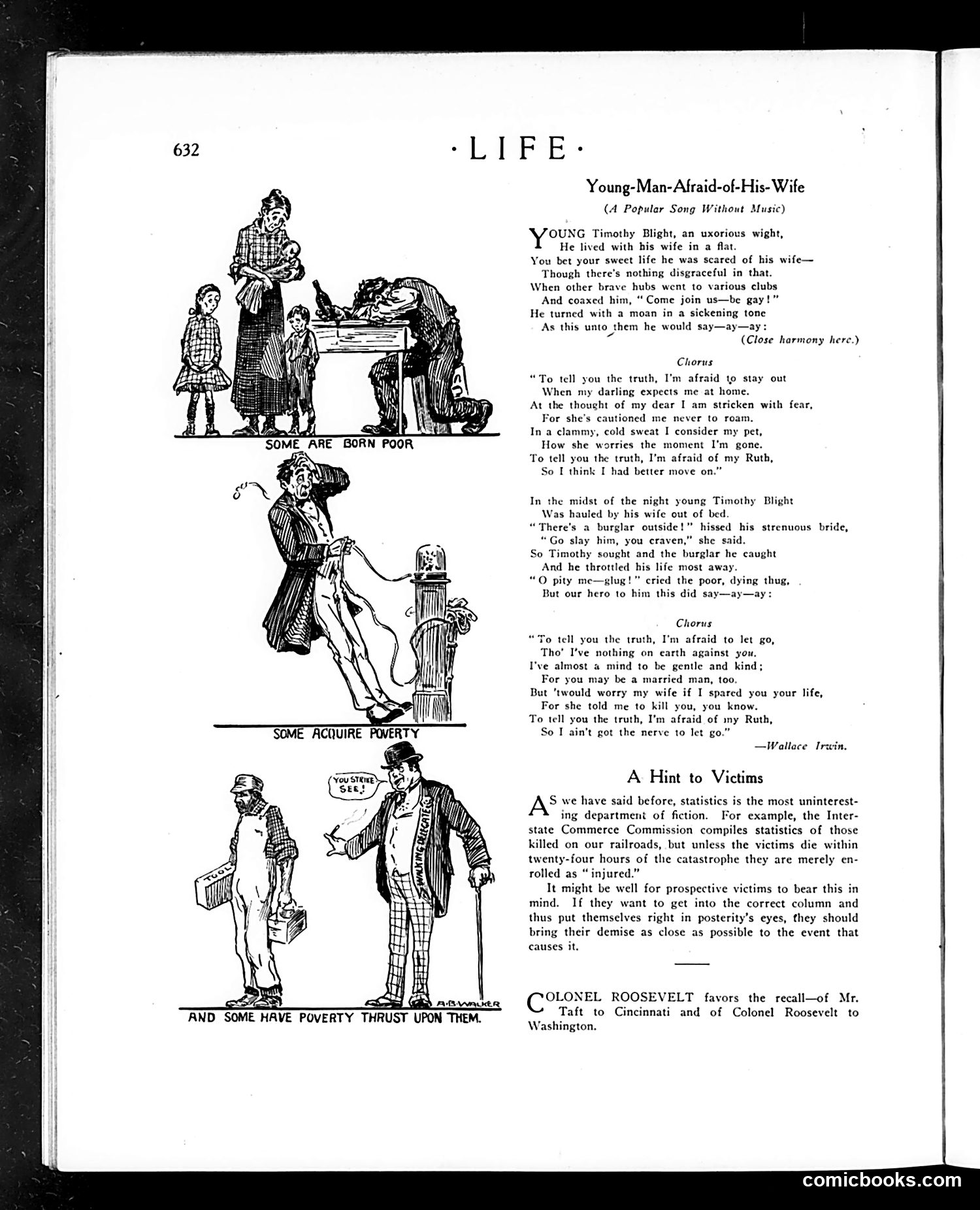
This page satirizes a popular song about marital dynamics through exaggerated gender roles. Timothy Blight is a henpecked husband so terrified of his domineering wife Ruth that he refuses to socialize with other men. The joke escalates absurdly: when Ruth orders him to kill a burglar, he does so—then can't stop because he fears disappointing her more than committing murder. The accompanying illustrations depict poverty and social class struggles ("Some Are Born Poor," "Some Acquire Poverty," "And Some Have Poverty Thrust Upon Them"), contrasting with the middle-class domestic anxiety of the main story. The "Hint to Victims" section mockingly advises accident victims to die *within* 24 hours to be counted as "killed" rather than merely "injured" in Interstate Commerce Commission statistics—satirizing how bureaucratic definitions miss human reality. A brief note favors Theodore Roosevelt's political return, likely from 1912 when he challenged Taft for the presidency.
📄 Transcribed text from this page (OCR, searchable)
Machine-transcribed from the original scan — historical spelling and the odd misread are preserved.
> LE. Young-Man-Afraid-of-His- Wife (A Popular Song Without Music) OUNG Timothy Blight, an uxorious wight, He lived with his wife in a flat. You bet your sweet life he was scared of his wife— Though there's nothing disgraceful in that. When other brave hubs went to various clubs And coaxed him, “Come join us—be gay! He turned with a moan in a sickening tone As this unto them he would say—ay—ay: “ (Close harmony here.) Chorus “To tell you the truth, I'm afraid to stay out When my darling expects me at home. At the thought of my dear I am stricken with fear, For she’s cautioned me never to roam. In a clammy, cold sweat I consider my pet, How she worries the moment I'm gone. To tell you the truth, I'm afraid of my Ruth, So I think I had better move on.” In the midst of the night young Timothy Blight Was hauled by his wife out of bed. here's a burglar outside!” hissed his strenuous bride, “Go slay him, you craven,” she sai So Timothy sought and the burglar he caught And he throttled his life most away. “O pity me—glug!” cried the poor, dying thug, But our hero to him this did say—ay—ay: Chorus “To tell you the truth, I'm afraid to let go, Tho’ I’ve nothing on earth against you. I've almost a mind to be gentle and kind; For you may be a married man, too. But ‘twould worry my wife if I spared you your life, For she told me to kill you, you know. To tell you the truth, I'm afraid of my Ruth, So I ain't got the nerve to let go.” —Wallace Irwin, A Hint to Victims S we have said before, statistics is the most uninterest- ing department of fiction. For example, the Inter- state Commerce Commission compiles statistics of those killed on our railroads, but unless the ims die within twenty-four hours of the catastrophe they are merely en- rolled as “ injured.” It might be well for prospective victims to bear this in mind. If they want to get into the correct column and thus put themselves right in posterity’s eyes, they should bring their demise as close as possible to the event that causes it. : OLONEL ROOSEVELT favors the recall—of Mr. AND SOME HAVE POVERTY 4 Taft to Cincinnati and of Colonel Roosevelt to Washington. comicbooks.com