
A complete issue · 40 pages · 1912
Life — February 29, 1912
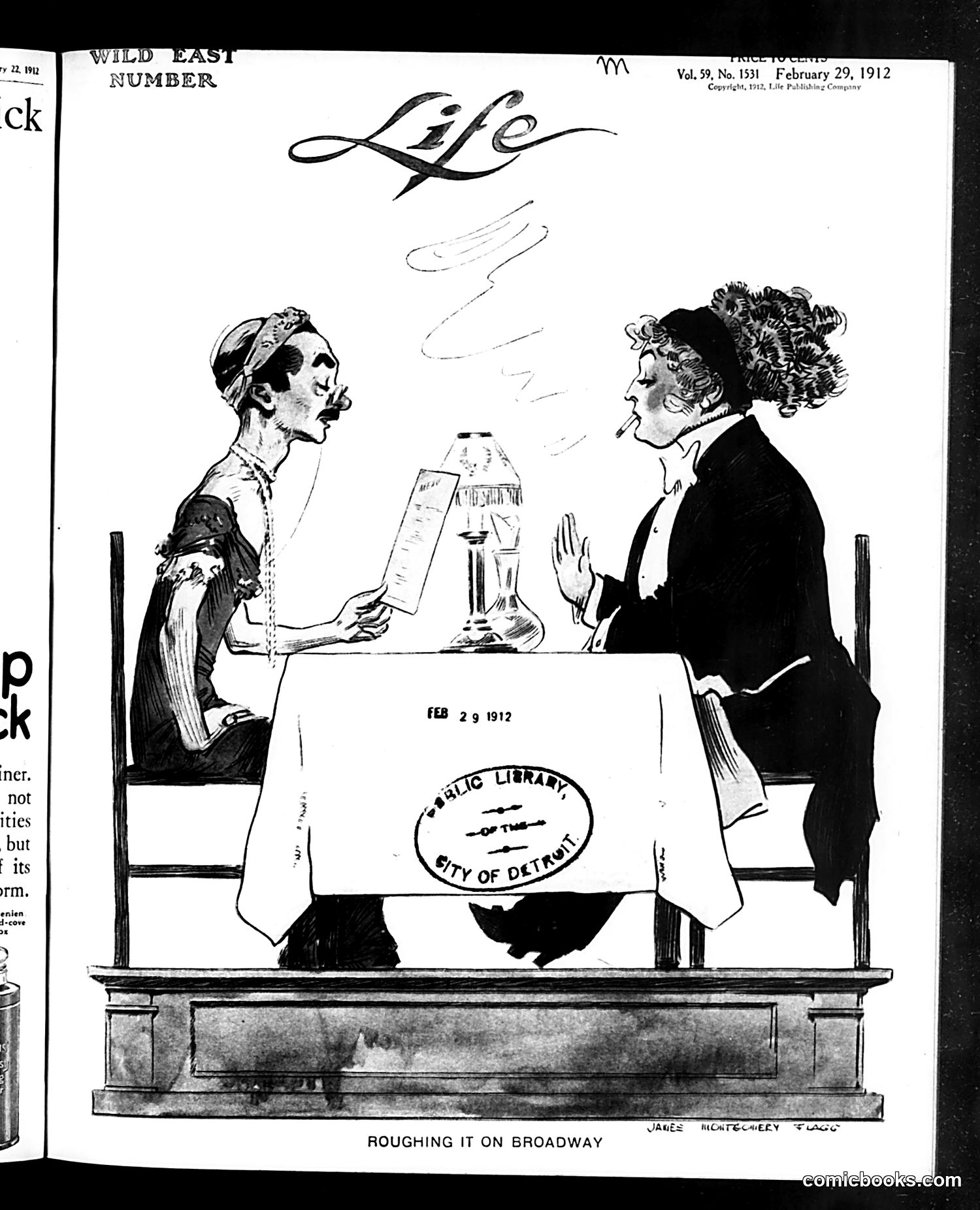
This February 1912 Life Magazine cartoon satirizes theatrical dining on Broadway. Two figures sit at a restaurant table with a library stamp visible on the tablecloth—suggesting they're using borrowed or makeshift materials. The woman on the left appears gaunt and refined, while the man on the right gestures dismissively at a modest meal and water glass. The joke targets Broadway performers or theatrical folk who affect sophistication and refinement despite financial hardship. "Roughing it" (living simply) ironically describes their situation while dining out, implying they're pretending to elegance they cannot afford. The library stamp adds humor, suggesting even their table linens are borrowed or improvised—a commentary on theatrical world's financial precarity hidden beneath affected airs.
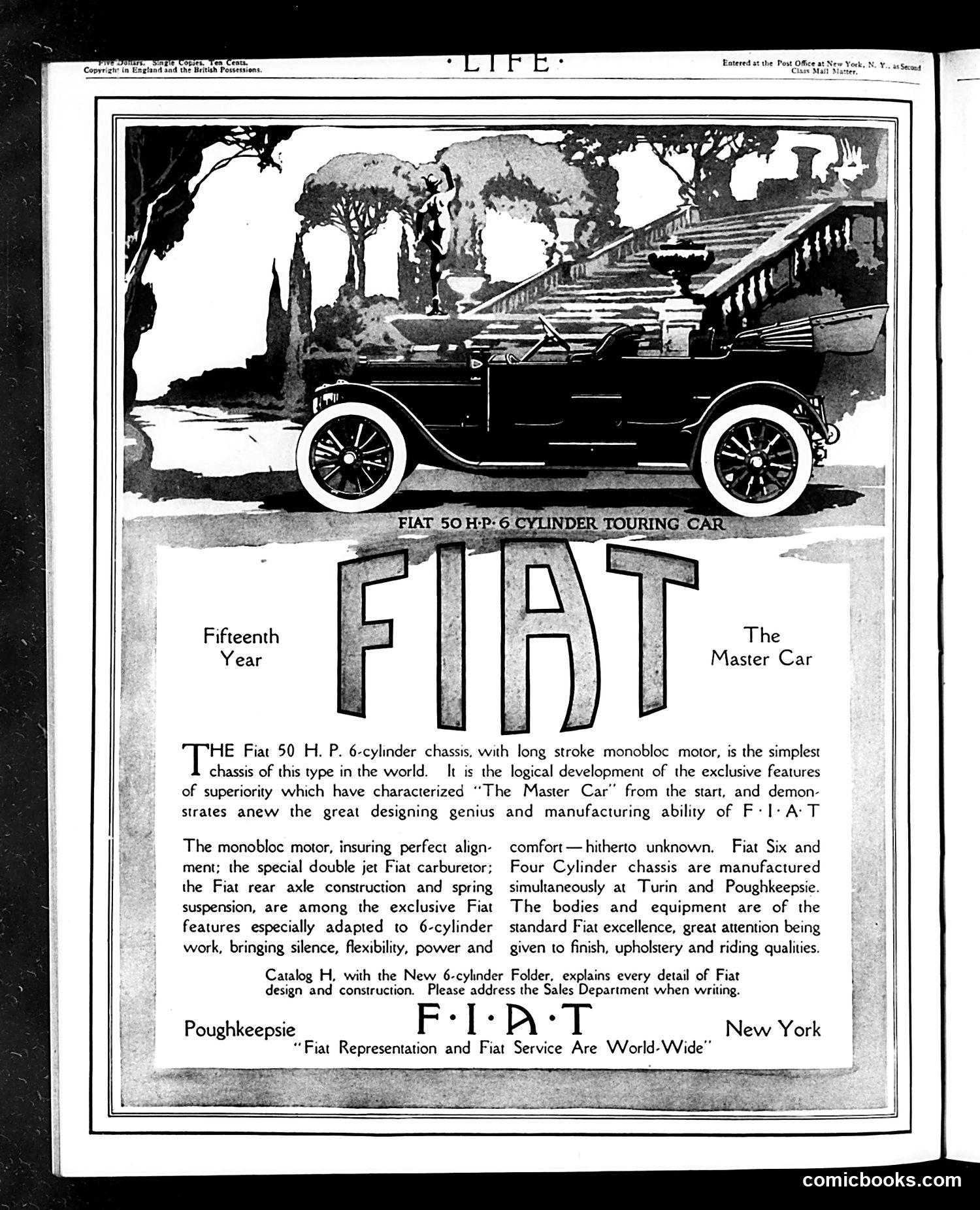
This page is **not a political cartoon or satirical content**—it is a straightforward **automobile advertisement** for the Fiat 50 H.P. 6-cylinder touring car. The ad celebrates Fiat as "The Master Car" and its fifteenth year of production. It emphasizes engineering features: the monobloc motor, double-jet carburetor, and rear axle construction. The ornate illustrated background (Italian villa, cypress trees, grand staircase) suggests luxury and European elegance to appeal to wealthy American buyers. The text claims Fiat's design represents "superior" manufacturing ability and offers "silence, flexibility, power and comfort." The ad directs interested parties to contact the Poughkeepsie, New York sales department. This represents early 1910s automotive marketing targeting affluent Americans.
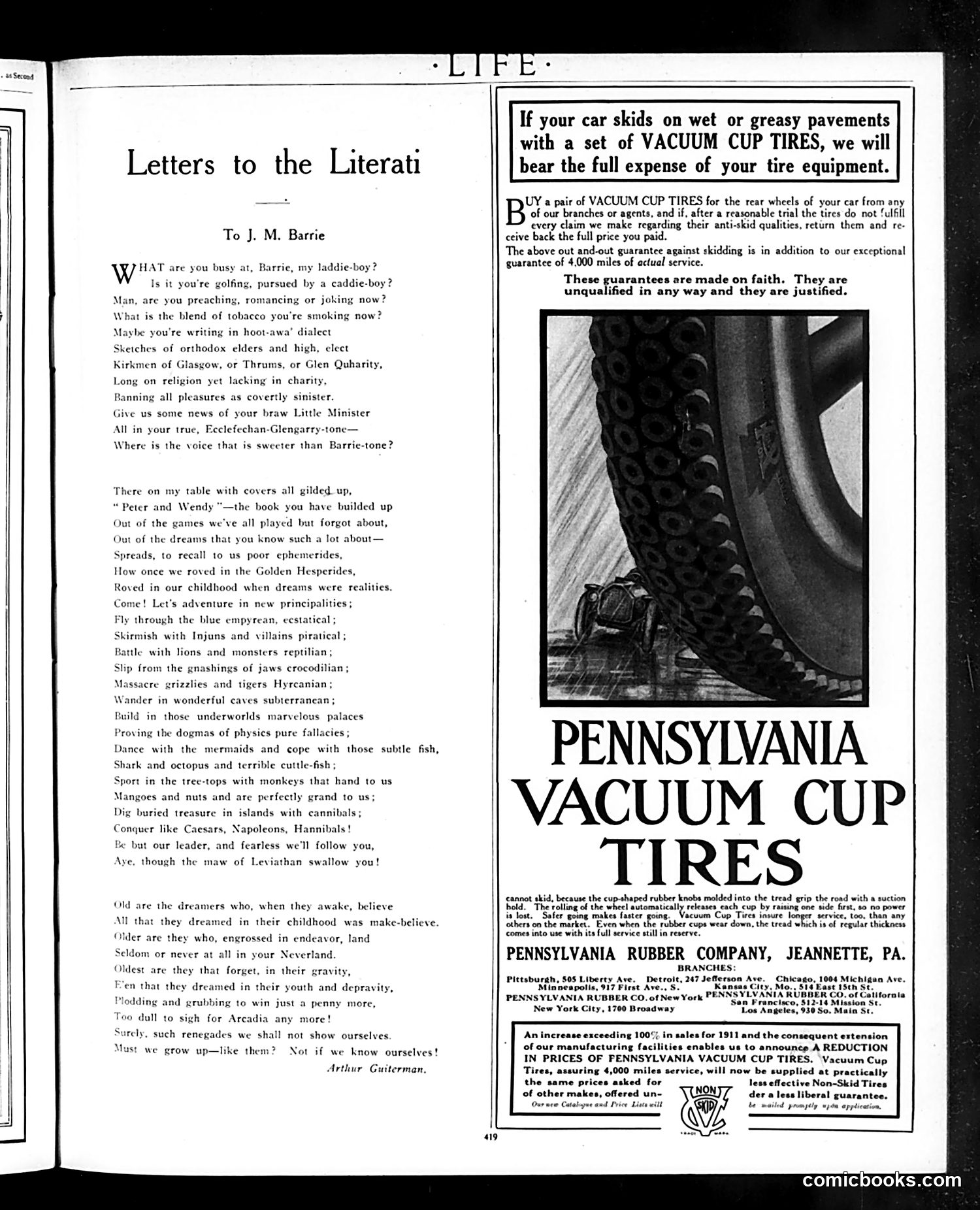
This page is primarily **advertising**, not satire or political commentary. The left column contains "Letters to the Literati"—a poem addressed to J.M. Barrie (author of *Peter Pan*). The poem nostalgically references childhood adventures and literary fantasies, written by Arthur Guiterman. The right side is a full-page **advertisement for Pennsylvania Vacuum Cup Tires** from the Pennsylvania Rubber Company in Jeannette, PA. The ad features a photograph of a tire tread on wet pavement and emphasizes the tire's anti-skidding properties with a guarantee of 4,000 miles of service. There is **no political cartoon or satire** on this page. It's a straightforward combination of literary content and commercial advertising typical of *Life* magazine's format during this period.
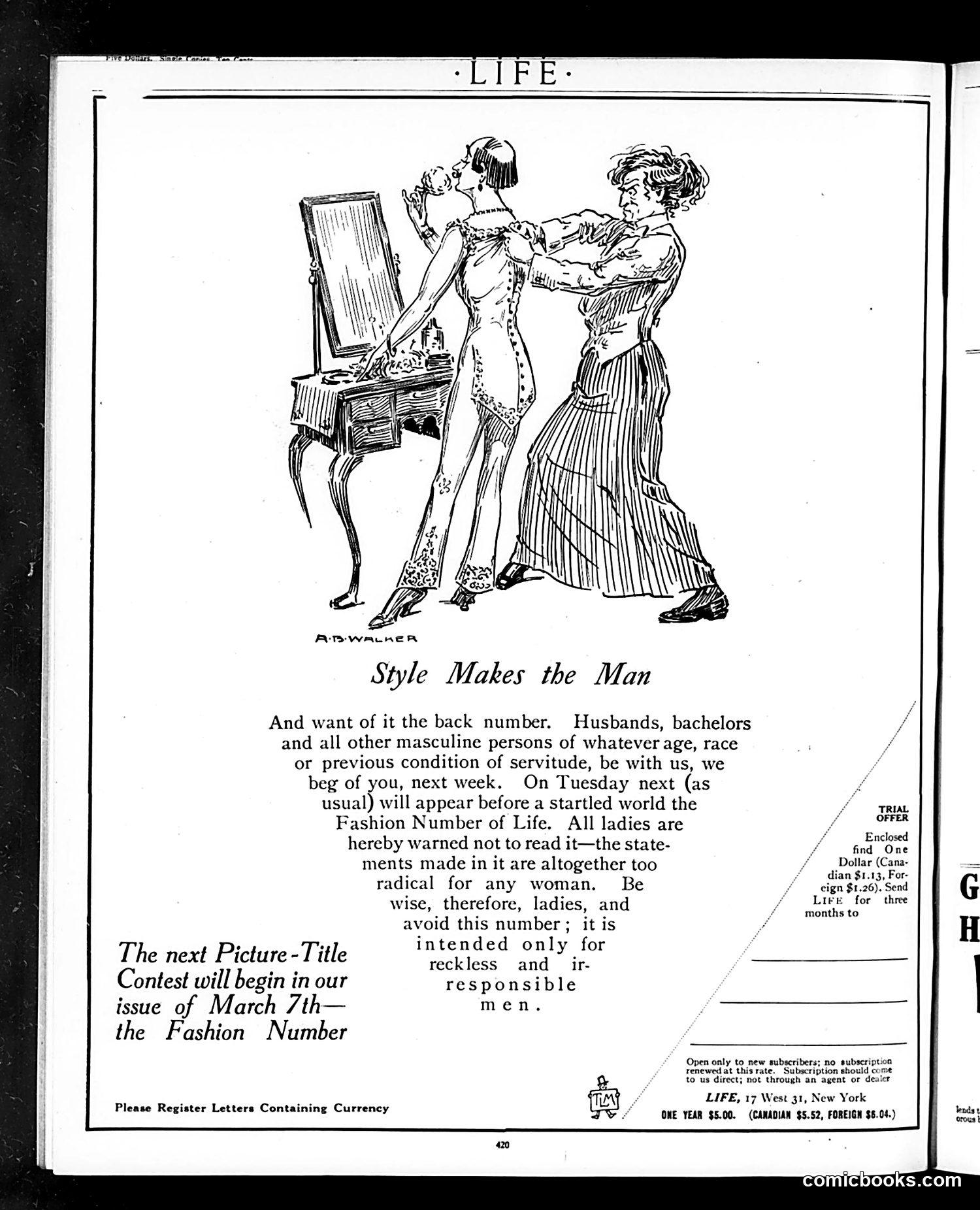
This is a satirical announcement from *Life* magazine's upcoming "Fashion Number." The cartoon by A.B. Walker depicts a woman being dressed/styled by another woman at a vanity mirror, illustrating the title "Style Makes the Man." The satire is directed at men: the text humorously invites "husbands, bachelors and all other masculine persons" to read next week's fashion issue, while simultaneously warning ladies *not* to read it. The joke suggests that fashion advice in the magazine will be so radical or emasculating that it's "only for reckless and irresponsible men"—implying that respectable women should avoid exposing men to such potentially corrupting style guidance. This reflects early 20th-century anxieties about changing gender roles and fashion's power to reshape masculine identity.
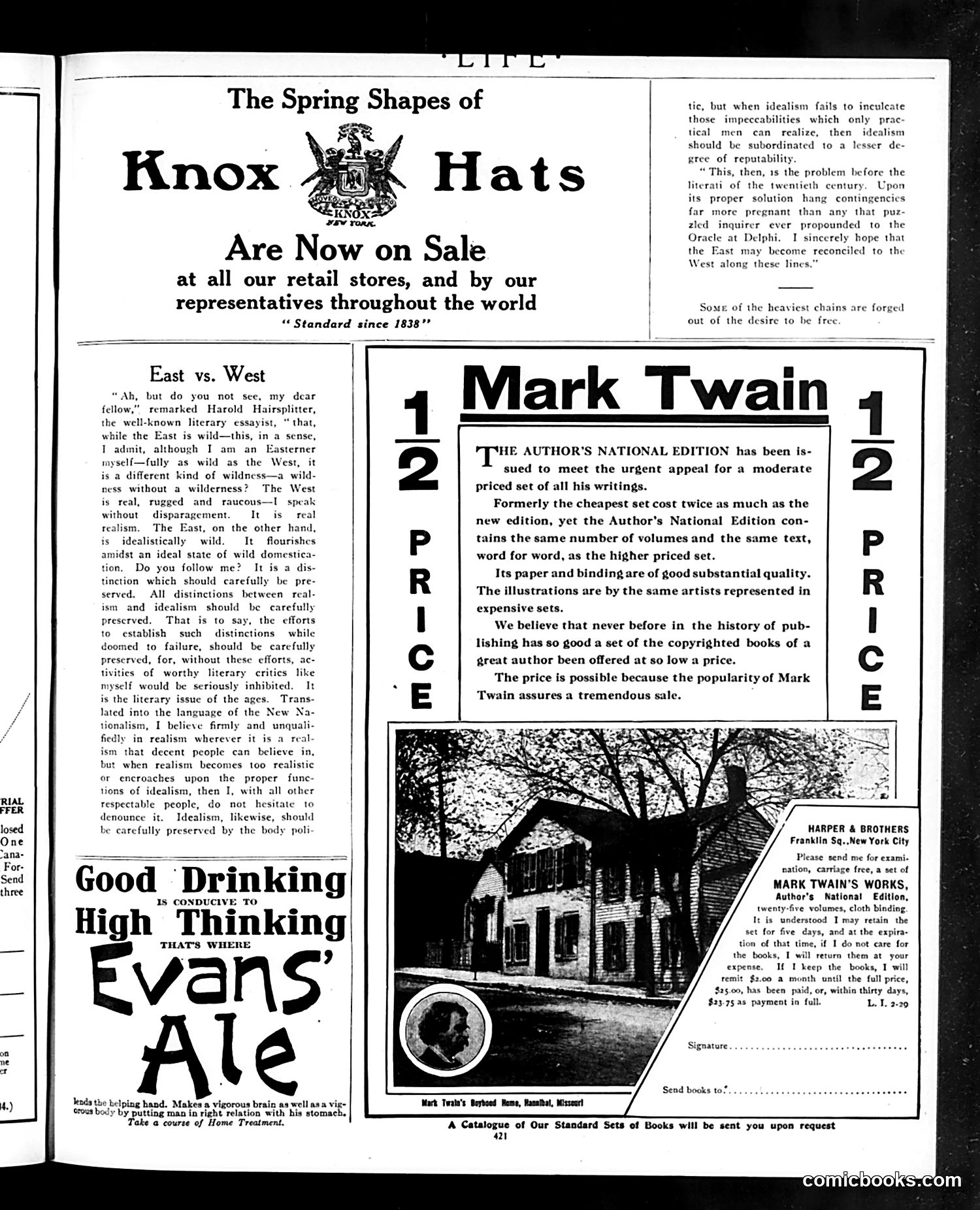
This page is primarily **advertising rather than political satire**. It contains three main ads: 1. **Knox Hats** advertisement promoting their spring styles 2. **Mark Twain's National Edition** book set—marketed as an affordable, high-quality collection of the famous author's complete works at moderate price 3. **Evans' Ale** advertisement The only editorial content is an "East vs. West" essay on the left side, discussing philosophical differences between Eastern and Western thought—a legitimate political/cultural commentary, not satire. The Mark Twain edition appears designed to appeal to middle-class readers seeking literary prestige at accessible prices. There are no political cartoons or caricatures on this page—it's a commercial publication page from what appears to be the early 20th century.
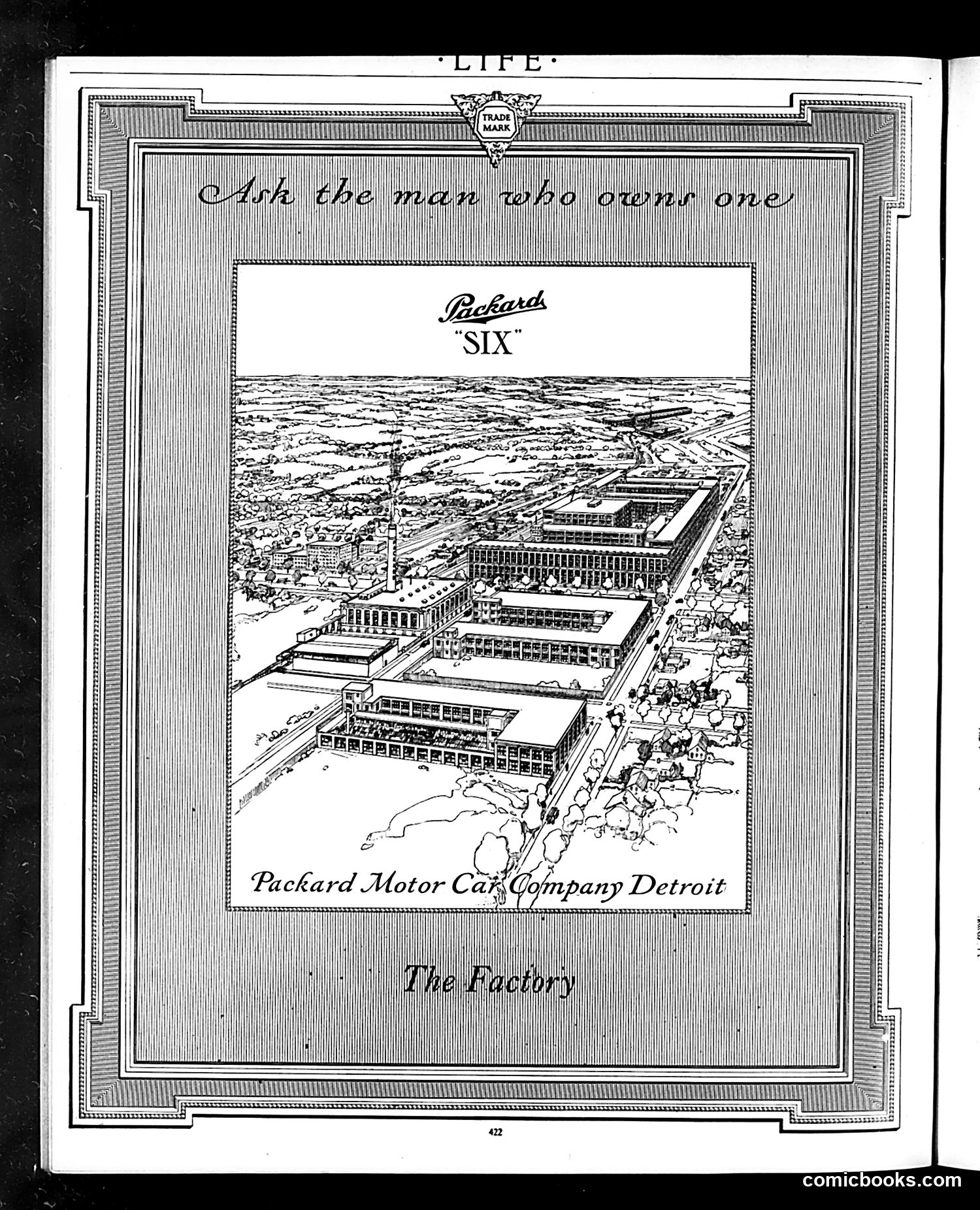
This page is primarily **advertising rather than satire or political commentary**. It presents an aerial illustration of the Packard Motor Car Company's Detroit factory complex, captioned "The Factory." The headline "Ask the man who owns one" was Packard's actual advertising slogan, emphasizing customer satisfaction and testimonial marketing. The detailed architectural drawing shows the manufacturing facility's layout—multiple large industrial buildings arranged in a coordinated campus—designed to impress readers with Packard's scale and modern production capabilities during the early automotive era. There is no political cartoon or satirical commentary visible on this page. It functions as corporate advertising showcasing industrial infrastructure and manufacturing prowess to potential customers and investors.
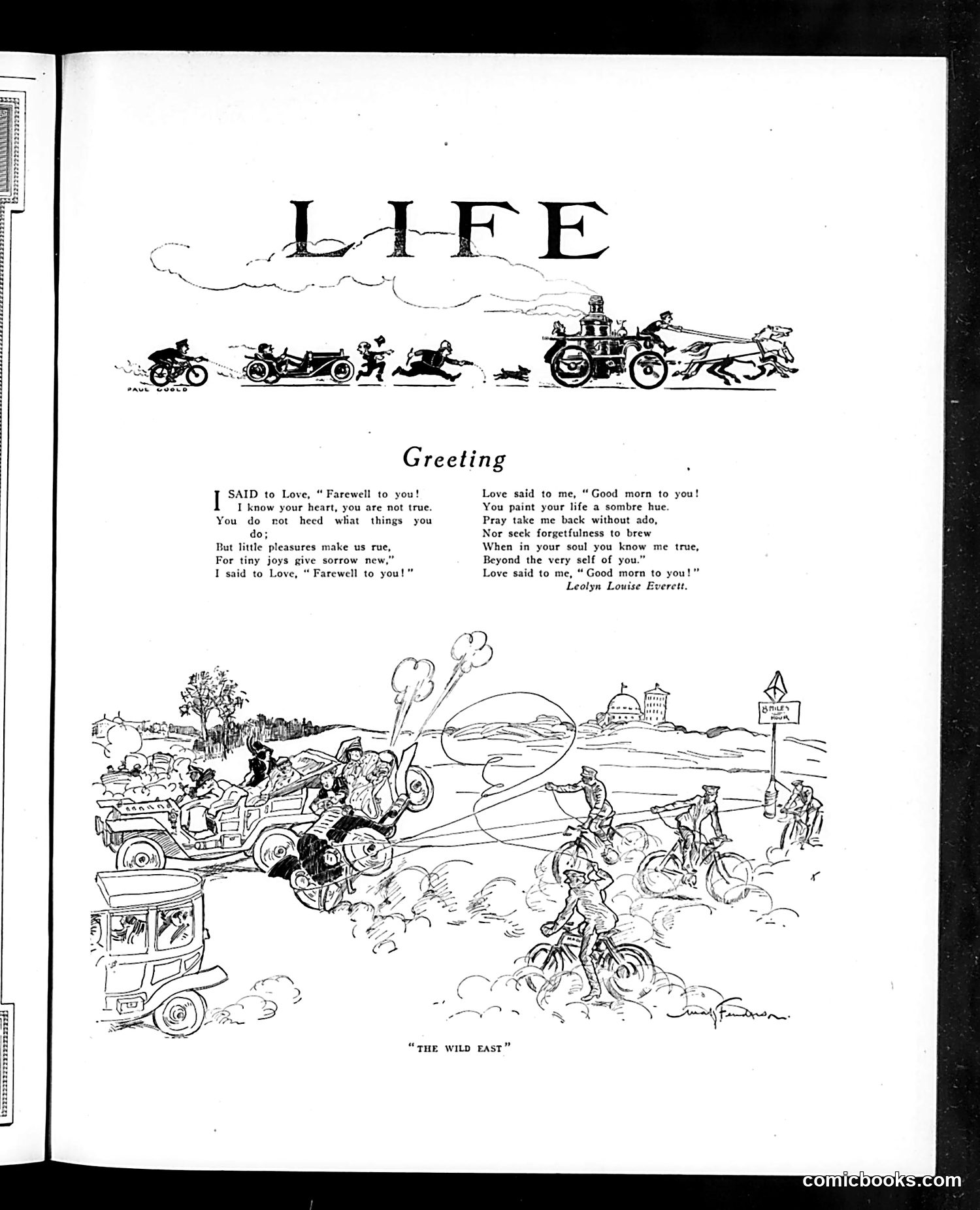
This page features a poetic greeting titled "Life" with accompanying illustrations. The top shows a progression of transportation methods—motorcycles, cars, and motorcycles again—suggesting life's journey or pace. The poem, attributed to Laolya Louise Everett, contrasts two voices: one saying "Farewell" (associated with sorrow and life's transience), the other responding "Good morn" (suggesting optimism and renewal). The verses explore themes of love, heartbreak, and perseverance. The lower cartoon, labeled "THE WILD EAST," depicts a chaotic scene of mixed transportation—automobiles, motorcycles, and bicycles—amid clouds of dust and confusion. This likely satirizes the rapid, disorderly modernization and transportation chaos of the era, possibly in Eastern American cities or regions.
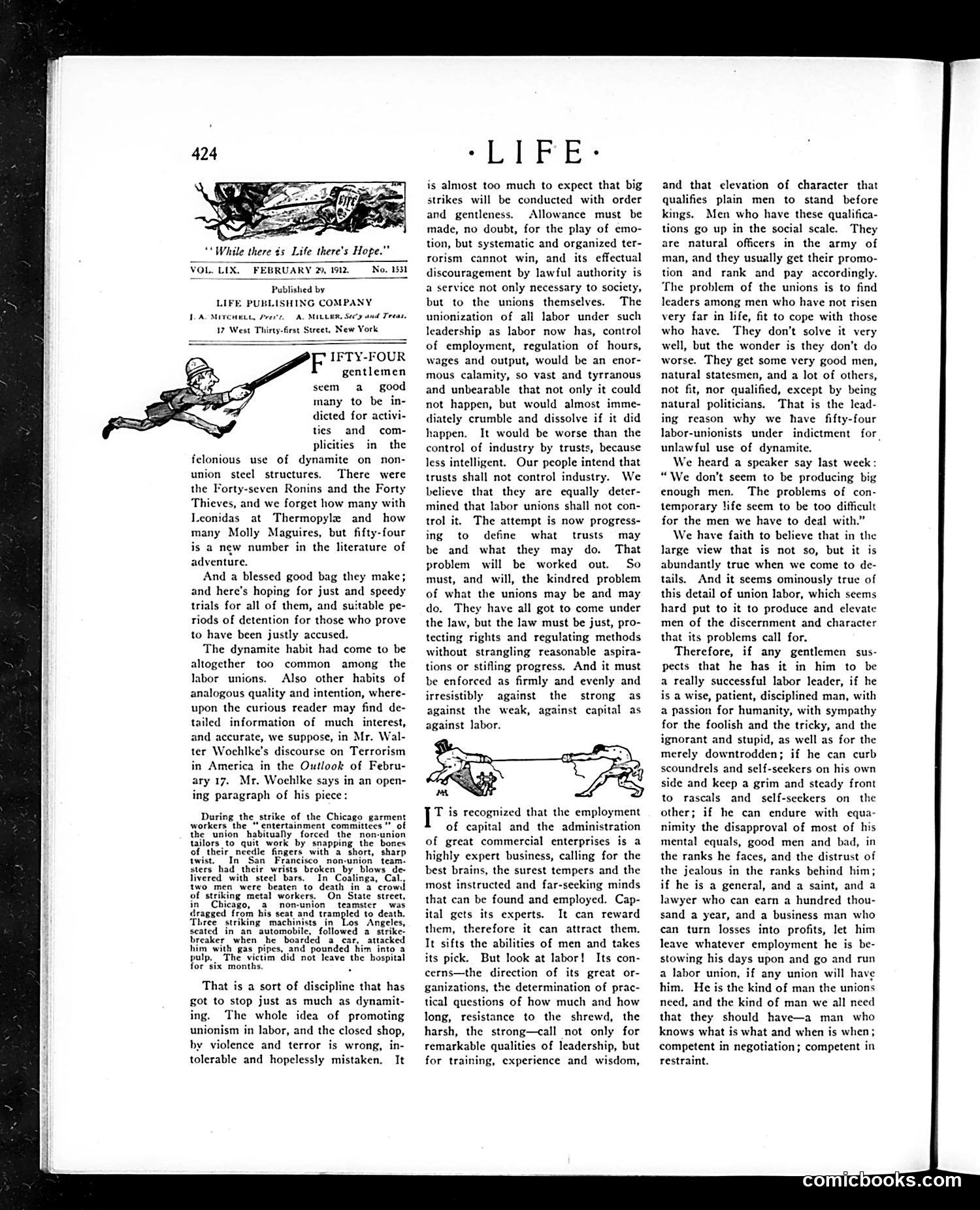
This page presents editorial arguments against violent labor union tactics and dynamite attacks on non-union structures. The text references specific incidents: the "Forty-seven Bomb and the Thirty Thieves" and "Molly Maguires," and mentions a Chicago garment workers' strike involving tailors and a fatal accident. The cartoons (small illustrations of figures in conflict) visually reinforce the written critique of union violence. The editorial argues that while labor deserves fair treatment and regulation, unions shouldn't employ terrorism or dynamite. It advocates for competent, restrained labor leadership—men educated in negotiation and restraint rather than violence. The piece reflects early 20th-century anxieties about radical labor movements and anarchist tactics, positioning the magazine as pro-worker but anti-violent-extremism.
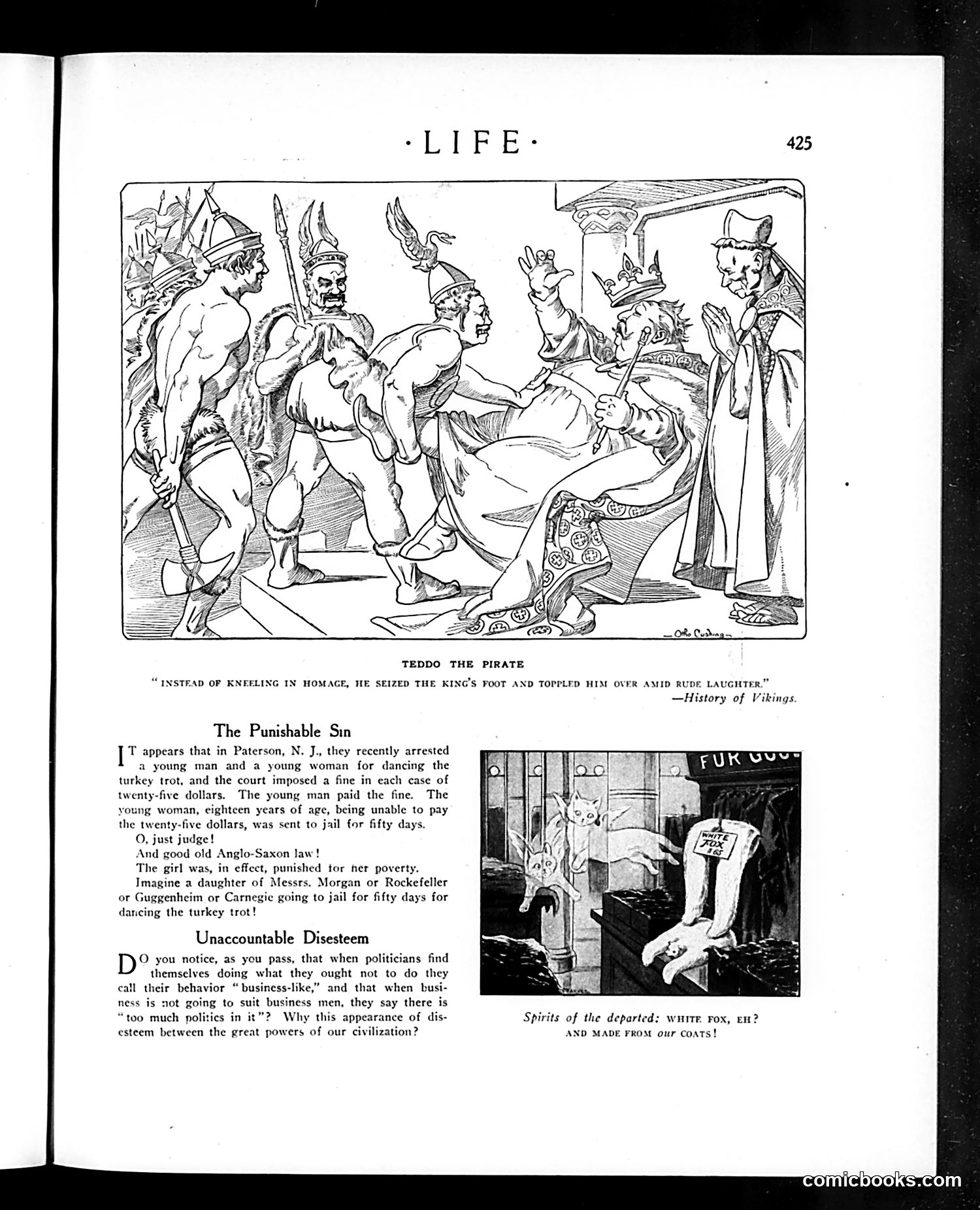
**Top Illustration: "Teddo the Pirate"** A satirical engraving depicting what appears to be a medieval or Viking-era scene. The caption references Theodore Roosevelt ("Teddo"), suggesting he's caricatured as a pirate who disrespectfully seized "the King's foot and toppled him over amid rude laughter." This likely critiques Roosevelt's aggressive foreign policy or diplomatic conduct. **"The Punishable Sin"** Satirizes class-based justice: a young couple was jailed for dancing the "turkey trot" (a contemporary dance), while wealthy industrialists like Morgan, Rockefeller, and Carnegie face no consequences for their actions. The writer argues this reveals hypocrisy in American law enforcement. **"Unaccountable Disesteem"** Questions why politicians and businessmen escape criticism when behaving unethically, yet expect to be treated as respectable.
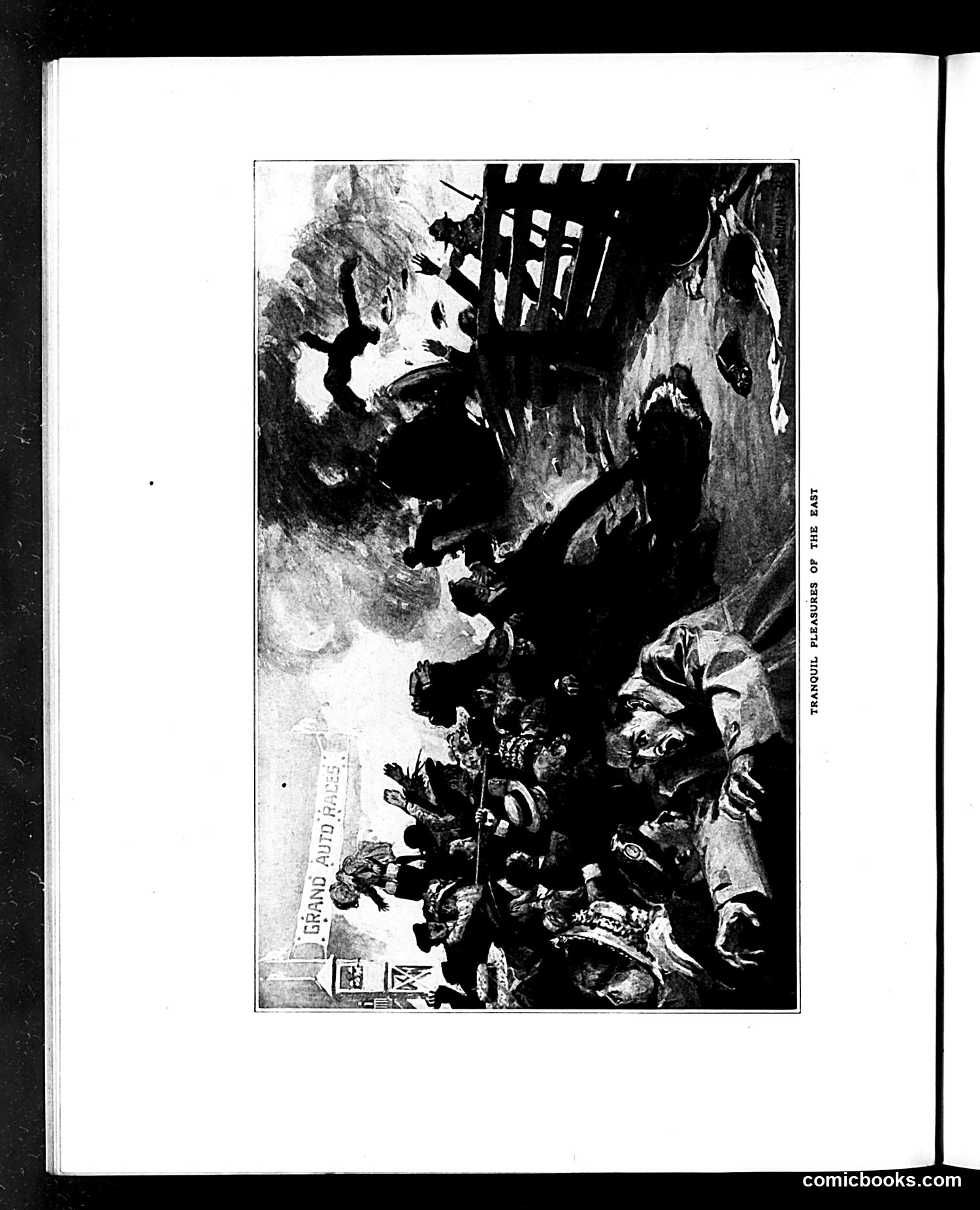
This page contains a dramatic black and white illustration titled "Fandango Pleasures of the East" (visible on the right margin). The image appears to be a classical or historical artwork depicting an interior scene with multiple figures in period costume engaged in what seems to be a social gathering or theatrical performance. The composition shows figures in elaborate dress, some appearing to dance or gesture expressively, with architectural elements like wooden beams visible above. The style and subject matter suggest this is reproducing a historical painting or engraving rather than original satirical commentary. Without additional text on the page itself identifying specific political figures or contemporary references, the satirical intent—if any—is unclear from the image alone. This appears primarily to be an art reproduction rather than a political cartoon with contemporary commentary.
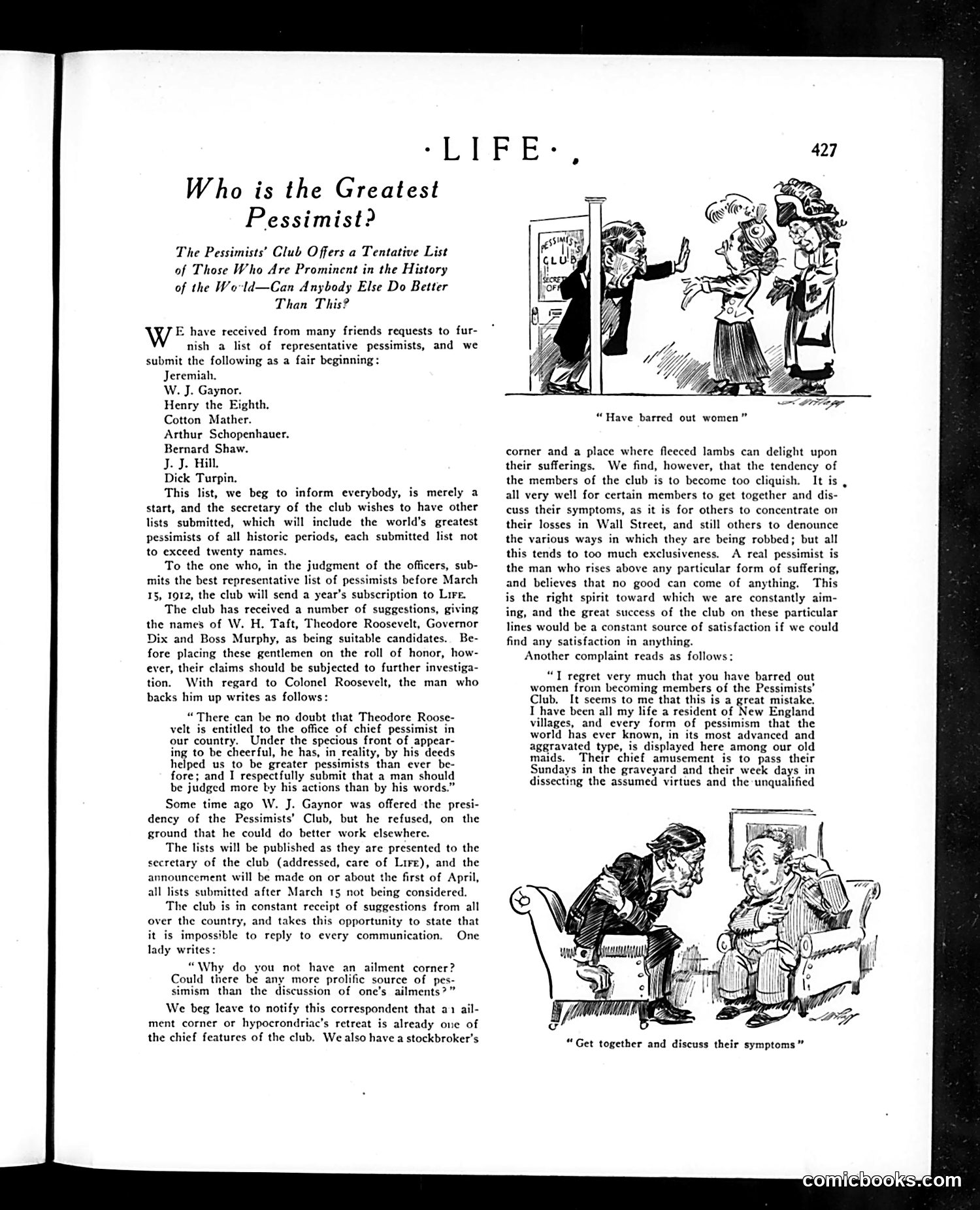
This satirical piece mocks a "Pessimists' Club" that compiles lists of history's greatest pessimists. The article presents a humorous roster including W.J. Gaynor, Henry VIII, Cotton Mather, Arthur Schopenhauer, Bernard Shaw, J.J. Hill, and Dick Turpin. The two cartoons illustrate club activities: one shows members discussing their miseries ("Get together and discuss their symptoms"), while another depicts them barring women ("Have barred out women"). The satire targets pessimism as a fashionable affectation among certain intellectuals and public figures. The article pokes fun at people who wear gloom like a badge of honor, suggesting their complaints are performative rather than genuine. The club concept itself ridicules organized pessimism as both absurd and self-indulgent.
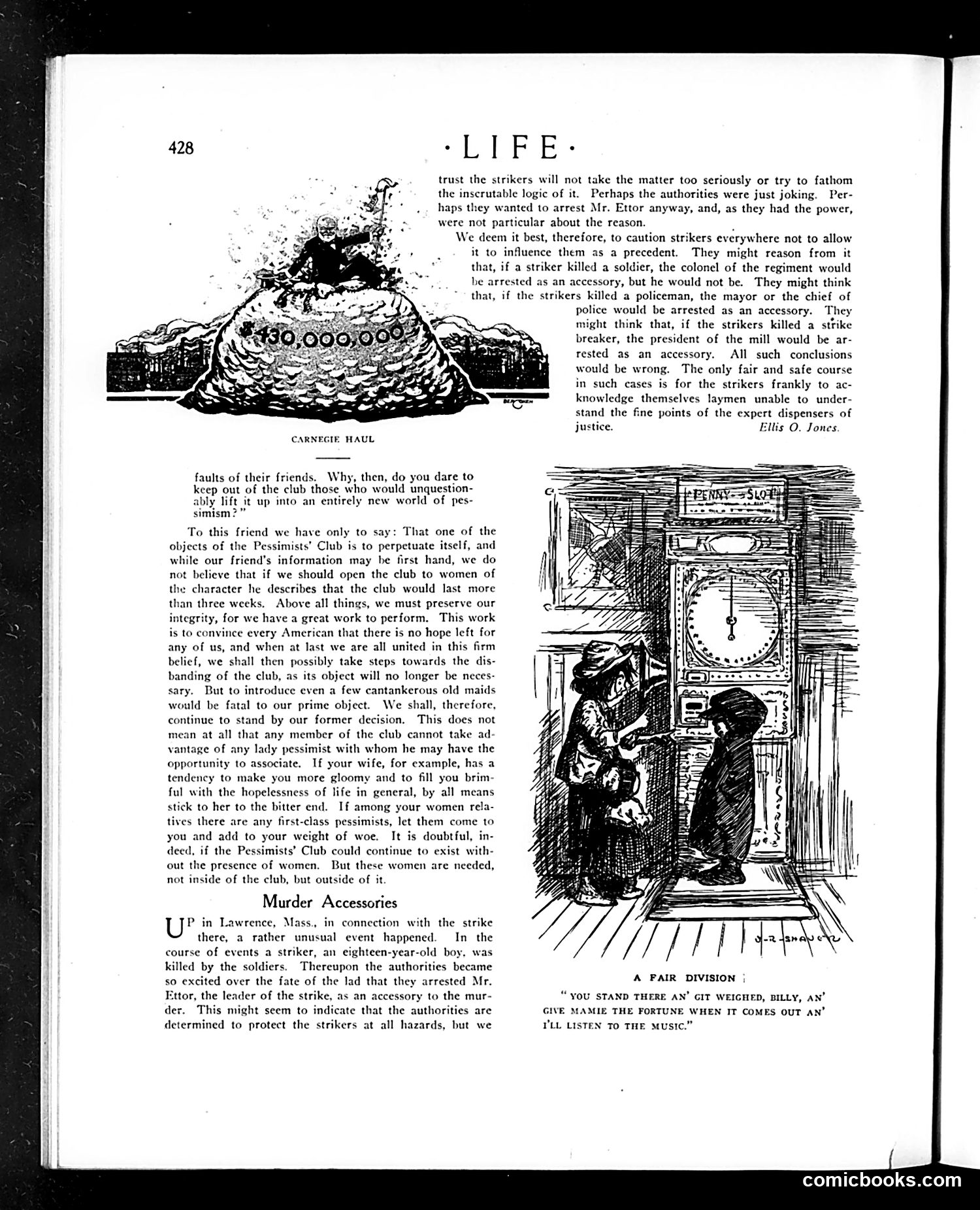
This page contains satirical commentary on labor strikes and a separate cartoon titled "A Fair Division." **Top Section ("Carnegie Haul"):** The illustration shows a figure sitting atop an enormous pile of money labeled "$30,000,000," satirizing Andrew Carnegie's vast wealth accumulation. The accompanying text debates whether strike leaders should be held as accessories to murder when strikers kill soldiers or police, arguing that such logic would be absurd and dangerous to civil liberties. **Bottom Cartoon ("A Fair Division"):** Shows two figures at a fortune-telling machine. The caption jokes about dividing fortune/wealth: one will "git weighed, Billy" while another listens to music, humorously suggesting unequal distribution of luck or prosperity—likely mocking class disparities of the era. Both items critique wealth inequality and labor tensions during America's industrial period.
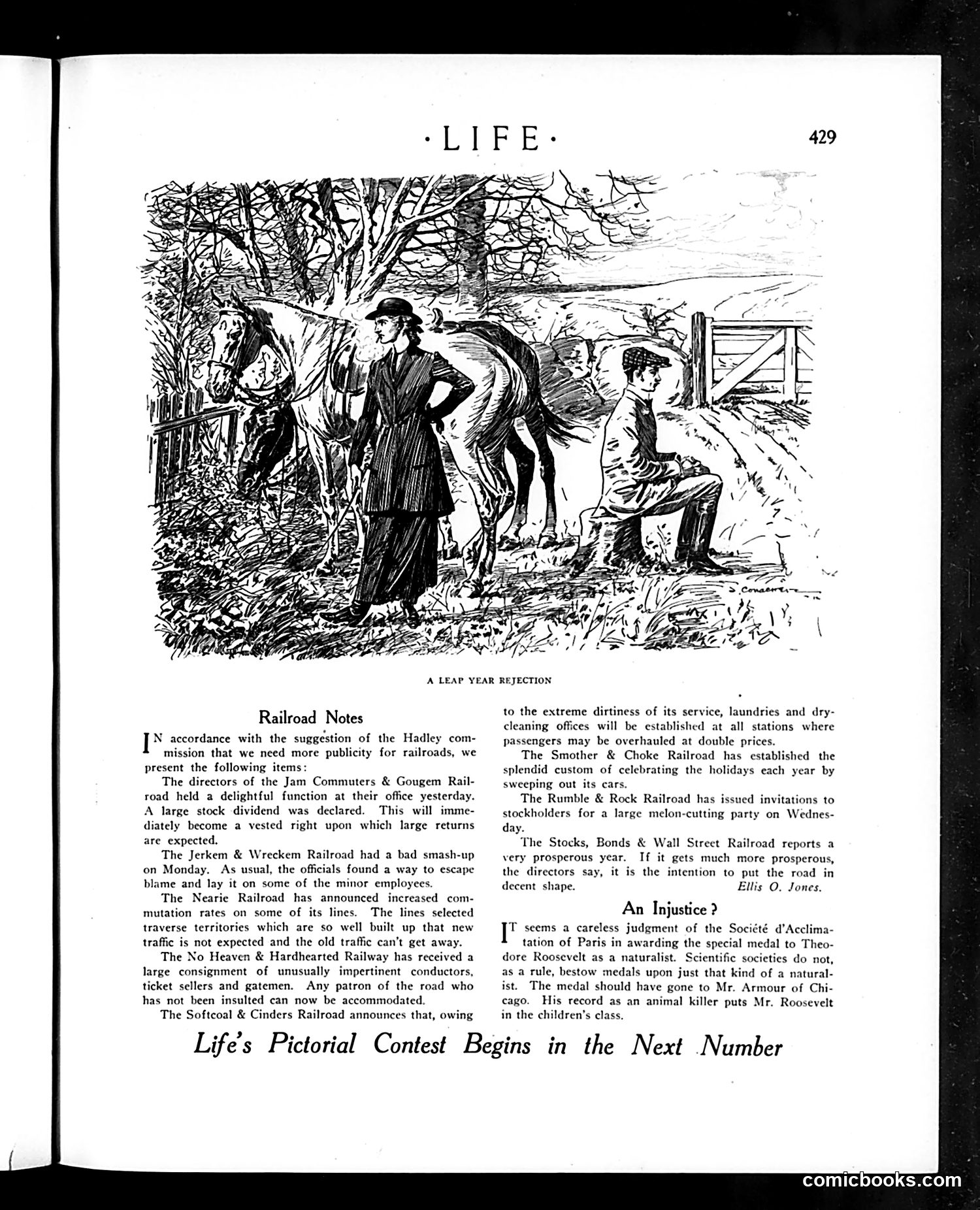
This cartoon depicts a **leap year proposal scene**—a satirical reference to the tradition that women could propose to men during leap years. The image shows a woman (left, in dark dress) actively proposing to a man (right, seated), while two other figures observe. The man's body language suggests reluctance or discomfort with the reversed gender roles. The joke plays on early 20th-century social anxieties about women's changing roles and independence. By depicting a woman taking the traditionally masculine initiative in courtship, the cartoon mocks both female assertiveness and male discomfort with it. This reflects contemporary debates about women's suffrage and evolving gender expectations in American society.
This page contains no cartoon or satirical illustration. It is a text-only article titled "Life Wins $1,043.14," reporting on a copyright lawsuit victory. The *Life* magazine successfully sued the *New York Mail and Express* newspaper for reprinting copyrighted pictures and content without permission or credit. The article celebrates this legal win as a matter of principle rather than monetary gain. It argues that artists and writers deserve protection for their creative labor, comparing their intellectual property to physical property. The piece also establishes precedent for copyright law enforcement and encourages other publishers to respect copyright when reprinting material from other publications.
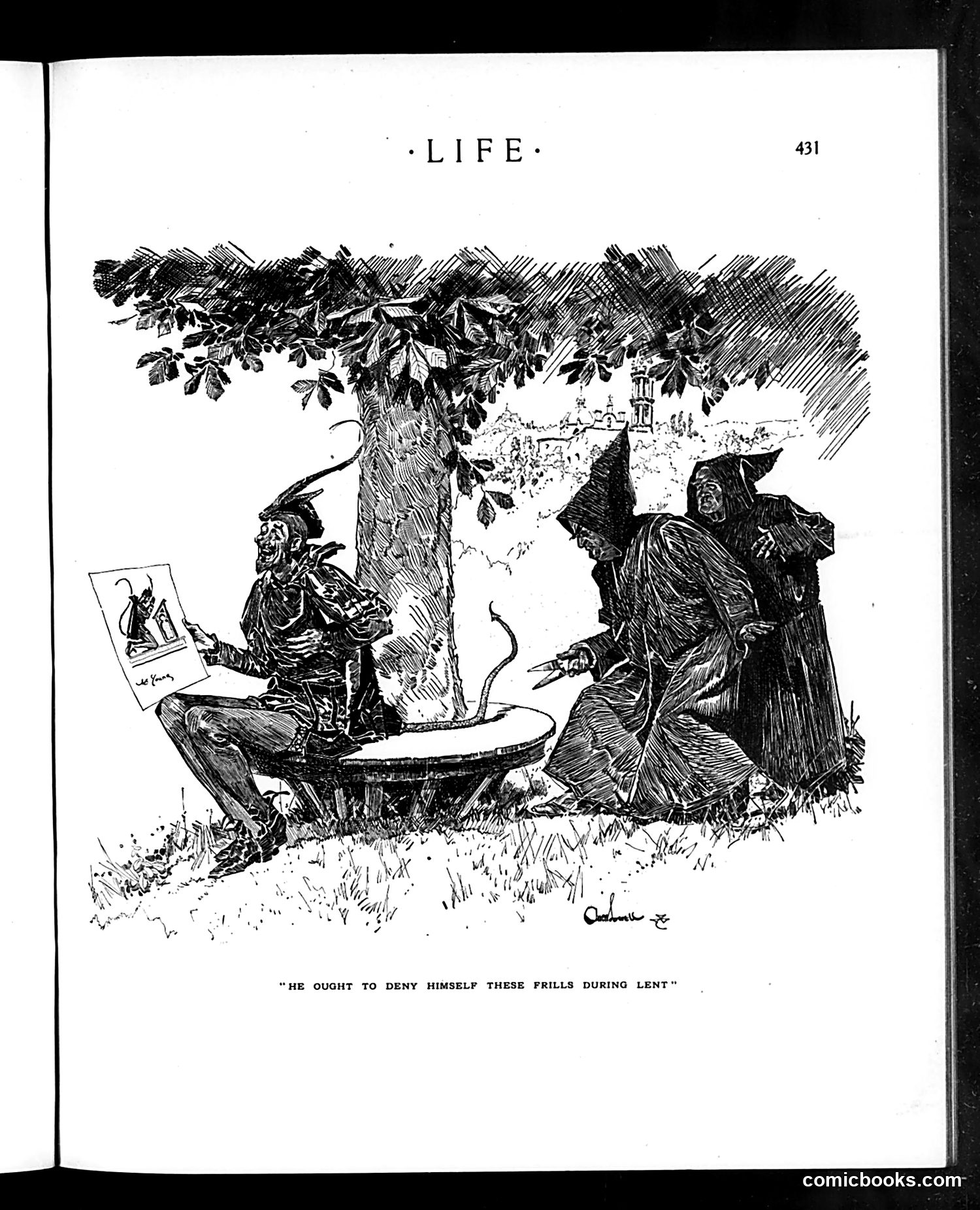
This is a satirical cartoon from Life magazine (page 431) depicting two demon or devil figures beneath a tree, observing a third figure (left) indulging in what appears to be luxurious pursuits—possibly eating or enjoying entertainment. **The Satire:** The caption references Lent, the Christian period of fasting and self-denial before Easter. The joke mocks religious hypocrisy: the demons are commenting that this person should be denying himself "frills" (luxuries) during Lent, as Christian tradition demands. **The Point:** The cartoon satirizes those who claim religious devotion while continuing worldly indulgences. The demons' observation is ironic—they're essentially encouraging better adherence to Christian discipline, highlighting the contradiction between professed faith and actual behavior. This was likely aimed at wealthy or prominent figures publicly seen enjoying luxuries during Lent.
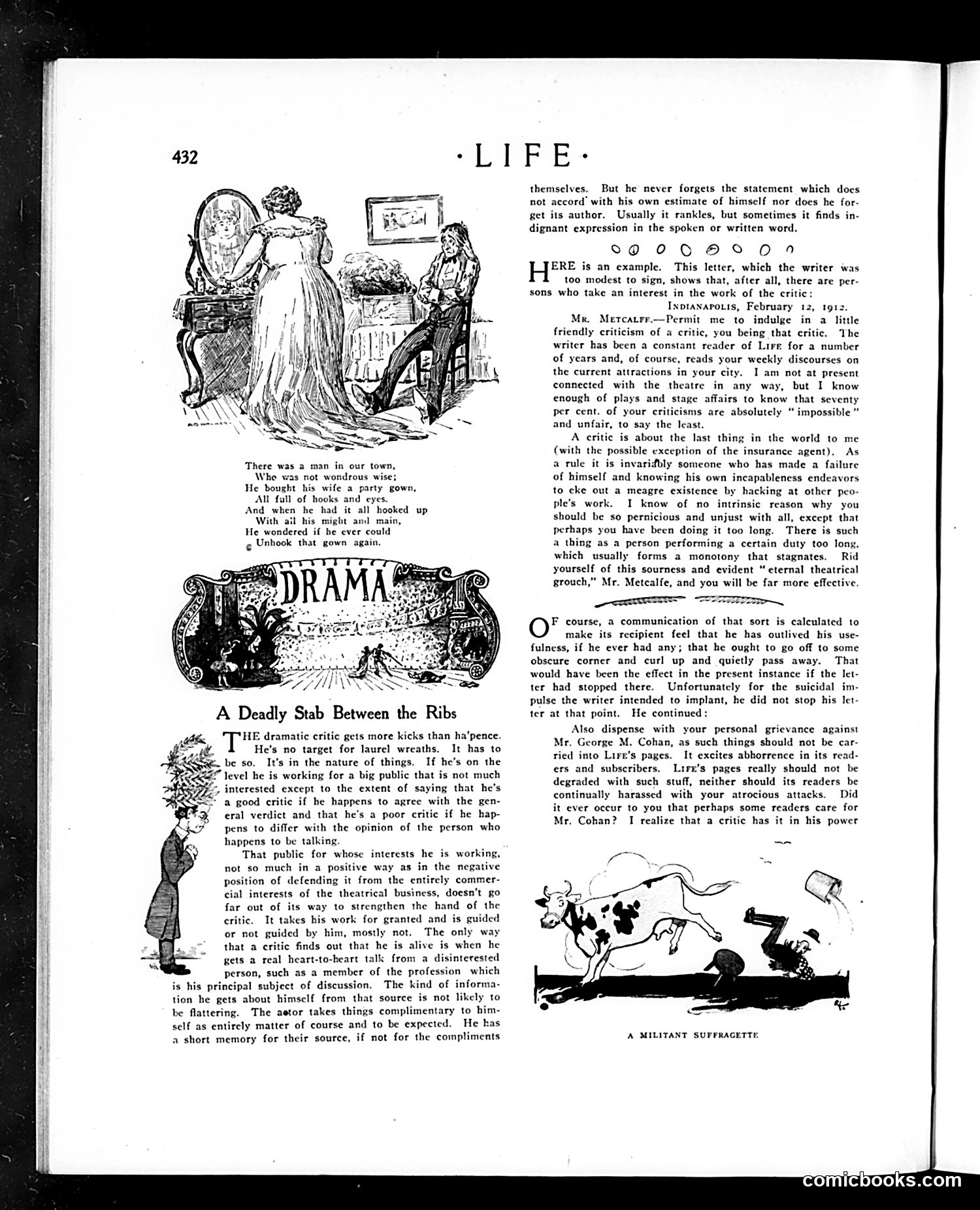
This page contains two distinct pieces of satire: **"A Deadly Stab Between the Ribs"** is an essay defending theater critics against attacks from actors and theatrical professionals. The text argues that critics perform an unpopular but necessary function—protecting public interests against commercial theater interests. It illustrates this with a letter from an Indianapolis reader brutally attacking critic "Mr. Metcalfe," calling him a failed person whose seventy percent of criticisms are unfair and suggesting he's grown stale from doing the job too long. **The opening poem and illustration** joke about a man who buys his wife an elaborate party gown with many hooks and eyes (fasteners), then worries he won't be able to unfasten it again—likely a double entendre about marital intimacy and the complications of women's fashion. **"A Militant Suffragette"** (cartoon, lower right) depicts a woman attacking a man, likely referencing the militant suffrage movement's confrontational tactics of the era. The page satirizes both personal relationships and professional conflicts in Edwardian society.
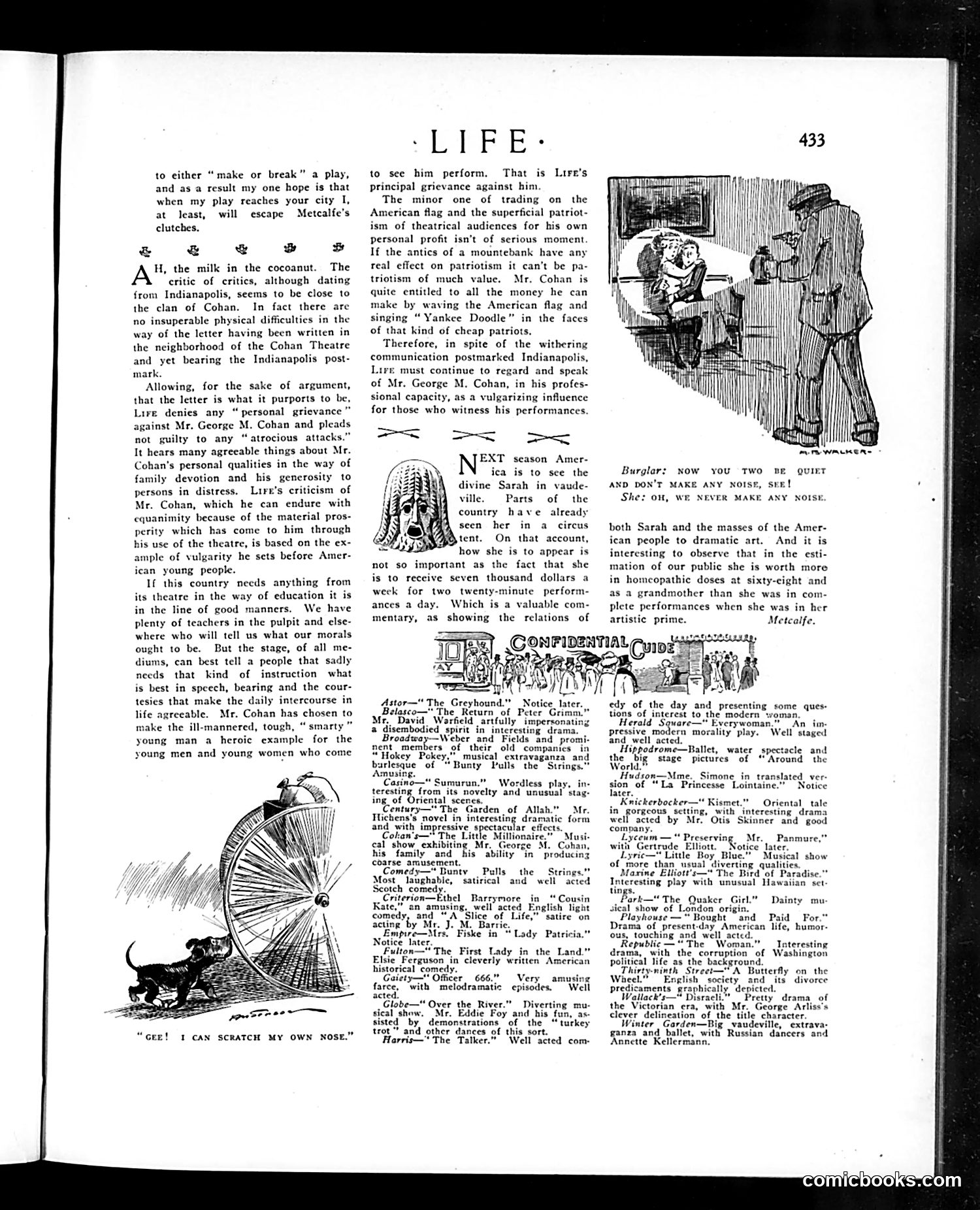
This page critiques performer George M. Cohan as a "vulgarizing influence" on American youth. Life magazine defends its criticism against what appears to be a defensive letter (possibly from Cohan or his allies, postmarked Indianapolis). The key complaint: Cohan exemplifies ill-mannered, "smarty" behavior on stage, setting a poor moral example for young people. While Life acknowledges Cohan's business success and patriotic flag-waving in performances like "Yankee Doodle," it dismisses this as cheap showmanship exploiting audiences' patriotism. The secondary criticism targets Cohan's commercialism—noting Sarah Bernhardt's enormous vaudeville salary ($7,000 weekly) as commentary on theater's mercenary values over artistic merit. The cartoon (top right) and illustrations are theatrical advertisements unrelated to the Cohan critique. The satire reflects Progressive Era concerns about entertainment's moral responsibility to educate rather than debase public taste.
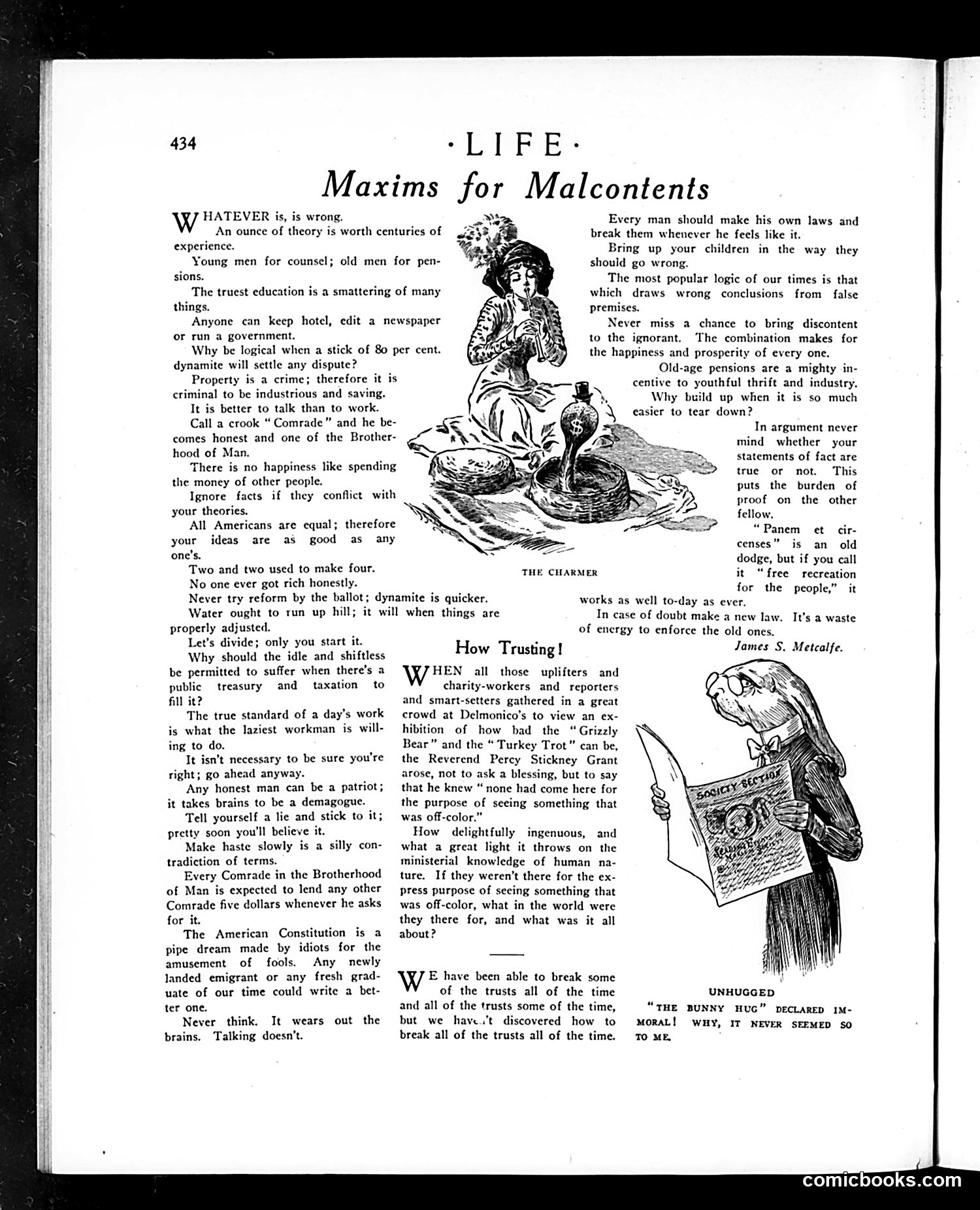
This page satirizes radical socialist and anarchist ideology popular in early 20th-century America. The "Maxims" section mockingly inverts conventional wisdom—advocating dynamite over ballot reform, dismissing property rights, promoting government redistribution, and rejecting rational thought. It's targeting the radical left's perceived hypocrisy and dangerous rhetoric. The illustration labeled "The Charmer" depicts a fashionable woman (likely representing socialist seductiveness or propaganda) distributing these poisonous ideas. Below, James S. Metcalfe's piece "How Trusting!" criticizes Reverend Percy Stickney Grant's naïve defense of attendees at a Delmonico's dance exhibition (referencing contemporary "Turkey Trot" dance scandals), sarcastically suggesting his claim that nobody came to see inappropriate content was disingenuous. The final cartoon "Unhugged" jokes about the "Bunny Hug" dance craze. Together, the page combines political critique of radical ideology with social commentary on contemporary moral anxieties.
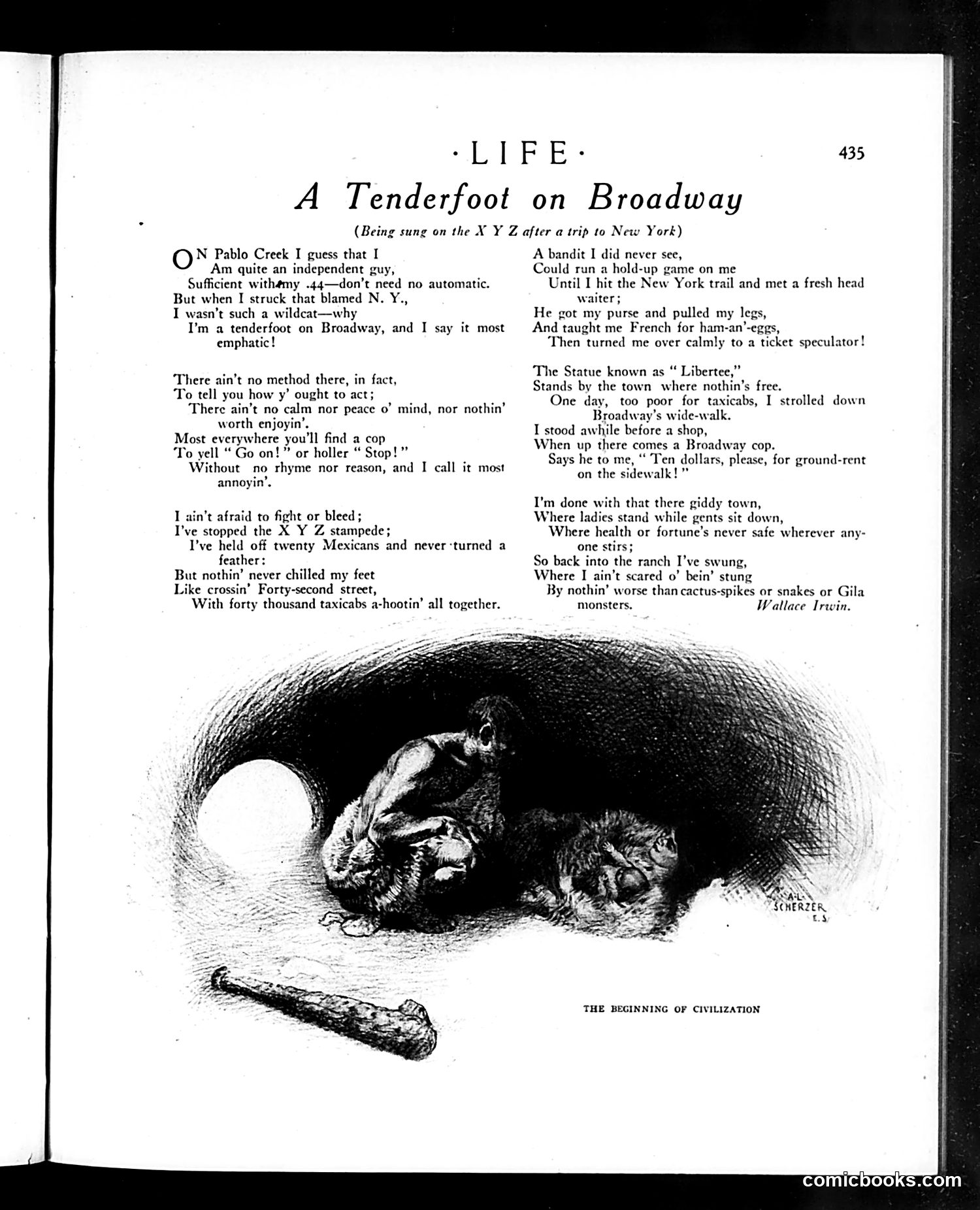
This satirical song, by Wallace Irwin, mocks New York City through the perspective of a Western cowboy confronting urban life. The "tenderfoot" (inexperienced newcomer) boasts of frontier toughness—his .44 revolver, fighting ability, and fearlessness—yet finds himself utterly overwhelmed by Manhattan's chaos. The humor targets urban sophistication as a con: aggressive taxi drivers, corrupt cops extracting bribes (demanding "ground-rent" for standing on sidewalks), predatory waiters robbing tourists, and ticket scalpers. The Statue of Liberty's ironic caption—"where nothin's free"—emphasizes pervasive corruption and commercialism. The accompanying illustration shows primitive humans huddled in a cave, captioned "The Beginning of Civilization," sarcastically suggesting that New York's cutthroat capitalism represents the nadir, not apex, of civilization. The satire critiques 1910s urban greed and disorder through nostalgic contrast with the "honest" frontier.
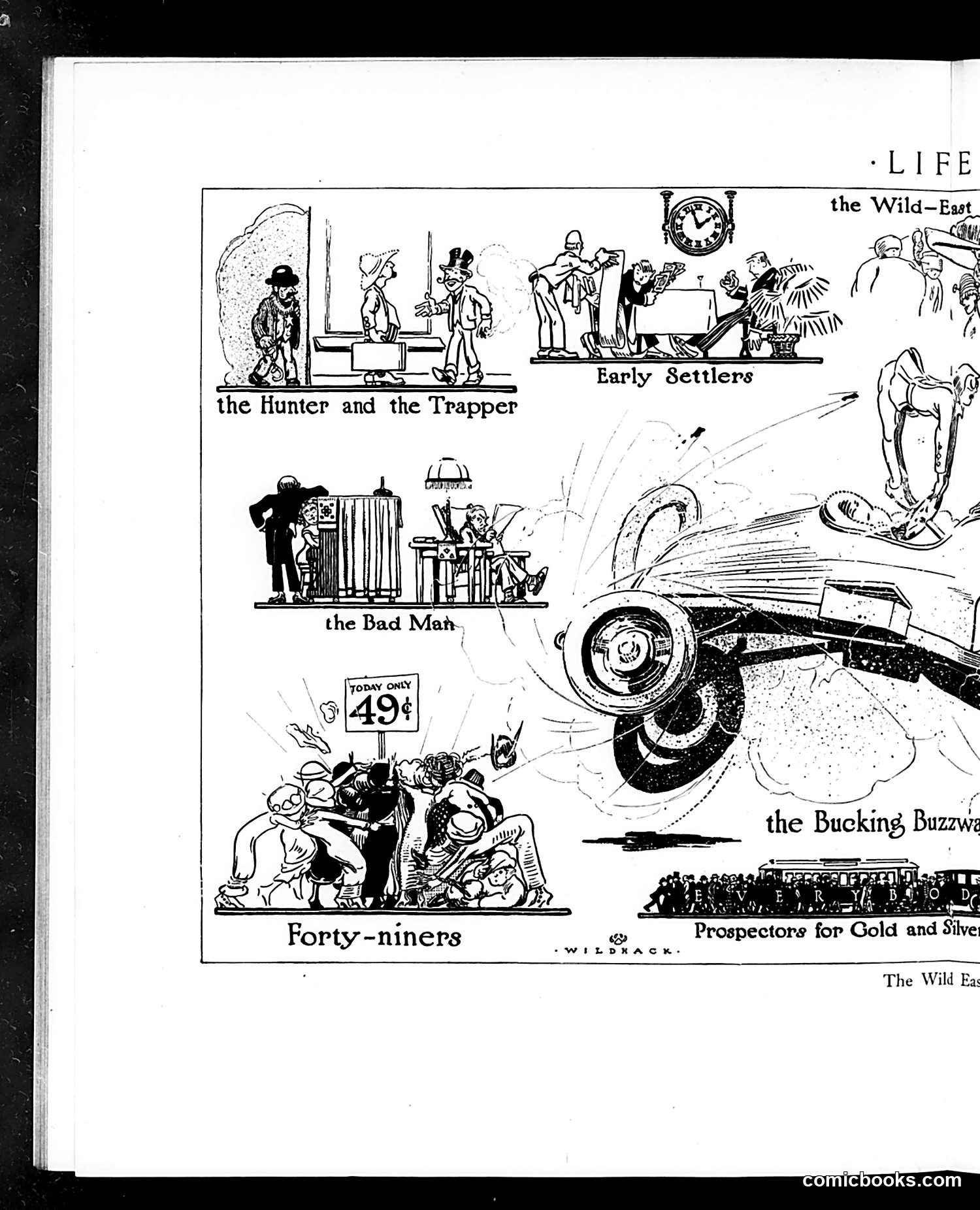
This is a satirical illustration about American frontier archetypes and the "Wild East" (likely contrasting with the Wild West). The page shows several stereotypical frontier characters: "the Hunter and the Trapper," "Early Settlers," "the Bad Man" (a criminal figure), and "Forty-niners" (gold rush prospectors). A central dramatic image depicts a bucking horse or automobile crash, labeled "the Bucking Buzzwagon," suggesting mechanized chaos. The "49¢" price tag on the Forty-niners panel indicates this may be advertising or price comparison. The overall satire appears to mock romanticized frontier mythology while the mechanical imagery suggests the transition from Old West to modern industrial America. Without clearer context about the magazine's date, the exact satirical targets remain somewhat unclear, though the juxtaposition of frontier nostalgia with modern violence suggests commentary on American mythology.
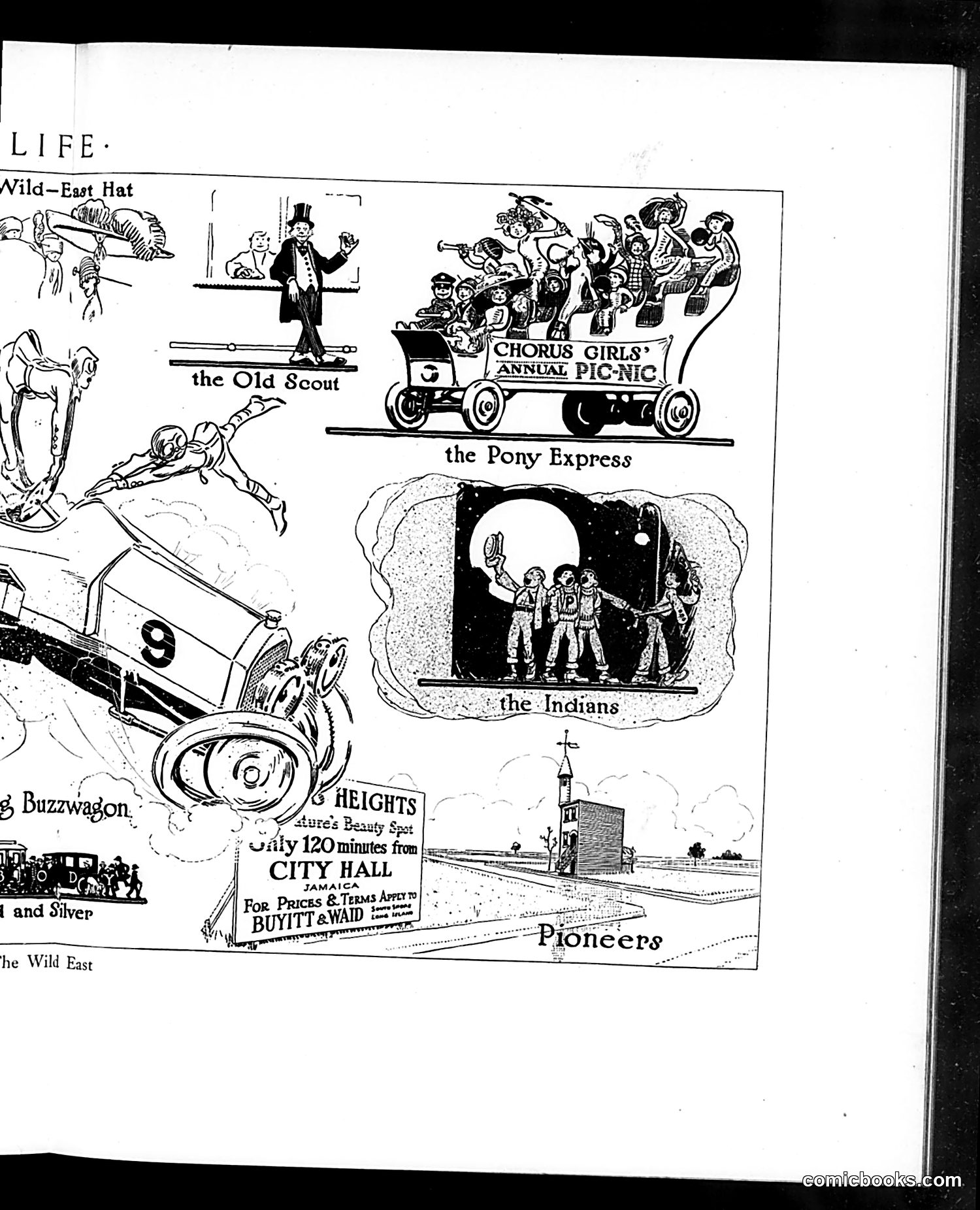
This appears to be an advertisement or promotional page for an amusement park attraction, likely from the early 20th century. The illustrations depict themed rides or exhibits labeled "the Old Scout," "the Pony Express," "the Indians," and "Pioneers"—all referencing American frontier imagery. The "Chorus Girls' Annual Pic-Nic" suggests entertainment featuring young women performers. The layout promotes an attraction near Jamaica, accessible "only 120 minutes from City Hall" by Buyitt & Waid (transit operators). The overall tone reflects early 1900s American entertainment culture, using romanticized "Wild West" and Native American themes as attractions. What stands out to modern readers is the casual, stereotypical treatment of "the Indians" as a mere entertainment spectacle—reflecting the era's dismissive attitudes toward Native Americans as exotic curiosities rather than people.
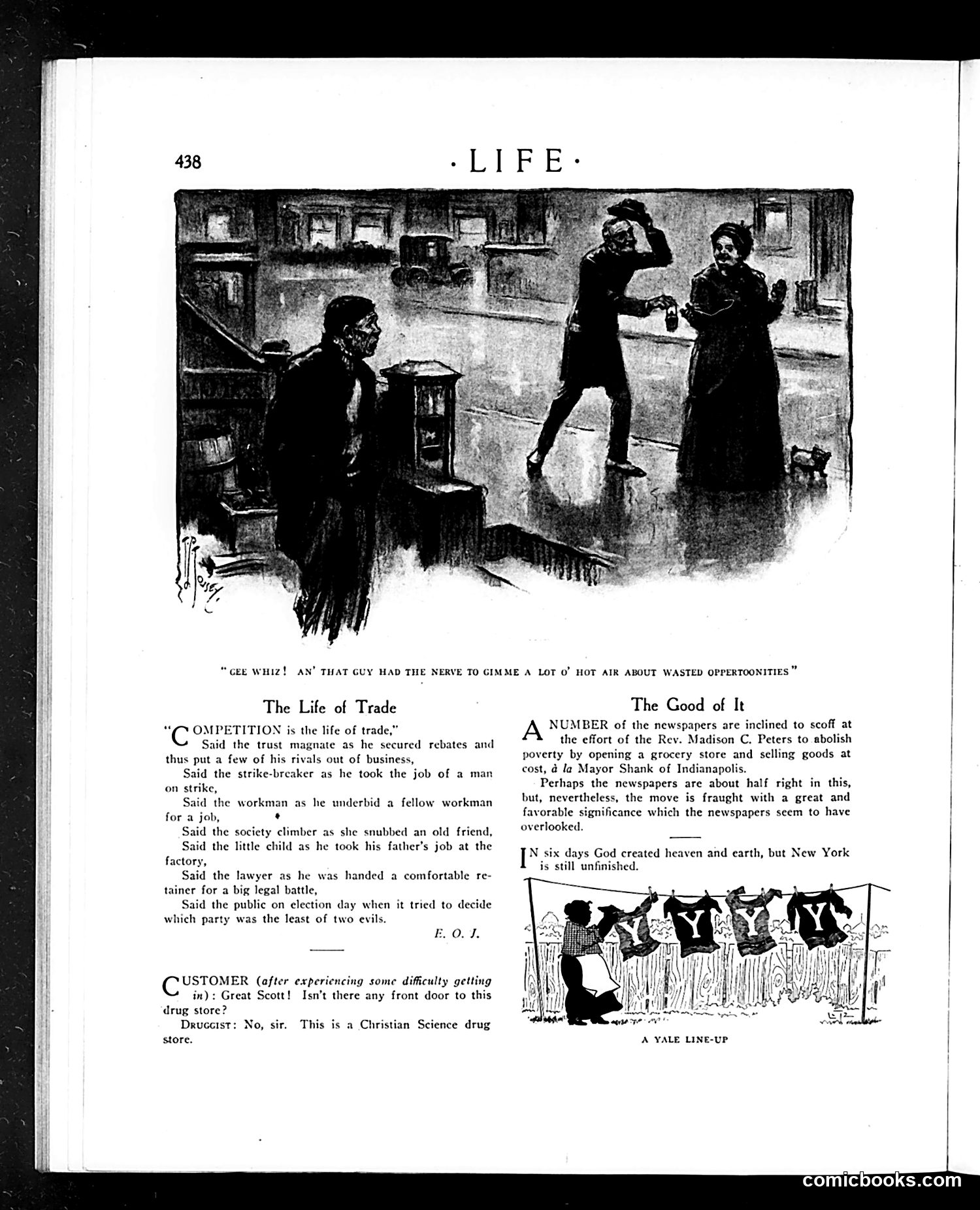
This page contains three separate satirical pieces criticizing American capitalism and social hypocrisy circa early 1900s. **"The Life of Trade"** mocks the phrase "competition is the life of trade" by listing hypocritical applications: a trust magnate crushes rivals through rebates, strikebreakers undercut workers, society climbers betray friends, children displace parents in factories, and lawyers profit from conflicts. The satire suggests "competition" masks exploitation and moral corruption across all social classes. **The Drug Store cartoon** jokes about Christian Science—a religion that emphasizes faith healing over medicine. A customer seeks the front door; the druggist reveals there is none, implying Christian Science practitioners reject conventional medical treatment entirely, making a "Christian Science drug store" absurdly pointless. **"The Good of It"** cautiously defends a reverend's poverty-reduction grocery store, sardonically noting New York's endless problems ("still unfinished") while mocking the newspapers that scoff at charitable efforts. The "Yale Line-Up" cartoon's meaning is unclear from the visible image.
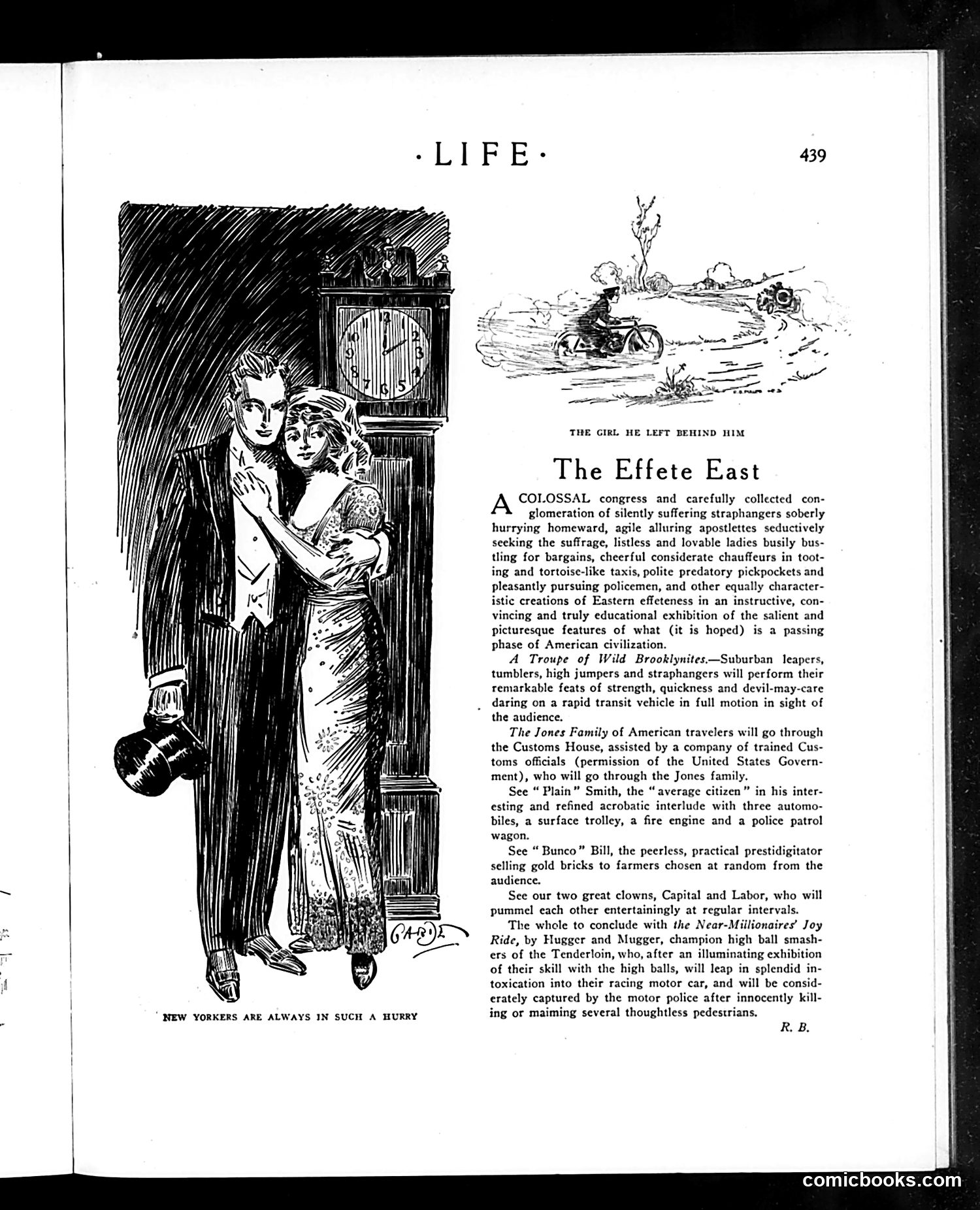
This satirical piece mocks Eastern urban life—particularly New York City—as decadent and culturally exhausted ("effete"). The left cartoon shows a man and woman in a doorway with a grandfather clock, captioned "New Yorkers Are Always in Such a Hurry," playing on stereotypes of frantic city dwellers. The main text describes a fictional "congress" or exhibition displaying Eastern types as curiosities: hurried commuters, suffragettes ("apostlettes"), street criminals, and corrupt officials. It then catalogs performers representing American urban vice: dangerous subway acrobats, customs corruption, reckless drivers, con artists, and "Capital and Labor" in violent conflict. The finale features drunken wealthy men ("Near-Millionaires") committing vehicular manslaughter with police indifference. The satire targets urban corruption, class conflict, reckless wealth, and institutional hypocrisy while stereotyping the East as morally bankrupt compared to (implied) wholesome America.
This page reviews Vicente Blasco Ibáñez's novel *The Blood of the Arena*, a Spanish work about a matador's rise from poverty to fame in bullfighting. The reviewer uses satirical framing—marketing the book as "sightseeing" entertainment for wealthy readers seeking exotic European spectacle. The satire targets two audiences: First, it mocks American upper-class consumers who treat foreign cultures as entertainment ("Look-see" literature), viewing Spanish bullfighting primarily as thrilling pageantry. Second, it critiques the novel itself for initially seducing readers with glamorous descriptions of the matador's social ascent before revealing the brutal reality—the "behind-the-scenes" truth of animal suffering and the crowd's bloodlust. The reviewer praises how Ibáñez uses bullfighting as a lens to expose Spanish society's values and contradictions. The title *"A Prince of Toreadors and a Princess from Tuscany"* emphasizes the European aristocratic mystique these works peddle to foreign audiences. The underlying message: don't mistake exotic appeal for genuine understanding.
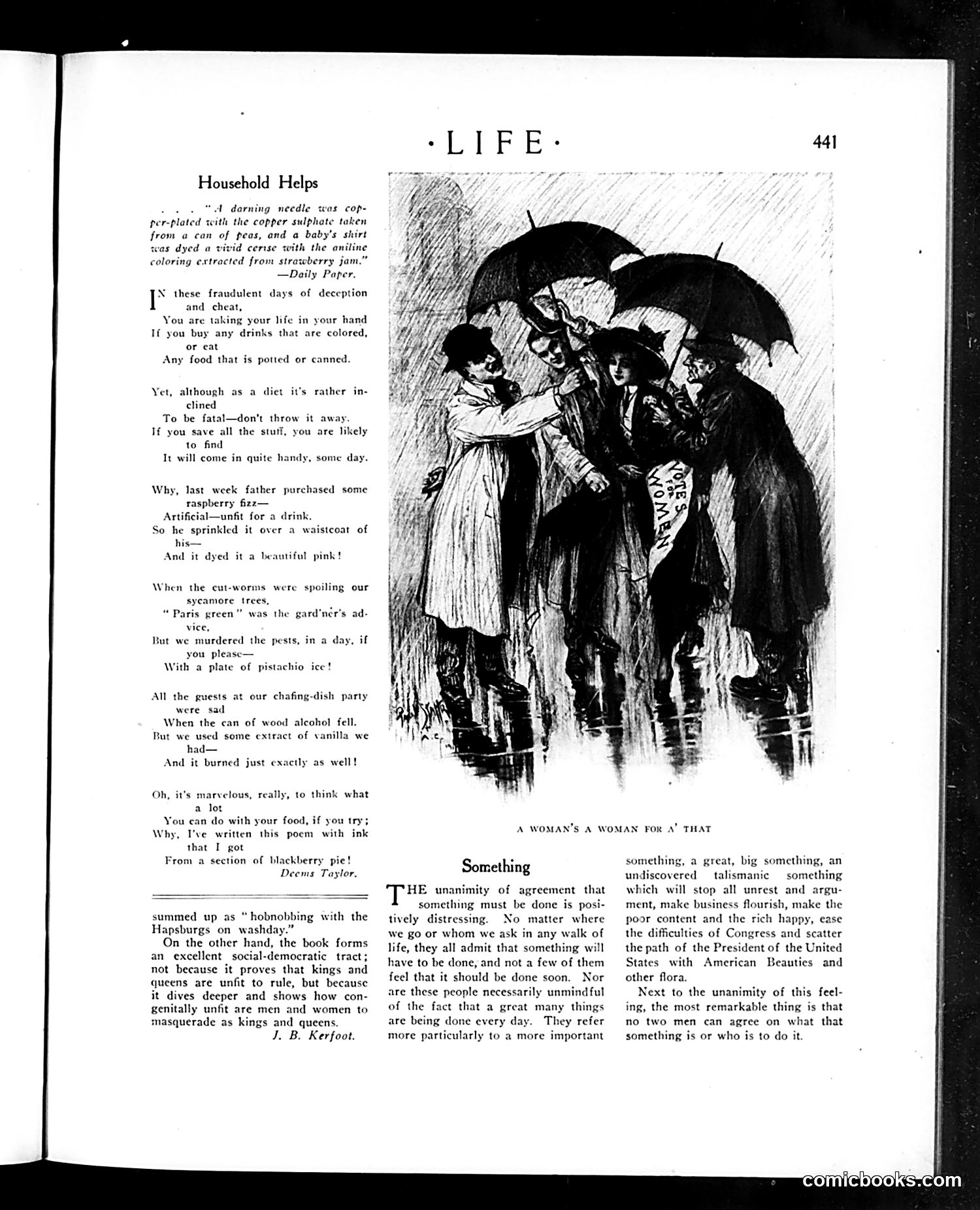
This page from *Life* magazine contains humorous commentary on early 20th-century food safety concerns and political frustration. **The "Household Helps" section** (by Deems Taylor) satirizes anxiety about adulterated foods. The poem jokes that since commercial products contain harmful substances—copper-plated needles, synthetic dyes, pesticides—people should repurpose them for other uses. The humor lies in treating poisoned food as a resource rather than danger. This reflects real Progressive-era fears about unregulated food manufacturing and patent medicines. **The "Something" essay** criticizes vague political rhetoric. Written during an era of social unrest (likely pre-WWI), it mocks how politicians and reformers constantly insist "something must be done" about unnamed problems, yet cannot agree what that "something" is. This appears to be satire of grandiose political promises without concrete solutions—a timeless critique. The illustration shows figures in rain, possibly depicting everyday people or political figures, though the specific reference is unclear without additional context.
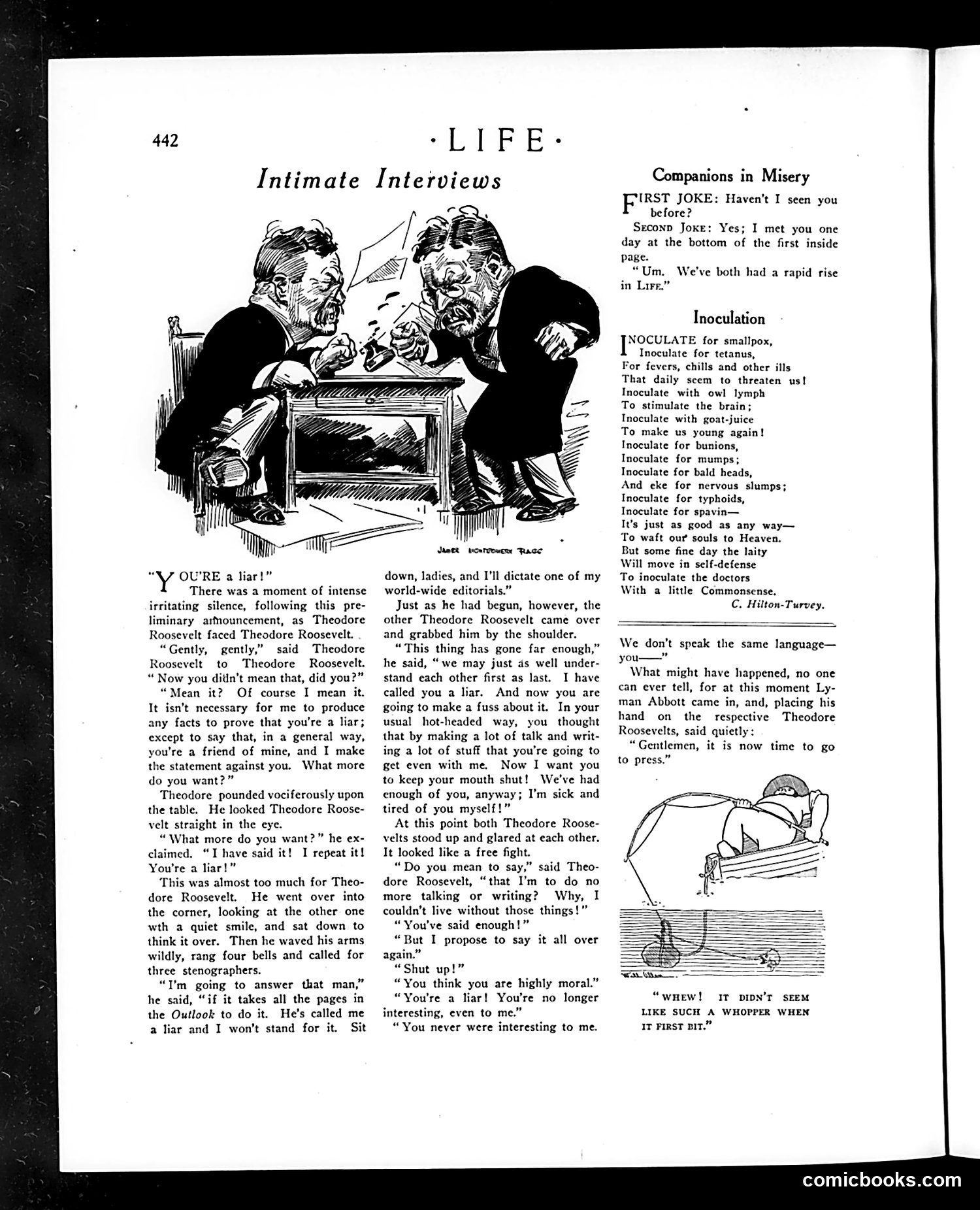
This satirical cartoon depicts Theodore Roosevelt arguing *with himself*, a visual joke about his famously combative personality and prolific output. The two "Theodores" quarrel over who is the liar, with one threatening to fill entire pages of the *Outlook* (a magazine Roosevelt edited) with rebuttals—mocking his tendency toward verbose, aggressive public statements. The satire critiques Roosevelt's argumentative nature and his reliance on writing and speech to dominate public discourse. By literally splitting him in two, the cartoon suggests his contradictions and endless self-justifications. The appearance of editor Lyman Abbott telling both versions "it is now time to go to press" punctures the absurdity: even Roosevelt's internal conflicts must serve publication deadlines. This likely dates to Roosevelt's post-presidency period when he remained a prominent, opinionated public figure.
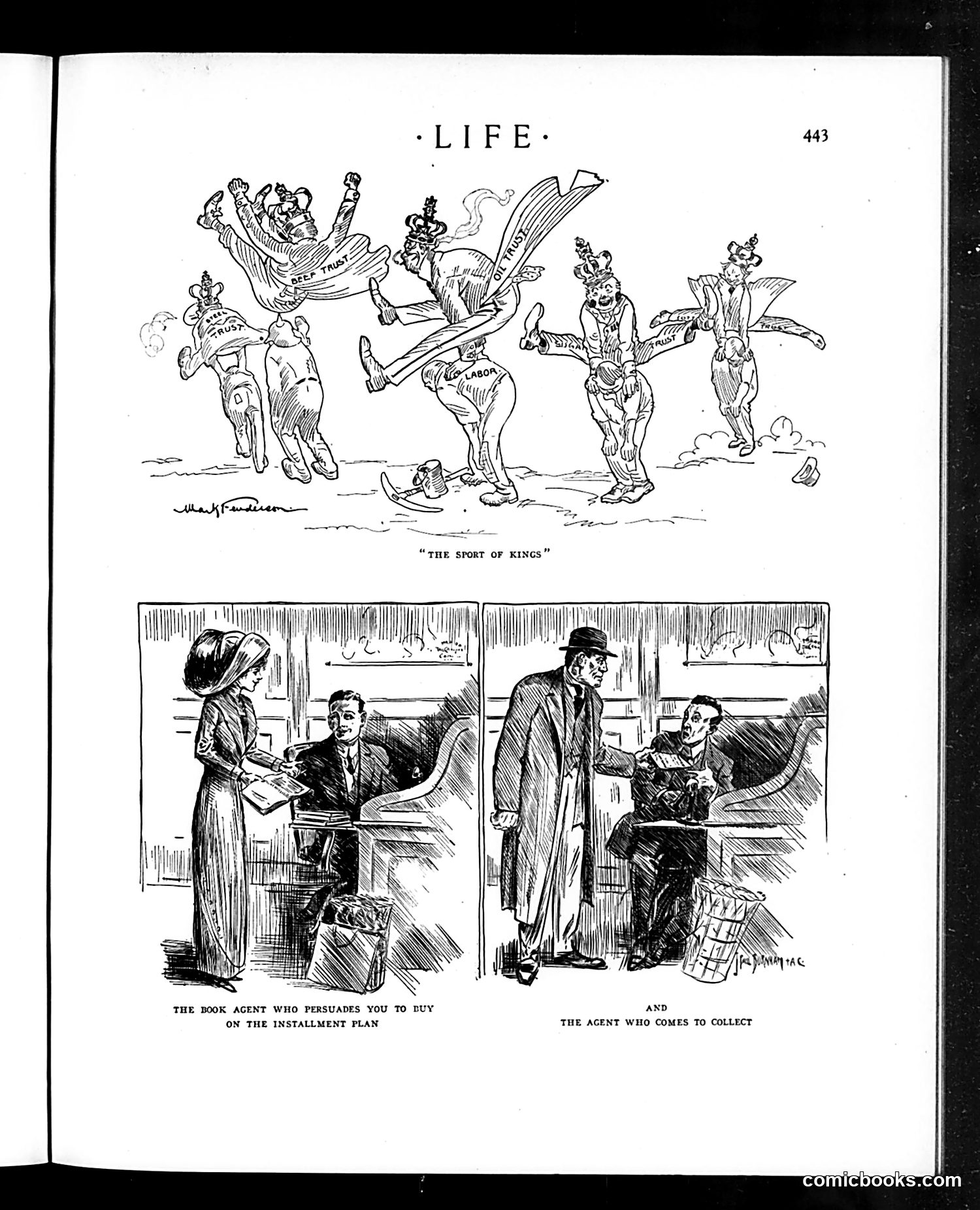
This page contains two distinct cartoons satirizing the book sales industry, likely from the early 20th century. The top cartoon, titled "The Sport of Kings," depicts crowned figures engaged in acrobatic antics, suggesting that book-selling activities are treated as entertainment or sport by the wealthy. The bottom two panels contrast the contrasting behavior of book agents: the left shows a charming agent persuading a customer to purchase books on an installment plan, while the right reveals the same agent's aggressive demeanor when collecting payments. The satire criticizes the deceptive sales tactics of installment-plan book agents who charm customers into purchases, then become threatening collectors. This reflects consumer complaints about aggressive debt collection practices and predatory lending schemes that were apparently common enough to merit public mockery in *Life* magazine.
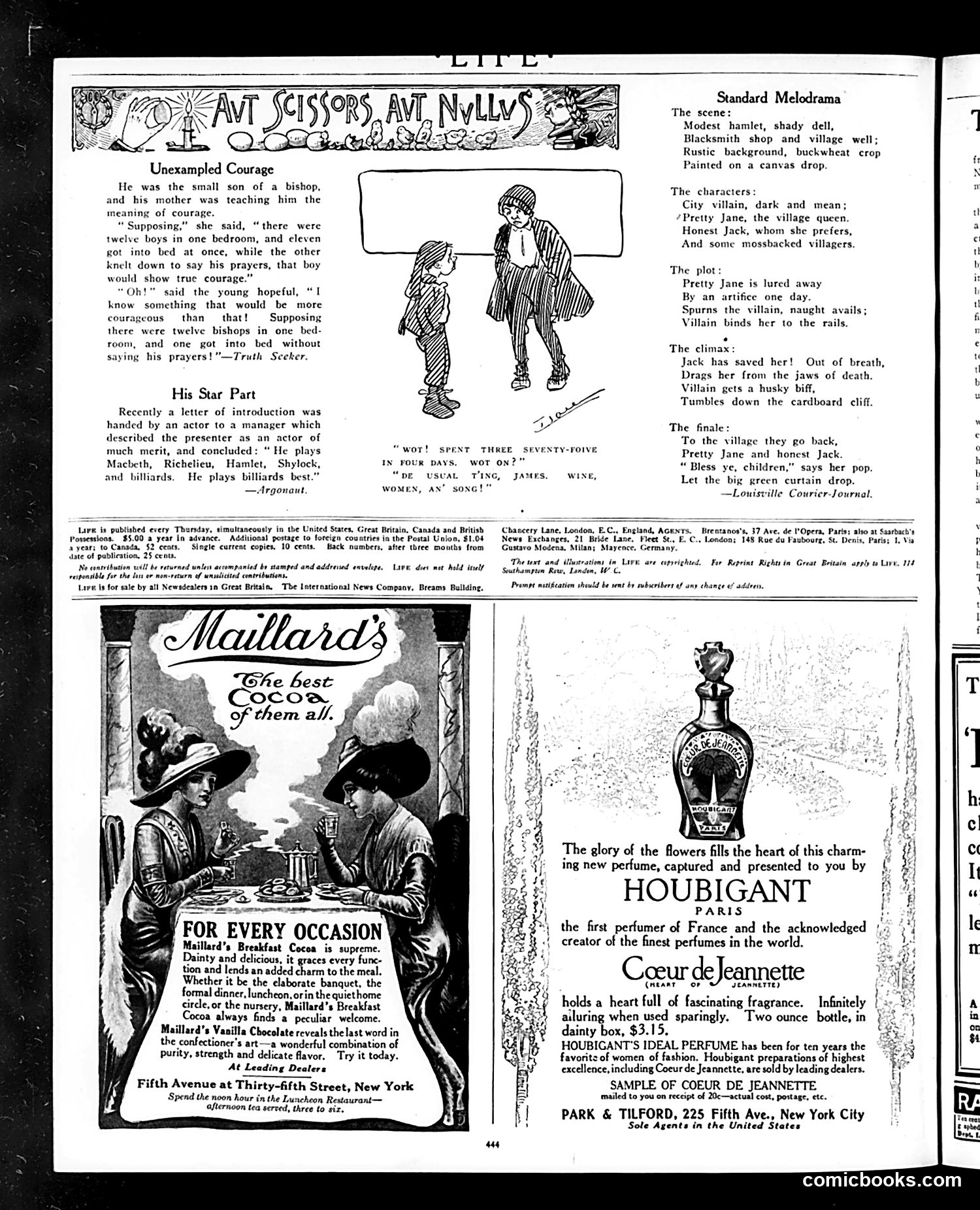
This page from *Life* magazine contains three distinct humor pieces plus advertisements. **"Unexampled Courage"** and **"His Star Part"** are brief jokes. The first mocks religious piety by having a bishop's son suggest that praying bishops would be more courageous than praying boys—a mild dig at clergy. The second satirizes actors' vanity: a letter of introduction praises an actor for playing great dramatic roles but concludes he "plays billiards best," suggesting his actual talent lies only in billiards. **"Standard Melodrama"** parodies the overwrought theatrical conventions of early 20th-century popular drama. It mockingly outlines the predictable formula: virtuous heroine ("Pretty Jane"), honest hero ("Honest Jack"), mustache-twirling villain, and absurdly convenient plot resolutions (the villain literally tumbles off a cardboard cliff). The satire targets the genre's artificial staging and predictable narrative structure that audiences found thrilling but were, to sophisticated viewers, risibly simplistic. The page is primarily **advertisements** for Maillard's cocoa and Houbigant perfume.
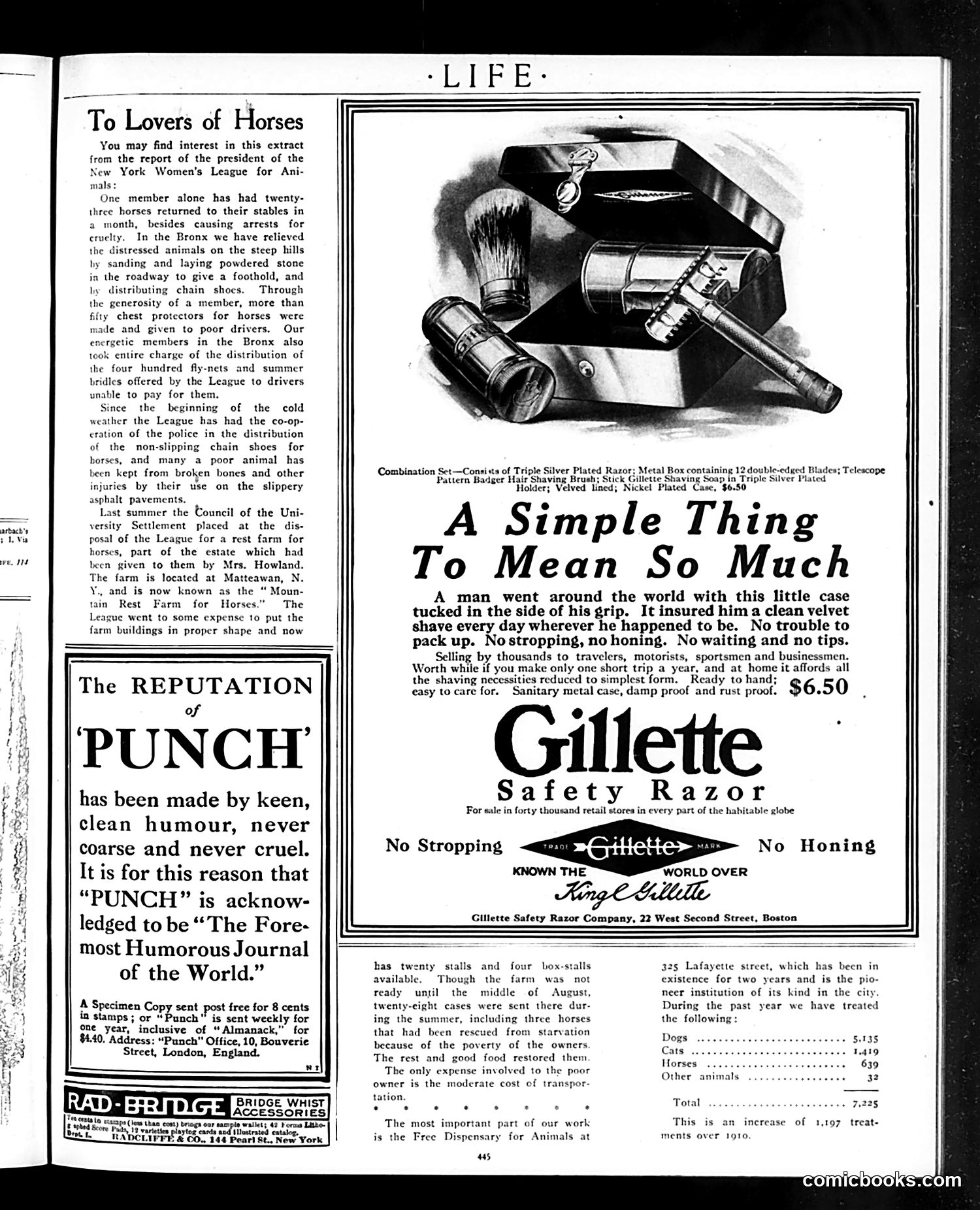
This page is primarily **advertising and organizational reporting**, not political satire. The main elements are: **Left side:** A report from the New York Women's League for Animals detailing their horse welfare work—rescuing mistreated horses, distributing anti-slip shoes and fly-nets to poor drivers, and operating a rest farm. The statistics show they treated 7,235 animals in one year. **Center/Right:** A **Gillette Safety Razor advertisement** with an illustration of a grooming kit. The ad emphasizes convenience for travelers and businessmen—no stropping or honing required. **Bottom left:** An advertisement for *Punch* magazine, describing its reputation for "keen, clean humour, never coarse and never cruel." **Context for modern readers:** This reflects Progressive Era concern for animal welfare and worker conditions (poor drivers and their horses). The Gillette ad represents early 20th-century marketing of modern convenience products to mobile professionals. There is **no political cartoon or satirical humor** on this page—it's a straightforward mix of advocacy journalism and product advertising.
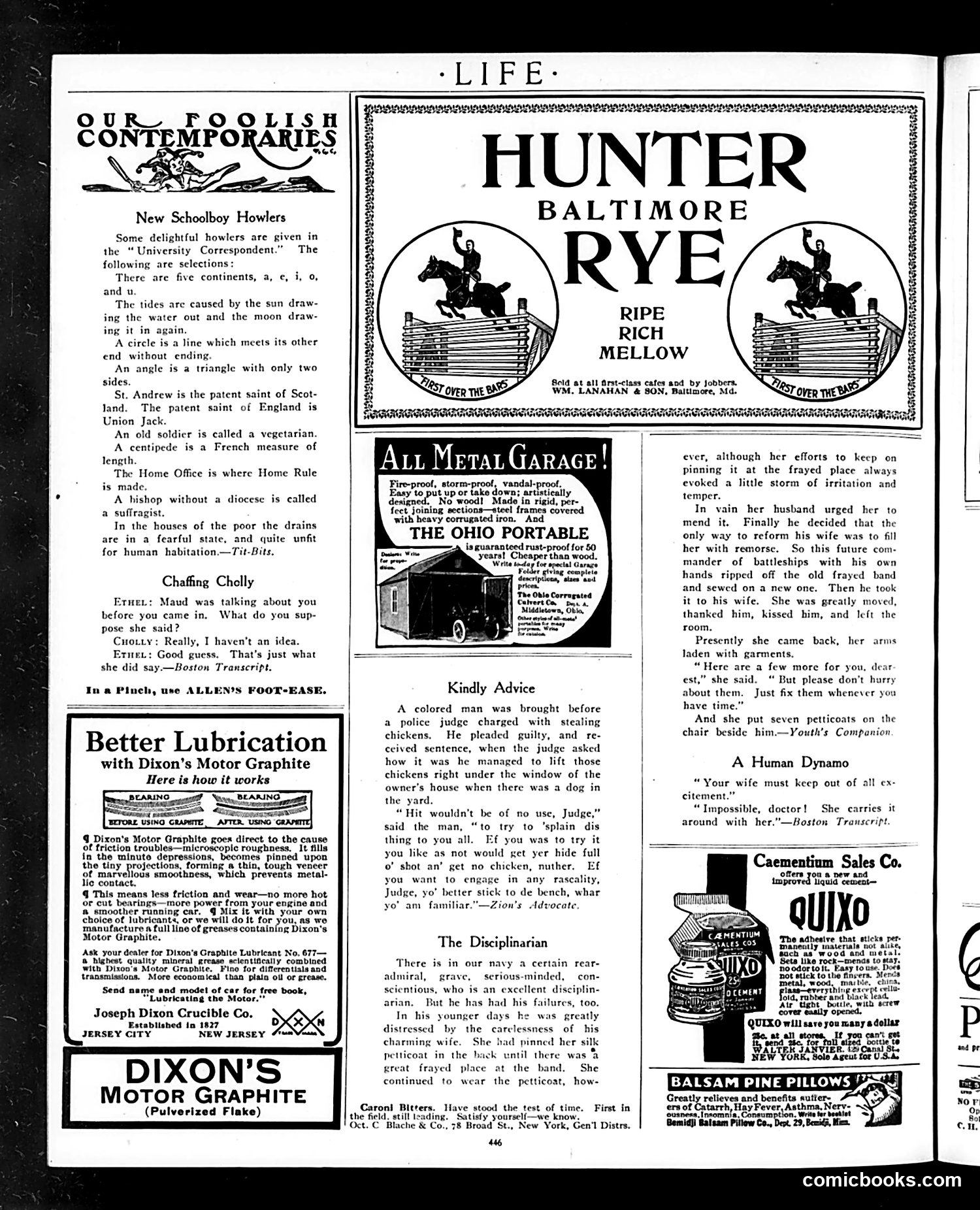
This page from *Life* magazine combines humor with period advertising. The main satirical section, "Our Foolish Contemporaries," mocks absurd student definitions—such as defining "St. Andrew" as Scotland's "patent saint" (misunderstanding "patron") and calling a bishop without a diocese a "suffragist." These mock scholboy howlers were popular humor, ridiculing educational failures through intentional malapropisms. The "Kindly Advice" anecdote uses racist dialect humor common to the era, presenting a Black defendant's clever courtroom retort mocking judicial hypocrisy—ironically the sharpest commentary on the page. The remainder consists of period advertisements for lubricants, garages, rye whiskey, and other products. The page reflects early-20th-century *Life* as a vehicle for satirizing contemporary foolishness alongside commercial messaging.
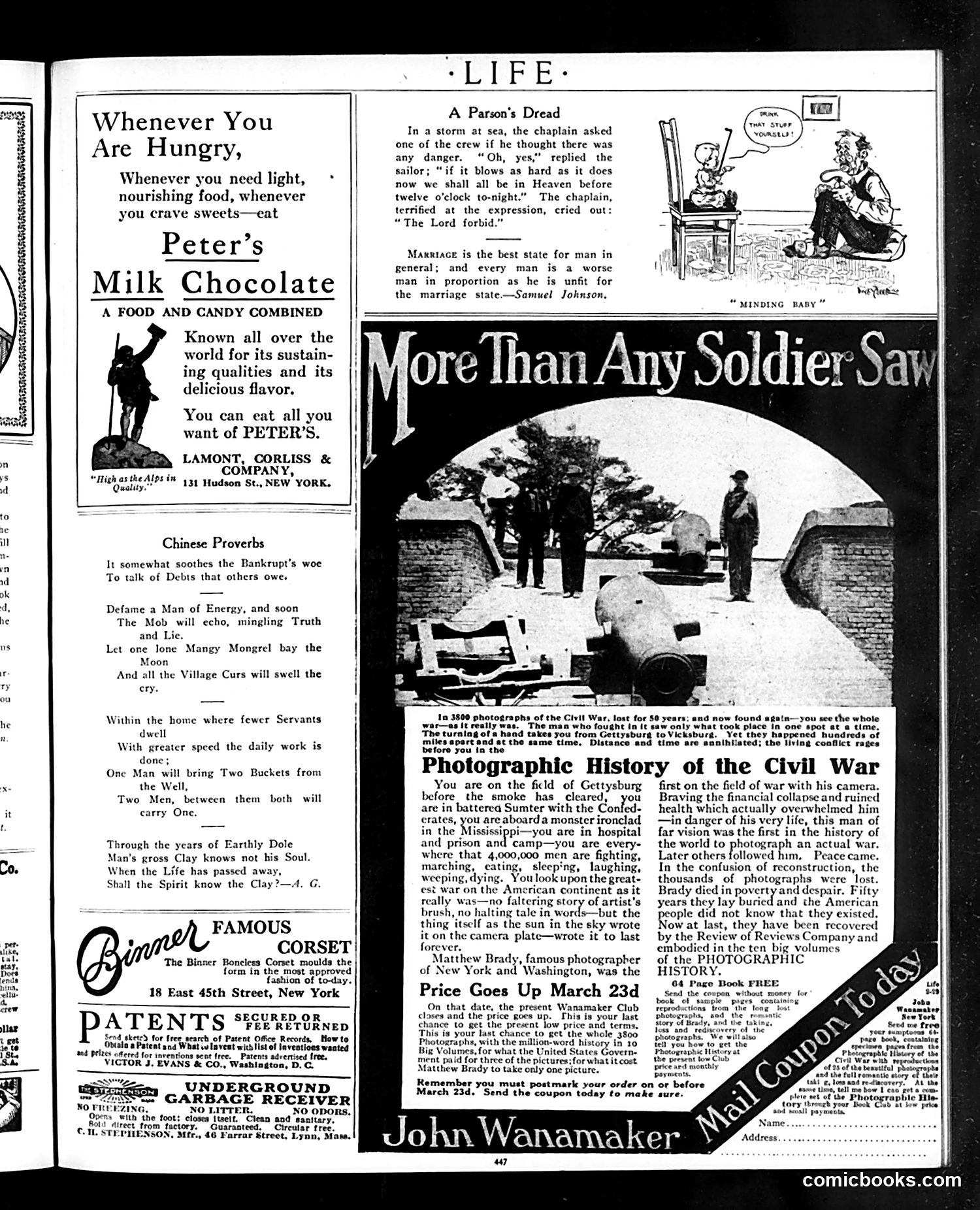
This page is primarily **advertising and light humor**, not political satire. The main elements: **Advertisements:** Peter's Milk Chocolate, Binner Corset, and prominently, the "Photographic History of the Civil War" by Matthew Brady—a multi-volume collection being marketed by John Wanamaker. The Brady ad emphasizes that his photographs captured the Civil War's reality more authentically than artists' renderings. **Light humor pieces:** - "A Parson's Dread" is a mild joke about a sailor's confidence in divine rescue during a storm, which alarms the chaplain. - "Minding Baby" (small cartoon) and "Chinese Proverbs" offer gentle, moralizing observations. **Historical context:** Matthew Brady was indeed a famous Civil War photographer whose negatives were lost and recovered decades later—this ad capitalizes on that rediscovery to market the reproduction collection before a March 23rd price increase. The page reflects *Life* magazine's mixed function: satirical commentary alongside commercial content aimed at educated, middle-class readers.
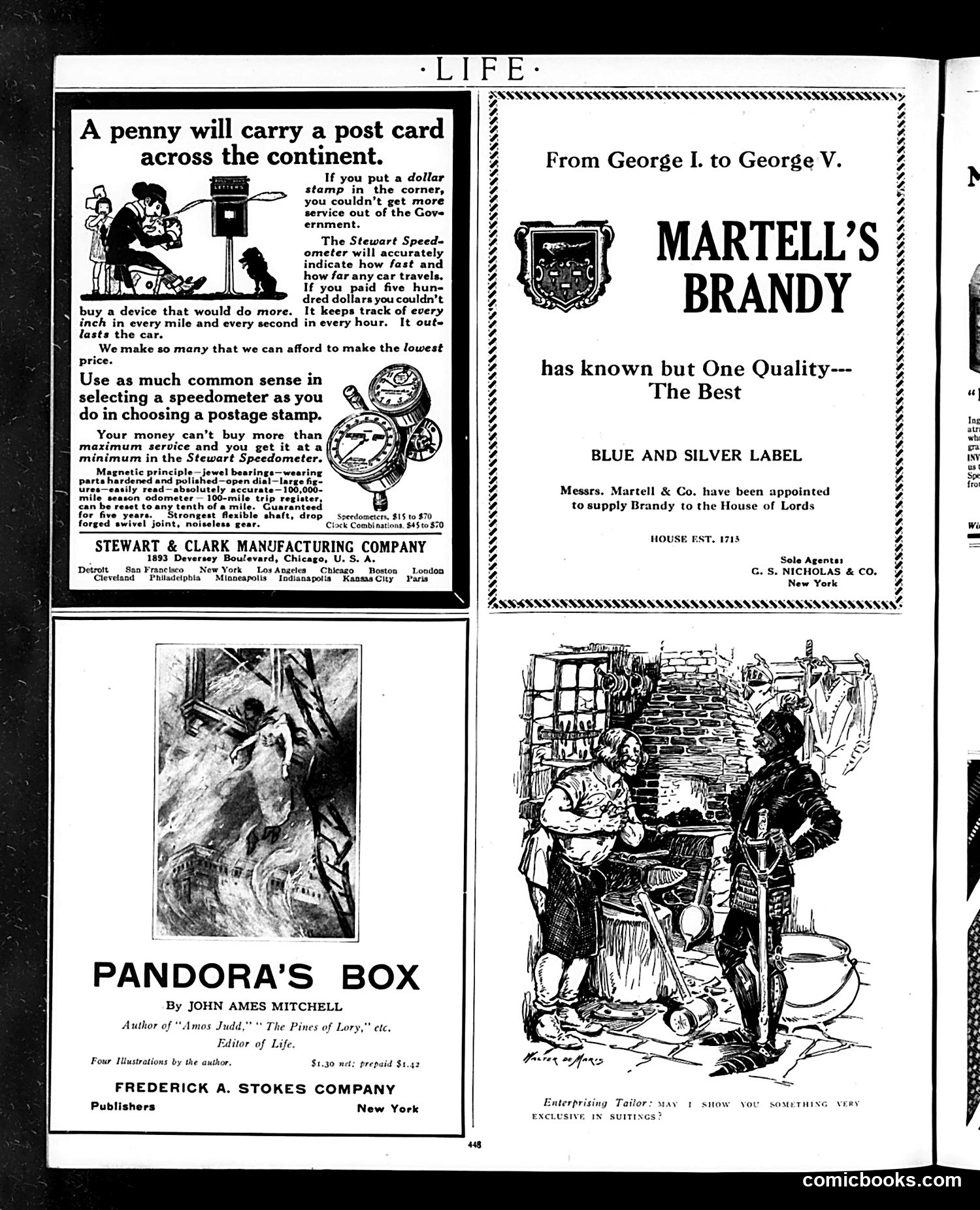
This page contains **primarily advertisements and book promotion**, not political satire. The top left advertises Stewart speedometers, using comparative humor: a penny postcard costs minimal postage, yet a dollar stamp yields no better service—similarly, expensive speedometers offer no better function than cheaper models. The ad emphasizes value for money. The upper right promotes **Martell's Brandy**, highlighting its royal appointment to the British House of Lords since 1713, spanning from "George I to George V" (British monarchs), suggesting centuries of quality and prestige. The lower left advertises **"Pandora's Box" by John Ames Mitchell**, editor of Life, a book available through Frederick A. Stokes Company. The lower right illustration appears to be a scene from the book—an "Enterprising Tailor" showing exclusive suit fabrics to what appears to be military or aristocratic figures. This is promotional content rather than political commentary. The page functions primarily as a marketing vehicle for various products and publications.
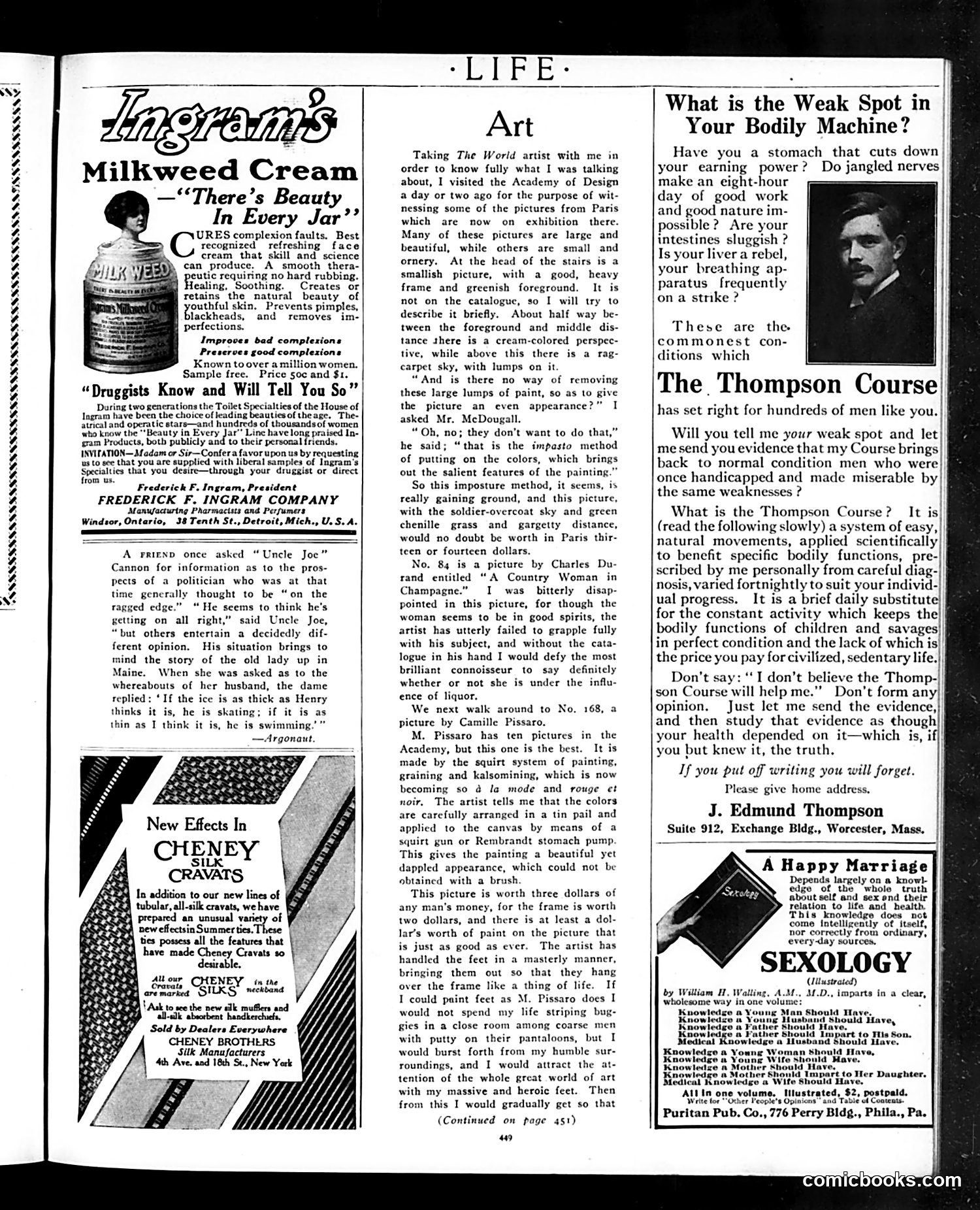
This page combines advertisements with editorial content typical of early 20th-century Life magazine. **Main Content:** The "Art" column discusses an Academy of Design exhibition featuring paintings from Paris. The author critiques a specific painting (No. 84 by Charles Durand, "A Country Woman in Champagne"), describing its technical flaws—particularly the awkward "soldier-overcoat sky" and poorly rendered landscape. The satire lies in the detailed, humorous dissection of a mediocre artwork's pretensions. **Advertisements:** - **Ingram's Milkweed Cream**: A beauty product claiming to cure complexion faults - **Cheney Silk Cravats**: Featuring "new effects" in neckwear - **The Thomson Course**: A mail-order health/fitness system promising to cure bodily weaknesses through "natural movements" - **Sexology book**: A guidebook on marital and sexual knowledge The juxtaposition is satirical: Life presents both artistic mediocrity and commercial snake-oil remedies as equally dubious—reflecting the magazine's skeptical stance toward both pretentious culture and dubious consumer products of the era.
This page is **not a political cartoon or satirical content**—it's a **commemorative advertisement** celebrating Scribner's Magazine's 25th anniversary. The page contains only laudatory text quotes from major newspapers (New York Times, The Outlook, New York Tribune, Chicago Record-Herald) praising the magazine's literary quality and editorial distinction. The quotes highlight that Scribner's published major writers like Robert Louis Stevenson, George Meredith, and Edith Wharton, and maintained high standards combining "belles-lettres" (fine literature) with art and knowledge. At the bottom, Charles Scribner's Sons advertises the magazine at $3.00/year or 25 cents per issue. There is **no cartoon, no satire, and no political commentary** visible. This is a straightforward publisher's tribute page in *Life* magazine itself—essentially one magazine celebrating a competitor's milestone.
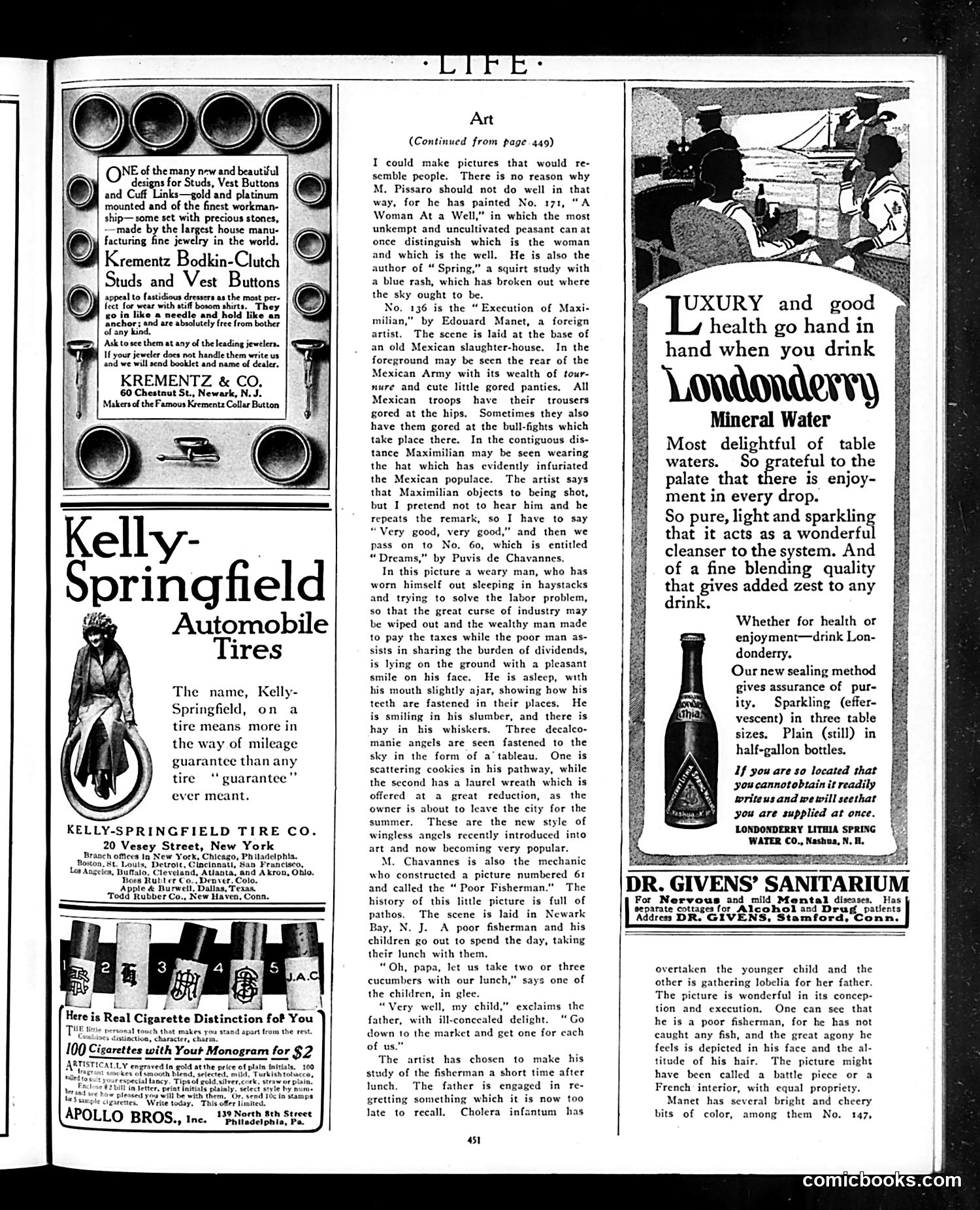
This page is primarily **advertising** for luxury goods (jewelry studs, automobile tires, cigarettes), but includes an extended **art criticism** section mocking contemporary art movements. The art commentary (continued from page 449) satirizes **Impressionist and modern painters**, particularly **Camille Pissaro** and **Édouard Manet**. The critic ridicules Pissaro's "Woman at a Well" painting, claiming the peasant subject is so crude that even an uncultivated viewer can distinguish the woman from the well. He mocks Puvis de Chavannes's "Dreams" for its sentimental imagery of a sleeping laborer surrounded by absurd details like "wingless angels" scattering cookies. The satire targets the **obscurity and pretentiousness of modern art**, suggesting these avant-garde works are incomprehensible or silly to ordinary viewers. This reflects late-19th-century American skepticism toward Modernism and European artistic experimentation.
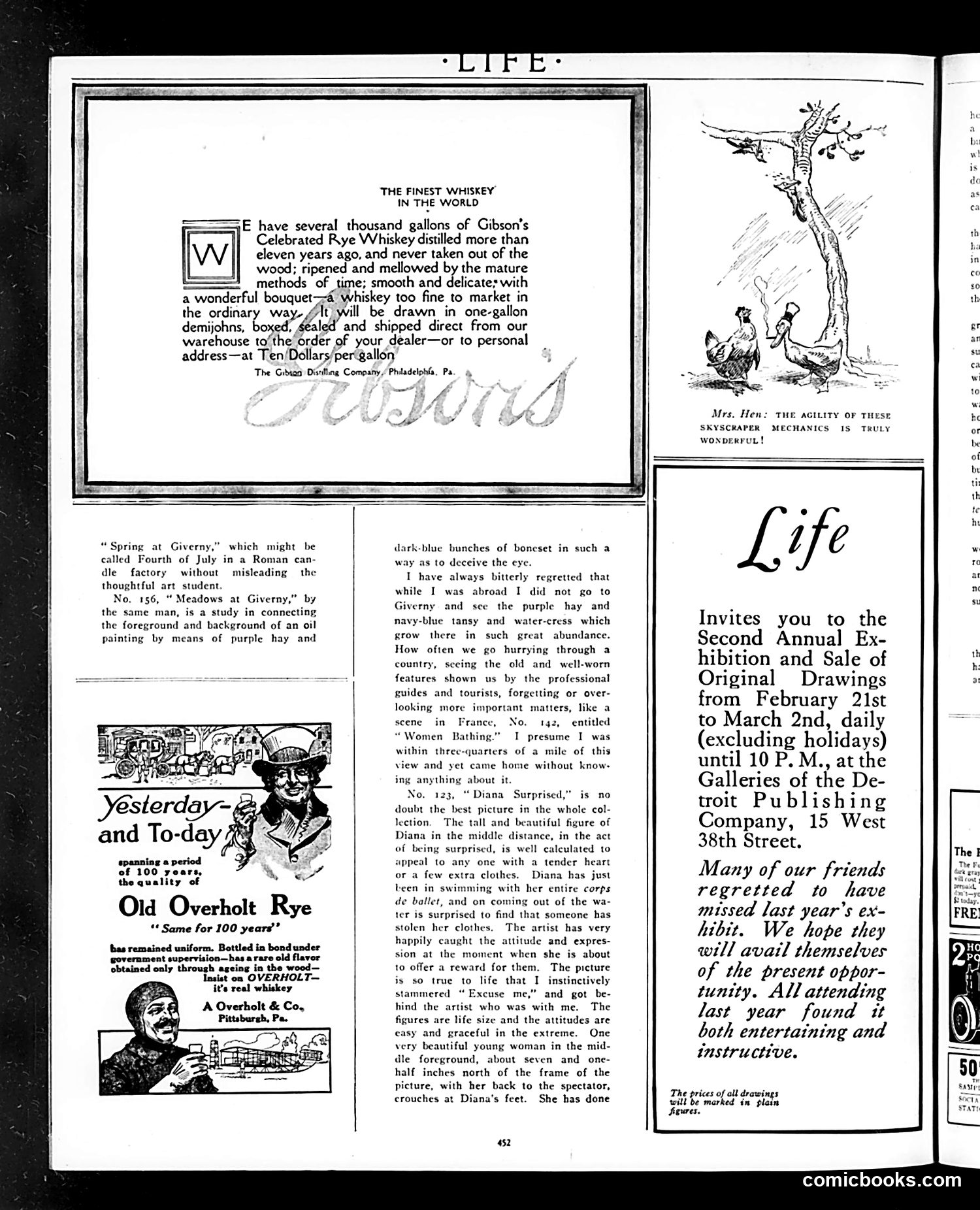
This page is primarily **advertising and announcements** rather than political satire. It contains: 1. **Three whiskey ads** (Gibson's Rye, Old Overholt Rye) — typical period liquor marketing, notable because this predates Prohibition's enforcement 2. **An art criticism essay** discussing paintings shown at what appears to be an exhibition, including works titled "Spring at Giverny," "Diana Surprised," and "Women Bathing." The unnamed author humorously regrets missing certain scenic views while traveling and makes a comedic aside about a nude bathing scene, stammering "Excuse me" behind the artist 3. **An announcement** for the Detroit Publishing Company's "Second Annual Exhibition and Sale of Original Drawings" (February 21 - March 2) The page reflects early 20th-century Life magazine content: a mix of consumer advertising, cultural commentary, and art world coverage aimed at educated, affluent readers.
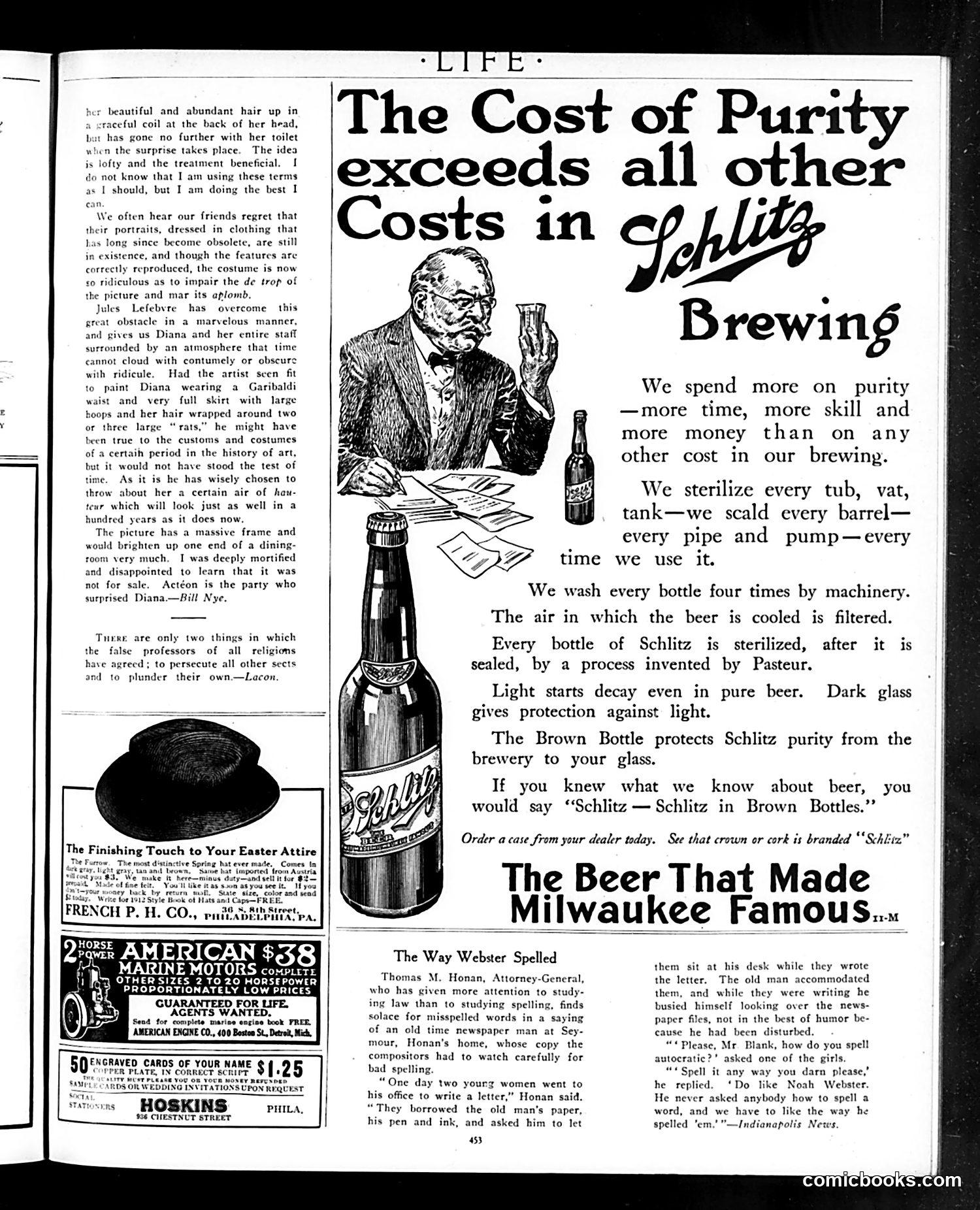
This page contains three distinct elements: 1. **Left column essay** (by Bill Nye): A art criticism discussing painter Jules Lefebvre's portrait of Diana. The writer praises how Lefebvre avoided making the painting look dated by using timeless classical styling rather than contemporary 1880s-90s fashions (mentioning period details like "Garibaldi waist" and "rats"—hair pads). 2. **Center/right: Schlitz Beer advertisement** claiming superior purity standards—sterilizing equipment, washing bottles multiple times, using dark glass for protection. This reflects late-19th-century brewing industry competition emphasizing sanitation (Pasteurization was relatively new). 3. **Bottom right: Humorous anecdote** about Attorney General Honan, contrasting a meticulous old newspaper compositor with the casual attitude "do it any way you want"—implying standards have relaxed. The Noah Webster reference suggests even famous authorities weren't pedantic about spelling. The page is primarily **advertising-driven content** mixed with light satirical commentary on art, industry standards, and declining attention to detail.
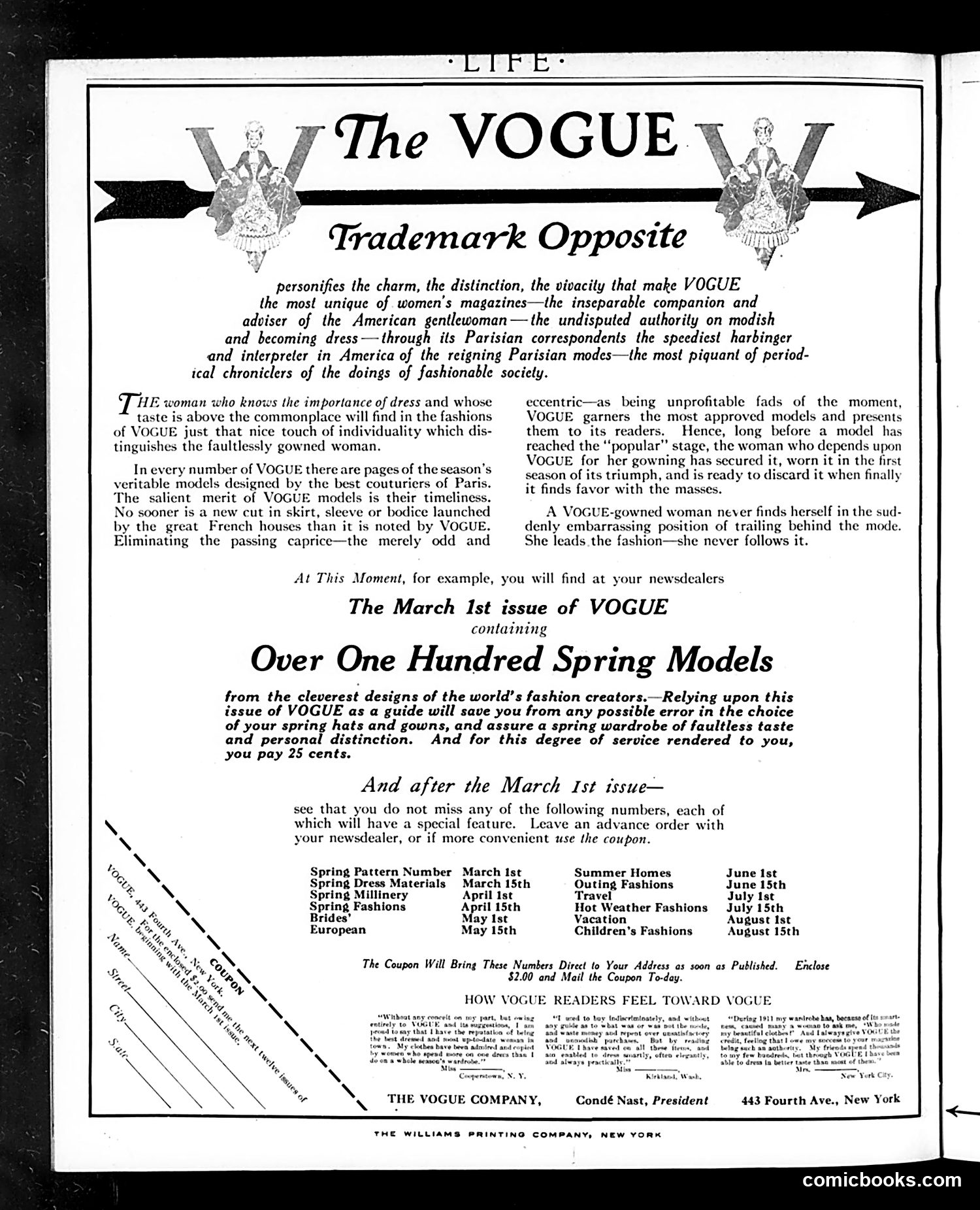
This is primarily a **full-page advertisement for Vogue magazine**, not a political cartoon. The page promotes Vogue as the authoritative fashion guide for American gentlewomen, emphasizing its role in reporting Parisian fashion trends before they reach mass popularity. The "Trademark Opposite" headline appears ironic—the text claims Vogue *leads* fashion rather than following it, positioning readers as fashion pioneers rather than trend-followers. The advertisement promises that Vogue subscribers wear styles "in the first season of its triumph" before the masses adopt them, establishing social distinction through early adoption. The page advertises the March 1st issue featuring "Over One Hundred Spring Models" for 25 cents and promotes upcoming special issues (April, May, June, July, August) with a mail-in coupon for $2.00. This reflects **early 20th-century class marketing**: Vogue positioned itself as an arbiter of taste for wealthy, fashionable women, distinguishing them from ordinary consumers who follow trends belatedly.
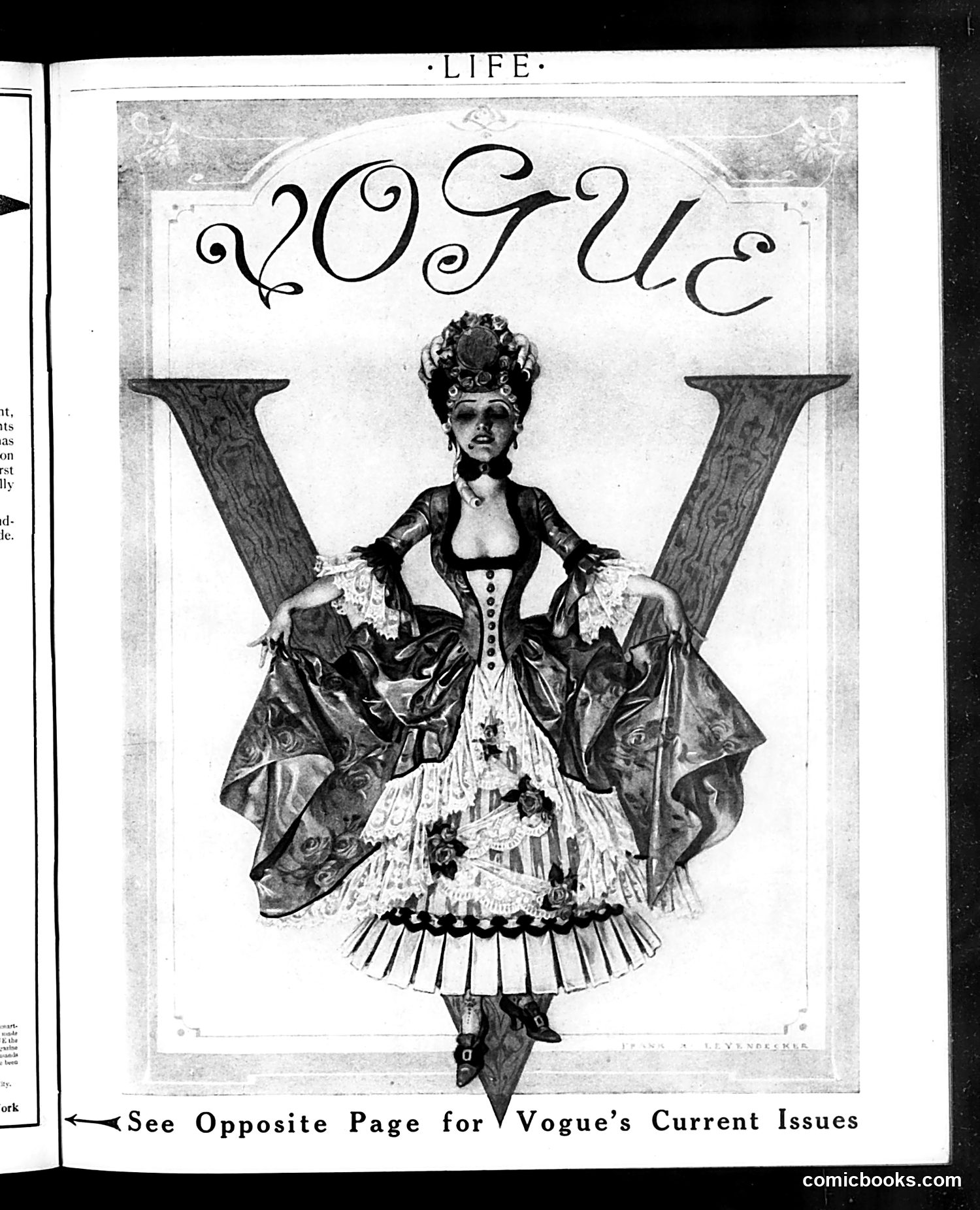
This is a cover or title page from *Life* magazine featuring an illustration labeled "VOGUE" in stylized script. The image depicts a fashionably dressed woman in elaborate early 20th-century attire—a dark jacket with large sleeves, a white pleated skirt, and an ornate hat—positioned within an oversized decorative "W." The satire appears to mock the fashion magazine *Vogue* and the vogue (fashion trend) industry itself. The woman's exaggerated, theatrical pose and expensive clothing suggest commentary on the extravagance and pretension of high fashion. The note directing readers to "See Opposite Page for Vogue's Current Issues" indicates *Life* was using humor to critique fashion magazine content, likely lampooning the excesses and absurdities of contemporary style culture and fashion obsession.
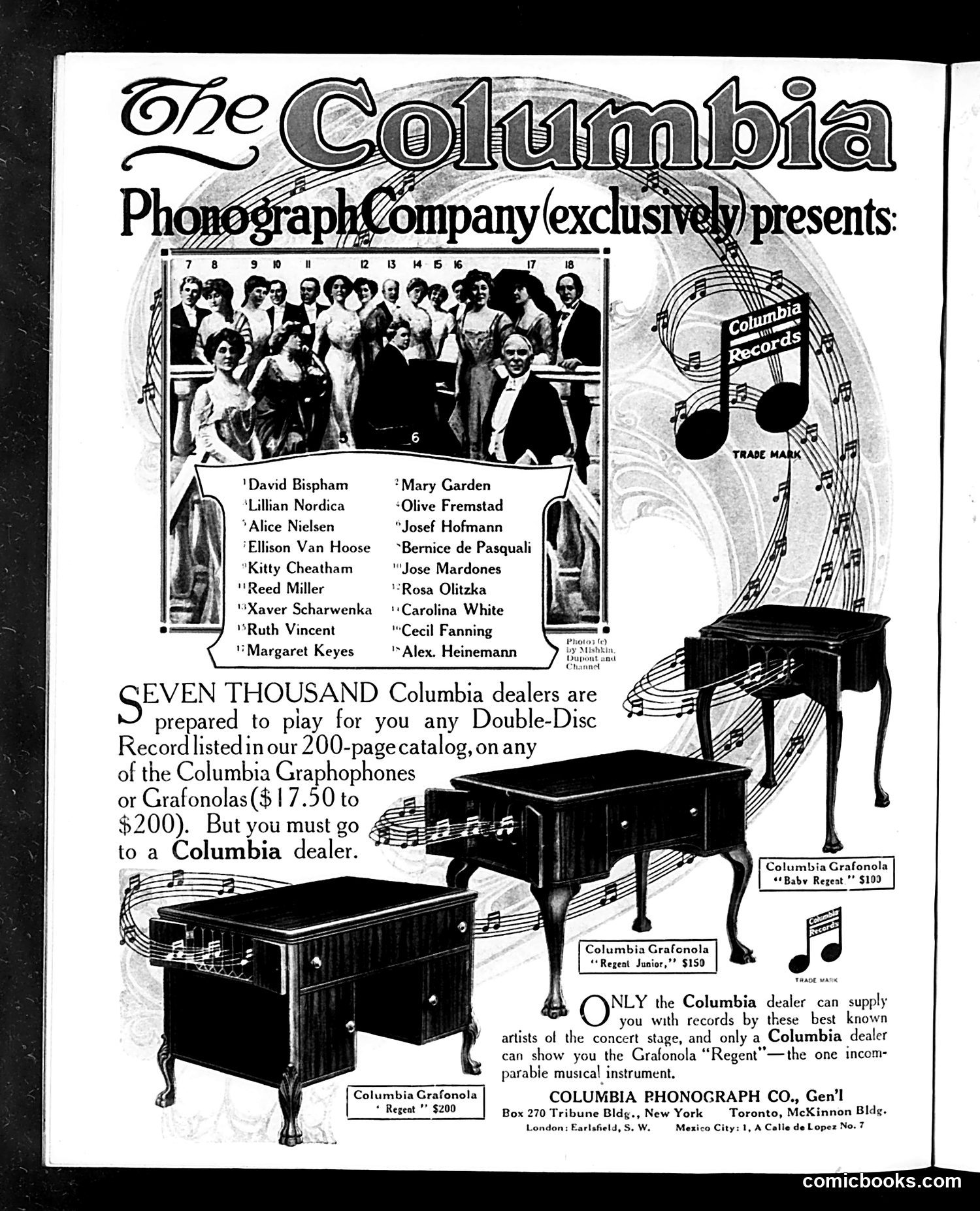
This is a **product advertisement**, not satire or political commentary. Columbia Phonograph Company promotes its gramophones and records by featuring prominent **opera and classical music artists** of the early 20th century—names like David Bispham, Mary Garden, and Josef Hofmann, who were celebrated concert performers of the era. The ad's strategy emphasizes **exclusivity**: only Columbia dealers can supply records by these "best known artists" and showcase the high-end "Regent" grafonola model. Three grafonola models are pictured, priced from $109 to $200—substantial sums indicating luxury products for affluent consumers. The numbered group photo suggests these are the featured artists. The message: owning a Columbia grafonola grants access to world-class musical performance in your home—a significant selling point in the pre-radio era when recorded music was novel and aspirational.