
Life, 1912-02-29 · page 24 of 40
Life — February 29, 1912 — page 24: what you’re looking at
What you’re looking at
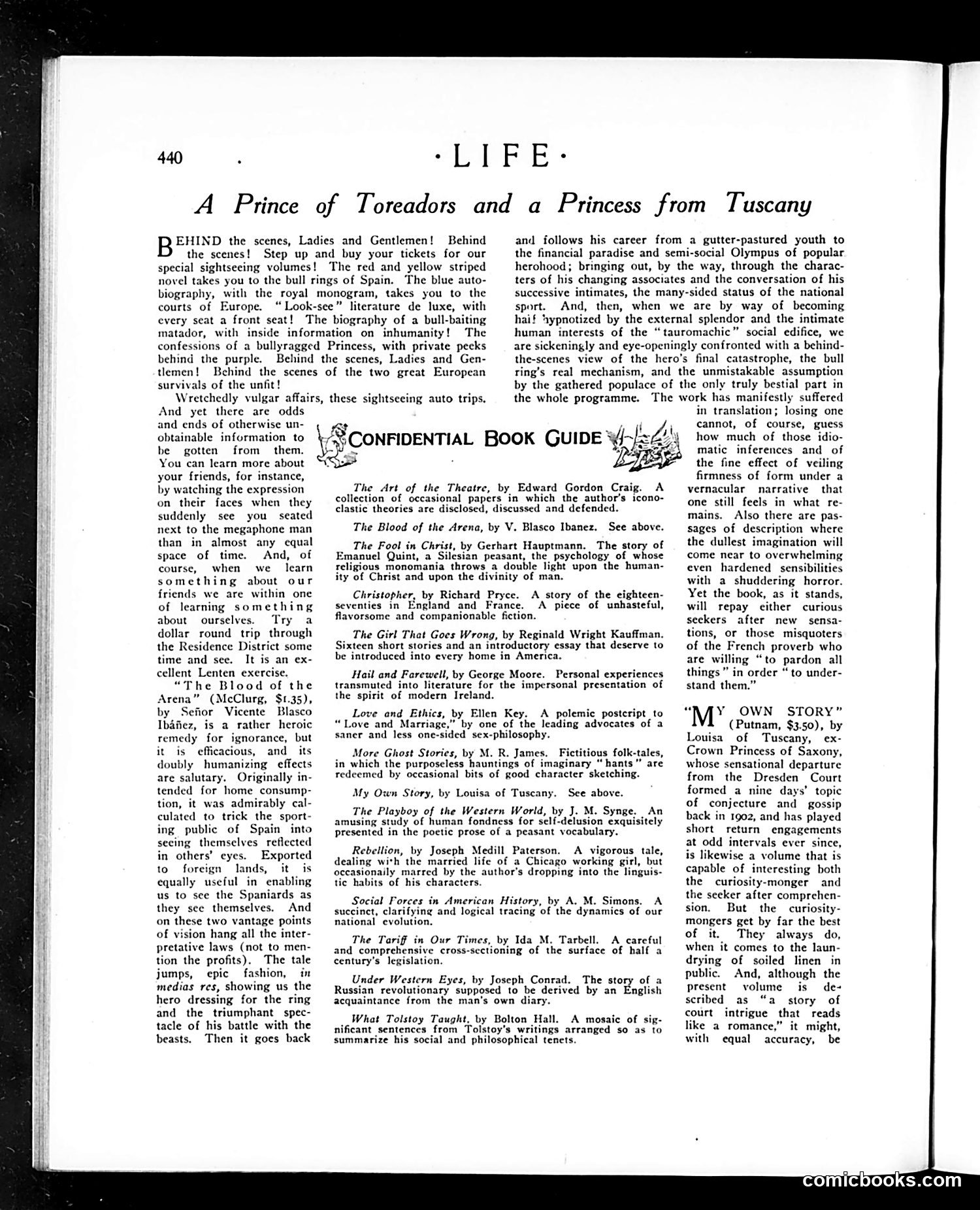
This page reviews Vicente Blasco Ibáñez's novel *The Blood of the Arena*, a Spanish work about a matador's rise from poverty to fame in bullfighting. The reviewer uses satirical framing—marketing the book as "sightseeing" entertainment for wealthy readers seeking exotic European spectacle. The satire targets two audiences: First, it mocks American upper-class consumers who treat foreign cultures as entertainment ("Look-see" literature), viewing Spanish bullfighting primarily as thrilling pageantry. Second, it critiques the novel itself for initially seducing readers with glamorous descriptions of the matador's social ascent before revealing the brutal reality—the "behind-the-scenes" truth of animal suffering and the crowd's bloodlust. The reviewer praises how Ibáñez uses bullfighting as a lens to expose Spanish society's values and contradictions. The title *"A Prince of Toreadors and a Princess from Tuscany"* emphasizes the European aristocratic mystique these works peddle to foreign audiences. The underlying message: don't mistake exotic appeal for genuine understanding.
📄 Transcribed text from this page (OCR, searchable)
Machine-transcribed from the original scan — historical spelling and the odd misread are preserved.
440 “DDE E = A Prince of Toreadors and a Princess from Tuscany EHIND the scenes, Ladies and Gentlemen! Behind the scenes! Step up and buy your tickets for our special sightseeing volumes! ‘The red and yellow striped novel takes you to the bull rings of Spain. The blue auto- biography, with the royal monogram, takes you to the courts of Europe. “Look-see” literature de luxe, with every seat a front seat! The biography of a bull-baiting matador, with inside information on inhumanity! The confessions of a bullyragged Princess, with private pecks behind the purple. Behind the scenes, Ladies and Gen- tlemen! Behind the scenes of the two great European survivals of the unfit! and follows his career from a gutter-pastured youth to the financial paradise and semi-social Olympus of popular herohood; bringing out, by the way, through the charac- ters of his changing associates and the conversation of his successive intimates, the many-sided status of the national sport. And, then, when we are by way of becoming haif 4ypnotized by the external splendor and the intimate human interests of the “tauromachic” social edifice, we are sickeningly and eye-openingly confronted with a behind- the-scenes view of the hero’s final catastrophe, the bull ring’s real mechanism, and the unmistakable assumption by the gathered populace of the only truly bestial part in Wretchedly vulgar affairs, these sightseeing auto trips. And yet there are odds and ends of otherwise un- obtainable information to be gotten from them. You can learn more about your friends, for instance, by watching the expression on their faces when they suddenly see you seated next to the megaphone man than in almost any equal space of time. And, of course, when we learn something about our friends we are within one of learning something about ourselves. Try a dollar round trip through the Residence District some time and see. It is an ex- cellent Lenten exercise. “The Blood of the Aren (McClurg, $1.35), by Sefior Vicente Blasco Ibafiez, is a rather heroic remedy for ignorance, but it is efficacious, and_ its doubly humanizing effects are salutary, Originally in- tended for home consump- tion, it was admirably cal- culated to trick the sport- ing public of Spain into secing themselves reflected in others’ eyes. Exported to foreign lands, it is equally useful in enabling us to see the Spaniards as they see themselves. And on these two vantage points of vision hang all the inter- pretative laws (not to men- tion the profits). The tale jumps, epic fashion, in medias res, showing us the hero dressing for the ring and the triumphant spec- tacle of his battle with the beasts. Then it goes back the whole programme. et CONFIDENTIAL BOOK GUIDE ¥j~/: The Art of the Theatre, by Edward Gordon Craig. A collection of occasional papers in which the author's icono- clastic theories are disclosed, discussed and defended. The Blood of the Arena, by V. Blasco Ibanez. The Fool in Christ, by Gerhart Hauptmann. The story of Emanuel Quint, a Silesian peasant, the psychology of whose religious monomania throws a double light upon the human- ity of Christ and upon the divinity of man. A story of the eighteen- ‘A piece of unhasteful, See above. Christopher, by Richard Pryce. seventies in England and France. flavorsome and companionable fiction. The Girl That Goes Wrong, by Reginald Wright Kauffman. Sixteen short stories and an introductory essay that deserve to be introduced into every home in America. Hail and Farewell, by George Moore. Personal experiences transmuted into literature for the impersonal presentation of the spirit of modern Ireland. Love and Ethics, by Ellen Key. A polemic posteript to “Love and Marriage,” by one of the leading advocates of a saner and less one-sided sex-philosophy. More Ghost Stories, by M. R. James. Fictitious folk-tales, in which the purposcless hauntings of imaginary “hants” are redeemed by occasional bits of good character sketching. My Own Story, by Louisa of Tuscany. See above. The Playboy of the Western World, by J. M. Synge. An amusing study of human fondness for self-delusion exquisitely presented in the poetic prose of a peasant vocabulary. Rebellion, by Joseph Medill Paterson. A vigorous tale, dealing with the married life of a Chicago working girl, but occasionaily marred by the author's dropping into the linguis- tic habits of his characters. Social Forces in American History, by A. M. Simons. A succinct, clarifying and logical tracing of the dynamics of our national’ evolution. The Tariff in Our Times, by Ida M. Tarbell. A_ careful and comprehensive cross-sectioning of the surface of half a century’s legislation. Under Western Eyes, by Joseph Conrad. Russian revolutionary supposed to be derived by an acquaintance from the man’s own diary. _ What Tolstoy Taught, by Bolton Hall. A mosaic of sig- nificant sentences from Tolstoy's writings arranged so as to summarize his social and philosophical tenets. The story of a English The work has manifest] suffered in translation; losing one cannot, of course, guess how much of those idio- matic inferences and of the fine effect of veiling firmness of form under a vernacular narrative that one still feels in what re- mains. Also there are pas- sages of description where the dullest imagination will come near to overwhelming even hardened sensibilities with a shuddering horror. Yet the book, as it stand will repay either curious seckers after new sensa- tions, or those misquoters of the French proverb who are willing “to pardon all things” in order “to under- stand them.” “M Y OWN STORY” (Putnam, $3.50), by Louisa of Tuscany, ex- Crown Princess of Saxony, whose sensational departure from the Dresden Court formed a nine days’ topic of conjecture and gossip back in 1902, and has played short return engagements at odd intervals ever since, is likewise a volume that is capable of interesting both the curiosity-monger and the seeker after comprehen- sion. But the curiosity- mongers get by far the best of it. They always do, when it comes to the laun- drying of soiled linen in public. And, although the present volume is de- scribed as “a_ story of court intrigue that reads like a romance,” it might, with equal accuracy, be comicbooks.com