
Life, 1912-02-29 · page 17 of 40
Life — February 29, 1912 — page 17: what you’re looking at
What you’re looking at
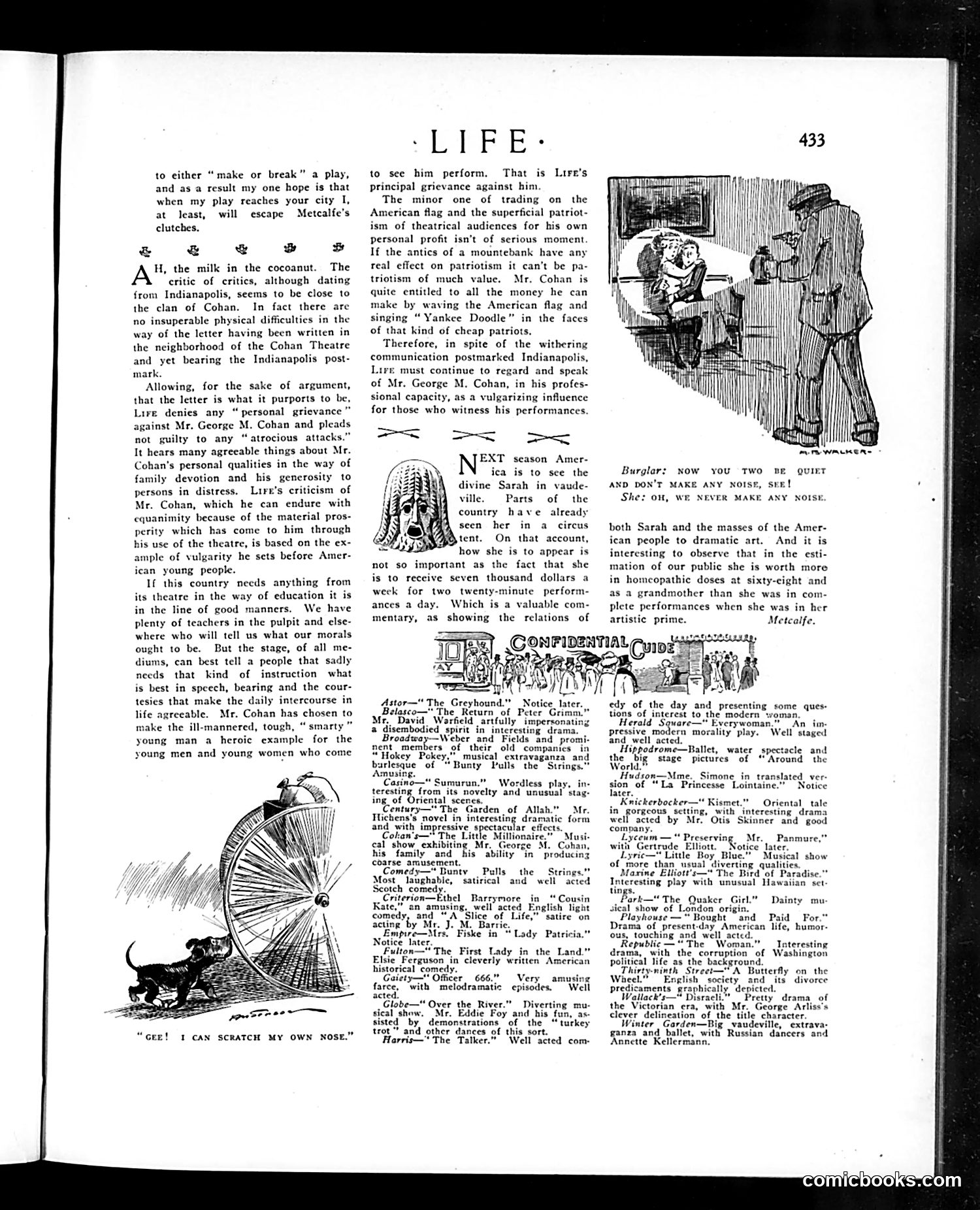
This page critiques performer George M. Cohan as a "vulgarizing influence" on American youth. Life magazine defends its criticism against what appears to be a defensive letter (possibly from Cohan or his allies, postmarked Indianapolis). The key complaint: Cohan exemplifies ill-mannered, "smarty" behavior on stage, setting a poor moral example for young people. While Life acknowledges Cohan's business success and patriotic flag-waving in performances like "Yankee Doodle," it dismisses this as cheap showmanship exploiting audiences' patriotism. The secondary criticism targets Cohan's commercialism—noting Sarah Bernhardt's enormous vaudeville salary ($7,000 weekly) as commentary on theater's mercenary values over artistic merit. The cartoon (top right) and illustrations are theatrical advertisements unrelated to the Cohan critique. The satire reflects Progressive Era concerns about entertainment's moral responsibility to educate rather than debase public taste.
📄 Transcribed text from this page (OCR, searchable)
Machine-transcribed from the original scan — historical spelling and the odd misread are preserved.
to either “make or break” a play, and as a result my one hope is that when my play reaches your city I, at least, will escape Metealfe’s clutches, & & & Ed & H, the milk in the cocoanut. The critic of critics, although dating from Indianapolis, seems to be close to the clan of Cohan. In fact there are no insuperable physical difficulties in the way of the letter having been written in the neighborhood of the Cohan Theatre and yet bearing the Indianapolis post- mark. Allowing, for the sake of argument, that the letter is what it purports to be, Lire denies any “personal grievance ” against Mr. George M. Cohan and pleads not guilty to any “atrocious attacks.” It hears many agreeable things about Mr. Cohan's personal qualities in the way of family devotion and his generosity to persons in distress. Lire’s criticism of Mr. Cohan, which he can endure with equanimity because of the material pros- perity which has come to him through his use of the theatre, is based on the ex- ample of vulgarity he sets before Amer- ican young people. If this country needs anything from its theatre in the way of education it is in the line of good manners. We have plenty of teachers in the pulpit and else- where who will tell us what our morals ought to be. But the stage, of all me- diums, can best tell a people that sadly needs that kind of instruction what is best in speech, bearing and the cour- tesies that make the daily intercourse in life agreeable. Mr. Cohan has chosen to make the ill-mannered, tough, “ smarty " young man a heroic example for the young men and young women who come :LITFE* to see him perform. That is Lirr’s principal grievance against him. The minor one of trading on the American flag and the superficial patriot- ism of theatrical audiences for his own personal profit isn’t of serious moment. If the antics of a mountebank have any real effect on patriotism it can't be pa- triotism of much value. Mr. Cohan is quite entitled to all the money he can make by waving the American flag and singing “Yankee Doodle” in the faces of that kind of cheap patriots, Therefore, in spite of the withering communication postmarked Indianapolis, Lire must continue to regard and speak of Mr. George M. Cohan, in his profes- sional capacity, as a vulgarizing influence for those who witness his performances. > >= EXT season Amer- ica is to see the divine Sarah in vaude- ville, Parts of the country have already seen her in a circus tent. On that account, how she is to appear is not so important as the fact that she is to receive seven thousand dollars a week for two twenty-minute perform- ances a day. Which is a valuable com- mentary, as showing the relations of Astor—" The Greyhound.” _N. Belasco—" The Return of Peter Grimm Mr. David Warfield artfully impersonating a disembodied spirit in interesting drama. Broadway—Weber and Fields and. promi: nent members of their old companies in “Hokey Pokey," musical extravaganza and burlesque of “Bunty Pulls the. Strings.” Amusing. Casino—" Sumurun.” Wordless play, in- teresting from its novelty and unusual stag. ing_ of Oriental scenes. Century—" The Garden of Allah.” Mr. Hichens's novel in interesting dramatic form and with impressive spectacular effects. Colan's—" The Little Millionaire.” Musi- cal show exhibiting Mr. George M. Cohan, his family and his ability in producing coarse amusement. Comedy—" Bunty Most” laughable, Scotch comedy. Criterion—Ethel Barrymore in Kate,” an amusing, well 3 comedy, and “A Slice of Lif acting by Mr. J. M. Barri Empire—Mrs. Fiske in “Lady Patricia." Notice later. Fulton—"The First Lady in the Land.” Elsie Ferguson in cleveriy written American historical comedy. Gaiety—"* Officer 666. farce, with melodramatic acted. Globe—" Over the River.” sical show, Mr, Eddie Foy and his fun, as: sisted by’ demonstrations of the ‘turkey trot” and other dances of this sort. Harris—" The Talker.” Well acted com- Pulls the String satirical and well acted Very amusing episodes. Well Diverting mu- TE WRUKERS Burglar: Now you Two 1e AND DON’T MAKE ANY Norse, SEE! She: of, WE NEVER MAKE ANY NOISE. ouier both Sarah and the masses of the Amer- ican people to dramatic art. And it is interesting to observe that in the esti- mation of our public she is worth more in homeopathic doses at sixty-eight and as a grandmother than she was in com- plete performances when she was in her artistic prime. Metcalfe. edy of the day and presenting some ques: tions of interest to the modern woman. Herald Seuare—" Everywoman.” An im: pressive modern morality play. Well staged and well acted. Hippodrome—Ballet, the big stage World.” _ Hudson—Mme. Simone in translated, ver- sion of “La Princesse Lointaine.” Notice later. __ Knickerbocker—" Kismet.” Oriental. tale in gorgeous setting, with ‘interesting drama well acted by Mr.’ Otis Skinner and. good company. Lycenm — "Preserving. Mr.| Panmure,” with Gertrude Elliott. | Notice later. ic—" Little Boy Blue.” Musical show of ‘more than. usual diverting qualities Maxine Elliott's—* The Bird of Paradise.” Interesting play with unusual Hawaiian set- water (spectacle and pictures of “Around the tings. ‘ark— The Quaker Girl.” sical show of London origin. Dainty mu- Playhouse —™ Bought and Paid | For.” Drama of present-day American life, humor- ous, touching and well acted. : Republic —" The Woman.” Interesting drama, with the corruption of Washington political life as the background Thirty-ninth Street—" A Butterfly on the Wheel.” English society. and its divorce Predicaments graphically depicted. Wallack’s—* Disracli.” Pretty. drama_ of the Victorian era, with Mr. George Arliss’s clever delineation’ of the title character. Winter Garden—Big vaudeville, extrava- ganza and ballet, with Russian dancers and Annette Kellermann,