
Life, 1912-02-29 · page 25 of 40
Life — February 29, 1912 — page 25: what you’re looking at
What you’re looking at
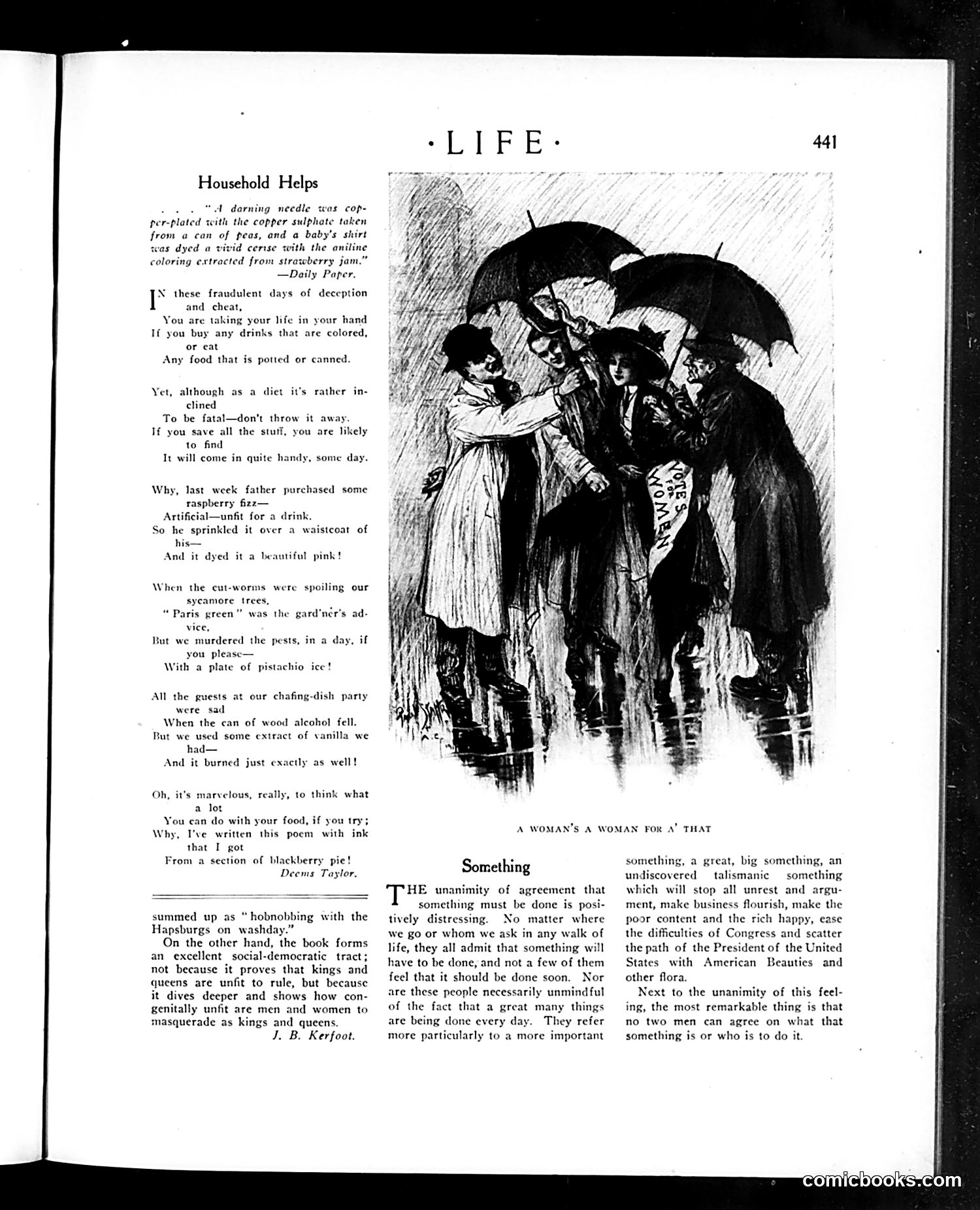
This page from *Life* magazine contains humorous commentary on early 20th-century food safety concerns and political frustration. **The "Household Helps" section** (by Deems Taylor) satirizes anxiety about adulterated foods. The poem jokes that since commercial products contain harmful substances—copper-plated needles, synthetic dyes, pesticides—people should repurpose them for other uses. The humor lies in treating poisoned food as a resource rather than danger. This reflects real Progressive-era fears about unregulated food manufacturing and patent medicines. **The "Something" essay** criticizes vague political rhetoric. Written during an era of social unrest (likely pre-WWI), it mocks how politicians and reformers constantly insist "something must be done" about unnamed problems, yet cannot agree what that "something" is. This appears to be satire of grandiose political promises without concrete solutions—a timeless critique. The illustration shows figures in rain, possibly depicting everyday people or political figures, though the specific reference is unclear without additional context.
📄 Transcribed text from this page (OCR, searchable)
Machine-transcribed from the original scan — historical spelling and the odd misread are preserved.
Household Helps . 2. “a darning needle was cop- per-plated with the copper sulphate taken from a can of peas, and a baby's shirt was dyed a vivid cerse with the aniline coloring extracted from: strawberry jam.” —Daily Paper. N these fraudulent days of deception and cheat, You are taking your life in your hand If you buy any drinks that are colored, or cat Any food that is potted or canned. Yet, although as a diet it's rather in- clined To be fatal—don't throw it away. If you save all the stutf, you are likely to find It will come in quite handy, some day. Why, last week father purchased some raspberry fizz— Artificial—unfit for a drink So he sprinkled it over a waistcoat of his And it dyed it a beautiful pink! When the cut-worms were spoiling our ‘amore trees, “Paris green” was the gard’nér’s ad- vice, But we murdered the pests, in a day, if you pleasc— With a plate of pistachio ice! All the guests at our chafing-dish party were sad When the can of wood alcohol fell. But we used some extract of vanilla we had— And it burned just exactly as well! Oh, it’s marvelous, really, to think what a lot You can do with your food, if you try; Why, I've written this poem with ink that I got From a section of blackberry pie! Deems Taylor. summed up as “hobnobbing with the Hapsburgs on washda On the other hand, the book forms an excellent social-democratic tract; not because it proves that kings and queens are unfit to rule, but because it dives deeper and shows how con- genitally unfit are men and women to masquerade as kings and queens. J. B. Kerfoot. A WOMAN'S A WOMAN FOR A’ THAT Something HE unanimity of agreement that something must be done is posi- tively distressing. No matter where we go or whom we ask in any walk of life, they all admit that something will have to be done, and not a few of them feel that it should be done soon. Nor are these people necessarily unmindful of the fact that a great many things are being done every day. They refer more particularly to a more important something, a great, big something, an undiscovered talismanic — something which will stop all unrest and argu- ment, make business flourish, make the poor content and the rich happy, ease the difficulties of Congress and scatter the path of the President of the United States with American Beauties and other flora. Next to the unanimity of this feel- ing, the most remarkable thing is that no two men can agree on what that something is or who is to do it.