
Life, 1912-02-29 · page 11 of 40
Life — February 29, 1912 — page 11: what you’re looking at
What you’re looking at
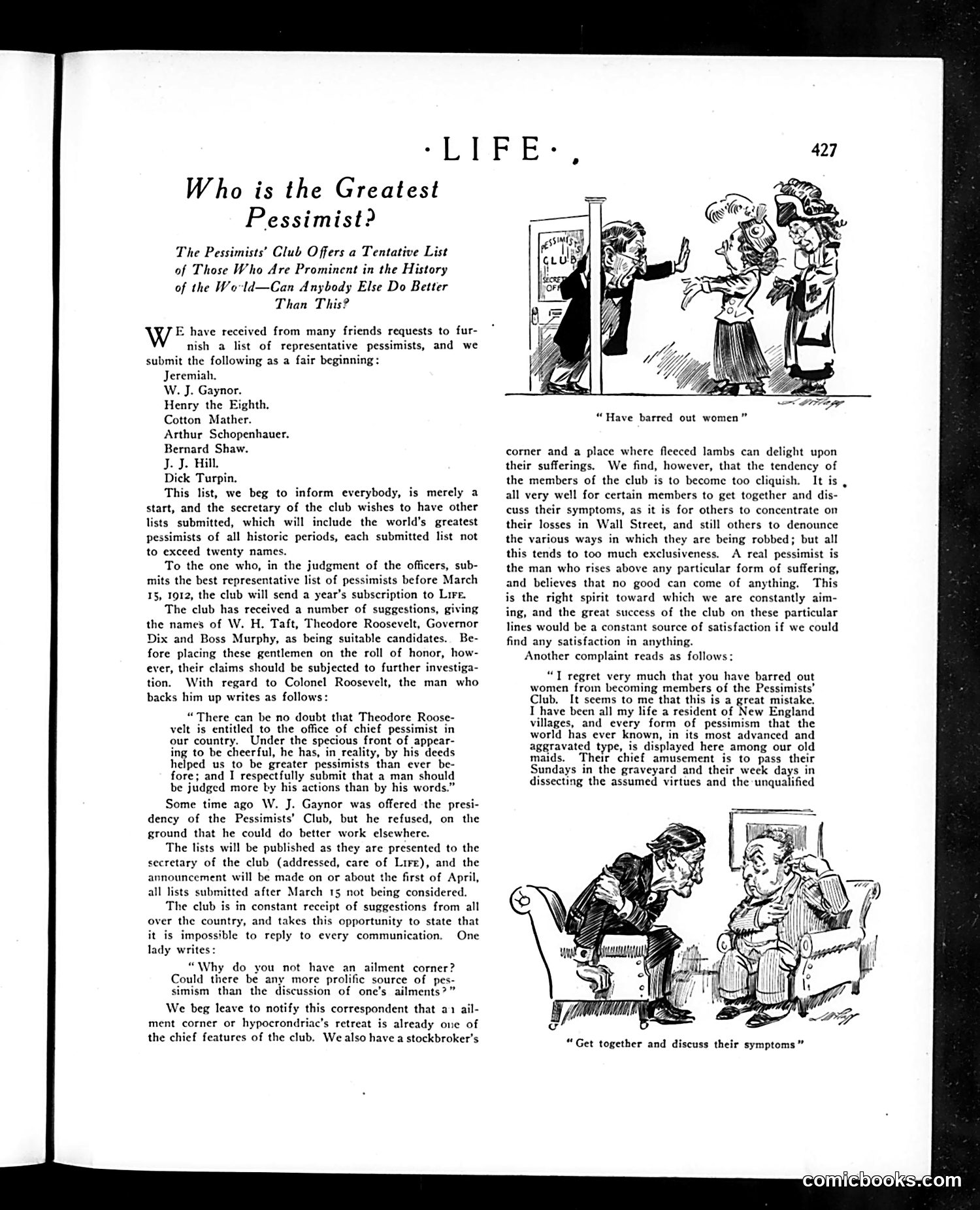
This satirical piece mocks a "Pessimists' Club" that compiles lists of history's greatest pessimists. The article presents a humorous roster including W.J. Gaynor, Henry VIII, Cotton Mather, Arthur Schopenhauer, Bernard Shaw, J.J. Hill, and Dick Turpin. The two cartoons illustrate club activities: one shows members discussing their miseries ("Get together and discuss their symptoms"), while another depicts them barring women ("Have barred out women"). The satire targets pessimism as a fashionable affectation among certain intellectuals and public figures. The article pokes fun at people who wear gloom like a badge of honor, suggesting their complaints are performative rather than genuine. The club concept itself ridicules organized pessimism as both absurd and self-indulgent.
📄 Transcribed text from this page (OCR, searchable)
Machine-transcribed from the original scan — historical spelling and the odd misread are preserved.
‘LIFE, Who is the Greatest Pessimist? The Pessimists’ Club Offers a Tentative List of Those Who Are Prominent in the History of the Wold—Can Anybody Else Do Better Than This? WE have received from many friends requests to fur- nish a list of representative pessimists, and we submit the following as a fair beginning: Jeremiah. W. J. Gaynor. Henry the Eighth, Cotton Mather. Arthur Schopenhauer. Bernard Shaw. J. J. Hill, Dick Turpin. This list, we beg to inform everybody, is merely a start, and the secretary of the club wishes to have other lists submitted, which will include the world’s greatest pessimists of all historic periods, each submitted list not to exceed twenty names. To the one who, in the judgment of the officers, sub- mits the best representative list of pessimists before March 15, 1912, the club will send a year’s subscription to Lir The club has received a number of suggestions, giving the names of W. H. Taft, Theodore Roosevelt, Governor Dix and Boss Murphy, as being suitable candidates. Be- fore placing these gentlemen on the roll of honor, how- ever, their claims should be subjected to further investiga- tion. With regard to Colonel Roosevelt, the man who backs him up writes as follows: “There can be no doubt that Theodore Roose- velt is entitled to the office of chief pessimist in our country. Under the specious front of appear- ing to be cheerful, he has, in reality, by his deeds helped us to be greater pessimists than ever be- fore; and I respectfully submit that a man should be judged more by his actions than by his words.” Some time ago W. J. Gaynor was offered the presi- dency of the Pessimists’ Club, but he refused, on the ground that he could do better work elsewhere. The lists will be published as they are presented to the secretary of the club (addressed, care of Lire), and the announcement will be made on or about the first of April, all lists submitted after March 15 not being considered. The club is in constant receipt of suggestions from all over the country, and takes this opportunity to state that it is impossible to reply to every communication. One lady writes: “Why do you not have an ailment corner? Could there be any more prolific source of pes- simism than the discussion of one’s ailments?” We beg leave to notify this correspondent that a1 ail- ment corner or hypocrondriac’s retreat is already one of the chief features of the club. We also have a stockbroker’s “Have barred out women” corner and a place where fleeced lambs can delight upon their sufferings. We find, however, that the tendency of the members of the club is to become too cliquish. It is all very well for certain members to get together and dis- cuss their symptoms, as it is for others to concentrate on their losses in Wall Street, and still others to denounce the various ways in which they are being robbed; but all this tends to too much exclusiveness. A real pessimist is the man who rises above any particular form of suffering, and believes that no good can come of anything. This is the right spirit toward which we are constantly aim- ing, and the great success of the club on these particular lines would be a constant source of satisfaction if we could find any satisfaction in anything. Another complaint reads as follows: “T regret very much that you have barred out women from becoming members of the Pessimists’ Club. It seems to me that this is a great mistake. I have been all my life a resident of New England villages, and every form of pessimism that the world has ever known, in its most advanced and aggravated type, is displayed here among our old maids. Their chief amusement is to pass their Sundays in the graveyard and their week days in dissecting the assumed virtues and the unqualified “Get together and discuss their symptoms”