
Life, 1912-02-29 · page 16 of 40
Life — February 29, 1912 — page 16: what you’re looking at
What you’re looking at
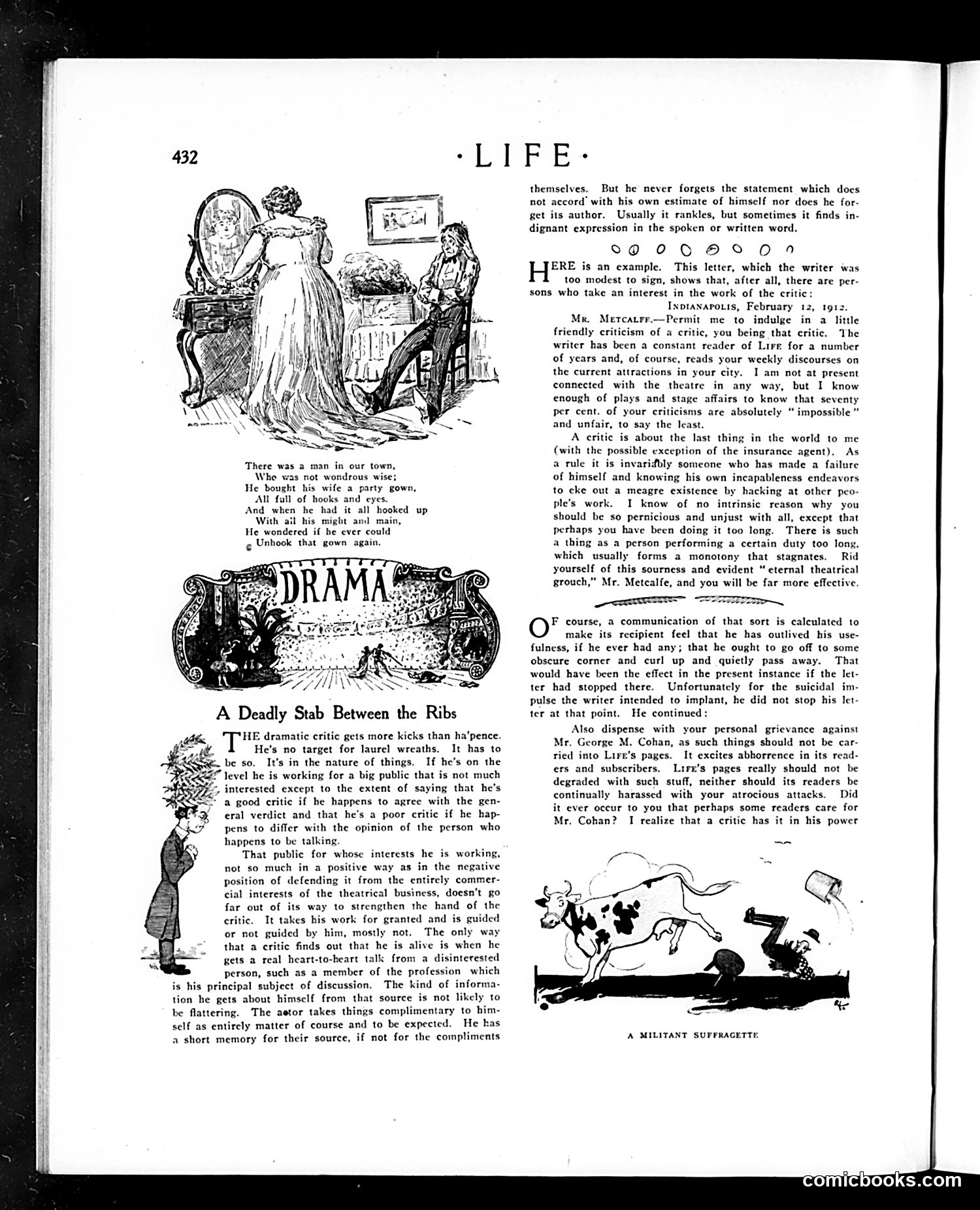
This page contains two distinct pieces of satire: **"A Deadly Stab Between the Ribs"** is an essay defending theater critics against attacks from actors and theatrical professionals. The text argues that critics perform an unpopular but necessary function—protecting public interests against commercial theater interests. It illustrates this with a letter from an Indianapolis reader brutally attacking critic "Mr. Metcalfe," calling him a failed person whose seventy percent of criticisms are unfair and suggesting he's grown stale from doing the job too long. **The opening poem and illustration** joke about a man who buys his wife an elaborate party gown with many hooks and eyes (fasteners), then worries he won't be able to unfasten it again—likely a double entendre about marital intimacy and the complications of women's fashion. **"A Militant Suffragette"** (cartoon, lower right) depicts a woman attacking a man, likely referencing the militant suffrage movement's confrontational tactics of the era. The page satirizes both personal relationships and professional conflicts in Edwardian society.
📄 Transcribed text from this page (OCR, searchable)
Machine-transcribed from the original scan — historical spelling and the odd misread are preserved.
#1 PE There was a man in our town, Whe was not wondrous wise; He bought his wife a party gown, All full of hooks and eyes. And when he had it all hooked up With ail his might and main, He wondered if he ever could ¢ Unbook that gown again. A Deadly Stab Between the Ribs , HE dramatic critic gets more kicks than ha’pence. = 4 He's no target for laurel wreaths. It has to x. be so. It’s in the nature of things. If he’s on the ZEf level he is working for a big public that is not much -, interested except to the extent of saying that he’s “a good critic if he happens to agree with the gen- eral verdict and that he’s a poor critic if he hap- pens to differ with the opinion of the person who happens to be talking. That public for whose interests he is working, not so much in a positive way as in the negat position of defending it from the entirely commer- cial interests of the theatrical business, doesn’t go far out of its way to strengthen the hand of the critic. It takes his work for granted and is guided or not guided by him, mostly not. The only way that a critic finds out that he is alive is when he gets a real heart-to-heart talk from a disinterested person, such as a member of the profession which is his principal subject of discussion. The kind of informa- tion he gets about himself from that source is not likely to be flattering. The aetor takes things complimentary to him- self as entirely matter of course and to be expected. He kas a short memory for their source, if not for the compliments themselves. But he never forgets the statement which does not accord’ with his own estimate of himself nor does he for- get its author. Usually it rankles, but sometimes it finds in- dignant expression in the spoken or written word. ceaq00 AS 09 ERE is an example. This letter, which the writer was too modest to sign, shows that, after all, there are per- sons who take an interest in the work of the critic: Ixptanapouis, February 12, 1912. Mg. Mertcarr.—Permit me to indulge in a little friendly criticism of a critic, you being that critic. The writer has been a constant reader of Lire for a number of years and, of course, reads your weekly discourses on the current attractions in your city. I am not at present connected with the theatre in any way, but I know enough of plays and stage affairs to know that seventy per cent. of your criticisms are absolutely “ impossible” and unfair, to say the least. A critic is about the last thing in the world to me (with the possible exception of the insurance agent), As a rule it is invaridbly someone who has made a failure of himself and knowing his own incapableness endeavors to cke out a meagre existence by hacking at other pco- ple's work. I know of no intrinsic reason why you should be so pernicious and unjust with all, except that perhaps you have been doing it too long. There is such a thing as a person performing a certain duty too long, which usually forms a monotony that stagnates. Rid yourself of this sourness and evident “eternal theatrical grouch,” Mr. Metcalfe, and you will be far more effective oe coors oe F course, a communication of that sort is calculated to make its recipient feel that he has outlived his use- fulness, if he ever had any; that he ought to go off to some obscure corner and curl up and quietly pass away. That would have been the effect in the present instance if the let- ter had stopped there. Unfortunately for the suicidal im- pulse the writer intended to implant, he did not stop his let- ter at that point. He continued: Also dispense with your personal grievance against Mr. George M. Cohan, as such things should not be car- ried into Lire’s pages. It excites abhorrence in its read- ers and subscribers. Lire’s pages really should not be degraded with such stuff, neither should its readers be continually harassed with your atrocious attacks. Did it ever occur to you that perhaps some readers care for Mr. Cohan? I realize that a critic has it in his power A MILITANT SUFFRAGETTE comicbooks.com