
Life, 1912-02-29 · page 37 of 40
Life — February 29, 1912 — page 37: what you’re looking at
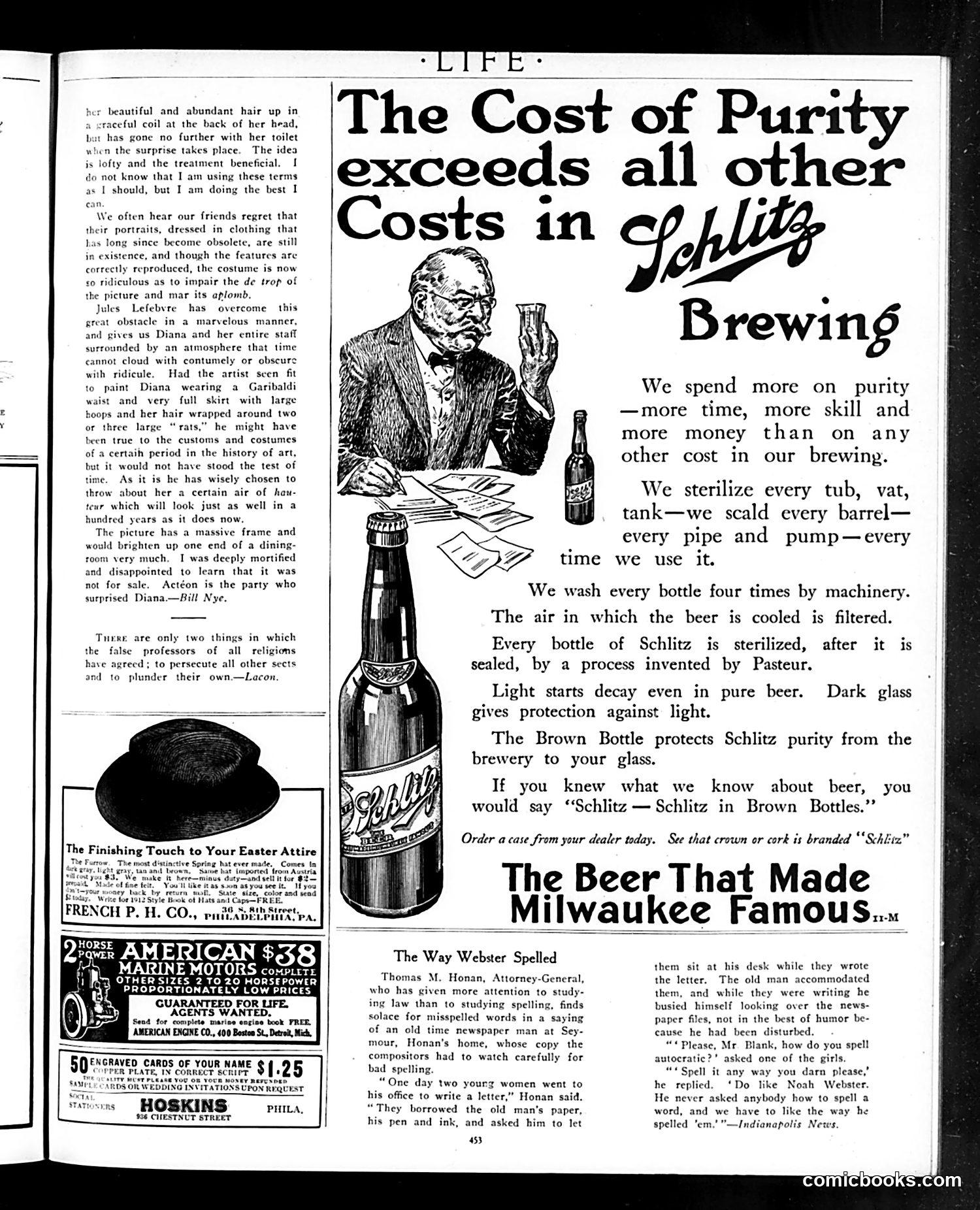
What you’re looking at
This page contains three distinct elements: 1. **Left column essay** (by Bill Nye): A art criticism discussing painter Jules Lefebvre's portrait of Diana. The writer praises how Lefebvre avoided making the painting look dated by using timeless classical styling rather than contemporary 1880s-90s fashions (mentioning period details like "Garibaldi waist" and "rats"—hair pads). 2. **Center/right: Schlitz Beer advertisement** claiming superior purity standards—sterilizing equipment, washing bottles multiple times, using dark glass for protection. This reflects late-19th-century brewing industry competition emphasizing sanitation (Pasteurization was relatively new). 3. **Bottom right: Humorous anecdote** about Attorney General Honan, contrasting a meticulous old newspaper compositor with the casual attitude "do it any way you want"—implying standards have relaxed. The Noah Webster reference suggests even famous authorities weren't pedantic about spelling. The page is primarily **advertising-driven content** mixed with light satirical commentary on art, industry standards, and declining attention to detail.
📄 Transcribed text from this page (OCR, searchable)
Machine-transcribed from the original scan — historical spelling and the odd misread are preserved.
her beautiful and abundant hair up in raceful coil at the back of her head, but has gone no further with her toilet when the surprise takes place. The idea is lofty and the treatment beneficial. do not know that I am using these terms as I should, but I am doing the best I We often hear our friends regret that their portraits, dressed in clothing that has long since become obsolete, are still in existence, and though the features are correctly reproduced, the costume is now so ridiculous as to impair the de trop of the picture and mar its aplomd, Jules Lefebvre has overcome this great obstacle in a marvelous manner, and gives us Diana and her entire staff surrounded by an atmosphere that time cannot cloud with contumely or obscure with ridicule. Had the artist seen fit to paint Diana wearing a Garibaldi waist and very full skirt’ with large hoops and her hair wrapped around two or three large “rats,” he might have been true to the customs and costumes of a certaih period in the history of art, but it would not have stood the test of As it is he has wisely chosen to throw about her a certain air of hau- teur which will look just as well in a hundred years as it does now. The picture has a massive frame and would brighten up one end of a dining- room very much, I was deeply mortified and disappointed to learn that it was not for sale. Actéon is the party who surprised Diana.—Bill Nye. Tuer are only two things in which the false professors of all religions have agreed ; to persecute all other sects and to plunder their own.—Lacon. The Finishing Touc! Fa 7 OTHER SIZES 2 TO 20 HORSEPOWER f PROPORTIONATELY LOW PRICES GUARANTEED FOR LIFE. AGENTS WANT! Send for complete marice engine book FREE. AMERICAN ENGINE CO., 400 Boston St, Detroit, Mich, ENGRAVED C PON RI PHILA, $36 CHESTNUT STREET The Cost of Purity exceeds all other Costs in of, LAF Brewing We spend more on _ purity —more time, more skill and more money than on any other cost in our brewing. We sterilize every tub, vat, tank—we scald every barrel— every pipe and pump—every time we use it. We wash every bottle four times by machinery. The air in which the beer is cooled is filtered. Every bottle of Schlitz is sterilized, after it is sealed, by a process invented by Pasteur. Light starts decay even in pure beer. gives protection against light. Dark glass The Brown Bottle protects Schlitz purity from the brewery to your glass. Tf you knew what we know about beer, you would say ‘Schlitz — Schlitz in Brown Bottles.” Order a case from your dealer today. See that crown or cork is branded ‘‘Schl:tz” The Beer That Made Milwaukee Famous... The Way Webster Spelled Thomas M. Honan, Attorney-General, them sit at his desk while they wrote the letter. The old man accommodated who has given more attention to study- ing law than to studying spelling, finds solace for misspelled words in a saying of an old time newspaper man at Sey- mour, Honan’s home, whose copy the compositors had to watch carefully for bad spelling. “One day two young women went to his office to write a letter,” Honan said. “They borrowed the old man's paper, his pen and ink, and asked him to let 453 them, and while they were writing he busied himself looking over the news- paper files, not in the best of humor be- cause he had been disturbed. “Please, Mr Blank, how do you spell autocratic?’ asked one of the girls. “* Spell it any way you darn please, he replied. ‘Do like Noah Webster. He never asked anybody how to spell a word, and we have to like the way he spelled ‘em.'”—Indianapolis News.