
Life, 1912-02-29 · page 8 of 40
Life — February 29, 1912 — page 8: what you’re looking at
What you’re looking at
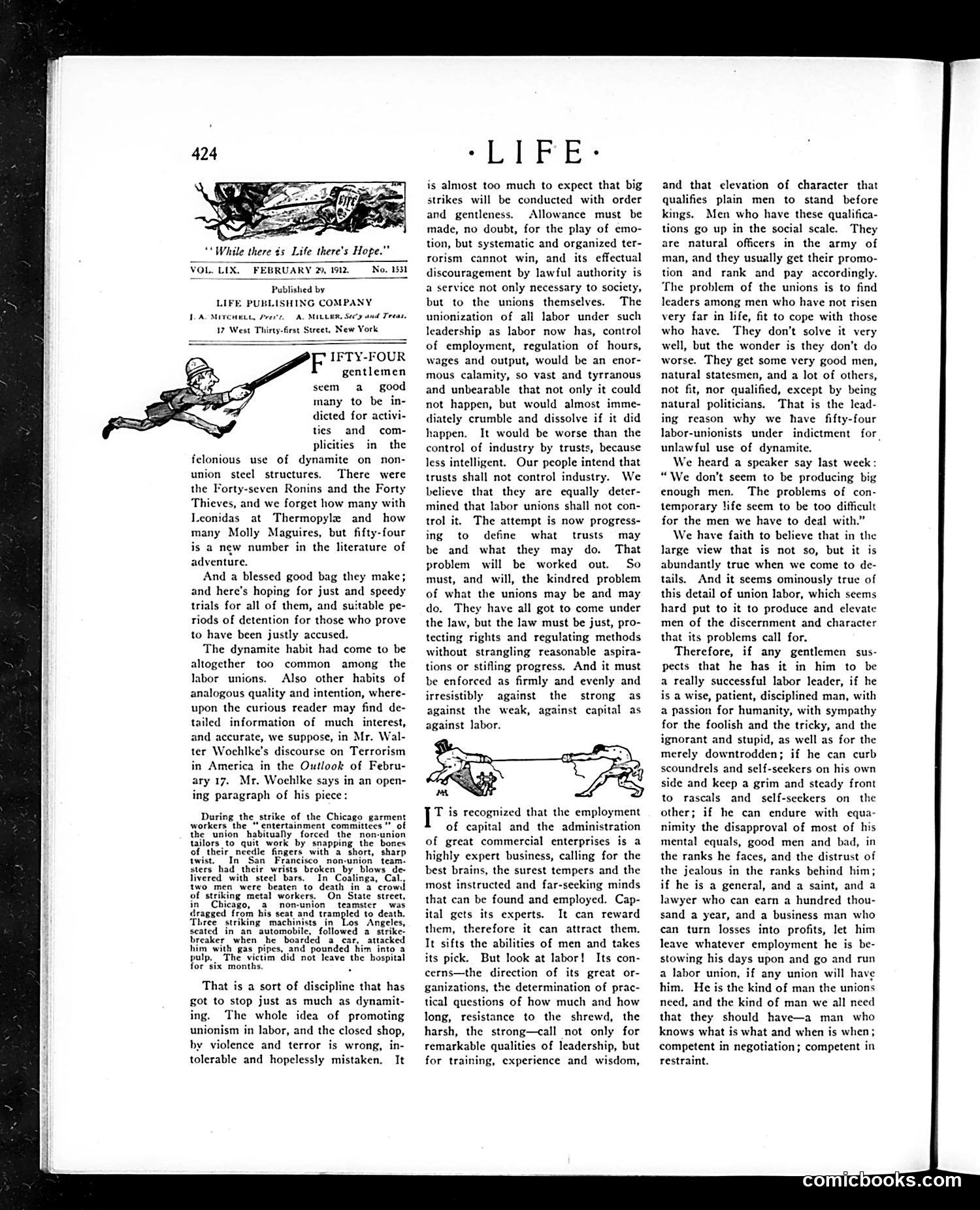
This page presents editorial arguments against violent labor union tactics and dynamite attacks on non-union structures. The text references specific incidents: the "Forty-seven Bomb and the Thirty Thieves" and "Molly Maguires," and mentions a Chicago garment workers' strike involving tailors and a fatal accident. The cartoons (small illustrations of figures in conflict) visually reinforce the written critique of union violence. The editorial argues that while labor deserves fair treatment and regulation, unions shouldn't employ terrorism or dynamite. It advocates for competent, restrained labor leadership—men educated in negotiation and restraint rather than violence. The piece reflects early 20th-century anxieties about radical labor movements and anarchist tactics, positioning the magazine as pro-worker but anti-violent-extremism.
📄 Transcribed text from this page (OCR, searchable)
Machine-transcribed from the original scan — historical spelling and the odd misread are preserved.
“"While there ¢s Life there's Hope.” No. 1531 VOL. LIX. F RUARY 2, 1912, Published by LIFE PUBLISHING COMPANY LA Mirren, A. MILLER, See‘y anid Treas, 1 Thirty-frst Street, New York IFTY-FOUR gentlemen seem a good many to be in- dicted for activi- ties and com- plicities in the felonious use of dynamite on non- union steel structures. There were the Forty-seven Ronins and the Forty Thieves, and we forget how many with Leonidas at Thermopyle and how many Molly Maguires, but fifty-four is a new number in the literature of adventure. And a blessed good bag they make; and here's hoping for just and speedy trials for all of them, and suitable pe- riods of detention for those who prove to have been justly accused. The dynamite habit had come to be altogether too common among the labor unions. Also other habits of analogous quality and intention, where- upon the curious reader may find de- tailed information of much interest, and accurate, we suppose, in Mr. Wal- ter Woehlke’s discourse on Terrorism in America in the Outlook of Febru- ary 17, Mr. Woehlke says in an open- ing paragraph of his piece: During the, strike of the Chicago garment workers the “entertainment committees” of the union habitually forced the non-union tailors to quit work by snapping the bones of their needle fingers with a short, sharp twist. In San Francisco, non-union team. sters had their wrists broken by blows de livered with steel bars. In Coalinga, Cal., two men were beaten to death in a ‘crowd of striking metal workers. On State street, in Chicago, a non-union teamster was dragged from his seat and trampled to death, Three striking machinists in Los Angeles, seated in an automobile, followed a strike: breaker when he boarded a car, attacked him with gas. pipes, and pounded him into a pulp. The victim did not leave the hospital for six months 7 That is a sort of discipline that has got to stop just as much as dynamit- ing. The whole idea of promoting unionism in labor, and the closed shop, by violence and terror is wrong, in- tolerable and hopelessly mistaken. It “LIF E* is almost too much to expect that big strikes will be conducted with order and gentleness. Allowance must be made, no doubt, for the play of emo- tion, but systematic and organized ter- rorism cannot win, and its effectual discouragement by lawful authority is a service not only necessary to society, but to the unions themselves. The unionization of all labor under such leadership as labor now has, control of employment, regulation of hours, wages and output, would be an enor- mous calamity, so vast and tyrranous and unbearable that not only it could not happen, but would almost imme- diately crumble and dissolve if it did happen. It would be worse than the control of industry by trusts, because less intelligent. Our people intend that trusts shall not control industry. We believe that they are equally deter- mined that labor unions shall not con- trol it. The attempt is now progress- ing to define what trusts may be and what they may do. That problem will be worked out. So must, and will, the kindred problem of what the unions may be and may do. They have all got to come under the law, but the law must be just, pro- tecting rights and regulating methods without strangling reasonable aspira- tions or stifling progress. And it must be enforced as firmly and evenly and irresistibly against the strong as against the weak, against capital as against labor. T is recognized that the employment of capital and the administration of great commercial enterprises is a highly expert business, calling for the best brains, the surest tempers and the most instructed and far-secking minds that can be found and employed. Cap- ital gets its experts. It can reward them, therefore it can attract them. It sifts the abilities of men and takes its pick. But look at labor! Its con- cerns—the direction of its great or- ganizations, the determination of prac- tical questions of how much and how long, resistance to the shrewd, the harsh, the strong—call not only for remarkable qualities of leadership, but for training, experience and wisdom, and that elevation of character that qualifies plain men to stand before kings. Men who have these qualifica- tions go up in the social scale. They are natural officers in the army of man, and they usually get their promo- tion and rank and pay accordingly. The problem of the unions is to find leaders among men who have not risen very far in life, fit to cope with those who have. They don't solve it very well, but the wonder is they don’t do worse. They get some very good men, natural statesmen, and a lot of others, not fit, nor qualified, except by being natural politicians. That is the lead- ing reason why we have fifty-four labor-unionists under indictment for, unlawful use of dynamite. We heard a speaker say last week: “We don’t seem to be producing big enough men. The problems of con- temporary life seem to be too difficult for the men we have to dedl with.” We have faith to believe that in the large view that is not so, but it is abundantly true when we come to de- tails. And it seems ominously true of this detail of union labor, which seems hard put to it to produce and elevate men of the discernment and character that its problems call for. Therefore, if any gentlemen sus- pects that he has it in him to be a really successful labor leader, if he is a wise, patient, disciplined man, with a passion for humanity, with sympathy for the foolish and the tricky, and the ignorant and stupid, as well as for the merely downtrodden; if he can curb scoundrels and self-seekers on his own side and keep a grim and steady front to rascals and self-seckers on the other; if he can endure with equa- nimity the disapproval of most of his mental equals, good men and bad, in the ranks he faces, and the distrust of the jealous in the ranks behind him; if he is a general, and a saint, and a lawyer who can earn a hundred thou- sand a year, and a business man who can turn losses into profits, let him leave whatever employment he is be- stowing his days upon and go and run a labor union, if any union will have him. He is the kind of man the unions need, and the kind of man we all need that they should have—a man who knows what is what and when is when; competent in negotiation; competent in restraint. comicbooks.com