
Life, 1912-02-29 · page 14 of 40
Life — February 29, 1912 — page 14: what you’re looking at
What you’re looking at
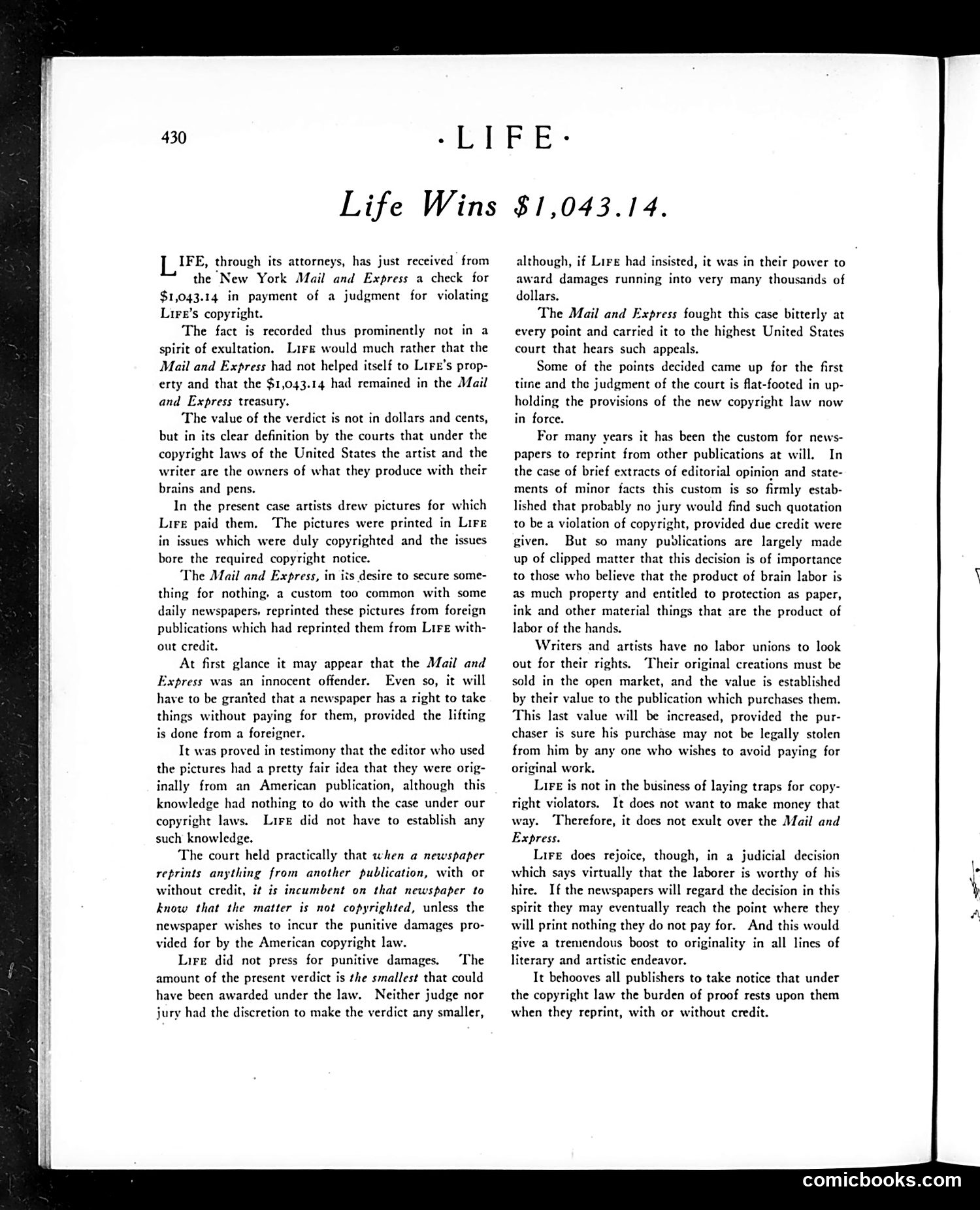
This page contains no cartoon or satirical illustration. It is a text-only article titled "Life Wins $1,043.14," reporting on a copyright lawsuit victory. The *Life* magazine successfully sued the *New York Mail and Express* newspaper for reprinting copyrighted pictures and content without permission or credit. The article celebrates this legal win as a matter of principle rather than monetary gain. It argues that artists and writers deserve protection for their creative labor, comparing their intellectual property to physical property. The piece also establishes precedent for copyright law enforcement and encourages other publishers to respect copyright when reprinting material from other publications.
📄 Transcribed text from this page (OCR, searchable)
Machine-transcribed from the original scan — historical spelling and the odd misread are preserved.
-LIPE- Life Wins $1,043.14. LIFE. through its attorneys, has just received from the New York Mail and Express a check for $1,043.14 in payment of a judgment for violating Lire’s copyright. The fact is recorded thus prominently not in a spirit of exultation. Lirg would much rather that the Mail and Express had not helped itself to Lire’s prop- erty and that the $1,043.14 had remained in the Mail and Express treasury. The value of the verdict is not in dollars and cents, but in its clear definition by the courts that under the copyright laws of the United States the artist and the writer are the owners of what they produce with their brains and pens. In the present case artists drew pictures for which Lire paid them. The pictures were printed in Lire in issues which were duly copyrighted and the issues bore the required copyright notice. ‘The Mail and Express, in its desire to secure some- thing for nothing, a custom too common with some daily newspapers, reprinted these pictures from foreign publications which had reprinted them from Lire with- out credit. At first glance it may appear that the Mail and Express was an innocent offender. Even so, it will have to be granted that a newspaper has a right to take things without paying for them, provided the lifting is done from a foreigner. It was proved in testimony that the editor who used the pictures had a pretty fair idea that they were orig- inally from an American publication, although this knowledge had nothing to do with the case under our copyright laws. Lire did not have to establish any such knowledge. The court held practically that when a newspaper reprints anything from another publication, with or without credit, it is incumbent on that newspaper to know that the matter is not copyrighted, unless the newspaper wishes to incur the punitive damages pro- vided for by the American copyright law. Lire did not press for punitive damages. The amount of the present verdict is the smallest that could have been awarded under the law. Neither judge nor jury had the discretion to make the verdict any smaller, although, if Lire had insisted, it was in their power to award damages running into very many thousands of dollars, The Mail and Express fought this case bitterly at every point and carried it to the highest United States court that hears such appeals. Some of the points decided came up for the first time and the judgment of the court is flat-footed in up- holding the provisions of the new copyright law now in force. For many years it has been the custom for news- Papers to reprint from other publications at will. In the case of brief extracts of editorial opinion and state- ments of minor facts this custom is so firmly estab- lished that probably no jury would find such quotation to be a violation of copyright, provided due credit were given. But so many puolications are largely made up of clipped matter that this decision is of importance to those who believe that the product of brain labor is as much property and entitled to protection as paper, ink and other material things that are the product of labor of the hands. Writers and artists have no labor unions to look out for their rights. Their original creations must be sold in the open market, and the value is established by their value to the publication which purchases them. This last value will be increased, provided the pur- chaser is sure his purchase may not be legally stolen from him by any one who wishes to avoid paying for original work. Lire is not in the business of laying traps for copy- right violators. It does not want to make money that way. Therefore, it does not exult over the Mail and Express. Lire does rejoice, though, in a judicial decision which says virtually that the laborer is worthy of his hire. If the newspapers will regard the decision in this spirit they may eventually reach the point where they will print nothing they do not pay for. And this would give a tremendous boost to originality in all lines of literary and artistic endeavor. It behooves all publishers to take notice that under the copyright law the burden of proof rests upon them when they reprint, with or without credit. comicbooks.com