
A complete issue · 50 pages · 1911
Life — October 5, 1911
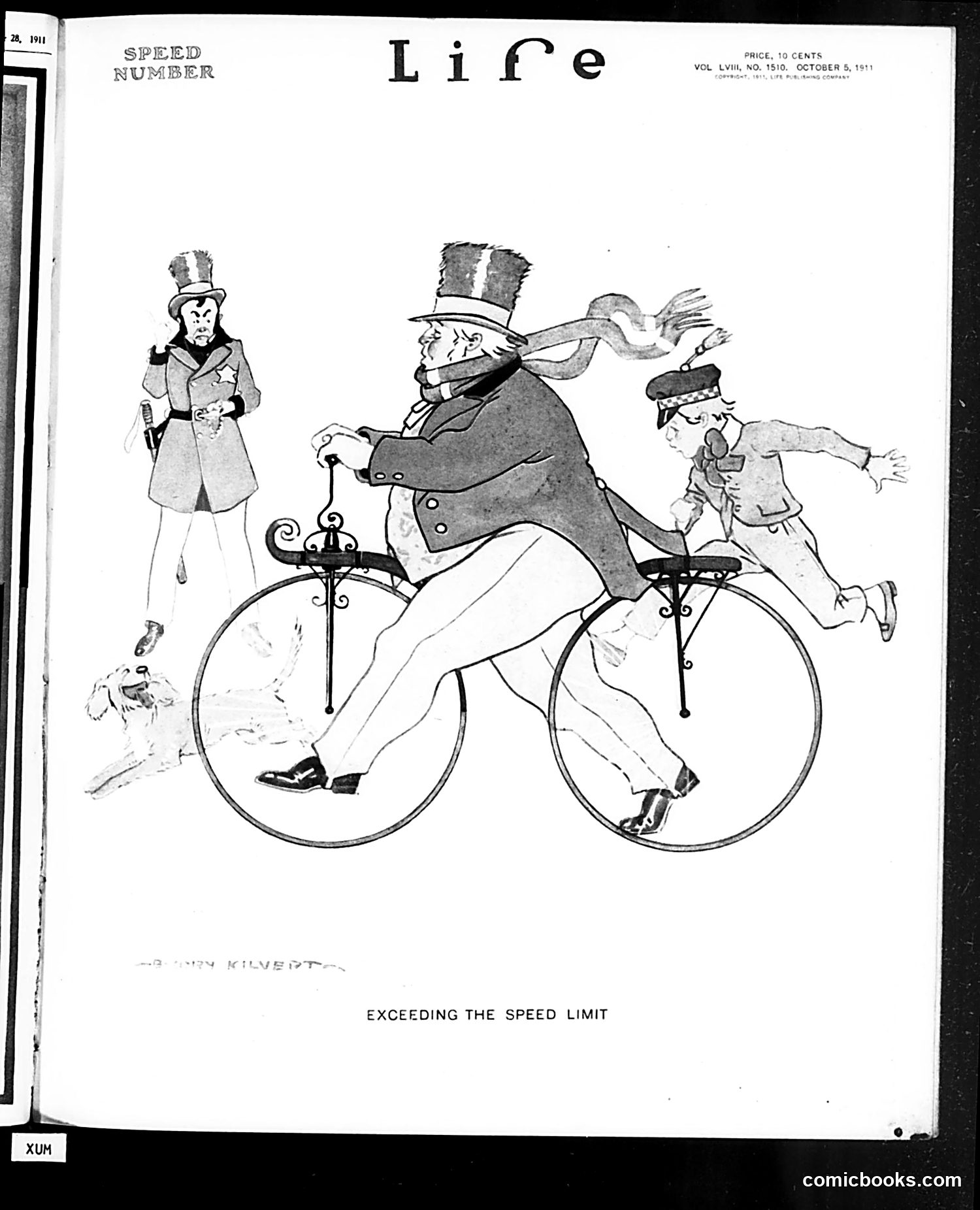
This cartoon satirizes early automobile safety concerns. A portly man in a top hat rides a bicycle at high speed with a young child seated behind, while Uncle Sam (identifiable by his starred top hat, left) watches disapprovingly. The caption "Exceeding the Speed Limit" suggests reckless behavior. The joke likely critiques wealthy or powerful figures who disregard traffic laws and endanger children through irresponsible driving. The bicycle—not yet an automobile—may indicate this was drawn during the early motorcar era when speed limits were novel and frequently ignored by the privileged classes. The small dog in the lower left adds to the scene's chaos, emphasizing the danger created by excessive speed.
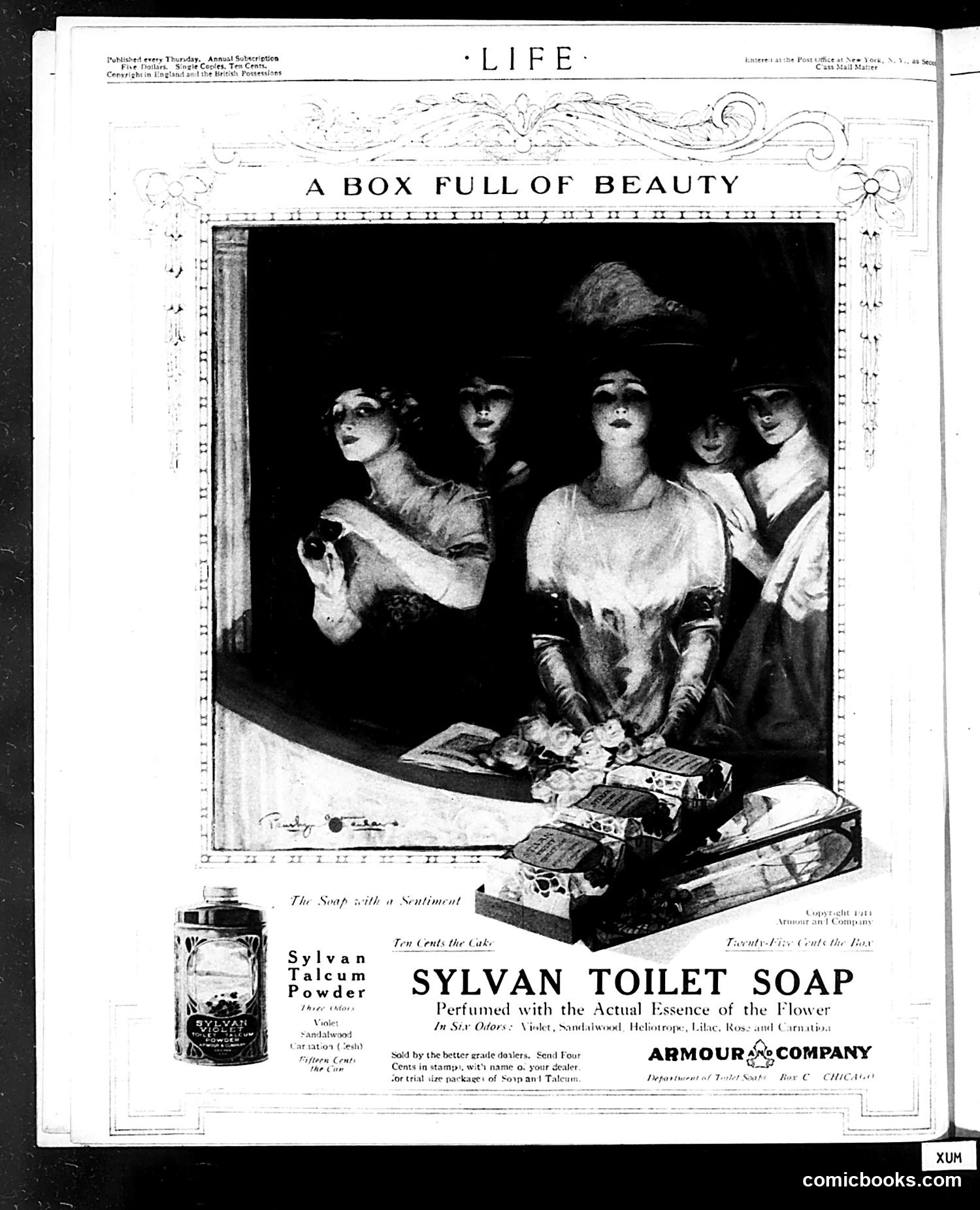
This page is **primarily an advertisement**, not satirical content. It features "Sylvan Toilet Soap" by Armour & Company, promoted with the headline "A Box Full of Beauty." The image shows five elegantly dressed women in early 20th-century attire examining the soap product. The advertisement emphasizes the soap's appeal to refined, fashionable women and its supposed luxury—it's "perfumed with the Actual Essence of the Flower" in various scents (Violet, Sandalwood, Heliotrope, Lilac, and Rose). The tagline "The Soap with a Sentiment" suggests emotional or aesthetic appeal beyond basic hygiene. Priced at "Twenty-Five Cents the Box," it positioned the product as an accessible luxury item. This represents typical early-1900s marketing that associated consumer goods with elegance and social status.
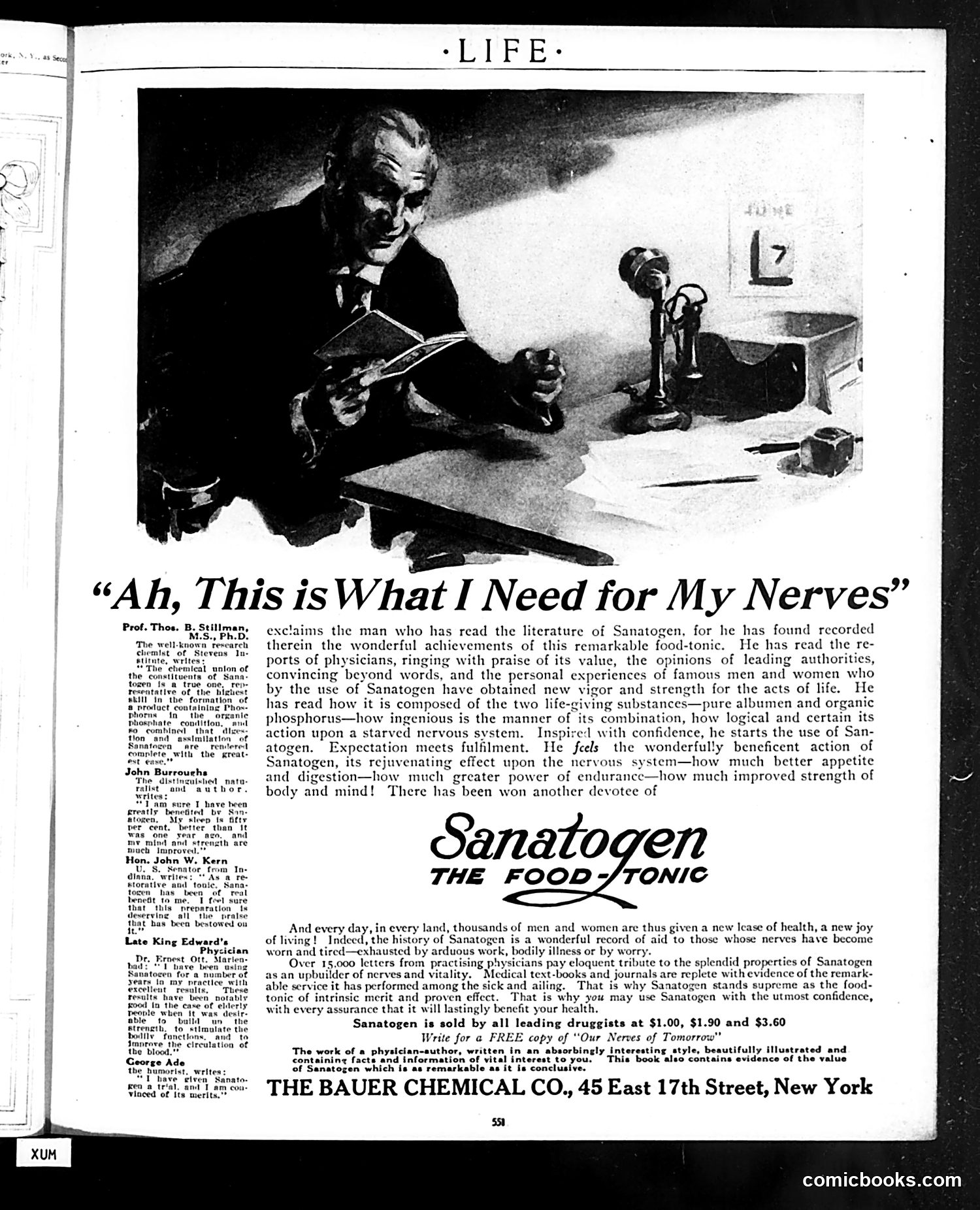
This page is primarily a **product advertisement** for Sanatogen, a "food-tonic," rather than political satire. The illustration shows a man at a desk reading literature about the product, with testimonial quotes praising its benefits. The advertisement features endorsements from named individuals (Prof. Thos. B. Stillman, John Burroughs, Hon. John W. Kern, Dr. Ernest Ott, and Laila Mechau) claiming Sanatogen improved their nerves, strength, and vitality. The product is positioned as containing "pure albumen and organic phosphorus" that supposedly rejuvenates the nervous system. This represents early 20th-century patent medicine marketing, where vague health claims and appeals to authority were common advertising tactics. The satire, if any, lies in Life magazine publishing such earnest—but medically dubious—promotional content.
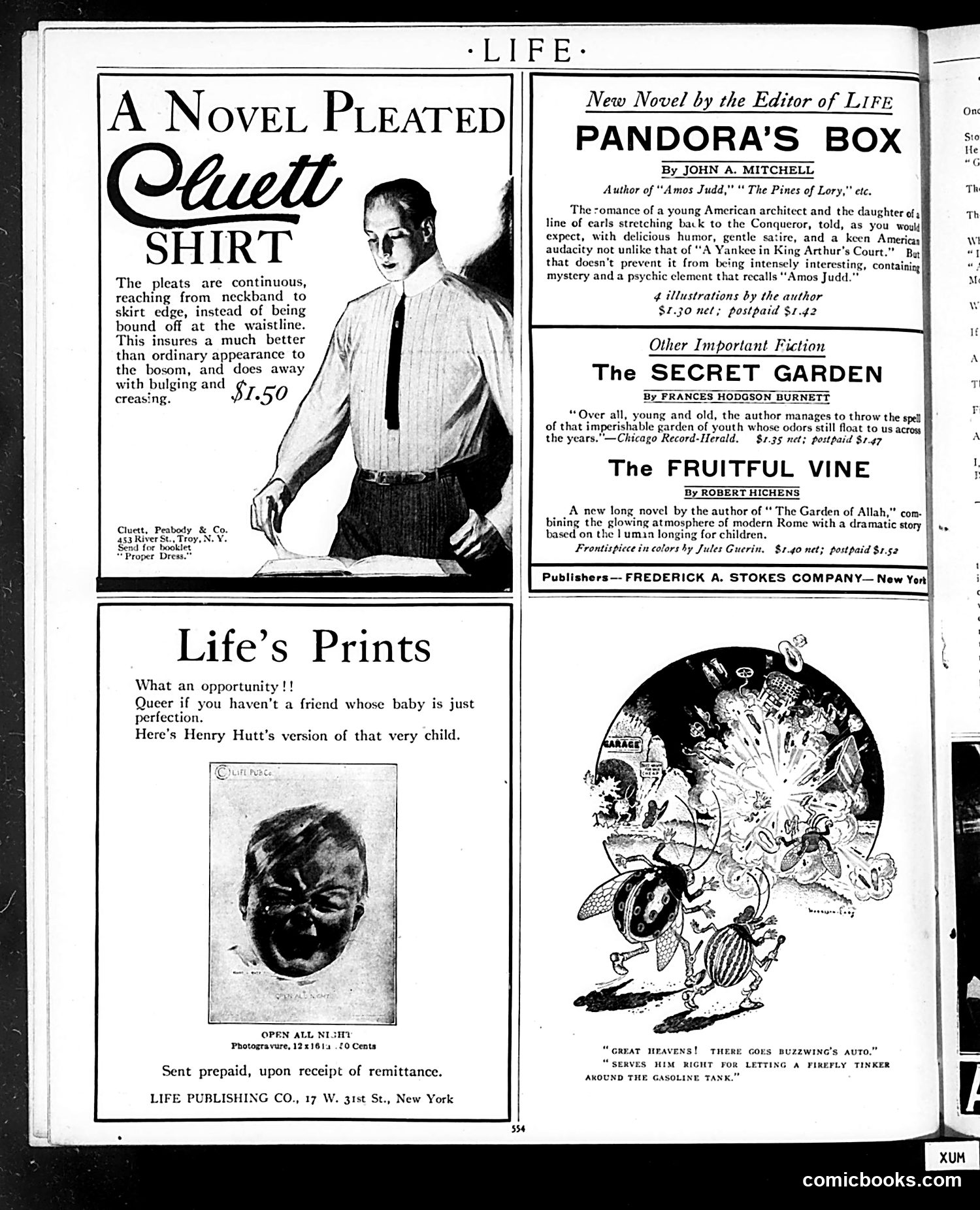
This page is primarily **advertising and book promotions** rather than political satire. The left side advertises a **Cluett Shirt** ($1.50) featuring a pleated design, with continuous pleats from neckband to hem to improve appearance and reduce creasing. The right side promotes three novels from Frederick A. Stokes Company, including *Pandora's Box* by John A. Mitchell. Below is a **Life's Prints** section showcasing a baby portrait by Henry Hutt—presented as a humorous gift opportunity ("Queer if you haven't a friend whose baby is just perfect"). The bottom right contains a whimsical cartoon illustration (artist signed) depicting insects and creatures around what appears to be a firefly's "auto," with the caption about a "buzzing auto" and gasoline tank—a lighthearted, nonsensical joke typical of early 20th-century humor magazines.
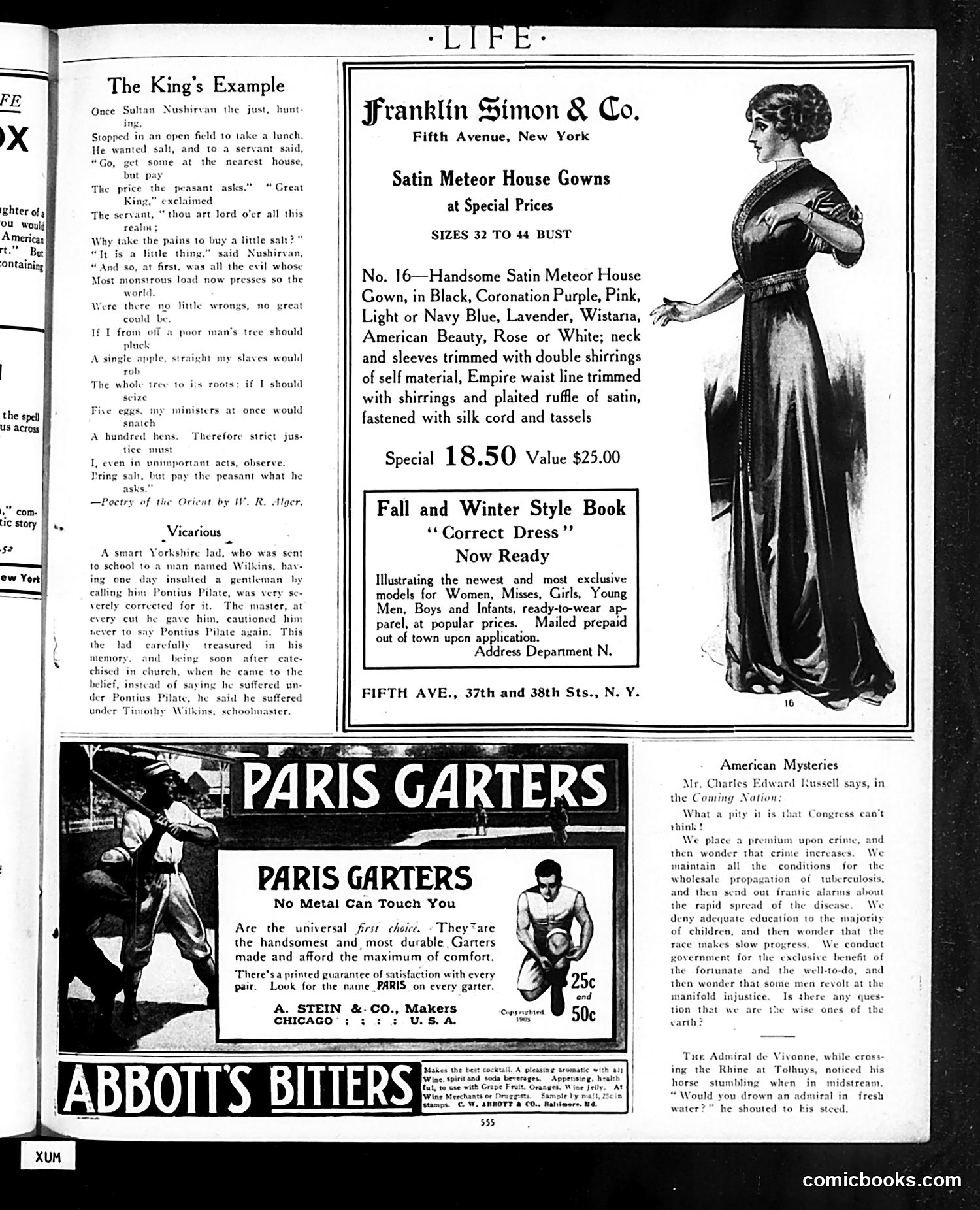
This page is primarily **advertising and light social commentary**, not political satire. The main content includes: 1. **"The King's Example"** — a short satirical poem about King Nusirvan supposedly teaching peasants a lesson about accepting hardship without complaint. The moral appears to critique blind obedience to authority. 2. **"Vicarious"** — a brief anecdote mocking how a schoolmaster named Pontius Pilate carefully corrects a student's behavior while being morally questionable himself—commentary on hypocrisy. 3. **Advertisements** dominating the page: Franklin Simon & Co. fashion gowns, Paris Garters, and Abbott's Bitters products. The page reflects early 20th-century *Life* magazine's mix of light humor targeting social pretension and fashion/consumer culture, rather than hard political commentary.
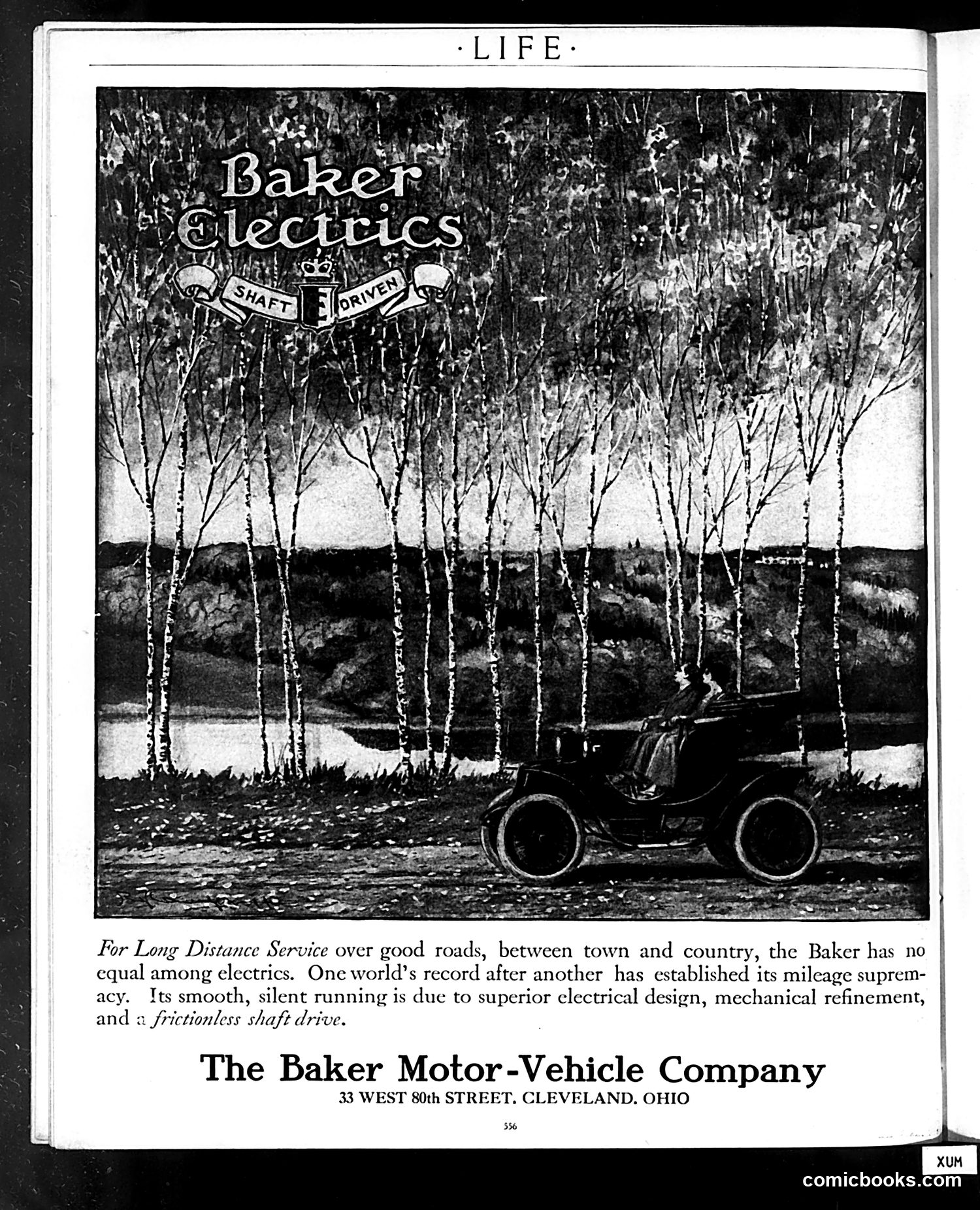
This page is primarily a **commercial advertisement** for Baker Motor-Vehicle Company of Cleveland, Ohio, not political satire or editorial content. The ad promotes Baker electric automobiles, showing a vintage early-1900s electric car in a scenic landscape with birch trees. The copy emphasizes the vehicle's advantages for "long distance service over good roads, between town and country," highlighting its "superior electrical design, mechanical refinement, and frictionless shaft drive." The "Shaft Driver" logo suggests this was a notable selling point. The advertisement appeals to middle-class drivers seeking reliable transportation, positioning Baker electrics as superior to competitors. This reflects the pre-WWI era when electric vehicles competed seriously with gasoline engines before internal combustion ultimately dominated the market.
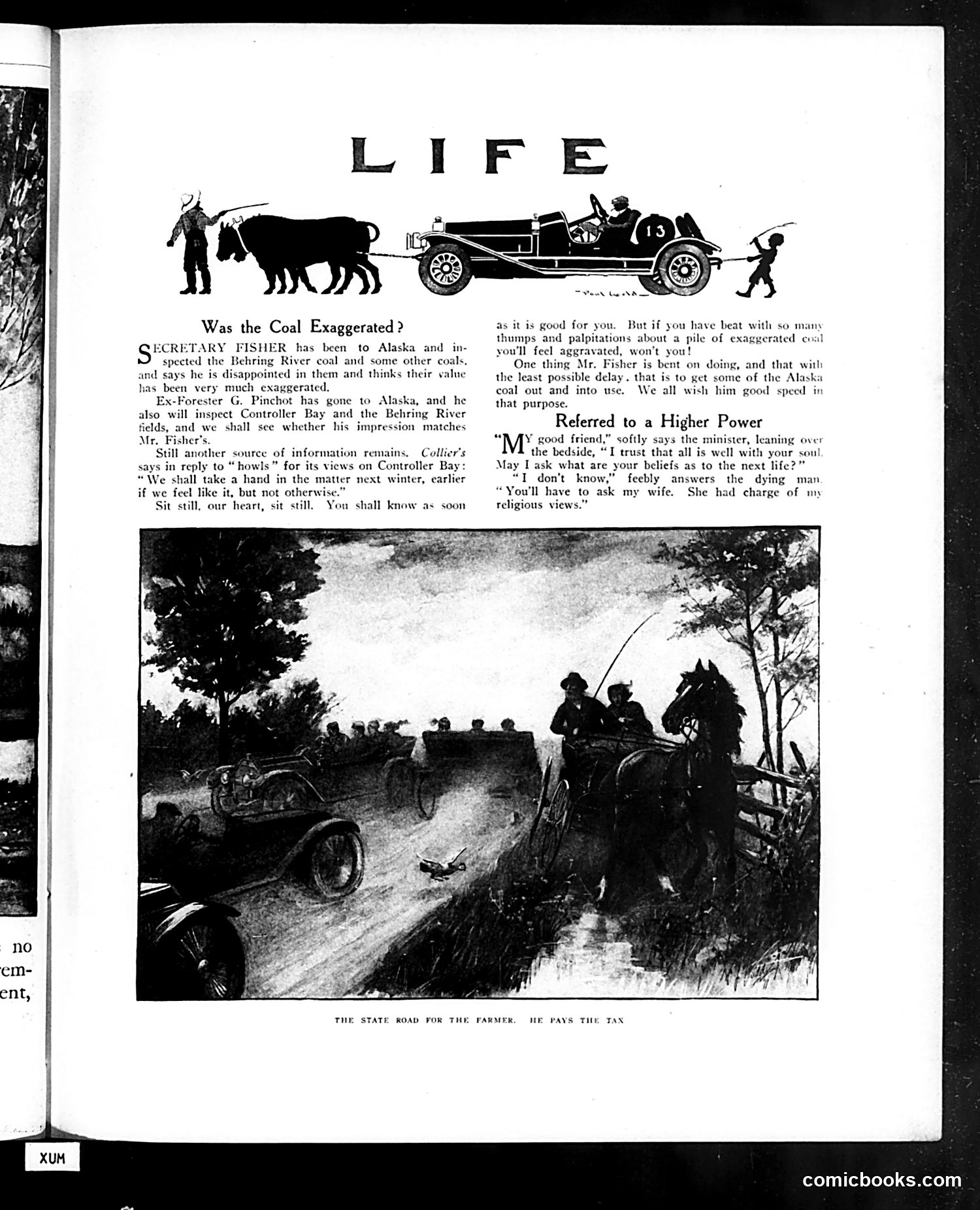
This page satirizes disputes over Alaska coal development and resource management. The headline "Was the Coal Exaggerated?" refers to debates about whether Alaska's coal reserves were being overstated. The text mentions Secretary Fisher and Ex-Forester Pinchot visiting Alaska to inspect coal fields and the Bering River area, suggesting a government investigation into whether claims about Alaska's resources matched reality. The illustration below shows a rural road scene with horses and an early automobile—"THE STATE ROAD FOR THE FARMER. HE PAYS THE TAX"—implying satire about infrastructure spending priorities and taxation burdens on farmers. The broader context concerns Progressive Era debates about resource conservation, government oversight, and fair development of public lands versus private interests.
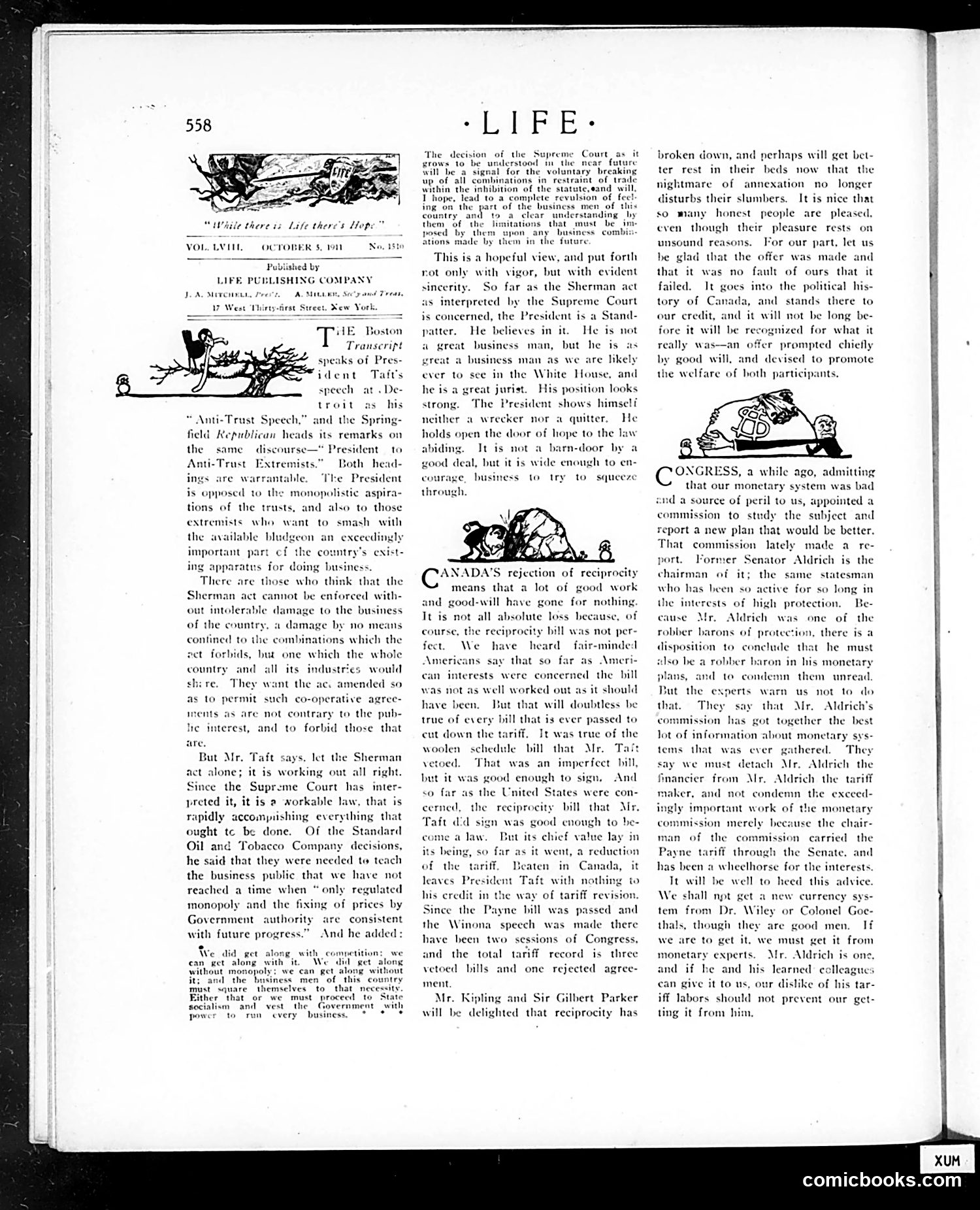
This page from *Life* magazine discusses President Taft's policies regarding trusts and tariffs. The main cartoon (top left) titled "Wait! There is Life there's Hope" depicts a figure apparently struggling or in distress. The article criticizes Canada's rejection of reciprocal trade agreements and discusses Taft's handling of anti-trust legislation. The text references the Sherman Act's enforcement and debates over tariff policy, particularly mentioning the "Payne bill" and trade negotiations with Canada. A secondary cartoon (bottom right) shows what appears to be a turtle or tortoise, likely symbolizing slow progress or cautious movement—fitting the editorial's theme of deliberate but incomplete policy reforms under Taft's administration. The overall satire critiques Taft's moderate approach to monopolies and trade as insufficient, though the specific identities of all caricatured figures remain unclear from the image quality.
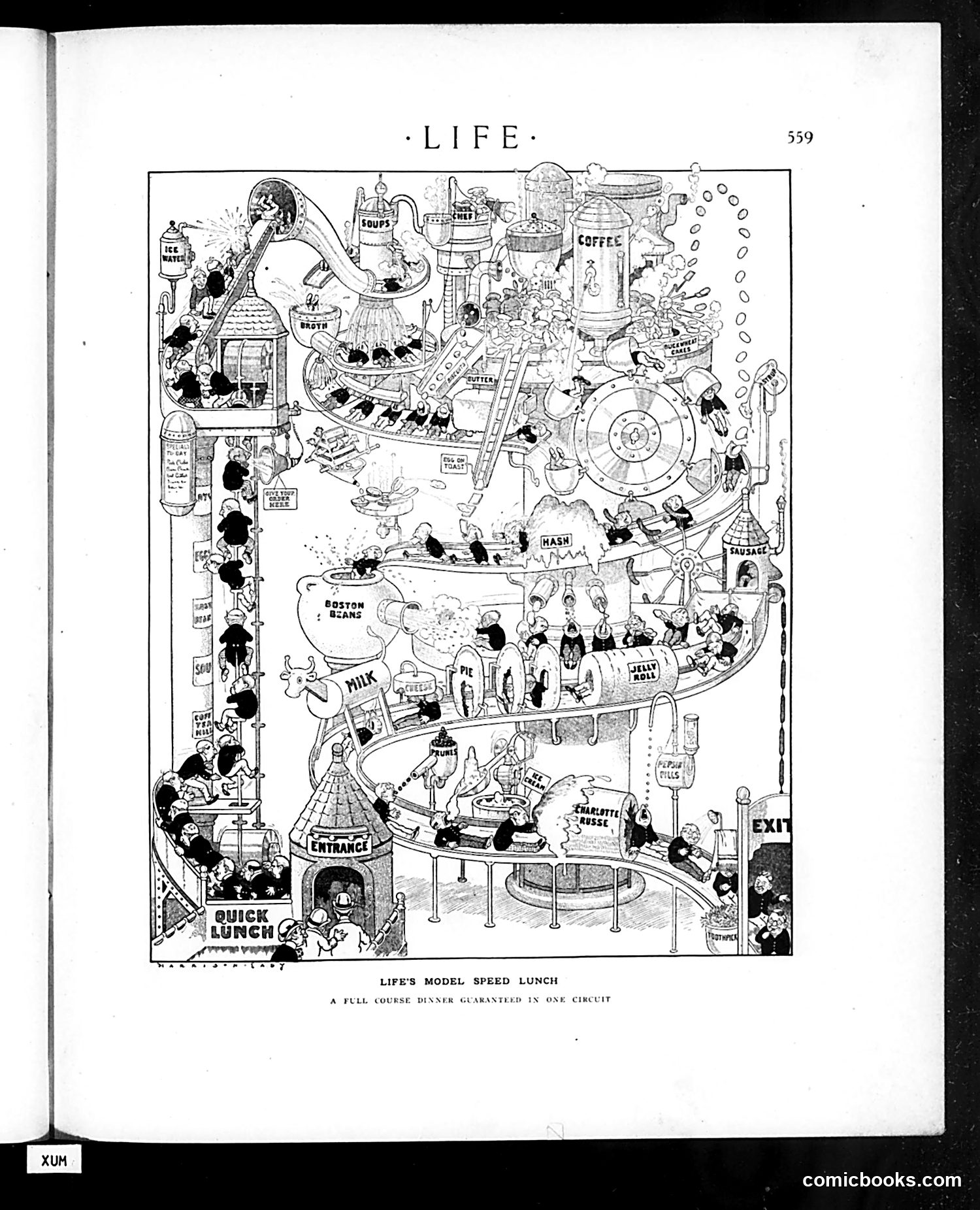
This is a satirical illustration of an automated restaurant or cafeteria system. The cartoon depicts a complex, Rube Goldberg-style mechanical contraption designed to serve a "full course dinner guaranteed in one circuit." The satire targets the early 20th-century American obsession with efficiency, automation, and speed in dining. Rather than enjoying leisurely meals, patrons move through an elaborate assembly-line system past labeled stations (visible: "SOUPS," "COFFEE," "BOSTON BEANS," "MILK," "HASH," "SPAGHETTI SAUCE," "BUTTER ROLLS"). The joke mocks modernization's excesses—the absurdly complicated machinery needed to deliver what should be a simple, pleasant dining experience. People are reduced to automatons moving through an impersonal industrial process, satirizing both mechanization and American consumer culture's emphasis on speed over quality.
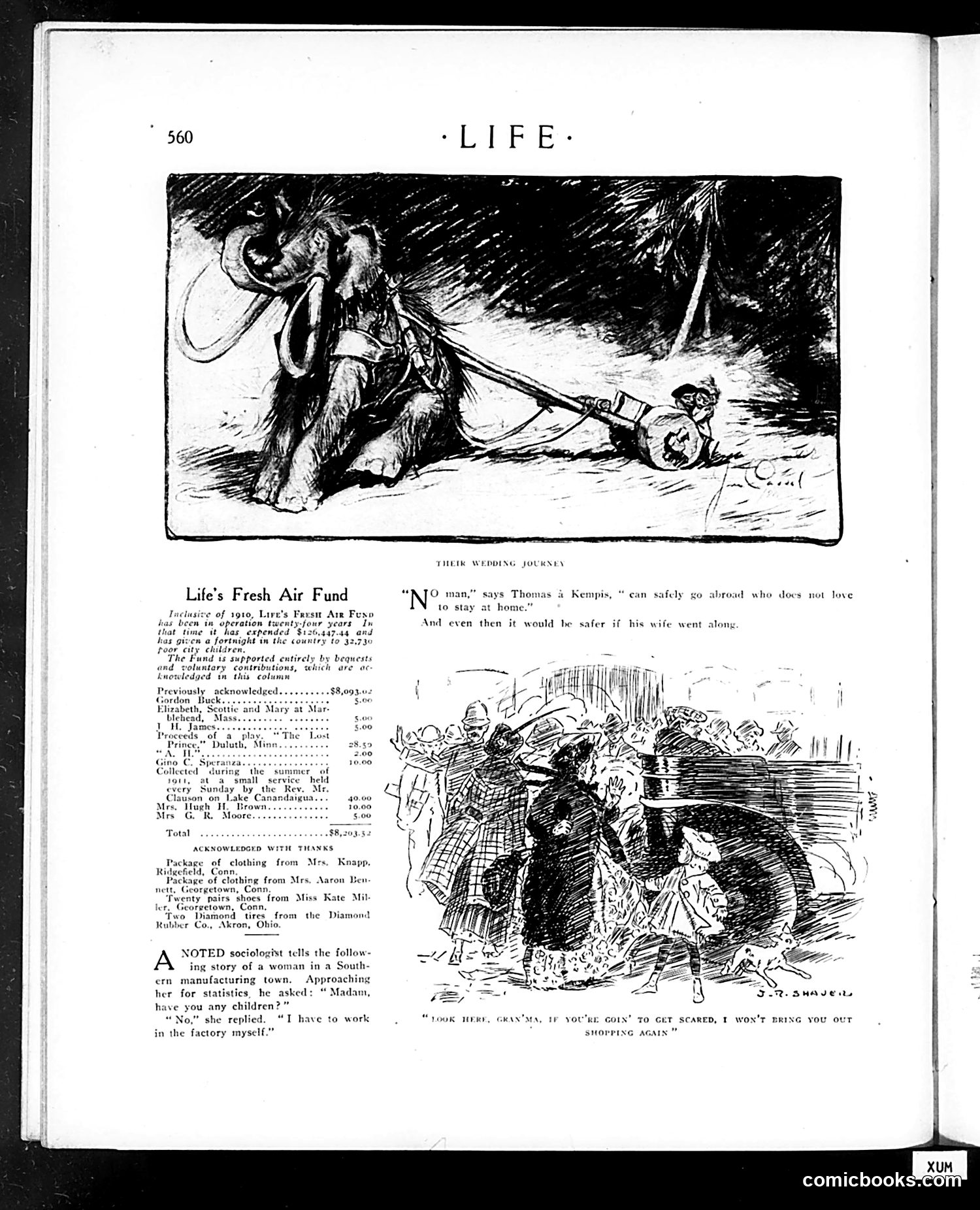
This page contains two satirical cartoons addressing early 20th-century social issues. **Top cartoon ("Their Wedding Journey"):** Depicts a couple departing on a wedding trip with minimal luggage. The accompanying quote from "Thomas à Kempus" ironically suggests that only those who love home should travel abroad—a jest about newlyweds abandoning domestic comfort. **Bottom cartoon ("Look Here, Grandma..."):** Shows a grandmother with a child amid shopping chaos, satirizing consumer culture and the anxieties of holiday shopping. The child's plea—"if you're going to get scared, I won't bring you out shopping again"—mocks the stress of retail experiences. The page also features a "Fresh Air Fund" fundraising section supporting poor children's access to outdoor recreation—reflecting Progressive Era concerns about urban poverty and children's welfare.
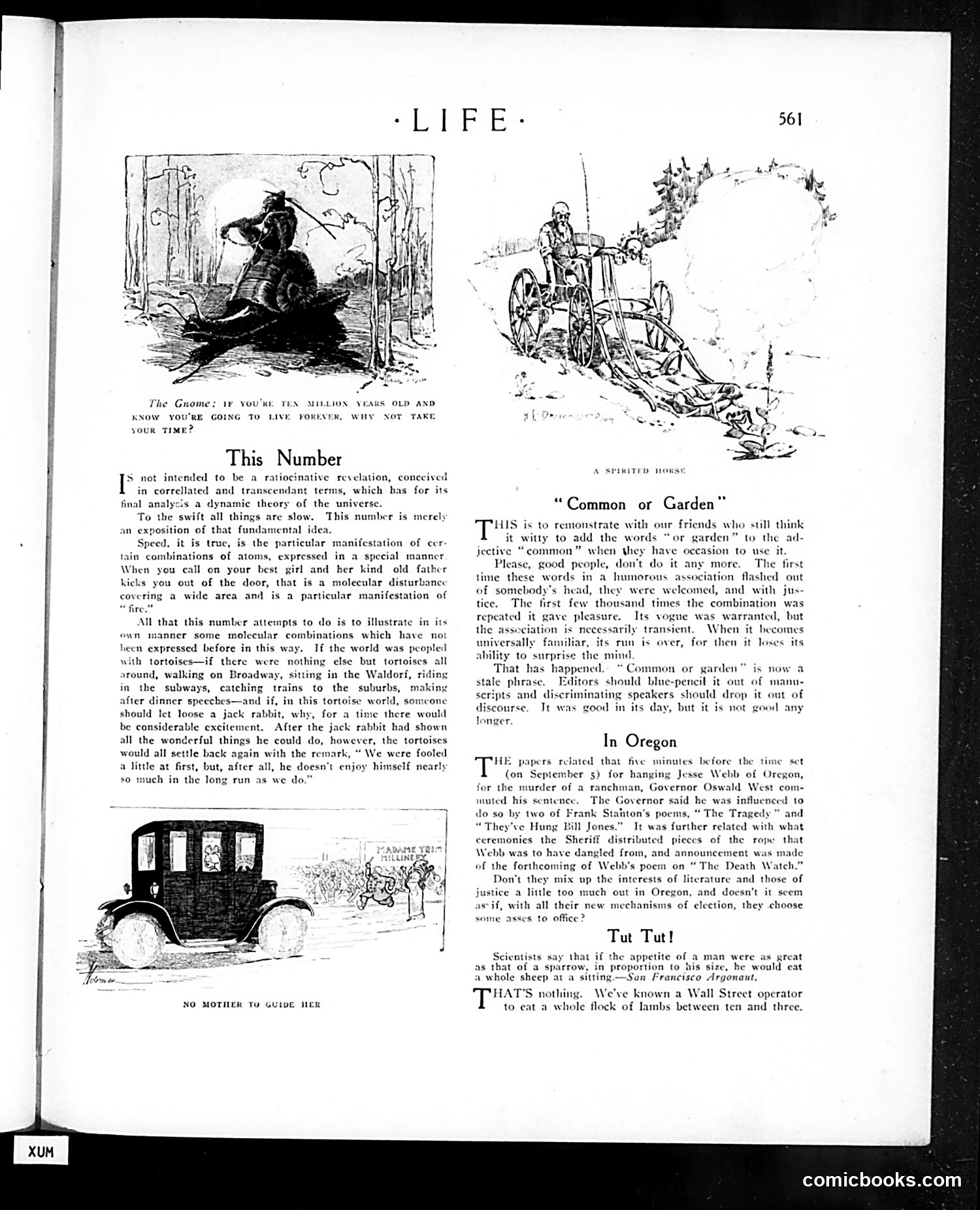
This page contains three separate satirical pieces: 1. **"The Gnome"** (top left): A dark woodland scene with text mocking someone for worrying about time and mortality—suggesting they should enjoy life rather than obsess over its brevity. 2. **"A Spirited Horse"** (top right): Shows a man on a cart being pulled by an energetic horse, captioned to suggest the horse's vitality. 3. **"Common or Garden"** (center): Critiques the overuse of the phrase "common or garden" as a tired literary cliché that should be retired from writing. 4. **"In Oregon"** (right): References the execution of labor activist Joe Hill (1915), mentioning Governor Oswald West and poems about the event—contemporary political commentary on capital punishment. 5. **"No Mother to Guide Her"** (bottom left): A cartoon showing an early automobile, likely satirizing women drivers or modern independence.
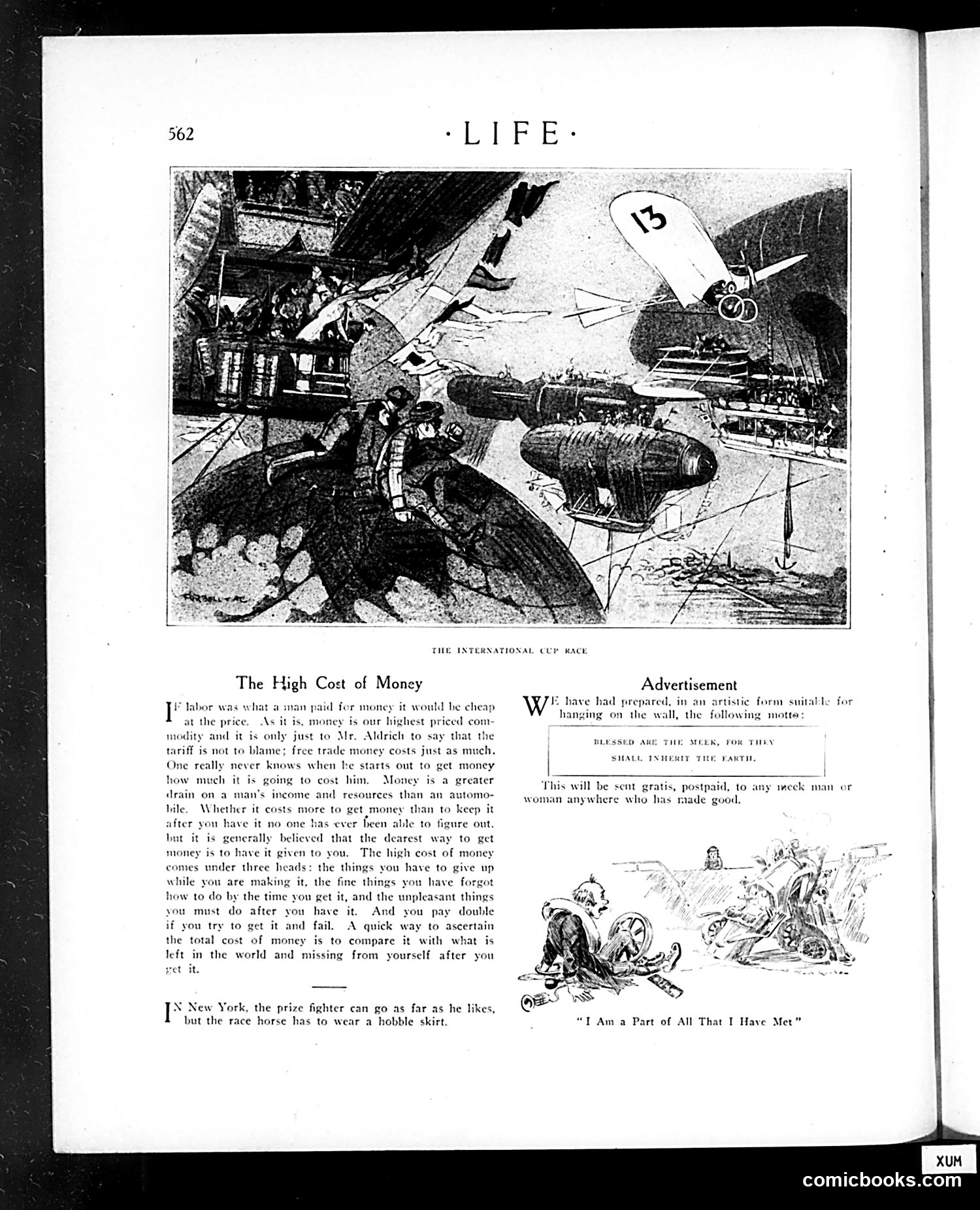
**Top Image:** "The International Cup Race" shows an aerial view of what appears to be an early aviation or racing event, with aircraft marked "13" visible. The mechanical detail suggests early 20th-century technology. **Main Article:** "The High Cost of Money" discusses the financial burden of obtaining wealth—the effort, sacrifices, and "unpleasant things" required to earn money. The piece suggests that getting rich comes with hidden costs beyond mere monetary gain. **Advertisement:** Promotes a publication titled "I Am a Part of All That I Have Met," offering free distribution to any "meek man or woman anywhere who has made good." The accompanying illustration depicts figures in a pastoral or historical scene. The page satirizes both modern wealth-seeking and consumer culture through mixed messaging about success.
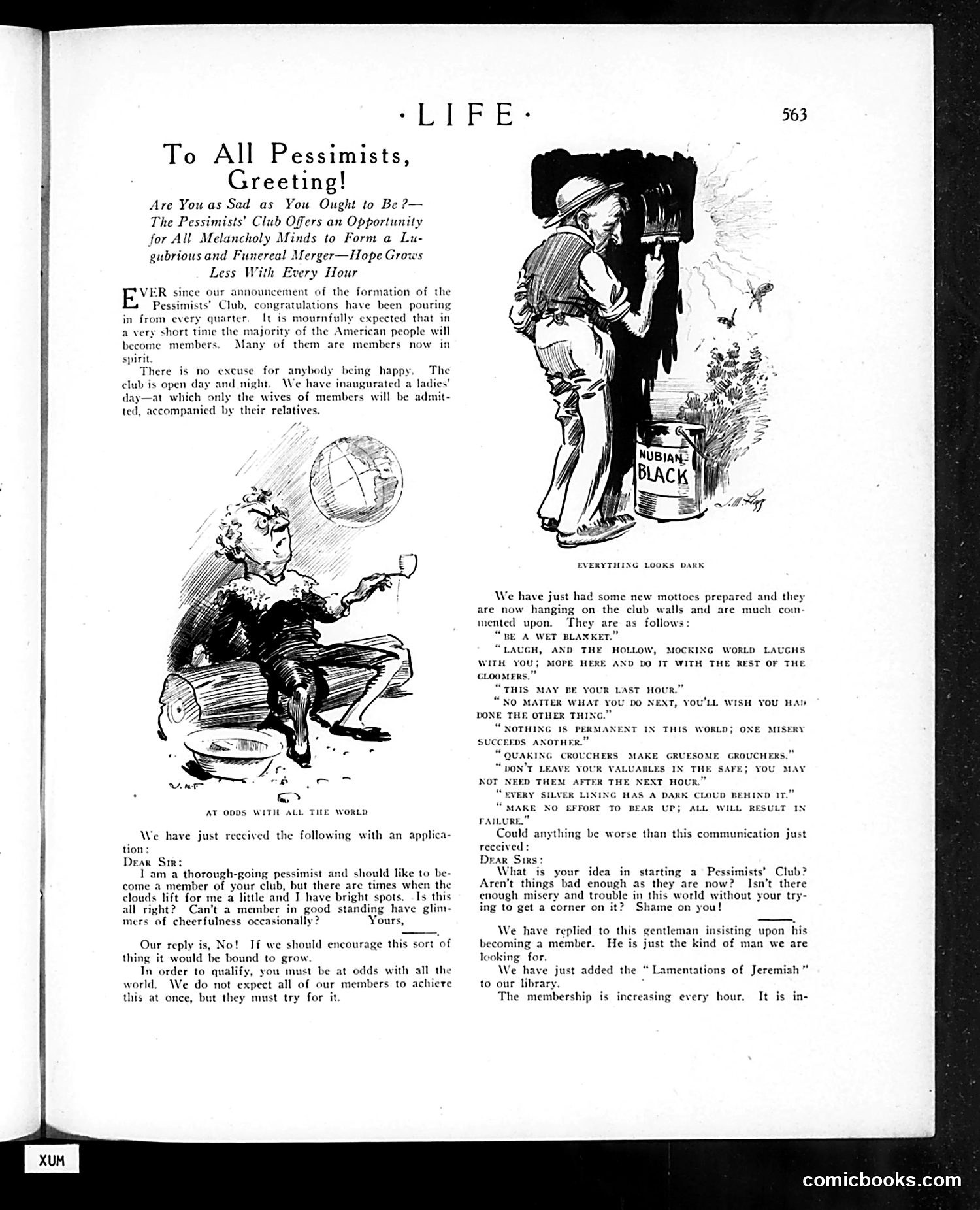
This satirical piece mocks the early-20th-century vogue for pessimism as a fashionable worldview. Life magazine announces a fictional "Pessimists' Club" that actively recruits members committed to gloom and despair. The humor works through exaggeration: the club's bylaws require members to be "at odds with all the world," its mottos deliberately invert common wisdom ("Every silver lining has a dark cloud behind it"), and the magazine ironically notes membership is "increasing every hour." The accompanying illustrations—a dejected figure at "odds with all the world" and a pessimist painting everything black—visually reinforce the absurdity. The satire targets not genuine suffering but rather pessimism as performative melancholy, a self-indulgent attitude adopted by middle-class Americans. By treating pessimism as an organized "merger" and social club, Life ridicules it as a shallow fad rather than serious philosophy, implying that such fashionable gloom deserves mockery rather than respect.
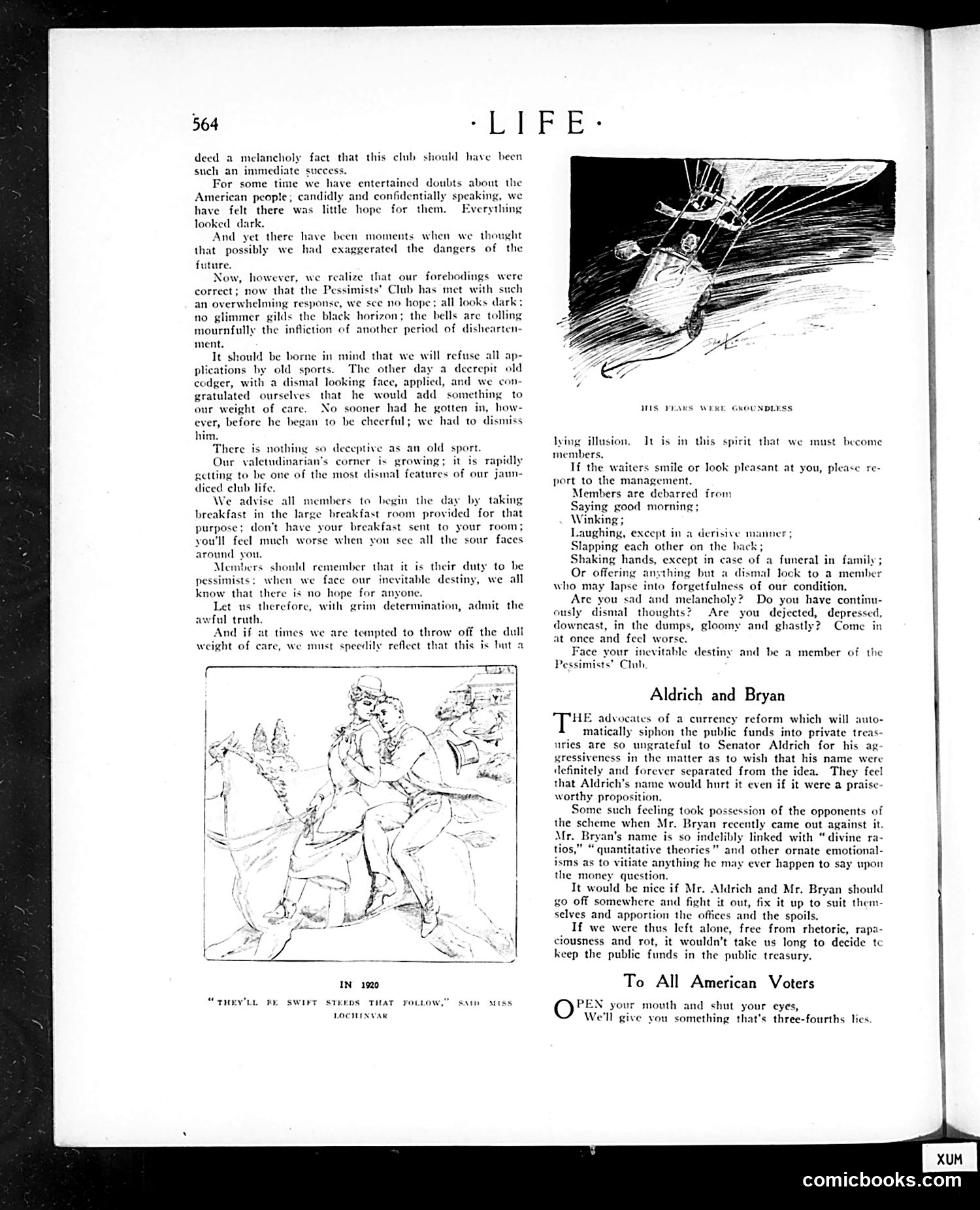
This page contains two distinct satirical pieces: **"The Pessimists' Club"** (left): A humorous mock-serious article lampooning American pessimism and defeatism. The accompanying cartoons illustrate club members engaged in deliberately joyless activities. The satire mocks those who cultivate gloom as an identity, with rules prohibiting smiling, laughing (except derisively), or cheerfulness. It's a commentary on widespread cultural pessimism of the era. **"Aldrich and Bryan"** (right): Political satire targeting Senator Nelson Aldrich and William Jennings Bryan regarding currency reform debates. The piece sarcastically suggests their names are so politically toxic that their opposition to each other's proposals—despite potentially being right—makes their positions suspect to voters. The satire criticizes how partisan loyalty and personalities overshadow substantive policy discussion on monetary issues. Both pieces exemplify Life's acidic social and political commentary typical of early 20th-century American humor journalism.
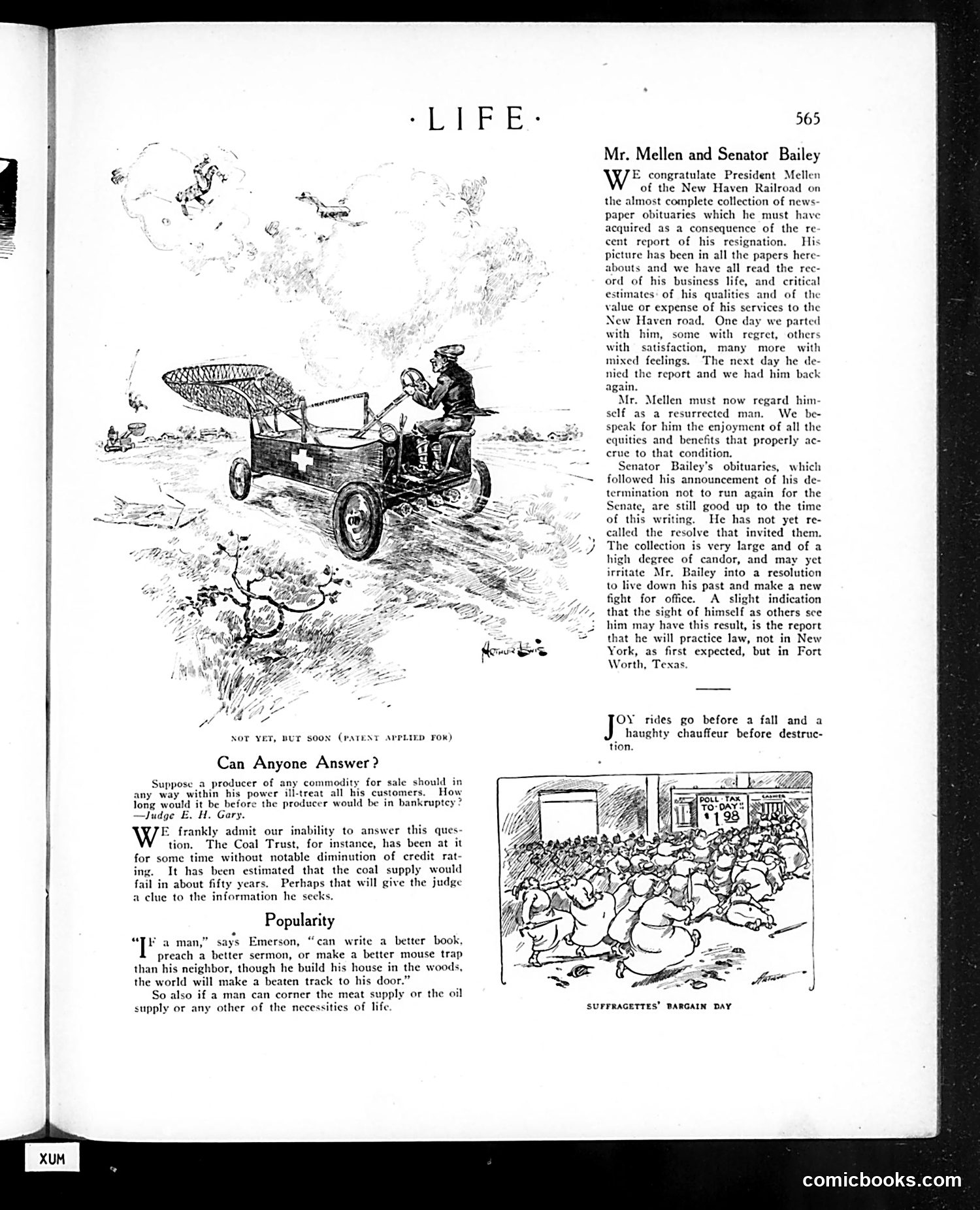
This page contains three satirical pieces critiquing American business and political figures: **"Can Anyone Answer?"** mocks Judge E.H. Gary's rhetorical question about producers mistreating customers. Life's response is scathing: the Coal Trust has been abusing customers for years without facing bankruptcy, suggesting that monopolies can exploit people indefinitely. The follow-up "Popularity" section extends this, noting that cornering essential supplies (meat, oil) is as effective as building a better mousetrap—a biting inversion of Emerson's optimistic philosophy. **"Mr. Mellen and Senator Bailey"** sarcastically celebrates railroad executive Charles Mellen's and Senator Joseph Bailey's premature "obituaries" in newspapers after their announced resignations. Life jokes they've been "resurrected" by denying the reports. The piece implies their public reputations were so damaged that newspapers eagerly published retrospectives on their careers—treating them as already finished figures. **"Suffragettes' Bargain Day"** (bottom cartoon) appears to depict a crowded shopping scene, likely satirizing suffragette activism through consumer culture imagery, though the specific reference is unclear without additional context.
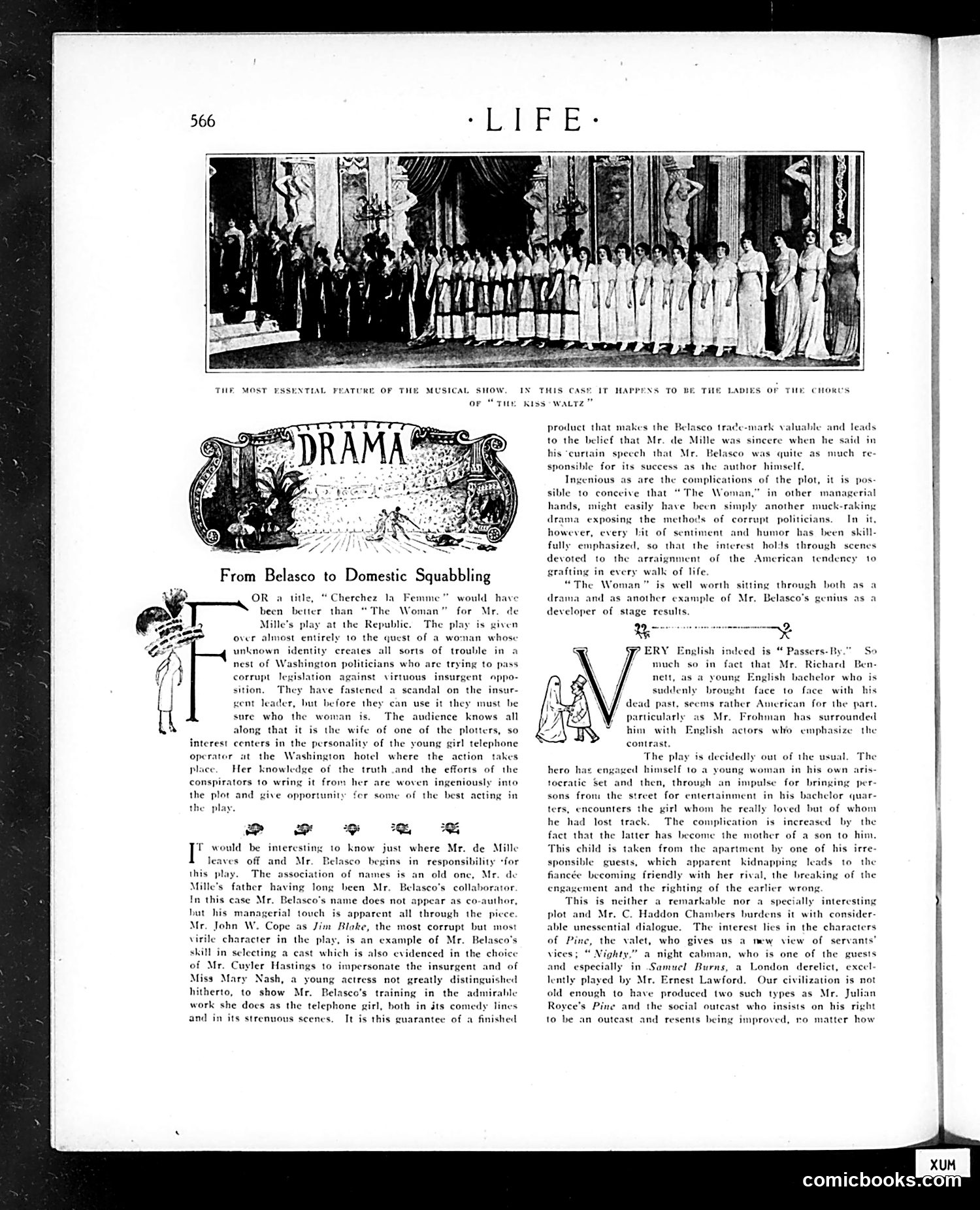
This page reviews theatrical productions, primarily focusing on "The Woman," a play by Cecil B. DeMille at the Republic Theatre. The article discusses DeMille's collaboration with renowned theatrical producer David Belasco, crediting Belasco's directorial skill for the play's success. The review describes a plot involving Washington politicians attempting to blackmail an insurgent leader using scandal. A telephone operator at a Washington hotel holds crucial knowledge. The article praises the casting choices and Belasco's reputation for selecting talented performers. The page also briefly reviews "Passers-By," noting its English setting and protagonist—a young English bachelor confronting his past. The critic observes that actor Richard Bennett seems "rather American for the part," despite Frohman surrounding him with English actors for contrast. The top photograph shows a chorus line from a musical production, illustrating "the most essential feature" of musical shows at this era.
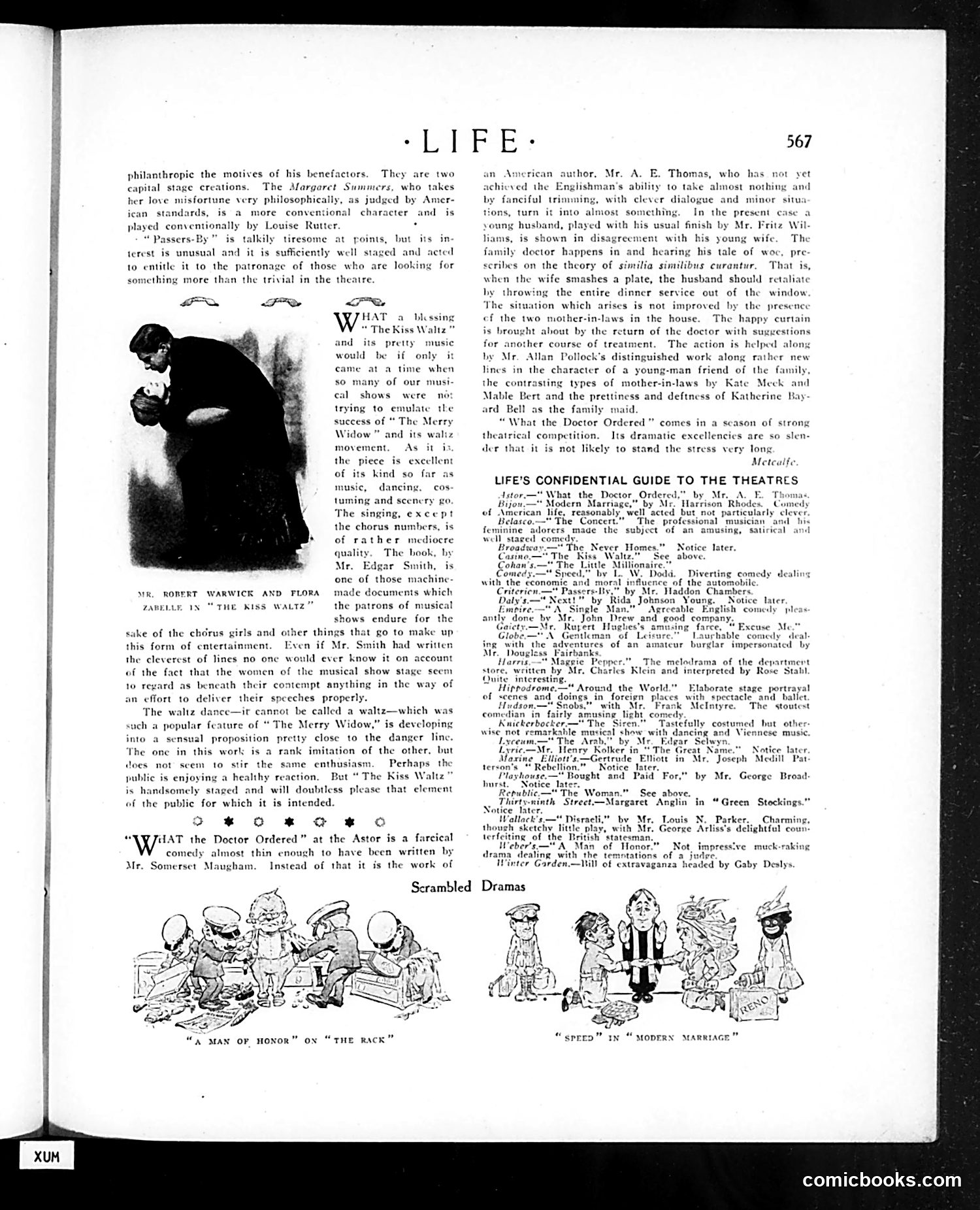
This page from *Life* magazine (page 567) reviews several theatrical productions opening in New York, with particular focus on musical comedies and farces popular in the early 20th century. The main reviews critique "The Kiss Waltz" (a musical with weak dialogue but pretty staging) and "What the Doctor Ordered" (a farce by A.E. Thomas about marital discord, where a doctor prescribes that spouses reciprocate each other's destructive behavior—when the wife breaks a plate, the husband throws the dinner service out the window). The cartoons at bottom, labeled "Scrambled Dramas," appear to be humorous visual mashups of theatrical plots—"A Man of Honor" on "The Rack" and "Speed" in "Modern Marriage"—satirizing how formulaic and interchangeable theatrical plots had become. The tone is mildly dismissive of contemporary theater's intellectual content while acknowledging audience appetite for spectacle and chorus girls.
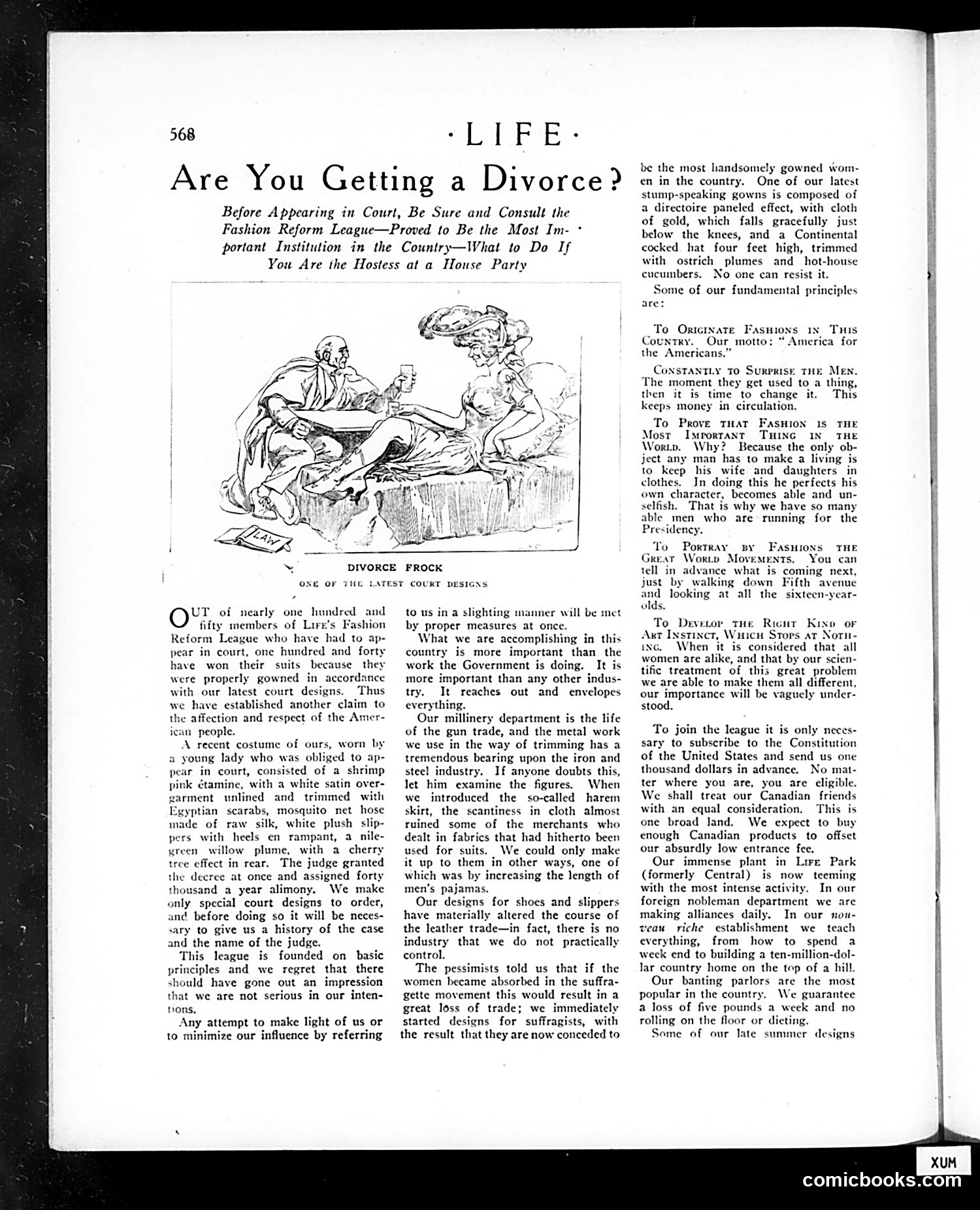
This page satirizes the pretensions of a fictional "Fashion Reform League" that claims absurdly outsized influence over American life. The cartoon depicts a divorce proceeding, labeled "Divorce Frock: One of the Latest Court Designs." The text mockingly asserts that the League's members win 140 of 150 court cases through proper courtroom attire alone—suggesting judges grant divorces based on fashionable clothing rather than legal merit. The League further claims fashion controls industries from steel to leather trade, and that their suffragette designs made activist women "the most handsomely gowned" in the country. The satire targets fashion industry self-importance and the broader early-20th-century anxiety about women's changing roles (suffrage, divorce). By inflating fashion's claimed power over commerce, law, and politics to absurd levels, *Life* mocks both the fashion industry's grandiosity and society's anxieties about female independence and consumption.
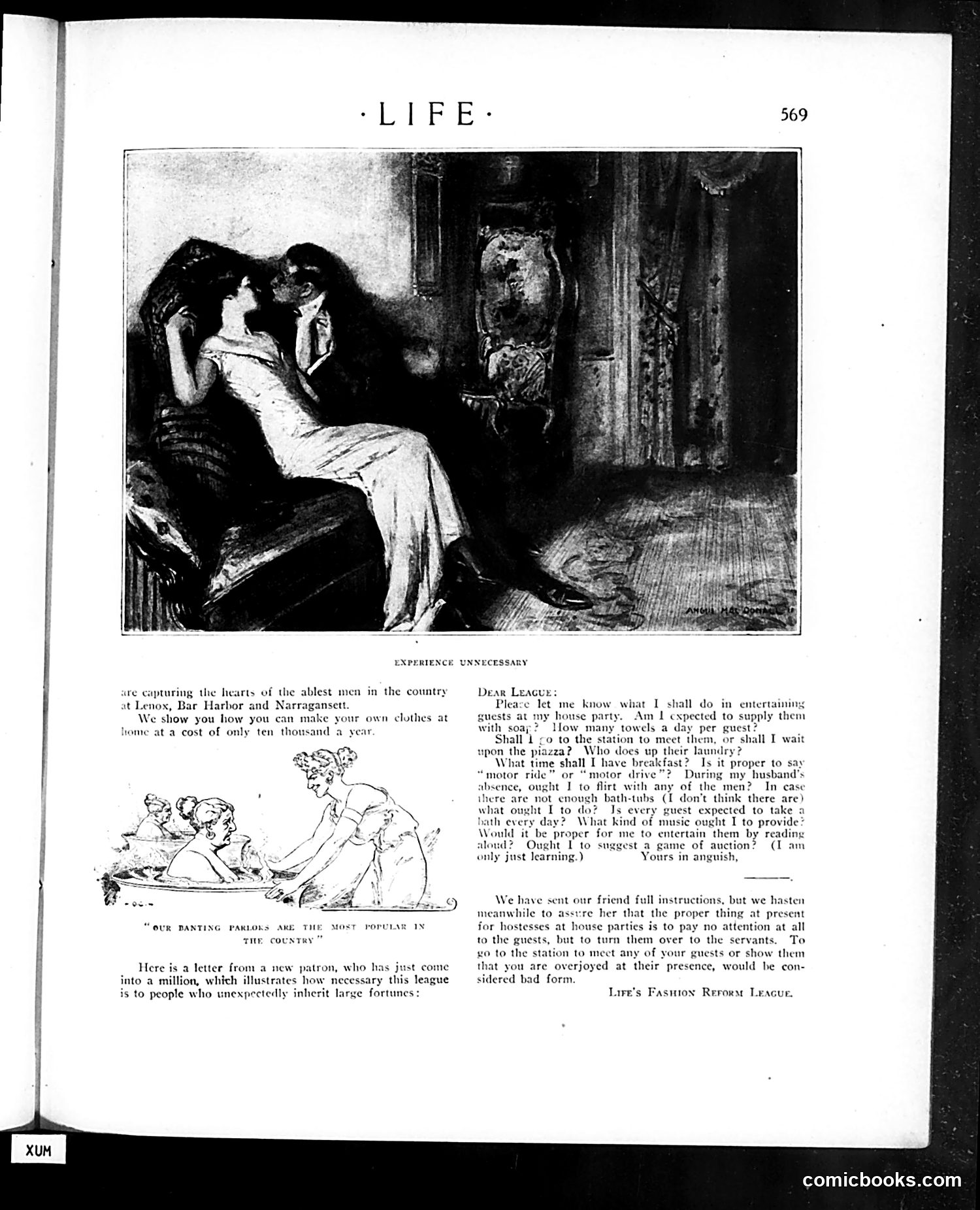
This page satirizes newly wealthy Americans navigating high-society etiquette. The main cartoon depicts a woman reclining while being attended to—illustrating the satirical point about leisure among the rich. The letter is from a woman who has "unexpectedly" inherited wealth and is hosting a house party. She's comically anxious about every detail: should she greet guests? Provide towels? What's proper conversation? Can she flirt with male guests? Should she entertain them personally? **The satire's point**: Life's mock "Fashion Reform League" advises that *the proper thing* is to completely ignore your guests and leave them entirely to servants—treating them as mere obligations rather than welcoming them. This ridicules both the social pretension of the newly rich (obsessing over trivial rules) and upper-class coldness (ignoring guests is considered "good form"). The joke mocks how absurd and backwards wealthy society's rules are.
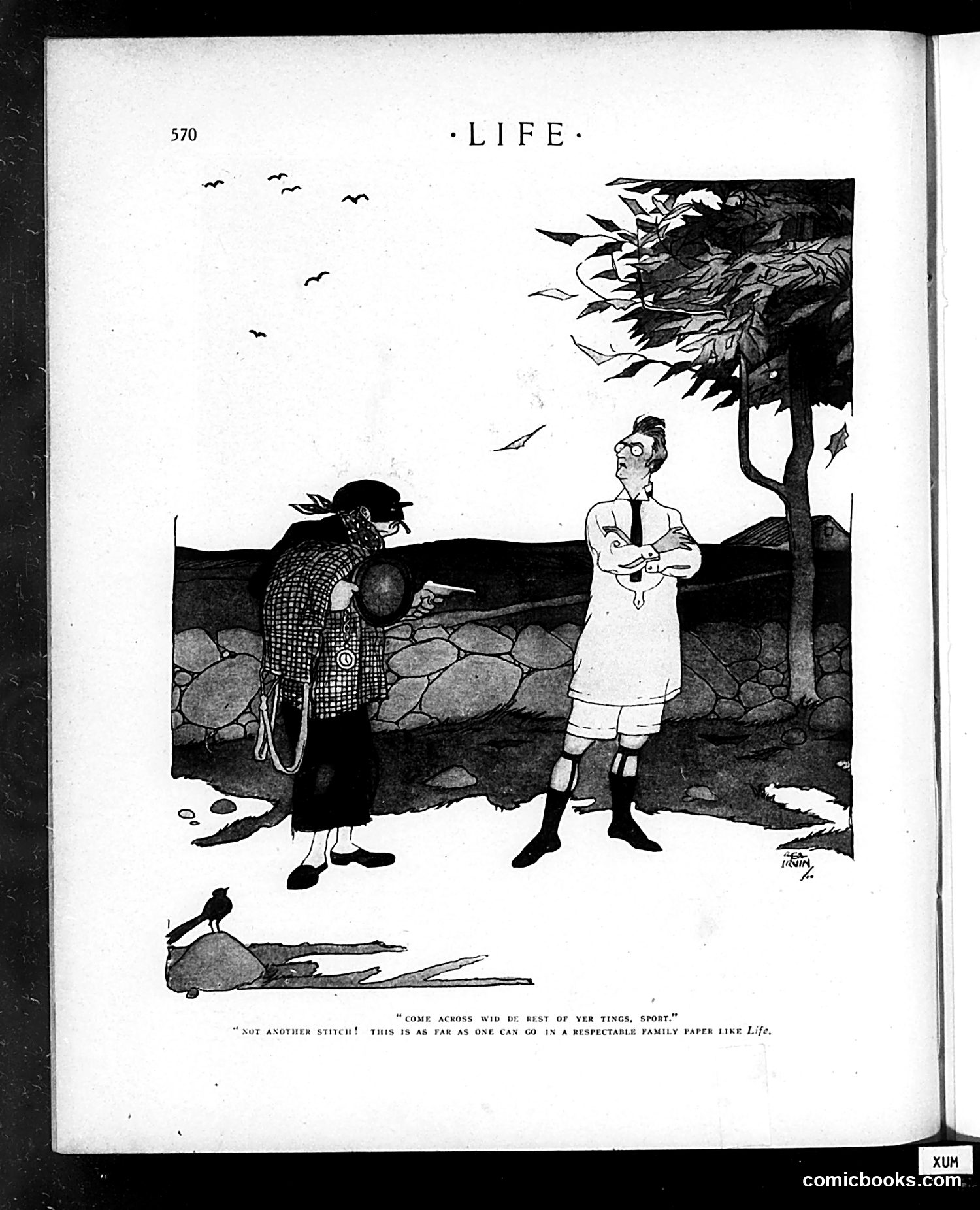
This cartoon satirizes evolving standards of modesty and propriety in early 20th-century America. It depicts two figures—one appearing to be a working-class character (suggested by dialect and clothing) demanding the other undress further, while the other protests they've reached the limit of what Life magazine, a "respectable family paper," can publish. The joke targets the tension between: - Public appetite for increasingly risqué content - Editorial standards meant to maintain family-friendly respectability - Class differences in attitudes toward propriety The cartoon's self-aware commentary on its own publication's boundaries was typical of Life's satirical approach. The exaggerated working-class dialect ("WID DE") reflects period stereotyping conventions.
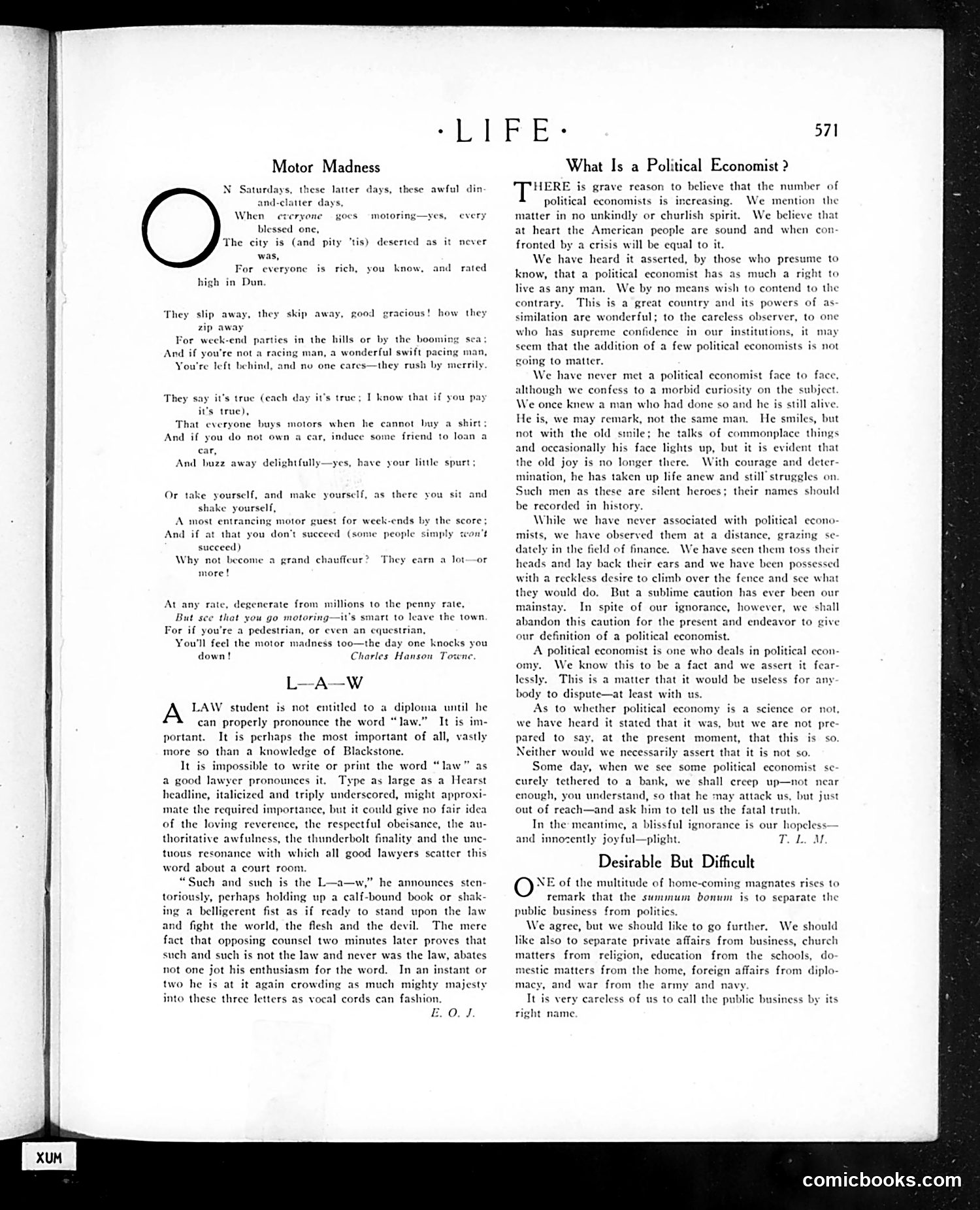
This page contains three distinct satirical pieces from Life magazine: **"Motor Madness"** (poem by Charles Hanson Towne): Satirizes the 1920s automobile craze, mocking how everyone—regardless of wealth—rushes to own cars for weekend trips. The joke is that people buy motors they can't afford, and those without cars beg rides from friends, all to appear fashionable and urban. The final line threatens that non-motorists will eventually be hit by cars. **"L—A—W"** (brief sketch): Ridicules how lawyers pronounce and reverence the word "law" with exaggerated solemnity and theatrical gestures in courtrooms, treating it as sacred despite contradictory rulings. The satire targets the pretentious pomposity of legal professionals. **"What Is a Political Economist?"** (essay): Humorously dismisses political economists as useless additions to society. The author sardonically notes they have a "right to live" while implying they contribute nothing—and that meeting one causes psychological damage to otherwise normal people. All three pieces employ gentle, humorous mockery of contemporary American social types and professions.
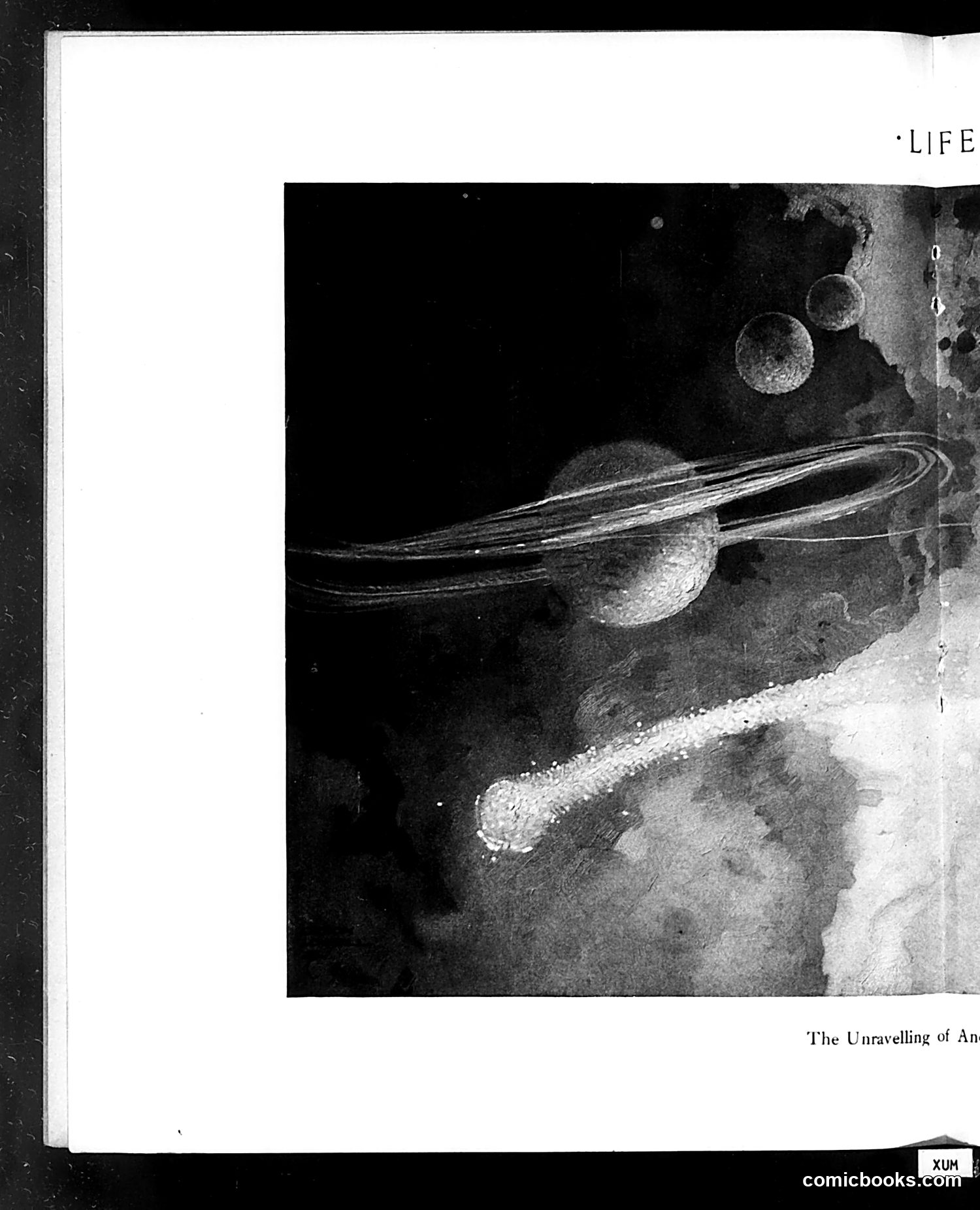
This page from *Life* magazine shows a black and white illustration depicting a planetary system with Saturn (recognizable by its rings) prominently featured alongside other celestial bodies. The partially visible caption reads "The Unraveling of An[...]" but is cut off. The image appears to be **scientific or speculative illustration** rather than political satire. It depicts cosmic or astronomical imagery—likely illustrating a piece about space, astronomy, or theoretical physics. Without the complete caption or article text, the specific satirical point remains unclear, though the title suggests a narrative about something coming apart or being revealed. The sophisticated astronomical rendering suggests this addressed a serious scientific or philosophical topic for *Life's* educated readership.
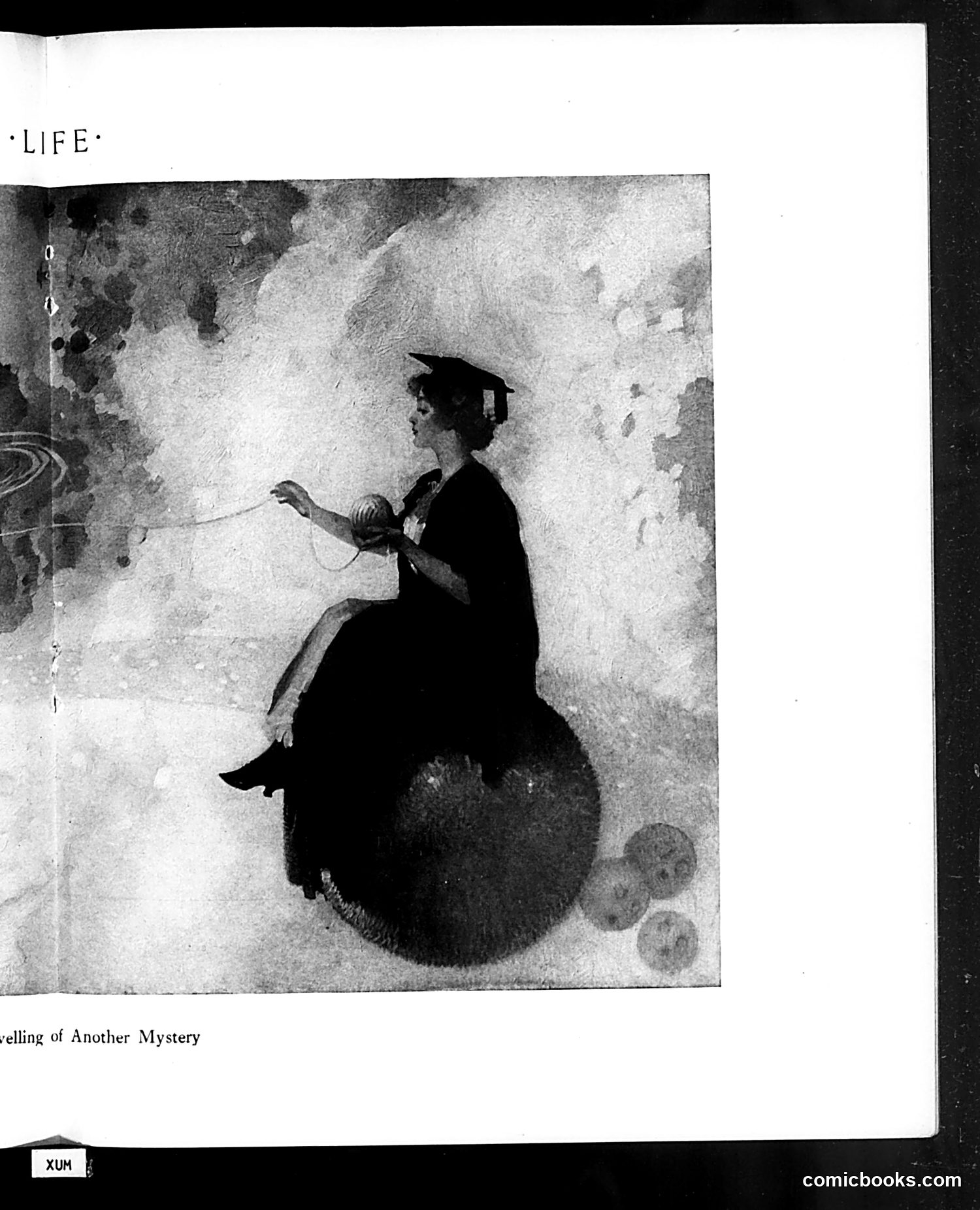
This page from *Life* magazine shows a silhouetted figure in profile, seated and gesturing expressively against a textured background. The figure wears what appears to be academic robes or formal dress with a distinctive hat, suggesting someone of intellectual or institutional authority. The caption reads "yelling of Another Mystery," indicating this is satirizing someone's tendency to complain or protest about mysterious or unclear matters. Without additional context or visible date information, the specific identity and political reference remain unclear. The dramatic silhouette technique was common in early 20th-century satirical illustration to create bold, recognizable figures for *Life*'s commentary on contemporary figures or social trends.
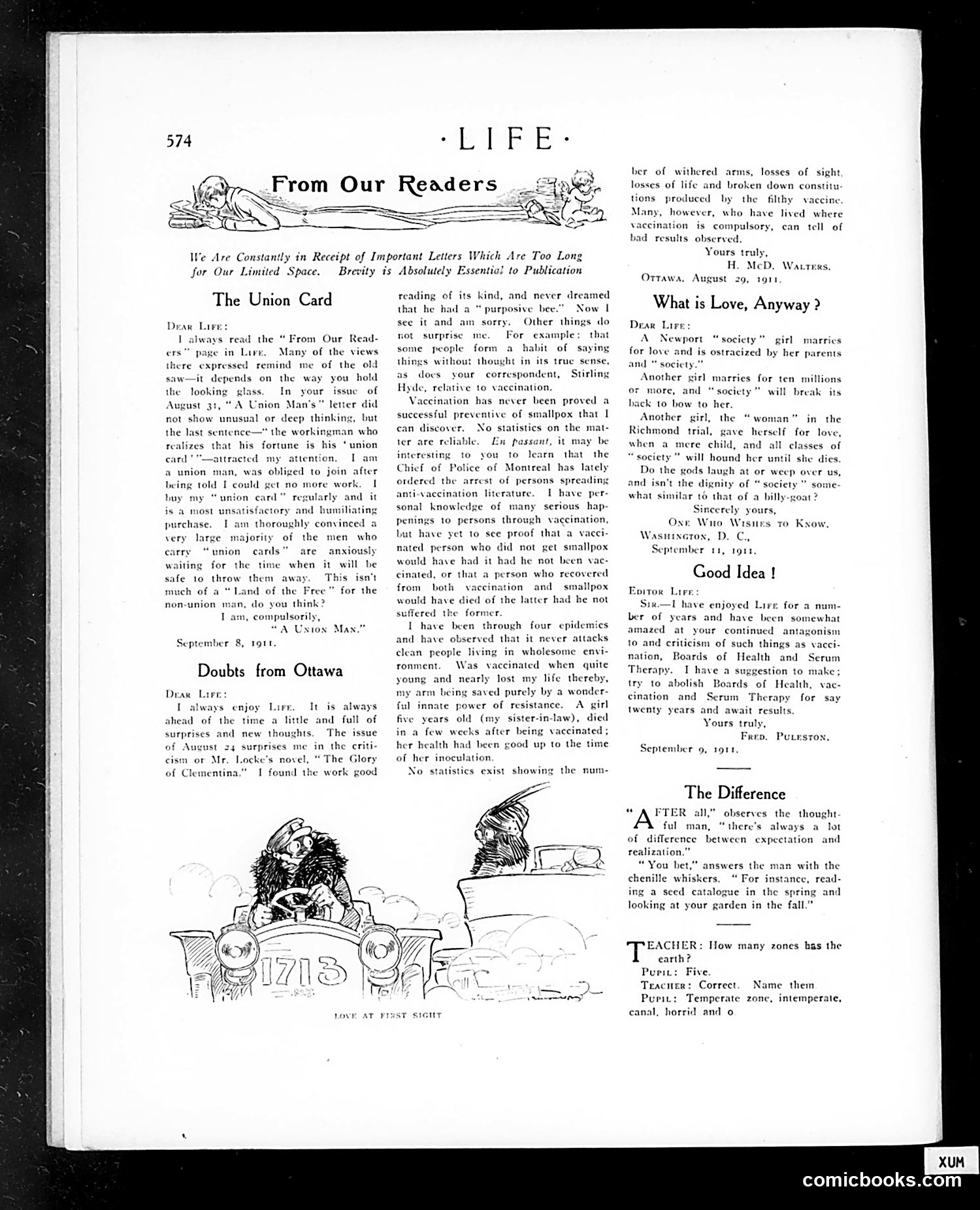
This page presents readers' letters responding to recent *Life* articles. The main cartoon depicts two figures in an early automobile labeled "1913," illustrating the caption "Love at First Sight"—a visual pun on romantic attraction applied to a car. The letters address serious social debates of 1911: **"The Union Card"** criticizes mandatory union membership, arguing workers are coerced into joining despite reluctance. **"Doubts from Ottawa"** challenges vaccination's effectiveness and safety, citing personal anecdotes of vaccination injuries and deaths while claiming clean living prevents disease—reflecting genuine anti-vaccination sentiment that existed in the early 20th century. **"What is Love, Anyway?"** critiques class hypocrisy: wealthy girls who marry for money gain social acceptance, while poor girls who give themselves for love face permanent ostracism. The writer questions society's moral consistency. These letters reveal *Life*'s role as a forum for public debate on labor rights, medical skepticism, and social inequality—issues that resonated with educated readers of the era.

I can see this is a page from a publication (marked "XUM" in the lower left corner and "comicbooks.com" in the lower right), but the image itself is almost entirely black or heavily degraded, making it impossible to discern any actual cartoon content, text, figures, or captions that would allow me to identify the subject matter, political references, or satirical intent. Without visible details—whether character depictions, dialogue, or contextual imagery—I cannot accurately explain what this page means or what historical/political events it references. The page appears to be either a scanning error, severely damaged original, or improperly digitized. To provide accurate analysis per your guidelines, I would need a legible version of this page.

I can see this is a mostly blank or very dark page from what appears to be a Life magazine archive (based on the "comicbooks.com" watermark). The page is almost entirely black with minimal visible content - just a white border on the right side and some faint marks or text that are illegible in this reproduction. Without being able to discern any actual cartoon, illustration, or readable text, I cannot identify specific figures, political references, or satirical intent. The image quality or scanning may have rendered the original content invisible. To properly analyze this page's meaning and context, a clearer reproduction would be necessary.
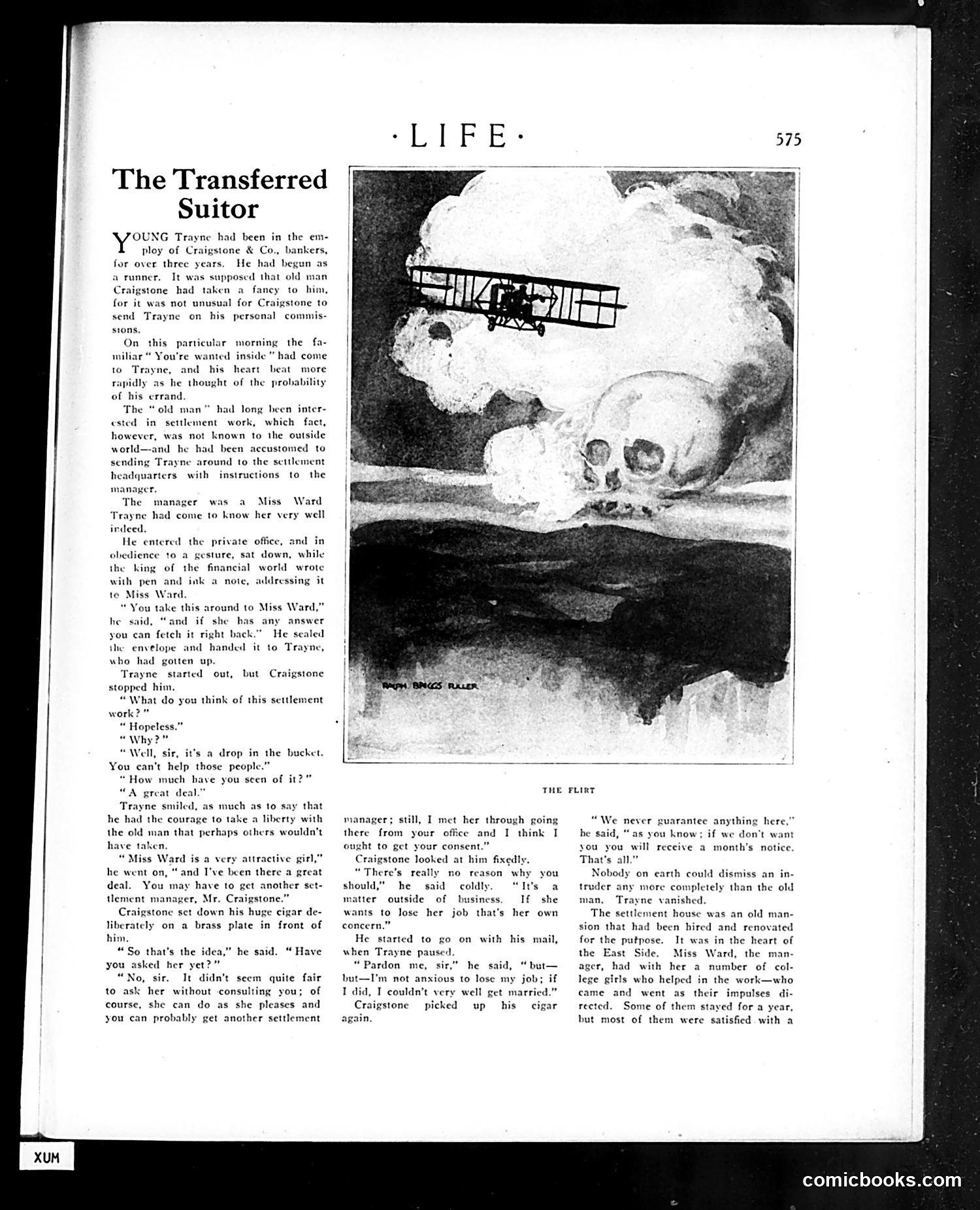
This is a serialized story (not a political cartoon) about workplace romance and class dynamics in early 20th-century America. **The Setup**: Young Trayne works for Mr. Craigstone, a wealthy banker who secretly supports settlement work—charitable programs serving poor immigrants on the East Side. Craigstone regularly sends Trayne to deliver instructions to Miss Ward, the settlement house manager. **The Plot**: Trayne has fallen for Miss Ward and seeks Craigstone's permission to propose marriage. Craigstone responds with calculated coldness, claiming it's "outside business" while implying Trayne would lose his job if she refuses him. **The Satire**: The humor lies in the power imbalance—Craigstone controls both Trayne's livelihood and his romantic prospects through the settlement connection, yet pretends the matter is purely personal. Trayne's deference to ask permission satirizes rigid workplace hierarchies and the vulnerability of young employees. The "transferred suitor" likely refers to Trayne being passed along between Craigstone's authority and Miss Ward's attention.
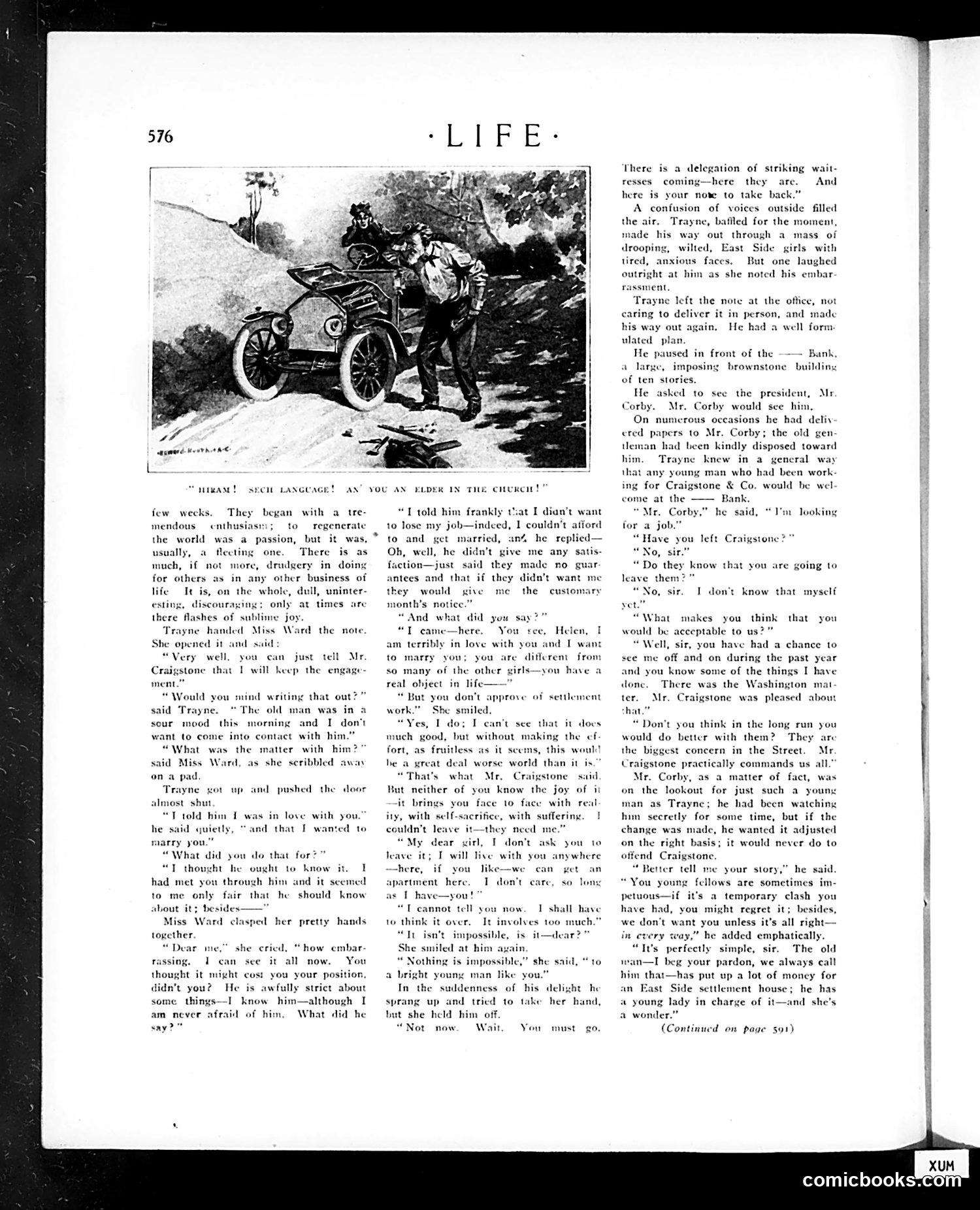
This page depicts a serialized romantic story, not political satire. The illustration shows a young man (Trayne) arriving by early automobile to deliver a note. The narrative concerns a conflict between love and work. Trayne has confessed his love for Miss Helen Ward to their employer, Mr. Craigstone, who disapproved and threatened dismissal. Trayne quit rather than abandon his intentions to marry Helen, who works in "settlement work" (charitable social reform, popular among Progressive-era idealists). The dialogue reveals tension between duty and personal happiness. Helen insists Trayne wait while she considers—she won't abandon her work for marriage. Trayne then seeks Mr. Corby at a bank, apparently to secure employment and prove he can support marriage. This reflects early 20th-century anxieties about class, marriage, and women's independence—themes common in *Life* magazine's serialized fiction for middle-class readers.
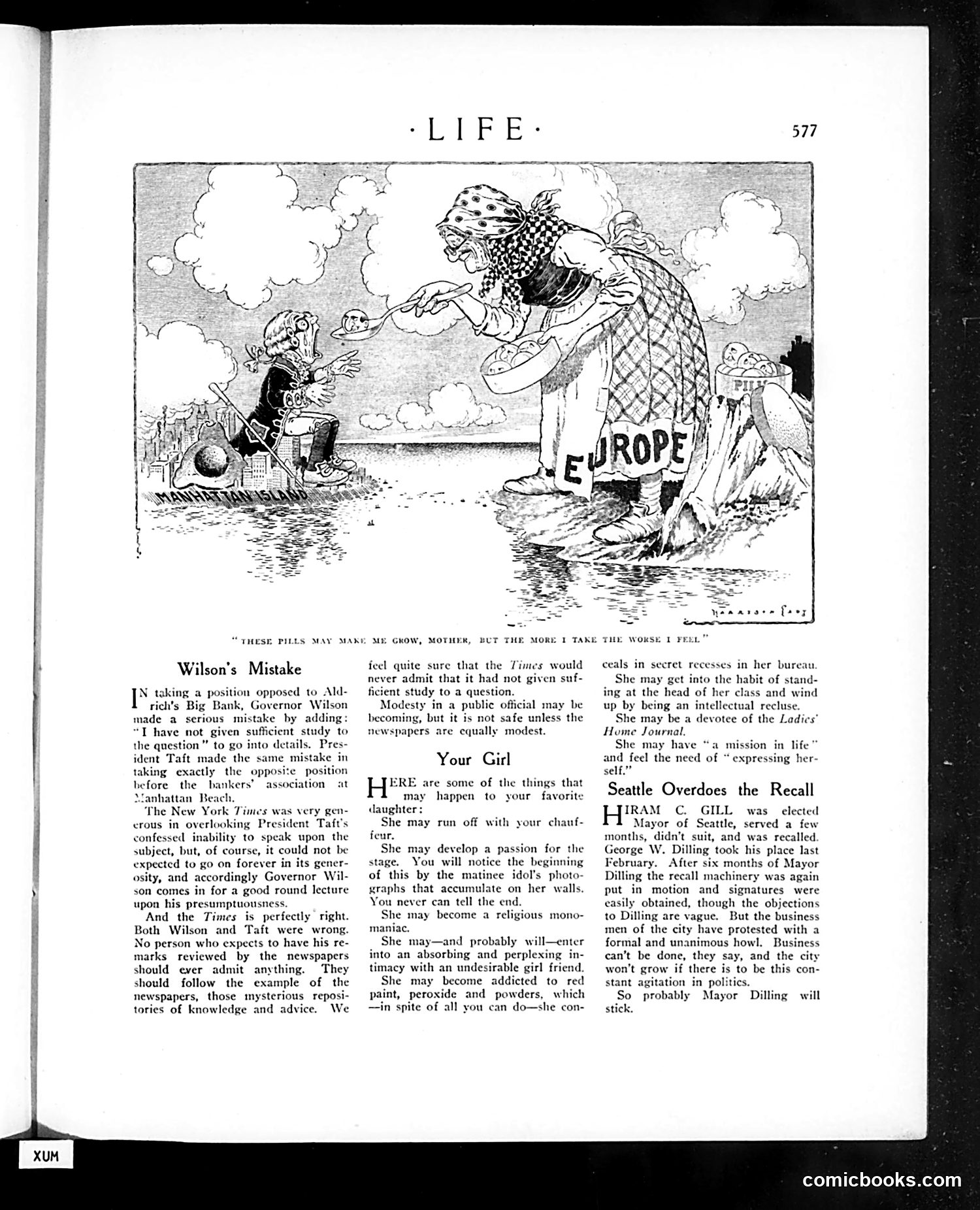
This *Life* magazine page contains political and social satire from the Progressive Era (approximately 1910s). **"Wilson's Mistake"** criticizes both Governor Woodrow Wilson and President William Howard Taft for admitting ignorance about banking policy—Wilson confessed insufficient study of Aldrich's proposed banking bill. The satire argues that public officials shouldn't admit uncertainty, since newspapers (themselves unmodest) will exploit such admissions. It's ironic social commentary on political theater. **The cartoon** (top) depicts Europe as a menacing giant threatening a small figure labeled "Europe," likely referencing American isolationism concerns or imperial overreach. **"Your Girl"** humorously catalogs potential scandals involving daughters—affairs, theatrical ambitions, religious fanaticism, makeup, intellectualism—reflecting anxieties about changing women's independence. **"Seattle Overdoes the Recall"** reports that Seattle's aggressive recall mechanism (removing Mayor Dilling after six months) is harming business confidence, suggesting even progressive reforms can be taken too far.
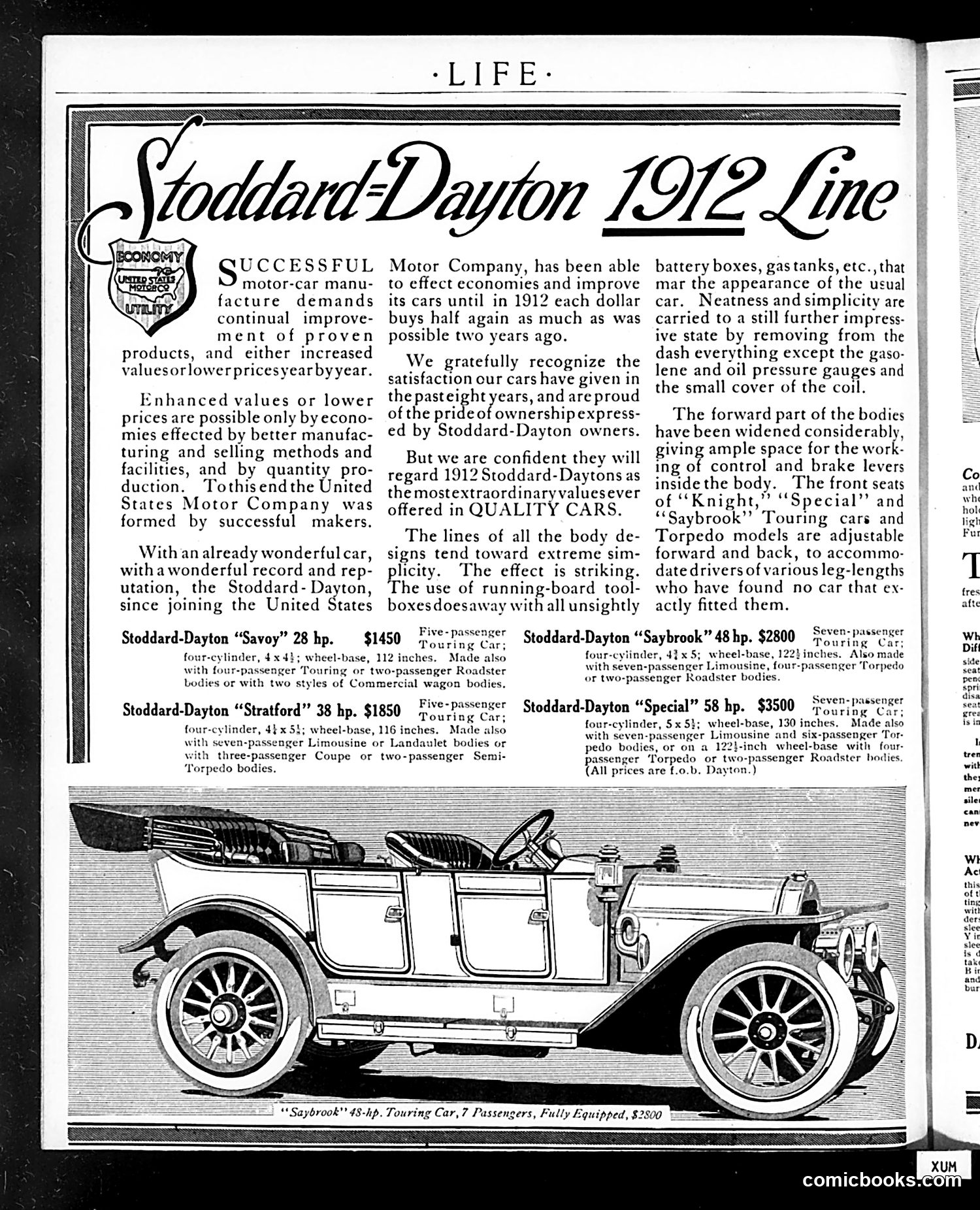
This is **not a cartoon or satire**—it's a straightforward automobile advertisement from *Life* magazine's advertising section. The page promotes the Stoddard-Dayton automobile line, manufactured by the United States Motor Company. The text emphasizes the company's claim that through efficient manufacturing and economies of scale, they can offer improved cars at lower prices: "each dollar buys half again as much as was possible two years ago." The advertisement highlights design innovations (hidden toolboxes, simplified dashboards, adjustable seats) and lists five models with varying horsepower and prices ($1,450–$3,500). An engraving shows a seven-passenger touring car in period style. The tone is promotional boasting about American industrial efficiency—a common theme in early 1900s advertising reflecting confidence in mass-production manufacturing advances.
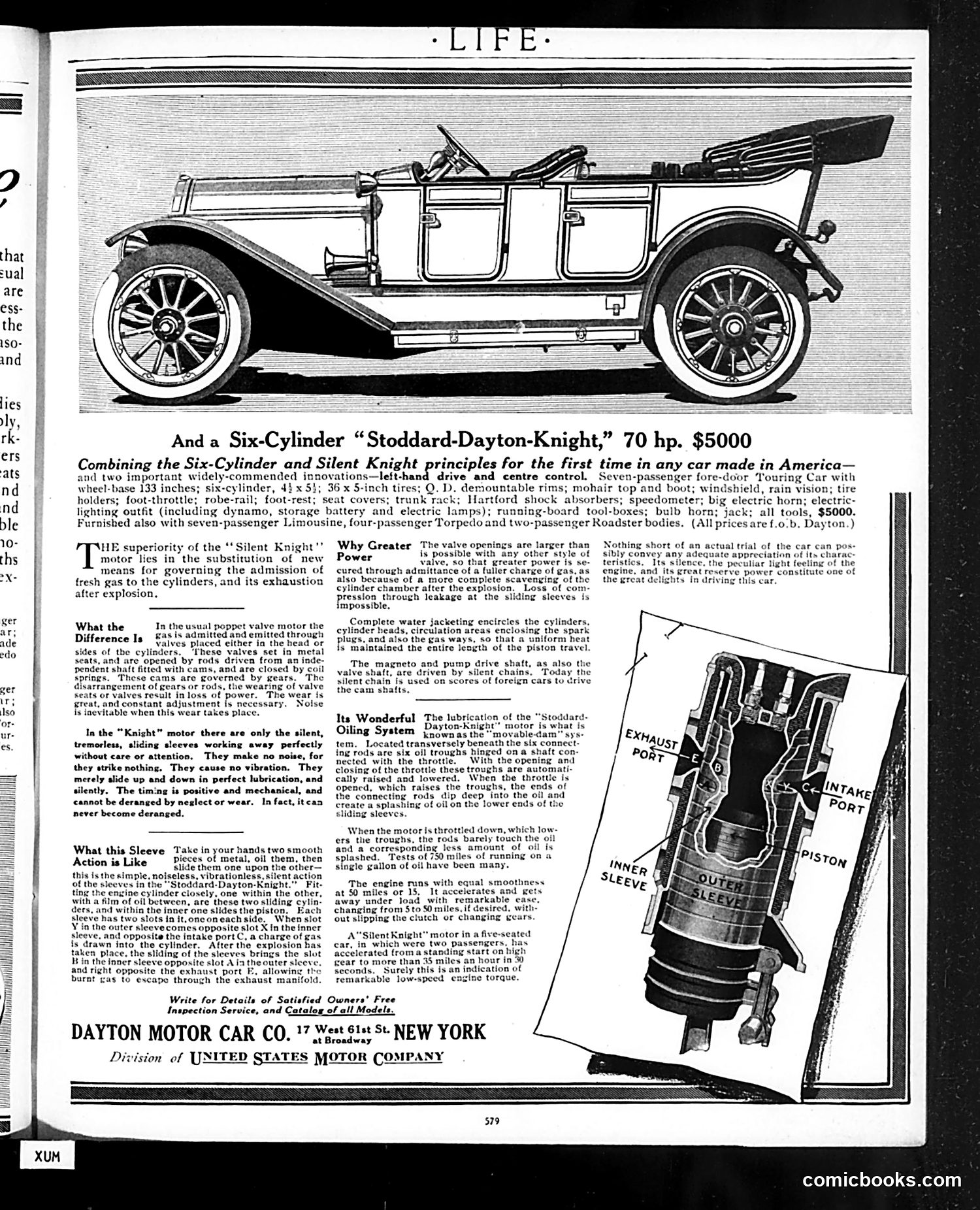
This page is primarily a **car advertisement**, not political satire or commentary. It promotes the Stoddard-Dayton-Knight automobile, a six-cylinder vehicle priced at $5000. The ad emphasizes the car's innovative "Silent Knight" engine technology, which used sliding sleeves instead of traditional poppet valves. The accompanying diagram (right side) illustrates how these sleeves function mechanically. The text repeatedly stresses the engine's silent, vibration-free operation and reliability—key selling points for early 1900s automobiles. The ad highlights practical features: left-hand drive, demountable rims, electric lighting, shock absorbers, and seven-passenger capacity. It's directed at affluent buyers seeking modern engineering and comfort. **Life magazine** regularly featured automobile advertisements alongside satirical content. This particular page contains no political cartoons or social satire—it's straightforward product marketing from the Dayton Motor Car Company (a division of United States Motor Company), based in New York.
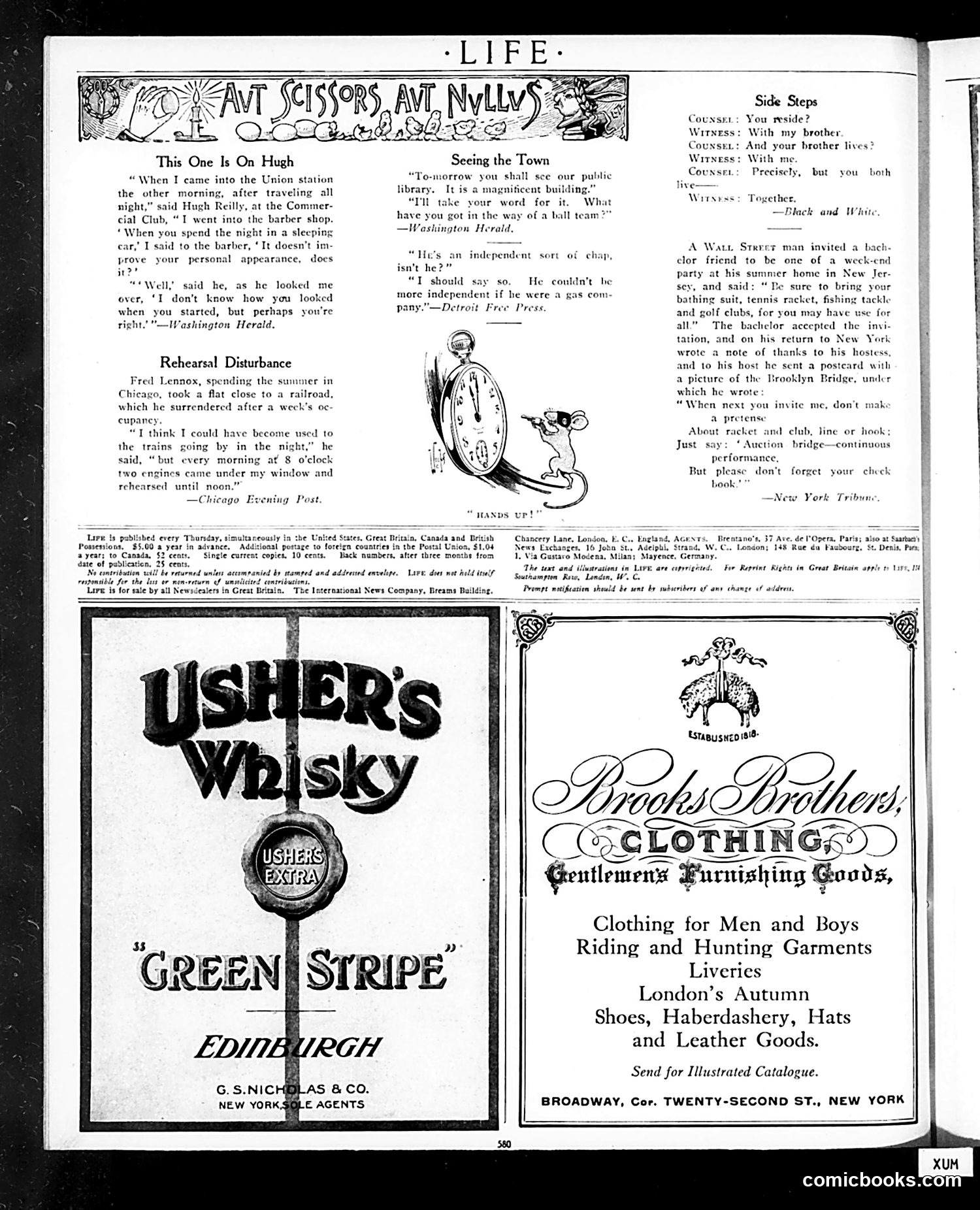
This page from *Life* magazine contains several brief humorous anecdotes rather than political cartoons. The jokes reflect early 20th-century American social observations: **"This One Is On Hugh"** mocks a barber's backhanded compliment to a tired traveler—implying the passenger looks so disheveled that personal grooming seems futile. **"Rehearsal Disturbance"** jokes about a Chicago apartment dweller's complaint that railroad engines practicing nearby were unbearable. **"Seeing the Town"** satirizes civic pride: a host boasts of the public library while admitting the town lacks a baseball team. **"Side Steps"** uses circular logic humor in a courtroom exchange about residence. **The final anecdote** satirizes wealthy hosts' expectations—a guest sarcastically thanks his host for the invitation by sending a postcard of the Brooklyn Bridge, noting that next time the host should simply ask him to bring his checkbook, mocking the expense of week-end entertaining. The page is primarily advertising, featuring Usher's Whisky and Brooks Brothers Clothing.
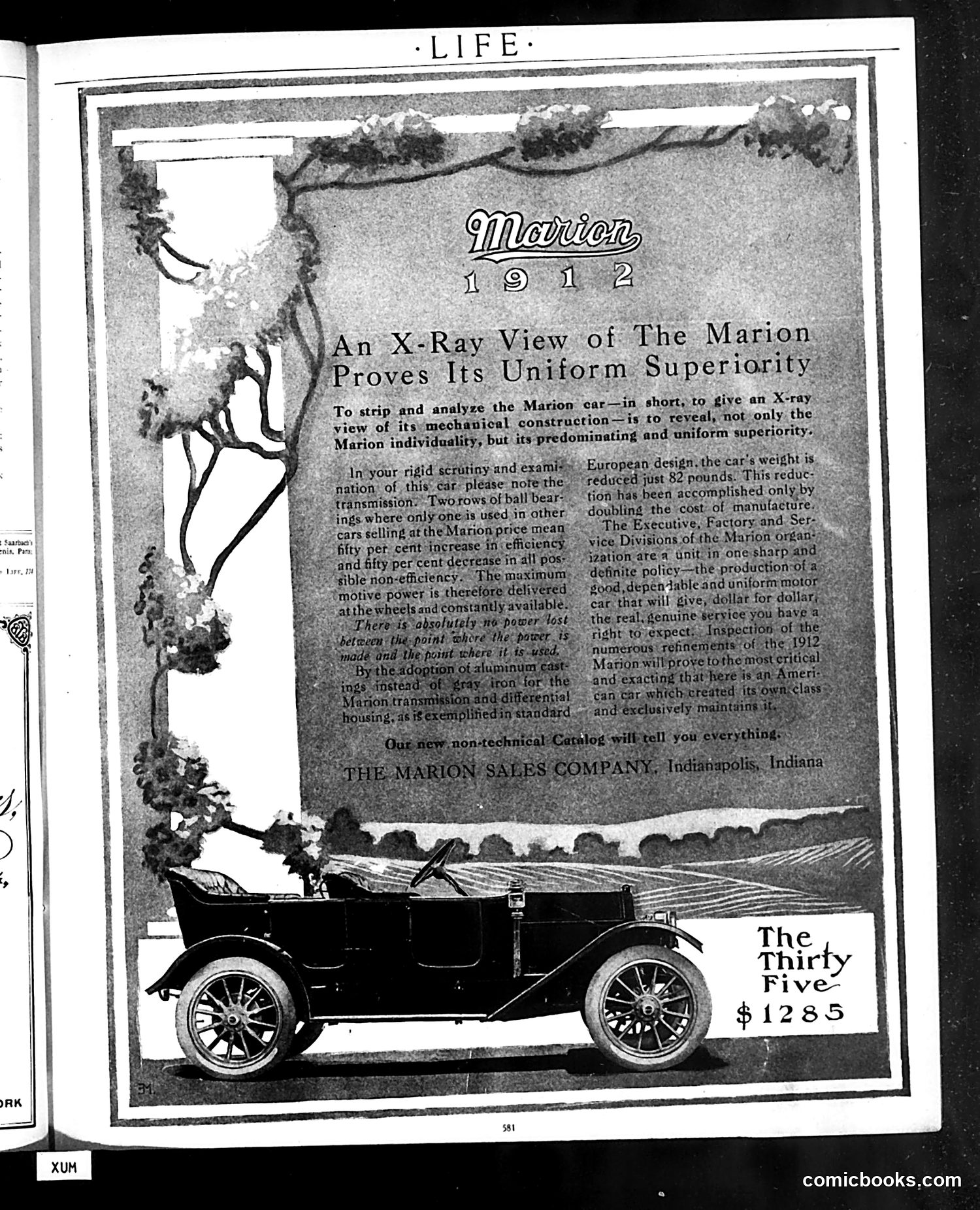
This is a **Marion automobile advertisement**, not political satire. It appeared in *Life* magazine in 1912. The ad promotes the Marion motorcar, manufactured by the Marion Sales Company in Indianapolis, Indiana. The "X-Ray View" headline uses a then-modern scientific metaphor to suggest transparency about the car's mechanical superiority—implying Marion's engineering is so advanced it can withstand scrutiny. Key selling points highlighted include: lightweight construction (62 pounds reduction), efficient transmission with two ball bearings, aluminum castings, and consistent power delivery. The car pictured, called "The Thirty Five," cost $1,285. The decorative vines and landscape framing are typical Art Nouveau-influenced design common in early automotive advertising. This represents how manufacturers marketed cars as technological marvels to a public still fascinated by automobile innovation.
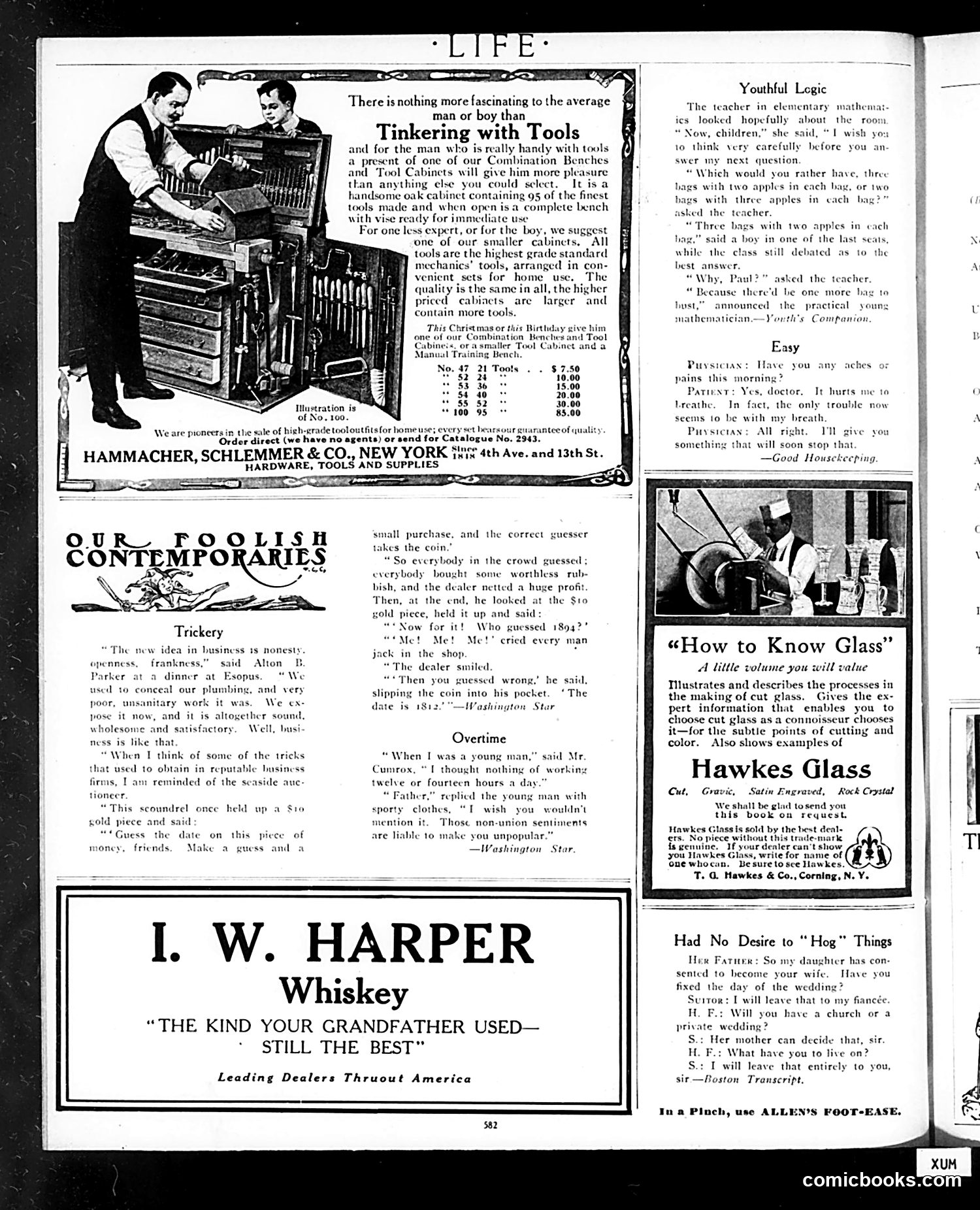
This page is primarily **advertising**, not political satire. It contains several product advertisements interspersed with brief humorous anecdotes. The main content includes: 1. **Hammacher, Schlemmer & Co.** tool cabinet ad (top left) — shows two men examining a combination workbench with 95 tools, marketed as a gift for handy men and boys. 2. **"Our Foolish Contemporaries"** section — three short joke anecdotes about business trickery, overtime work complaints, and date-guessing schemes. These are generic humor pieces, not political commentary. 3. **I.W. Harper Whiskey** ad — nostalgic tagline claiming superiority through tradition ("The kind your grandfather used"). 4. **"Youthful Logic"** and **"Easy"** — brief joke pieces about a math teacher and a doctor. 5. **Hawkes Glass** ad — promoting decorative glassware with information booklet. The page reflects early 20th-century advertising and light humor conventions. There is **no apparent political cartoon or satirical commentary** visible — it's a typical magazine page mixing ads with filler humor content.
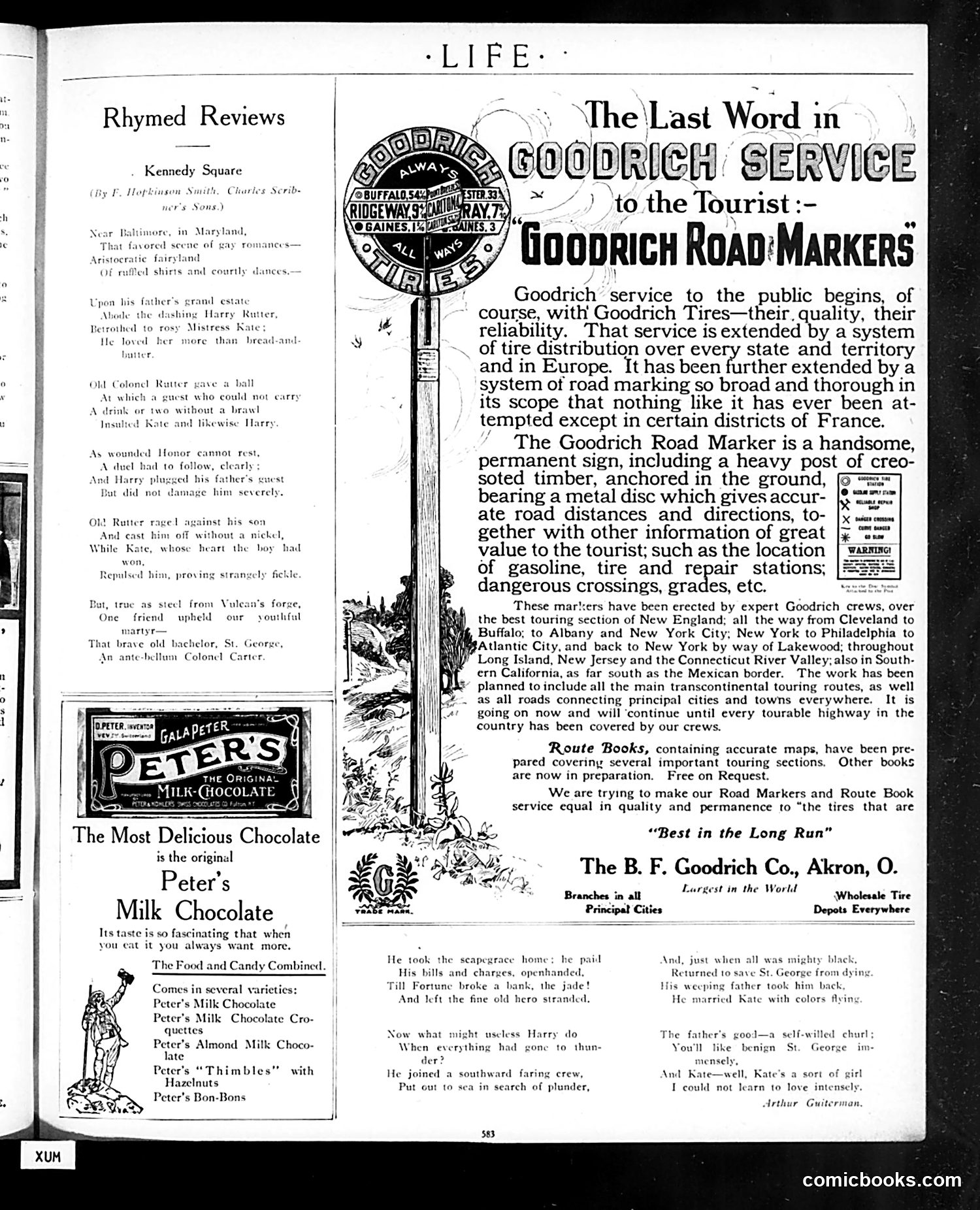
This page is **primarily advertising** for two products: Peter's Milk Chocolate and Goodrich Road Markers. The left column contains "Rhymed Reviews," a satirical poem titled "Kennedy Square" that appears to mock aristocratic life near Baltimore—referencing characters like "Harry Rutter" and "Colonel Rutter" in humorous verse about balls, honor, and social pretension. The main content features a Goodrich advertisement showcasing their roadside markers (metal signs on posts) that helped tourists navigate American roads. The text emphasizes their nationwide coverage and service quality. A circular Goodrich tire logo and illustration of the road marker itself are prominent. Below is poetry continuing the narrative, likely unrelated to the ads. The page reflects early 1900s American consumer culture and the emerging tourist industry dependent on automobile infrastructure.
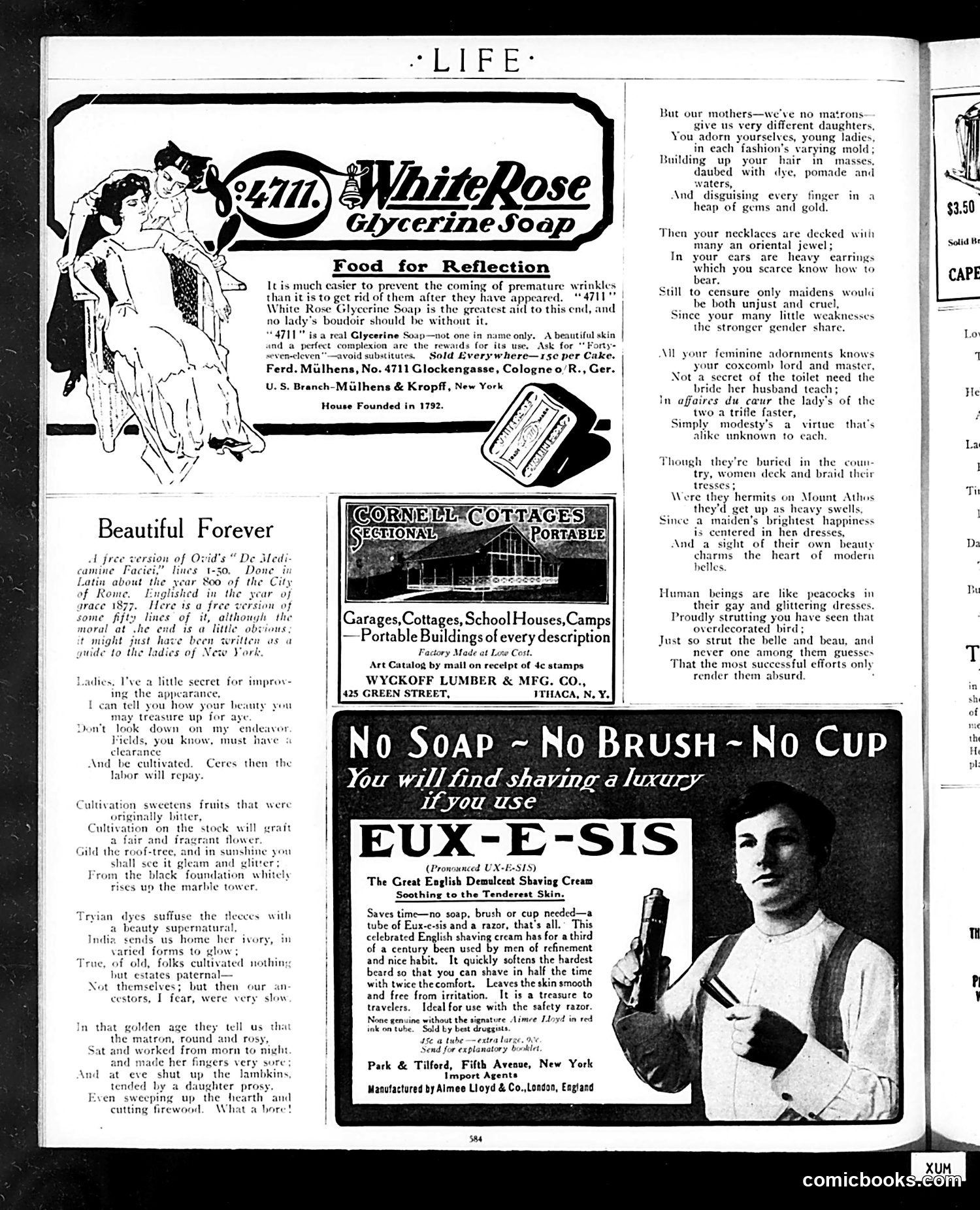
This page is primarily **advertising** from an early 20th-century *Life* magazine, with one satirical poem embedded. The main content consists of product ads (White Rose Glycerine Soap, Cornell Cottages, Eux-e-sis shaving cream) interspersed with two prose/poetic pieces. The satirical element appears in the lengthy poem titled **"Beautiful Forever,"** which mocks **women's vanity and excessive ornamentation**. The speaker criticizes ladies for: - Piling up their hair with dyes and pomades - Wearing excessive jewelry and heavy earrings - Obsessing over fashion and appearance The poem uses classical references (Ovid) and concludes with a biting comparison: women are like "peacocks in their gay and glittering dresses," strutting about, unaware their "successful efforts only render them absurd." The satire is **misogynistic by modern standards**—mocking women for caring about appearance while simultaneously *selling beauty products* on the same page, creating ironic commercial contradiction typical of early *Life* magazine's satirical approach.
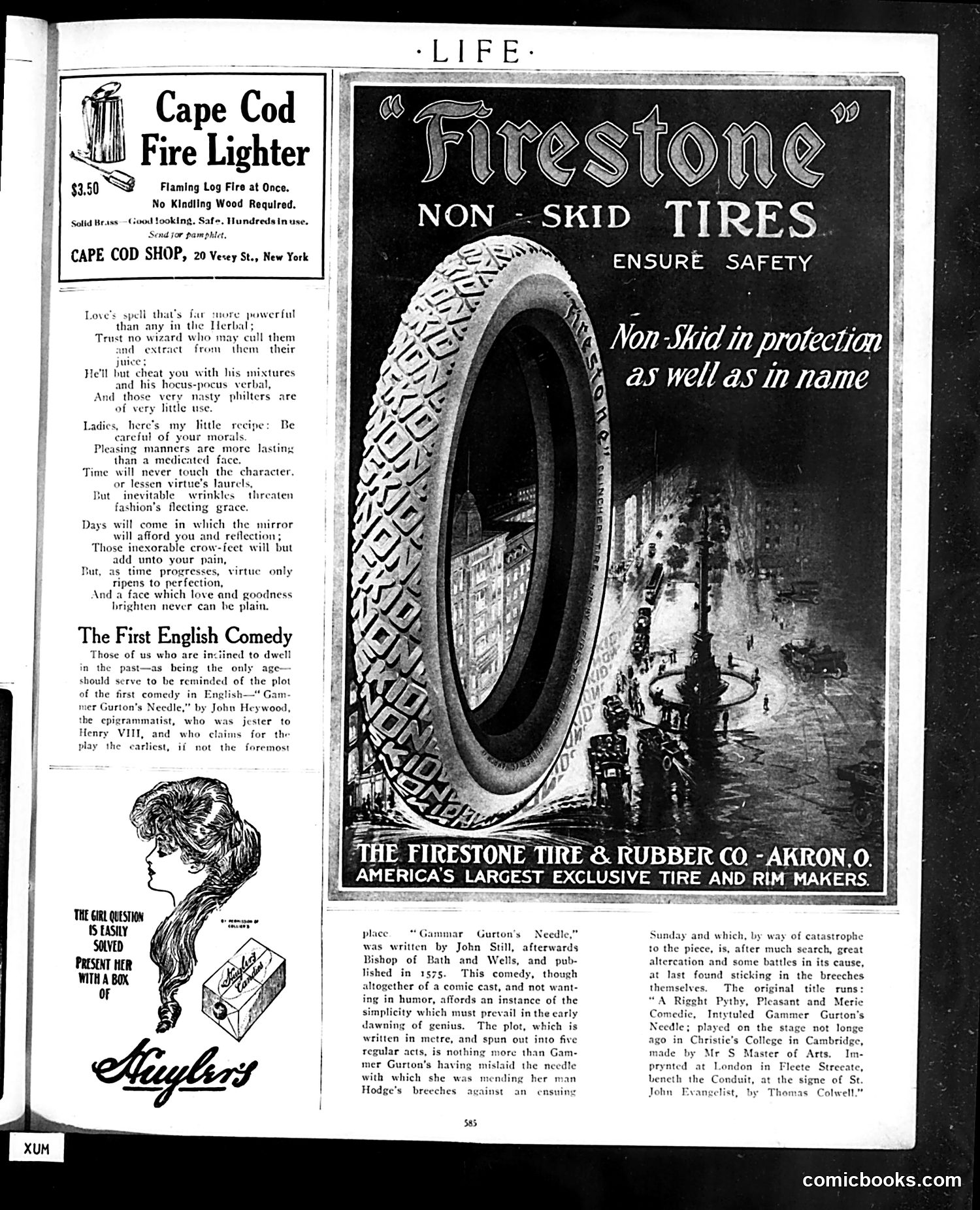
This page combines advertisements with literary content, typical of early 20th-century *Life* magazine format. **Left side** features two ads: a Cape Cod fire lighter ($3.50) and Saylor's (product unclear from image). Between them is sentimental poetry about love, virtue, and aging—advising women that "pleasing manners" and moral character matter more than physical beauty, though "inevitable wrinkles" will come with time. **Right side** is a large Firestone Tire advertisement showing a non-skid tire with a motorcycle on a nighttime road, emphasizing safety. **Bottom content** discusses "The First English Comedy"—John Heywood's *Gammer Gurton's Needle* (1575), a play about an old woman searching for a lost needle found stuck in a servant's breeches. The text treats this as culturally significant early English theater, tracing its publication history and noting its simple plot structure typical of early dramatic works. The page reflects *Life*'s blend of consumer advertising, moral instruction for women, and cultural/literary discussion aimed at educated middle-class readers.
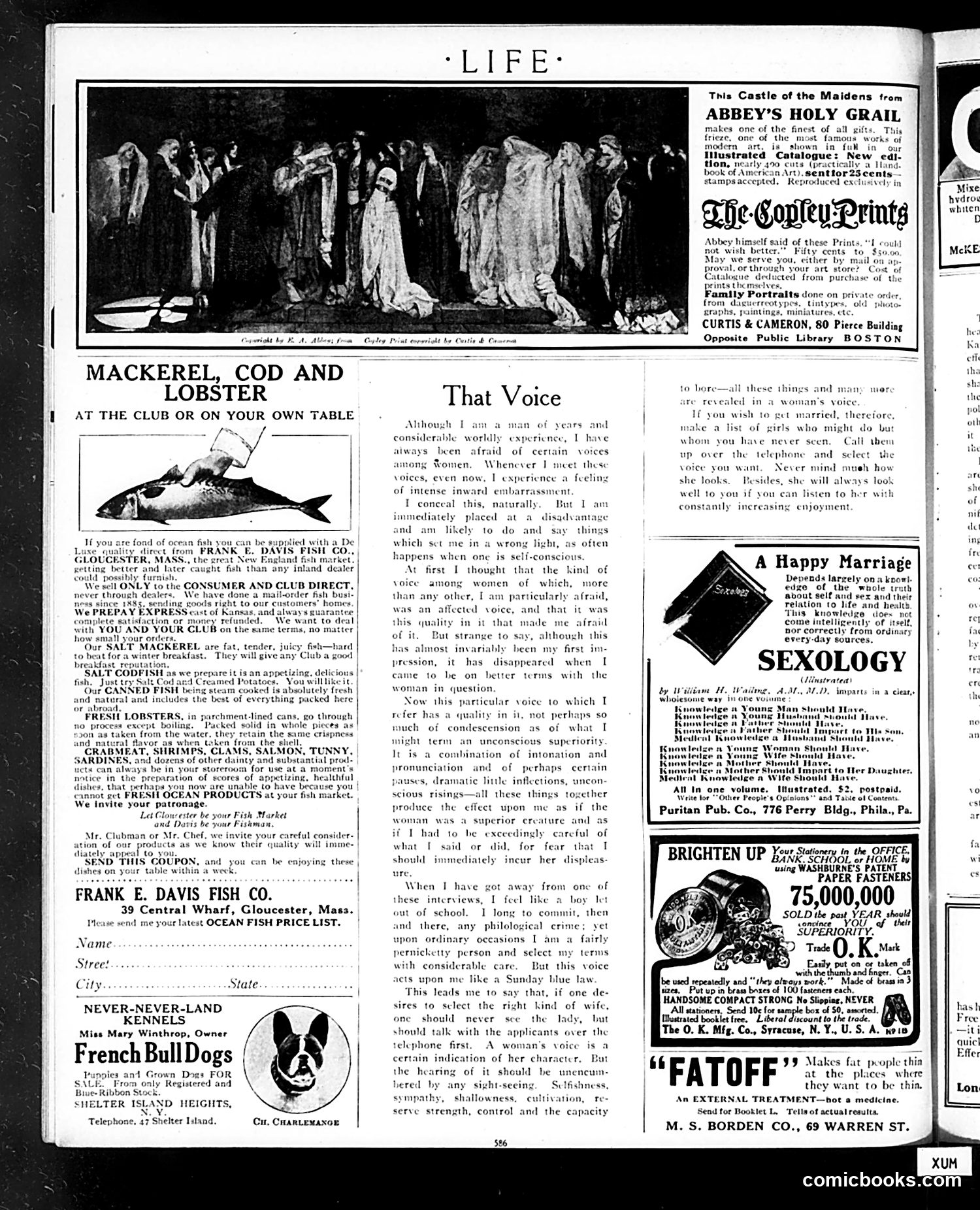
This page is primarily **advertising with one substantial article**. The main content is "That Voice," a humorous essay about a man's irrational fear of certain women's voices—specifically those conveying unconscious superiority through inflection and pronunciation. The author argues that a woman's voice reliably reveals her character, and humorously suggests men select wives by telephone rather than in person, to avoid visual distraction. The piece is social satire targeting early 20th-century gender dynamics and courtship conventions. It playfully mocks both women's affected speech patterns and men's susceptibility to them, while also satirizing the emerging telephone as a courtship tool. The remaining space comprises fish market advertisements (Frank E. Davis Fish Co.), a French Bulldog breeder ad, and various product advertisements including reproductions of religious art and "Sexology" books—typical of Life's mixed editorial-commercial format.
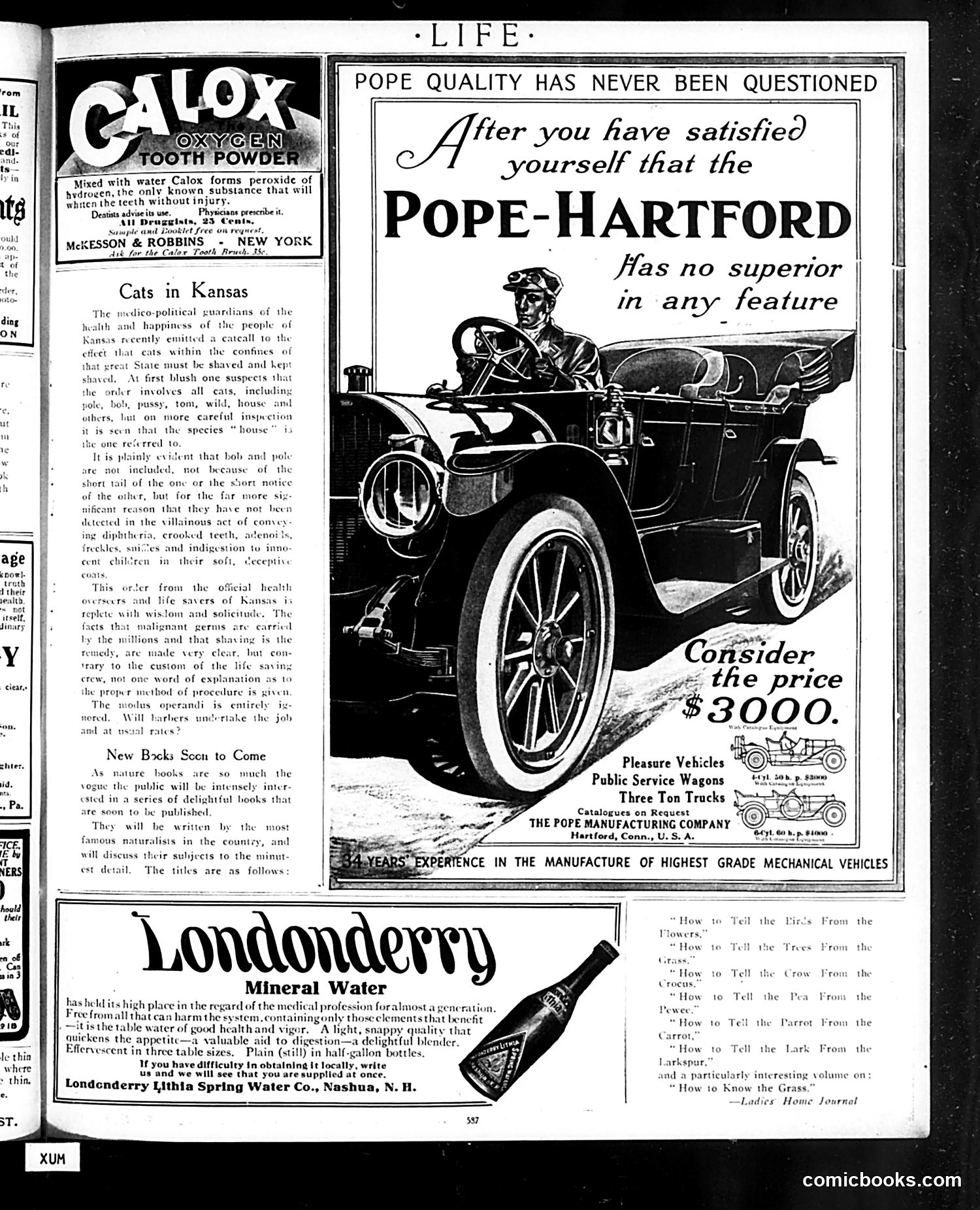
This page is primarily **advertisements** for consumer products (Calox toothpowder, Pope-Hartford automobiles, Londonderry mineral water) interspersed with brief editorial content. The notable satirical piece is "Cats in Kansas," which mocks a real Kansas health order mandating that house cats be shaved and kept indoors. Life ridicules the authorities for their overwrought concern about cats spreading diseases (diphtheria, crooked teeth, adenoiditis) to children, while providing no practical guidance on *how* to implement this absurd policy. The satire suggests the officials are being performatively alarmist without thinking through consequences—particularly the question of whether barbers will undertake shaving cats "at usual rates." The brief "New Books Soon to Come" section appears to joke about upcoming "nature books," though the OCR is too corrupted to determine if this is additional satire. The advertisements are straightforward period marketing with no apparent satirical intent.
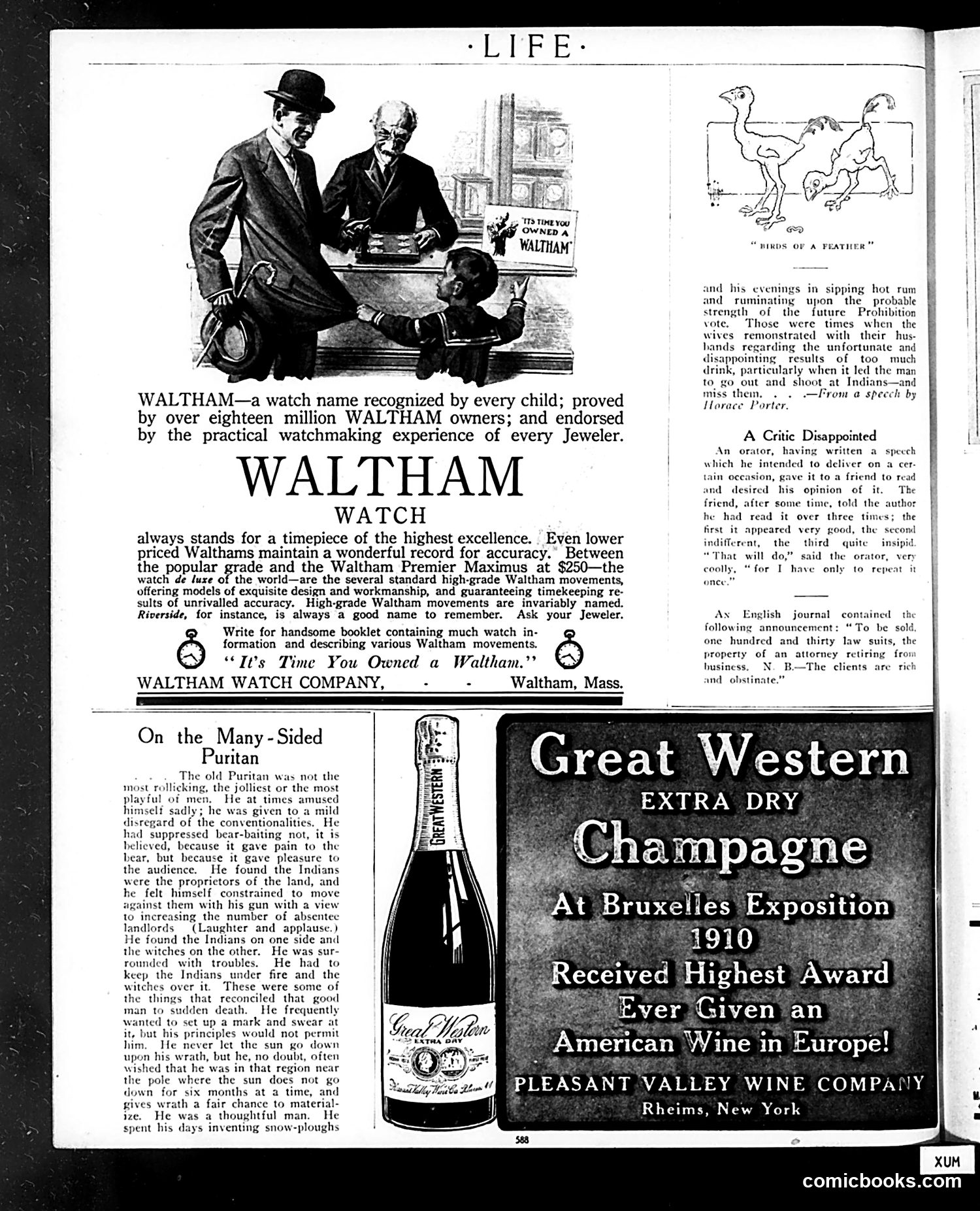
This page is primarily **advertising** with brief satirical content interspersed. The **Waltham Watch ad** dominates—a straightforward product endorsement claiming 18 million owners and superior accuracy. The illustration shows businessmen conducting a transaction, emphasizing reliability. The scattered **humor pieces** appear unrelated to each other: one mocks an orator whose speech degrades upon repetition; another satirizes an English attorney with many wealthy, difficult clients available for sale; a third describes a Puritan's grim life managing Indians, witches, and his own suppressed desires—the joke being his joyless existence made him welcome death. The "Birds of a Feather" cartoon (upper right) is unclear without caption context. The **Great Western Champagne ad** claims a 1910 Brussels award as "highest ever given an American wine in Europe"—likely promotional exaggeration typical of era advertising. The page reflects early 20th-century magazine culture: ads mixed with brief satirical commentary on contemporary social types and historical figures.
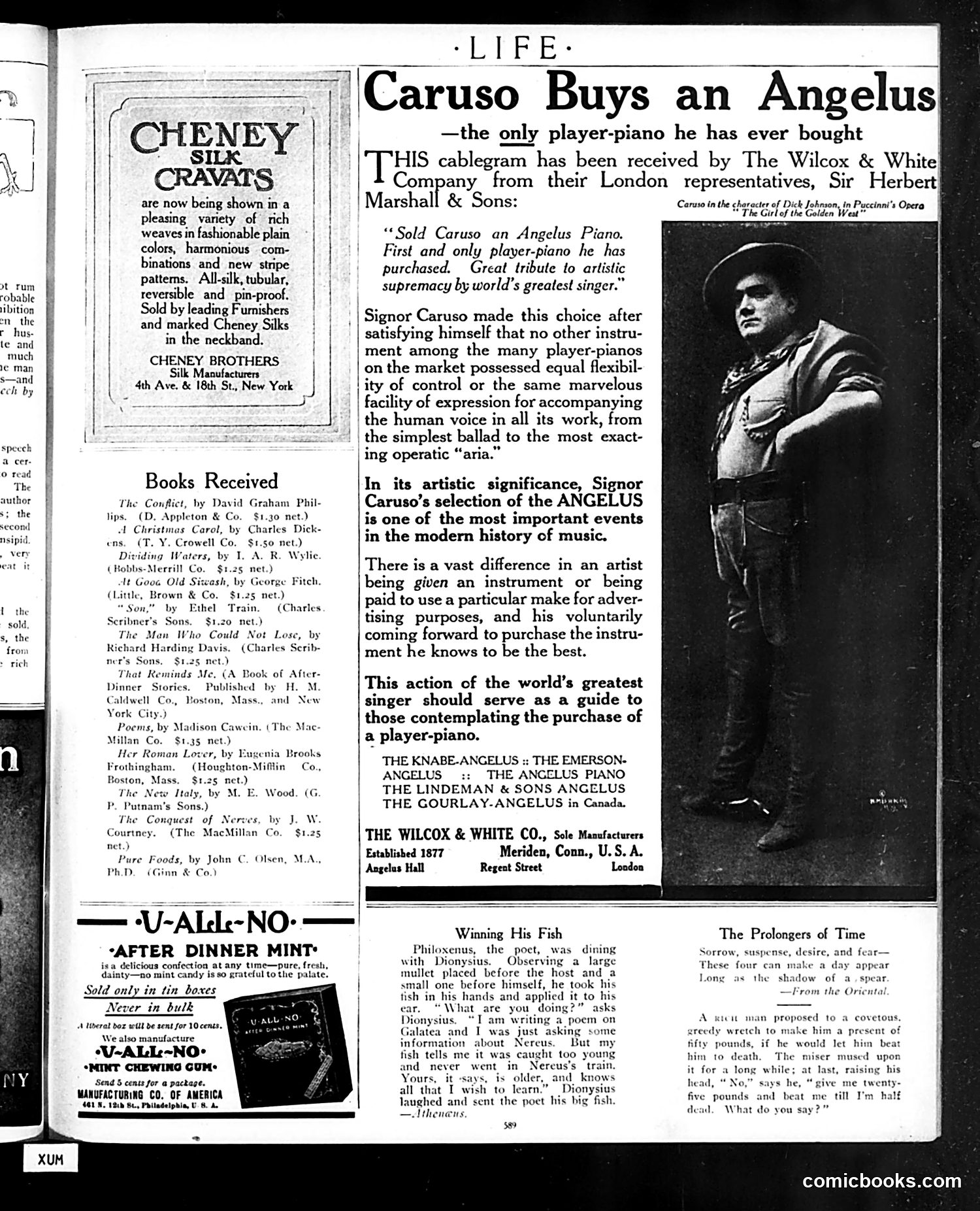
This page is primarily **advertising**, not satire or political commentary. The main feature is a **promotional advertisement** for Angelus player-pianos, featuring renowned opera singer Enrico Caruso. The ad claims Caruso voluntarily purchased an Angelus—his first and only player-piano—as a testament to its superior quality and artistic capability. A photograph shows Caruso in operatic costume (as Dick Johnson from Puccini's opera). The advertisement's strategy is to leverage Caruso's fame and credibility: by presenting his choice as *voluntary* rather than paid endorsement, it suggests objective artistic judgment rather than commercial promotion. The page also contains: - A **Cheney Silk advertisement** (left column) - A **"Books Received"** literary review section - Two **U-All-No mint product ads** - Two brief **humorous anecdotes** ("Winning His Fish," "The Prolongers of Time") No political satire or caricature is present on this page. It's a standard Life magazine advertising and content layout from the early 20th century.
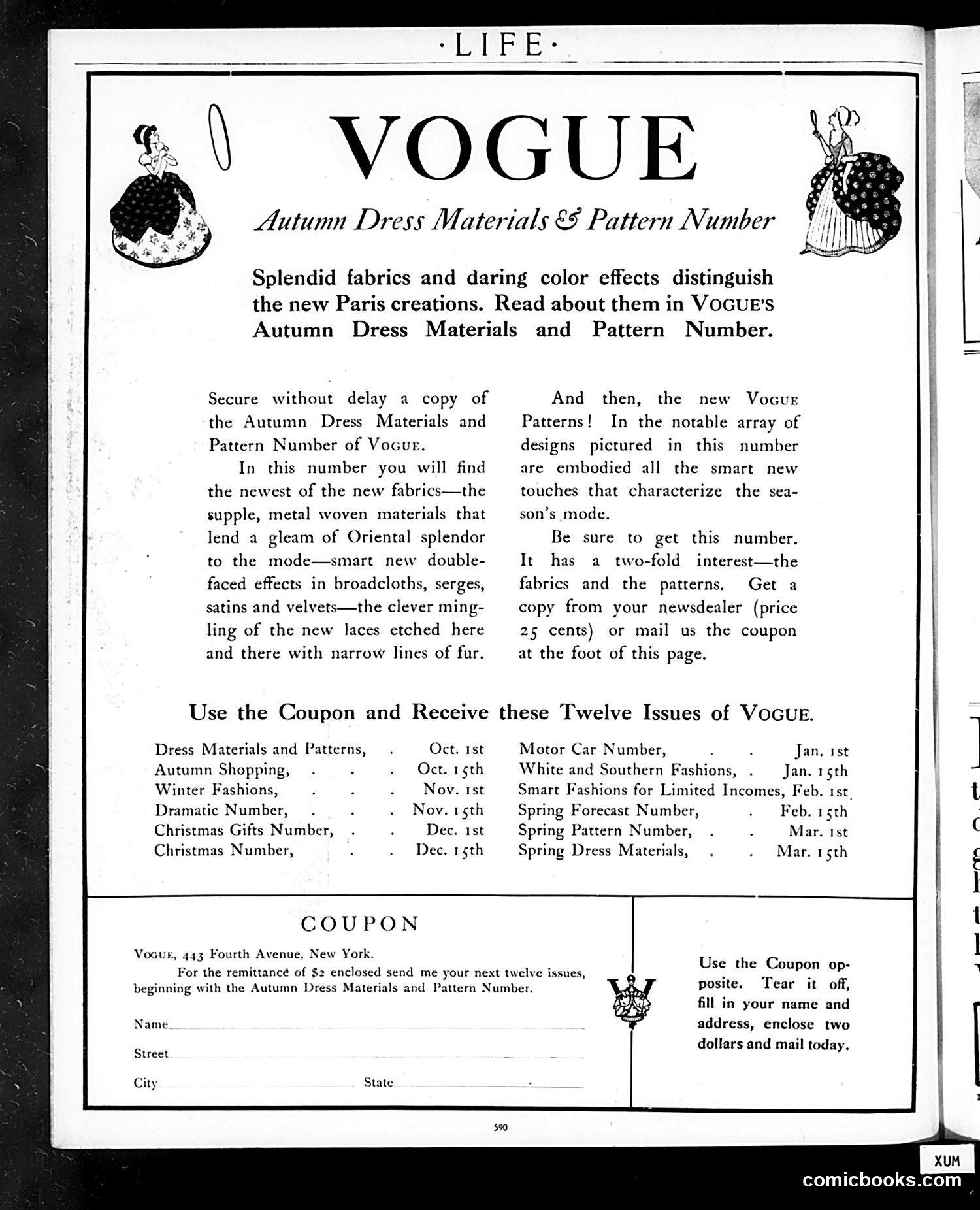
This is not a political cartoon or satire—it's a straightforward advertisement for Vogue magazine's subscription service. The page promotes Vogue's "Autumn Dress Materials and Pattern Number," highlighting new Paris fashions featuring luxurious fabrics like metal-woven materials, double-faced broadcloth, and embellished laces with fur accents. The two illustrated figures in the upper corners appear to be women modeling fashionable autumn dresses, showcasing the "Oriental splendor" and elegant styling the advertisement promotes. The coupon at the bottom offers a subscription: readers can mail $2 to receive twelve consecutive issues of Vogue, beginning with the autumn dress materials edition. Each upcoming issue targets seasonal interests (winter fashions, Christmas gifts, spring patterns, etc.), running from October through March. This represents early 20th-century magazine marketing—using coupons and installment offers to build sustained readership.
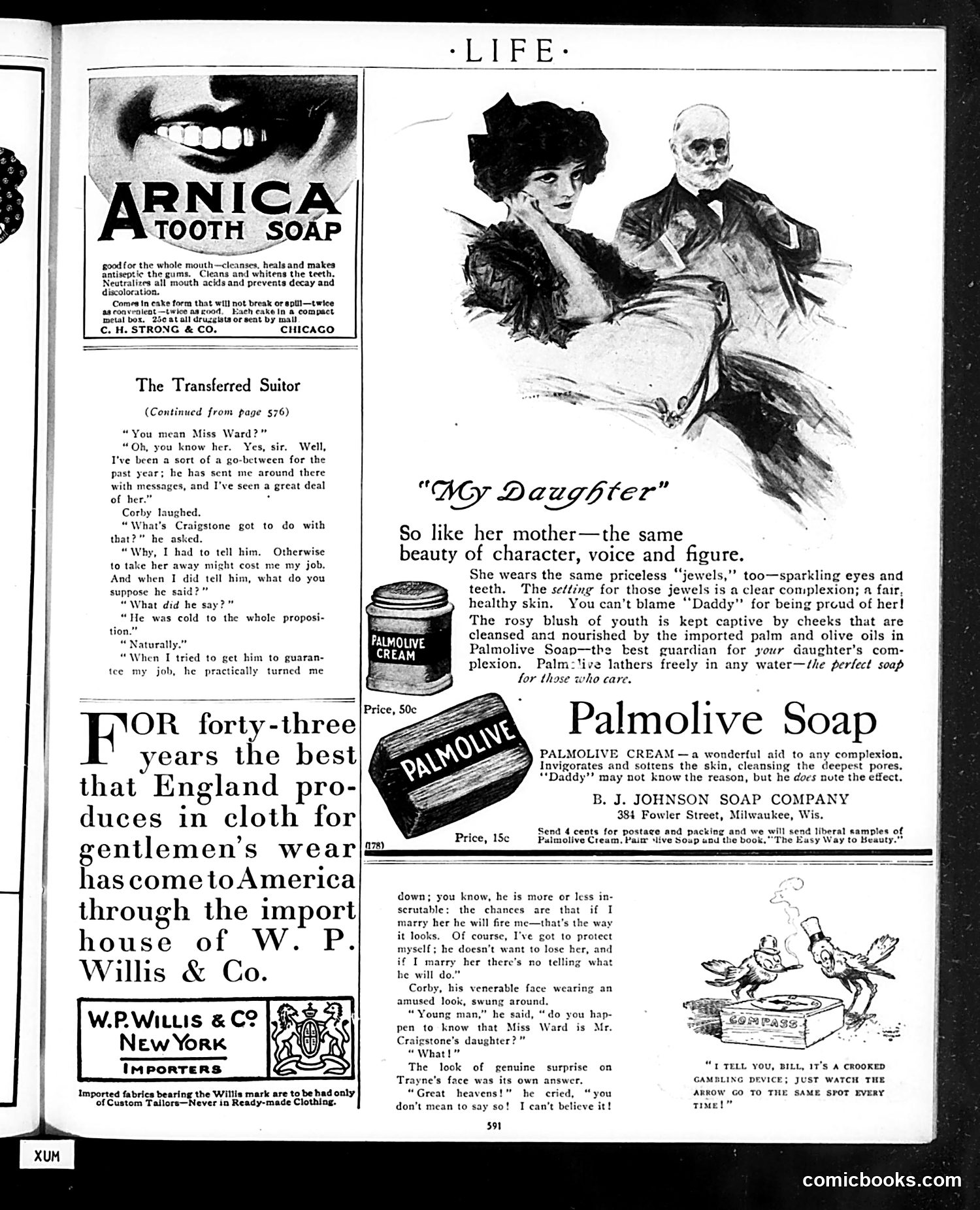
This page contains a serialized romantic story (continued from page 576) about workplace romance and class complications. The plot concerns a go-between named Corby who has been delivering messages between a young man (Trayne) and Miss Ward. When Corby reveals he told his employer Craigstone about the courtship to protect his job, Craigstone coldly rejects the proposal. The dramatic twist comes when Craigstone reveals Miss Ward is actually his daughter—information Trayne apparently didn't know, suggesting he was courting above his station without realizing it. The page also contains period advertisements for Arnica Tooth Soap, W.P. Willis & Co. imported fabrics for gentlemen, and Palmolive Soap, which uses an illustration titled "My Daughter" to market beauty products by appealing to fathers' pride in their daughters' complexions.
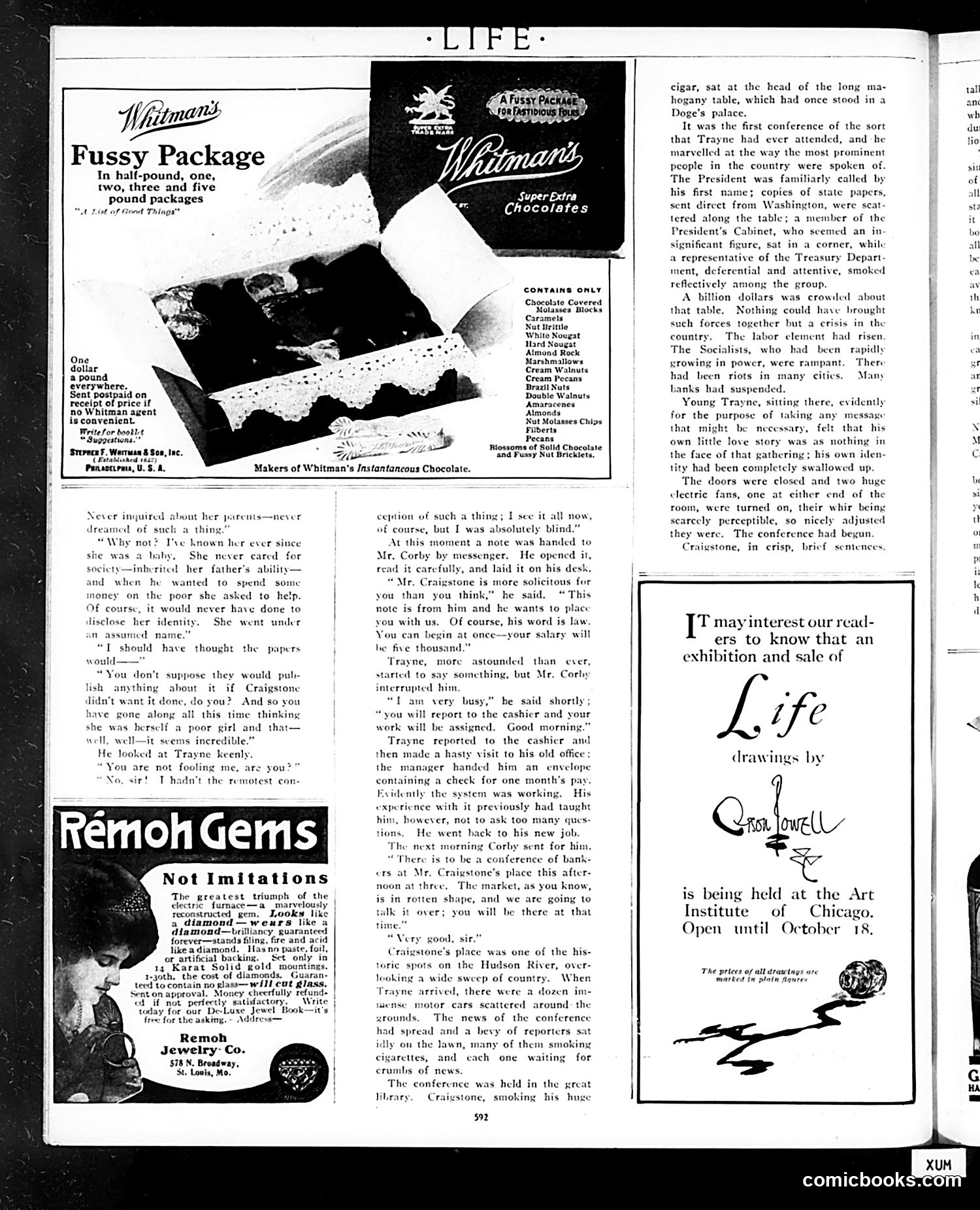
This page is primarily **advertising** with embedded fiction narrative. The main content consists of: **Advertisements:** - Whitman's chocolates (prominent, top) - Remoh Gems jewelry (left side) **Fiction narrative** (right column): Depicts what appears to be an **urgent political/economic crisis meeting** with high government officials. References include: the President, Cabinet members, Treasury Department representatives, and notably "the labor element" and "Socialists" causing unrest and riots in cities. **Key context for modern readers:** This reflects **early 20th-century American anxieties** about labor unrest and socialist movements. The narrative treats a secret government conference as dramatic—suggesting contemporary fears of social upheaval. A young protagonist named Trayne attends, apparently summoned for some mission by powerful figures. The **tone is serious despite the magazine's satirical reputation**—this appears to be serialized fiction rather than satire. The juxtaposition of frivolous chocolate ads with grave political crisis reflects the magazine's mixed editorial approach.
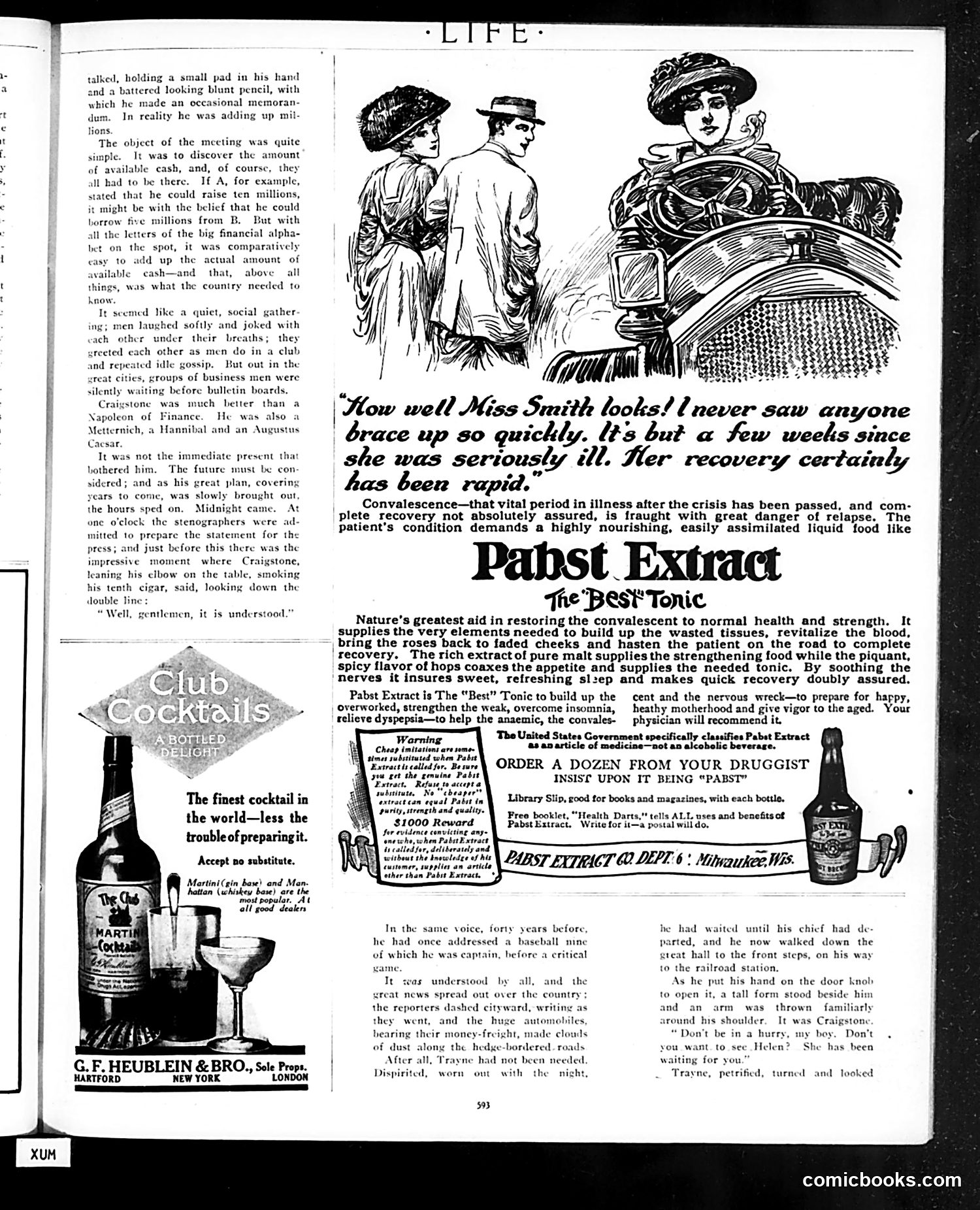
This page from *Life* magazine is primarily **advertising**, not satire. The dominant content is a full-page advertisement for **Pabst Extract**, a malt tonic marketed as a medicinal recovery drink. The small illustration at the top depicts a social/business scene—men in early 20th-century dress discussing finances—but serves mainly as narrative context for the adjacent advertorial testimonial about "Miss Smith's" rapid recovery from illness, which transitions into the Pabst pitch. The advertisement exploits a common historical practice: marketing alcohol-based tonics as legitimate medicine. The U.S. government classified Pabst Extract as "medicine, not an alcoholic beverage," a legal loophole allowing alcohol sales during periods of temperance concern. The ad emphasizes medical benefits—building strength, aiding convalescence, promoting sleep—while the small cocktail advertisement for Club Cocktails appears separately. There is **no political satire visible here**. This reflects early 20th-century commercial practices where patent medicines and tonics freely claimed therapeutic properties now considered fraudulent.
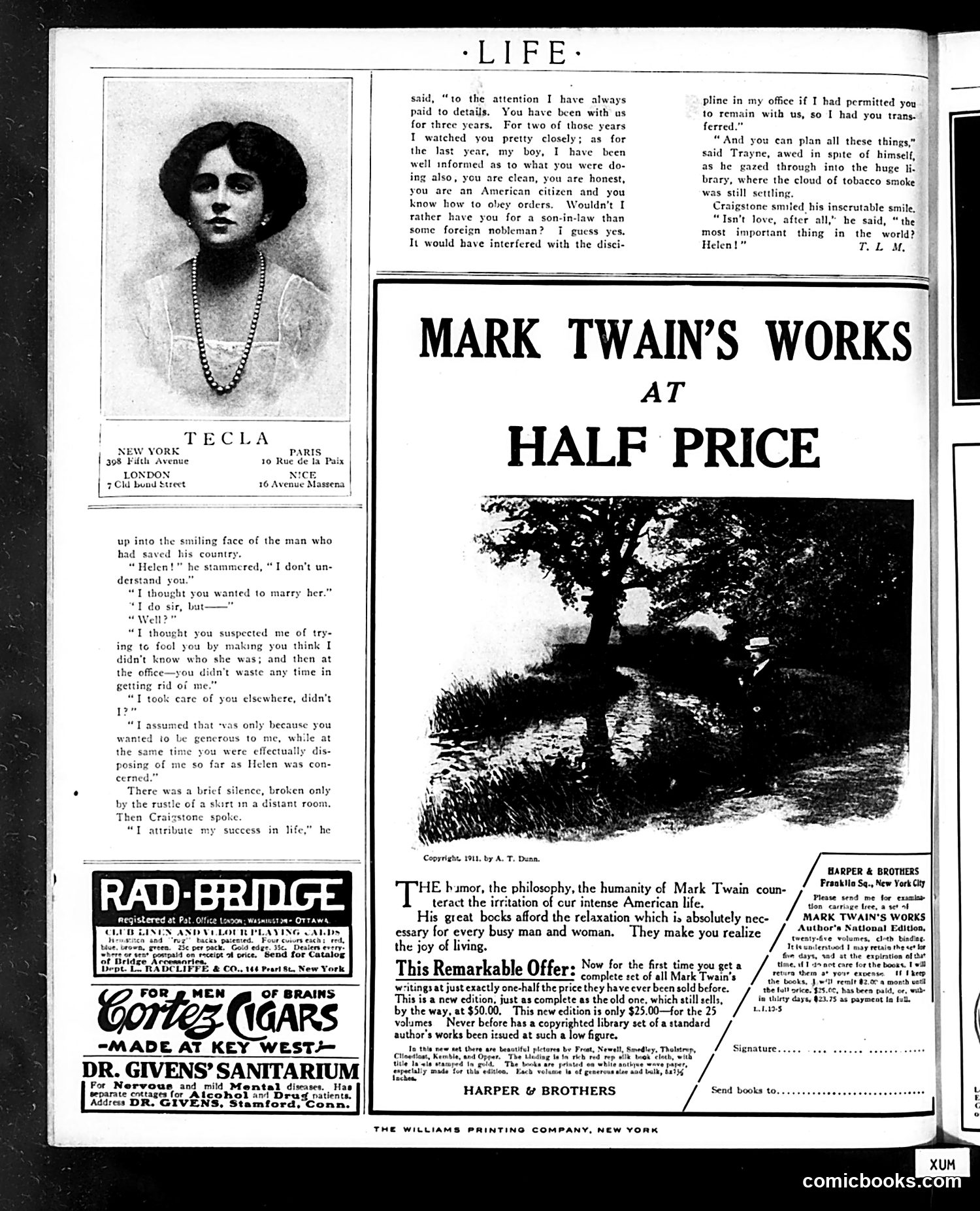
This page is primarily **advertising**, not political satire. The dominant content is a large advertisement for Mark Twain's works at half price, promoted by Harper & Brothers publishers. The upper portion contains a **fictional narrative excerpt** (appears to be from a serialized story in Life), featuring dialogue between characters named Craigstone, Trayne, and Helen about employment, loyalty, and marriage. The accompanying portrait labeled "TECLA" shows a woman's face and lists addresses for what appears to be a business or organization in New York, London, Paris, and Nice. The page also includes advertisements for unrelated products: **Cortez Cigars** ("for men of brains"), **Rad-Bridge** (appears to be a card game or accessories), and **Dr. Givens' Sanitarium** (a medical facility). The Mark Twain promotion emphasizes that his collected works now cost $25 instead of $50—a significant discount meant to appeal to busy American readers seeking relaxation and philosophy.
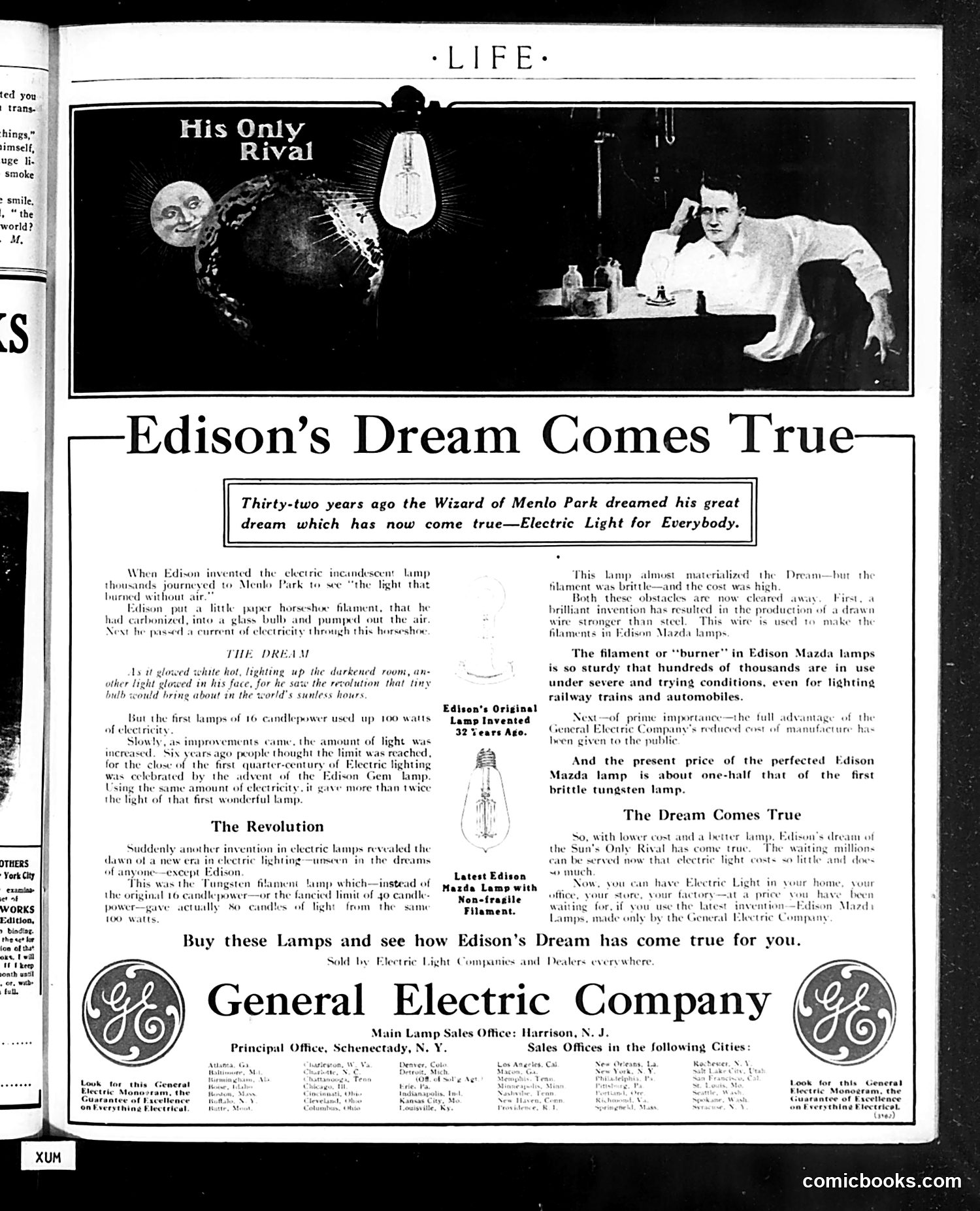
This is primarily a **General Electric Company advertisement**, not satire. The top cartoon titled "His Only Rival" appears to show Edison (left, as the moon/night) competing with electric light (the bulb in center) as rivals to a man at a desk (right)—humorously suggesting the lamp is Edison's only competitor. The bulk of the page celebrates Edison's 1890 incandescent lamp invention and its evolution. It traces improvements: Edison's original carbonized filament gave way to stronger tungsten filaments, reducing both cost and power consumption while increasing brightness. The text emphasizes that electric lighting—once a luxury—is now affordable for "everybody." The "dream" referenced is electrification for all homes and businesses. Modern readers might miss that reliable, affordable electric lighting was genuinely revolutionary in the early 1900s, transforming daily life by extending productive hours beyond daylight.
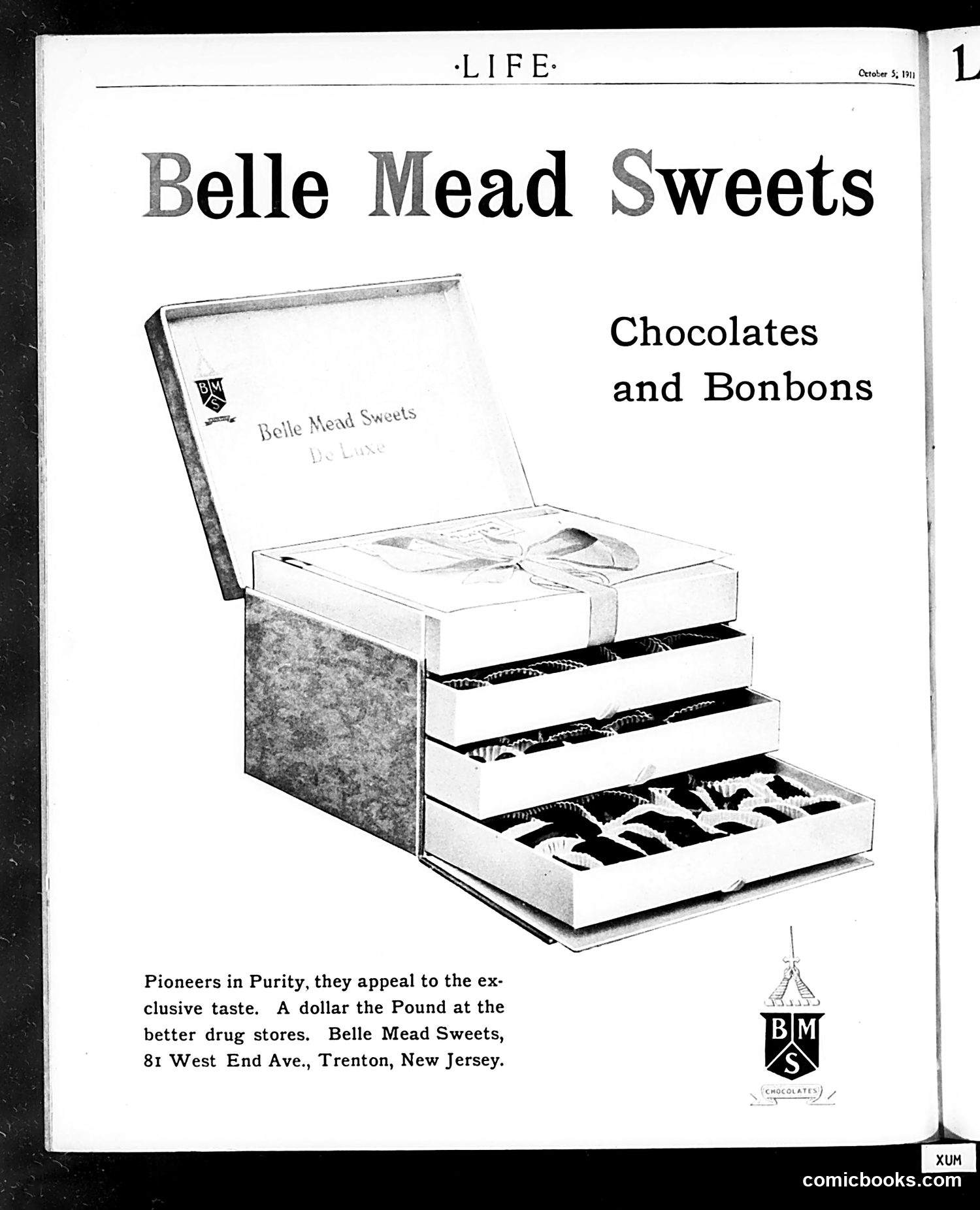
This is a straightforward **advertisement**, not satire or a cartoon. It promotes Belle Mead Sweets, a confectionery company based in Trenton, New Jersey, advertising their chocolates and bonbons. The ad features a product photo showing an elegant tiered candy box with multiple drawers displaying assorted chocolates. The marketing copy emphasizes "Purity" and appeals to "exclusive taste," positioning the product as premium candy available at better drug stores for "a dollar the Pound"—a significant price point for 1911. The company logo (BMS in a shield) appears at bottom. This represents typical early-20th-century advertising: product-focused, emphasizing quality and social status, and utilizing drug stores as primary retail distribution channels for confectionery goods.