
Life, 1911-10-05 · page 18 of 50
Life — October 5, 1911 — page 18: what you’re looking at
What you’re looking at
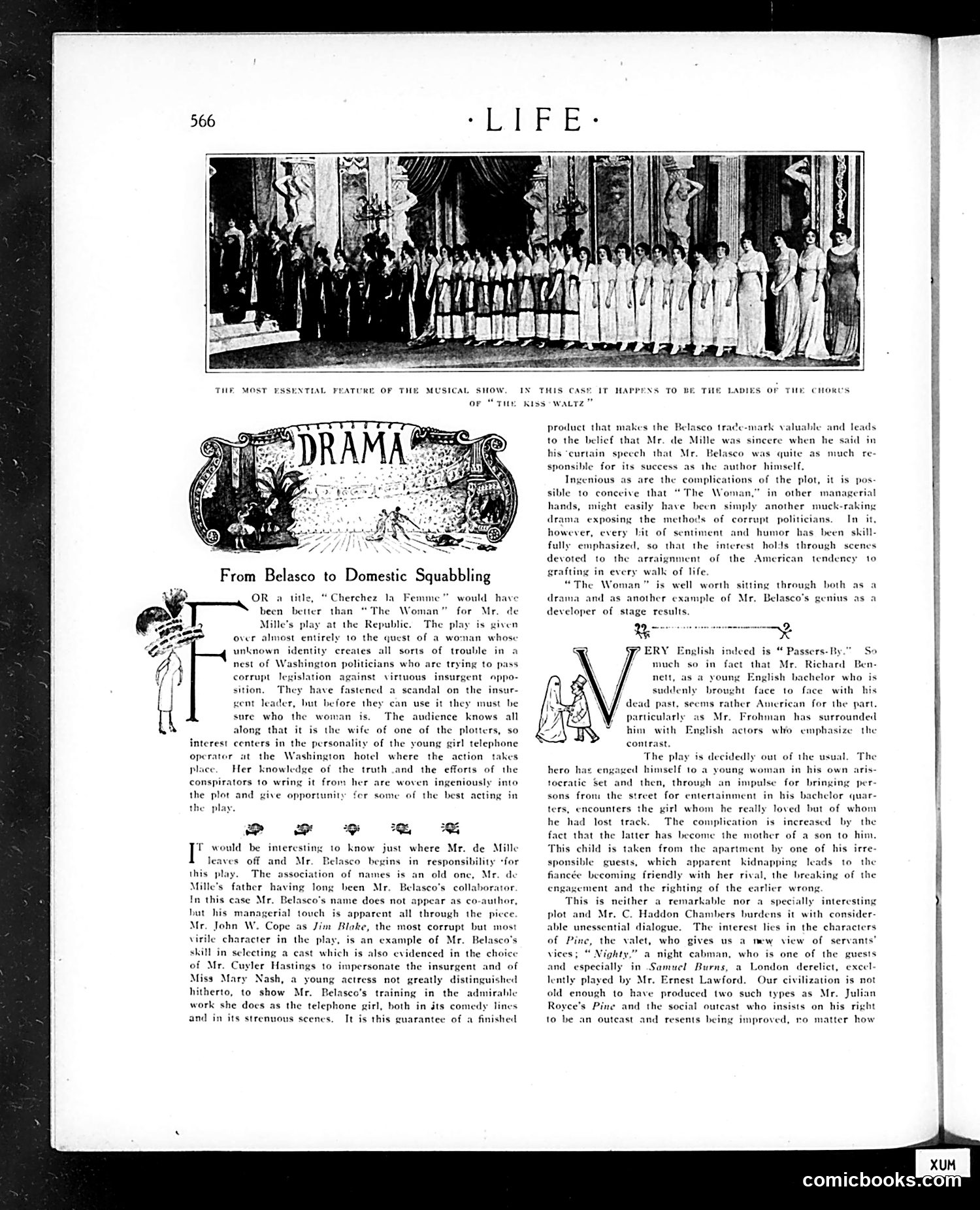
This page reviews theatrical productions, primarily focusing on "The Woman," a play by Cecil B. DeMille at the Republic Theatre. The article discusses DeMille's collaboration with renowned theatrical producer David Belasco, crediting Belasco's directorial skill for the play's success. The review describes a plot involving Washington politicians attempting to blackmail an insurgent leader using scandal. A telephone operator at a Washington hotel holds crucial knowledge. The article praises the casting choices and Belasco's reputation for selecting talented performers. The page also briefly reviews "Passers-By," noting its English setting and protagonist—a young English bachelor confronting his past. The critic observes that actor Richard Bennett seems "rather American for the part," despite Frohman surrounding him with English actors for contrast. The top photograph shows a chorus line from a musical production, illustrating "the most essential feature" of musical shows at this era.
📄 Transcribed text from this page (OCR, searchable)
Machine-transcribed from the original scan — historical spelling and the odd misread are preserved.
THE MOST ESSENTIAL FEATURE OF THE MUSICAL Siow. or “ri From Belasco to Domestic Squabbling OR a title, “Cherchez la Femme” would have becn better than “The Woman” for Mr. de Mille’s play at the Republic. The play is given over almost entirely to the quest of a woman whose unknown identity creates all sorts of trouble in a nest of Washington politicians who are trying to pass corrupt legislation against virtuous insurgent oppo- sition. They have fastened a scandal on the insur- kent leader, but bef sure who the woman is. The audience knows all along that it is the wife of one of the plotters, so interest centers in the personality of the young girl telephone operator at the Washington hotel where the action takes place, Her knowledge of the truth and the efforts of the conspirators to wring it from her are woven ingeniously into € they can use it they must be the plot and give opportunity for some of the best acting in the play. [7 jtoutd be interesting to know just where Mr. de Mill leaves off and Mr. Belasco begins in responsibility “for un old onc, Mr. dk Mille’s father having long been Mr. Belasco's collaborator this play. The association of names In this case Mr, Belasco’s name does not appear as co-author, but his managerial touch is apparent all through the picce Mr. John W. Cope as Jim Blake, the most corrupt but most virile character in the play, is an example of Mr. Belasco’s skill in selecting a cast which is also evidenced in the choice of Mr. Cuyler Hastings to impersonate the insurgent and of Miss Mary Nash, a young actress not greatly distinguished hitherto, to show Mr. Relasco's training in the admirable work she does as the telephone girl, both in dts comedy lines and in its strenuous scenes, It is this guarantee of a finished IN THIS CASE IT HAPPENS TO BE THE LADIES OF THE CHOKES: KISS WALTZ” product that makes the Belasco trade-mark valuable and le: to the belicf that Mr. de Mille was sincere when he said his ‘curtain speech that Mr. Belasco was quite as much re- le for its success as the author himself, ious as are the complications of the plot, it is pos- to conceive that “The Woman,” in other man. hands, might easily have been simply another muck-raking drama exposing the metho’s of corrupt politicians. Init, however, every Lit of sentiment and humor has been skill- fully emphasized, so that the interest holds through scenes devoted to the arraignment of the American tendency 10 grafting in every walk of life. “The Woman” is well worth sitting through both as a drama and as another cxample of Mr, Belasco’s genius as developer of stage results 97 ERY English indeed is “ Passers- By.” Pf wwch so in fact that Mr. Richard Be nett, as a young English bachelor who is suddenly brought ce to face with b dead past, particularly as Mr. Frohman has surrounded ms rather American for the part. him with English actors who emphasize the contrast. The play is decidedly out of the usual. The himself 10 a young woman in his own aris- tocratic Set and then, through an impulse for bringing per sons from the street for entertainment in his bachelor quar- ved but of whom he had lost track. The coniplication is increased by the fact that the latter has become the mother of a son to him. This child is taken from the apartment by one of his irre- sponsible guests, which apparent kidnapping leads to the fiancée becoming friendly with her rival, the breaking of the engagement and the righting of the earlier wrong This is neither a remarkable nor a specially interesting plot and Mr. C, Haddon Chambers burdens it with consider- ters, encounters the xirl whom he really able unessential dialogue. The interest lies in the characters of Pine, the valet, who gives us a mew view of servants’ vices; “Mighty.” a night cabman, who is one of the guests and especially in Samuel Burns, a London derelict, excel lently played by Mr. Ernest Lawford. Our civilization is not old enough to have produced two such types as Mr. Julian Royce’s Pine and the social outcast who insists on his right to be an outcast and resents being improved, ro matter how comicbook $.co