
Life, 1911-10-05 · page 13 of 50
Life — October 5, 1911 — page 13: what you’re looking at
What you’re looking at
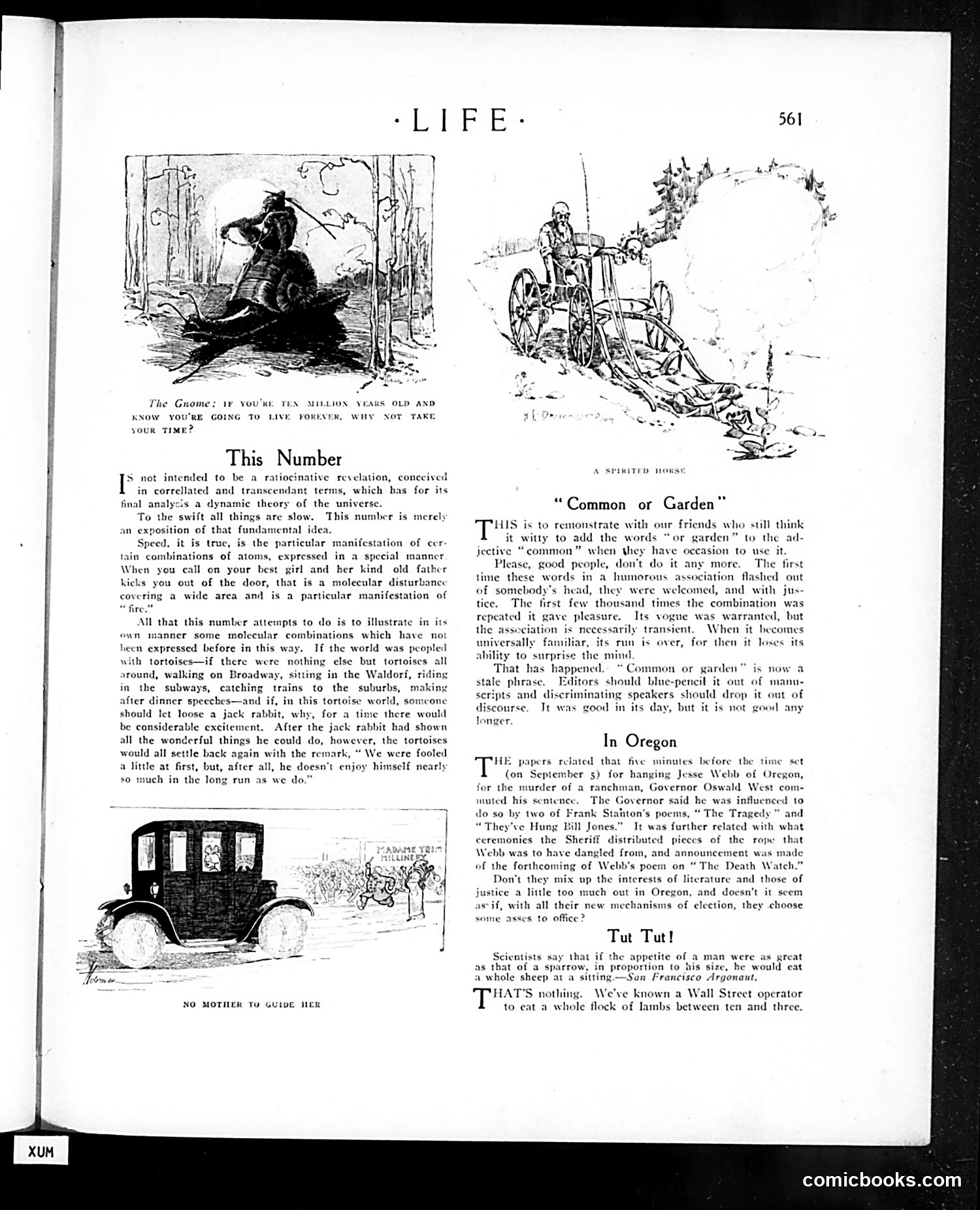
This page contains three separate satirical pieces: 1. **"The Gnome"** (top left): A dark woodland scene with text mocking someone for worrying about time and mortality—suggesting they should enjoy life rather than obsess over its brevity. 2. **"A Spirited Horse"** (top right): Shows a man on a cart being pulled by an energetic horse, captioned to suggest the horse's vitality. 3. **"Common or Garden"** (center): Critiques the overuse of the phrase "common or garden" as a tired literary cliché that should be retired from writing. 4. **"In Oregon"** (right): References the execution of labor activist Joe Hill (1915), mentioning Governor Oswald West and poems about the event—contemporary political commentary on capital punishment. 5. **"No Mother to Guide Her"** (bottom left): A cartoon showing an early automobile, likely satirizing women drivers or modern independence.
📄 Transcribed text from this page (OCR, searchable)
Machine-transcribed from the original scan — historical spelling and the odd misread are preserved.
SST N MILLION YEARS OLD AND NOT TAKE The Gnome: ie you'K KNOW YOU'RE GOING TO LIVE FOREVER, WITY YOUR TIME? This Number ie not intended to be a ratiocinative revelation, conceived in correllated and transcendant terms, which has for its final analysis a dynamic theory of the universe. To the swift all things are slow. This number is merely an exposition of that fundamental idea. Speed, it is truc, is the particular manifestation of cer tain combinations of atoms, expressed in a special manner When you call on your best girl and her kind old father kicks you out of the door, that is a molecular disturbance covering a wide area and is a particular manifestation of All that this number attempts to do is to illustrate in its own nner some molecular combinations which have not heen expressed before in this way. If the world was pcople: with tortoises—if there were nothing else but tortoises all 1round, walking on Broadway, sitting in the Waldorf, riding in the subways, catching trains to the suburbs, making after dinner speeches—and if, in this tortoise world, somcone should Iet loose a jack rabbit, why, for a time there would be considerable excitement. After the jack rabbit had shown all the wonderful things he could do, however, the tortoises would all settle back again with the remark, “ We were fooled a little at first, but, after all, he doesn’t enjoy himself nearly so much in the long run as we do.” NO MOTIIEK To GUIDE HER A SriKITED Mt “Common or Garden” HIS is to remonstrate with our friends who still think it witty to add the words “or garden” to the ad- jective “common” when they have occasion to use it. Please, good people, don't do it any more. The first time these words in a humorous association flashed out f somebody’s head, they were welcomed, and with jus tice. The first few thousand times the combination was ve pleasure. Its vogue was warranted, but tion is necessarily transient. When it becomes universally familiar, its run is over, for then it loses its al to surprise the mind That has happened, “Common or garden” is now a stale phrase. Editors should bluc-pencil it out of manu- scripts and discriminating speakers should drop it out of discourse. Jt was good in its day, but it is not good any longer, In Oregon related that five minutes before the time set (on September 5) for hanging Jesse Webb of Oregon, for the murder of a ranchman, Governor Oswald West com- muted his sentence. The Governor said he was influenced 10 do so by two of Frank Stahton’s poems, “ The Tragedy ” and “They've Hung Bill Jones.” It was further related with what ceremonies the Sheriff distributed pieces of the rope that Webb was to have dangled from, and announcement was made of the forthcoming of W "s poem on “ The Death Watch.” Don’t they mix up the interests of literature and those of justice a little too much out in Oregon, and doesn’t it seem is-if, with all their new mechanisms of election, they choose Tut Tut! Scientists say that if the appetite of a man were as great as that of a sparrow, in proportion to his size, he would eat a whole sheep at a sitting —San Francisco Argonaut, HAT’S nothing. We've known a Wall Street operator to eat a whole flock of lambs between ten and three. asses to office comicbooks.com