
Life, 1911-10-05 · page 30 of 50
Life — October 5, 1911 — page 30: what you’re looking at
What you’re looking at
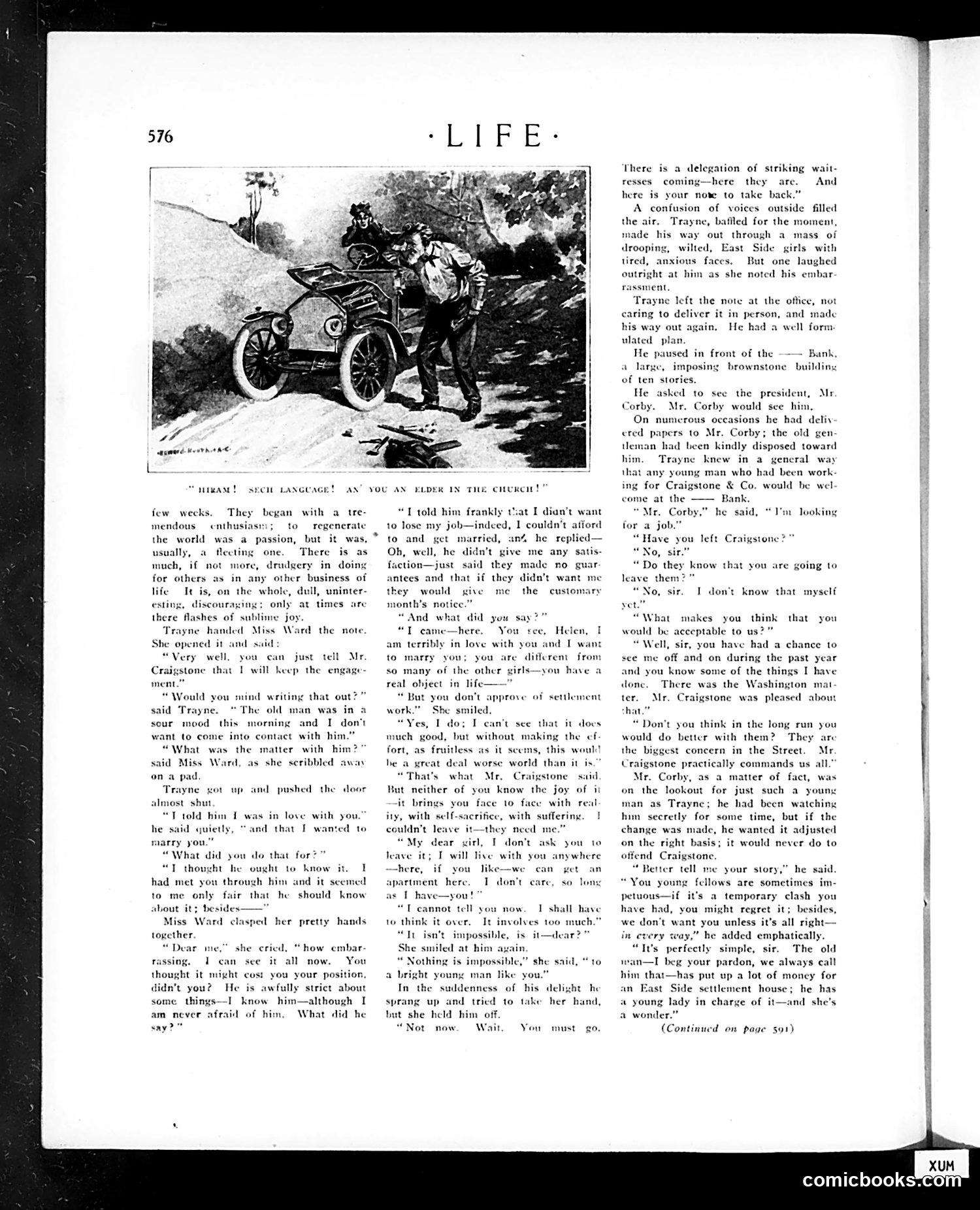
This page depicts a serialized romantic story, not political satire. The illustration shows a young man (Trayne) arriving by early automobile to deliver a note. The narrative concerns a conflict between love and work. Trayne has confessed his love for Miss Helen Ward to their employer, Mr. Craigstone, who disapproved and threatened dismissal. Trayne quit rather than abandon his intentions to marry Helen, who works in "settlement work" (charitable social reform, popular among Progressive-era idealists). The dialogue reveals tension between duty and personal happiness. Helen insists Trayne wait while she considers—she won't abandon her work for marriage. Trayne then seeks Mr. Corby at a bank, apparently to secure employment and prove he can support marriage. This reflects early 20th-century anxieties about class, marriage, and women's independence—themes common in *Life* magazine's serialized fiction for middle-class readers.
📄 Transcribed text from this page (OCR, searchable)
Machine-transcribed from the original scan — historical spelling and the odd misread are preserved.
“7 eager Heat ht & “IRAM! SECIL LANGUAG! AN few weeks. They began with a tre- mendous enthusiasms; to regenerate the world was a passion, but it was, yy one. There is as re, drudgery in doing usually, a fleet much, if not for others as in any other business of life It is, on the whole, dull, uninter- esting, dis ng; only at times arc there flashes of sublime joy. ayne handed Miss Ward the note She opened it and said: “Very well. you ¢: Craigstone that 1 will keep: the ment.” “Would you mind writing that ou said Trayne, “The old man was in sour mood this morning and I don’t want to come into contact with him.” “What was the matter with him?” said Miss Ward, as she scribbled away on a pad Trayne got up and pushed the almost shut “T told him I was in love with you, he said and that f wanted to marry you.” “What did you do that for?” “T thought he ought to know it. 1 had met you through him and it seemed to me only fair that he should know our. 1 just tell Mr. door uietly, about it; besides Miss Ward clasped her pretty hands together. “Dear me," she cried, “how embar- Tocan see it all now. You jon, rassing. thought it might cost you your pos didn’t you? some things—I am never afraid of him. tayo He is awfully strict about him—although I What did he know you AN ELDER IN THE cHtUKcIE!' “LT told him frankly that I dian’t want » 1 couldn't afford anf he replied— 10 lose my job—indce: to and get married Oh, well, he didn’t give me any satis- faction—just said they made no guar antees and that if they didn’t want me they would give me the month’s notice.” And what did you say I came—here. You ree, Helen, I am terribly in love with you and I want to marry so many of the other girls—you have a real object in life—" “But you don't approve of settlement work.” She smiled. “Yes, I do; I can't see that it docs much good, but without making the ef fort, as fruitless as it seems, this woul! customary you; you are different from he a great deal worse world than it is hat's her of you know the joy of iv it brings you face to fac what Mr. Craigstone said with real ity, with self-sacrifice, with suffering. 1 couldn't leave ii “My dear girl, IF don't ask you to leave it; I will live with you -here, if you lik apartment here. T don't care, so long as 1 have—you! “T cannot tell y to think it over. “Tt isn’t impossibl She smiled at him a “ Nothing is impossible,” she said, a bright young man like you.” In the suddenness of his delight he sprang up and tried to take her hand, but she held him off. Wait You -they need me.” nywhere we can get an 1 shall have It involves too 1 1 now ich.”” is it—dear in ot now must go, There is a delegation of striking wait- resses. coming—here they are. And here is your nove to take back.” A confusion of voices outside filled the air. Trayne, bafiled for the moment, made his way out through a mass of drooping East Side girls with lired, anxious faces. But one laughed outright at him as she noted his embar wilt rassment Trayne left the r caring to deliver it in person, and made his way out again. He had a well form. ulated plan He paused in front of the ——~ Bank. a large, imposing brownstone building of ten stories. He asked to see the president, Mr Corby. Mr. Corby would see him, On numerous occasions he had deliy ered papers to Mr. Corby; the old gen an had been kindly disposed toward Trayne knew in a general way any young man who had been work- ing for Craigstone & Co. would he wel come at the ke “Mr. Corby,” he said, “I'm looking ior a job.” “Have you left Craigsione?” 0, sir.” “Do they know that you are leave them te at the office, not soing to “No, sir, I don't know that myself yet “What makes you think that you would be acceptable to us?” “Well, sir, you have had a chance to see me off and on during the past ycar and you know some of the things I have done. There was the Washington ma ter. Mr. Cra hat “Don't you think in the long run you would do better with them? They arc the biggest concern in the Street. Mr Craigstone practically commands us all.” Mr. Corby, as a matter of fact, was on the lookout for just such a youny man as Trayne; he had been watching him secretly for some time, but if the change was made, he wanted it adjusted on the right basis; it would never do to offend Craigstone. “Better tell me your story,” he said “You young fellows are sometimes im- petuous—if it's a temporary clash you have had, you might regret it; besides, we don't want you unless it’s all right— in every way,” be added emphatically. “It’s perfectly simple, sir. The old an—I beg your pardon, we always call s put up a lot of money for ide settlement house; he has ed about stone was pl in him that—h st an Ej a youn lady in charge of it—and she's a wonder.” (Continued on page 501) comicbook $-CO