
Life, 1911-10-05 · page 23 of 50
Life — October 5, 1911 — page 23: what you’re looking at
What you’re looking at
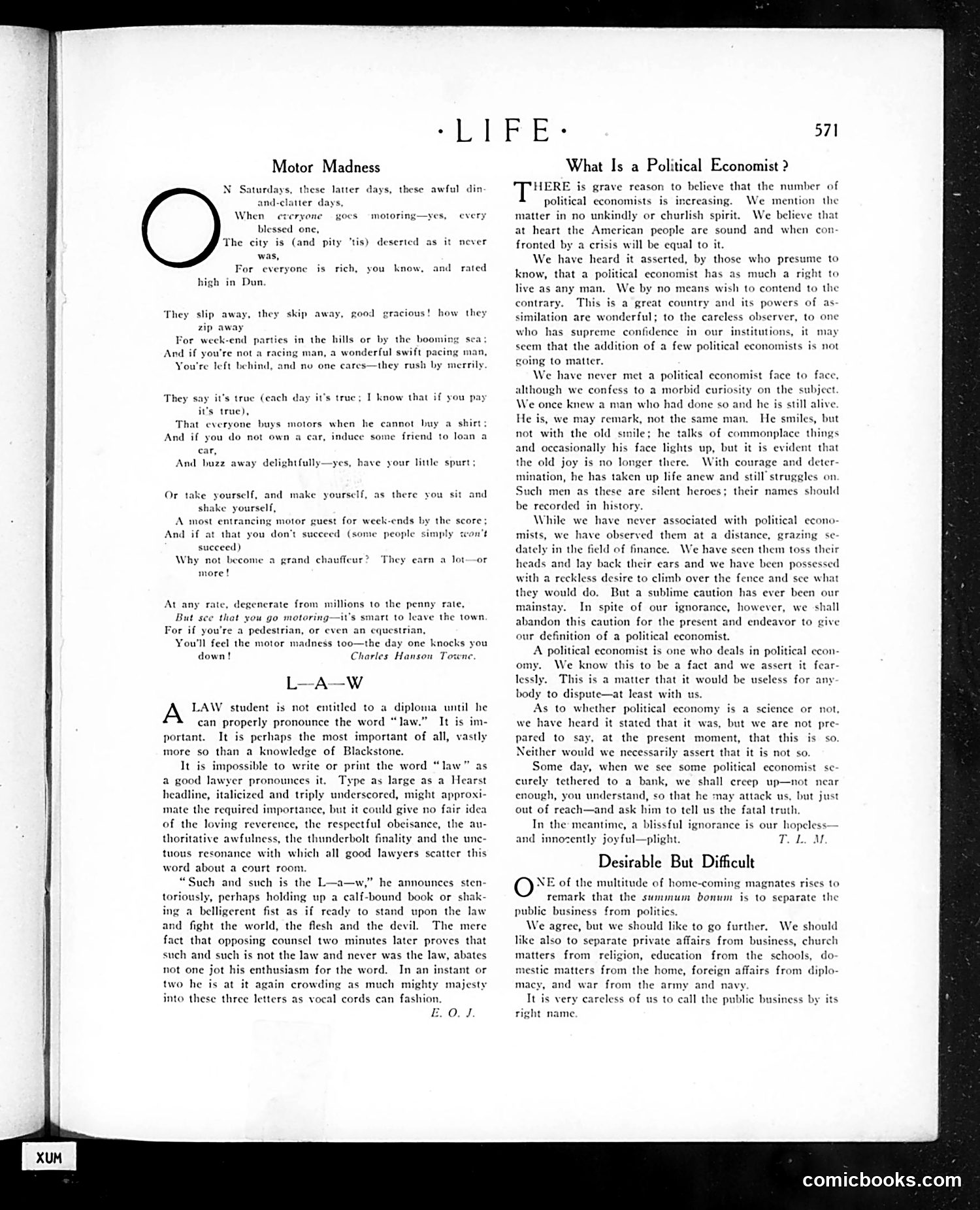
This page contains three distinct satirical pieces from Life magazine: **"Motor Madness"** (poem by Charles Hanson Towne): Satirizes the 1920s automobile craze, mocking how everyone—regardless of wealth—rushes to own cars for weekend trips. The joke is that people buy motors they can't afford, and those without cars beg rides from friends, all to appear fashionable and urban. The final line threatens that non-motorists will eventually be hit by cars. **"L—A—W"** (brief sketch): Ridicules how lawyers pronounce and reverence the word "law" with exaggerated solemnity and theatrical gestures in courtrooms, treating it as sacred despite contradictory rulings. The satire targets the pretentious pomposity of legal professionals. **"What Is a Political Economist?"** (essay): Humorously dismisses political economists as useless additions to society. The author sardonically notes they have a "right to live" while implying they contribute nothing—and that meeting one causes psychological damage to otherwise normal people. All three pieces employ gentle, humorous mockery of contemporary American social types and professions.
📄 Transcribed text from this page (OCR, searchable)
Machine-transcribed from the original scan — historical spelling and the odd misread are preserved.
“rE Motor Madness N Saturdays, these latter days, these awful din and-clatter days, When ereryone goes motoring—yes, every blessed one, The city is (and pi is) deserted as it never was, For everyone is rich, you know, and rated high in Dun. ‘They slip away, they skip away, good gracious! how they zip away For week-end parties in the hills or by the booming sea: And if you're not a racing man, a wonderful swift pacing man, You're left behind, and no one cares—they rush by merrily They say it’s trac (each day it's true; I know that if you pay it’s true), That everyone buys motors when he cannot buy a sh And if you do not own a car, induce some friend to loan a car, And buzz away delightfully—yes, have your little spurt; Or take yourself, and make yourself, as there you sit an shake yourself, A most entrancing motor guest for week-ends by the score; And if at that you don’t succeed (some people simply scon't succeed) Why not become a grand chauffeur? They earn a lot—or more! At any rate, degenerate from millions to the penny rate, But sce that you go motoring—it’s smart to leave the town For if you're a pedestrian, or even an equestrian, You'll feel the motor madness too—the day one knocks you down! Charles Hanson Towne. L—A—W A LAW student is not entitled to a diploma until he can properly pronounce the word “law.” It is im- portant. It is perhaps the most important of all, vastly more so than a knowledge of Blackstone. It is impossible to write or print the word “law” as a good lawyer pronounces it, Type as large as a Hearst headline, italicized and triply underscored, might approxi- mate the required importance, but it could give no fair idea of the loving reverence, the respectful obeisance, the au- thoritative awfulness, the thunderbolt finality and the unc- tuous resonance with which all good lawyers scatter this word about a court room. “Such and such is the L—a—w,” he announces sten- toriously, perhaps holding up a calf-bound book or shak- ing a belligerent fist as if ready to stand upon the law and fight the world, the flesh and the devil. The mere fact that opposing counsel two minutes later proves that such and such is not the law and never was the law, abates not one jot his enthusiasm for the word. In an instant or two he is at it again crowding as much mighty majes into these three letters as vocal cords can fashion. oO. J. What Is a Political Economist ? HERE is grave reason to believe that the number of political economists is increasing. We mention the matter in no unkindly or churlish spirit. We believe tha at heart the American people are sound and when con- fronted by a crisis will be equal to it. We have heard it asserted, by those who presume to know, that a political economist has as much a right to live as any man. We by no means wish to contend to the contrary. This is a great country and its powers of as similation are wonderful; to the careless observer, to one who has supreme confidence in our institutions, it may seem that the addition of a few political economists is not going to matter. We have never met a political economist face to face, though we confess to a morbid curiosity on the subject We once knew a man who had done so and he is still alive. He is, we may remark, not the same man. He smiles, but not with the old stnile; he talks of commonplace things and occasionally his face lights up, but it is evident that the old joy is no longer there. With courage and deter- mination, he has taken up life anew and still’ struggles on. Such men as these are silent heroes; their names should be recorded in history. While we have never associated with political econo- mists, we have observed them at a distance, grazing se- dately in the field of finance. We have seen them toss their heads and lay back their ears and we have been possessed with a reckless desire to climb over the fence and sce what they would do. But a sublime caution has ever been our mainstay. In spite of our ignorance, however, we shall abandon this caution for the present and endeavor to give our definition of a political economist. A political economist is one who deals in political econ- omy. We know this to be a fact and we assert it fear- lessly. This is a matter that it would be useless for any body to dispute—at least with us. As to whether political economy is a science or not, we have heard it stated that it was, but we are not pre- pared to say, at the present moment, that this is so. ‘either would we necessarily assert that it is not so. Some day, when we sce some political economist se curely tethered to a bank, we shall creep up—not near cnough, you understand, so that he may attack us, but just out of reach—and ask him to tell us the fatal truth. In the meantime, a blissful ignorance is our hopeless nd innozently joyful—plight. TL. M Desirable But Difficult NE of the multitude of home-coming magnates rises to remark that the summum bonum is to separate the public business from polities. We agree, but we should like to go further. We should like also to separate private affairs from business, church matters from religion, education from the schools, do- mestic matters from the home, foreign affairs from diplo- macy, and war from the army and navy. It is very careless of us to call the public business by its right name. comicbooks.com