
Life, 1911-10-05 · page 10 of 50
Life — October 5, 1911 — page 10: what you’re looking at
What you’re looking at
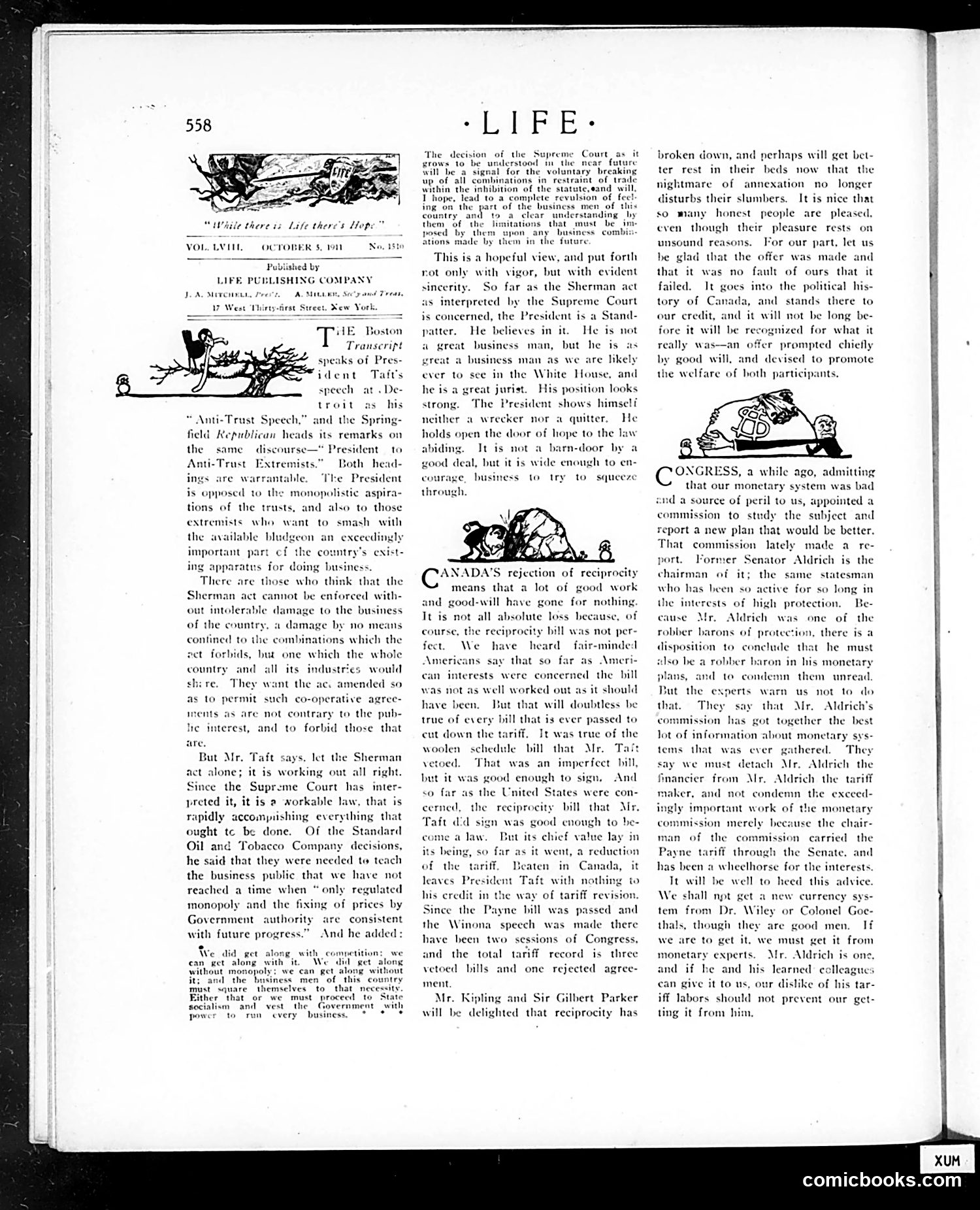
This page from *Life* magazine discusses President Taft's policies regarding trusts and tariffs. The main cartoon (top left) titled "Wait! There is Life there's Hope" depicts a figure apparently struggling or in distress. The article criticizes Canada's rejection of reciprocal trade agreements and discusses Taft's handling of anti-trust legislation. The text references the Sherman Act's enforcement and debates over tariff policy, particularly mentioning the "Payne bill" and trade negotiations with Canada. A secondary cartoon (bottom right) shows what appears to be a turtle or tortoise, likely symbolizing slow progress or cautious movement—fitting the editorial's theme of deliberate but incomplete policy reforms under Taft's administration. The overall satire critiques Taft's moderate approach to monopolies and trade as insufficient, though the specific identities of all caricatured figures remain unclear from the image quality.
📄 Transcribed text from this page (OCR, searchable)
Machine-transcribed from the original scan — historical spelling and the odd misread are preserved.
le there is Life there's He VOL. LV EL, OCTOBER 5, 1911 Published by PU SHE "OMPANY LIF J. A. Merona, 17 West Th first Street HE. Boston Transcript aks of Pres- ident. Taft's speech at .De- troit as his ch.” and the Spring- ads its remarks on * Anti-Trust Spe field Republican h the same discourse—" President to Anti-Trust Extremists.” Both head- i rantahle, ‘Te President is opposed 10 the monopolistic aspira- tions of the trusts, and also to those extremists who want to smash with the available bli important part cf the co an exceedit ron mtry’s eNist- ing apparatus for doing business. There are those who think that the Sherman act cannot be enforced with- to the business out intolerable damag of the country, a damage by no means contined to the combinations which the ct forbids, but one which the whole country and all its industries would shire. They want the ac. amended so as to permit such co-operative agree- ments as are not contrary to the pub- he interest, and to forbid those that But Mr. Taft says. let the Sherman act alone; it is working out all right. Since the Supreme Court has inter- preted it, it is @ workable Jaw, that is ipidly accompiishing everything that ought te be done. Of the Standard Oil and Tobacco Company decisions, he said that they were needed to teach the business public that we have not reached a time when “ ulated monopoly and the fixing of prices by Government authority are consistent with future progress.” And he added: “only re We did get can get along with it. We did get along without monopoly: we can get along without it; and the business men of this country must square themselves to that necessity. Either that or we must proceed to. State socialism and yest the Government w Jong. with competition: we “LIEN: The decision of the Supreme Court as it grows to be understood m the near future il be a signal for the volunta up of all combinations in restraint of trade hin the inhibition of the statute,eand will 1 hope, lead to a comple of fe ing on’ the part of the b f this puntey and to a clear nding nust) be int ny business combi in the future them of the I posed by them ay ations made by them tations This is a hopeful view, and put forth rot only with vigor, but with evident sincerity. So far as the Sherman act us interpreted by the Supreme Court is concerned, the President is a Stand- patter. He believes in it. He is not a great business man, but he is great a business man as we are likely ever to see in the White House, and reat jurist. His position lo strong. The President shows him: neither a wrecker nor a quitter. He holds open the door of hope to the law abiding. It is not a barn-door by a 1, but it is wide enough to en- business to try to. squeeze he is a good des ara through, ANADA'S rejection of reciprocity means that a lot of good work ‘ood-will have gone for nothing. and ¢ It is not all absolute loss because, of y bill wa course, the reciproci fect. We have heard fair-minded Americans say that so far as .\meri- ts were concerned the bill not pe! can intere: was not as well worked out as it should have been, But that will doubtless be true of every bill that is ever passed to cut down the tariff. It was true of the wool je bill that, Mr, Taft vetoed. That was an imperfcet bill, but it was good enough to sign, And so far as the United States were con- cerned, the reciprocity bill that Mr. sched: Taft did sign was good cnough to be- ca law, But its chief value lay in s being, so far as it went, a reductic the tariff, Beaten in Canada, it leaves President Taft with noth his credit in the way of tariff revision. Since the Payne bill was passed and the Winona speech was made there have been two sessions of Congress, and the total tariff record is three vetoed bills and one rejected agree- he ment Mr. Kipling and Sir ‘ilbert: Parker will be delighted that reciprocity has broken down, and perhaps will get bet- ter rest in their beds now that the nightmare of annexation no longer disturbs their slumbers. It is nice that y honest people are pleased. even though their pleasure rests on or our part, let us. unsound reasons. | be glad that the offer was made and that itv It of ours that it failed. It goes into the political his- tory of Canada, and stands there to our credit, and it will not be long be- fore it will be recognized for what it really was—an offer prompted chiefly by good will, and devised to promote the welfare of hoth participants. no ONGRESS, a while ago, admitting that our monetary system was bad anda source of peril to us, appointed a commission to stu the subject and report a new plan that would be better. y made a re- wrt. Former Senator Aldrich is the chairman of it; the same statesman en so active for so long in ion, B That commission late who has | the interests of high prot cause Mr. Aldrich was one of the there is a ber barons of protec disposition to conclude that he must also he a robber baron in his monetary ns, and te condemn them unread. But the experts warn us not to do that. They say that Mr, Aldrich’s commission has got together the best lot of information about monetary sys- tems that was ever gathered. They we must detach Mr. Aldrich the inancier from Mr. Aldrich the tariff maker, and not condemn the exceed- gly important work of the monetary commission merely because the cha in man of the commission carried the Payne tariff through the Senate. and has been a wheelhorse for the interests. It will be well to heed this advice We shall npt get a new currency s tem from Dr. Wiley or Colonel Goe- thals, though they are good men. If we are to get it, we must get it from monetary experts. Mr. Aldrich is one, and if he and his learned cellea an give it to us, our dislike of his tar- iff labors should not prevent our get- ting it from him, comicbooks.com