
A complete issue · 44 pages · 1911
Life — September 7, 1911
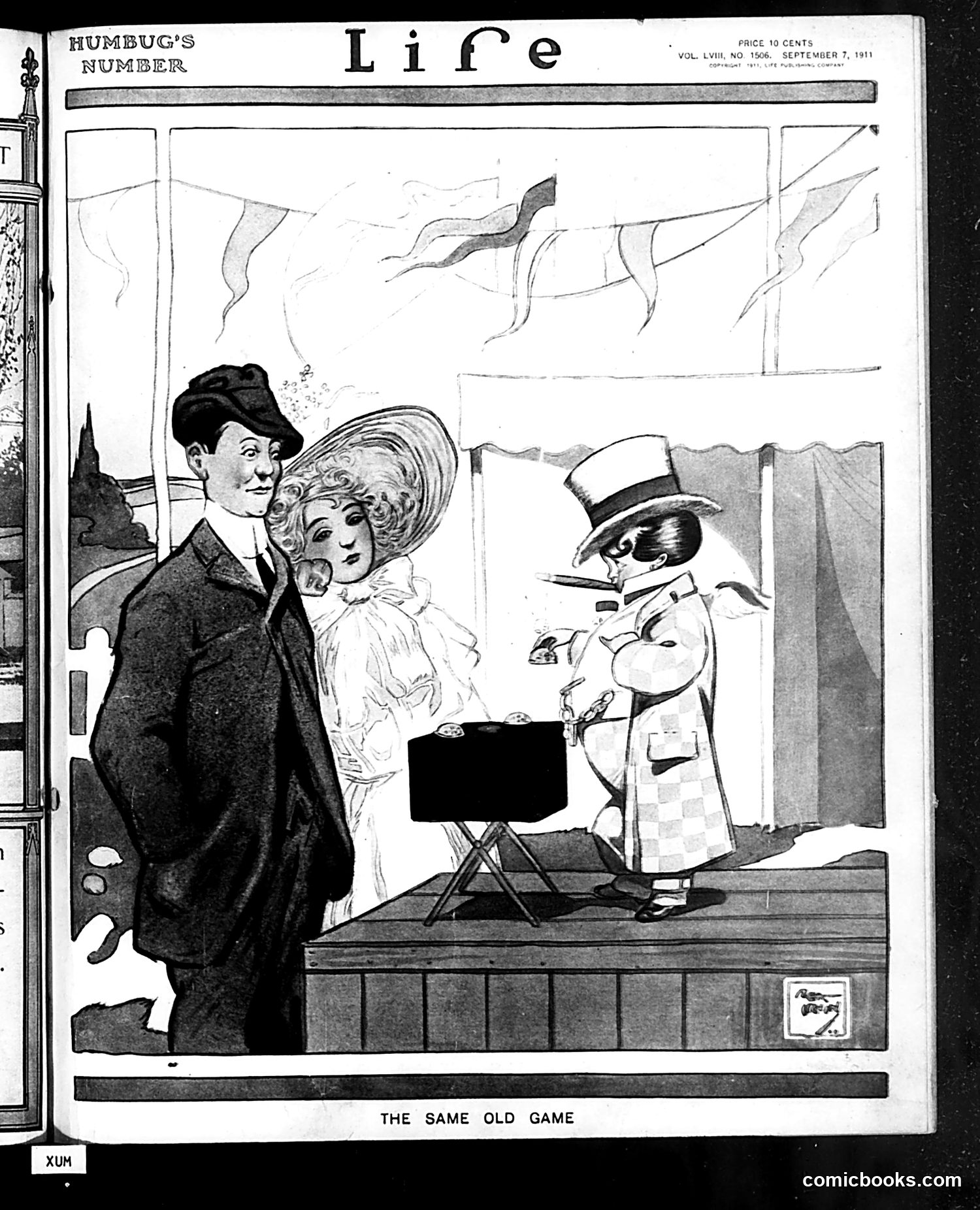
This cartoon satirizes a recurring social scenario about courtship and marriage prospects. A well-dressed couple (man in dark suit, woman in elaborate hat and dress) present themselves to what appears to be a military or uniformed official at a desk, suggesting they're seeking approval or registration—likely for an engagement or marriage. The title "The Same Old Game" indicates this depicts a timeless, repetitive social ritual. The satire suggests that despite changing fashions and modern times, the fundamental dance of courtship, parental oversight, and formal approval remains unchanged. The couple's fashionable 1911 attire contrasts with the cyclical nature of human romantic customs, mocking society's pretense of progress while fundamental social conventions persist unaltered.
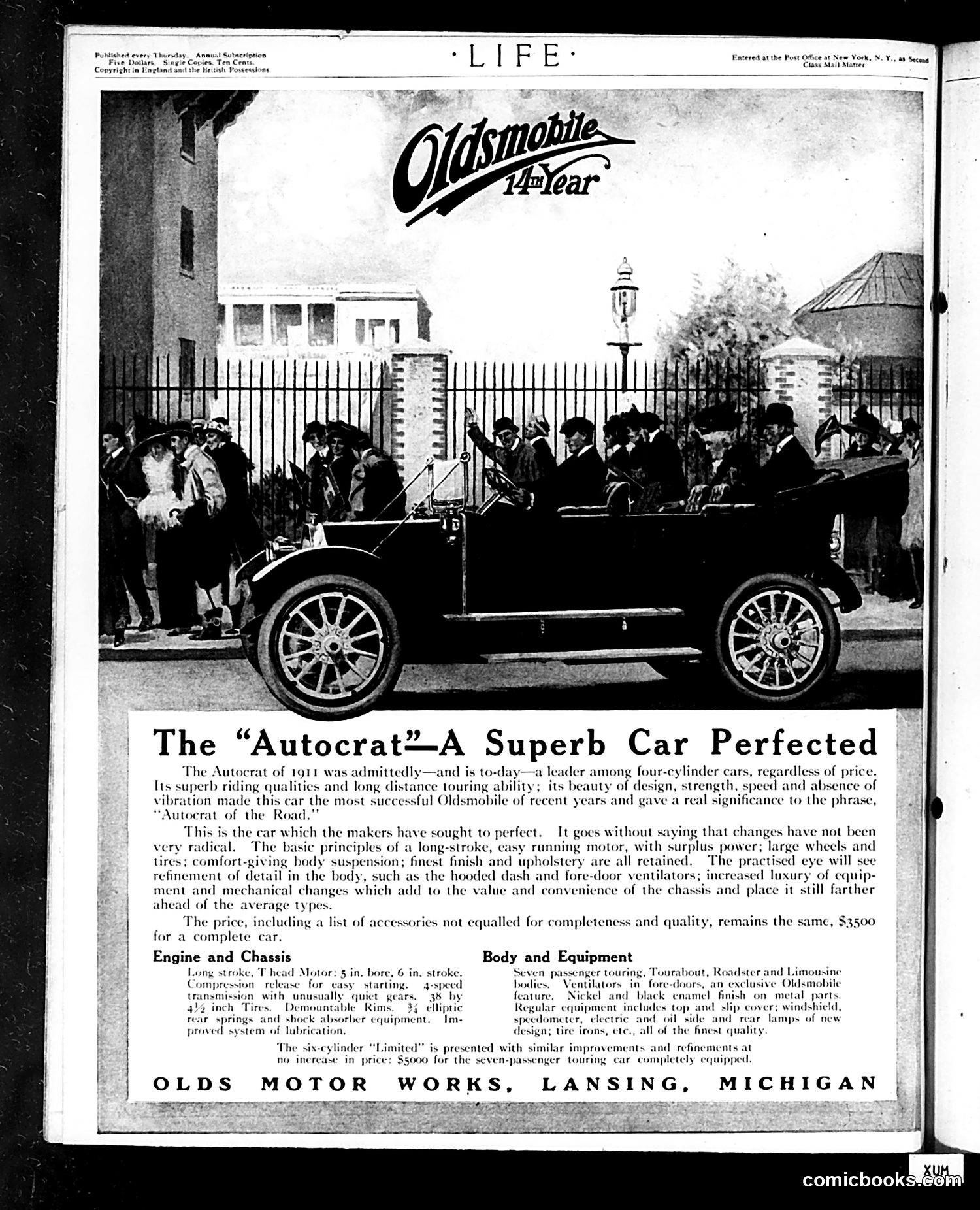
This page is primarily **an automobile advertisement**, not political satire. It features Oldsmobile's 1911 "Autocrat" model—a four-cylinder touring car priced at $1,350. The image shows a formal gathering of well-dressed men and women in early 1900s attire examining or boarding an open-air automobile outside an iron-gated estate. The scene emphasizes the car's prestige and luxury appeal to wealthy buyers. The advertisement text highlights engineering features (long-stroke motor, large wheels, four-speed transmission) and body options (Touring, Roadster, Limousine). It stresses the model's consistency and refinement rather than radical changes from previous years. There is **no political cartoon or satire** present. This is straightforward commercial marketing of automobiles to affluent early-20th-century consumers.
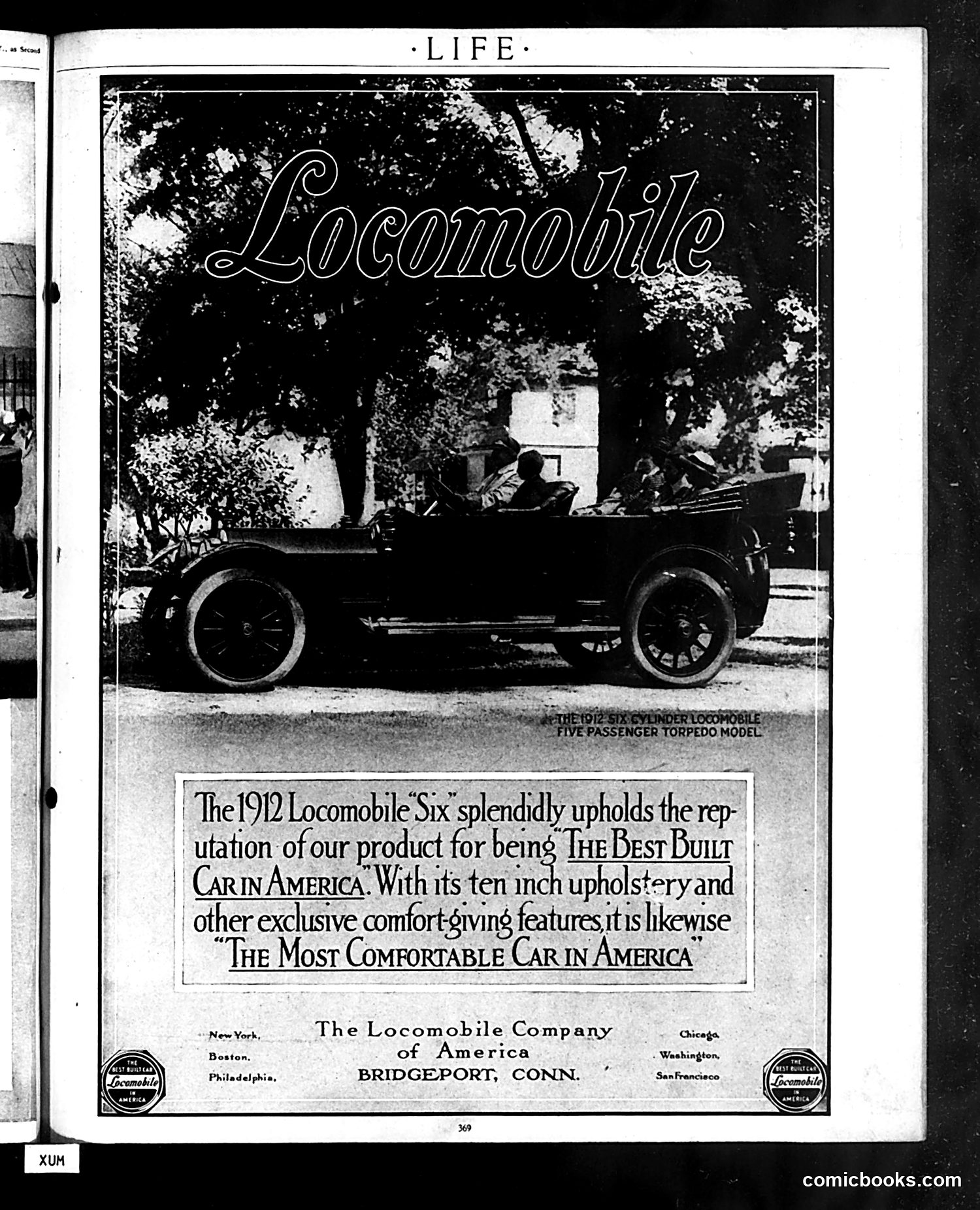
This page is **primarily an advertisement**, not satirical content. It's a full-page ad for the 1912 Locomotile automobile, published in *Life* magazine. The ad shows a side-profile photograph of an open-air five-passenger touring car beneath trees. The marketing copy claims the 1912 Locomotile "splendidly upholds the reputation of our product for being **The Best Built Car in America**" and touts its "ten inch upholstery and other exclusive comfort-giving features" as making it likewise "**The Most Comfortable Car in America.**" The Locomotile Company of America, based in Bridgeport, Connecticut, lists offices in major cities (New York, Boston, Philadelphia, Chicago, Washington, San Francisco). This reflects early automotive advertising's emphasis on comfort and quality craftsmanship as selling points to affluent consumers.
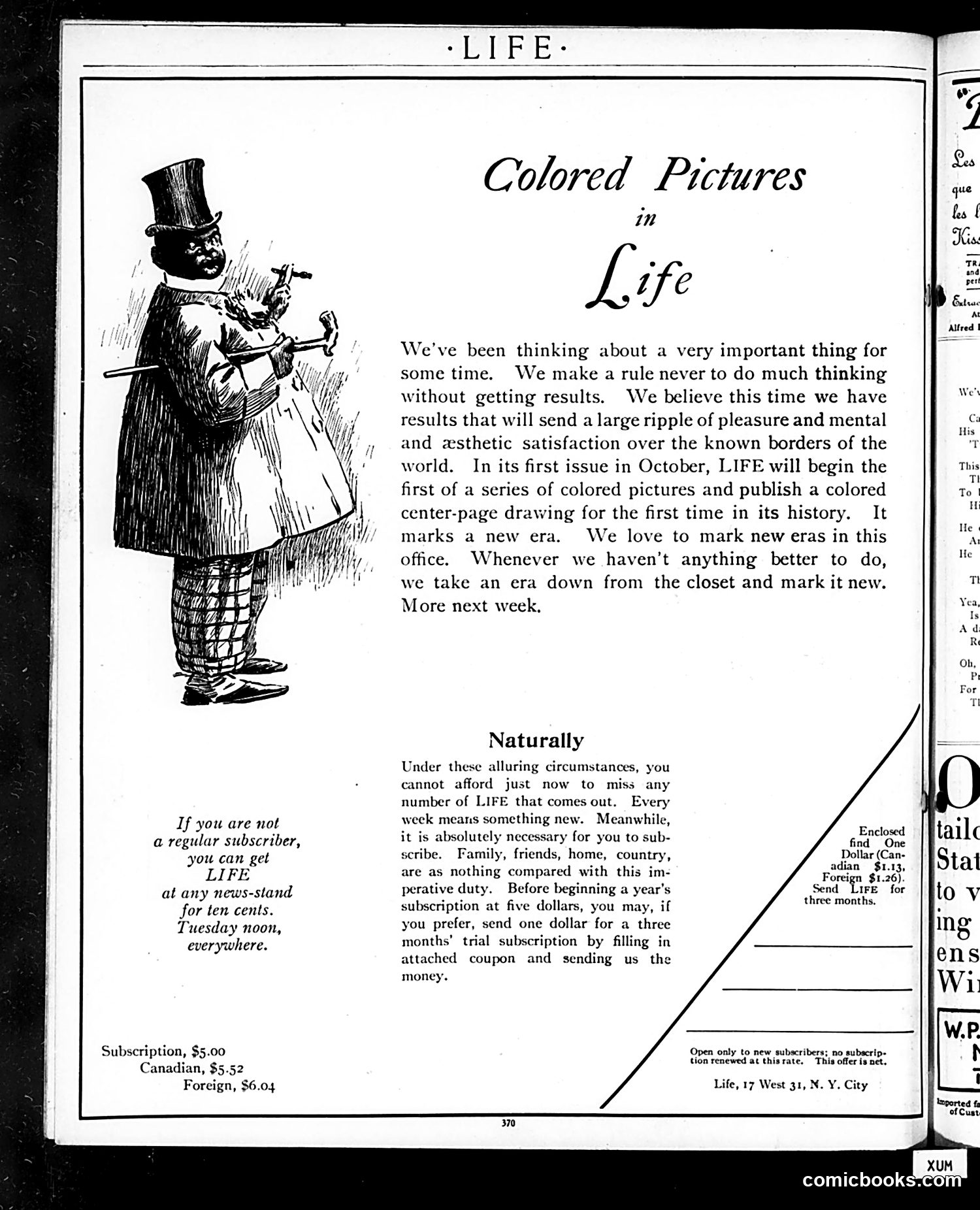
This is primarily an **advertisement/announcement**, not political satire. The page announces that *Life* magazine will begin publishing its first-ever colored pictures and center-page drawings, starting in October. The illustration shows a figure in formal dress (top hat and coat) holding what appears to be artistic materials—likely representing an artist or editor introducing this new visual innovation. The tone is celebratory: the editors describe this as marking "a new era" and emphasize that colored illustrations will enhance readers' "pleasure and mental and aesthetic satisfaction." The page also promotes subscription options ($5.00 annually, or $1 for a three-month trial) to encourage readers to experience this new feature.
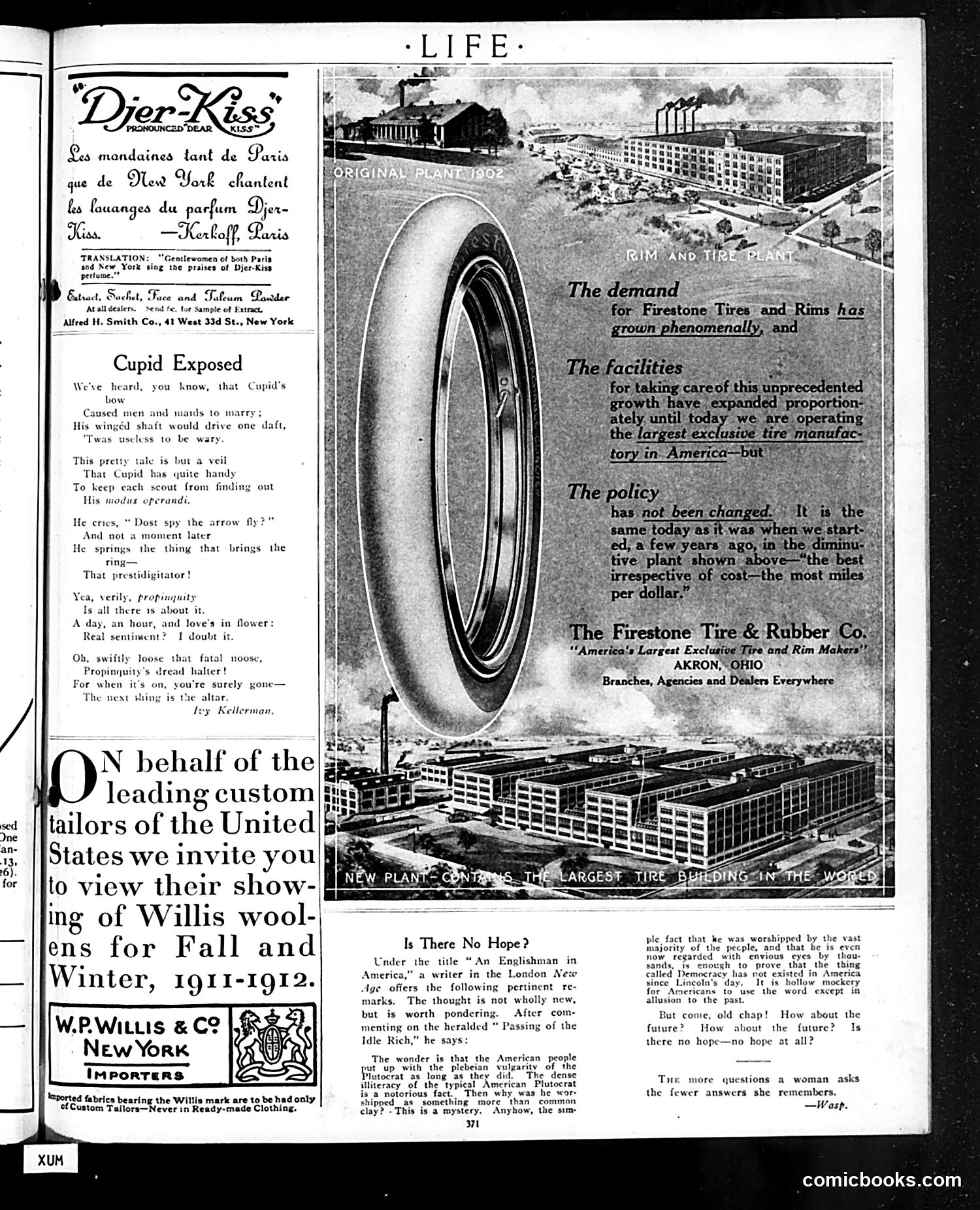
This Life magazine page (page 371) is primarily **advertising and light editorial content** rather than political satire. **Left column:** Features a Dior-Kiss perfume ad and a poem titled "Cupid Exposed" by Ira Kellerman—romantic doggerel about Cupid's arrow and marriage, typical magazine verse of the era. Below is a W.P. Willis & Co. advertisement for wool fabrics for tailors. **Center/Right:** A large Firestone Tire & Rubber Co. advertisement showcasing their manufacturing facilities in Akron, Ohio, emphasizing production capacity and consistent quality/value. **Bottom:** An article titled "Is There No Hope?" discussing American attitudes toward the British aristocracy, referencing "An Englishman in America" from the London *Spectator*. The page reflects early-20th-century consumer culture and Anglo-American social commentary rather than partisan political satire.
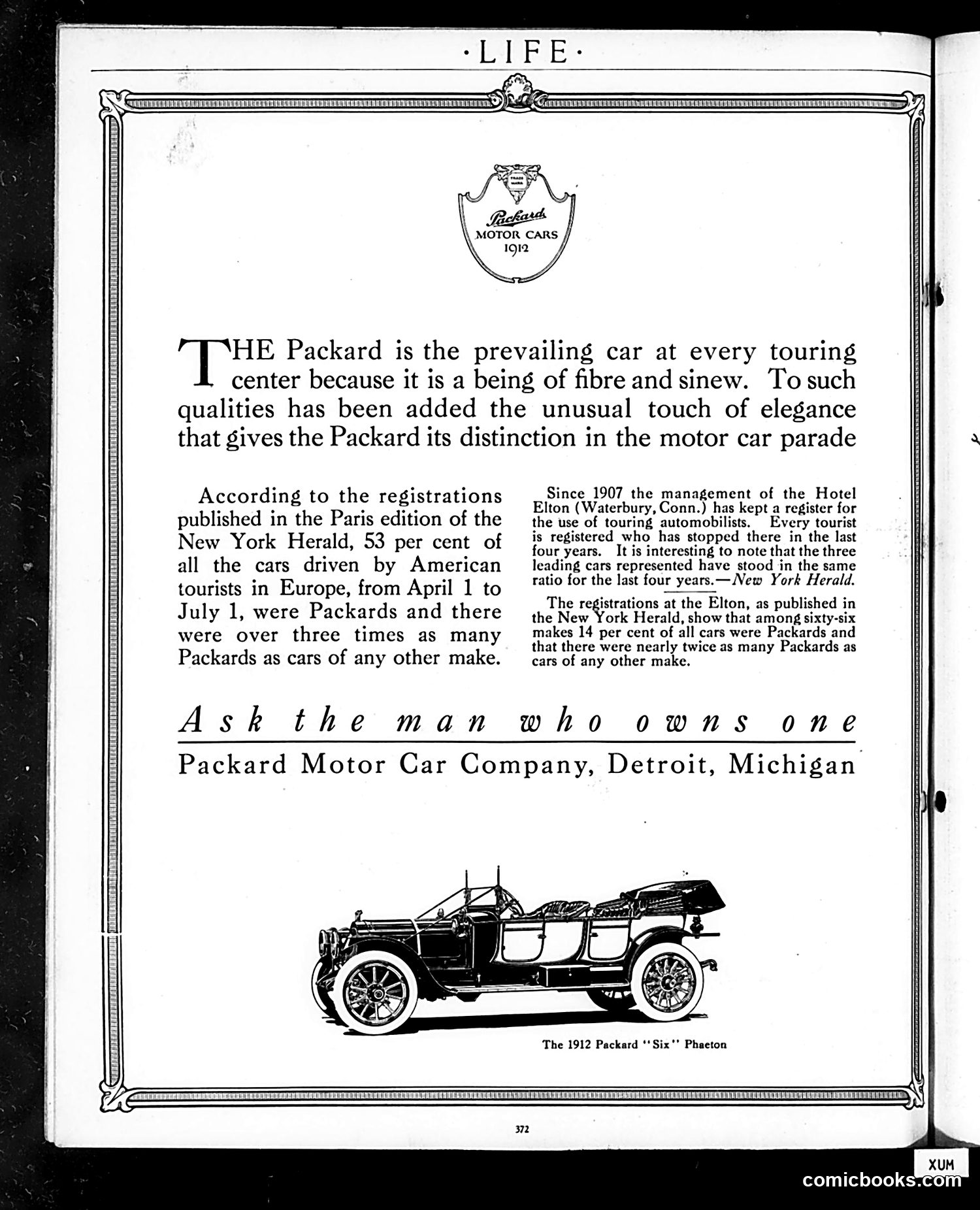
This page is **not a cartoon or satire**—it's a **straightforward advertisement** for the Packard Motor Car Company from 1912. The ad promotes Packards as the dominant choice among American tourists in Europe, citing statistics from the Paris edition of the New York Herald showing 53% of American-driven cars were Packards. Additional data from the Hotel Elton in Waterbury, Connecticut supports this claim, noting Packards appeared nearly twice as frequently as any other make. The appeal is to affluence and status: elegance, reliability, and international prestige. The illustration shows a 1912 Packard "Six" Phaeton—a luxury touring car typical of the era's high-end automobiles.
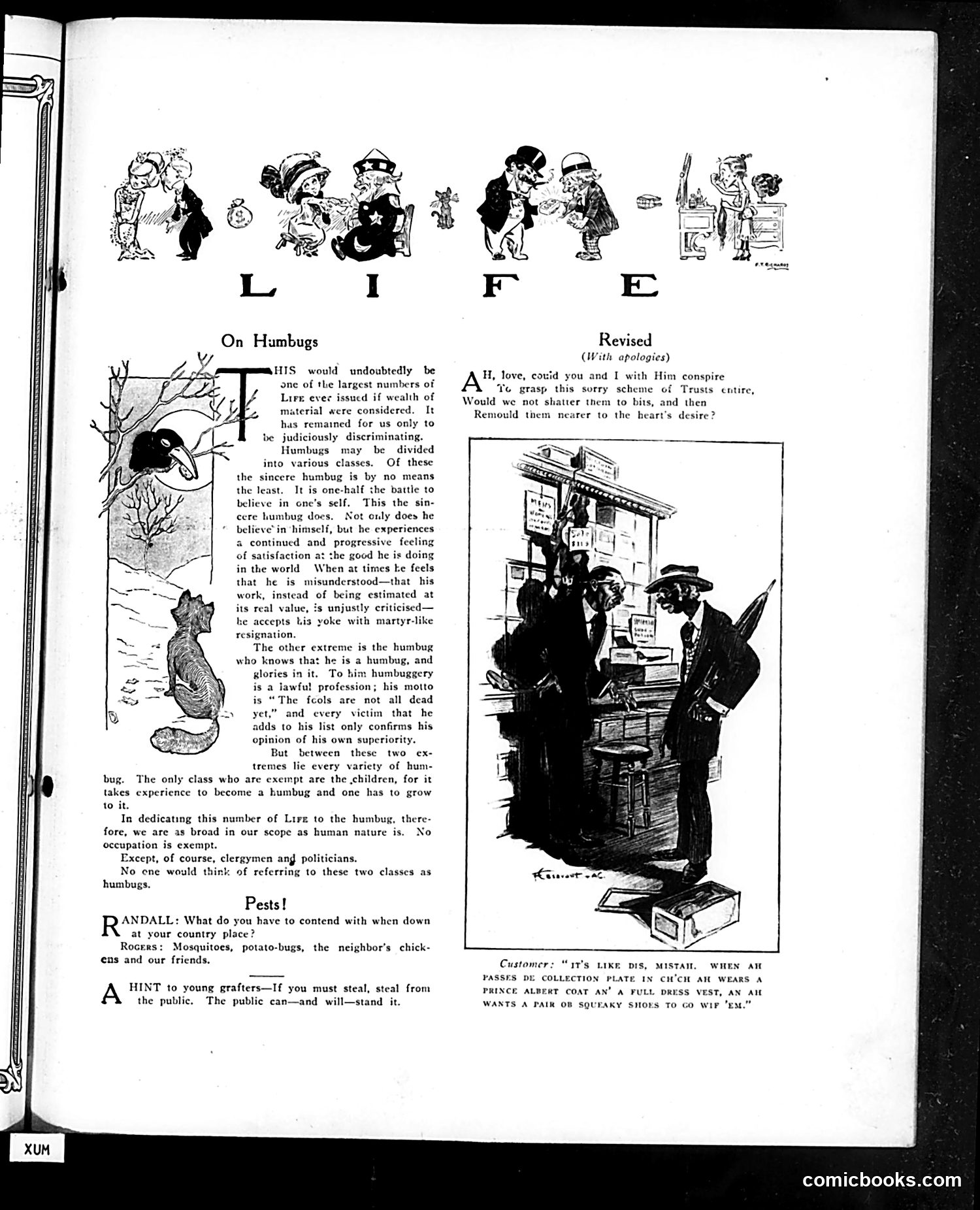
This page satirizes **pretentious hypocrisy** through two pieces: **"On Humbugs"** (left): A prose essay distinguishing types of humbugs—from the self-deceived person who genuinely believes in their own superiority, to the calculated charlatan who knows he's fraudulent. The text notes that "humbugerry" is a "lawful profession" and observes that even clergy and politicians qualify as humbugs, suggesting widespread social dishonesty. **"Revised (With Apologies)"** (right): A cartoon showing what appears to be a **wealthy fashionable man** at a tailor shop, obsessing over trivial details of dress (Prince Albert coats, squeaky shoes). The satire mocks upper-class vanity and materialism—the irony being that despite elaborate grooming, such people remain fundamentally hollow or fraudulent. Together, the pieces critique American social pretension and the gap between appearance and reality.
This page from *Life* magazine (September 7, 1911) contains a political editorial about trade unionism and labor activism. The small cartoon at top shows figures representing labor disputes—likely depicting the "closed shop" controversy mentioned in the text. The article, attributed to Mr. Clarence Darrow (the famous labor attorney), discusses whether unions should fight for closed shops (workplaces employing only union members). Darrow argues that while unions deserve support, violent methods and dynamite attacks undermine their cause. He suggests the closed shop will eventually prevail through legitimate organization rather than terrorism. The piece reflects early 20th-century debates over union tactics and the fear of radical labor violence that characterized the era.
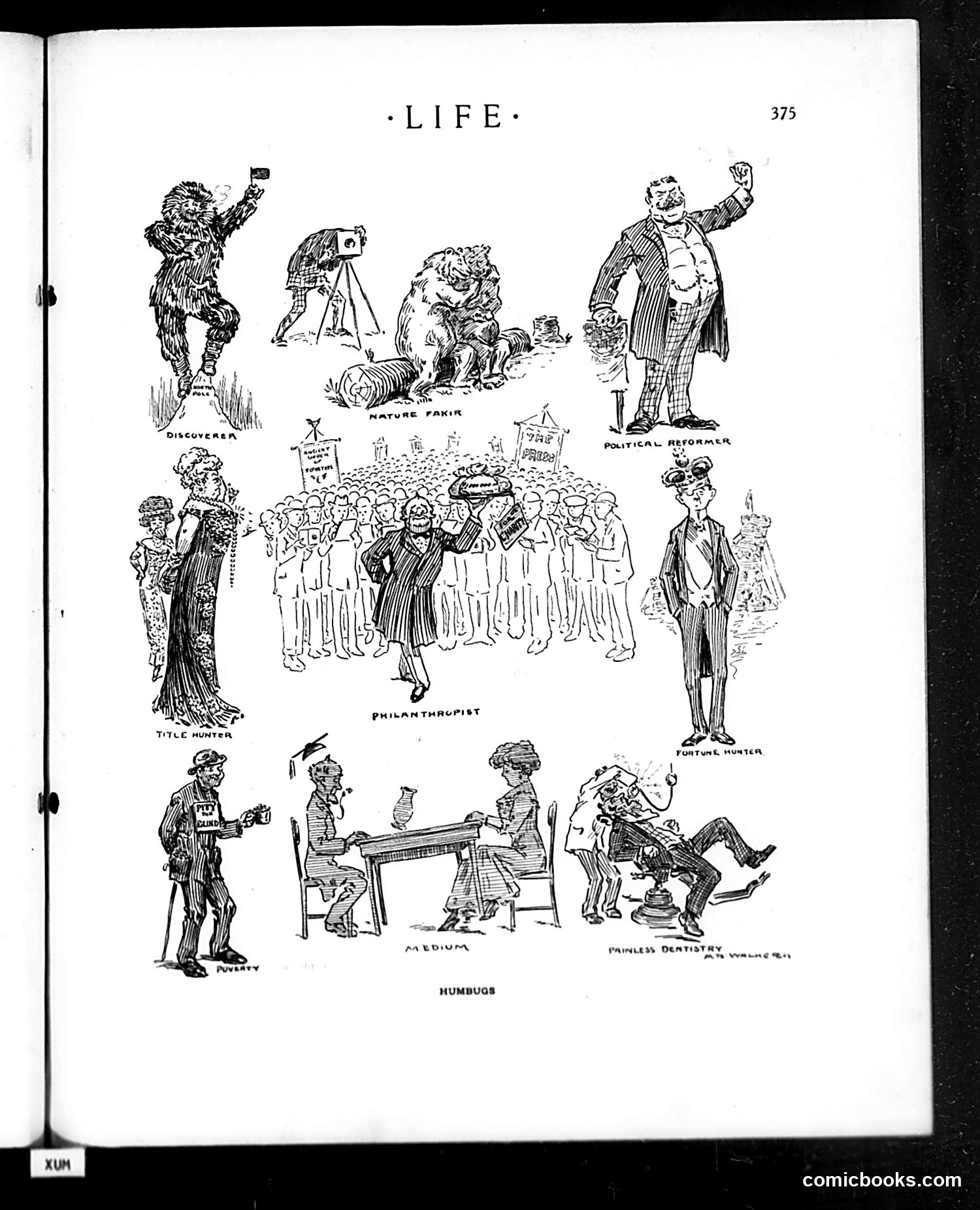
This satirical page presents caricatured "types" of people in early 20th-century American society, labeled as social stereotypes or character archetypes: **Upper section:** "Discoverer," "Nature Faker" (with camera), and "Political Reformer" depict different social roles or pretensions. **Center:** "Title Hunter," "Philanthropist" (surrounded by crowds), and "Fortune Hunter" represent people seeking social status or wealth through various means. **Lower section:** "Poverty," "Medium," "Humbugs" section includes "Painless Dentistry" and what appears to be social criticism of dubious professionals and charlatans. The cartoon satirizes common American social archetypes and fraudsters—people claiming false expertise or moral authority. The crowded "Philanthropist" figure particularly mocks performative charity, while "Nature Faker" likely references popular but inaccurate nature writers of the era.
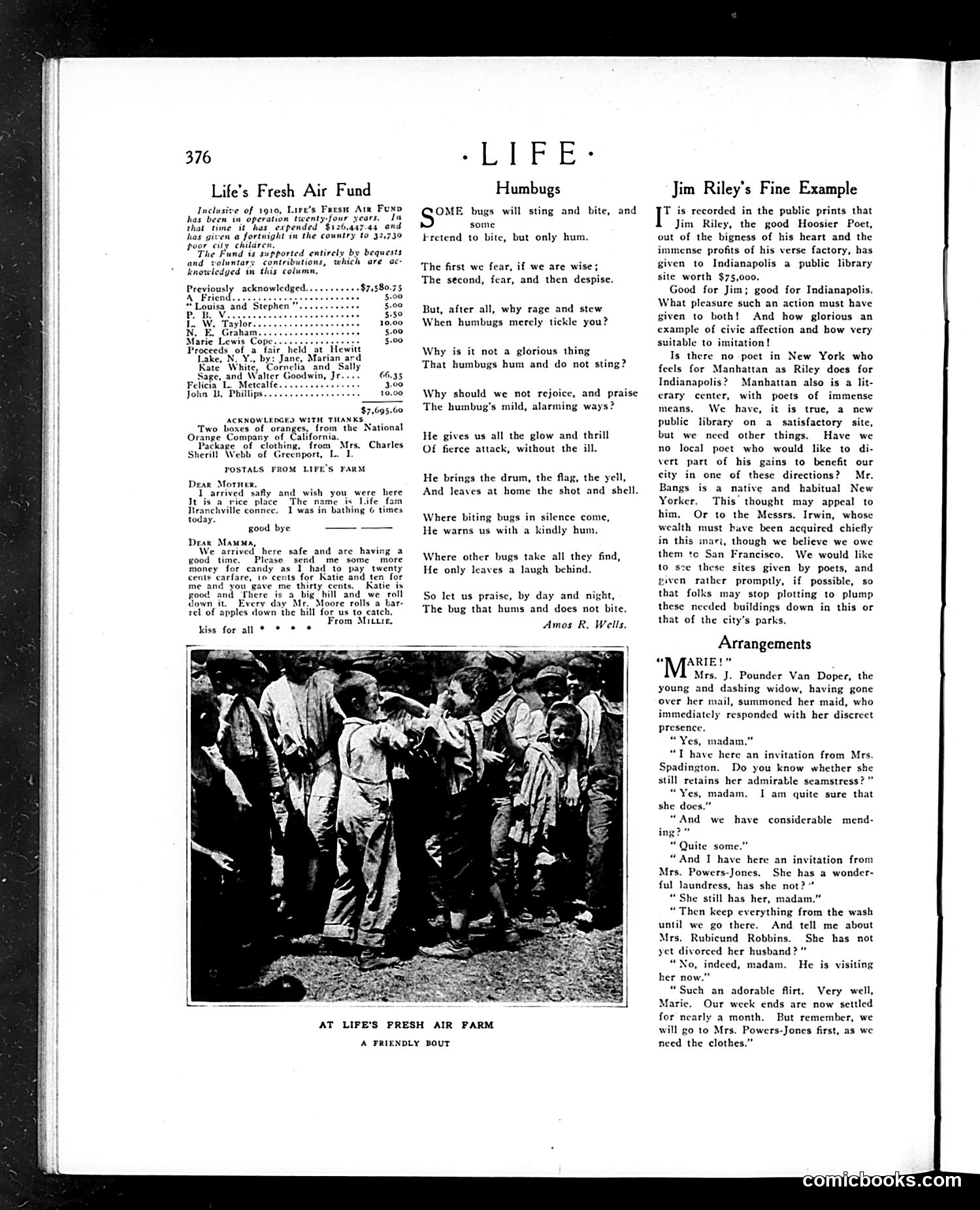
This page contains two distinct pieces: **"Humbugs" poem** (left): A humorous verse celebrating mosquitoes' mild nature compared to other insects—they merely tickle rather than cause serious harm. The satire gently mocks people's overwrought fear of minor annoyances. **"Jim Riley's Fine Example" (right)**: A literary commentary praising poet Jim Riley for his Indianapolis-focused work, arguing that American cities need local poets to celebrate their character. The author advocates for geographic cultural pride. **Photograph**: "At Life's Fresh Air Farm—A Friendly Rout" shows a candid group scene, likely documenting Life magazine's charitable fresh-air initiative for urban children—a common Progressive-era welfare program providing outdoor recreation to poor city dwellers. The page reflects early 20th-century American literary culture and social reform interests.
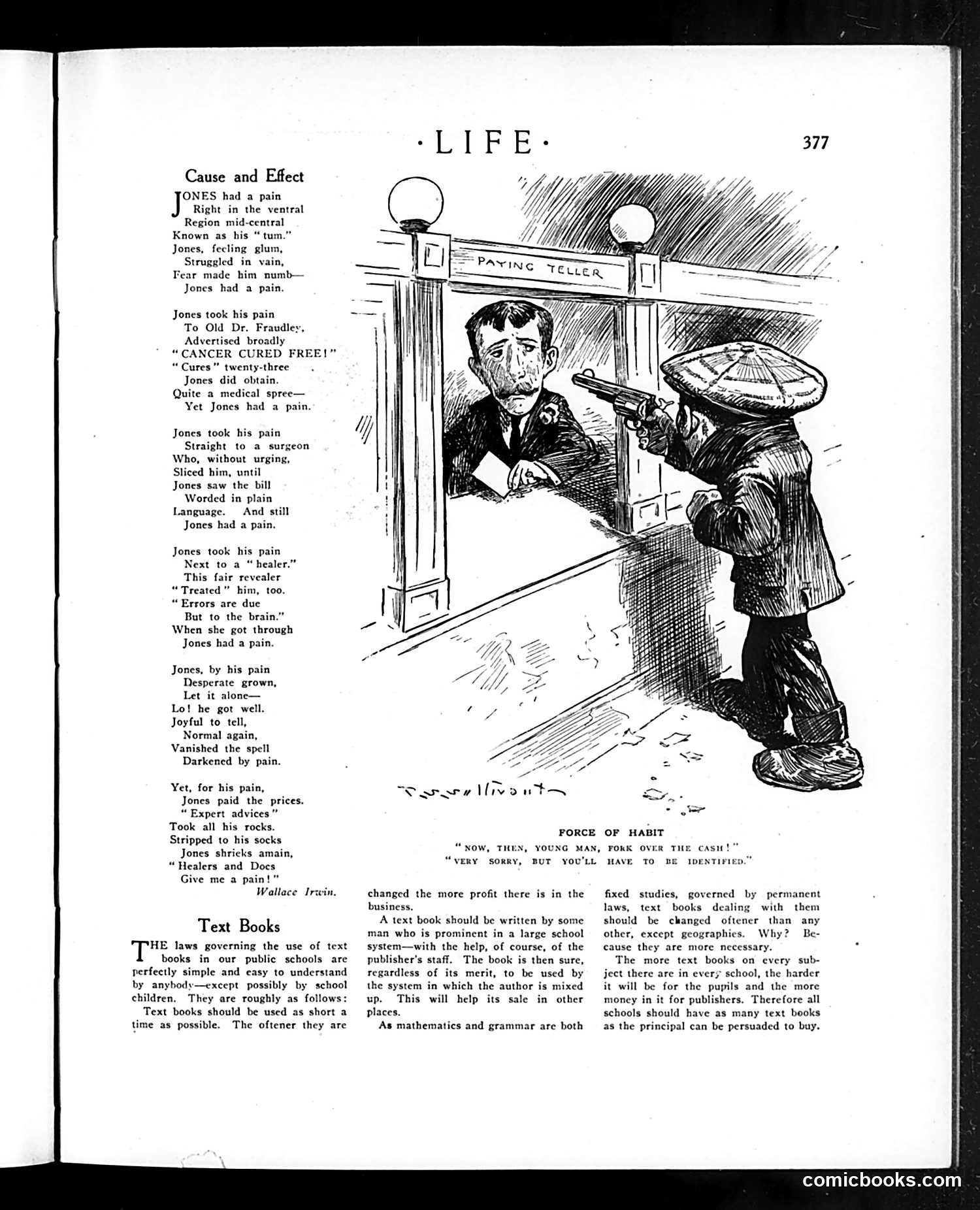
This satirical cartoon depicts a man at a "Paving Teller" window (a play on "paying teller" at a bank). The caption reads: "Now, then, young man, fork over the cash!" with the response "Very sorry, but you'll have to be identified." The joke satirizes the absurdity of bureaucratic procedure taken to illogical extremes. A paving teller—someone collecting payment for street paving work—demands identification before accepting payment, mimicking excessive banking practices. The cartoon critiques how institutions blindly follow rigid rules ("force of habit") without considering whether they make sense in context. The accompanying poem "Cause and Effect" by Wallace Irwin tells a similar story about Jones seeking medical cures, only to continue suffering—illustrating how people repeat ineffective actions habitually.
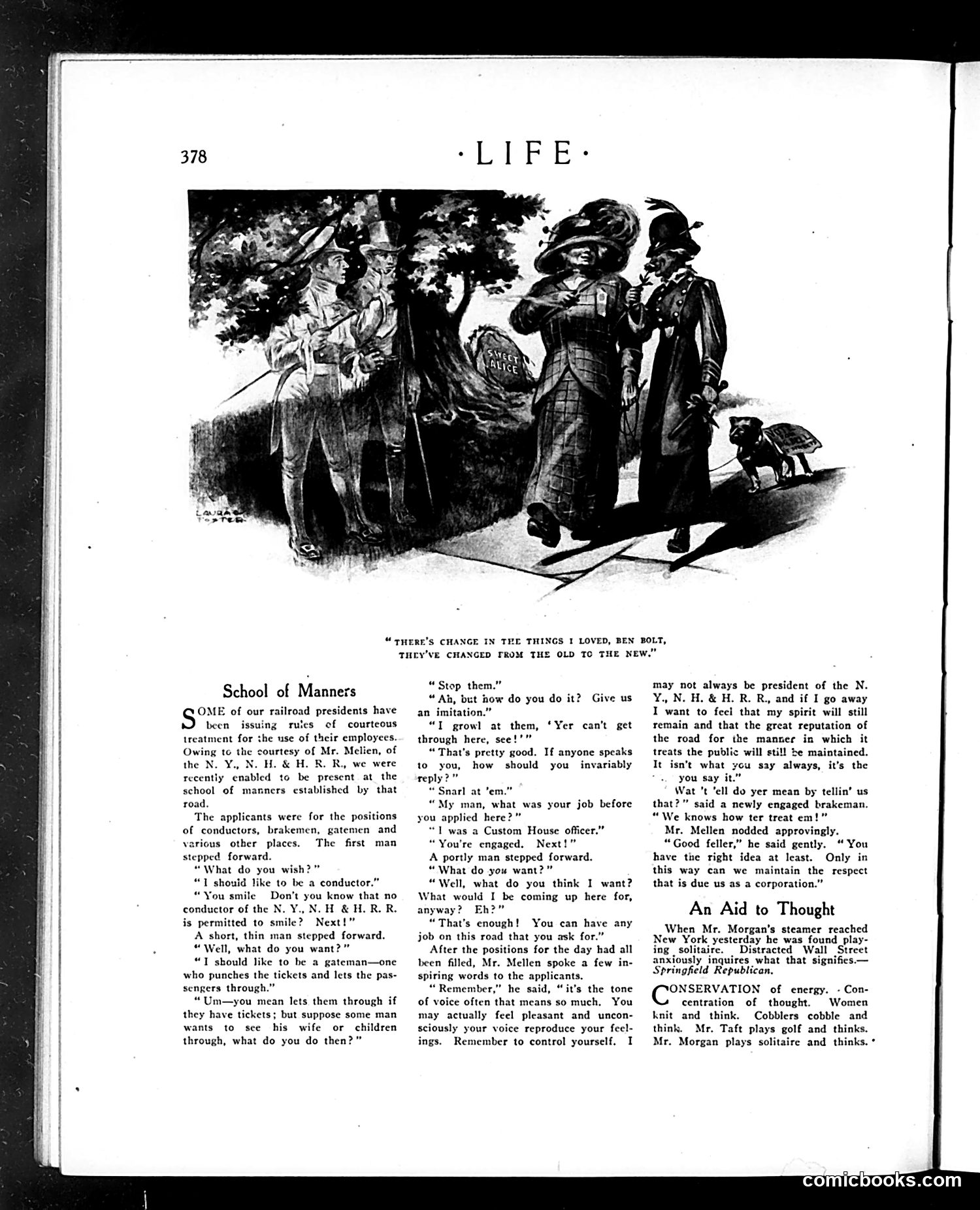
This page from *Life* magazine presents a satirical article titled "School of Manners" about railroad employee training. The illustration depicts what appears to be railroad officials instructing workers on proper conduct and deportment. The satire targets the N.Y., N.H. & H.R.R. (New York, New Haven & Hartford Railroad), which apparently established a formal "school of manners" to improve employee courtesy toward passengers. The dialogue humorously shows the absurdity of teaching railroad workers—particularly conductors and ticket-takers—rigid rules about voice control, self-restraint, and respectful address. The joke suggests that such formal instruction in basic courtesy to a working-class workforce is both patronizing and unlikely to succeed. The article mocks both corporate pretension and the assumption that manners can be taught through regimented schooling rather than genuine respect.
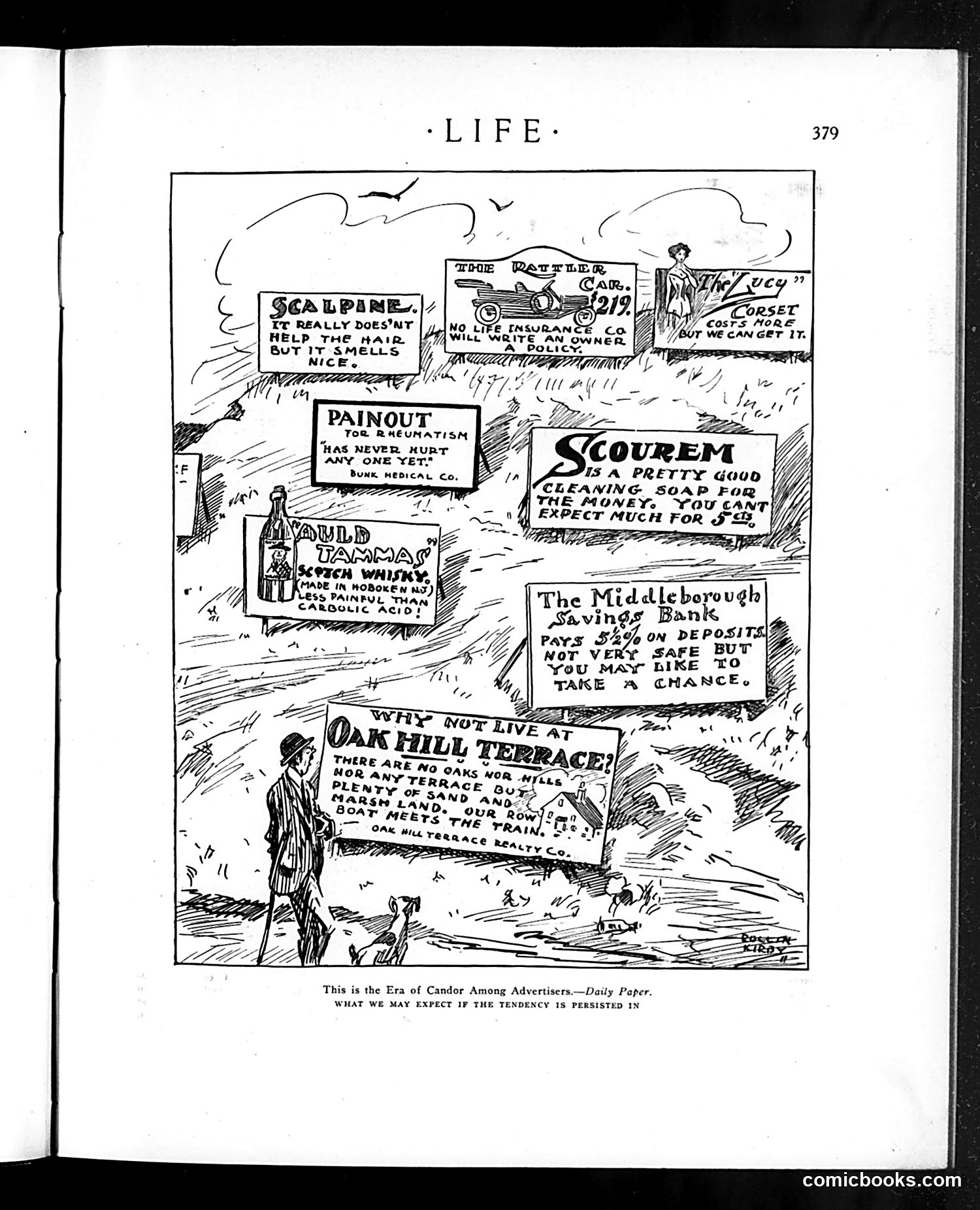
This cartoon satirizes misleading patent medicine and product advertisements prevalent in the era. The image shows various fraudulent claims displayed as roadside signs: Scalpine promises to restore hair, a life insurance company claims no underwriting needed, Painout claims safety, Scourem advertises miraculous cleaning power, Middleborough Savings Bank admits risky deposits, and Oak Hill Terrace promotes non-existent features. The figure observing these signs represents the gullible consumer. The caption notes this represents "the Era of Candor Among Advertisers," using heavy irony—the opposite is true. The satire criticizes how companies made extravagant, unsubstantiated health and financial claims to deceive the public, a widespread problem Life's satirists frequently mocked.
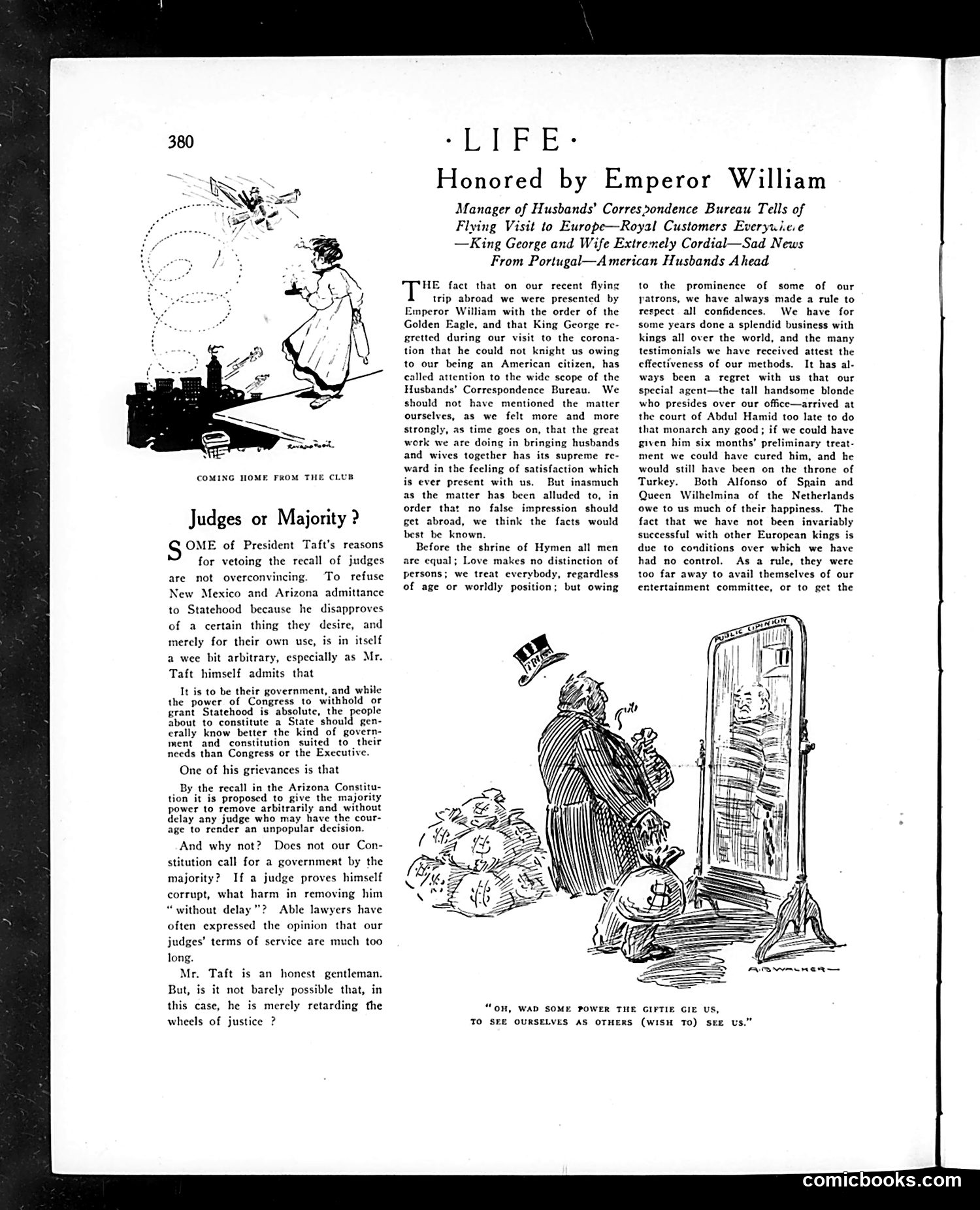
This page contains two distinct pieces of political commentary from the early 20th century. The upper article, "Honored by Emperor William," discusses President Taft's recent European visit and honors received from German Emperor William II. The writer defends Taft against criticism, arguing that accepting foreign honors and maintaining diplomatic relationships serves American interests. The lower section, "Judges or Majority?," critiques Taft's veto of judicial recall legislation in Arizona and New Mexico. The cartoon illustrates this debate: a figure (representing the judiciary or constitutional authority) stands at a doorway, suggesting tension between judicial independence and democratic majoritarian control—a key progressive-era controversy about whether voters should have power to remove judges.
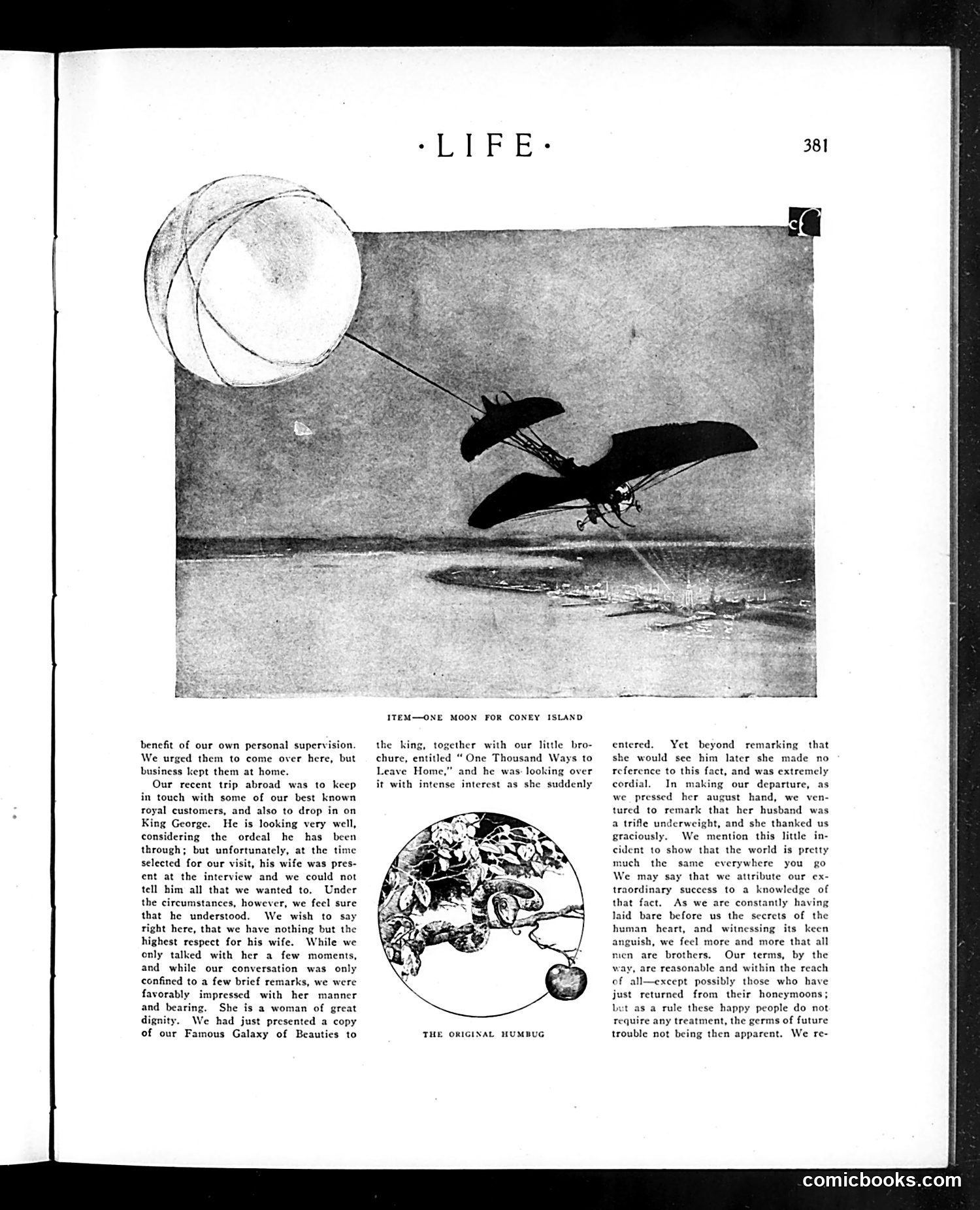
This page contains two satirical cartoons and accompanying text mocking a charlatan "beauty expert" or con artist. **"One Moon for Coney Island"** (top): Shows a figure with a net catching the moon, reflecting absurdist humor about Coney Island tourist attractions and exaggerated promises. **"The Original Humbug"** (bottom): Depicts a brain diagram, likely satirizing pseudoscientific claims about beauty treatments or personality analysis. The text narrates the author's supposedly prestigious work advising King George V and his queen, but the tone is deliberately pompous and self-aggrandizing—clearly mocking snake-oil salesmen who inflate their importance. References to a "Famous Galaxy of Beauties" and "One Thousand Ways to Leave Home" are invented promotional materials meant to expose the character's fraudulence. The phrase "humbug" in the title confirms the satire: Life is ridiculing beauty charlatans and their manipulative marketing tactics targeting the gullible.
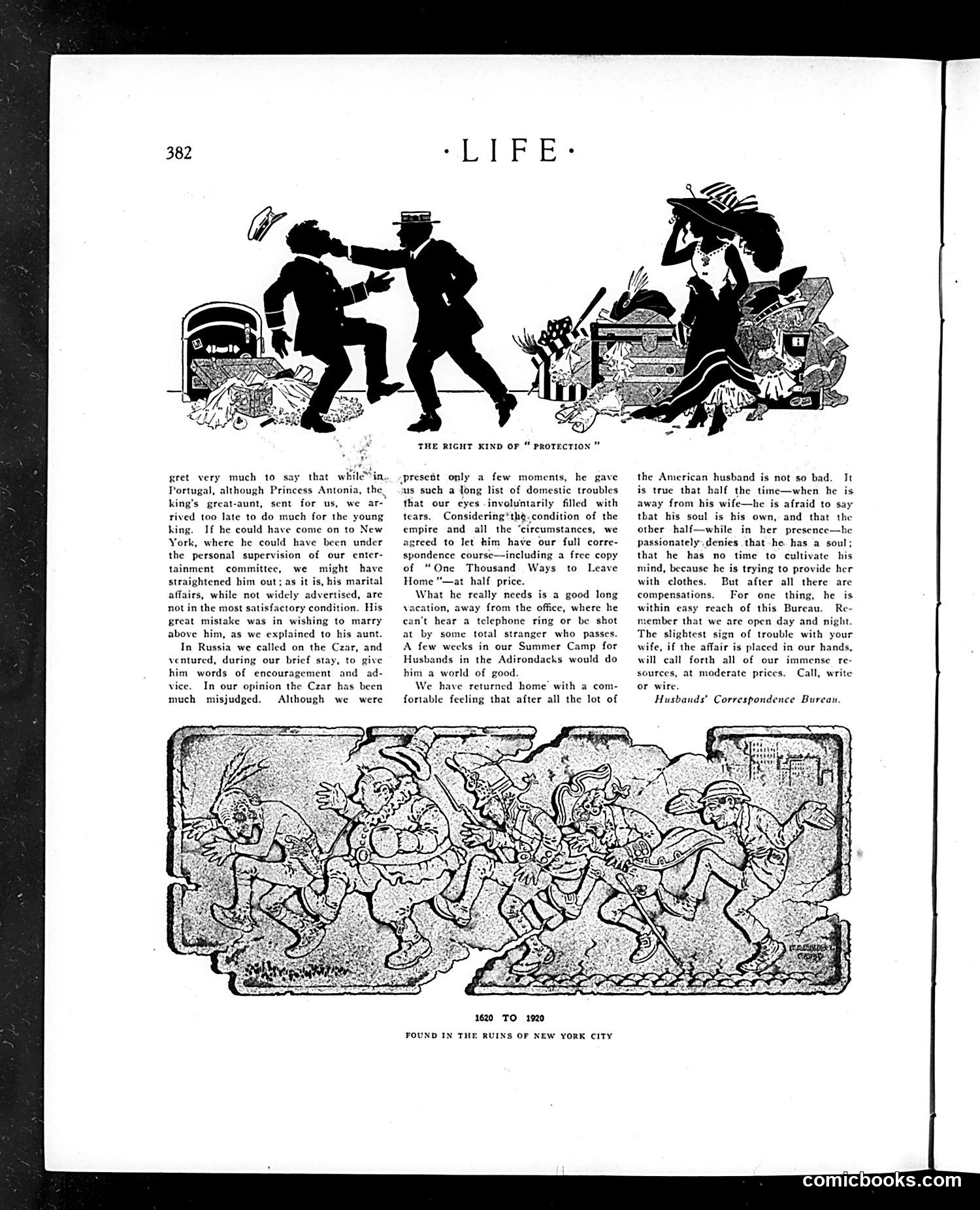
This page satirizes American marital advice and international diplomacy through a humorous "Husbands' Correspondence Bureau" narrative. The text mockingly describes the author's visits to European royalty—a Portuguese princess and the Russian Czar—offering them domestic advice as if they were ordinary clients needing marriage counseling. The top cartoon illustrates "The Right Kind of Protection," showing chaos with overflowing domestic troubles and disputes, contrasting with the bureau's promise of orderly solutions. The satire targets several things: American arrogance in offering unsolicited advice to foreign leaders; the emerging marriage-counseling industry; and gender dynamics of the era, where wives control husbands' finances and social lives. The advertisement for the "Husbands' Correspondence Bureau" (available "day and night") mocks both marital discord and commercialized solutions to personal problems. The bottom illustration from "1620 to 1920" appears historical/decorative, possibly contrasting past and present.
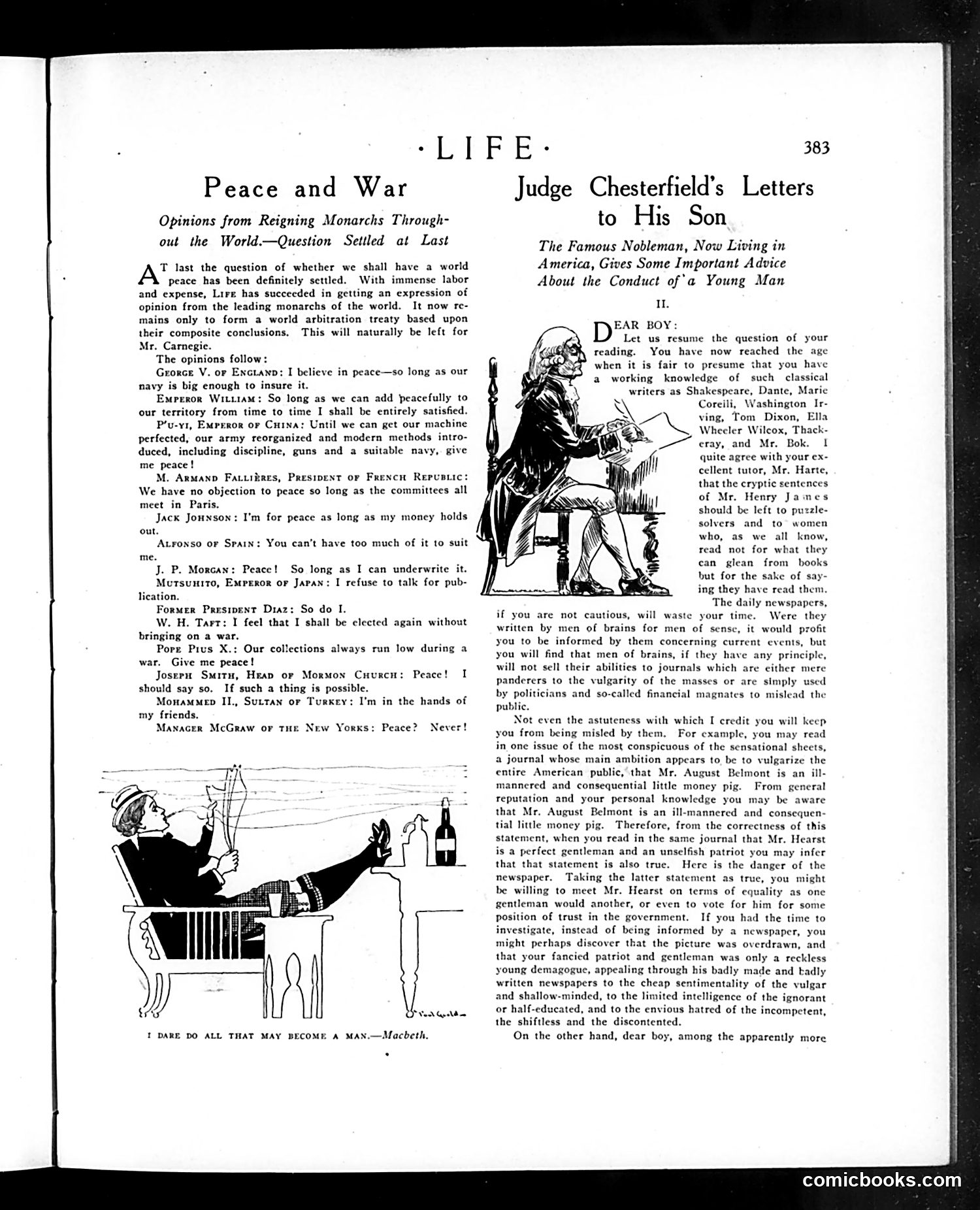
## "Peace and War" Section This satirical piece mocks world leaders' claims about wanting peace. Life presents fake "opinions" from monarchs and powerful figures, each revealing their actual self-interest disguised as peace advocacy. For instance, King George V wants peace "so long as our navy is big enough," and Emperor William desires peace while expanding territory. The joke: none actually want peace—they want security, profit, or power. Notably, J.P. Morgan (a banker, not a monarch) appears alongside rulers, suggesting American industrial titans wielded comparable power. The inclusion of "Manager McGraw of the New Yorks" (baseball) and boxer Jack Johnson adds absurdist humor, mocking America's obsession with mixing celebrity with serious matters. ## "Judge Chesterfield's Letters" This parodies aristocratic advice literature, presented as a British nobleman now in America tutoring his son. The accompanying sketch shows an idle gentleman reading. The satire critiques sensationalist newspapers (likely Hearst's publications), warning young readers to distrust their contradictions—if they correctly report something negative about Belmont, they might report falsehoods about Hearst, creating ironic logic.
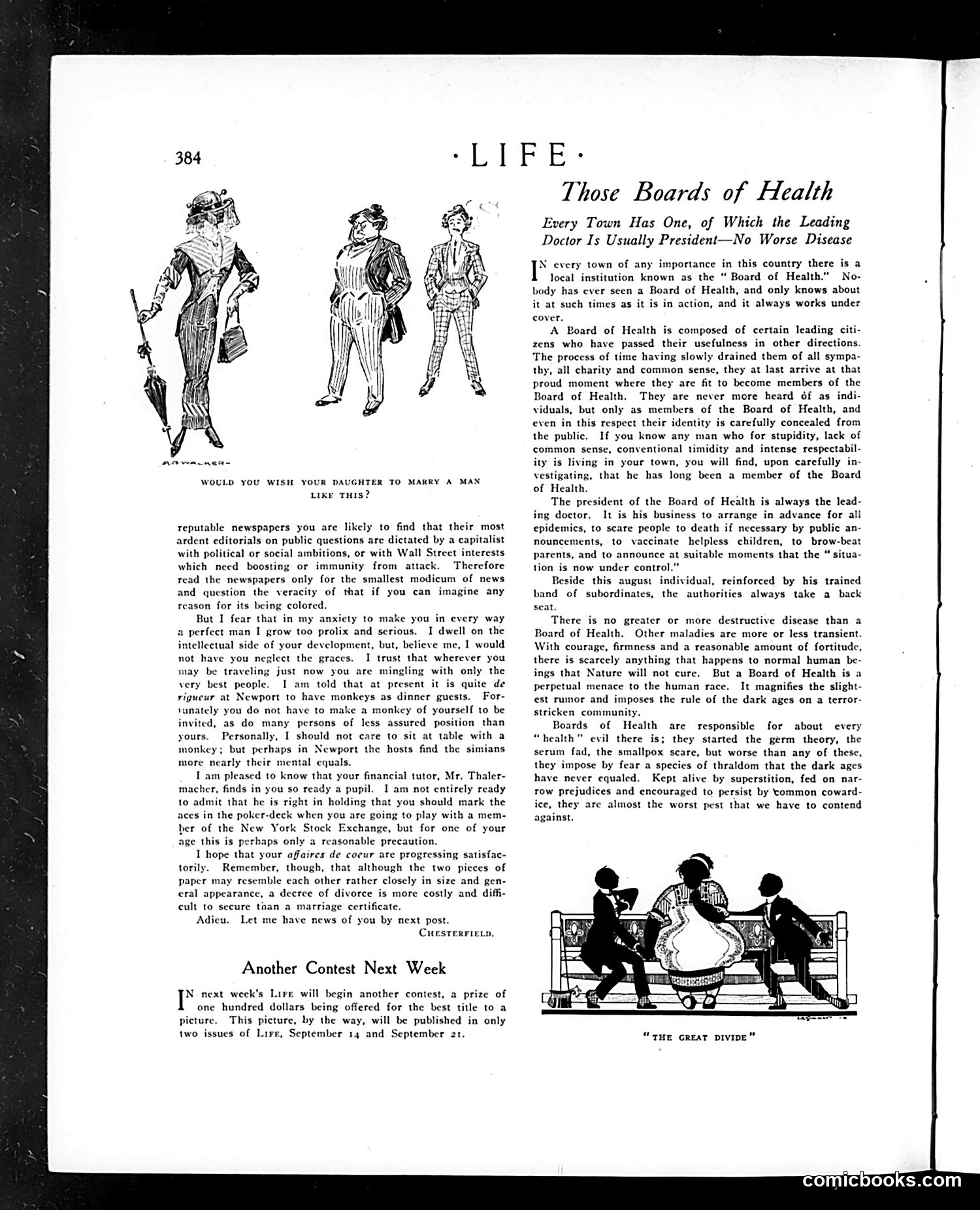
This page satirizes local Boards of Health as ineffectual bureaucracies composed of washed-up, unintelligent citizens. The text argues these boards operate in secrecy, staffed by people "drained of all sympathy, charity and common sense"—essentially society's least useful members. The satire targets the board president (always the leading doctor) for orchestrating public panic about epidemics, coercing vaccinations, and issuing hollow reassurances that "the situation is now under control." The author mocks their theatrical management of public health crises. The three illustrated figures above represent types being critiqued—likely depicting the pompous, disconnected nature of these board members. This reflects early 20th-century skepticism about both medical authority and local government competence, attacking public health institutions as self-serving theater rather than genuine disease prevention.
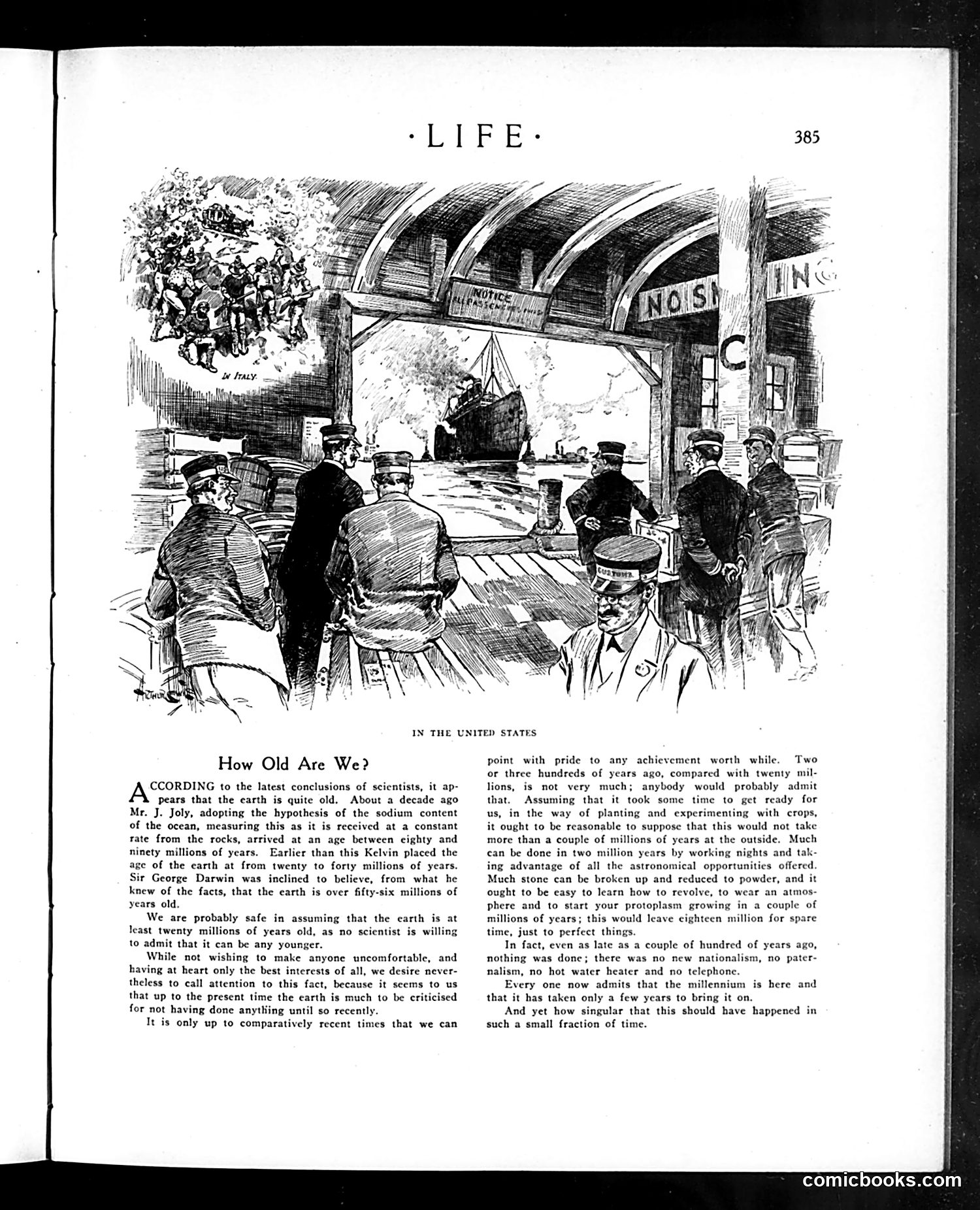
This is a humorous essay satirizing human arrogance about progress. The text discusses scientists' estimates that Earth is 20-90 million years old, then pivots to mock humanity's self-importance: we've accomplished "nothing" for millions of years, yet now (within "a couple of hundred years") we've achieved nationalism, hot water heaters, and telephones—and we're calling this "the millennium." The cartoon depicts a dock or harbor scene with well-dressed men observing ships, likely representing modern commerce and industrial achievement. **The satire's point:** Humans congratulate themselves on recent inventions and progress while ignoring that on geological timescales, our entire civilization is instantaneous and insignificant. The essay's tone is deliberately deadpan, treating humanity's modest modern conveniences as if they were cosmic achievements worthy of Earth's billions-of-years wait. This reflects turn-of-the-century anxieties about technology, progress, and humanity's place in the universe.
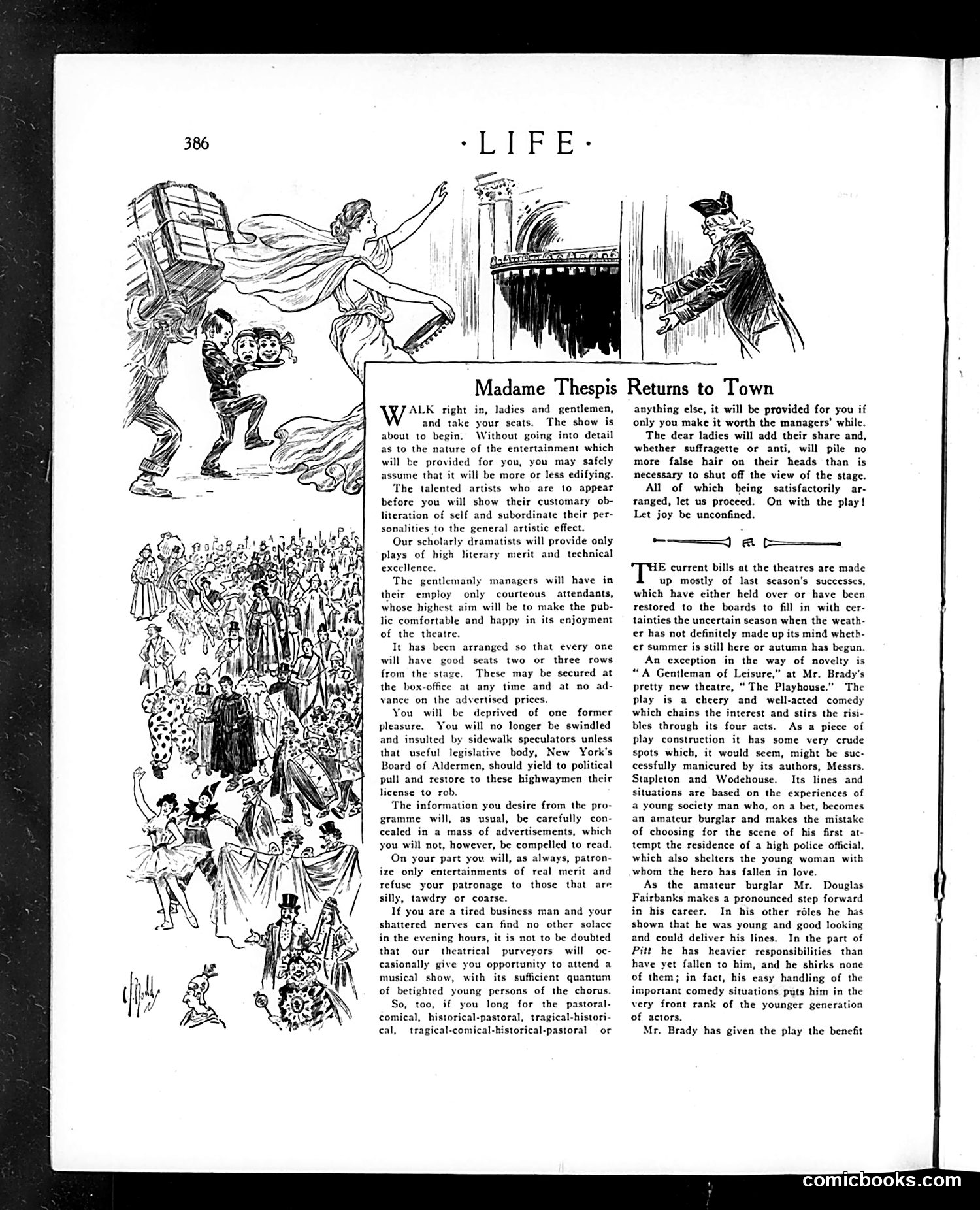
This is satirical commentary on theatrical season reopening, written as mock-earnest promises to theater patrons. "Madame Thespis" references the ancient Greek inventor of theater, personifying the theatrical world itself. The satire mocks standard theater industry practices through ironic "assurances": talented actors will subordinate ego (they notoriously don't), plays will have literary merit (they often don't), managers employ courteous staff (questionable), and audiences won't be cheated by sidewalk ticket scalpers—unless New York's corrupt Board of Aldermen restores their illegal licenses for bribes. The text sarcastically acknowledges theaters will show mostly recycled successes, hide program information in ads, and feature chorus girls with excessive hair additions. The accompanying illustrations show a theatrical barker promoting the show and crowds of audience members, visualizing the carnival-like atmosphere being critiqued. The satire targets both the theatrical industry's dubious practices and audience complicity in perpetuating them.
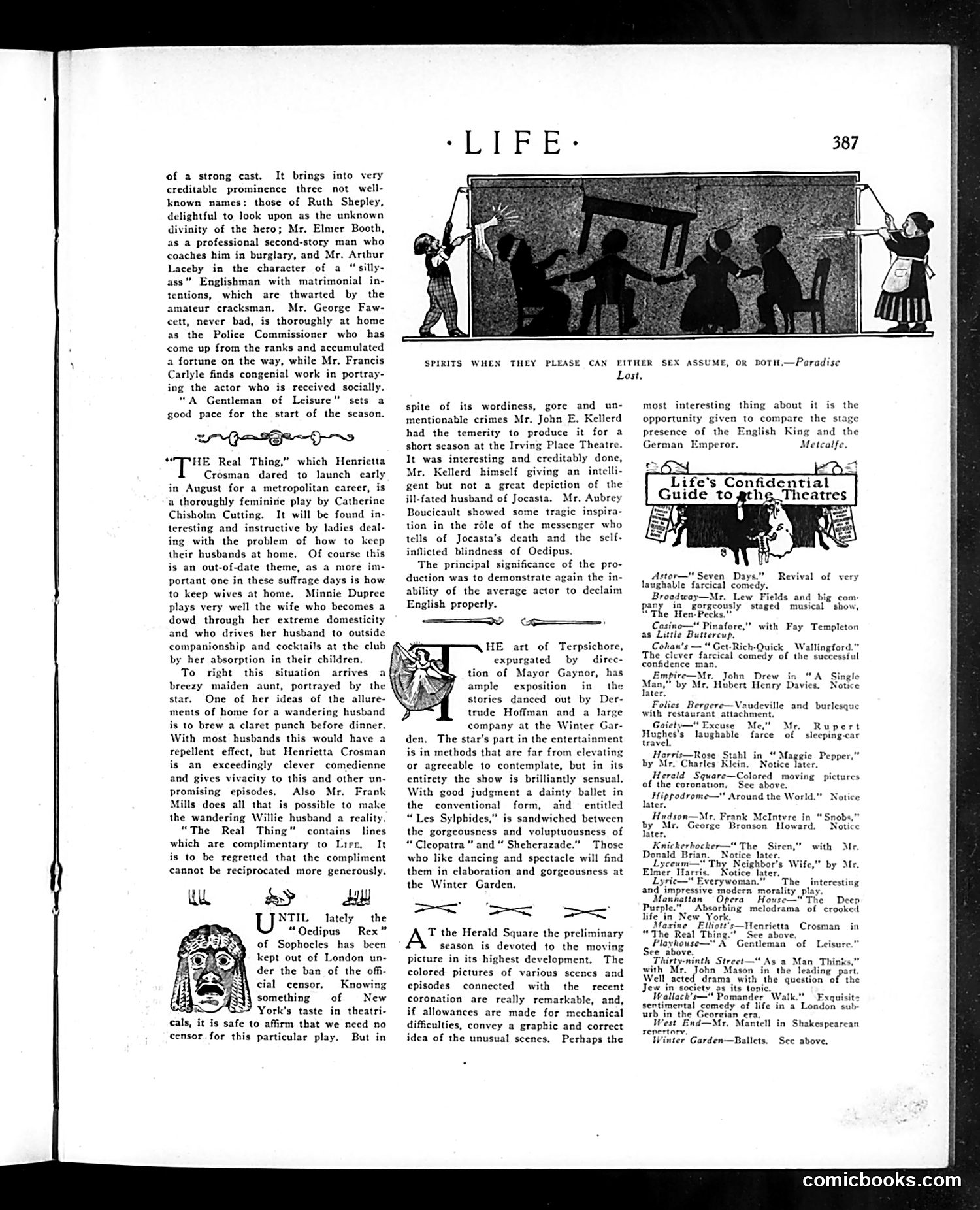
This page reviews several theatrical productions from early 20th-century New York. The main illustration depicts a scene from a play involving what appears to be a bedroom or interior setting with multiple figures. The text discusses productions including: - **"A Gentleman of Leisure"** and **"The Real Thing"** (starring Henrietta Crosman), a comedy about marriage and domestic life - **"Oedipus Rex"** at the Irving Place Theatre, recently unbanned by London censors, which the reviewer finds dramatically valid despite its dark content - A dance production at the Winter Garden by Detrude Hoffman, "expurgated by direction of Mayor Gaynor" — suggesting the mayor had censored or modified the choreography for propriety The page exemplifies Life magazine's role as cultural arbiter, providing theater criticism for educated urban audiences. References to censorship (both London's and Mayor Gaynor's) reflect Progressive Era concerns about theatrical morality. The mention of "suffrage days" places this in the pre-1920 women's voting era.
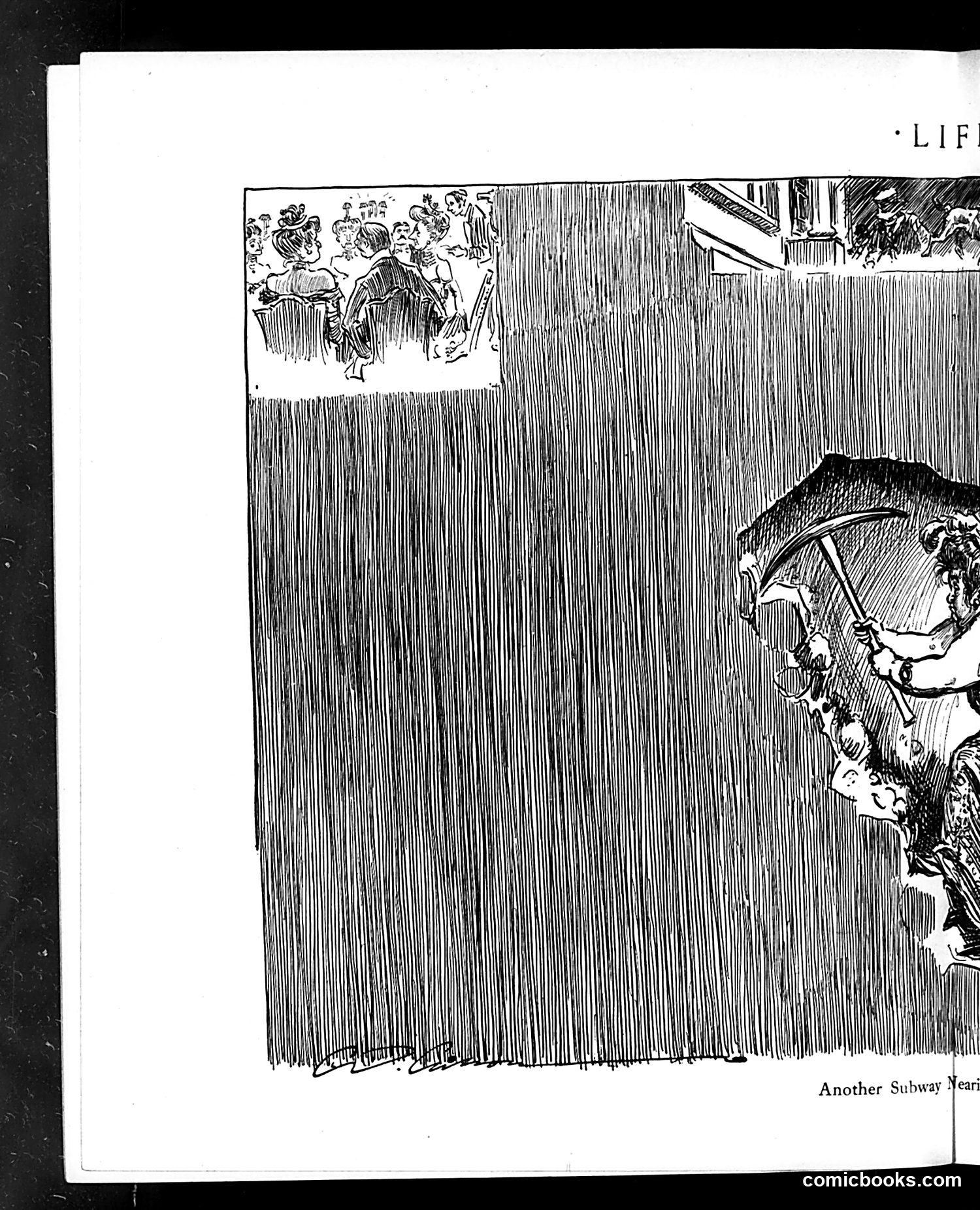
This cartoon satirizes the crowded conditions of early subway systems, likely New York City's. The large central panel depicts an impossibly packed mass of vertical lines representing a throng of commuters squeezed into a subway car—so densely packed they're reduced to abstract hatching. The smaller vignettes in the corners show well-dressed passengers in seemingly more spacious conditions, contrasting sharply with the claustrophobic central image. The title "Another Subway Year" suggests this is an annual commentary on the perpetual overcrowding problem. The satire critiques the subway's inability to accommodate passenger volume comfortably, reducing human experience to dehumanizing compression. This reflects real public frustration with transit infrastructure during the early 20th century.
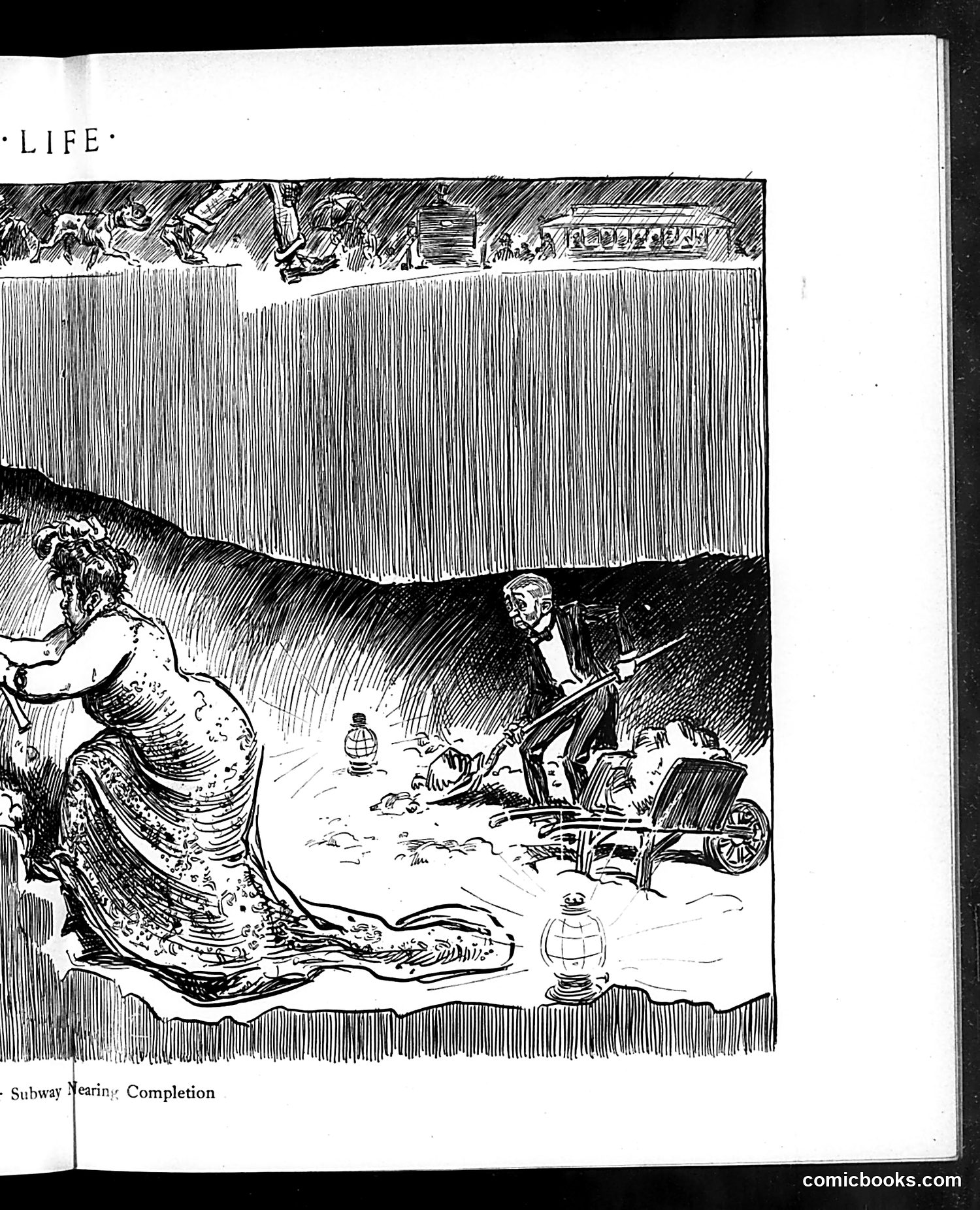
This political cartoon satirizes the construction delays of a subway system. A well-dressed woman in an elaborate dress sits on the beach, gazing longingly upward—apparently dreaming of the completed subway. Meanwhile, a man in formal attire stands nearby with construction equipment scattered about, suggesting ongoing, incomplete work. The satire critiques the gap between public expectation and reality: citizens are desperate for the promised subway's completion, yet construction drags on. The woman's yearning posture and elegant attire suggest this is affecting all social classes. The beach setting implies she's seeking leisure while waiting for infrastructure that remains perpetually "under construction"—a common source of frustration and public complaint in early 20th-century American cities.
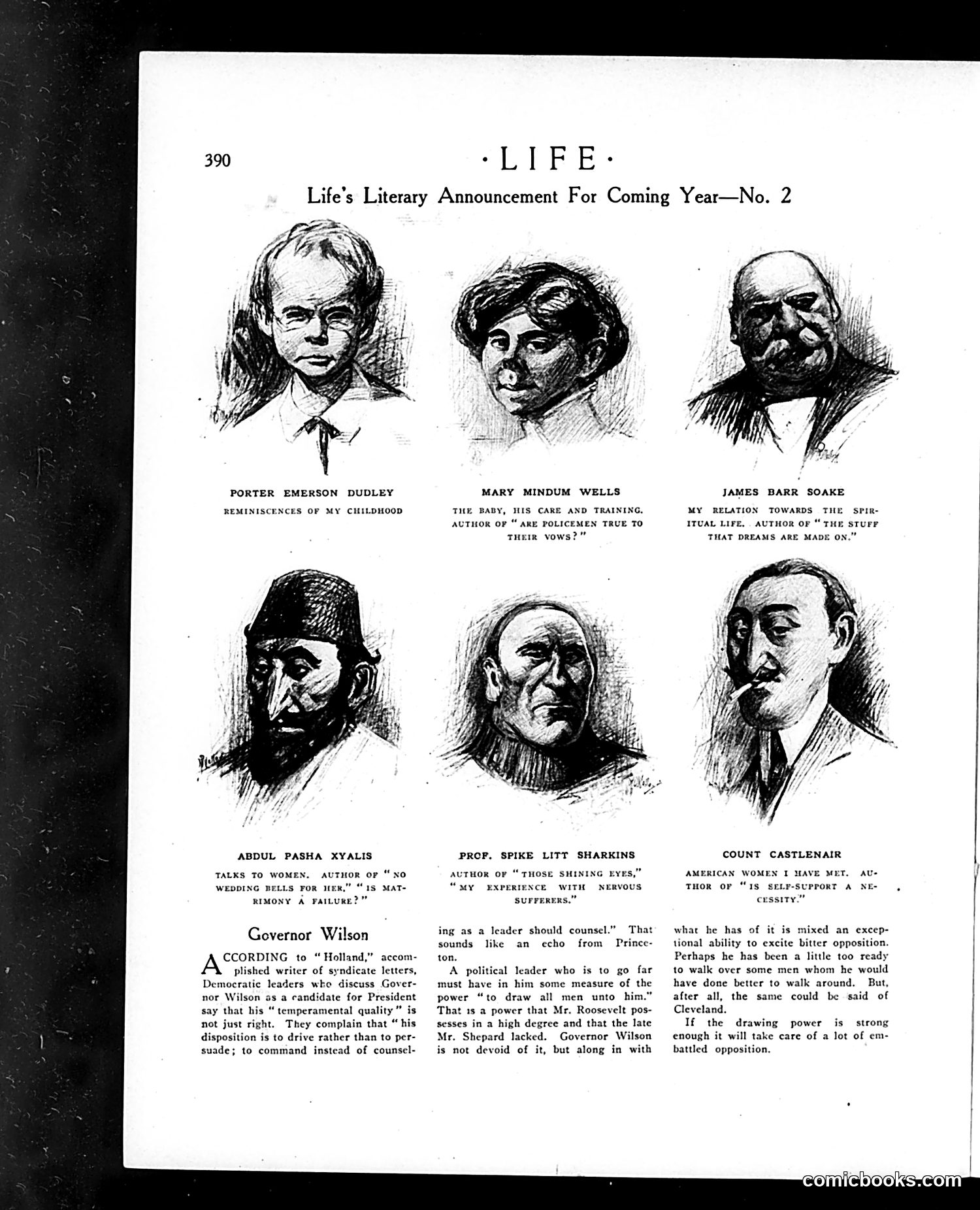
This page presents **satirical fake book announcements** mocking pretentious or absurd literary works. The invented titles ridicule contemporary trends—books on child-rearing, nervous conditions, spiritualism, and women's issues. The crude caricatures (particularly Abdul Pasha Xyalis and Prof. Spike Litt Sharkins) suggest these are parodies of real or imagined self-help and pop-psychology authors. The lower section pivots to serious political commentary on **Governor Woodrow Wilson** as a potential presidential candidate. The critique cites concerns that Wilson's authoritarian leadership style—his tendency to "command instead of counsel"—differs unfavorably from Theodore Roosevelt's personal magnetism. The writer suggests Wilson compensates with drawing power but generates fierce opposition. The Cleveland comparison likely references another divisive Democratic leader. This reflects pre-1912 presidential speculation about Wilson's viability.
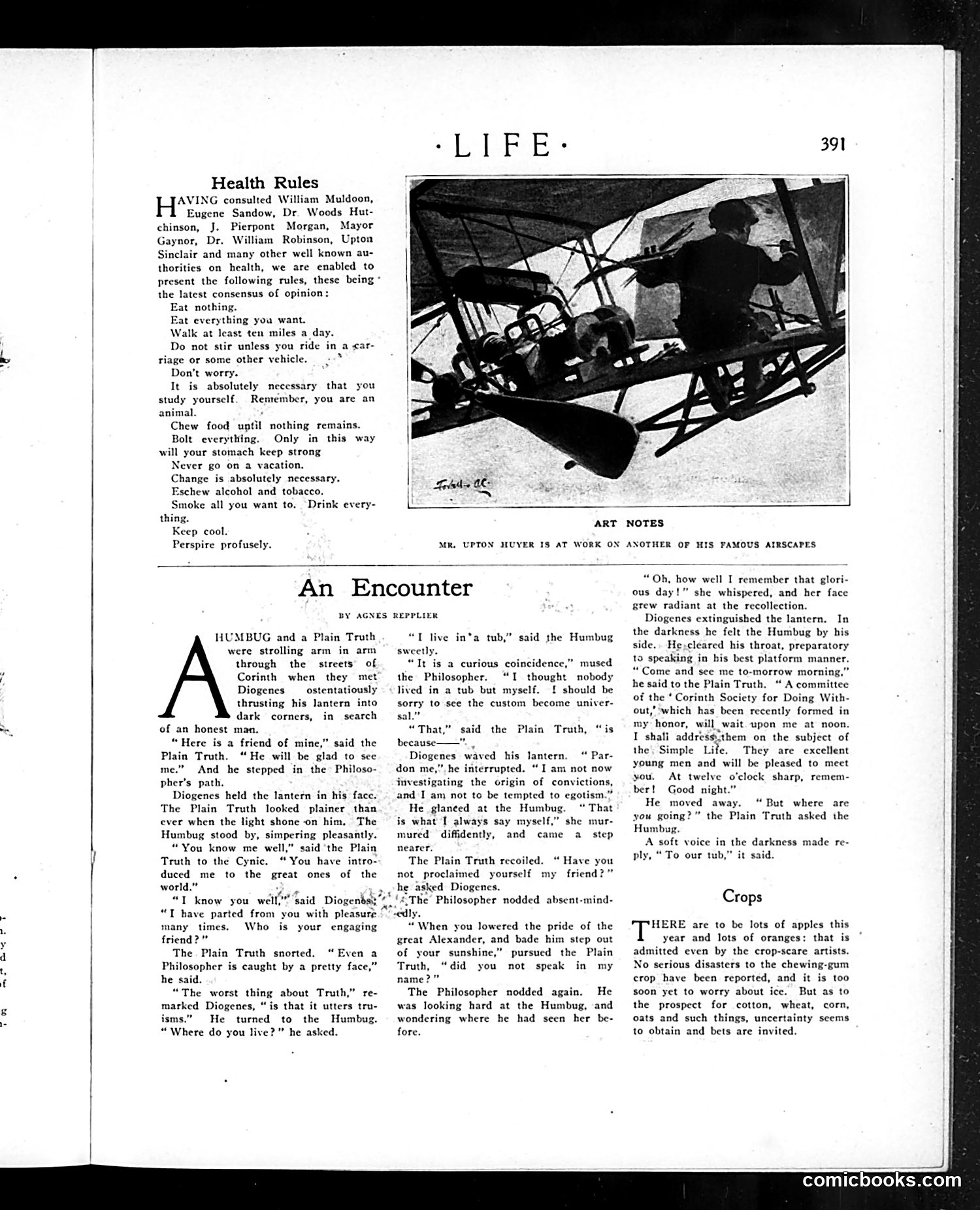
This page contains satirical health advice and a philosophical fable. The **"Health Rules"** section mocks contradictory wellness trends by listing opposite commands (eat nothing/eat everything; never vacation/change is necessary; avoid alcohol/drink everything). This ridicules the era's conflicting health fads and the various famous "authorities" consulted—including muckraker Upton Sinclair and strongman Eugene Sandow—suggesting no real consensus existed. The story **"An Encounter"** by Agnes Repplier uses classical figures: Diogenes (ancient Cynic philosopher famous for living ascetically in a tub and carrying a lantern seeking honest men) meets the **Plain Truth** and the **Humbug**. The fable shows how even a truth-seeker (Diogenes) abandons principle when charmed by flattery and attractiveness. The Humbug seduces him by pretending agreement and proximity, leading him away from the Plain Truth—suggesting hypocrisy corrupts even philosophers. It's social commentary on human weakness and pretense.
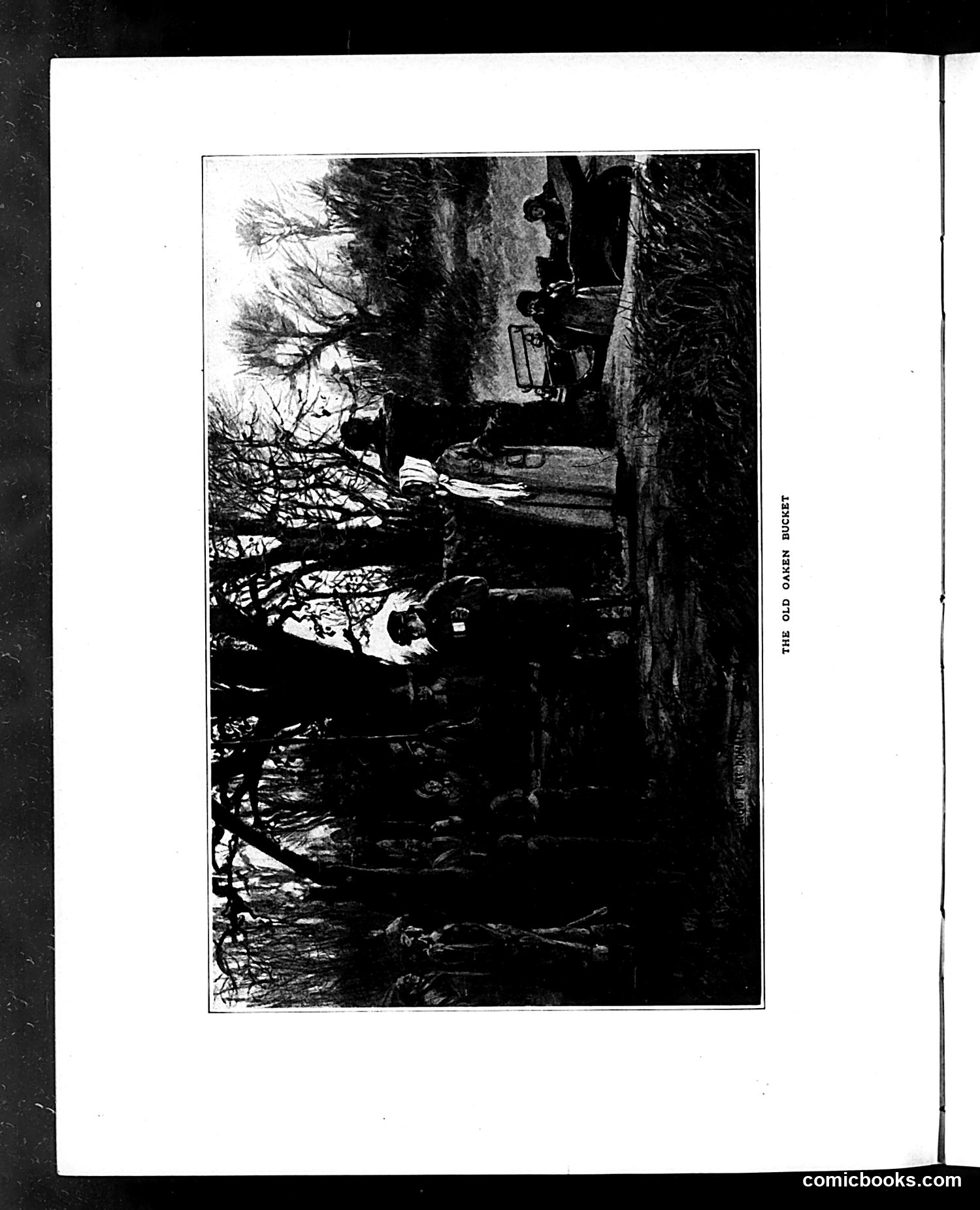
This page features a black and white photograph titled "The Old Oaken Bucket," which appears to be a nostalgic or ironic reference to the famous 19th-century poem celebrating rural, rustic American life. The image shows what appears to be an old wooden structure or bucket in a deteriorated natural setting with bare branches and weathered wood. The caption's reference to "the old oaken bucket" likely invokes the sentimental poem to contrast with the actual decrepit condition shown in the photograph—suggesting satire of romanticized rural imagery versus harsh reality. Without additional context from the full magazine page, the specific political or social commentary remains unclear, though it appears to critique idealized notions of American pastoral life.
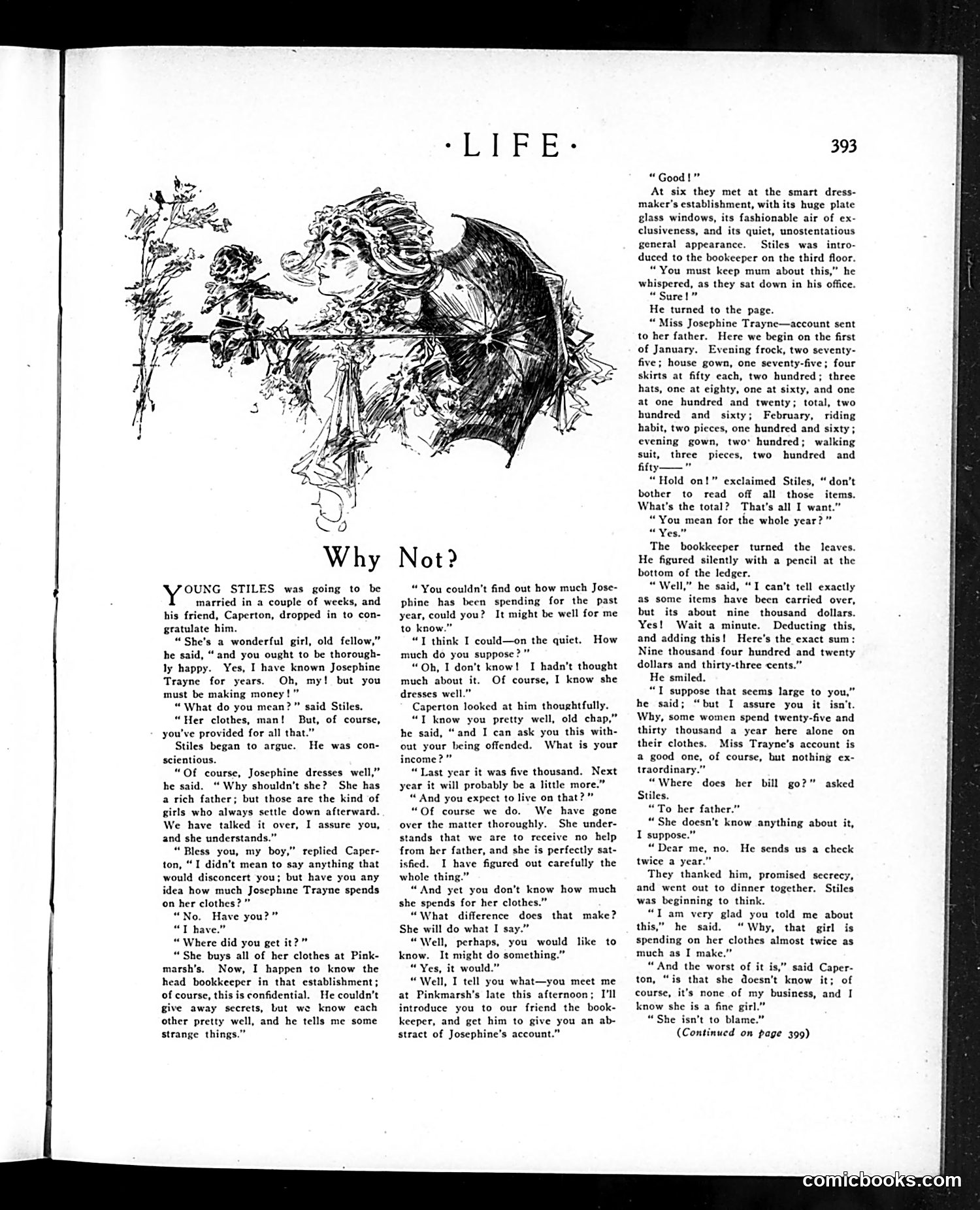
This story-cartoon satirizes the naïveté of young engaged men regarding women's spending habits. Young Stiles is about to marry Josephine Trayne, believing he understands her modest lifestyle despite her wealthy background. His friend Caperton suggests otherwise, revealing through a dressmaker's bookkeeper that Josephine has spent approximately nine thousand dollars annually on clothes alone—nearly double Stiles's five-thousand-dollar income. The satire targets the disconnect between male assumptions about female financial responsibility and the reality of upper-class women's fashion expenses. Stiles believed his fiancée would "settle down," but the account books expose his delusion. The joke exposes both masculine overconfidence and the genuine expense of fashionable dress for society women of the era, suggesting marriage will involve financial surprises he hasn't anticipated.
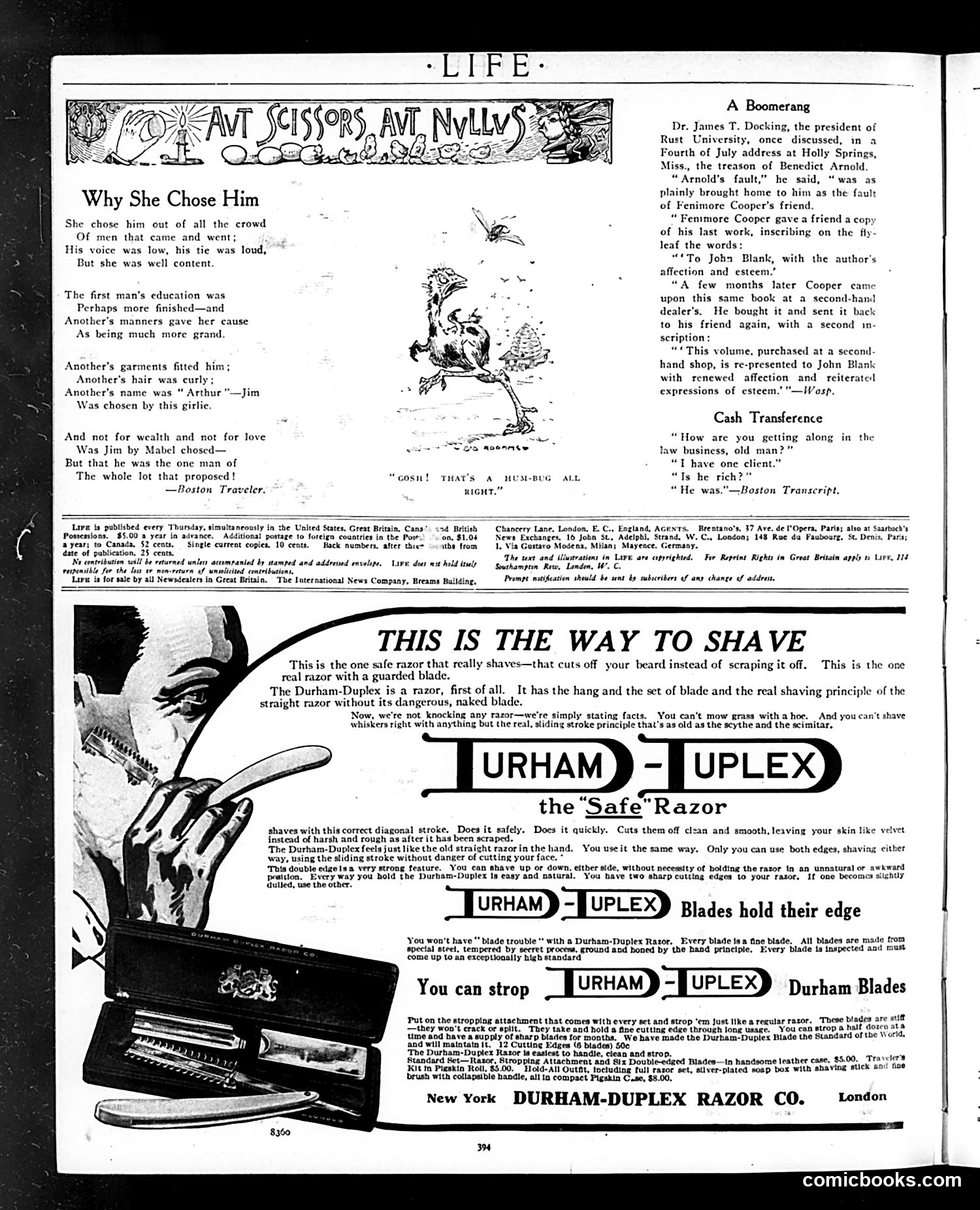
This Life magazine page contains three unrelated items: **"Why She Chose Him"** (upper left): A humorous poem about a woman named Mabel choosing Jim as a husband—not for his education, wealth, or appearance (which were inferior to other suitors), but simply because he was "the one man of the whole lot that proposed." The satire mocks both romantic idealization and practical female pragmatism. **"A Boomerang"** (upper right): An anecdote about Fenimore Cooper giving a friend a book with an inscription of affection, then later purchasing that same used book and returning it with a sarcastic inscription ("renewed affection and reiterated expressions of esteem"). The satire targets false sentiment—the gift's hollowness is exposed when Cooper treats his inscription cynically. **"Cash Transference"** (brief joke): A lawyer boasts of having one wealthy client, which turns out to be a humorous misunderstanding. The page's dominant content is **a Durham-Duplex razor advertisement** (lower half), which is not satirical—it's straightforward product marketing emphasizing safety features and shaving effectiveness.
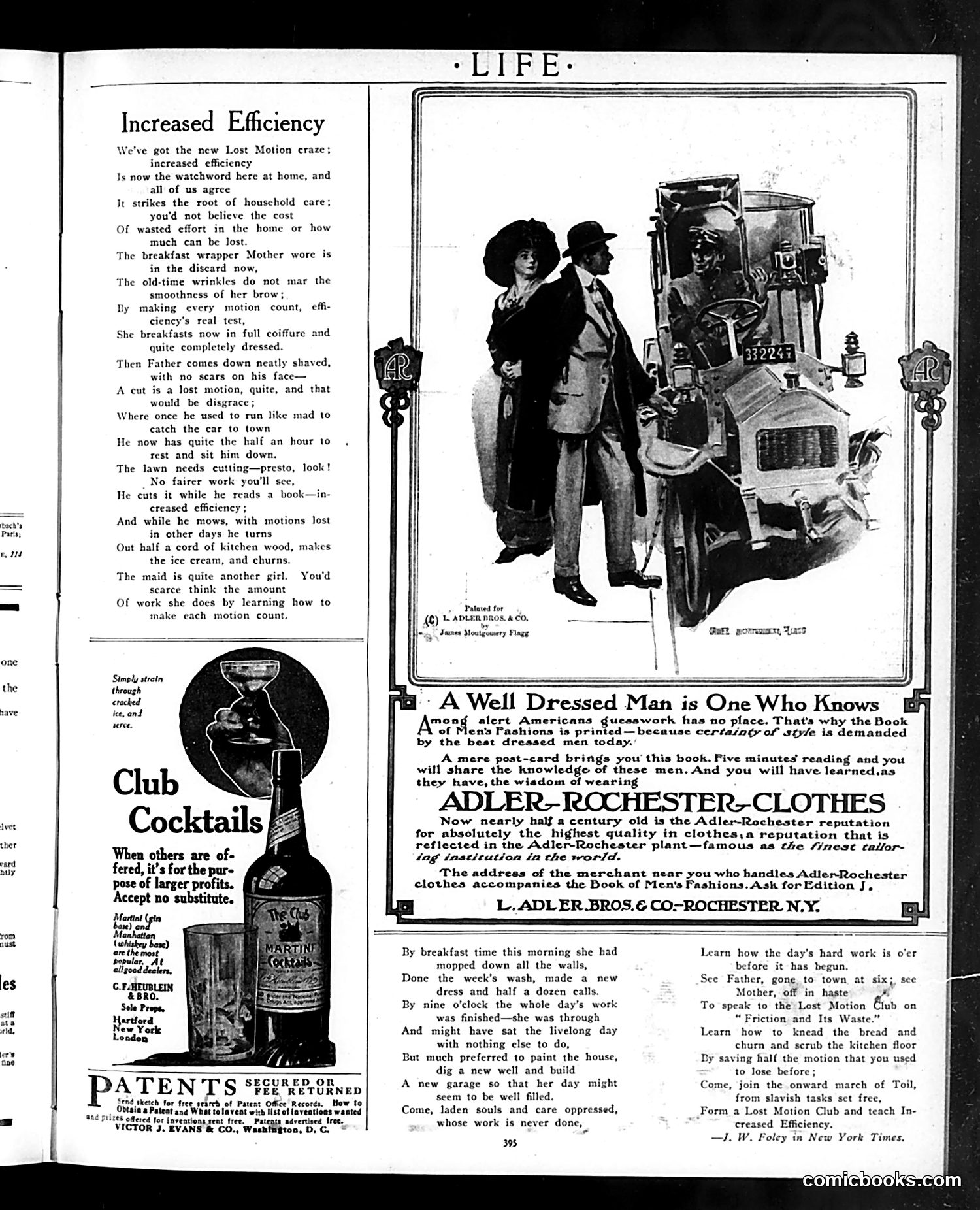
This is satire on the "Lost Motion" efficiency craze—likely referring to the Scientific Management/Taylorism movement popular in early 20th-century America. The poem mocks how families embrace this productivity obsession. The joke: by adopting "increased efficiency," ordinary people supposedly accomplish superhuman feats. Mother now dresses fully and does her hair before breakfast. Father shaves without cuts (eliminating "wasted" motion). He reads while mowing the lawn. The maid completes a week's work by 9 a.m., then voluntarily paints the house and digs a well because she has nothing else to do. The satire exposes the absurdity of applying industrial efficiency metrics to domestic life—the implication that people should work even harder at home under the guise of "saving motion." The companion advertisement for Adler-Rochester clothes undercuts the poem's message, suggesting that looking well-dressed (the opposite of wasting effort) is actually what matters to refined men.
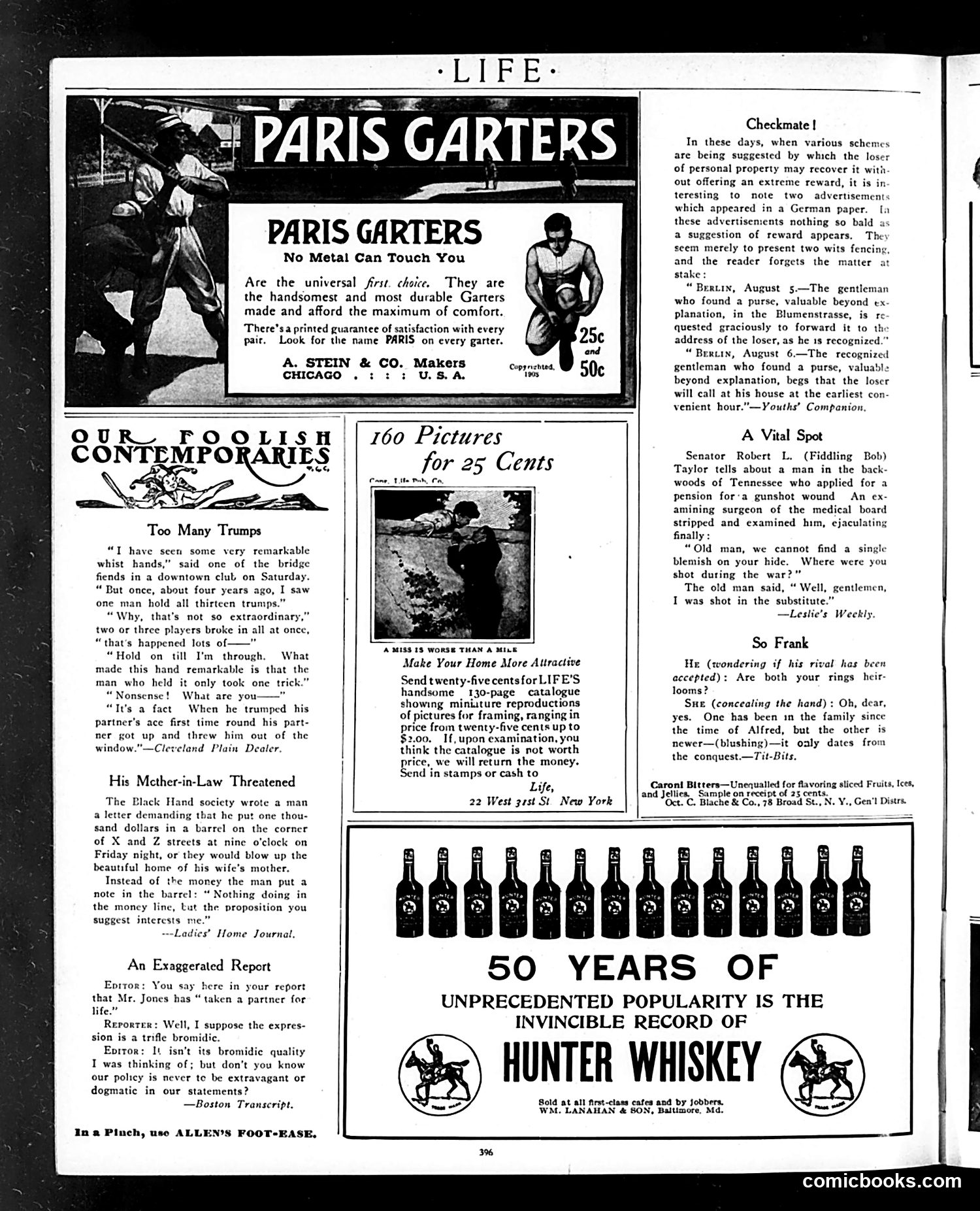
This page from *Life* magazine consists primarily of **advertisements and short humor pieces**, rather than political cartoons requiring historical context. The main content includes: **"Paris Garters"** ad—a standard product advertisement for men's garters. **"Our Foolish Contemporaries"** section—brief humorous anecdotes mocking everyday situations: a bridge player holding all thirteen trumps but losing a hand anyway; a "Black Hand" extortion threat that backfires when the victim shows no interest. **"Checkmate" and other short humor pieces**—witty exchanges published without specific historical figures or political references. The "Checkmate" item describes a clever lost-and-found exchange in a German newspaper where neither party explicitly acknowledges the purse, maintaining dignified fiction. **"Hunter Whiskey" advertisement**—celebrating 50 years of popularity. The humor is **general and timeless**: about card games, confidence schemes, family dynamics, and clever wordplay. No identifiable political figures, events, or caricatures appear. This is primarily a **commercials-heavy magazine page** with light, nonsensical period humor.
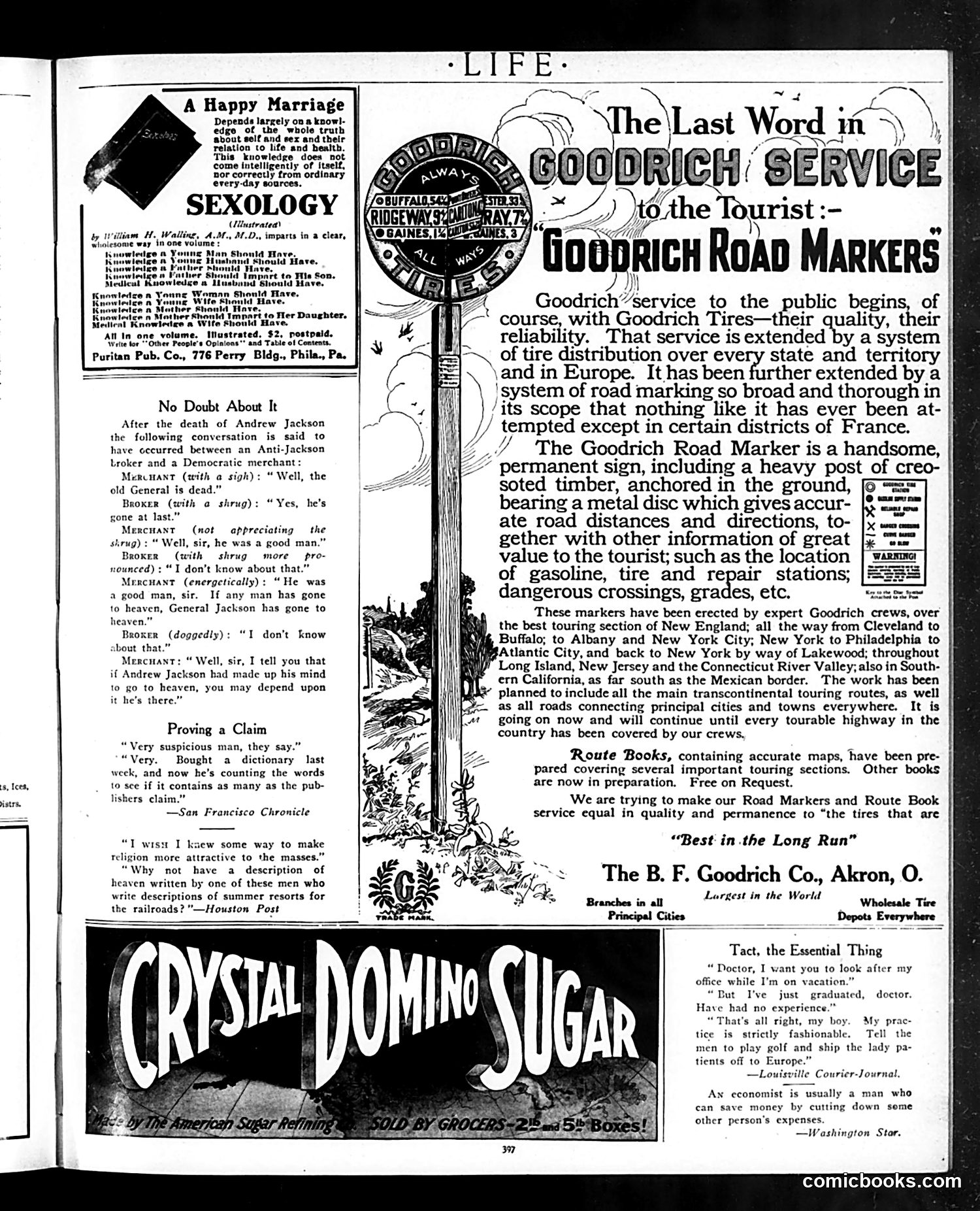
This page mixes editorial content with advertising. The main items are: **"No Doubt About It"**: A humorous anecdote about Andrew Jackson (U.S. president, died 1845). A Democratic merchant and Anti-Jackson broker debate whether Jackson went to heaven. The joke relies on the merchant's certainty that if Jackson *decided* to do something, he'd accomplish it—even reaching heaven—playing on Jackson's reputation for iron-willed determination. **"Goodrich Road Markers"**: A substantial advertisement for B.F. Goodrich tire company, promoting their system of permanent road signs installed across America to help tourists navigate. This reflects early-20th-century automobile tourism infrastructure development. **Minor items**: A "Sexology" book advertisement and brief satirical snippets about suspicious men and making religion attractive. The page is primarily **commercial**, with the Jackson anecdote providing light historical humor based on the president's famous stubbornness.
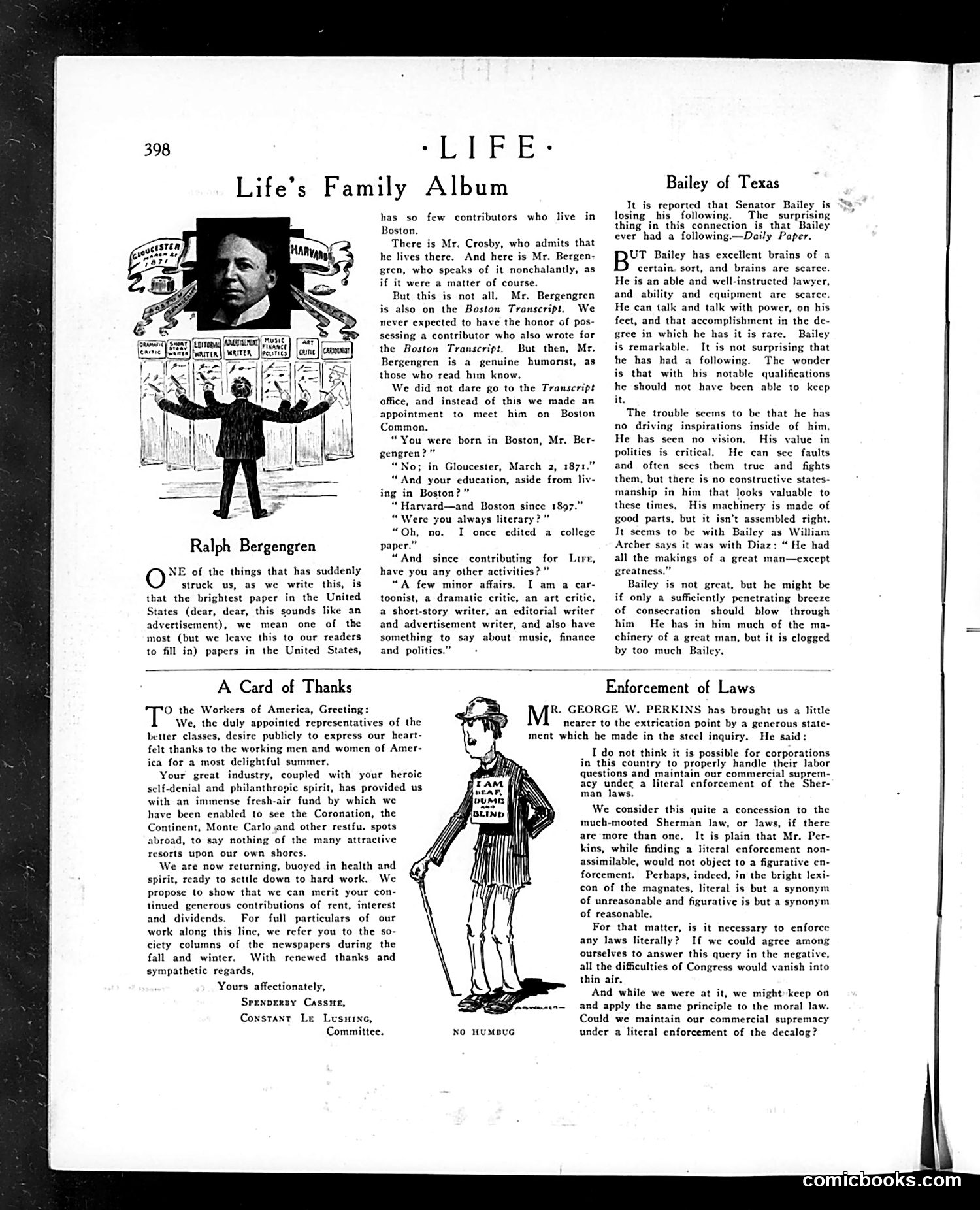
**"Ralph Bergengren" Profile:** This is a biographical feature on a Boston-based humorist and writer. The text presents a mock-serious interview establishing Bergengren as a Harvard-educated, multi-talented contributor to *Life* magazine and the *Boston Transcript*. The humor lies in listing his absurdly numerous roles (cartoonist, critic, dramatist, editorial writer, etc.), satirizing Renaissance-man pretensions. **"Bailey of Texas":** This section discusses Senator Bailey, criticizing him for losing political influence despite intellectual abilities. The satire argues Bailey possesses technical skills (lawyer, orator) but lacks moral vision or inspirational leadership—he's "all machinery" but "clogged by too much Bailey." The critique is that competence without principle produces hollow leadership. **"Enforcement of Laws" cartoon:** The illustration shows a figure labeled "I AM ENFORCING THE LAWS" striking a self-righteous pose—likely satirizing George W. Perkins (mentioned in text) for making patronizing public statements about labor while the wealthy enjoy leisure abroad. The joke exposes hypocrisy: the upper classes present themselves as civic-minded enforcers while exploiting workers.
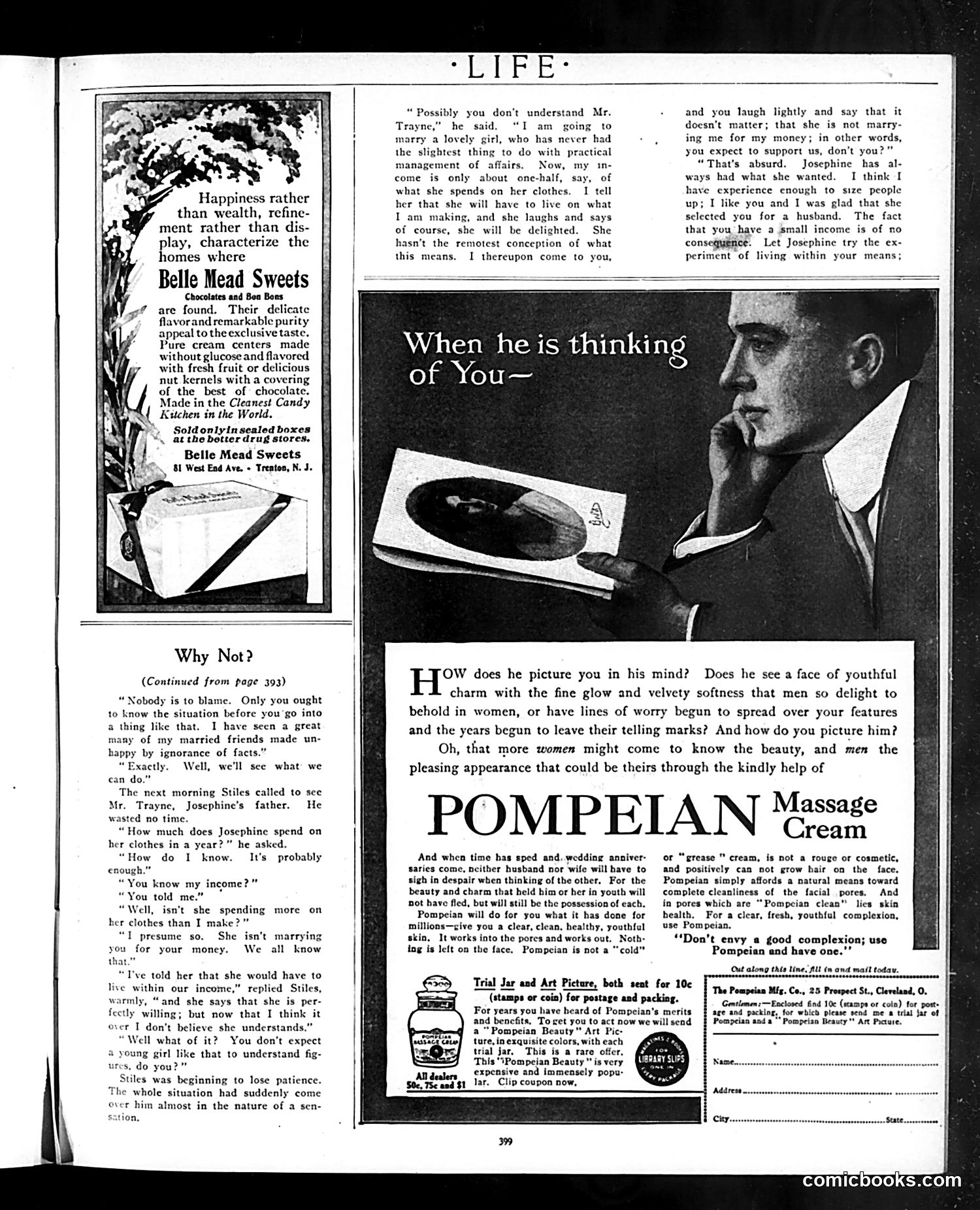
This page contains a serialized short story about premarital financial compatibility. The protagonist Stiles is concerned that his fiancée Josephine spends far more on clothes than his income allows, yet her father (Mr. Trayne) dismisses his worries, insisting she'll adapt and that Stiles shouldn't expect her to understand "figures." **The satire targets**: The era's casual attitude toward women's financial ignorance and spending habits, and fathers' dismissive responses to suitors' legitimate concerns about household budgets. The story presents Stiles as the reasonable party trying to establish realistic expectations, while Trayne embodies the indulgent patriarch who assumes love conquers fiscal reality. The page also includes advertisements (Belle Mead Sweets candy, Pompeian Massage Cream) typical of Life magazine's revenue model. The Pompeian ad uses vanity messaging—urging women to maintain youthful appearance for their husbands—reflecting contemporary gender expectations.
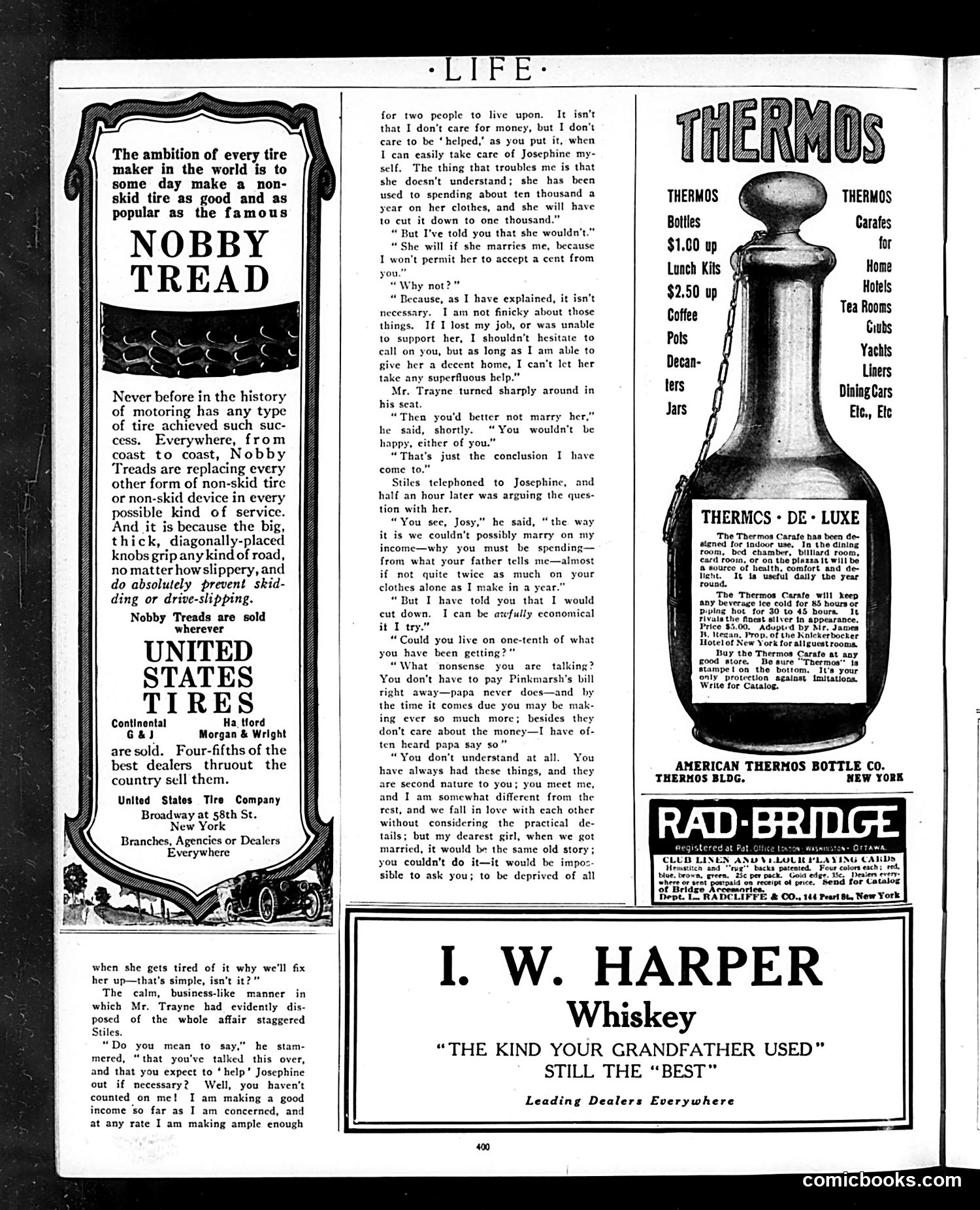
This page primarily contains **serialized fiction** ("The Kind Your Grandfather Used") depicting a class conflict: a young man of modest means (Stiles) loves a wealthy woman (Josephine) but refuses her father's financial support, insisting on independence. The narrative explores early 20th-century tensions around **masculinity, economic disparity, and marriage**. The conflict reflects period anxieties about: - Working-class pride versus wealthy dependency - Women's spending habits as a social marker - Intergenerational wealth and class mobility The **Nobby Tread tire advertisement** (left) uses patriotic language ("coast to coast") to promote American manufacturing superiority—reflecting post-WWI industrial confidence. Surrounding ads (Thermos bottles, I.W. Harper whiskey) target affluent readers—the magazine's demographic—reinforcing that *Life* was aimed at educated, prosperous audiences who would recognize these class dynamics in the serialized story.
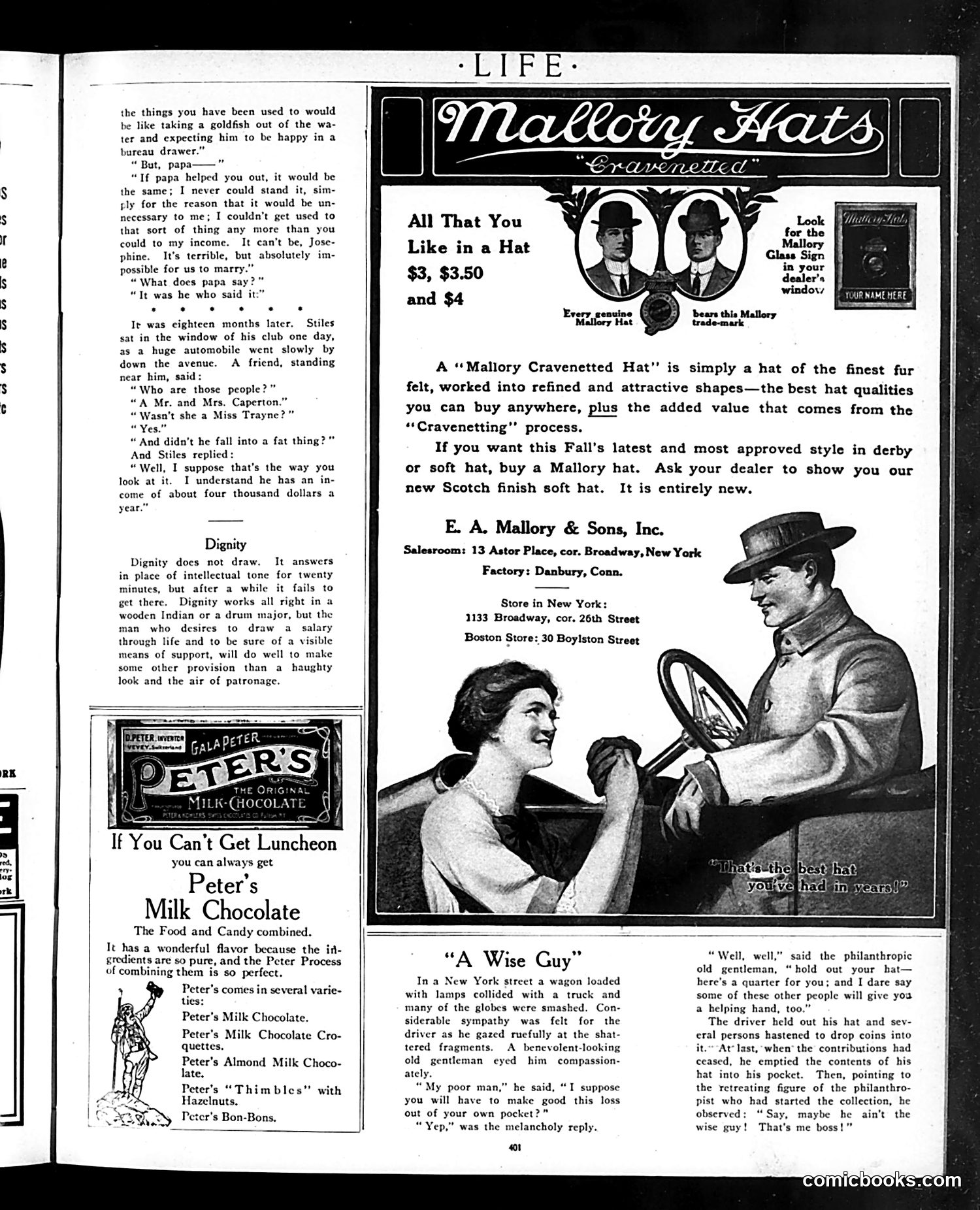
This page contains primarily **advertisements and short humor pieces rather than political cartoons**. The main content includes: 1. **A serialized story excerpt** about a romantic dilemma involving class differences—a wealthy man (Stiles) cannot marry a poor woman because the income disparity would be humiliating. 2. **"Dignity" essay**: A brief satirical piece mocking the idea that dignity alone can sustain a person financially. It argues that drawing a salary requires more than just a "haughty look and air of patronage." 3. **"A Wise Guy" humor piece**: A street anecdote where a truck driver's wagon damages lamps. A well-meaning gentleman collects charitable donations for the driver from passersby, but the driver cynically reveals he's the "wise guy"—implying he profited from the scam. **Product advertisements** for Mallory Hats and Peter's Milk Chocolate dominate the right side. The satirical tone targets **class pretension, false dignity, and con-artist mentality**—common themes in early 20th-century American humor.
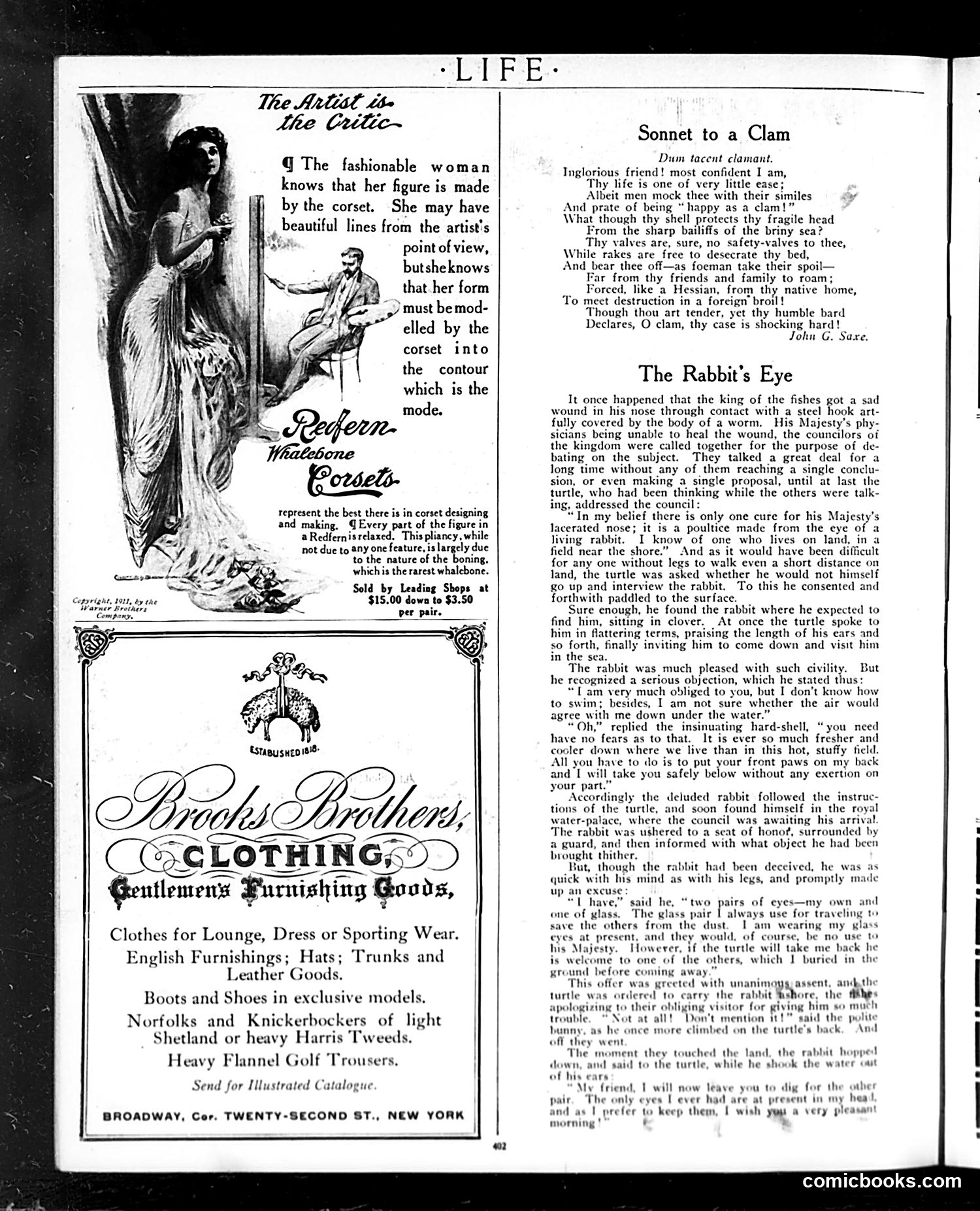
This page mixes advertising with literary content, typical of Life's satirical approach. **The Left Side:** A corset advertisement disguised as social commentary. The text sardonically notes that fashionable women's figures are entirely constructed by corsets—their "beautiful lines" come not from nature but from restrictive garments. The illustration shows a woman being molded into an artificial silhouette. The satire is implicit: Life is mocking both the fashion industry's deception and women's compliance with painful constraints presented as beauty. **The Right Side:** Two poems and a fable. "Sonnet to a Clam" humorously treats shellfish as tragic figures. "The Rabbit's Eye" is a cautionary fable about deception—a turtle tricks a rabbit into visiting underwater by flattering him, likely an allegory about trusting false promises. Both suggest themes of vulnerability and manipulation. The juxtaposition—artificial beauty standards alongside tales of being deceived and harmed—reinforces Life's satirical message about urban society's pretenses and dangers.
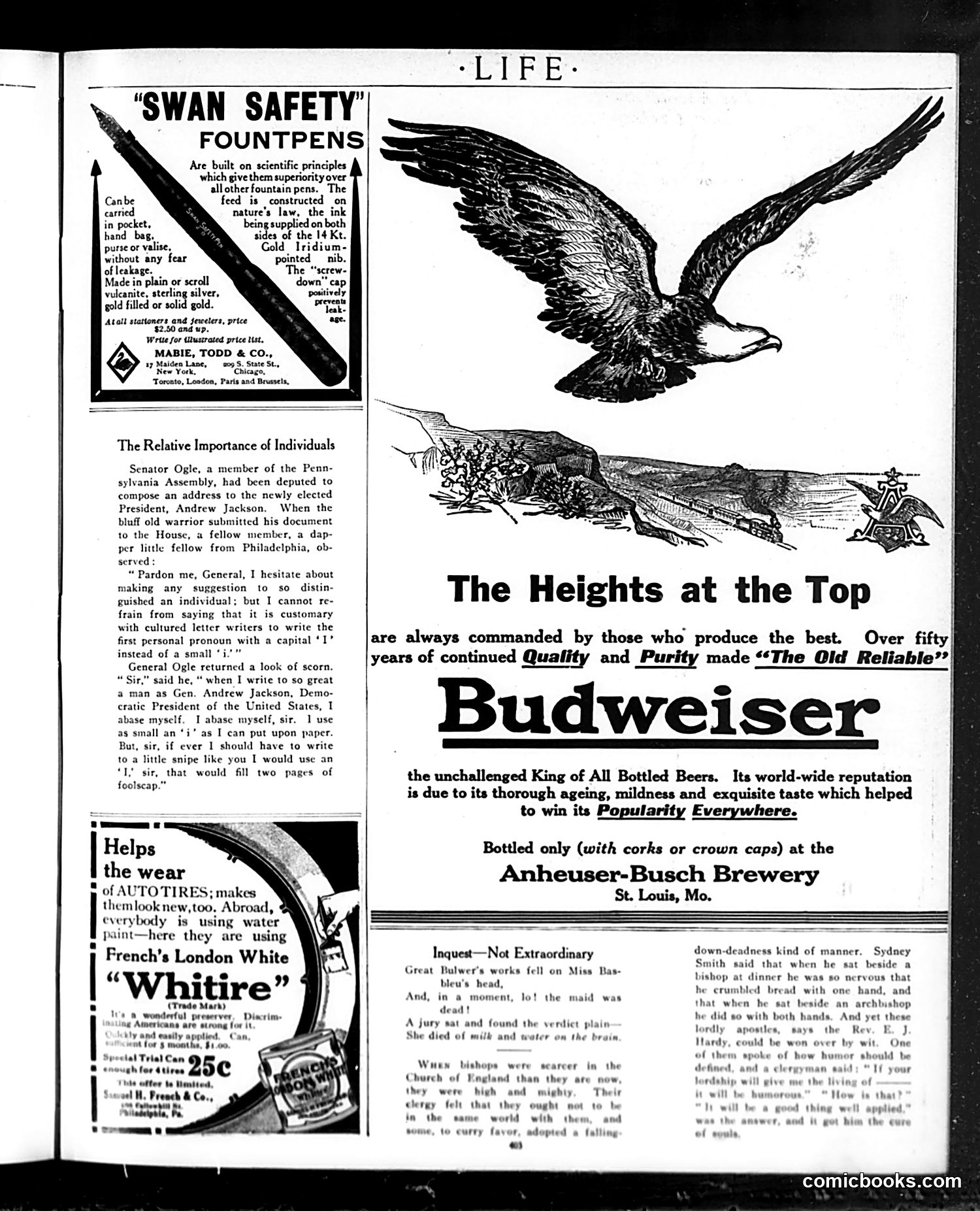
This page contains several distinct pieces of period satire and advertising: **"The Relative Importance of Individuals"** is a anecdote mocking pretension. Senator Ogle criticizes a fellow legislator for using lowercase "i" in a letter to President Andrew Jackson, suggesting proper grammar demands capitals. Ogle responds that he deliberately uses small letters to show humility before such a great man—but would use enormous letters when writing to this "little snipe," inverting social hierarchy through typography. The joke satirizes both excessive deference to authority and the pomposity of grammatical pedantry. **The remaining content** consists primarily of period advertisements (Swan Safety Fountain Pens, French's Whitire auto tire paint, Budweiser beer) and a brief anecdote about bishops' nervousness around literature. The page reflects early-20th-century American satirical humor emphasizing social class distinctions, pretension, and the relative importance of individuals in society.
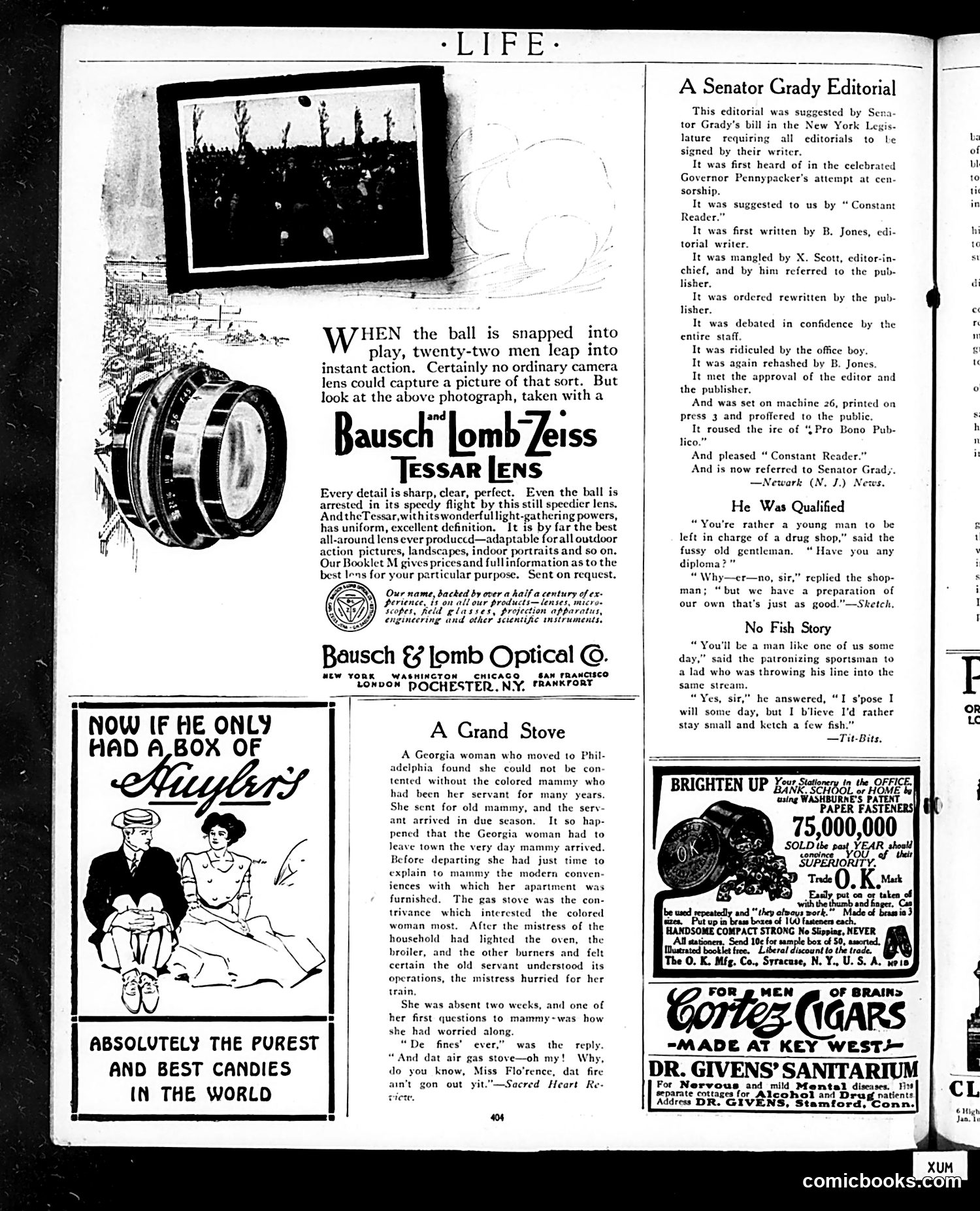
This page contains three distinct humor pieces from an early 20th-century American satirical magazine: **"A Grand Stove"** satirizes the presumed simplicity of enslaved and formerly enslaved Black servants. The "joke" hinges on a caricatured servant's alleged inability to understand modern appliances—she leaves a gas stove burning continuously during the owner's two-week absence, apparently unable to turn it off. This reflects racist stereotypes common to the period. **"A Senator Grady Editorial"** mocks a proposed law requiring signed newspaper editorials by tracing an article's chaotic journey through editorial hands—writer, editor-in-chief, publisher, staff debate, office boy ridicule—suggesting the editorial becomes distorted and unattributable by publication. It satirizes institutional muddling of responsibility. **The Ayers candy advertisement** (bottom left) simply promotes confections as an appealing gift alongside the humor pieces. The page also features a Bausch & Lomb camera lens advertisement with a dramatic football photograph, showcasing technological capability.
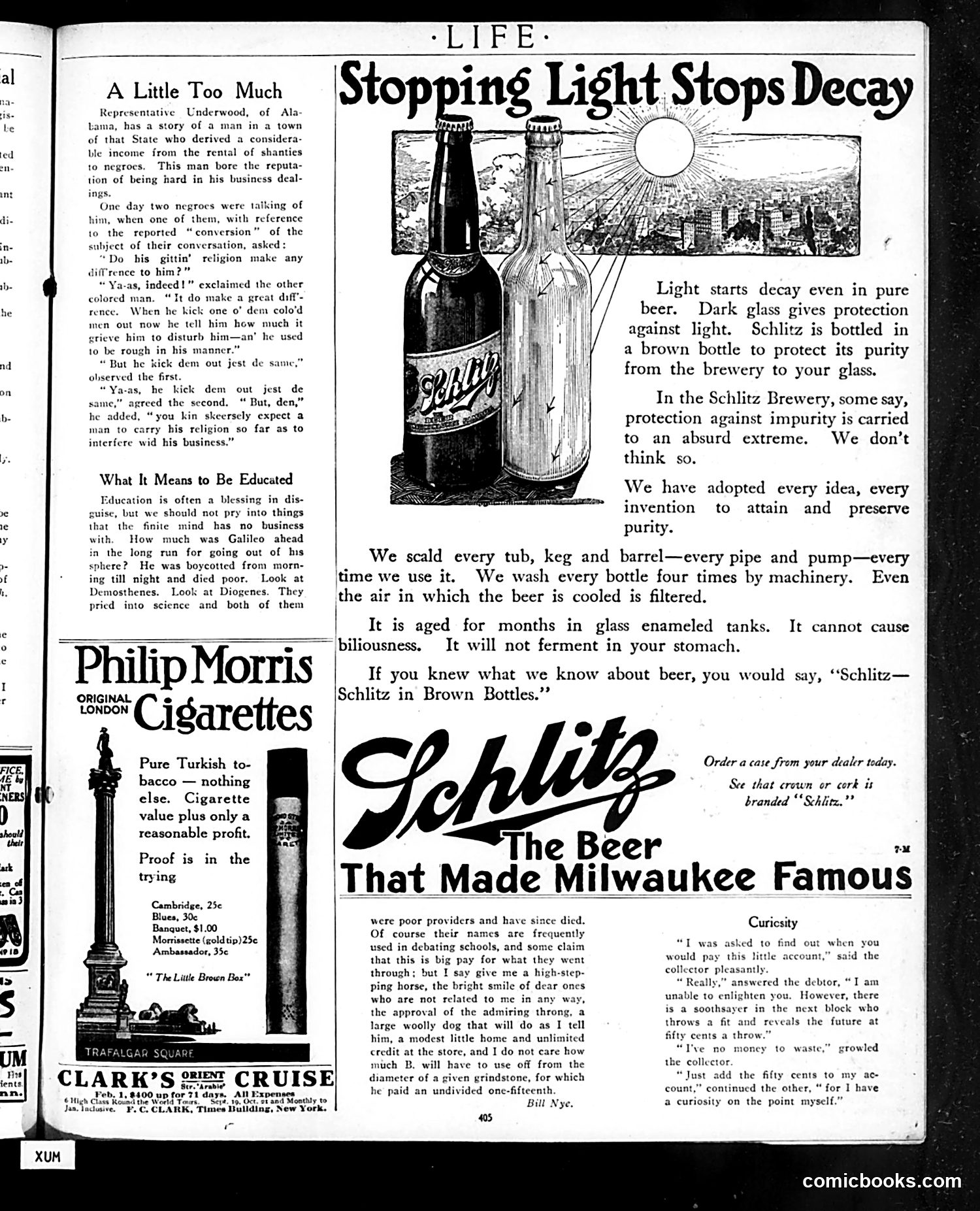
This page contains three unrelated pieces typical of *Life* magazine's satirical format: **"A Little Too Much"** presents a racist anecdote about an Alabama man who becomes religious but continues exploiting Black tenants with the same harshness—only now offering hypocritical apologies. The "joke" relies on period stereotypes of Black dialect and the satire of performative religious conversion masking unchanged cruelty. **"What It Means to Be Educated"** is a brief philosophical piece mocking impractical intellectualism by referencing historical figures (Galileo, Demosthenes, Diogenes) who suffered for their ideas. The remaining content is **advertising**: Philip Morris cigarettes, a Schlitz beer advertisement (emphasizing brown bottles protect purity), and a cruise line ad. The Schlitz ad dominates the page, making this essentially a sponsored publication. The page reflects early 20th-century editorial standards: casual racism, classical references assuming educated readership, and heavy advertising integration into editorial content.
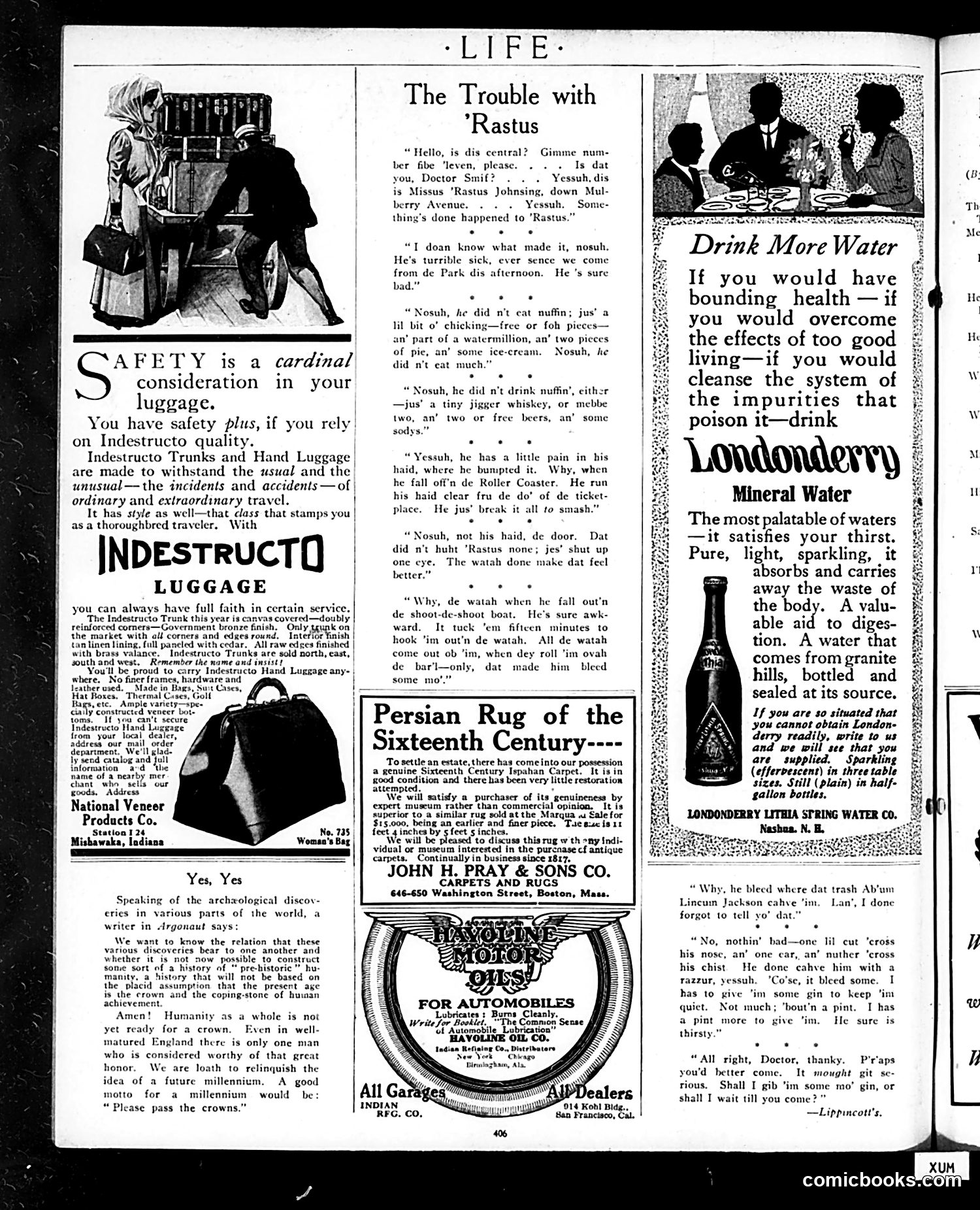
This page contains three main elements: **"The Trouble with 'Rastus"** (center): A racist dialect humor piece depicting a Black woman ("Missus 'Rastus Johnsing") calling a doctor about her sick husband. The "joke" relies on offensive stereotypes—phonetic dialect speech, casual consumption of alcohol and fried food, and physical clumsiness (injuries from amusement park rides). This reflects early-20th-century entertainment that mocked Black Americans through caricature and exaggerated speech patterns. **Advertisements** (left and right): Standard period ads for luggage, mineral water, and Persian rugs—relatively straightforward commercial content. **"Yes, Yes"** (lower left): A brief essay fragment about archaeological discoveries and human history—unrelated to the humor above. The racist cartoon represents attitudes normalized in mainstream American magazines of this era, reflecting deeply embedded prejudices in popular entertainment and publishing.
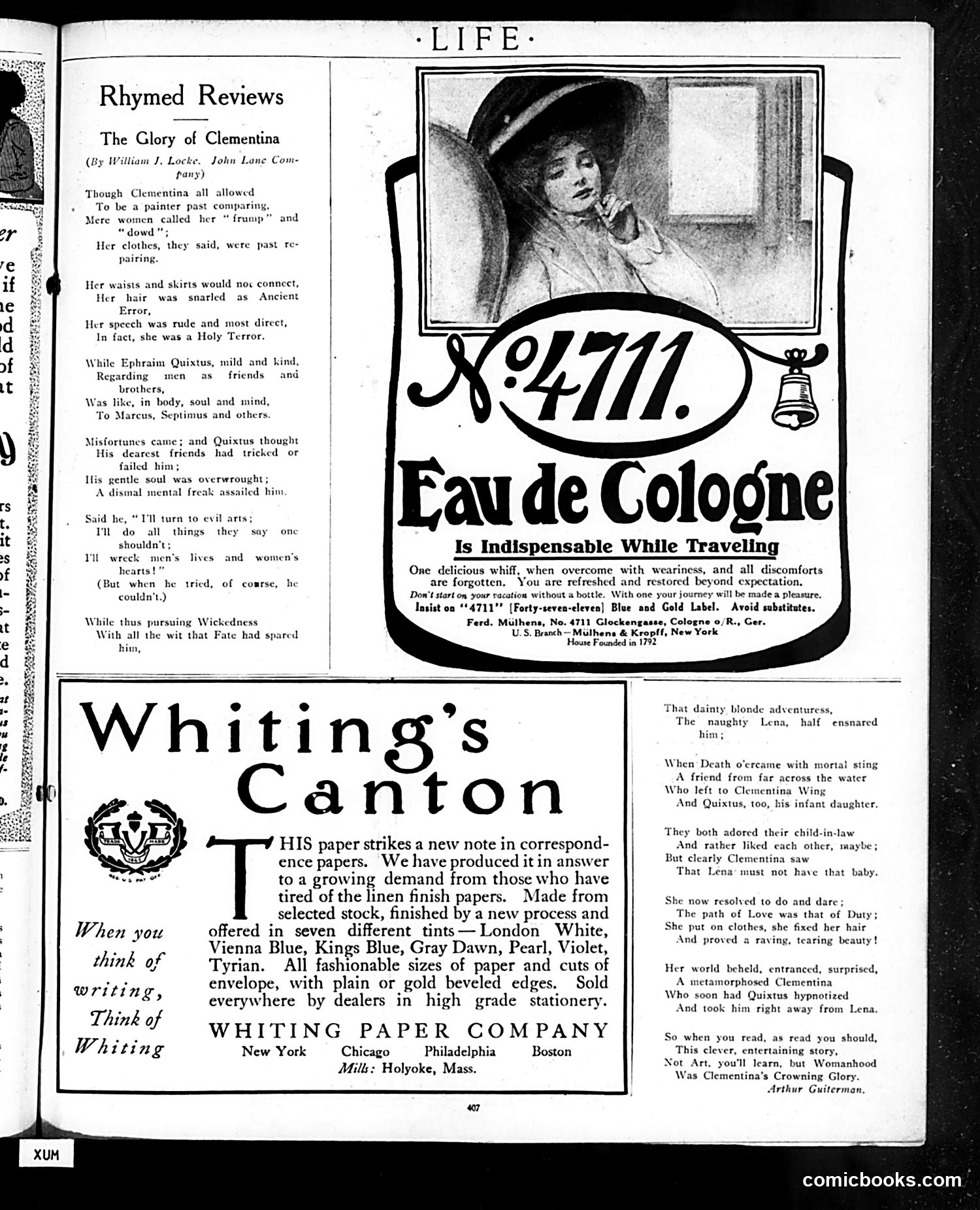
This is a book review in verse form, summarizing William J. Locke's novel about transformation and social redemption. The poem tells of Clementina, an unfeminine, socially awkward woman ("frump," unkempt, rude), and Ephraim Quixtus, a gentle man betrayed by friends who turns to wickedness. When a mutual child comes into their care, Clementina transforms herself—fixing her appearance and adopting feminine refinement—to win Quixtus away from the temptress "Lena." The satire's point, made explicit in the final lines: Clementina's "Crowning Glory" is not her artistic talent (mentioned first) but rather her **womanhood achieved through romantic self-improvement**. The reviewer Arthur Guiterman mocks the novel's apparent message that a woman's highest achievement lies in personal reformation for a man's sake, not in her own accomplishments. This reflects early 20th-century tensions around women's roles and agency.
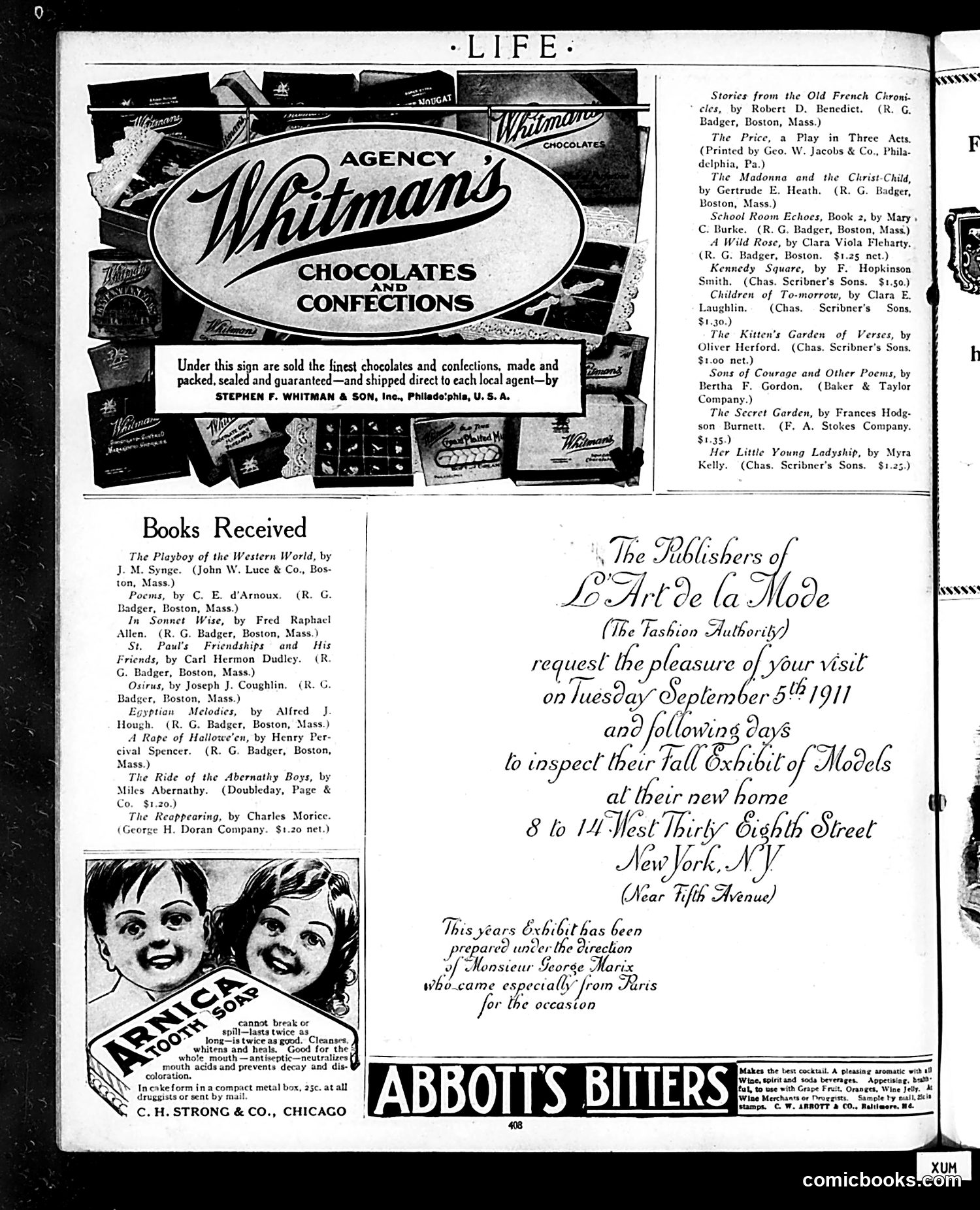
This page is primarily **advertising and book announcements**, not political satire. The dominant content includes: **Whitman's Chocolates advertisement** (top): A standard commercial ad emphasizing quality packaging and direct shipping to local agents—typical early 1900s marketing. **Books Received section**: A literary listing of newly published works, mostly from small Boston publishers (R.G. Badger), including plays, poetry, and novels. **L'Art de la Mode invitation** (center-right): A formal announcement inviting readers to a fall fashion exhibition opening September 5, 1911, at a New York showroom, featuring designs curated by a Parisian director. **Patent medicine ads** (bottom): Arnica toothpaste and Abbott's Bitters—typical period advertisements making health claims now considered dubious. The page reflects early 20th-century magazine content: literary culture, commercial advertising, and social events for affluent readers.
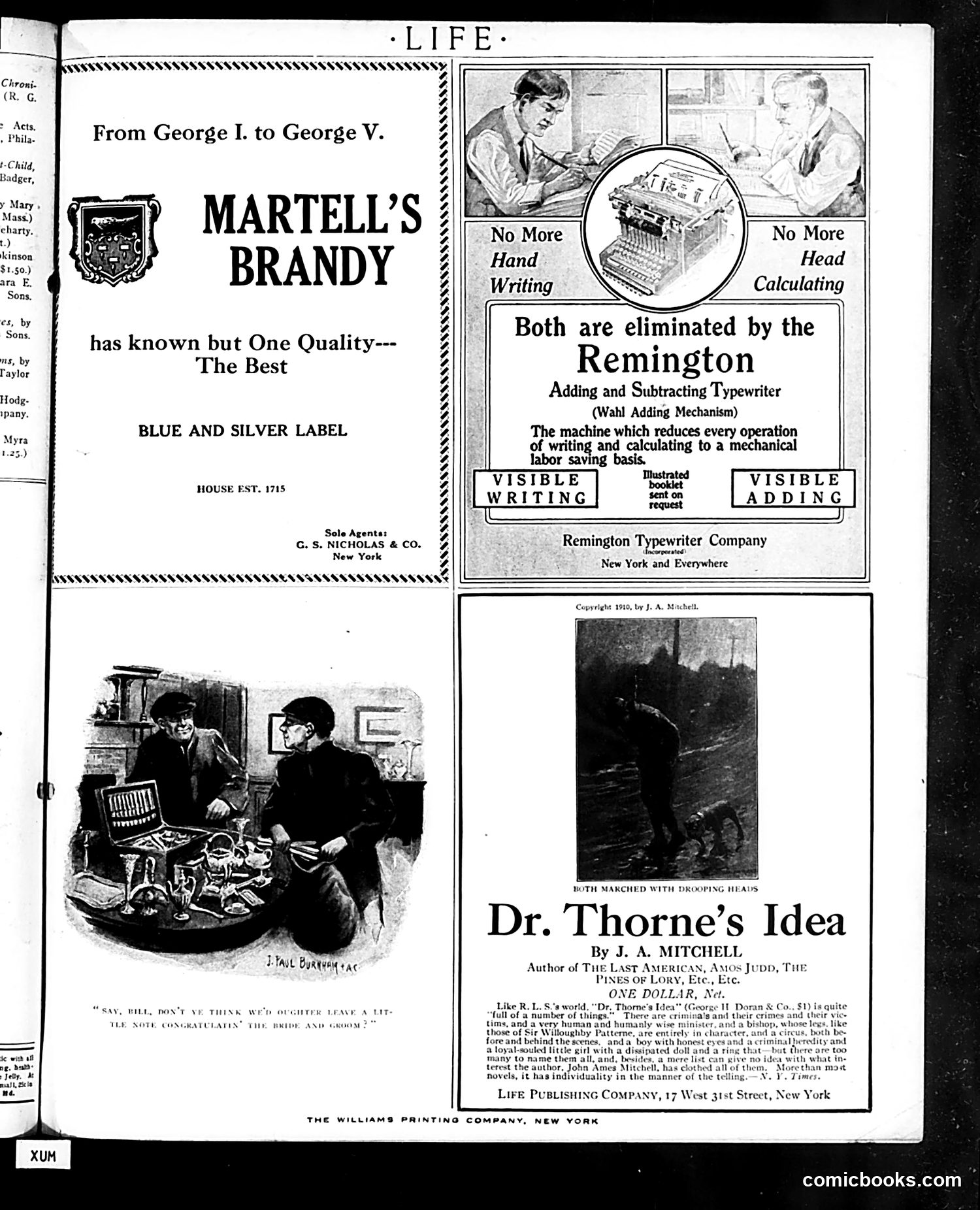
This page contains primarily **advertising** rather than political satire. The left side advertises **Martell's Brandy** (established 1715), emphasizing its single consistent quality across centuries—a straightforward luxury product pitch. The top right advertises the **Remington Adding and Subtracting Typewriter**, showing two men whose "hand writing" and "head calculating" tasks are "eliminated" by mechanization. This reflects early-20th-century optimism about labor-saving technology. The bottom section announces **"Dr. Thorne's Idea,"** a serialized story by J.A. Mitchell (Life's editor) about criminals and detection. The illustration shows two figures "marched with drooping heads"—likely criminals or suspects being escorted. The page represents typical Life magazine content: commercial advertising mixed with fiction serialization, with no evident political commentary or satire visible.
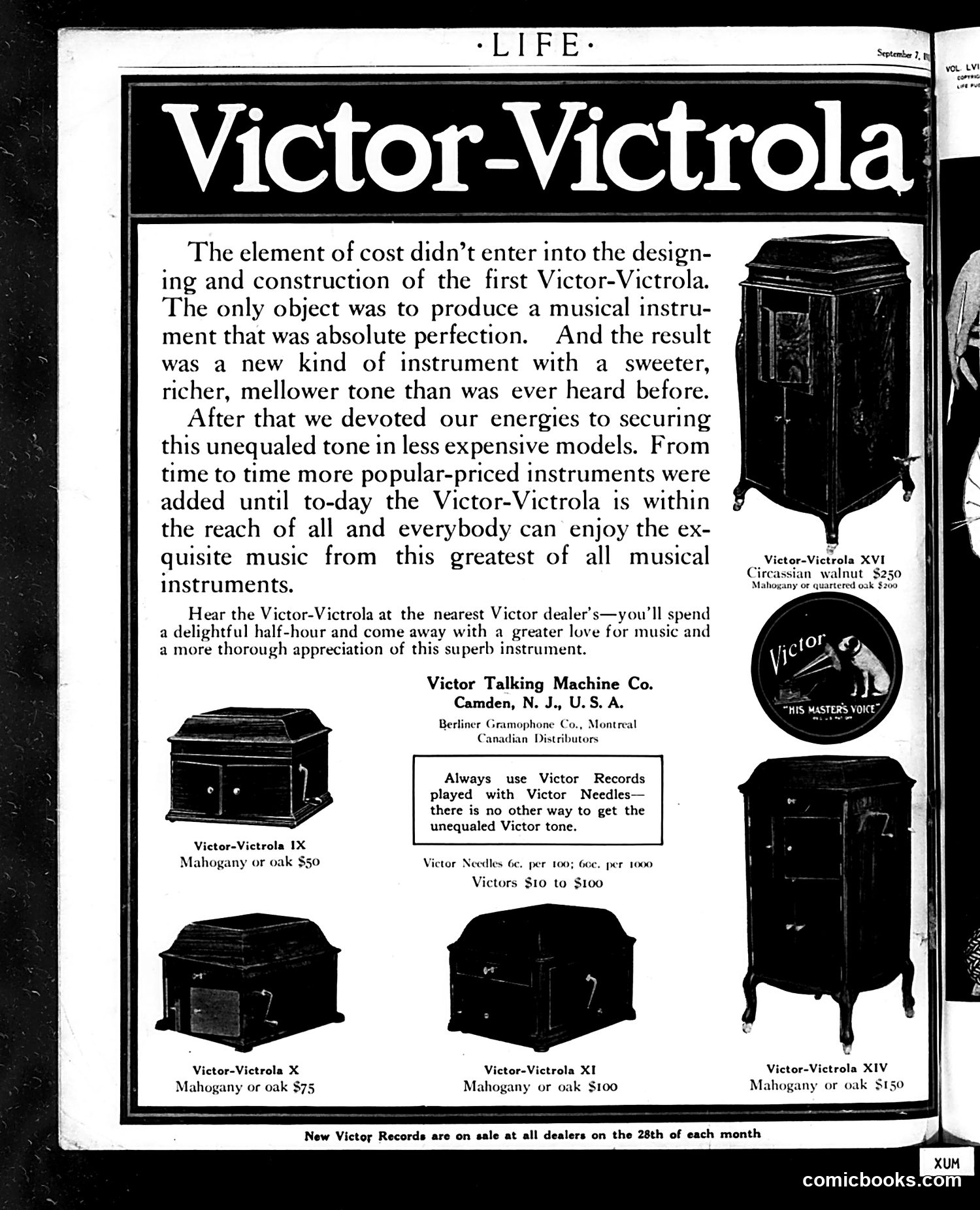
This page is **not satire or political content**—it's a straightforward advertisement for Victor-Victrola phonographs from the Victor Talking Machine Co. (Camden, N.J.). The ad promotes various gramophone models (priced $50–$150) by claiming the original design prioritized "absolute perfection" in tone over cost, then emphasizes how subsequent models made this technology accessible to "all and everybody." The company pushes customers to use Victor Records and Victor Needles specifically, claiming this is essential for achieving the superior "Victor tone." The iconic "His Master's Voice" logo (the dog and phonograph) appears as a circular trademark. **For modern readers**: This reflects early 20th-century consumer culture, where manufacturers marketed luxury goods by first establishing prestige (perfect tone regardless of cost) before democratizing access through cheaper variants—a marketing strategy still used today.