
Life, 1911-09-07 · page 27 of 44
Life — September 7, 1911 — page 27: what you’re looking at
What you’re looking at
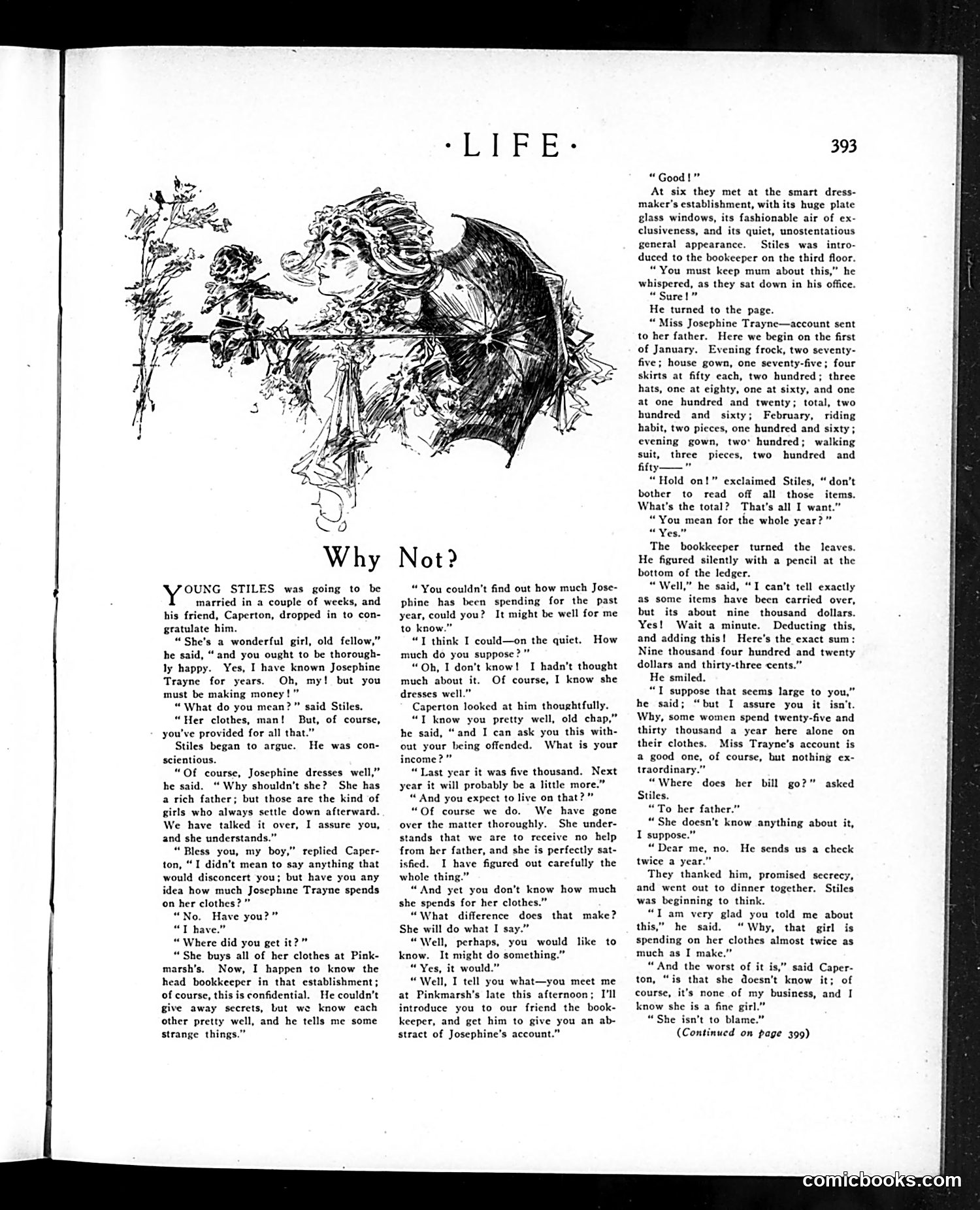
This story-cartoon satirizes the naïveté of young engaged men regarding women's spending habits. Young Stiles is about to marry Josephine Trayne, believing he understands her modest lifestyle despite her wealthy background. His friend Caperton suggests otherwise, revealing through a dressmaker's bookkeeper that Josephine has spent approximately nine thousand dollars annually on clothes alone—nearly double Stiles's five-thousand-dollar income. The satire targets the disconnect between male assumptions about female financial responsibility and the reality of upper-class women's fashion expenses. Stiles believed his fiancée would "settle down," but the account books expose his delusion. The joke exposes both masculine overconfidence and the genuine expense of fashionable dress for society women of the era, suggesting marriage will involve financial surprises he hasn't anticipated.
📄 Transcribed text from this page (OCR, searchable)
Machine-transcribed from the original scan — historical spelling and the odd misread are preserved.
OUNG STILES was going to be married in a couple of weeks, and his friend, Caperton, dropped in to con- gratulate him. “She's a wonderful girl, old fellow,” he said, “and you ought to be thorough- ly happy. Yes, I have known Josephine Trayne for years. Oh, my! but you must be making money!” “ What do you mean?” said Stiles. “Her clothes, man! But, of course, you've provided for all that Stiles began to argue. scientious. “Of course, Josephine dresses well,” he said. “ Why shouldn't she? She has a rich father; but those are the kind of girls who always settle down afterward. We have talked it over, I assure you, and she understands.” “Bless you, my boy,” replied Caper- ton, “I didn’t mean to say anything that would disconcert you; but have you any idea how much Josephine Trayne spends on her clothes?” “No. Have you?” “T have.” “ Where did you get it?” “She buys all of her clothes at Pink- marsh’s. Now, I happen to know the head bookkeeper in that establishment; of course, this is confidential. He couldn’t give away secrets, but we know cach other pretty well, and he tells me some strange things.” He was con- “You couldn't find out how much Jose- phine has been spending for the past year, could you? It might be well for me to know.” “T think I could—on the quiet. much do you suppose?” “Oh, I don't know! I hadn't thought much about it. Of course, I know she dresses well Caperton looked at him thoughtfully. “T know you pretty well, old chap,” he said, “and I can ask you this with- out your being offended. What is your income?” “Last ycar it was five thousand. Next year it will probably be a little more.” “ And you expect to live on that?” “Of course we do. We have gone over the matter thoroughly. She under- stands that we are to receive no help from her father, and she is perfectly sat- isfied. I have figured out carefully the whole thing.” “And yet you don’t know how much she spends for her clothes.” “What difference does She will do what I say.” “Well, perhaps, you would like to know. It might do something.” Yes, it would.” “Well, I tell you what—you meet me at Pinkmarsh’s late this afternoon; I'll introduce you to our friend the book- keeper, and get him to give you an ab- stract of Josephine’s account.” How that make? 393 “Good!” At six they met at the smart dress- maker's establishment, with its huge plate glass windows, its fashionable air of ex- clusiveness, and its quiet, unostentatious general appearance. Stiles was intro- duced to the bookeeper on the third floor. “You must keep mum about this,” he whispered, as they sat down in his office. “ Sure!” He turned to the page. “ Miss Josephine Trayne—account sent to her father. Here we begin on the first of January. Evening frock, two seventy- five; house gown, one seventy-five; four skirts at fifty each, two hundred; three hats, one at eighty, one at sixty, and one at one hundred and twenty; total, two hundred and sixty; February, riding habit, two pieces, one hundred and sixty; evening gown, two’ hundred; walking suit, three pieces, two hundred and fifty. x “Hold on!” exclaimed Stiles, “don’t bother to read off all those items. What's the total? That's all I want “You mean for the whole year?” “Yes.” The bookkeeper turned the leaves. He figured silently with a pencil at the bottom of the ledger. “Well,” he said, “I can’t tell exactly as some items have been carried over, but its about nine thousand dollars. Yes! Wait a minute. Deducting this, and adding this! Here's the exact sum: Nine thousand four hundred and twenty dollars and thirty-three cents.” He smiled. “TI suppose that seems large to you,” he said; “but I assure you it isn’t. Why, some women spend twenty-five and thirty thousand a year here alone on their clothes. Miss Trayne’s account is a good one, of course, but nothing ex- traordinary.’ “Where does her bill go?” asked Stiles. “To her father.” “She doesn't know anything about it, I suppose.” “ Dear me, no. twice a year.” They thanked him, promised secrecy, and went out to dinner together. Stiles was beginning to think. “Tam very glad you told me about this,” he said. “Why, that girl is spending on her clothes almost twice as much as I make.” “And the worst of it is,” said Caper- ton, “is that she doesn’t know it; of course, it’s none of my business, and I know she is a fine girl. “She isn’t to blame.” (Continued on page 399) He sends us a check