
Life, 1911-09-07 · page 17 of 44
Life — September 7, 1911 — page 17: what you’re looking at
What you’re looking at
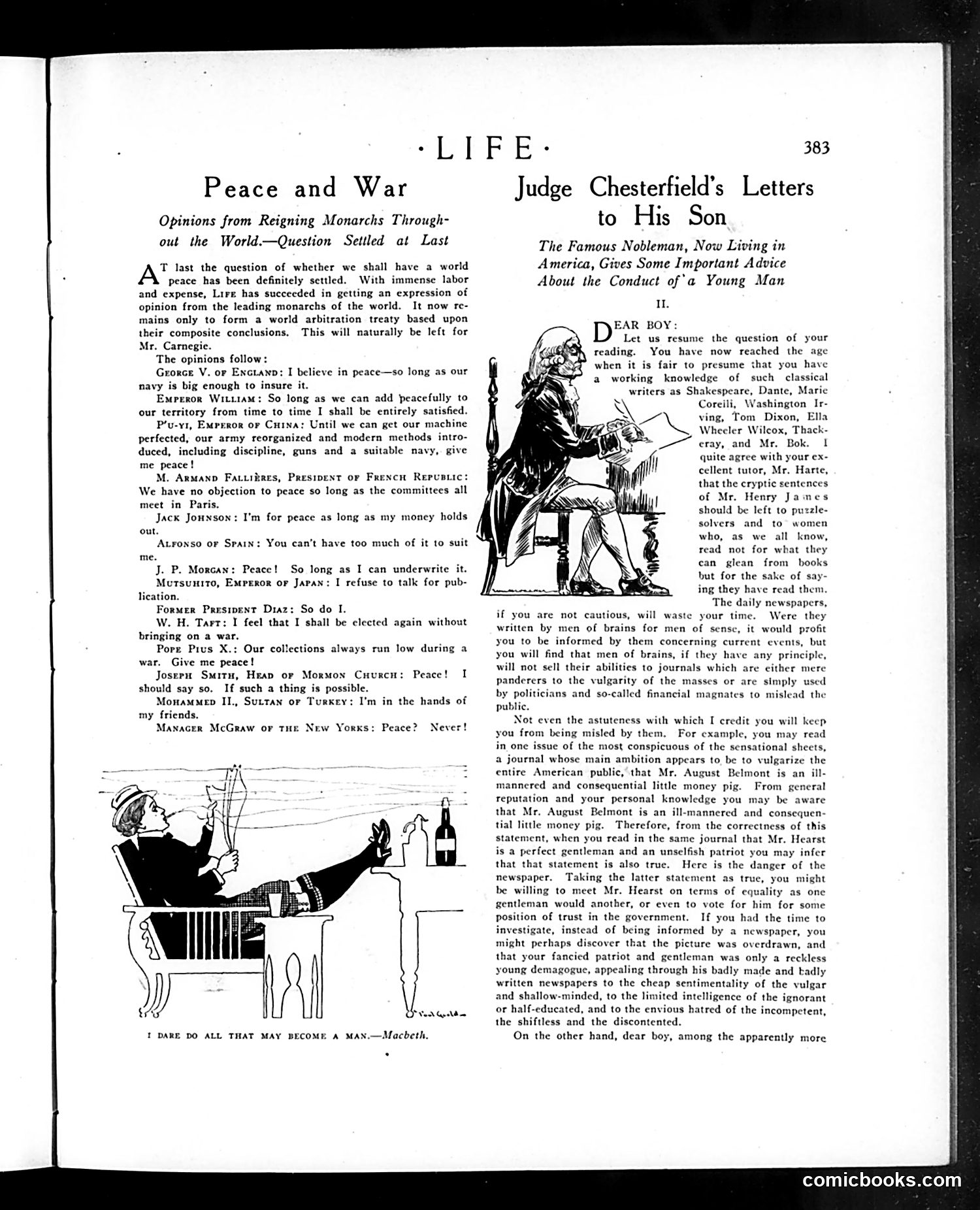
## "Peace and War" Section This satirical piece mocks world leaders' claims about wanting peace. Life presents fake "opinions" from monarchs and powerful figures, each revealing their actual self-interest disguised as peace advocacy. For instance, King George V wants peace "so long as our navy is big enough," and Emperor William desires peace while expanding territory. The joke: none actually want peace—they want security, profit, or power. Notably, J.P. Morgan (a banker, not a monarch) appears alongside rulers, suggesting American industrial titans wielded comparable power. The inclusion of "Manager McGraw of the New Yorks" (baseball) and boxer Jack Johnson adds absurdist humor, mocking America's obsession with mixing celebrity with serious matters. ## "Judge Chesterfield's Letters" This parodies aristocratic advice literature, presented as a British nobleman now in America tutoring his son. The accompanying sketch shows an idle gentleman reading. The satire critiques sensationalist newspapers (likely Hearst's publications), warning young readers to distrust their contradictions—if they correctly report something negative about Belmont, they might report falsehoods about Hearst, creating ironic logic.
📄 Transcribed text from this page (OCR, searchable)
Machine-transcribed from the original scan — historical spelling and the odd misread are preserved.
~-LIFE: 383 Peace and War Opinions from Reigning Monarchs Through- out the World.—Question Settled at Last T last the question of whether we shall have a world peace has been definitely settled. With immense labor and expense, Lire has succeeded in getting an expression of opinion from the leading monarchs of the world. It now re- mains only to form a world arbitration treaty based upon their composite conclusions, This will naturally be left for Mr. Carnegi The opinions follow: Grorce V. or Enctanp: I believe in peace—so long as our navy is big enough to insure it. Emreror Witt1am: So long as we can add peacefully to our territory from time to time I shall be entirely satisfied. P’u-v1, Emperor op Cuina: Until we can get our machine perfected, our army reorganized and modern methods intro- duced, including discipline, guns and a suitable navy, give me peace! M. ArManp Fattikres, Presipent or Frencn Reruptic: We have no objection to peace so long as the committees all meet in Pari: Jack JonNson : I'm for peace as long as my money holds out. Atroxso or Srain: You can't have too much of it to suit me. J. P. Morcan: Peace! So long as I can underwrite it. Murtsumito, Emperor or Jaran: I refuse to talk for pub- lication. Former Presipent Diaz: So do I. W. H. Tarr: I feel that I shall be elected again without bringing on a war. Pore Pius X.: Our collections always run low during a war. Give me peace! Joseru Situ, Heap or Moron Cuurcn: Peace! I should say so. If such a thing is possible. Monamaen II, Suntan or Turkey: I'm in the hands of my friends, Manacer McGraw or tHe New Yorks: Peace? Never! | Ved Gel 1 DARE DO ALL THAT MAY BECOME A MAN.—Macbeth. Judge Chesterfield’s Letters to His Son The Famous Nobleman, Now Living in America, Gives Some Important Advice About the Conduct of'a Young Man Il. D™ BOY: Let us resume the question of your } reading. You have now reached the age when it is fair to presume that you have a working knowledge of such classical writers as Shakespeare, Dante, Maric Coreili, Washington Ir- ving, Tom Dixon, Ella Wheeler Wilcox, Thack- cray, and Mr. Bok. 1 quite agree with your ex- cellent tutor, Mr. Harte, that the cryptic sentences of Mr. Henry James should be left to puzzle- solvers and to women who, as we all know, read not for what they can glean from books but for the sake of ing they have ri The daily newspapers, if you are not cautious, will waste your time. Were they written by men of brains for men of sense, it would profit you to be informed by them concerning current events, but you will find that men of brains, if they have any principle, will not sell their abilities to journals which are cither mere panderers to the vulgarity of the masses or are simply used by politicians and so-called financial magnates to mislead the publi even the astuteness with which I credit you will keep you from being misled by them. For example, you may read in one issue of the most conspicuous of the sensational sheets, a journal whose main ambition appears to be to vulgarize the entire American public, that Mr, August Belmont is an ill- mannered and consequential little money pig. From general reputation and your personal knowledge you may be aware that Mr. August Belmont is an ill-mannered and consequen- tial little money pig. Therefore, from the correctness of this statement, when you read in the same journal that Mr. Hearst is a perfect gentleman and an unselfish patriot you may infer that that statement is also true. Here is the danger of the newspaper. ing the latter statement as true, you might be willing to meet Mr. Hearst on terms of equality as one gentleman would another, or even to vote for him for some position of trust in the government. If you had the time to investigate, instead of being informed by a newspaper, you might perhaps discover that the picture was overdrawn, and that your fancied patriot and gentleman was only a reckless young demagogue, appealing through his badly made and tadly written newspapers to the cheap sentimentality of the vulgar and shallow-minded, to the limited intelligence of the ignorant or half-educated, and to the envious hatred of the incompetent, the shiftless and the discontented. On the other hand, dear boy, among the apparently more comicbooks.com