
Life, 1911-09-07 · page 12 of 44
Life — September 7, 1911 — page 12: what you’re looking at
What you’re looking at
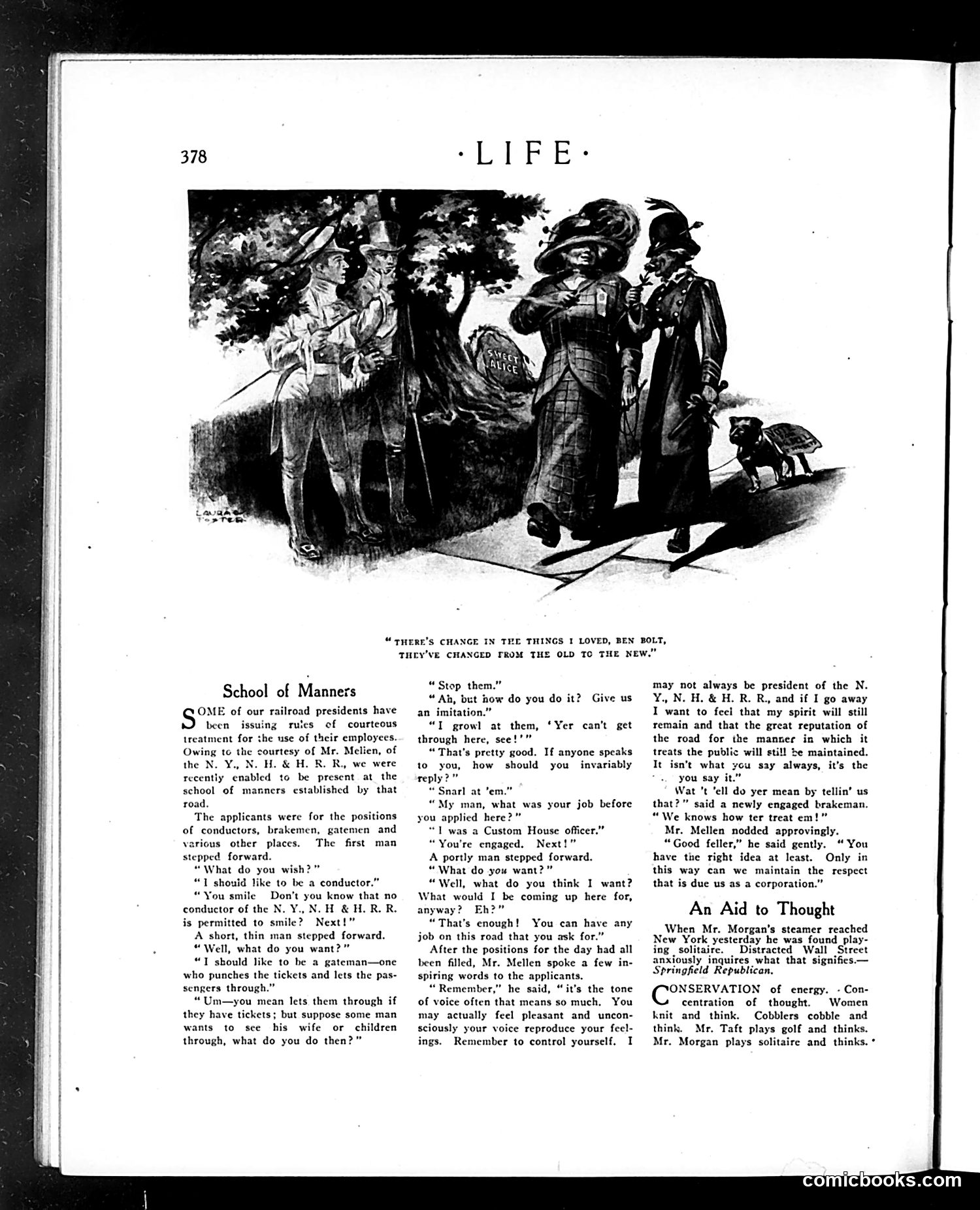
This page from *Life* magazine presents a satirical article titled "School of Manners" about railroad employee training. The illustration depicts what appears to be railroad officials instructing workers on proper conduct and deportment. The satire targets the N.Y., N.H. & H.R.R. (New York, New Haven & Hartford Railroad), which apparently established a formal "school of manners" to improve employee courtesy toward passengers. The dialogue humorously shows the absurdity of teaching railroad workers—particularly conductors and ticket-takers—rigid rules about voice control, self-restraint, and respectful address. The joke suggests that such formal instruction in basic courtesy to a working-class workforce is both patronizing and unlikely to succeed. The article mocks both corporate pretension and the assumption that manners can be taught through regimented schooling rather than genuine respect.
📄 Transcribed text from this page (OCR, searchable)
Machine-transcribed from the original scan — historical spelling and the odd misread are preserved.
“THERE'S CHANGE IN TEE THINGS I LOVED, BEN BOLT, THEY'VE CHANGED FROM THE OLD TO THE NEW.” School of Manners OME of our railroad presidents have been issuing rules of courteous treatment for the use of their employees. Owing to the courtesy of Mr. Melien, of the N. YN. H. & H. R. R, we were recently enabled to be present at the school of manners established by that road. The applicants were for the positions of conductors, brakemen, gatemen and various other places. The first man stepped forward. “What do you wish?” “1 should like to be a conductor.” “You smile Don’t you know that no conductor of the N. Y.,N.H & H.R.R is permitted to smile? Next!” A short, thin man stepped forward. “Well, what do you want?” “1 should like to be a gateman—one who punches the tickets and lets the pas- sengers through.” “Um—you mean lets them through if they have tickets; but suppose some man wants to sce his wife or children through, what do you do then?” “ Stop them. “Ah, but now do you do it? an imitation.” “I growl at them, ‘Yer can’t get through here, see!” “That's pretty good. If anyone speaks you, how should you invariably Give us “ Snarl at 'em.” “My man, what was your job before you applied here?” “1 was a Custom House officer.” “You're engaged. Next!” A portly man stepped forward. “ What do you want?” “Well, what do you think I want? What would I be coming up here for, anyway? Eh?” “That's enough! You can have any job on this road that you ask for.” After the positions for the day had all been filled, Mr. Mellen spoke a few in- of voice often that means so much, You may actually feel pleasant and uncon- sciously your voice reproduce your feel- ings. Remember to control yourself. I may not always be president of the N. Y., N. H. & H. R. R., and if I go away I want to feel that my spirit will still remain and that the great reputation of the road for the manner in which it treats the public will still be maintained. It isn’t what you say always, it’s the you say it. Wat 't ‘ell do yer mean by tellin’ us that?" said a newly engaged brakeman. “We knows how ter treat em!" Mr. Mellen nodded approvingly. “Good feller,” he said gently. “You have the right idea at least. Only in this way can we maintain the respect that is due us as a corporation.” An Aid to Thought When Mr. Morgan's steamer reached New York yesterday he was found play- ing solitaire. Distracted Wall Street anxiously inquires what that signifies— Springfield Republican, ONSERVATION of energy. - Con- centration of thought. Women knit and think. Cobblers cobble and think, Mr. Taft plays golf and thinks. Mr. Morgan plays solitaire and thinks. * comicbooks.com