
Life, 1911-09-07 · page 11 of 44
Life — September 7, 1911 — page 11: what you’re looking at
What you’re looking at
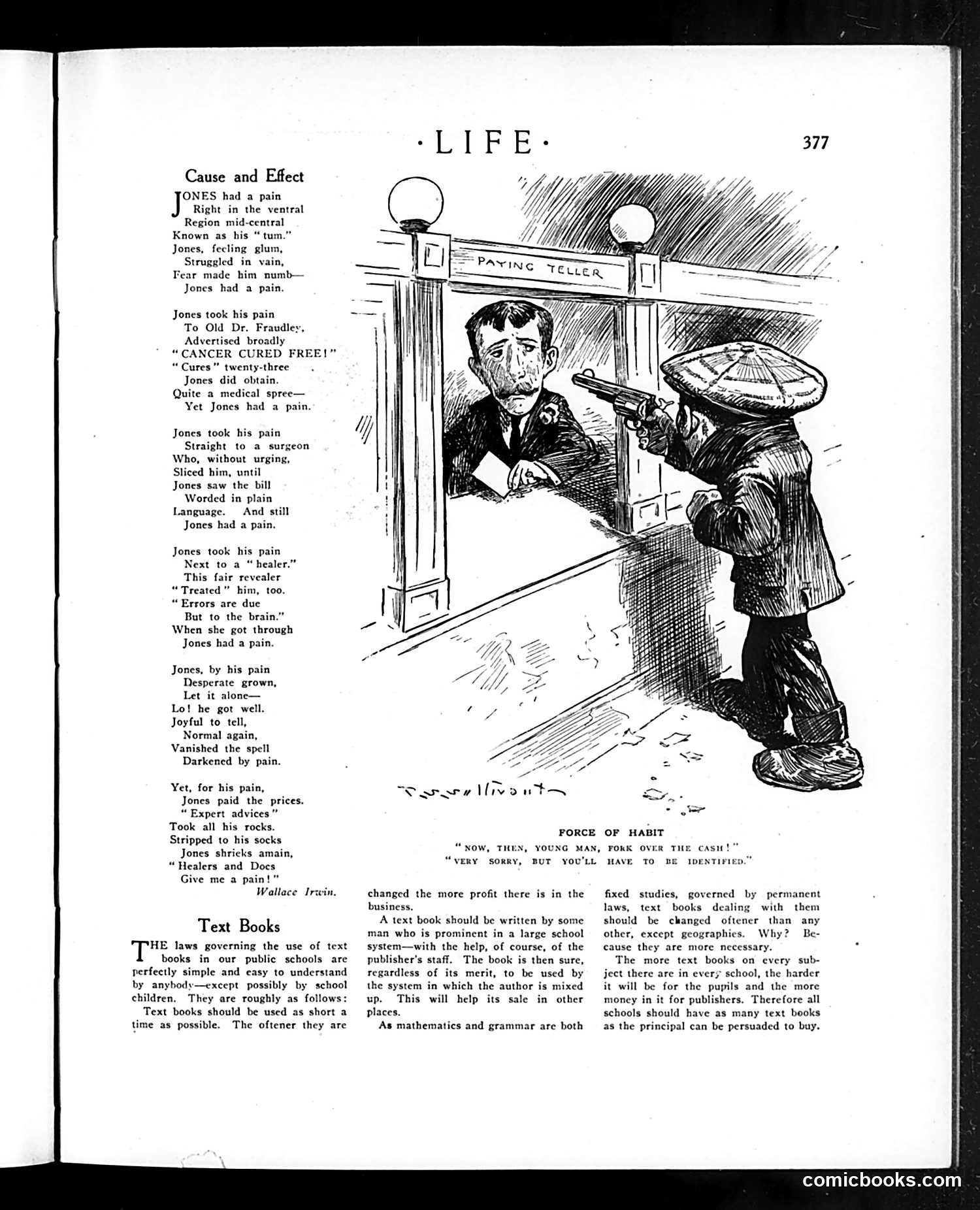
This satirical cartoon depicts a man at a "Paving Teller" window (a play on "paying teller" at a bank). The caption reads: "Now, then, young man, fork over the cash!" with the response "Very sorry, but you'll have to be identified." The joke satirizes the absurdity of bureaucratic procedure taken to illogical extremes. A paving teller—someone collecting payment for street paving work—demands identification before accepting payment, mimicking excessive banking practices. The cartoon critiques how institutions blindly follow rigid rules ("force of habit") without considering whether they make sense in context. The accompanying poem "Cause and Effect" by Wallace Irwin tells a similar story about Jones seeking medical cures, only to continue suffering—illustrating how people repeat ineffective actions habitually.
📄 Transcribed text from this page (OCR, searchable)
Machine-transcribed from the original scan — historical spelling and the odd misread are preserved.
Cause and Effect ONES had a pain J Right in the ventral Region mid-central Known as his “tum.” Jones, fecling glum, Struggled in vain, Fear made bim numb— Jones had a pain. Jones took his pain To Old Dr, Fraudley, Advertised broadly “CANCER CURED FREE!” “ Cures" twenty-three Jones did obtain. Quite a medical spree— Yet Jones had a pain. Jones took his pain Straight to a surgeon Who, without urging, Sliced him, until Jones saw the bill Worded in plain Language. And still Jones had a pain. Jones took his pain Next to a “healer.” This fair revealer “Treated” him, too. “Errors are due But to the brain.” When she got through Jones had a pain. Jones, by his pain Desperate grown, Let it alone— Lo! he got well. Joyful to tell, Normal again, Vanished the spell Darkened by pain. Yet, for his pain, Jones paid the prices. “ Expert advices” Took all his rocks. Stripped to his socks Jones shricks amain, “Healers and Docs Give me a pain Wallace Irvin. Text Books HE laws governing the use of text books in our public schools are perfectly simple and easy to understand by anybody—except possibly by school children, They are roughly as follows: Text books should be used as short a time as possible. The oftener they are “SD ogre a Miva wta FORCE rh PUM YY OF HABIT “NOW, THEN, YOUNG MAN, FOKK OVER THE casi!” “VERY SORRY, BUT YOU'LL changed the more profit there is in the business. A text book should be written by some man who is prominent in a large school system—with the help, of course, of the publisher's staff. The book is then sure, regardless of its merit, to be used by the system in which the author is mixed up. This will help its sale in other places. As mathematics and grammar are both MAVE TO BE IDENTIFIED.” fixed studies, governed by laws, text books dealing should be changed oftener other, except geographies. Why? cause they are more necessary. The more text books on every sub- ject there are in every school, the harder it will be for the pupils and the more money in it for publishers. Therefore all schools should have as many text books as the principal can be persuaded to buy. permanent with them than any Be- comicbooks.com