
Life, 1911-09-07 · page 29 of 44
Life — September 7, 1911 — page 29: what you’re looking at
What you’re looking at
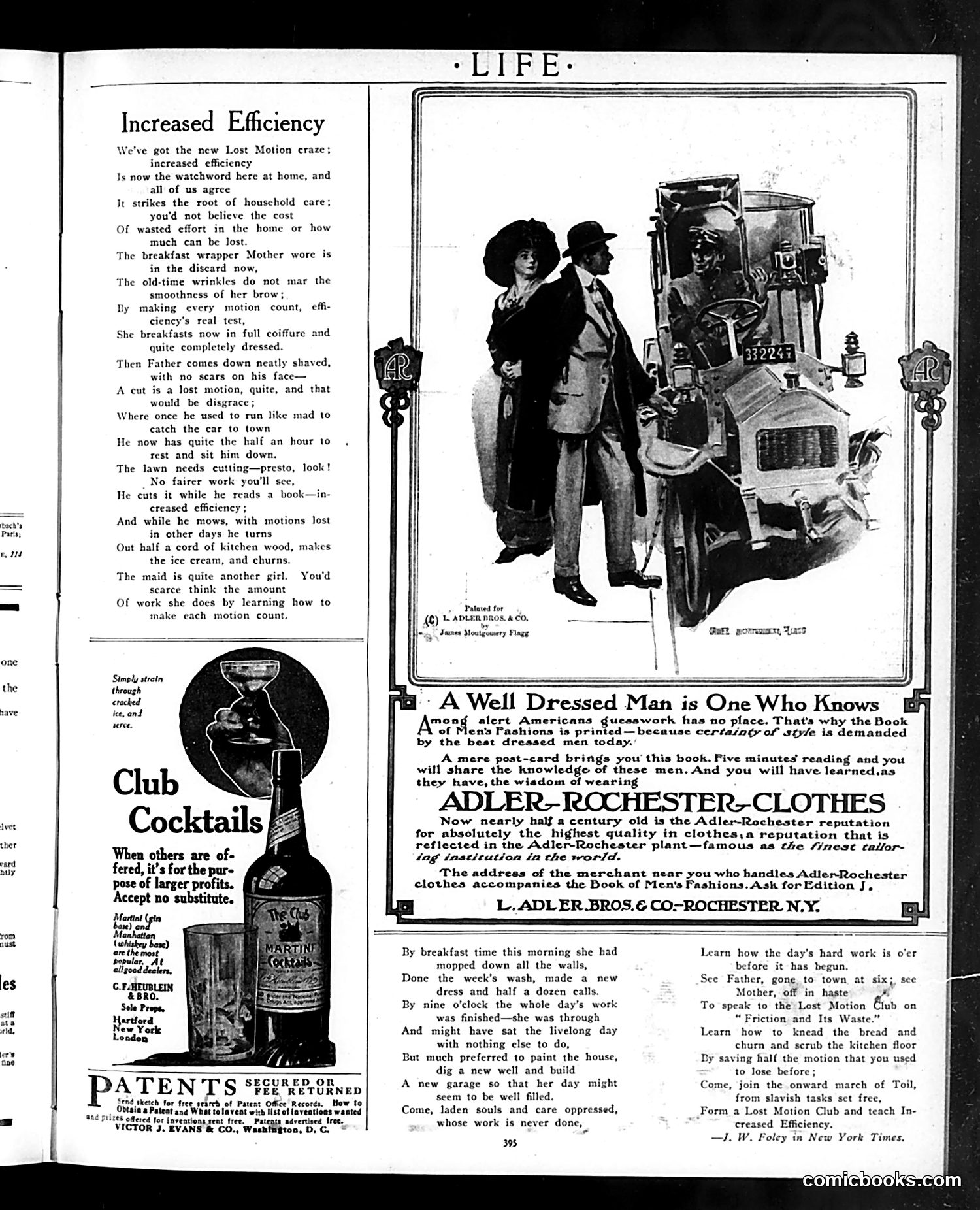
This is satire on the "Lost Motion" efficiency craze—likely referring to the Scientific Management/Taylorism movement popular in early 20th-century America. The poem mocks how families embrace this productivity obsession. The joke: by adopting "increased efficiency," ordinary people supposedly accomplish superhuman feats. Mother now dresses fully and does her hair before breakfast. Father shaves without cuts (eliminating "wasted" motion). He reads while mowing the lawn. The maid completes a week's work by 9 a.m., then voluntarily paints the house and digs a well because she has nothing else to do. The satire exposes the absurdity of applying industrial efficiency metrics to domestic life—the implication that people should work even harder at home under the guise of "saving motion." The companion advertisement for Adler-Rochester clothes undercuts the poem's message, suggesting that looking well-dressed (the opposite of wasting effort) is actually what matters to refined men.
📄 Transcribed text from this page (OCR, searchable)
Machine-transcribed from the original scan — historical spelling and the odd misread are preserved.
Paris; ed one the nave vet ther rand buy rom nase, les alt id, ers fine Increased Efficiency We've got the new Lost Motion craze; increased efficiency Is now the watchword here at home, and all of us agree It strikes the root of houschold care; you'd not believe the cost Of wasted effort in the home or how much can be lost. The breakfast wrapper Mother wore is in the discard now, The old-time wrinkles do not mar the smoothness of her brow; By making every motion count, effi- ciency’s real test, She breakfasts now in full coiffure and quite completely dressed. Then Father comes down neatly shaved, with no scars on his face— A cut is a lost motion, quite, and that would be disgrace ; Where once he used to run like mad to catch the car to town He now has quite the half an hour to rest and sit him down. The lawn needs cutting—presto, look! No fairer work you'll sc He cuts it while he reads a book—in- creased efficienc And while he mows, with motions lost in other days he turns Out half a cord of kitchen wood, makes the ice cream, and churns. The maid is quite another girl. You'd scarce think the amount Of work she docs by learning how to make each motion count. through P: Simply strein cracked fee, and werce, When others are of- pig se the Pare Pose of er its. Accept no substitute, + Patered for {G) + apt nnos.& co. ae ining _ Funes Moutgouery Flagg age porreman, Yd A Well Dressed Man is One Who Knows mong alert Americans guesswork has no place. That's why the Book of Men’s Fashions is printed— because cerras‘ay of sty/e is demanded by the best dressed men today. A mere post-card brings you this book. Five minutes reading and you will share the knowledge of these men. And you will have learned.as they have, the wiadom of wearing ADLER--ROCHESTER:-CLOTHES Now nearly half a century old is the Adler-Rochester reputation for absolutely the highest quality in clothes,a reputation that is reflected in the Adler-Rochester plant—famous as the //nest tailor dag institution in the world. The address of the merchant near you who handles AdlerRochester clothes accompanies the Book of Men's Fashions. Ask for Edition J, L. ADLER.BROS,6 CO-ROCHESTER N.Y. SECURED OR Send sk Ov ATE inventions sent tre BN VANS & CO., FEE RETURNED tent Office Records, Mor By breakfast time this morning she had mopped down all the walls, Done the week's wash, made a new dress and half a dozen calls. By nine o'clock the whole day’s work was finished—she was through And might have sat the livelong day with nothing else to do, But much preferred to paint the house, dig a new well and build A new garage so that her day might seem to be well filled. Come, laden souls and care oppressed, whose work is never done, 395, Learn how the day's hard work is o'er before it has begun. Sce Father, gone, to town at six; sce Mother, off in haste # To speak to the Lost Motion Club on “Friction and Its Waste.” Learn how to knead the bread and churn and scrub the kitchen floor Dy saving half the motion that you used to lose before; Come, join the onward march of Toil, from slavish tasks set free, Form a Lost Motion Club and teach In- creased Efficiency. J. W. Foley in New York Times.