
Life, 1911-09-07 · page 19 of 44
Life — September 7, 1911 — page 19: what you’re looking at
What you’re looking at
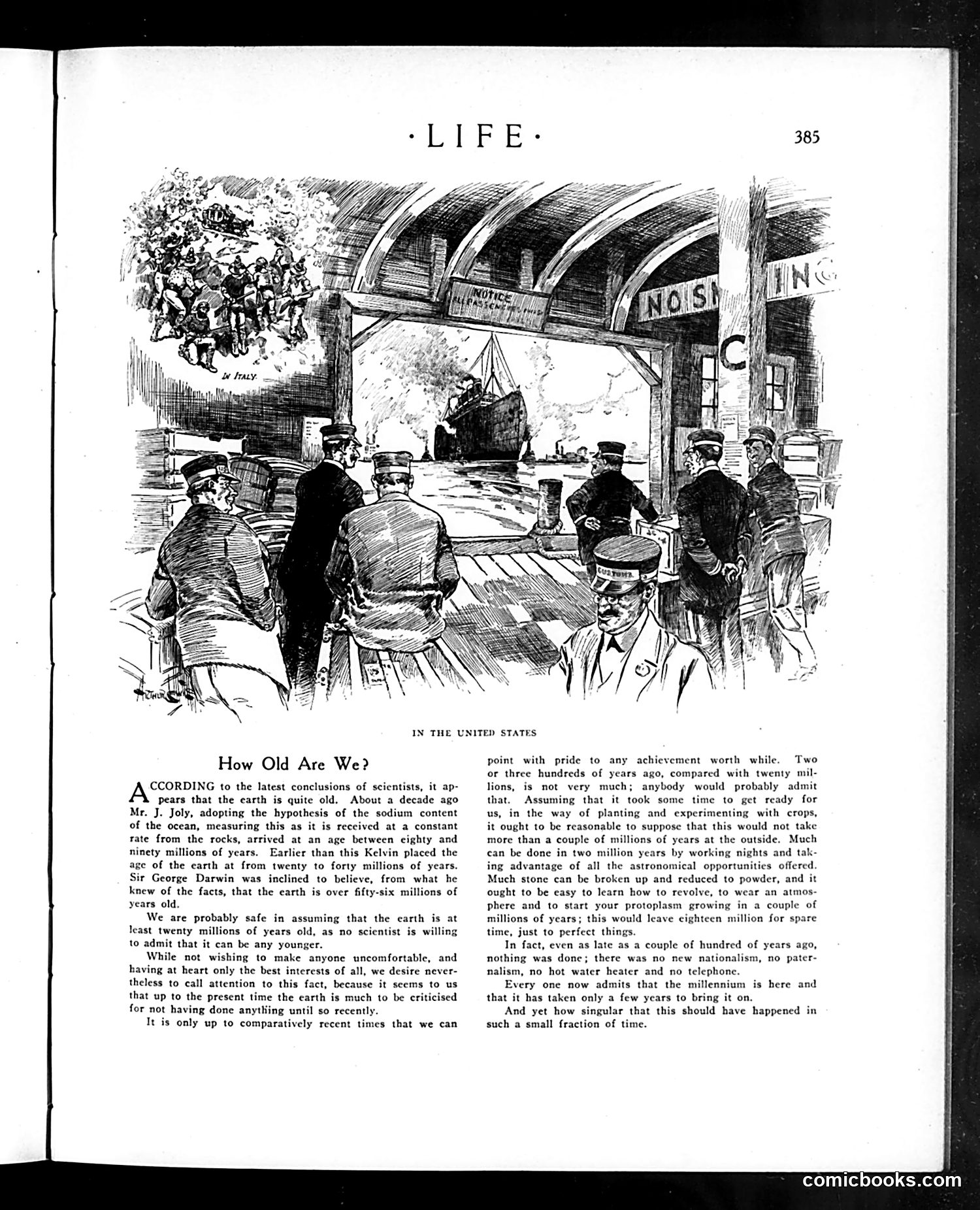
This is a humorous essay satirizing human arrogance about progress. The text discusses scientists' estimates that Earth is 20-90 million years old, then pivots to mock humanity's self-importance: we've accomplished "nothing" for millions of years, yet now (within "a couple of hundred years") we've achieved nationalism, hot water heaters, and telephones—and we're calling this "the millennium." The cartoon depicts a dock or harbor scene with well-dressed men observing ships, likely representing modern commerce and industrial achievement. **The satire's point:** Humans congratulate themselves on recent inventions and progress while ignoring that on geological timescales, our entire civilization is instantaneous and insignificant. The essay's tone is deliberately deadpan, treating humanity's modest modern conveniences as if they were cosmic achievements worthy of Earth's billions-of-years wait. This reflects turn-of-the-century anxieties about technology, progress, and humanity's place in the universe.
📄 Transcribed text from this page (OCR, searchable)
Machine-transcribed from the original scan — historical spelling and the odd misread are preserved.
IN THE UNITED STATES How Old Are We? CCORDING to the latest conclusions of scientists, ap- pears that the earth is quite old. About a decade ago Mr. J. Joly, adopting the hypothesis of the sodium content of the ocean, measuring this as it is received at a constant rate from the rocks, arrived at an age between eighty and ninety millions of years. Earlier than this Kelvin placed the age of the earth at from twenty to forty millions of years. Sir George Darwin was inclined to believe, from what he knew of the facts, that the earth is over fifty-six millions of years old, We are probably safe in assuming that the earth is at least twenty millions of years old, as no scientist is willing to admit that it can be any younger. While not wishing to make anyone uncomfortable, and having at heart only the best interests of all, we desire never- theless to call attention to this fact, because it seems to us that up to the present time the earth is much to be criticised for not having done anything until so recently. It is only up to comparatively recent times that we can point with pride to any achievement worth while. Two or three hundreds of years ago, compared with twenty mil- lions, is not very much; anybody would probably admit that. Assuming that it took some time to get ready for us, in the way of planting and experimenting with crops, it ought to be reasonable to suppose that this would not take more than a couple of millions of years at the outside. Much can be done in two million years by working nights and tak- ing advantage of all the astronomical opportunities offered. Much stone can be broken up and reduced to powder, and it ought to be easy to learn how to revolve, to wear an atmos- phere and to start your protoplasm growing in a couple of millions of years; this would leave cighteen million for spare time, just to perfect things. In fact, even as late as a couple of hundred of years ago, nothing was donc; there was no new nationalism, no pater- nalism, no hot water heater and no telephone. Every one now admits that the millennium is here and that it has taken only a few years to bring it on. And yet how singular that this should have happened in such a small fraction of time. comicbooks.com