
Life, 1911-09-07 · page 20 of 44
Life — September 7, 1911 — page 20: what you’re looking at
What you’re looking at
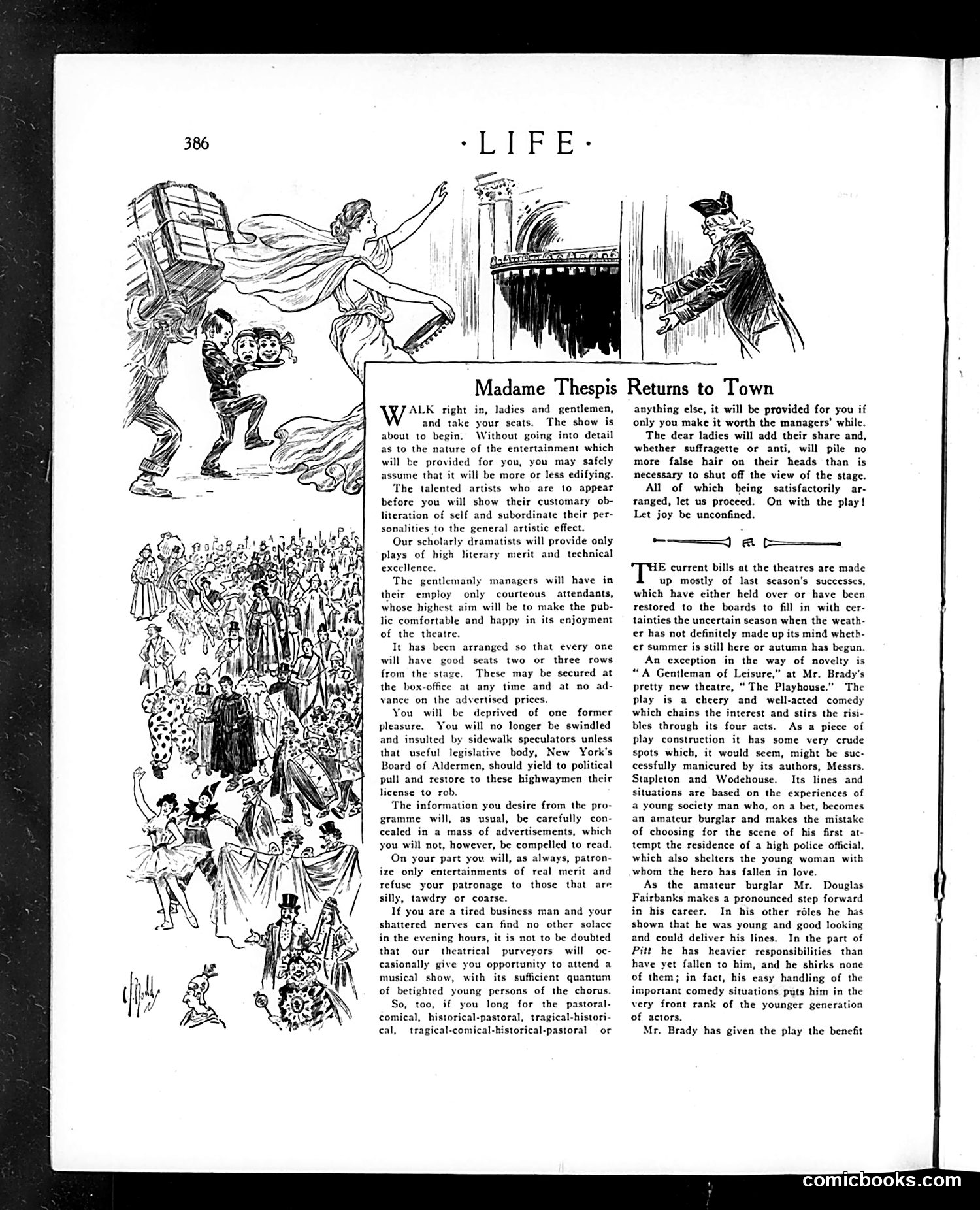
This is satirical commentary on theatrical season reopening, written as mock-earnest promises to theater patrons. "Madame Thespis" references the ancient Greek inventor of theater, personifying the theatrical world itself. The satire mocks standard theater industry practices through ironic "assurances": talented actors will subordinate ego (they notoriously don't), plays will have literary merit (they often don't), managers employ courteous staff (questionable), and audiences won't be cheated by sidewalk ticket scalpers—unless New York's corrupt Board of Aldermen restores their illegal licenses for bribes. The text sarcastically acknowledges theaters will show mostly recycled successes, hide program information in ads, and feature chorus girls with excessive hair additions. The accompanying illustrations show a theatrical barker promoting the show and crowds of audience members, visualizing the carnival-like atmosphere being critiqued. The satire targets both the theatrical industry's dubious practices and audience complicity in perpetuating them.
📄 Transcribed text from this page (OCR, searchable)
Machine-transcribed from the original scan — historical spelling and the odd misread are preserved.
Madame Thespis Returns to Town ws right in, ladies and gentlemen, and take your seats. The show is about to begin. Without going into detail as to the nature of the entertainment which will be provided for you, you may safely assume that it will be more or less edifying. The talented artists who are to appear before you will show their customary ob- iteration of self and subo sonalities to the general art Our scholarly dramatists will provide only plays of high literary merit and technical excellence. The gentlemanly managers will have in their employ only courteous attendants, whose highest aim will be to make the pub- lic comfortable and happy in its enjoyment of the It has been arranged so that every one will have good seats two or three rows from the: st These may be secured at the box-office at any time and at no ad- vance on the advertised prices. You will be deprived of one former pleasure. You will no longer be swindled and insulted by sidewalk speculators unless that useful legislative body, New York's Board of Aldermen, should yield to political pull and restore to these highwaymen their license to rob. The information you desire from the pro- gramme will, as usual, be carefully con- cealed in a mass of advertisements, which you will not, however, be compelled to read. On your part you will, as always, patron- ize only entertainments of real merit and refuse your patronage to those that are silly, tawdry or coarse. If you are a tired business man and your shattered nerves can find no other solace in the evening hours, it is not to be doubted that our theatrical purveyors will oc- casionally give you opportunity to attend a musical show, with its sufficient quantum of betighted young persons of the chorus. So, too, if you long for the pastoral- comical, historical-pastoral, tragical-histori- cal, tragical-comical-historical-pastoral or anything else, it will be provided for you if only you make it worth the managers’ while. The dear ladies will add their share and, whether suffragette or anti, will pile no more false hair on their heads than is necessary to shut off the view of the stage. All of which being satisfactorily ar- ranged, let us proceed. On with the play! Let joy be unconfined. — a >. E current bills at the theatres are made up mostly of last season's successes, which have cither held over or have been restored to the boards to fill in with cer- tainties the uncertain season when the weath- er has not definitely made up its mind wheth- er summer is still here or autumn has begun. An exception in the way of novelty is “A Gentleman of Leisure,” at Mr. Brady's pretty new theatre, “The Playhouse.” The play is a cheery and well-acted comedy which chains the interest and stirs the risi- bles through its four acts. As a piece of play construction it has some very crude spots which, it would scem, might be suc- cessfully manicured by its authors, Messrs. Stapleton and Wodehouse. Its lines and situations are based on the experiences of a young society man who, on a bet, becomes an amateur burglar and makes the mistake of choosing for the scene of his first at- tempt the residence of a high police official, which also shelters the young woman with whom the hero has fallen in love. As the amateur burglar Mr. Douglas Fairbanks makes a pronounced step forward in his career. In his other réles he has shown that he was young and good looking and could deliver his lines. In the part of Pitt he has heavier responsibilities than have yet fallen to him, and he shirks none of them; in fact, his casy handling of the important comedy situations puts him in the very front rank of the younger generation of actors. Mr. Brady has given the play the benefit comicbooks.com