
Life, 1911-09-07 · page 21 of 44
Life — September 7, 1911 — page 21: what you’re looking at
What you’re looking at
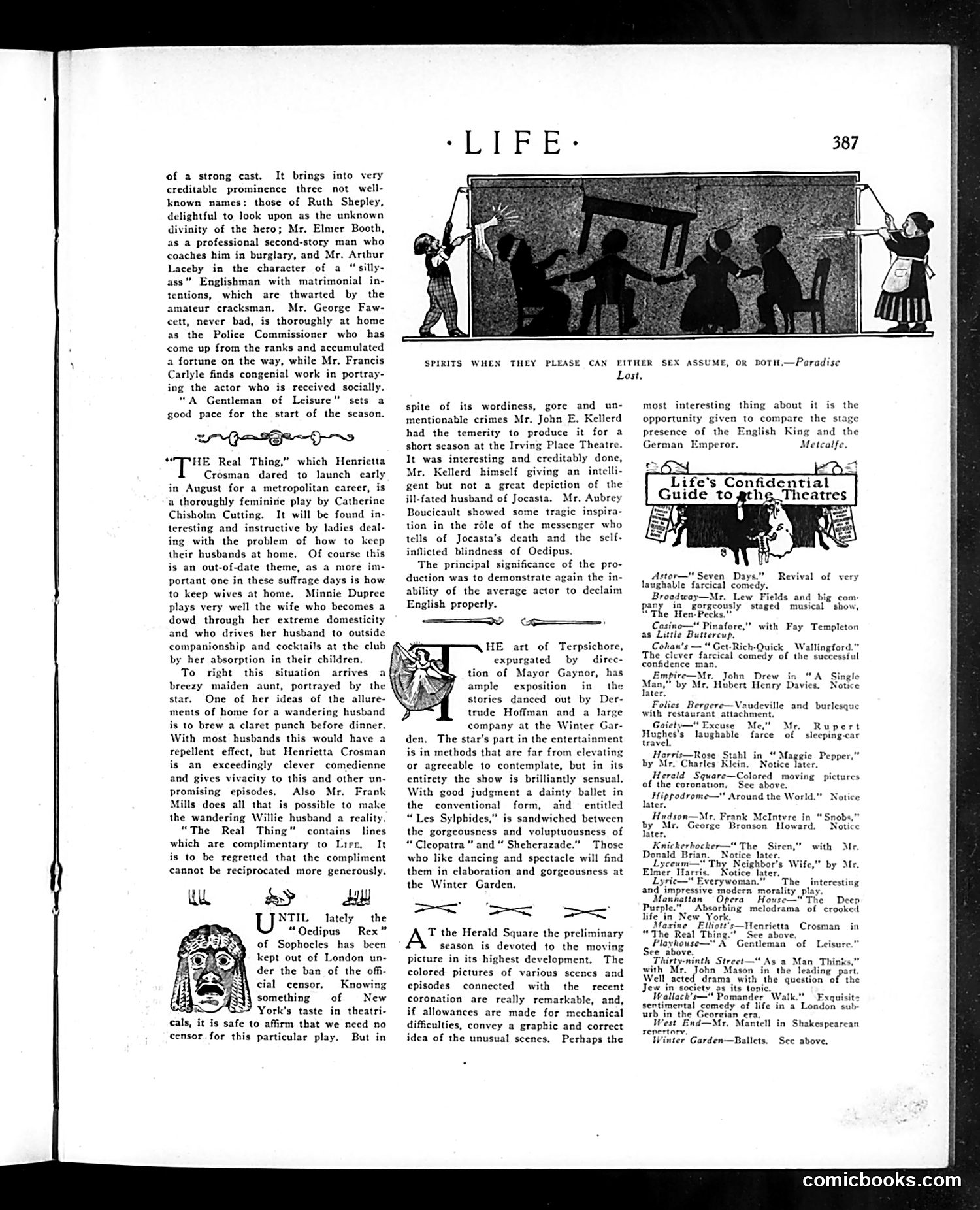
This page reviews several theatrical productions from early 20th-century New York. The main illustration depicts a scene from a play involving what appears to be a bedroom or interior setting with multiple figures. The text discusses productions including: - **"A Gentleman of Leisure"** and **"The Real Thing"** (starring Henrietta Crosman), a comedy about marriage and domestic life - **"Oedipus Rex"** at the Irving Place Theatre, recently unbanned by London censors, which the reviewer finds dramatically valid despite its dark content - A dance production at the Winter Garden by Detrude Hoffman, "expurgated by direction of Mayor Gaynor" — suggesting the mayor had censored or modified the choreography for propriety The page exemplifies Life magazine's role as cultural arbiter, providing theater criticism for educated urban audiences. References to censorship (both London's and Mayor Gaynor's) reflect Progressive Era concerns about theatrical morality. The mention of "suffrage days" places this in the pre-1920 women's voting era.
📄 Transcribed text from this page (OCR, searchable)
Machine-transcribed from the original scan — historical spelling and the odd misread are preserved.
of a strong cast. It brings into very creditable prominence three not well- known names: those of Ruth Shepley, delightful to look upon as the unknown divinity of the hero; Mr. Elmer Booth, as a professional second-story man who coaches him in burglary, and Mr. Arthur Laceby in the character of a “silly- ass” Englishman with matrimonial in- tentions, which are thwarted by the amateur cracksman. Mr. George Faw- cett, never bad, is thoroughly at home as the Police Commissioner who has come up from the ranks and accumulated a fortune on the way, while Mr. Francis Carlyle finds congenial work in portray- ing the actor who is received socially. “A Gentleman of Leisure” sets a good pace for the start of the season. 50 ane C es es ee) “THE Real Thing,” which Henrictta Crosman dared to launch carly in August for a metropolitan carcer, is a thoroughly feminine play by Catherine Chisholm Cutting. It will be found in- teresting and instructive by ladies deal- ing with the problem of how to keep their husbands at home. Of course this is an out-of-date theme, as a more im- portant once in these suffrage days is how to keep wives at home. Minnie Dupree plays very well the wife who becomes a dowd through her extreme domesticity and who drives her husband to outside companionship and cocktails at the club by her absorption in their children, To right this situation arrives a breezy maiden aunt, portrayed by the star. One of her ideas of the allure- ments of home for a wandering husband is to brew a claret punch before dinner. With most husbands this would have a repellent effect, but Henrietta Crosman is an exceedingly clever comedienne and gives vivacity to this and other un- promising episodes, Also Mr, Frank Mills does all that is possible to make the wandering Willie husband a reality. “The Real Thing” contains lines which are complimentary to Lirr, It is to be regretted that the compliment cannot be reciprocated more generously. ey a NTIL lately _ the “Ocdipus Rex” of Sophocles has been kept out of London un- der the ban of the offi- cial censor. Knowing something of New York’s taste in theatri- cals, it is safe to affirm that we need no censor for this particular play. But in SPIRITS WHEN THEY PLEASE CAN EITHER SEX ASSUME, OR BOTH.—Paradise Lost, spite of its wordiness, gore and un- mentionable crimes Mr. John E. Kellerd had the temerity to produce it for a short season at the Irving Place Theatre. It was interesting and creditably done, Mr. Kellerd himself giving an intclli- gent but not a great depiction of the ill-fated husband of Jocasta. Mr. Aubrey Boucicault showed some tragic inspira- tion in the rdle of the messenger who tells of Jocasta’s death and the self- inflicted blindness of Ocdipus. The principal significance of the pro- duction was to demonstrate again the in- ability of the average actor to declaim English properly. Sa Oe HE art of Terpsichore, expurgated by diree- tion of Mayor Gaynor, has ample exposition in the stories danced out by Der- trude Hoffman and a large company at the Winter Gar- den. The star's part in the entertainment is in methods that are far from elevating or agreeable to contemplate, but in its entirety the show is brilliantly sensual, With good judgment a dainty ballet in the conventional form, and entitled “Les Sylphides,” is sandwiched between the gorgeousness and voluptuousness of “ Cleopatra” and “ Sheherazade.” Those who like dancing and spectacle will find them in elaboration and gorgeousness at the Winter Garden. T the Herald Square the preliminary season is devoted to the moving Picture in its highest development. The colored pictures of various scencs and episodes connected with the recent coronation are really remarkable, and, if allowances are made for mechanical difficulties, convey a graphic and correct idea of the unusual scenes. Perhaps the most interesting thing about it is the opportunity given to compare the stage presence of the English King and the German E} Metcalfe. Life’s Confidential Guide to gth Astor—" Seven Days." laughable farcical comedy. Broadway—Mr. Lew Fields and big com: pany in gorgcously staged musical show, “The Hen-Pecks.” Casino—"' Pinafore,” with Fay Templeton as Little Buttercup. Cohan's — “ Get-Rich-Quick Wallingford.” The clever farcical comedy of the successful confidence man. ire—Mr. John Drew in “A Single by Mr. Hubert Henry Davies. Notice Revival of very Folies Bergere—Voudeville and burlesque with restaurant attachment. ie cuse Me," Mr. Rupert laughable farce of sleeping-car Harris—Rose Stahl in “ Maggie Pepi by Mr. Charles Klein, "Notice later. Herald Square—Colored moving pictures of the coronation, See above. Hippodrome—" Around the World." ) later. Hudson—Mr. Frank McIntyre in, “ Snobs by Mr. George Bronson Howard, Notice later. “The Siren,” Notice later. Thy Neighbor's Wife,” by Mr. Notice later. Lyric—" Everywoman.”” The and impressive modern morality. play. Manhattan Opera Howse—"*The Deen Purple.” Absorbing melodrama of crooked life in New York Marine Eltiott's—Menrietta “The Real Thing.” See above. Playhouse—" A” Gentleman with Mr. interesting Crosman in of Leisure.” nth Street—" As a Man Thinks,” fr. John Mason in the leading part Well acted ‘drama with the question of th Jew in society, as its tonic, Wallack's—" alk.” Exquisite sentimental comedy of life in a London sub- urb in the Georgian era. West End—Mr, Mantell in Shakespearean renertory. Winter Garden—Ballets. See above. comicbooks.com