
A complete issue · 44 pages · 1911
Life — March 23, 1911
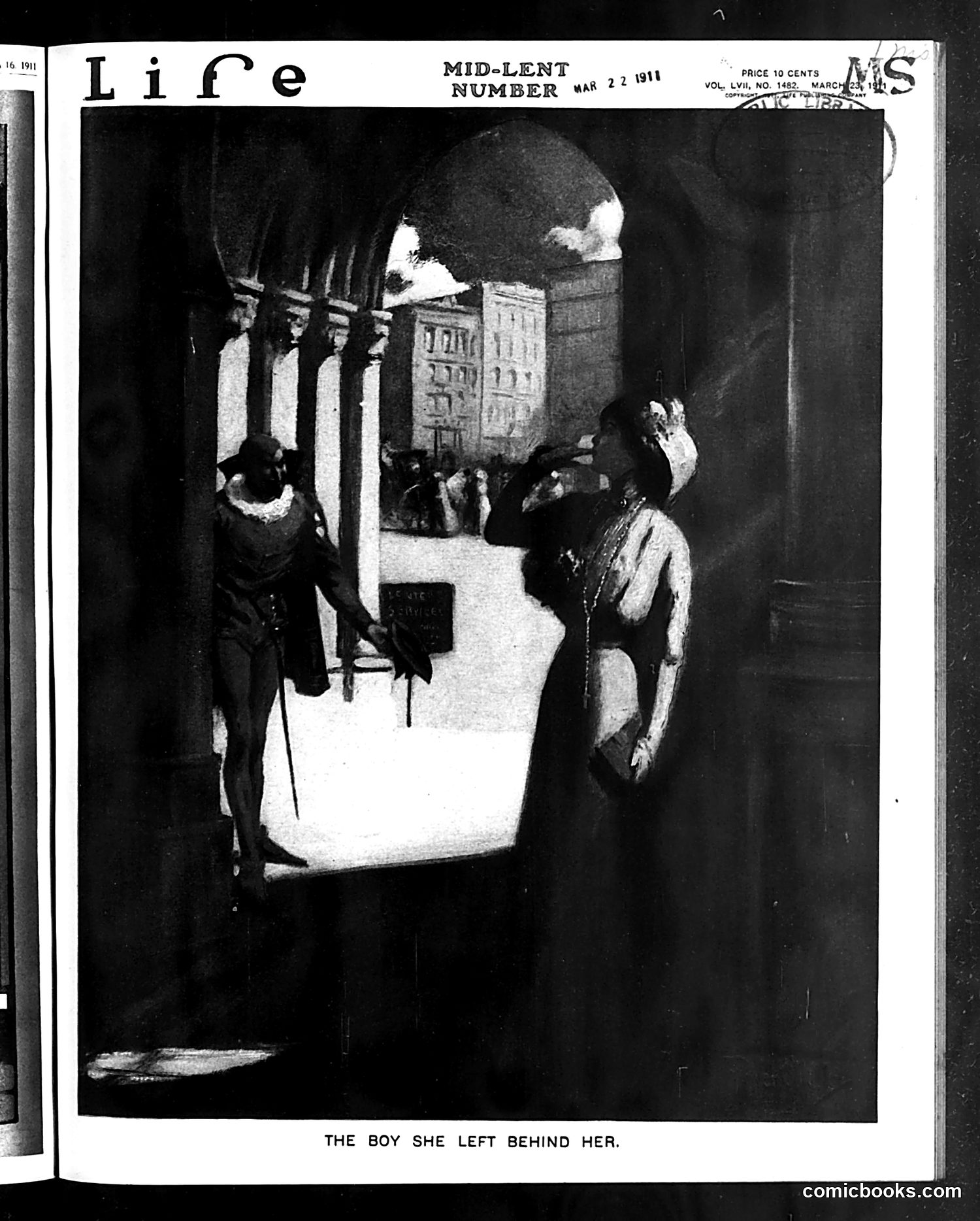
This is a Life magazine cover from March 22, 1911 depicting a dramatic scene titled "The Boy She Left Behind Her." The image shows a woman in early 1900s dress standing in a colonnade, gazing back at a figure left in shadow. Other figures populate the classical architectural setting. The caption and composition suggest a romantic or domestic narrative rather than political satire. Without additional OCR text from the magazine's interior or clearer identification of specific historical references, the exact meaning remains ambiguous. It appears to illustrate a sentimental story about separation or departure—possibly commentary on emigration, social mobility, or romantic choices common to early 20th-century popular culture. The title's phrasing suggests the woman has moved forward while someone remains behind.
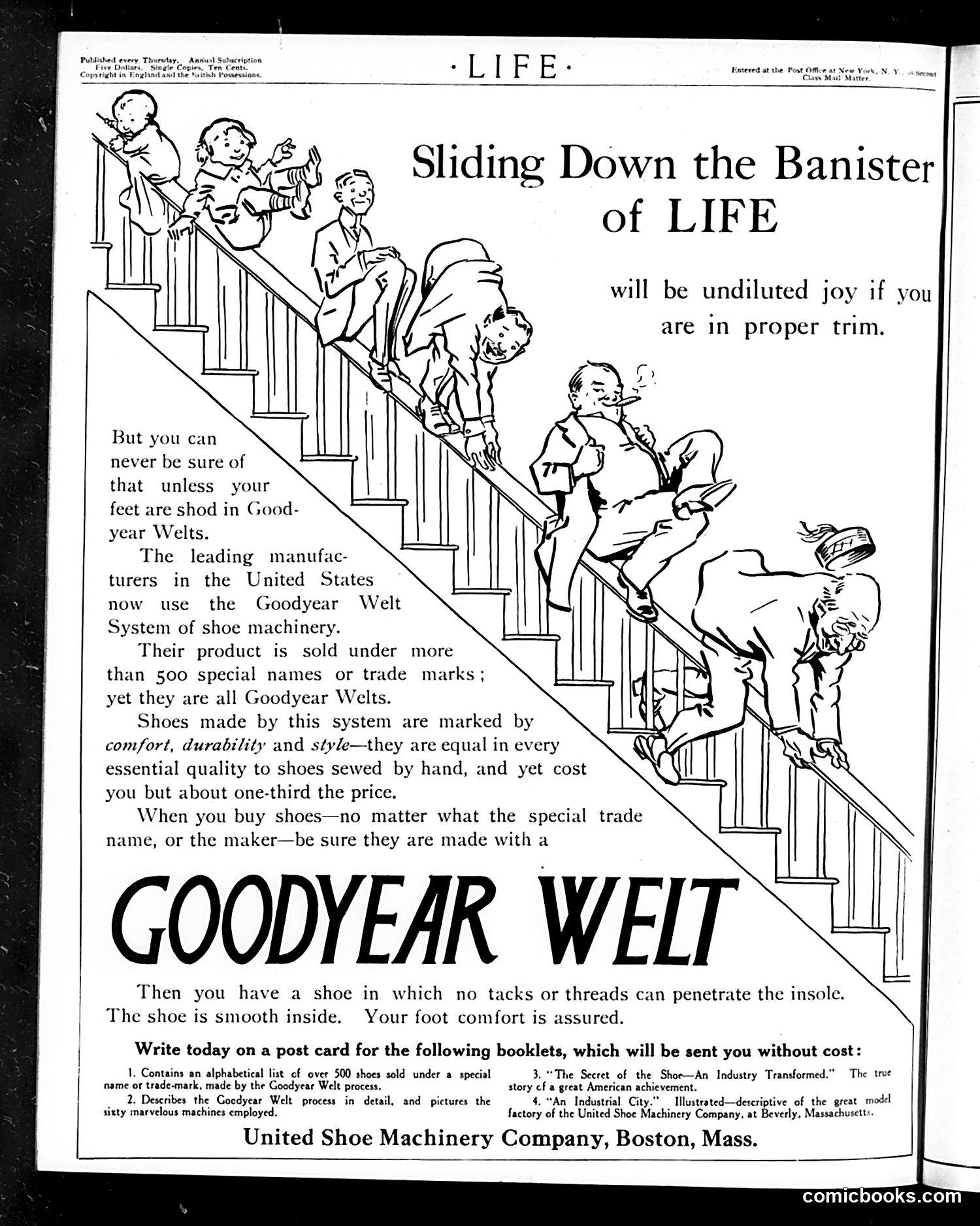
This page is **primarily an advertisement**, not satire or political commentary. It's a Goodyear Welt shoe advertisement from the United States Shoe Machinery Company (Boston, Massachusetts). The illustration depicts children of varying ages sliding down a bannister in sequence, metaphorically representing "sliding down the banister of LIFE." The ad argues that this journey "will be undiluted joy if you are in proper trim"—meaning with proper footwear. The advertisement promotes Goodyear Welt shoes, claiming they offer comfort, durability, and style at one-third the cost of hand-sewn alternatives. The pitch emphasizes that over 500 shoe brands use this manufacturing system, making quality footwear accessible to average consumers. The "satire" here is gentle wordplay rather than political commentary—using the playful image to sell practical products.
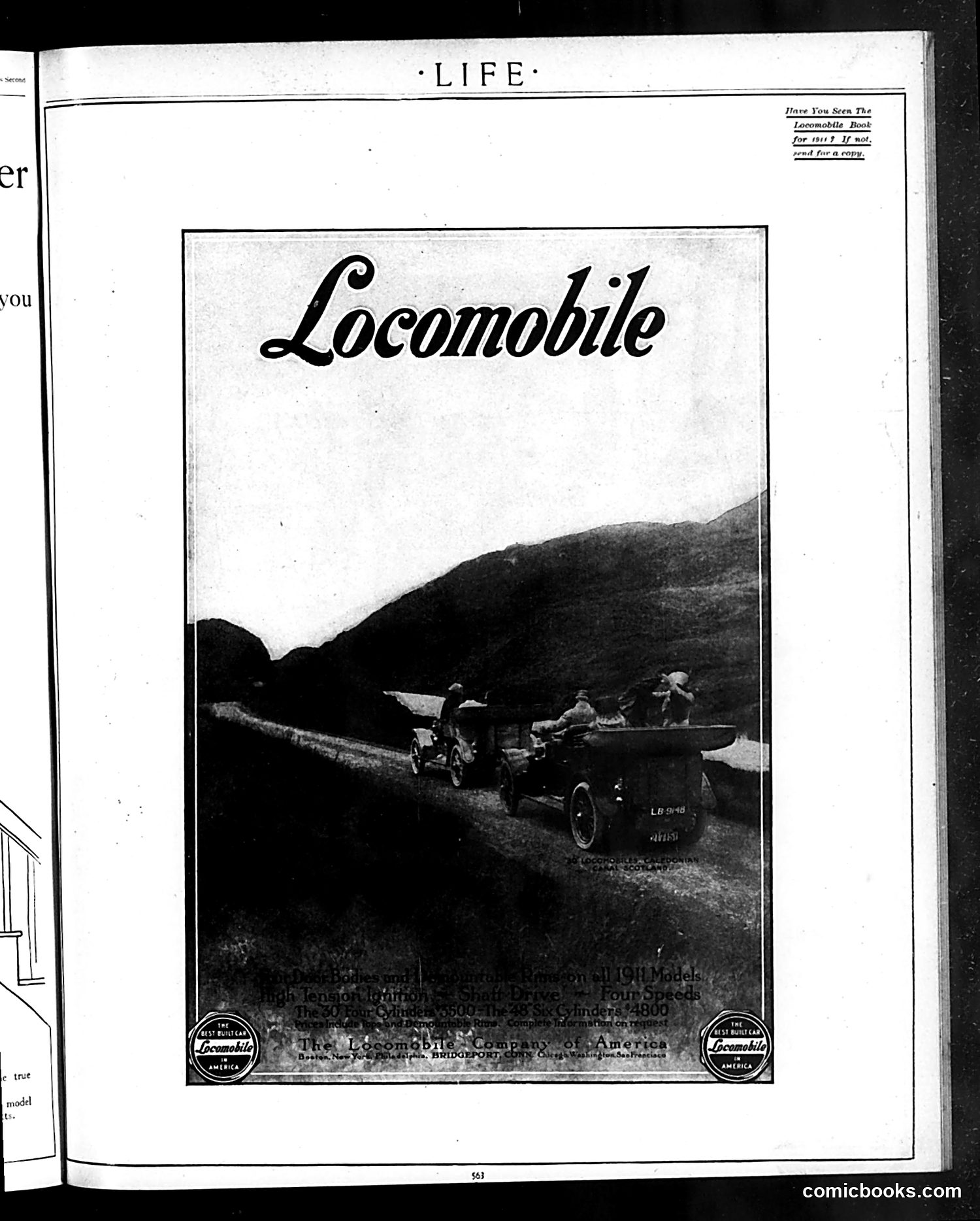
This page is primarily an **advertisement** for the Locomobile automobile, not political satire. The ad features a scenic photograph of early automobiles traveling through a mountainous landscape, showcasing the vehicle's touring capabilities. The Locomobile Company of America used this advertisement in Life magazine to promote their cars' reliability and performance for recreational travel. The image emphasizes leisure motoring—a relatively new concept in the early automotive era. The mountainous terrain and multiple vehicles suggest durability and comfort for extended journeys. This represents early 20th-century automobile marketing, targeting affluent readers of Life magazine who could afford luxury touring cars. The ad communicates status, adventure, and technological progress rather than making any political or satirical point.
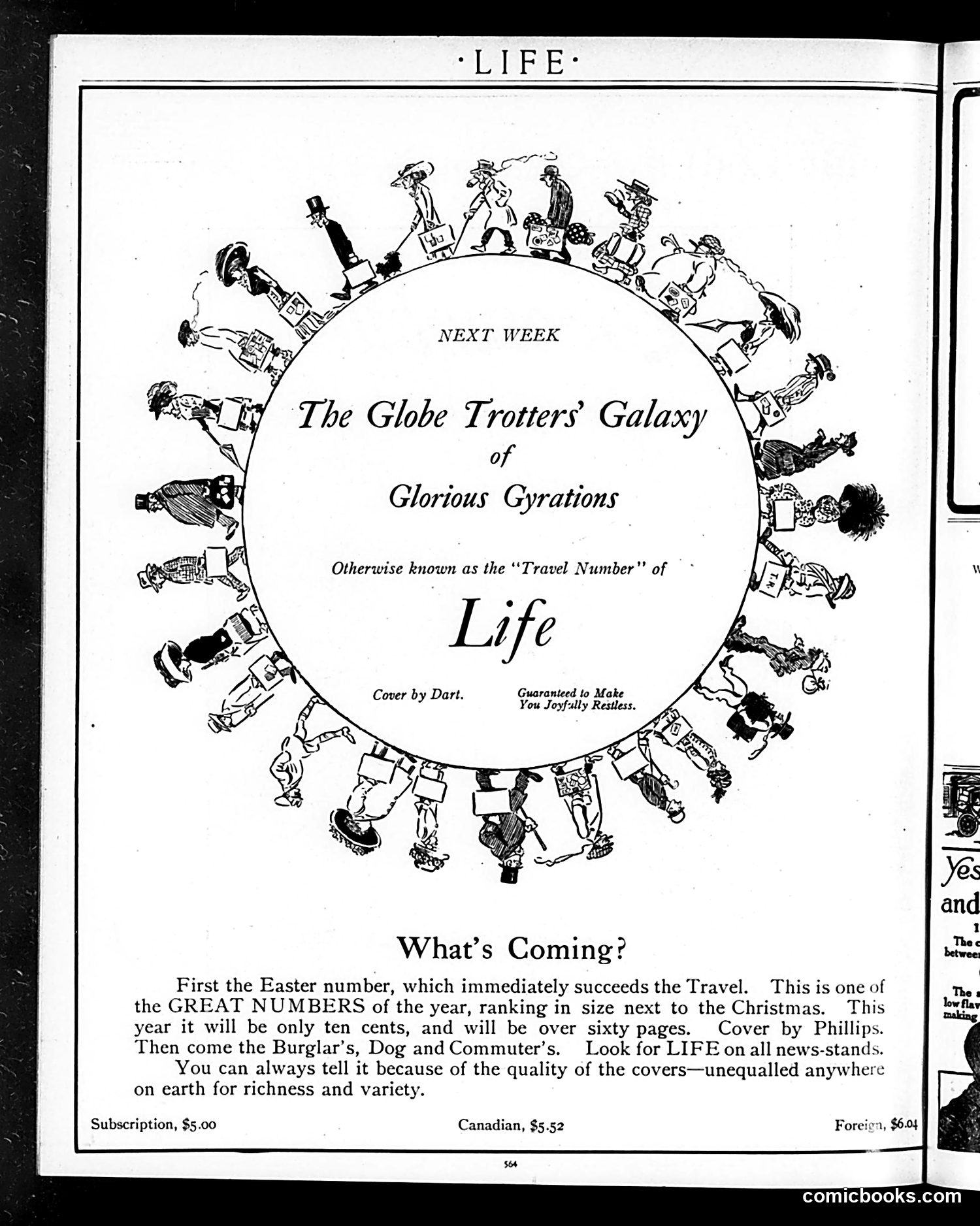
This is primarily a **house advertisement** for Life magazine's upcoming "Travel Number," not a political cartoon. The circular design features caricatured figures arranged around a globe, representing travelers in various comedic poses and costumes—suggesting different nationalities or travel stereotypes. The ad promotes Life's "Travel Number" as the next week's issue, calling it "The Globe Trotters' Galaxy of Glorious Gyrations." The text emphasizes this will be a major issue (following Easter, comparable to Christmas coverage), over sixty pages, with a cover by Dart. The surrounding figures appear to be generic travel-themed character types rather than specific political figures. This is primarily **commercial content** advertising the magazine's upcoming special edition to potential readers and subscribers.
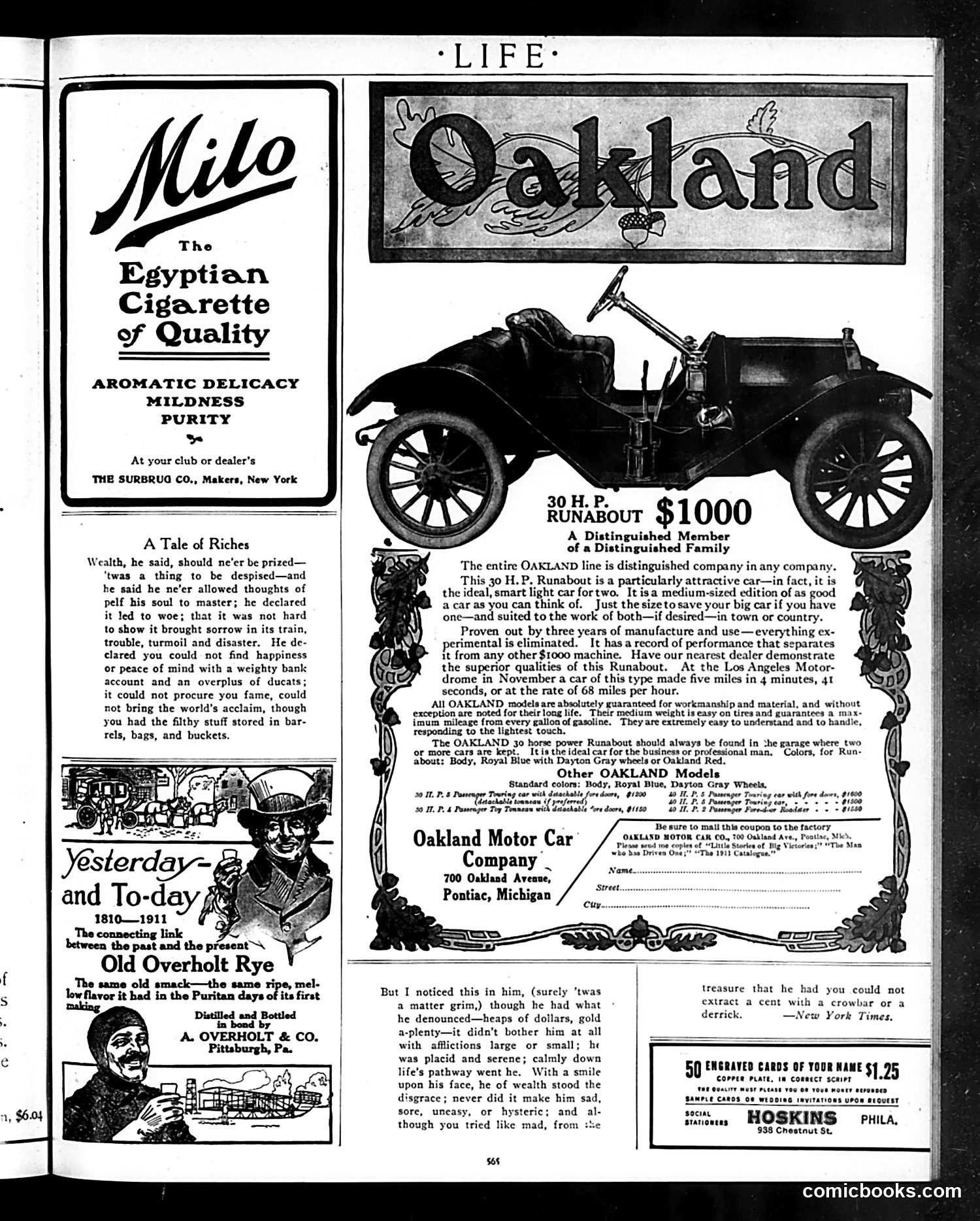
This page is primarily **advertising rather than political satire**. It features three main ads: 1. **Milo cigarettes** (Egyptian brand) emphasizing quality and mildness 2. **Oakland Motor Car** — a 30 H.P. Runabout priced at $1000, marketed as "a distinguished member of a distinguished family" 3. **Old Overholt Rye whiskey** with period imagery The Oakland ad includes a brief narrative snippet about wealth and character that appears unrelated to the automobile itself. The "Yesterday and To-day" whiskey ad uses nostalgic imagery contrasting past and present drinking culture. There's a small section on the right with what appears to be a story excerpt, but it's disconnected from the advertisements. This represents typical early 1910s *Life* magazine content — a mix of ads targeting affluent readers interested in automobiles, spirits, and luxury goods.
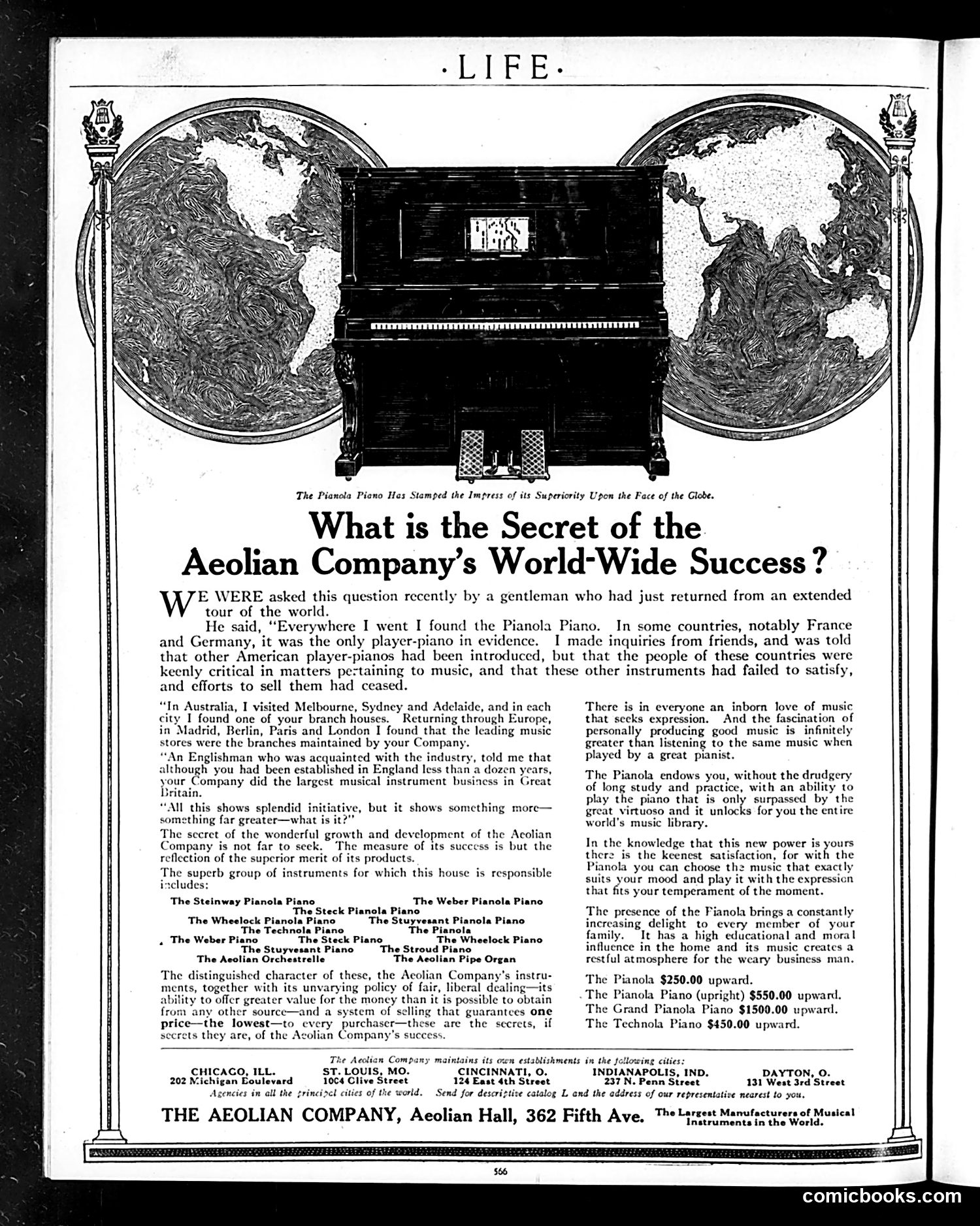
This is **not a cartoon or satire page**—it's a straightforward advertisement for the Aeolian Company's player pianos and related musical instruments. The page features two world maps flanking a central image of a Pianola piano, illustrating the company's claim to "world-wide success." The accompanying text is a testimonial format where a supposedly well-traveled gentleman describes finding Pianola pianos in music stores across France, Germany, Australia, and Britain—implying they dominate the global market. The ad emphasizes that player pianos democratize music performance, allowing anyone to produce professional-quality music without years of study. It lists various Aeolian instruments (Steinway, Weber, and Technola pianos, plus pipe organs) and their prices, positioning them as luxury goods for middle-class aspirants. This represents early 20th-century consumer advertising rather than editorial satire.
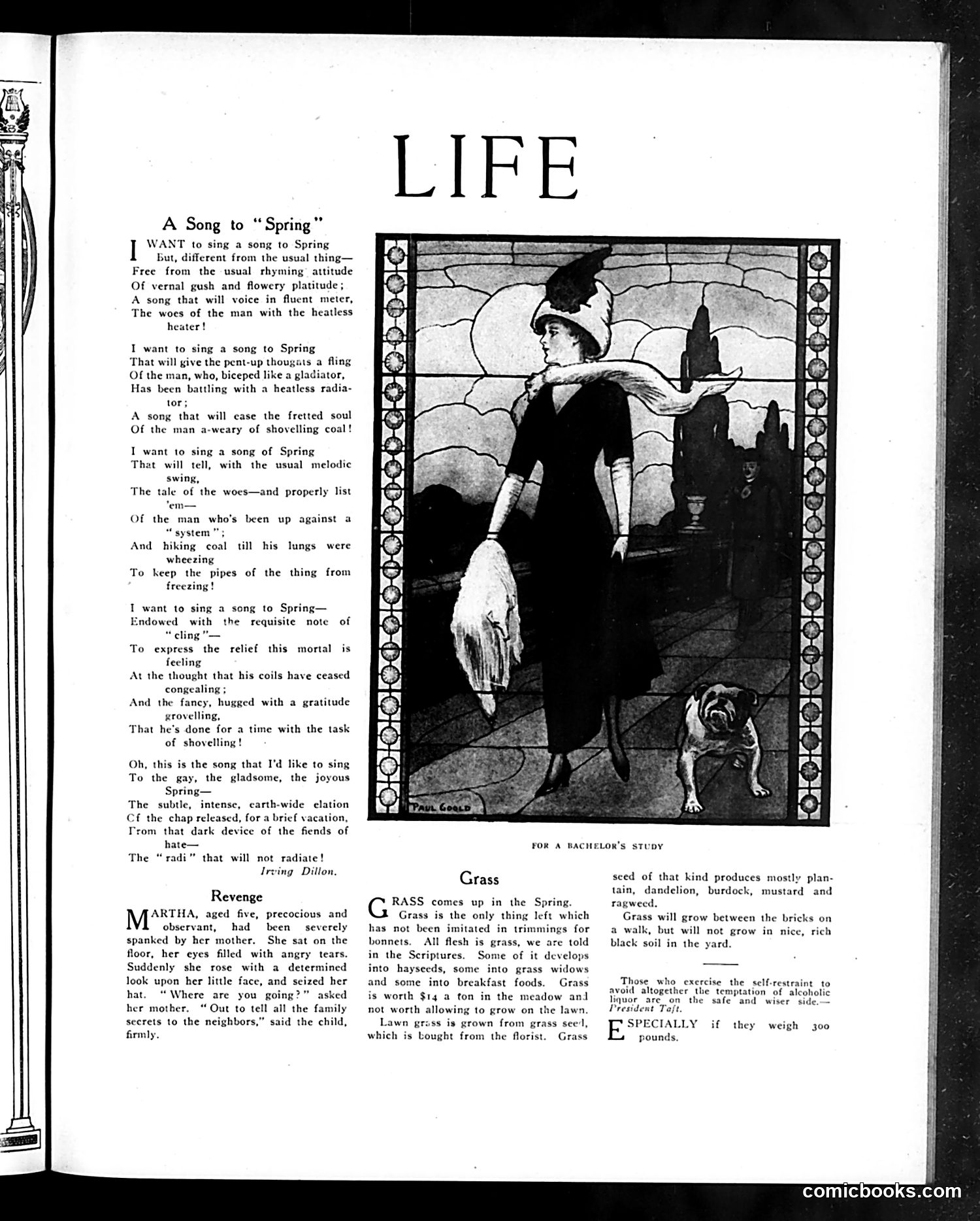
This page contains literary content rather than political satire. The left side features "A Song to 'Spring'" by Irving Dillon, a poem criticizing Spring as false comfort for working-class men suffering from harsh labor (coal shoveling, system work). It's social commentary on labor conditions dressed as verse. The main illustration titled "For a Bachelor's Study" shows a well-dressed woman with a dog, captioned to suggest she's a prospective romantic interest—likely satirizing bachelor lifestyle fantasies. Below are two brief prose pieces: "Revenge" (a domestic drama story) and "Grass" (discussing lawn care). Rather than political cartoons, this appears to be a typical Life magazine page mixing poetry, illustration, and short fiction with social observation—characteristic of early 20th-century American literary humor magazines.
This page critiques wealthy industrialists' attitudes toward money and labor. The text references **Mr. E.T. Martin's discourse** on how rich people view wealth as personal property rather than acknowledging workers' contributions. The article explicitly mentions **Mr. Carnegie** (steel magnate Andrew Carnegie) diffusing "cheerfulness" about dividend-generating steel bonds, contrasting this with the actual labor of "1,000 or 5,000 workmen." The cartoons (small illustrations visible) appear to satirize the disconnect between wealthy capitalists who passively collect dividends and the workers whose actual labor produces the wealth. The piece argues reformers should focus on ensuring fair wages and working conditions rather than attacking wealth itself—a Progressive Era debate about labor rights, capital, and social responsibility during early 20th-century industrial America.
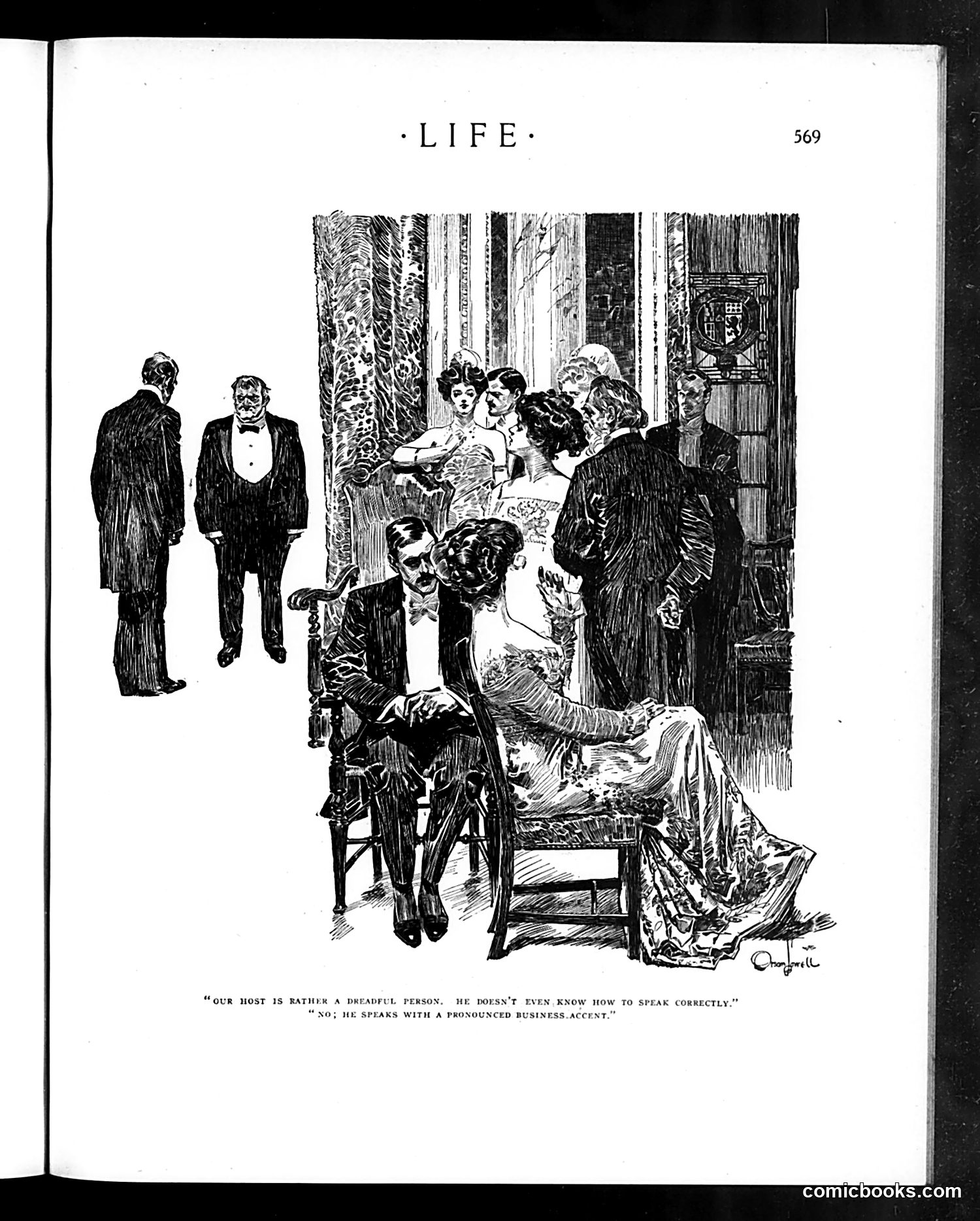
This single-panel cartoon depicts a formal social gathering—likely a wealthy household's salon or reception—where elegantly dressed guests converse. The central figure is a seated man in formal attire speaking with a woman in an elaborate gown. The caption reveals the satire: guests describe their host as "rather a dreadful person" who "doesn't even know how to speak correctly," yet paradoxically "speaks with a pronounced business accent." The joke targets American social pretension: wealthy businessmen of the period were often mocked for lacking proper genteel refinement despite their financial success. Their distinctive "business" speech patterns marked them as nouveau riche rather than established gentry—a source of both humor and social anxiety in early 20th-century American culture.
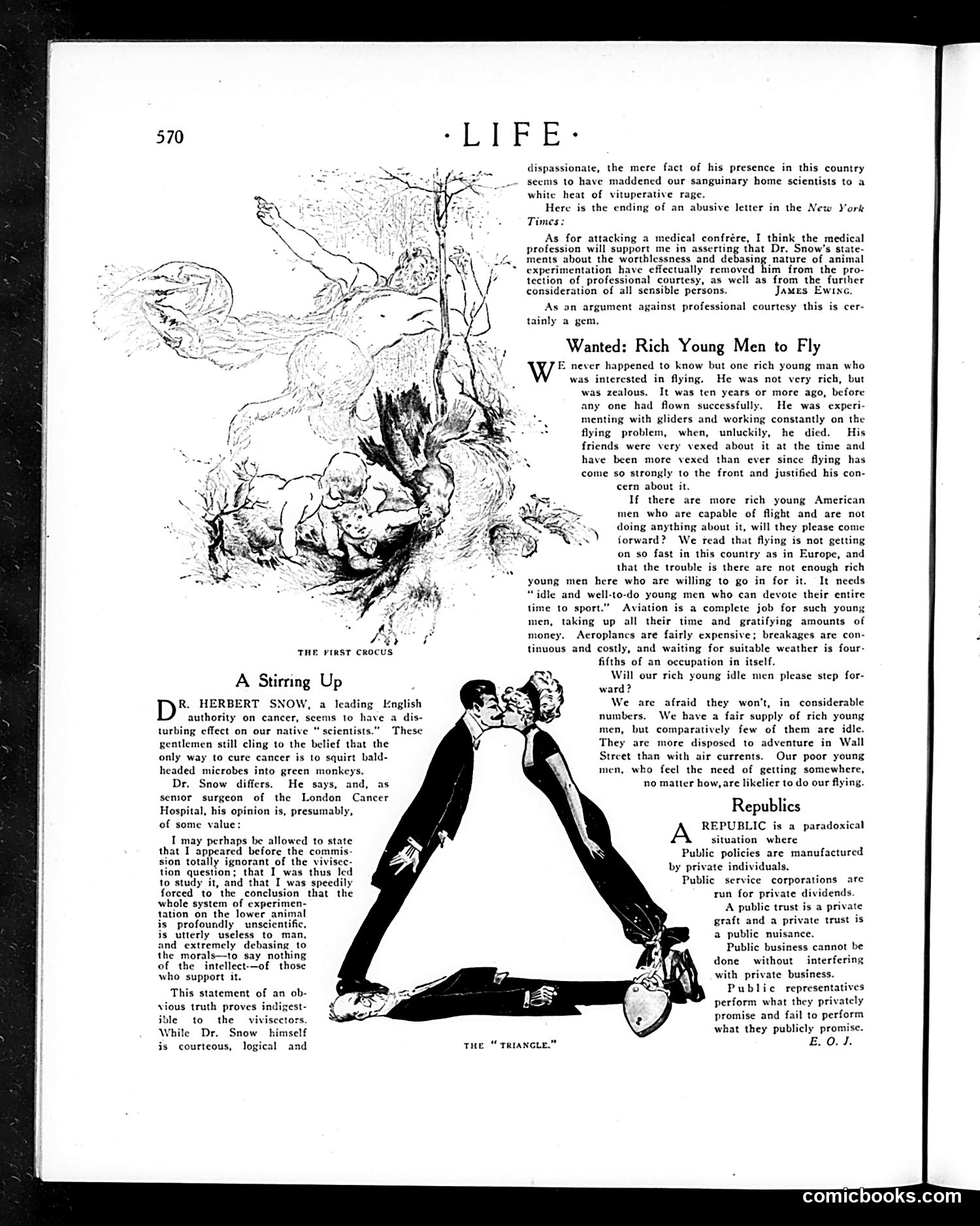
This page contains three distinct pieces: 1. **"The First Crocus"** (left illustration): A detailed sketch of early spring flowers, accompanying an article titled "A Stirring Up" about Dr. Herbert Snow, an English cancer authority, criticizing vivisection (animal experimentation). Snow argues animal testing is morally indefensible and useless for human medicine—a contemporary anti-vivisection debate. 2. **"The Triangle"** (center cartoon): Shows two men in a precarious balancing act on a unicycle, captioned "Wanted: Rich Young Men to Fly." The satire urges wealthy young men to fund aviation development, suggesting that only the independently wealthy can afford aviation's expensive, time-consuming demands—a commentary on early aviation requiring private financing. 3. **"Republics"** (right): A brief philosophical piece about paradoxes in public governance and private business interests.
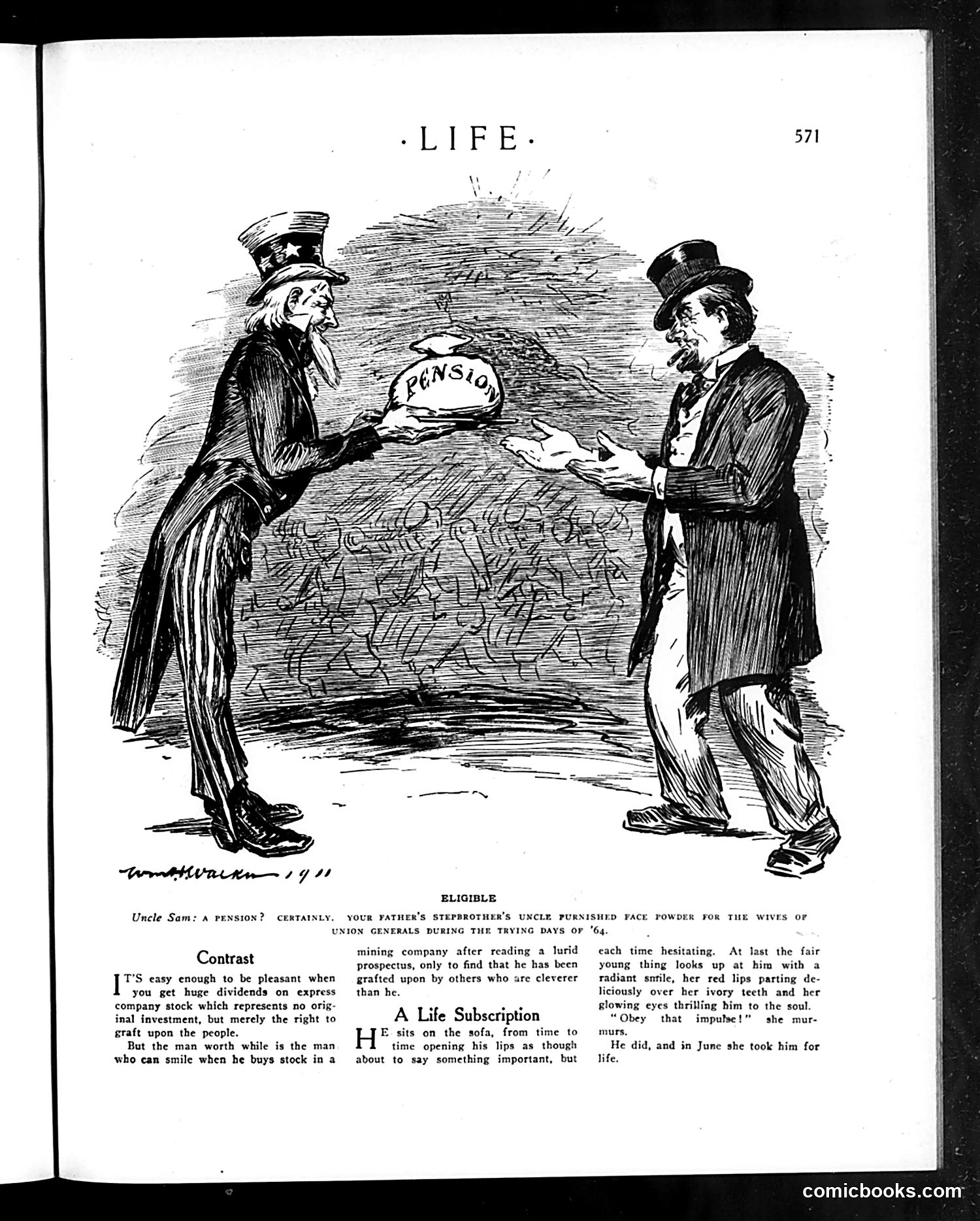
This cartoon depicts two men in top hats exchanging a bag labeled "PENSION." According to the caption, the figure on the left represents Uncle Sam, and the satire concerns pensions provided to the wives of Union generals during the Civil War era (specifically referencing "the trying days of '64"). The cartoon mocks what appears to be a financial transaction or deal involving military pensions. The joke suggests that Uncle Sam is distributing pensions somewhat carelessly or questionably—implying these payments may be going to undeserving recipients or representing wasteful government spending. The accompanying text discusses contrasting attitudes toward dividend income and stock investments, though the specific connection to the pension criticism isn't entirely clear from the visible OCR'd text.
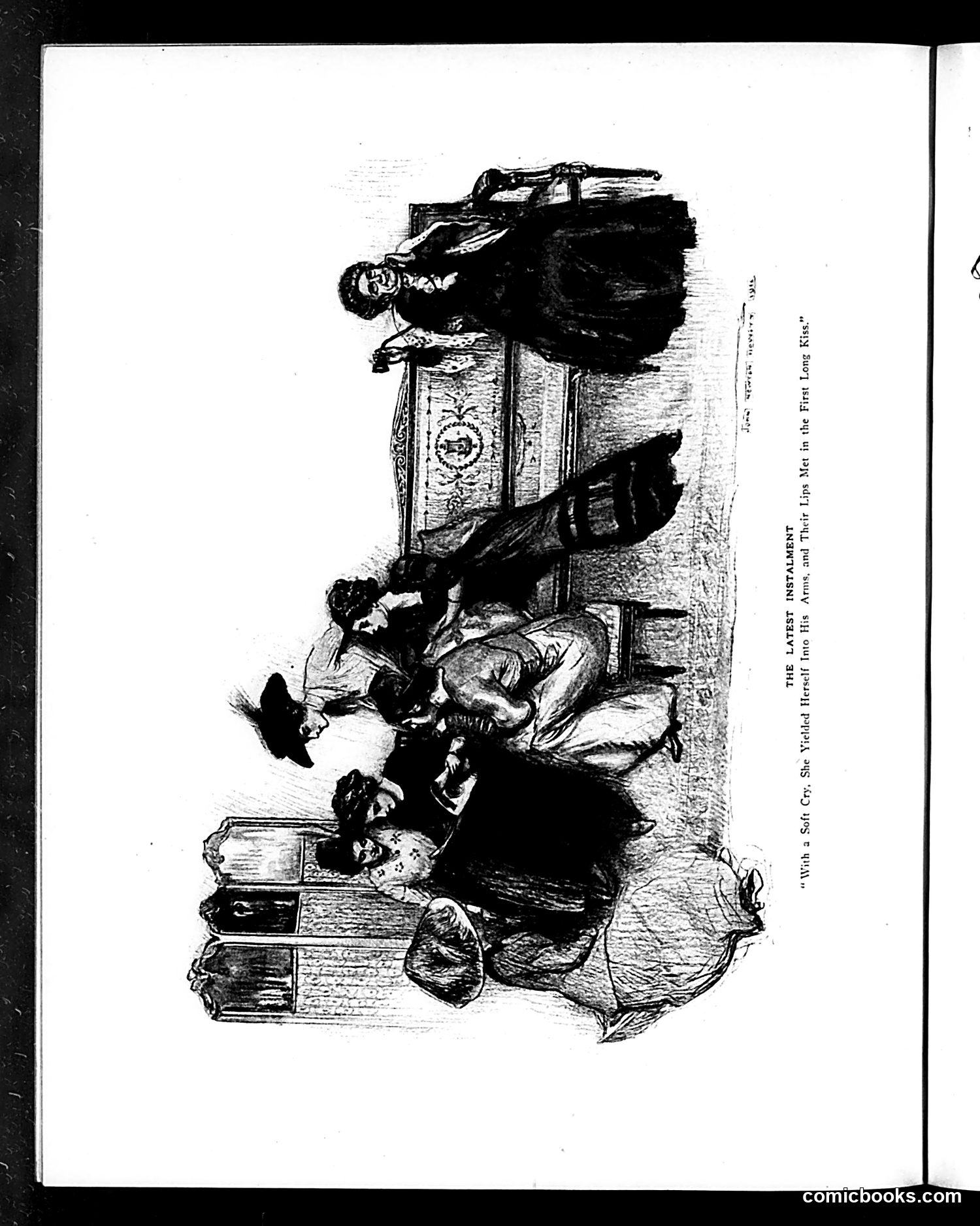
This is a single satirical illustration titled "THE LOVER'S FIRST BASKET" (visible in the right margin text). The image depicts a romantic scene turned absurd: a well-dressed gentleman stands atop a pedestal presenting a large decorative basket to a seated woman, while additional figures below appear to be reacting or assisting. The satire likely mocks Victorian courtship customs and the elaborate, performative nature of romantic gestures among the upper classes. The "basket" (possibly containing provisions or gifts) represents the ostentatious displays men made to impress women. The stacked composition with multiple figures suggests the social apparatus—servants, chaperones, or observers—required even in supposedly intimate moments. The humor targets the artificiality and excess of period romance rituals.
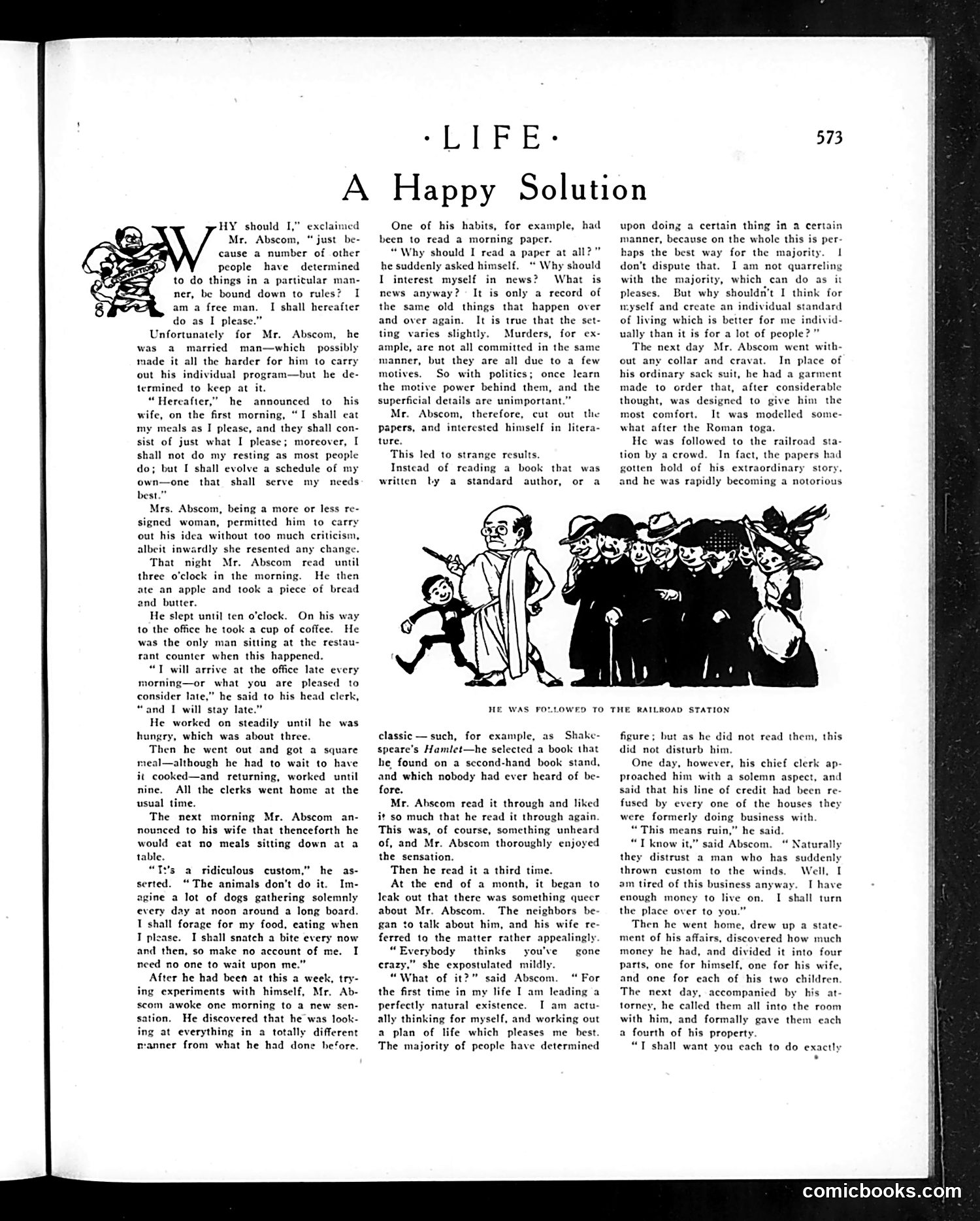
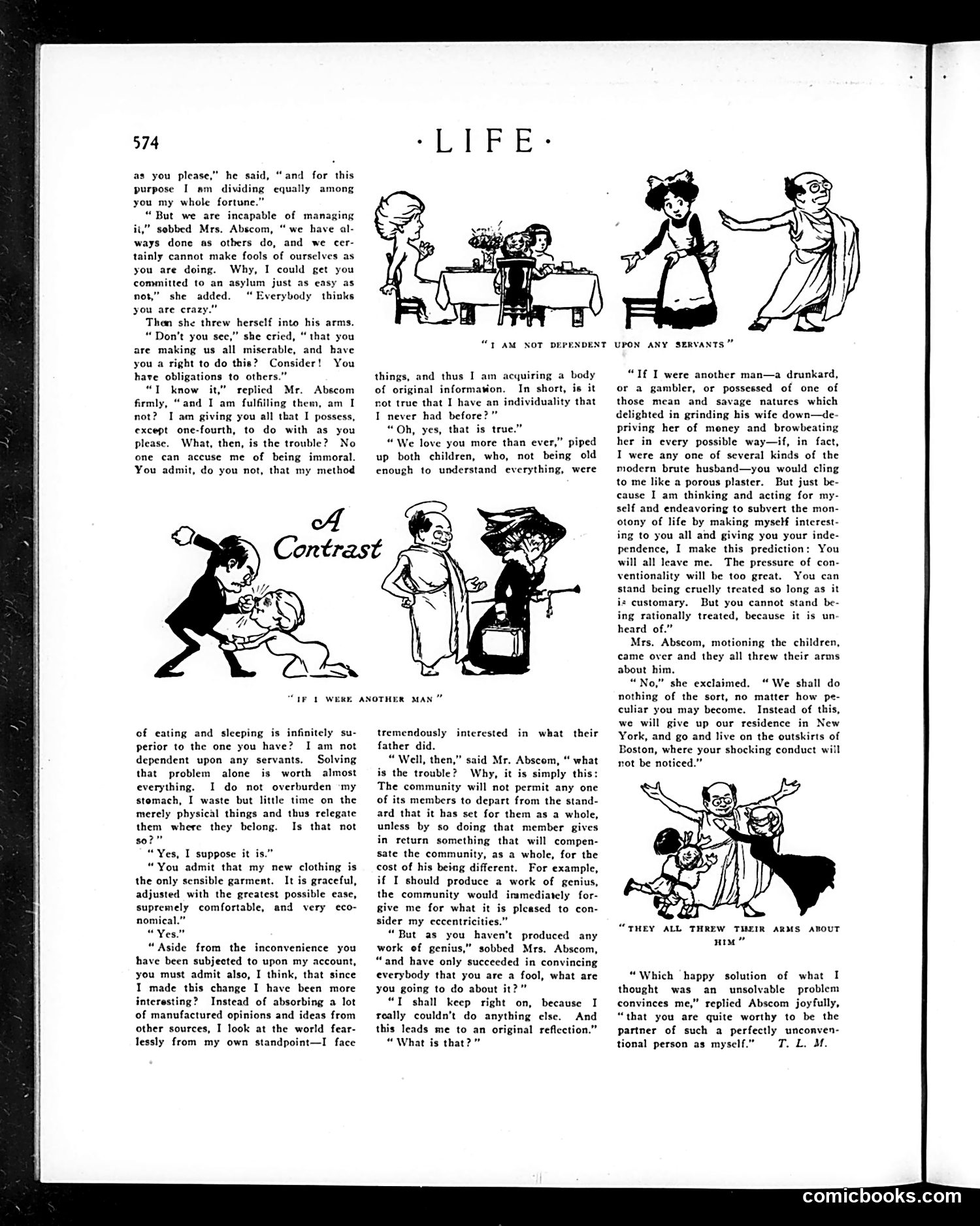
This appears to be a multi-panel satire about social conformity and individualism, centered on Mr. Abscom, who has rejected conventional living—wearing practical clothes, refusing servants, and thinking independently rather than absorbing "manufactured opinions." The cartoon's central irony: Abscom's wife and society would more readily tolerate a husband who is a "drunkard" or brute who "grinds his wife down" than one who simply acts independently and challenges social norms. The illustrations labeled "A Contrast" and "If I Were Another Man" visualize this hypocrisy. **The satire's point**: Society accepts and even enables conventional vices (drunkenness, cruelty) because they're customary, but punishes non-conformity and rationality as eccentricity or madness. Abscom's wife even threatens him with an asylum commitment simply for living differently—suggesting that independent thinking itself was viewed as pathological by early 20th-century conventional society. The piece critiques how conformity pressure, masked as propriety, actually enforces acceptance of genuine harm while rejecting harmless individuality.
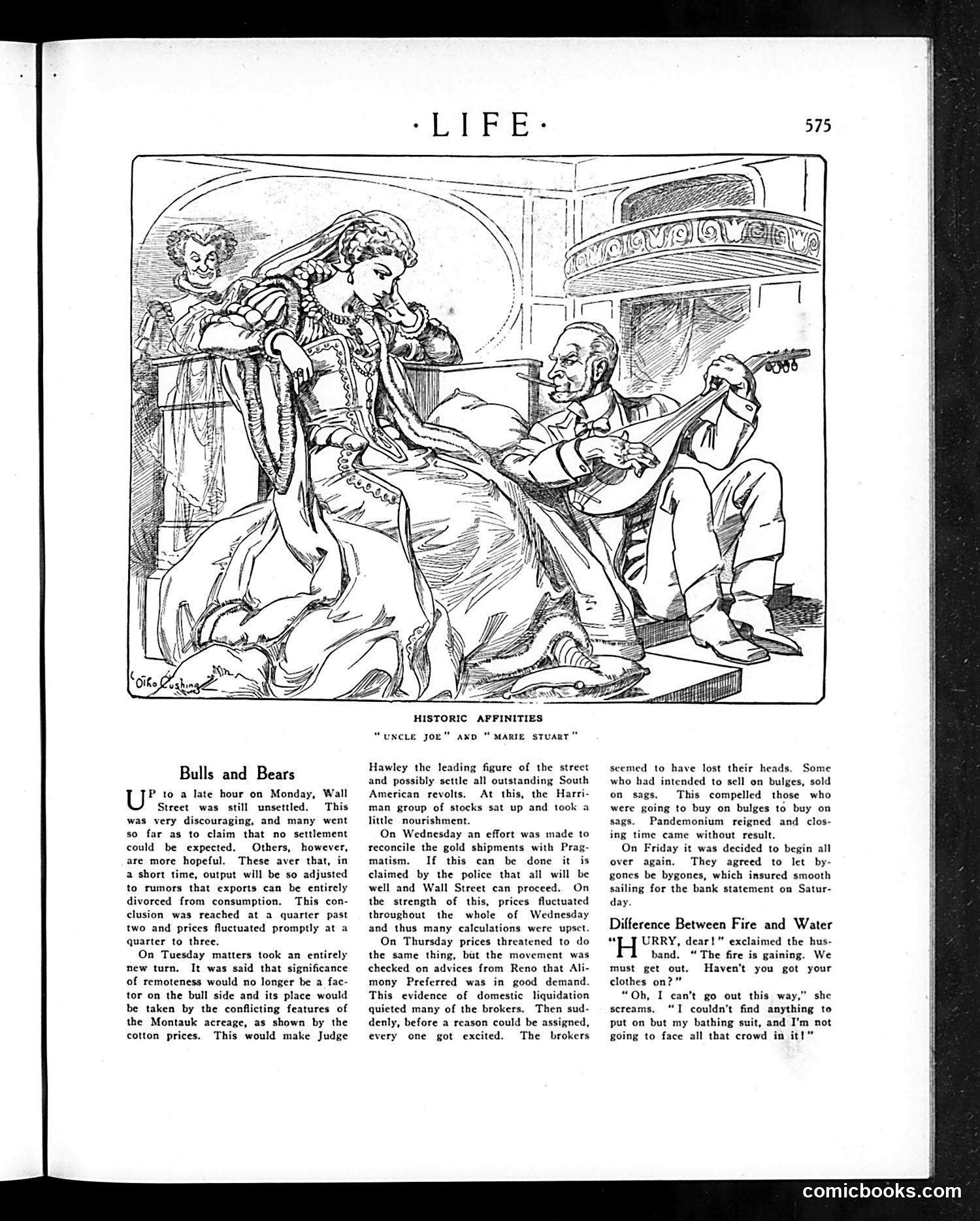
This page contains two satirical pieces from *Life* magazine: **"Bulls and Bears"** mocks Wall Street's volatility and traders' tendency to rationalize market movements through absurd logic. The text describes prices fluctuating based on nonsensical factors—"Montauk acreage," "Pragmatism," even "Alimony Preferred"—satirizing how brokers invent explanations for market swings rather than admitting random chaos. The humor lies in depicting financial markets as fundamentally irrational. **"Historic Affinities"** (the illustration above) appears to reference political figures as "Uncle Joe" and "Marie Stuart," though the specific identities remain unclear from the image alone. The cartoon satirizes historical or political parallels. **"Difference Between Fire and Water"** is a domestic comedy sketch where a wife refuses to evacuate a fire because she's wearing only a bathing suit and won't be seen publicly in it—prioritizing modesty over survival, a joke about Victorian-era social propriety.
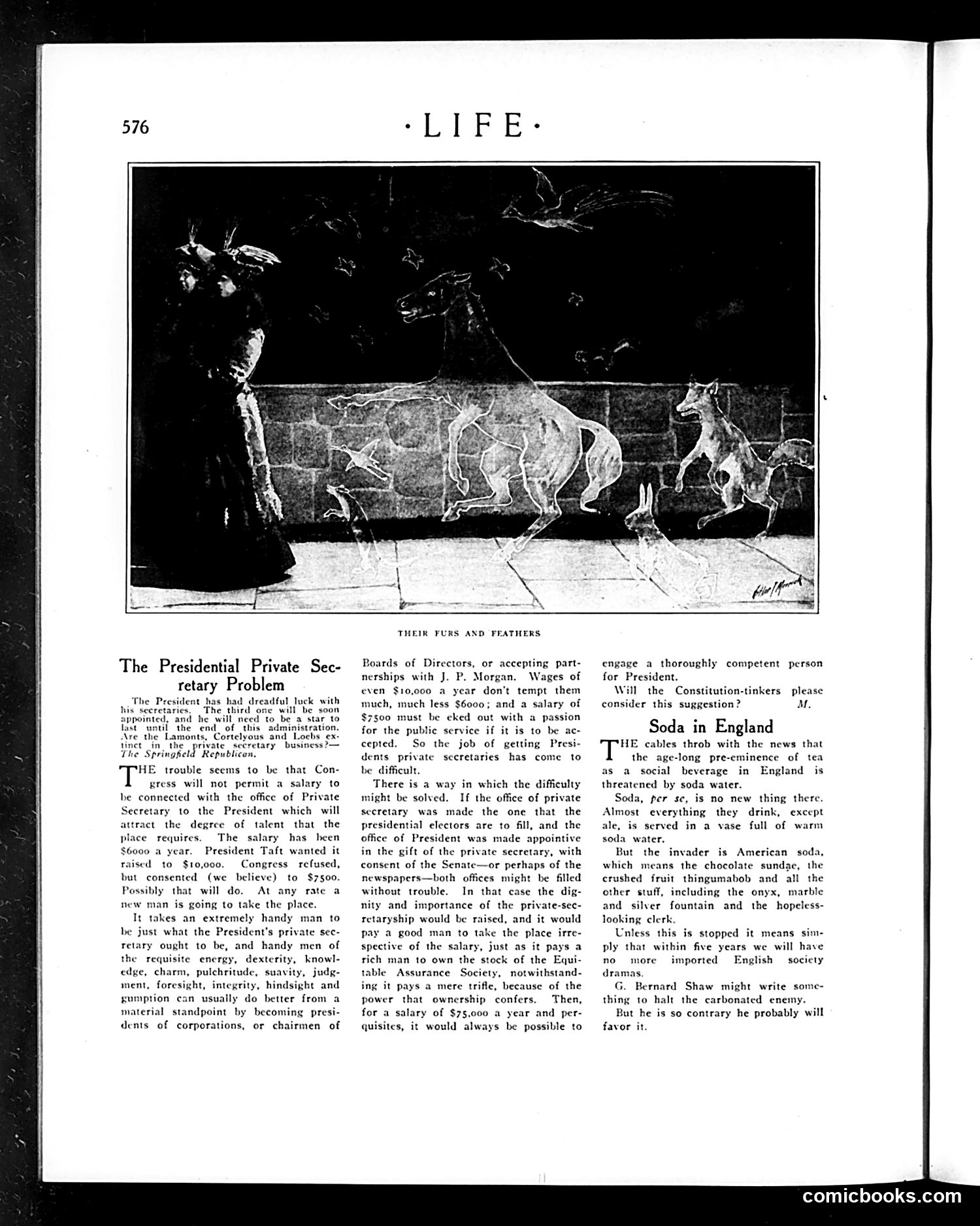
**The cartoon** (top) depicts a woman observing various animals performing tricks—likely satirizing the "private secretary problem" discussed below. The animals represent talented individuals being "trained" or managed, visualizing how difficult it is to find and retain qualified presidential secretaries. **Main article context**: President Taft's administration had experienced three private secretaries in quick succession. Congress refused adequate salary increases (staying at $6,000, later $7,500 rather than the requested $10,000), making the position unattractive to talented men who could earn more in corporate roles. **The satire's joke**: The article humorously proposes inverting the system entirely—making the private secretary's position the primary, powerful role (filled by presidential electors), with the President as an appointee. This absurdist solution mocks both Congress's penny-pinching and the genuine administrative problem. **Secondary item**: "Soda in England" satirizes American cultural invasion, suggesting carbonated beverages and soda fountains threaten England's tea tradition and theatrical culture—likely referencing period anxieties about American commercialism replacing European gentility.
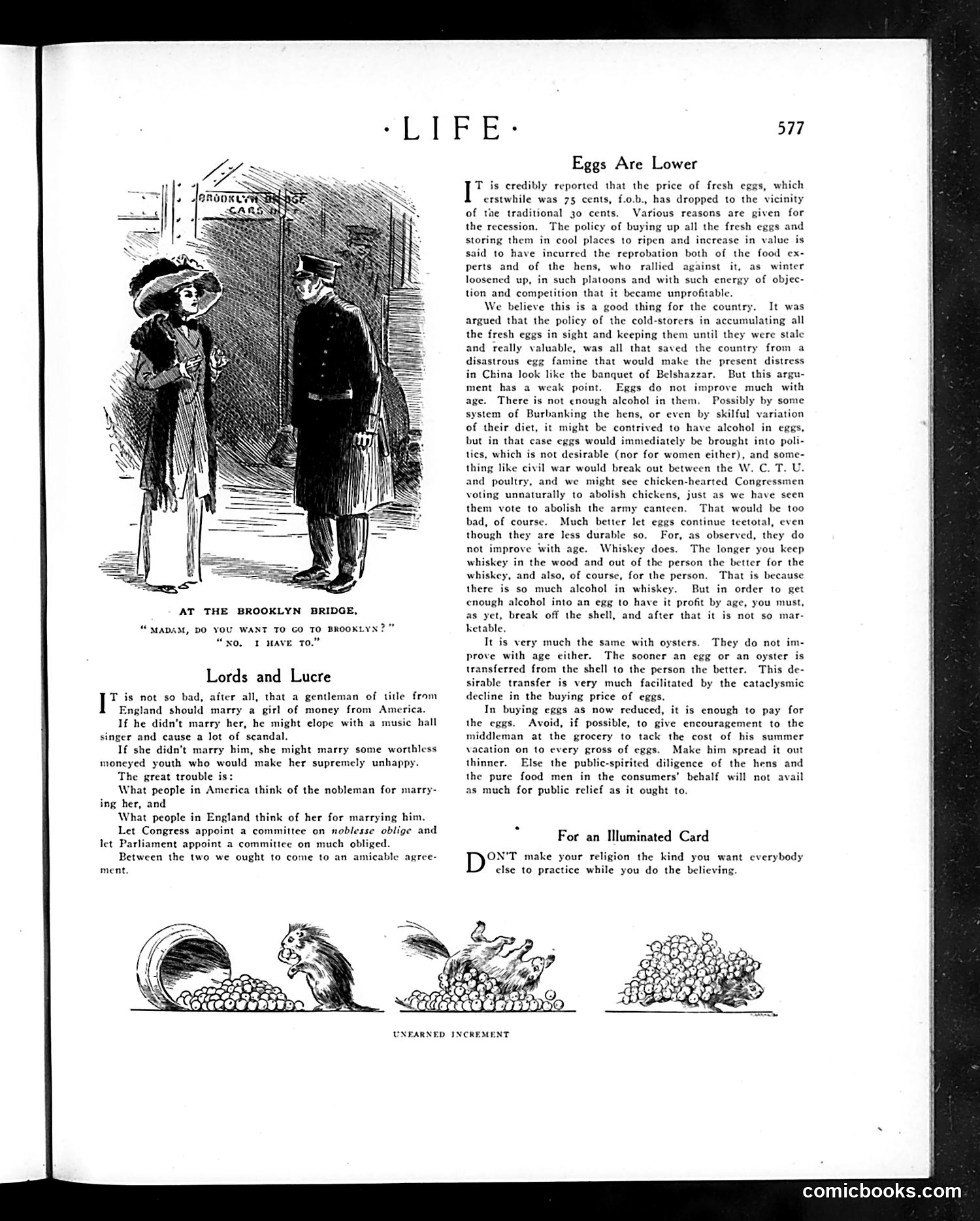
## "At the Brooklyn Bridge" Cartoon The sketch depicts a woman at the Brooklyn Bridge telling a man she doesn't *want* to go to Brooklyn but *has to*—likely a joke about reluctant obligation or marital duty, given the page's focus on transatlantic marriages. ## "Lords and Lucre" Section This satirizes marriages between English nobility and wealthy American heiresses. The piece mocks the hypocrisy on both sides: Americans resent the nobleman's mercenary motives, while the English resent the American woman's "new money" status. The proposed solution—Congressional and Parliamentary committees on "noblesse oblige"—is satirical commentary on how absurdly complicated societies treat such unions. ## "Eggs Are Lower" A humorous economic commentary on egg prices dropping from 75 cents to 30 cents. The author praises this, mocking previous speculation that hoarded eggs to inflate prices. The extended joke comparing eggs to whiskey (whiskey improves with age and alcohol content; eggs don't) is typical of Life's sophisticated, digressive humor style.
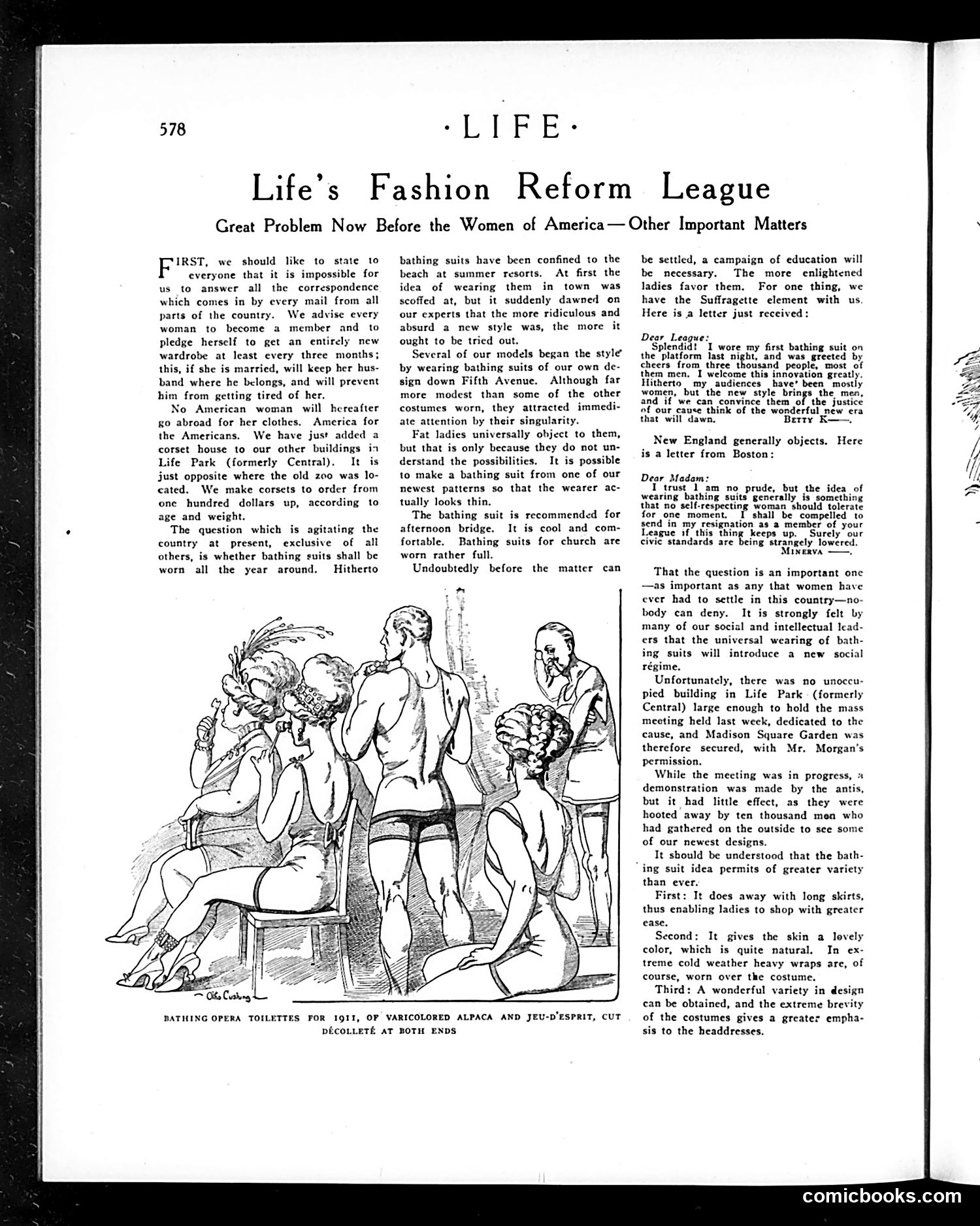
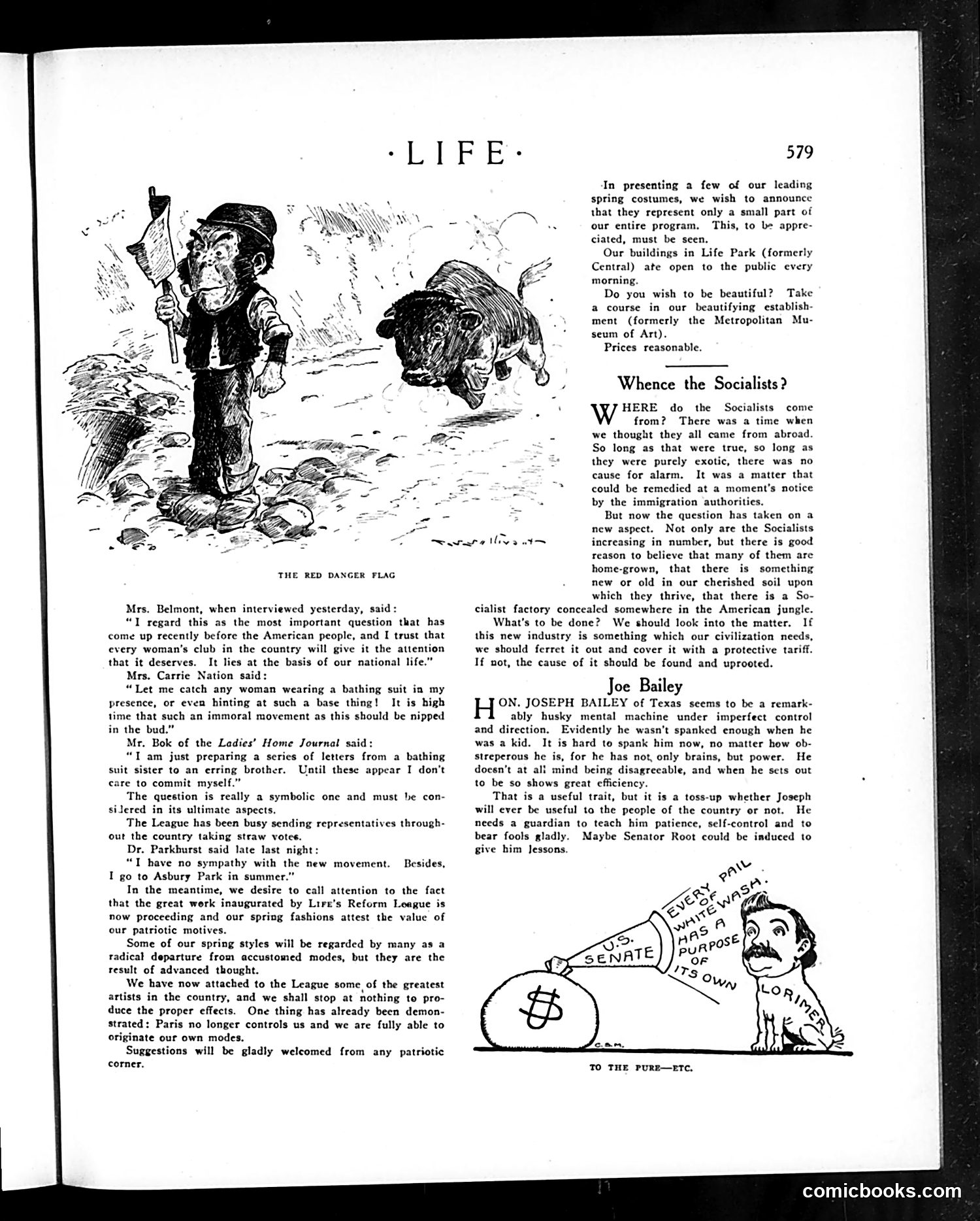
This 1909 *Life* page satirizes American moral panic through mock-serious commentary on women's bathing suits, presented as a national crisis. The "Red Danger Flag" cartoon depicts a figure waving a red flag at a charging bull—symbolizing how moral reformers (including prominent figures like Carrie Nation) are inflaming public hysteria over modest bathing-suit fashion as if it threatens civilization itself. The satire mocks the absurdity: respectable women's organizations treat swimwear as a matter of national importance worthy of "straw votes," while *Life* announces its own mock "Reform League" to combat this "immoral movement." The irony peaks when *Life* claims credit for spring fashions while declaring America finally independent from Paris fashion control—trivializing both the fashion industry and reform movements simultaneously. The "Whence the Socialists?" section shifts targets, mocking fears that socialism is somehow mysteriously spreading domestically rather than imported from abroad.
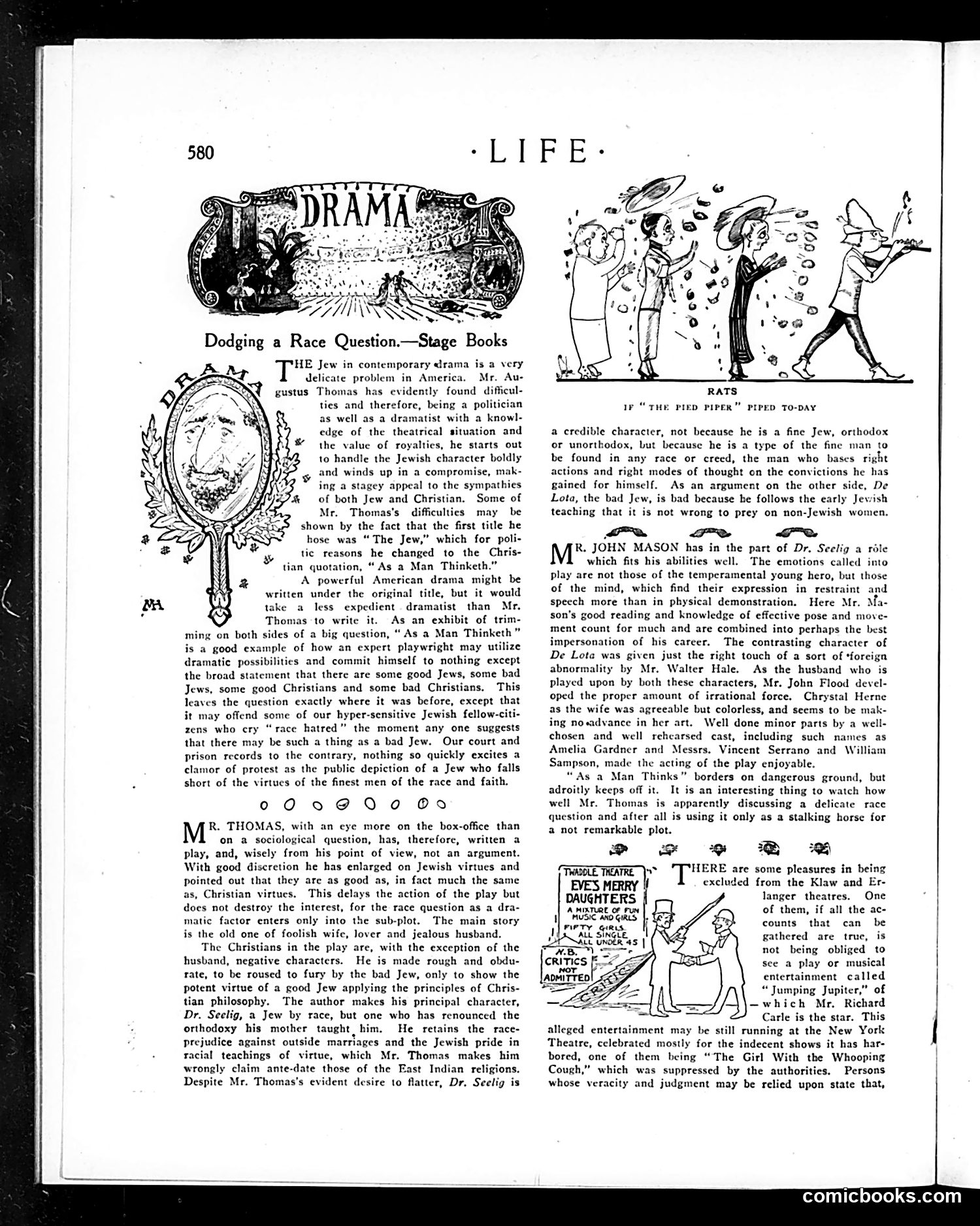
This page critiques playwright Augustus Thomas's play about a Jewish character, originally titled "The Jew" but renamed "As a Man Thinketh" for commercial reasons. The satire targets Thomas's political timidity: he avoided controversy by softening the original title, then presented a plot that makes moral points about Jewish virtue without genuinely engaging the "race question." The illustration labeled "If 'The Pied Piper' Piped To-Day" (upper right) appears to satirize how contemporary drama avoids substantive treatment of social issues—figures scatter in confusion rather than following a coherent path. Life criticizes Thomas for straddling both sides: the play contains "some good Jews, some bad Jews, some good Christians and some bad Christians," resolving nothing. The magazine suggests Thomas prioritized box-office appeal over honest dramatic exploration, appeasing both Jewish and Christian audiences while addressing no actual social problem. The critique exposes how commercial theater avoids meaningful engagement with contemporary prejudice.
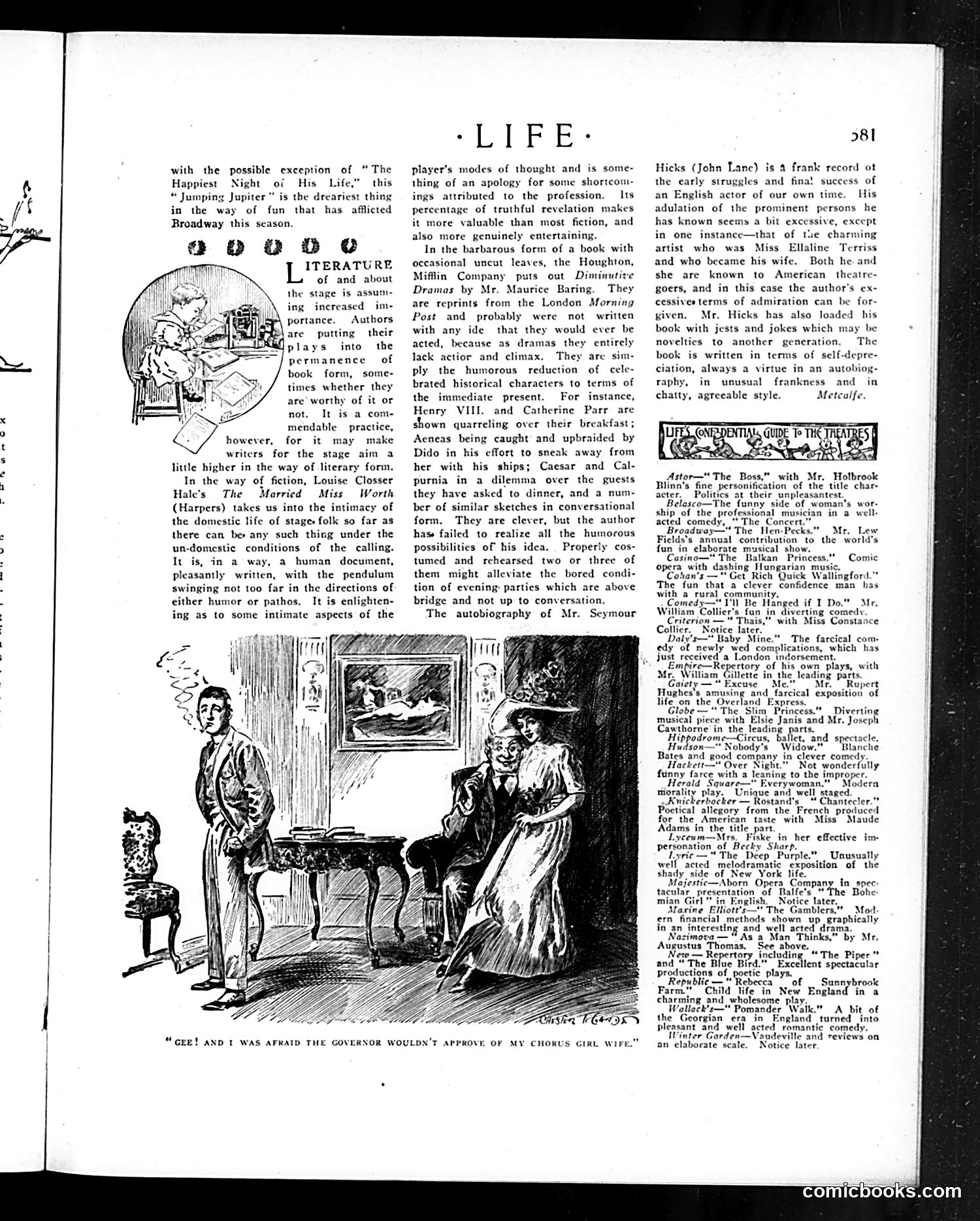
This is a **theater review and literary criticism page** from Life magazine (early 20th century). The main cartoon shows a man reassuring his wife about her past as a chorus girl, saying he was "afraid the Governor wouldn't approve"—a joke about social respectability. The implication is that marrying a chorus girl was once considered scandalous, especially to authority figures like governors, but the character is relieved it's acceptable. The accompanying text reviews recent Broadway plays and books about theatrical life, including Louise Closser Hale's novel about stage performers' domestic lives and Seymour Hicks's autobiography. The reviews note that theater folk led unconventional lives that fascinated the public. The page satirizes both the theater world's bohemian reputation and society's prudish attitudes toward entertainers—particularly chorus girls, who occupied an ambiguous social status between respectability and scandal.
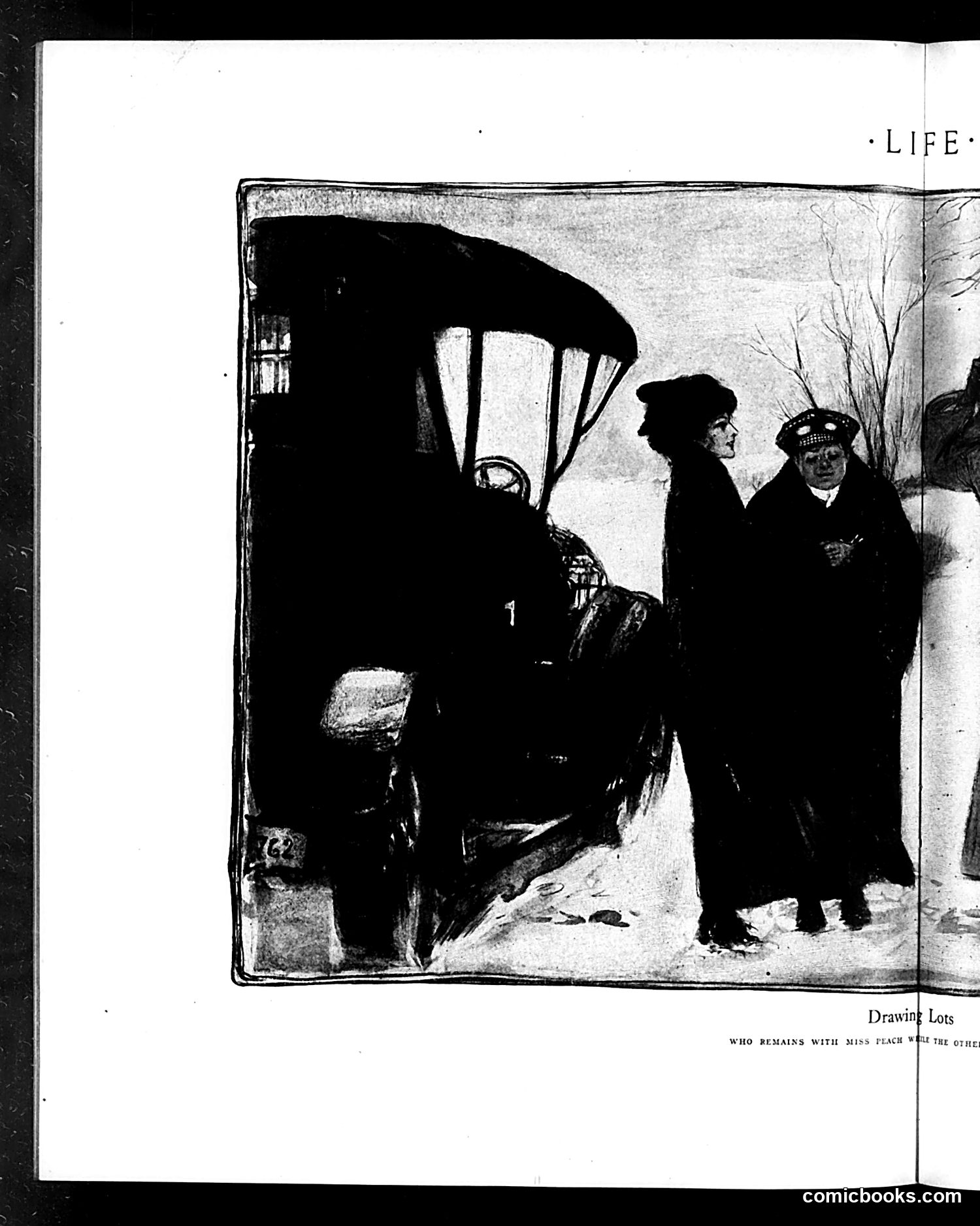
This appears to be a satirical cartoon from Life magazine depicting a scene where figures are drawing lots—a method of random selection, typically used to decide who must do something undesirable. The caption references "Miss Peach" and "the others," suggesting the cartoon comments on social dynamics, possibly regarding courtship, marriage prospects, or social obligation. Two men in hats stand outside what appears to be a carriage or enclosed space, while a woman inside looks out. The "drawing lots" mechanism suggests someone must remain with Miss Peach—implying this is an unwanted duty being decided by chance rather than volunteer. The satire likely mocks romantic or social conventions of the era, where remaining with an unappealing woman was portrayed as an unfortunate burden requiring random selection to assign fairly.
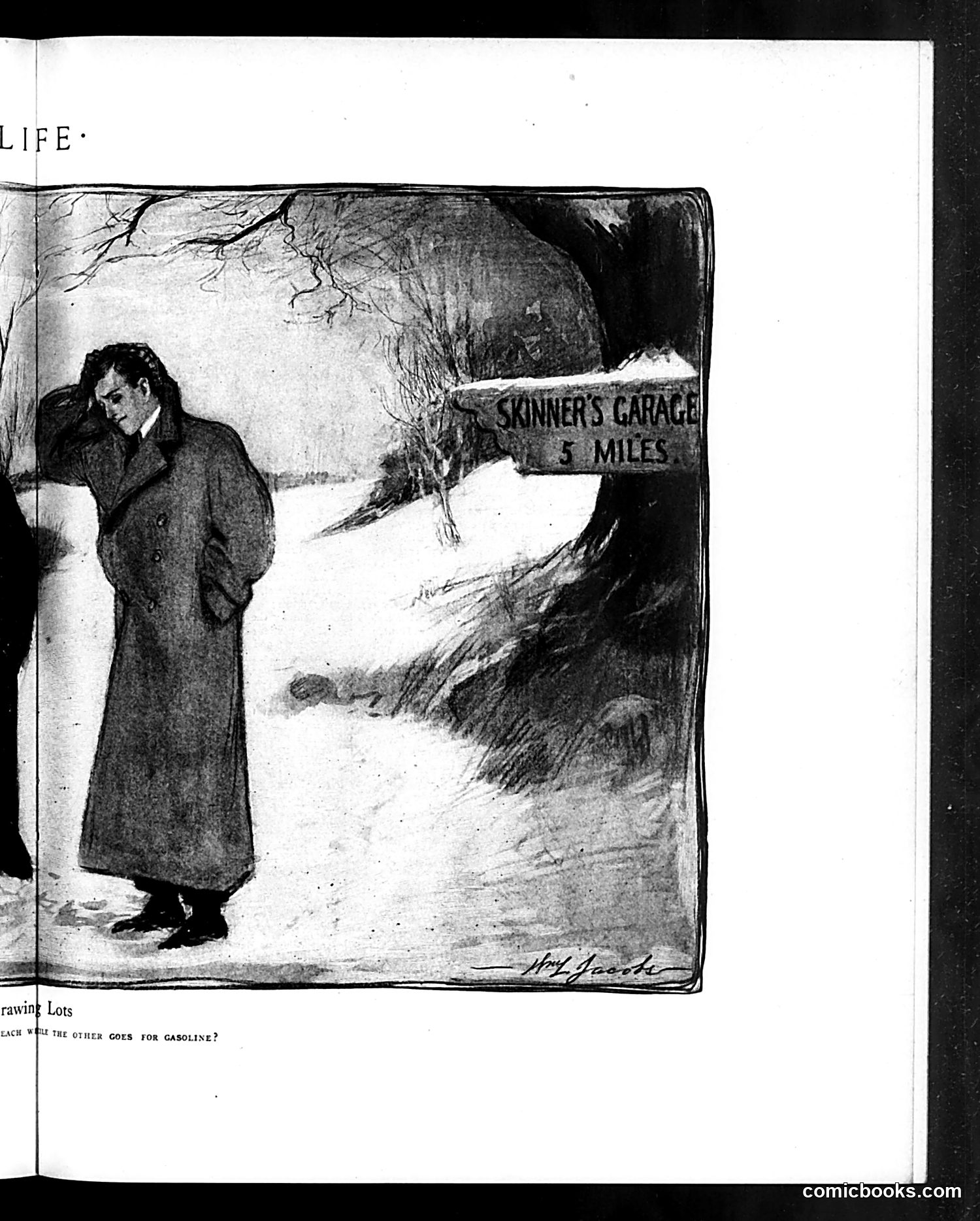
This cartoon depicts a man in a winter coat standing at a snowy roadside, looking at a sign reading "SKINNER'S GARAGE - 5 MILES." The caption asks "EACH WAY THE OTHER GOES FOR GASOLINE?" The satire concerns fuel scarcity or rationing, likely during wartime or economic hardship. The joke is that the stranded motorist faces a dilemma: whichever direction he walks to reach the garage (5 miles away), he'll use up gasoline just getting there and back—defeating the purpose of seeking fuel. It's commentary on an impossible situation where conservation efforts create catch-22 scenarios for ordinary people. The artist appears to be signed "Herb" at the bottom.
This is a book review section from *Life* magazine (page 584). The page contains two main reviews: 1. **Edward M. Forster's *Howard's End*** — The reviewer praises this novel's subtle, indirect storytelling approach. Rather than using obvious plot devices, Forster gradually reveals complex social relationships among three groups: daughters of a German scholar, the wealthy Wilcox family, and a culturally-minded but socially marginal young man. The reviewer notes the book received little recognition when published during the Civil War period but is now gaining deserved prominence. 2. **James Capen Adams's frontier memoir** — A reprinted 1856 account of "Grizzly Adams," a Massachusetts-born shoemaker-turned-California mountaineer who captured and tamed grizzly bears, later exhibiting them with P.T. Barnum. The reviewer calls this obscure frontier document an "American classic." The page emphasizes rediscovery of overlooked literary works.
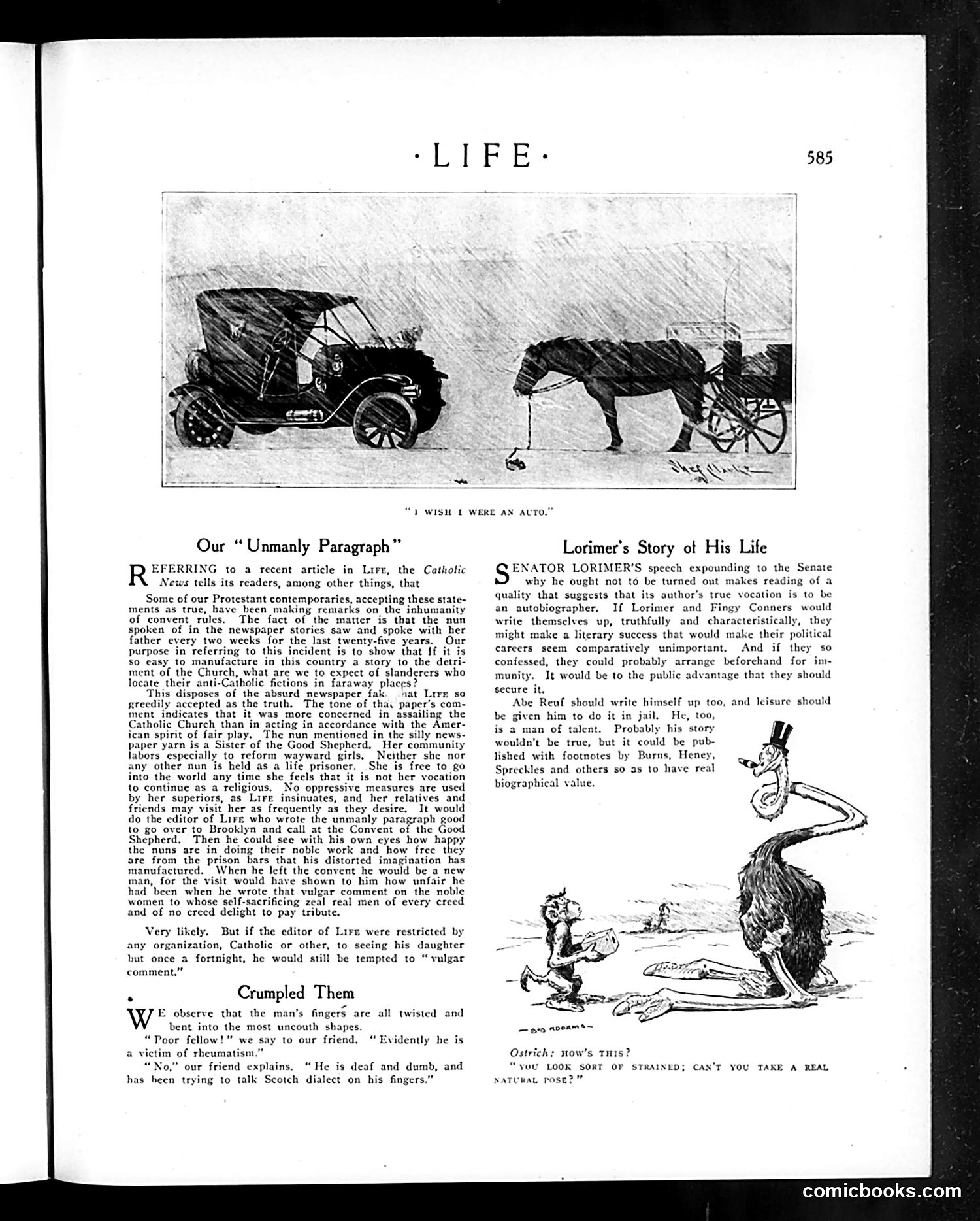
**Top Cartoon ("I Wish I Were an Auto"):** Shows a horse-drawn wagon beside an automobile—a simple visual joke about transportation modernization and the horse's envy of the newer technology. **"Our Unmanly Paragraph":** Life magazine defends Catholic convents against Protestant criticism, responding to reports of harsh treatment of nuns. The piece argues the original story was fabricated and attacks the competing publication's unfair reporting. **"Crumpled Them":** A brief joke about a deaf-and-dumb man attempting Scottish dialect through sign language, resulting in contorted fingers. **"Lorimer's Story of His Life":** Satirizes Senator Lorimer's self-defense speech to the Senate (likely regarding corruption allegations). The author suggests Lorimer and other implicated figures—including Abe Reuf and Fingy Conners—would be better suited as autobiographers than politicians. **Bottom Cartoon:** An ostrich struggling to maintain a "natural pose," likely satirizing forced artificiality or awkward public relations efforts.
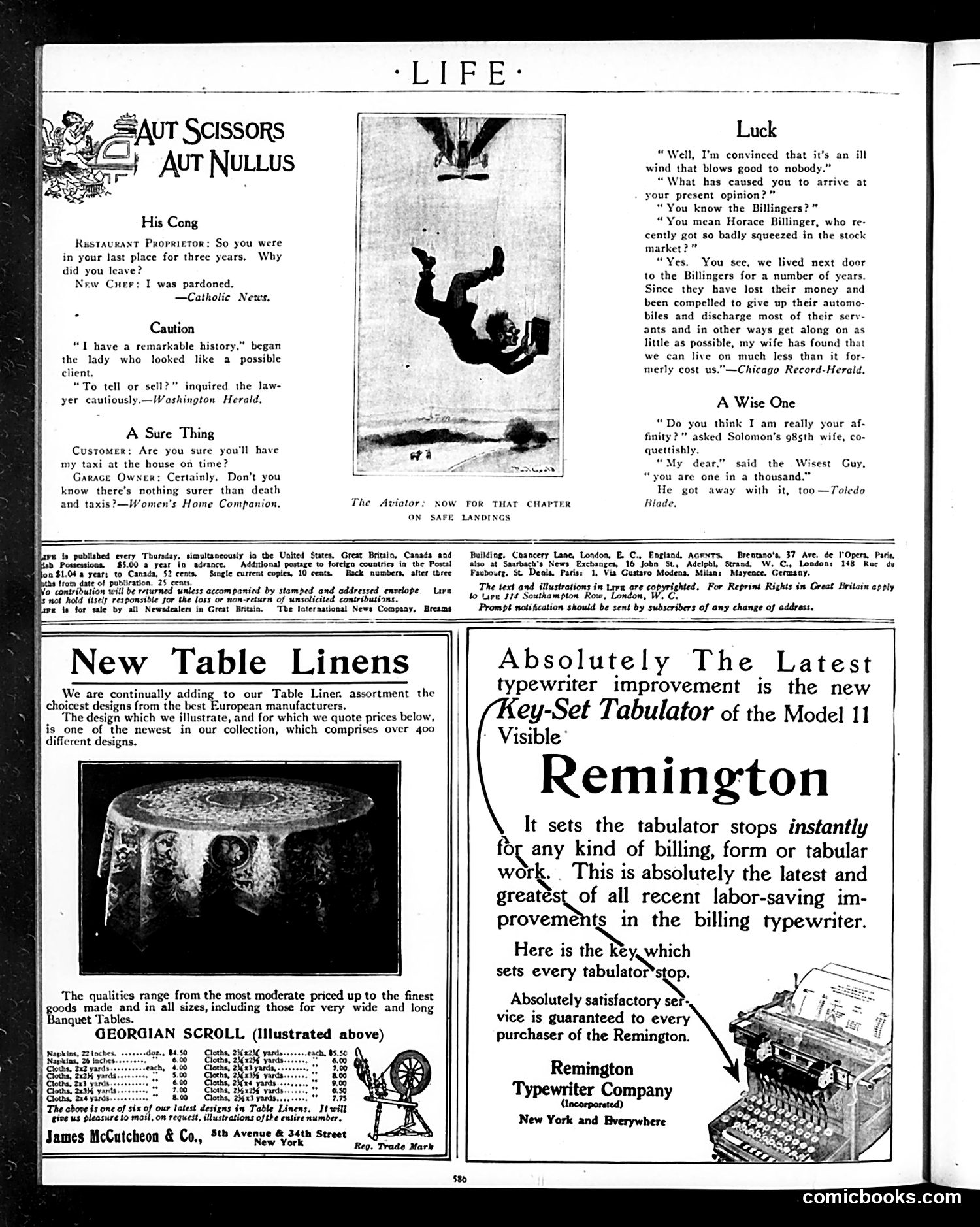
This page consists primarily of **short humorous anecdotes and advertisements** rather than political cartoons. The jokes satirize early 20th-century American social anxieties: - **"His Cong"**: A restaurant chef's casual mention of being "pardoned" from his last job darkly suggests criminal history, mocking both the chef's candor and hiring practices. - **"A Sure Thing"**: Contrasts the reliability of death and taxes with the unreliability of taxi service—common complaints about urban transportation. - **"Luck"**: Depicts wealthy neighbors (the Billingers) suffering financial ruin, allowing the narrator's wife to economize—satirizing schadenfreude and how economic hardship affects status-conscious middle-class households. - **"A Wise One"**: Solomon's quip to wife #988 relies on dated (and problematic) stereotypes about marriage. The page also advertises **table linens** and a **Remington typewriter's new "Key-Set Tabulator"** feature. The content reflects concerns of prosperous readers about servants, automobiles, and modern technology—typical Life magazine fare of this era.
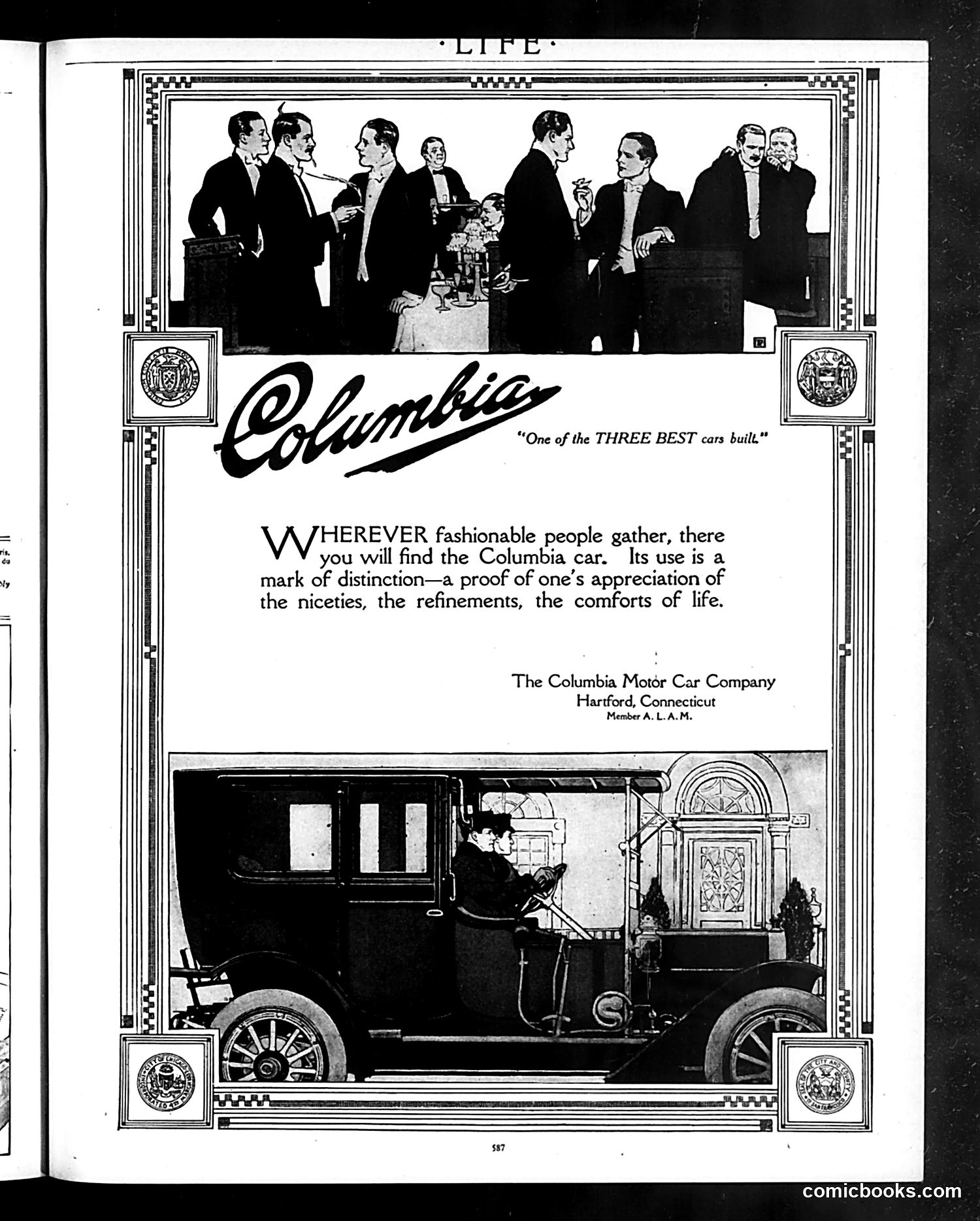
This is **not a political cartoon but a car advertisement** from Life magazine. It promotes the Columbia Motor Car Company of Hartford, Connecticut, claiming it's "one of the THREE BEST cars built." The ad uses social snobbery as its sales pitch: the Columbia is positioned as a status symbol for "fashionable people," marking the owner's appreciation for "refinements" and "comforts of life." The illustration shows a well-dressed driver arriving at what appears to be an elegant home, reinforcing aspirational, upper-class messaging. This reflects early automotive marketing targeting wealthy consumers, when owning a particular car brand signaled social standing. The rhetoric—equating car ownership with refinement and distinction—was typical of 1920s-era luxury goods advertising.
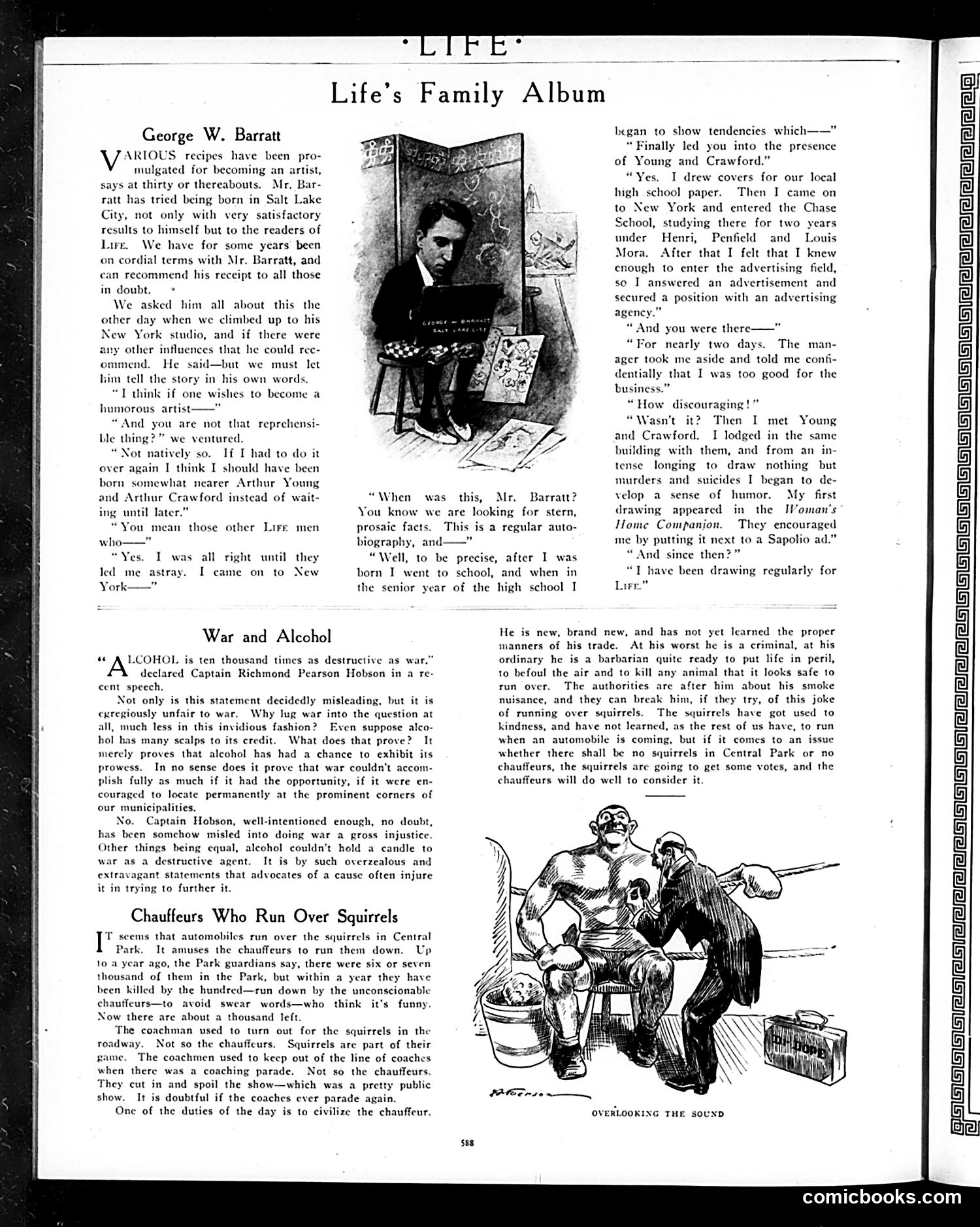
This page features three distinct pieces: **"Life's Family Album: George W. Barratt"** is an interview with a humorous artist/cartoonist. Barratt discusses his path to becoming a satirical illustrator for *Life*, mentioning mentors Arthur Young and Arthur Crawford (fellow *Life* contributors). The sketch shows him at work in his studio surrounded by drawings. **"War and Alcohol"** sarcastically critiques Captain Richmond Pearson Hobson's claim that alcohol is "ten thousand times as destructive as war." The author argues this comparison unfairly diminishes war's destructive capacity—essentially mocking Hobson's temperance advocacy by suggesting war could be equally or more destructive if given the same opportunity. **"Chauffeurs Who Run Over Squirrels"** reports a genuine problem in Central Park: automobile chauffeurs deliberately running over squirrels for amusement, reducing the population from 6,000-7,000 to about 1,000 in one year. The accompanying cartoon (captioned "Overlooking the Sound") satirizes wealthy people's indifference to animal cruelty.
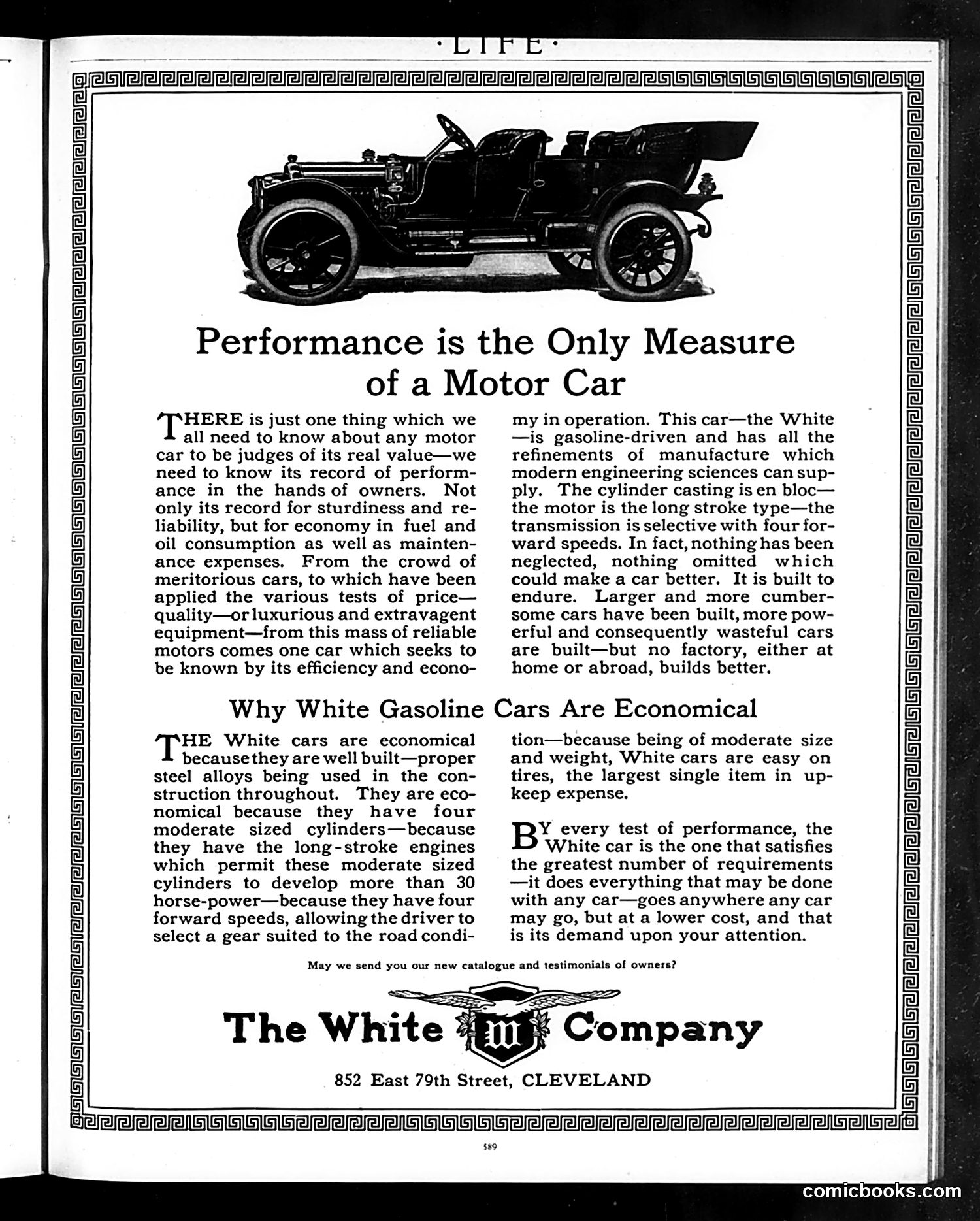
This is **not a cartoon or satire**—it's a straightforward automobile advertisement from *Life* magazine's early automotive era (likely 1900s-1910s based on the car's design). The White Company, a Cleveland-based manufacturer, promotes their gasoline-powered motor car by emphasizing **practical performance metrics over luxury or ostentation**. The ad argues that a car's true value lies in reliability, fuel economy, and maintenance costs—not in size, power, or extravagant features. The pitch targets practical-minded buyers by contrasting White's "moderate sized" four-cylinder engine (30+ horsepower) against larger, more wasteful competitors. The long-stroke engine design and four forward speeds are presented as modern engineering achievements. The decorative Greek border and dignified layout reflect the period's marketing style, when automobiles were still luxury items requiring detailed technical justification to potential buyers. There is no satire here—merely period advertising copy touting efficiency as a selling point.
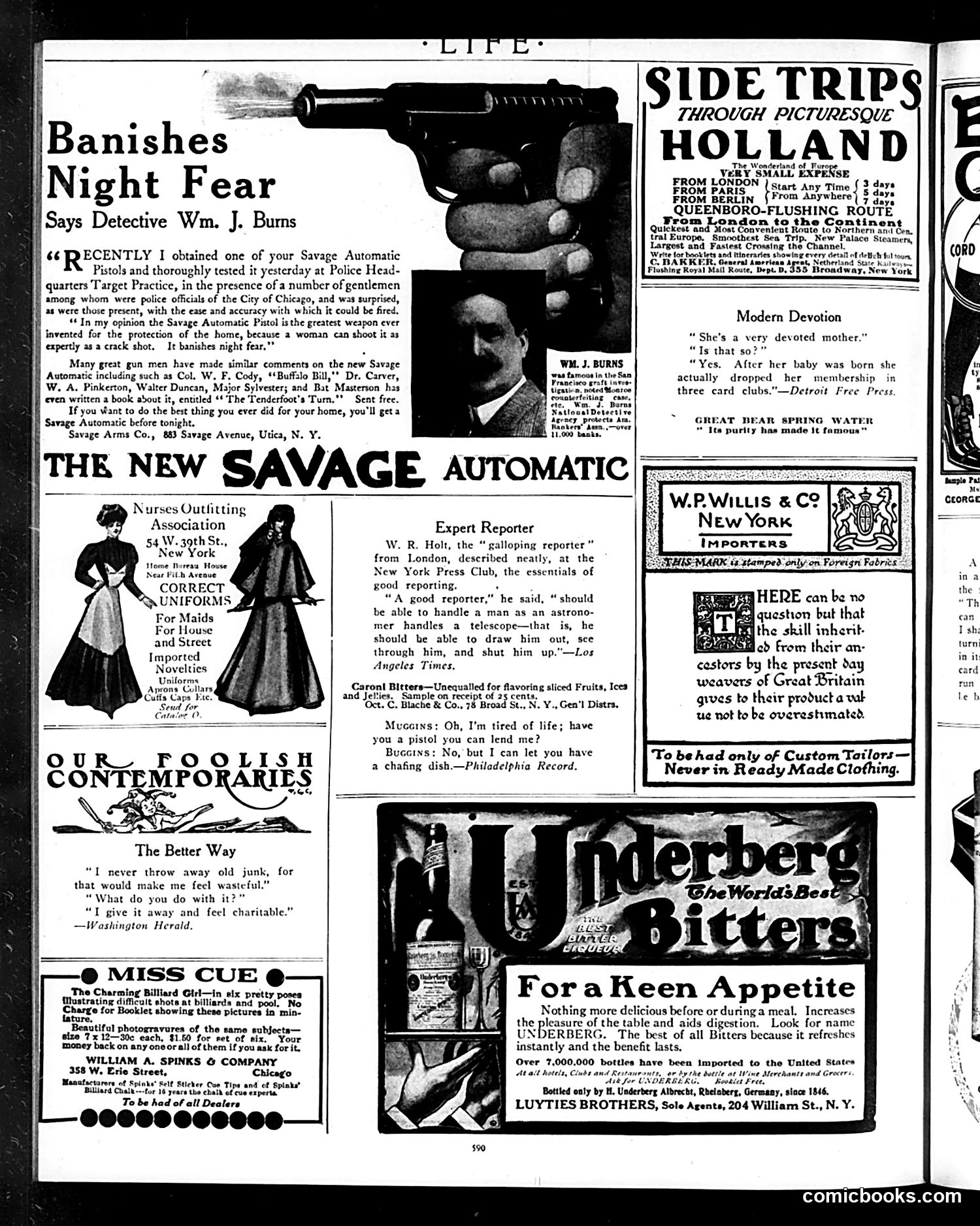
This page is primarily **advertising and filler content** rather than political satire. The dominant feature is a testimonial advertisement for the **Savage Automatic pistol**, endorsed by Detective William J. Burns. Burns claims the weapon is ideal for home protection, particularly effective because "a woman can shoot it as expertly as a crack shot. It banishes night fear." The irony—likely intentional for Life's satirical audience—is that marketing a firearm as a solution to anxiety reflects anxieties of the era about home security and women's vulnerability. Other content includes: - **Travel ads** for Holland tours - **Fashion notices** for nurses' uniforms - A **humor column** ("Our Foolish Contemporaries") mocking everyday absurdities - Various product advertisements (bitters, billiard instruction) - A brief joke about a "devoted mother" who dropped club memberships after childbirth The page reflects early 20th-century consumer culture and domestic concerns rather than explicit political commentary.
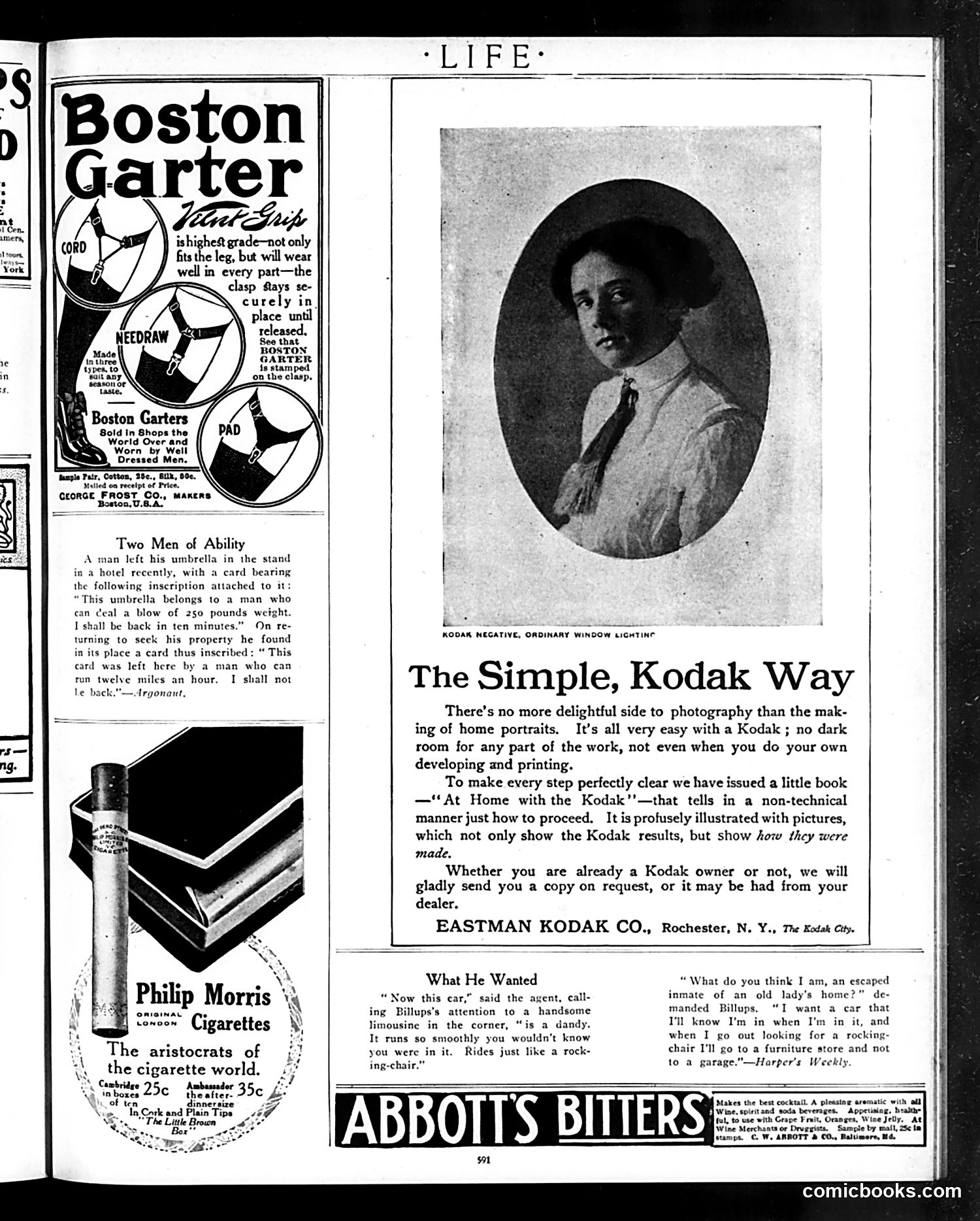
This page is primarily **advertising and humor content**, not political satire. The main visual feature is a **Kodak camera advertisement** showcasing home portrait photography, with an accompanying photograph demonstrating "ordinary window lighting" techniques. The ad emphasizes that Kodak photography is accessible to ordinary people—no darkroom required. Below are two separate **humorous anecdotes**: 1. "Two Men of Ability" depicts a classic joke about an umbrella left at a hotel with a boastful note (claiming the owner can take a 250-pound blow). The punchline: someone leaves a sarcastic reply claiming to have taken it, running twelve miles per hour. 2. "What He Wanted" presents a dialogue where a car salesman pitches a smooth-riding limousine, but the customer (Billups) sarcastically dismisses it—he wants a car that feels sturdy and reliable, not one that feels like furniture. The page also includes period **product advertisements**: Boston Garters (men's hosiery), Philip Morris cigarettes, and Abbott's Bitters (a medicinal tonic).
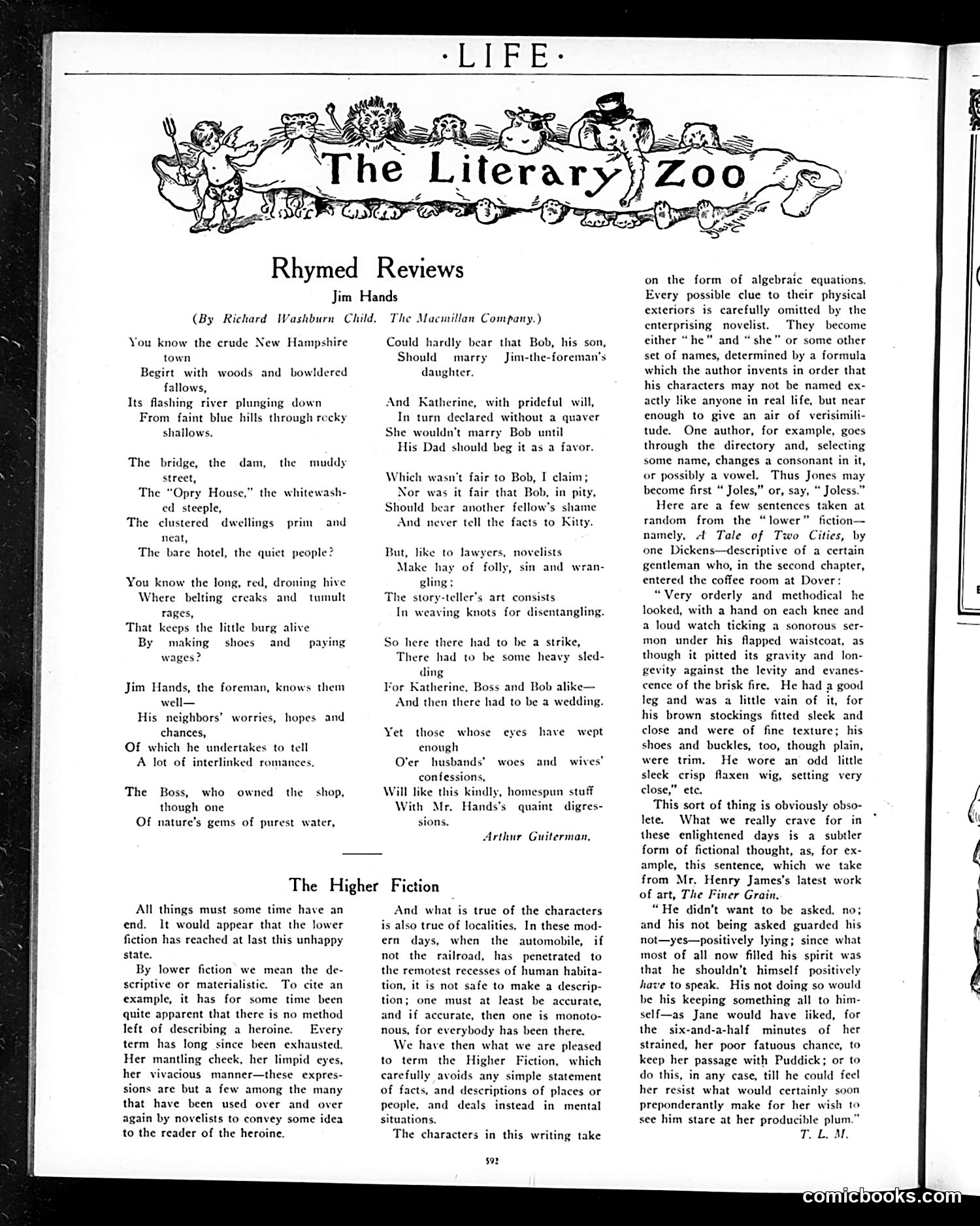
This page contains two literary reviews satirizing contemporary fiction trends. **"Jim Hands"** is a rhymed review by Arthur Guiterman of a novel depicting a New Hampshire factory town. The plot involves class conflict: a factory boss opposes his son marrying the foreman's daughter. Guiterman mocks how novelists artificially manufacture drama—requiring a strike and wedding to resolve the tension—suggesting the contrivance of sentimental popular fiction. **"The Higher Fiction"** critiques modernist literary trends. It argues that descriptive realism has exhausted itself: authors can no longer describe heroines without repetition, and detailed locations are impossible since automobiles have made everywhere accessible. The essay sarcastically praises "Higher Fiction," which avoids physical description entirely, reducing characters to abstract formulas or vague pronouns ("he"/"she"), treating them like algebraic equations. The satire targets both sentimental lower fiction and its experimental opposite—suggesting both approaches abandon genuine characterization for different reasons: one through overwrought cliché, the other through calculated obscurity.
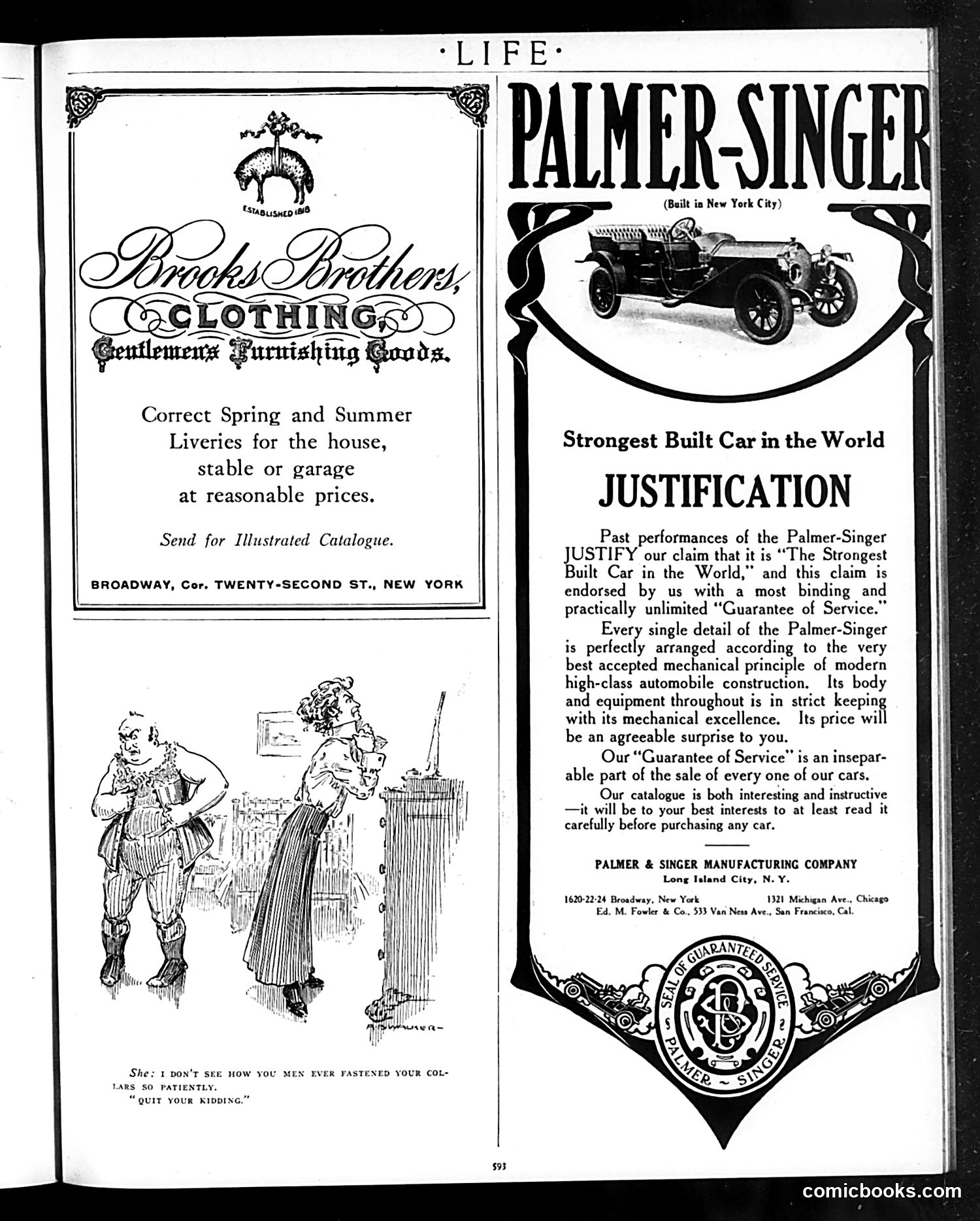
This page is primarily **advertising**, not editorial satire. The left side features Brooks Brothers clothing ads with a small humorous cartoon below showing a woman frustrated with a man's collar-fastening patience, captioned "Quit your kidding." This is mild domestic humor about men's grooming habits—a common trope of the era. The right side advertises the Palmer-Singer automobile, "Built in New York City," claiming it as the "Strongest Built Car in the World" with guarantees of service. The text emphasizes mechanical excellence and competitive pricing. **Context for modern readers:** Early 1900s automobiles were luxury goods requiring heavy marketing. The cartoon's gender dynamics (impatient woman, patient man) reflect period attitudes. Palmer-Singer Manufacturing was a real Long Island City automaker, later absorbed into other companies. The "Guarantee of Service" was a significant selling point when automobiles were still mechanically unreliable.
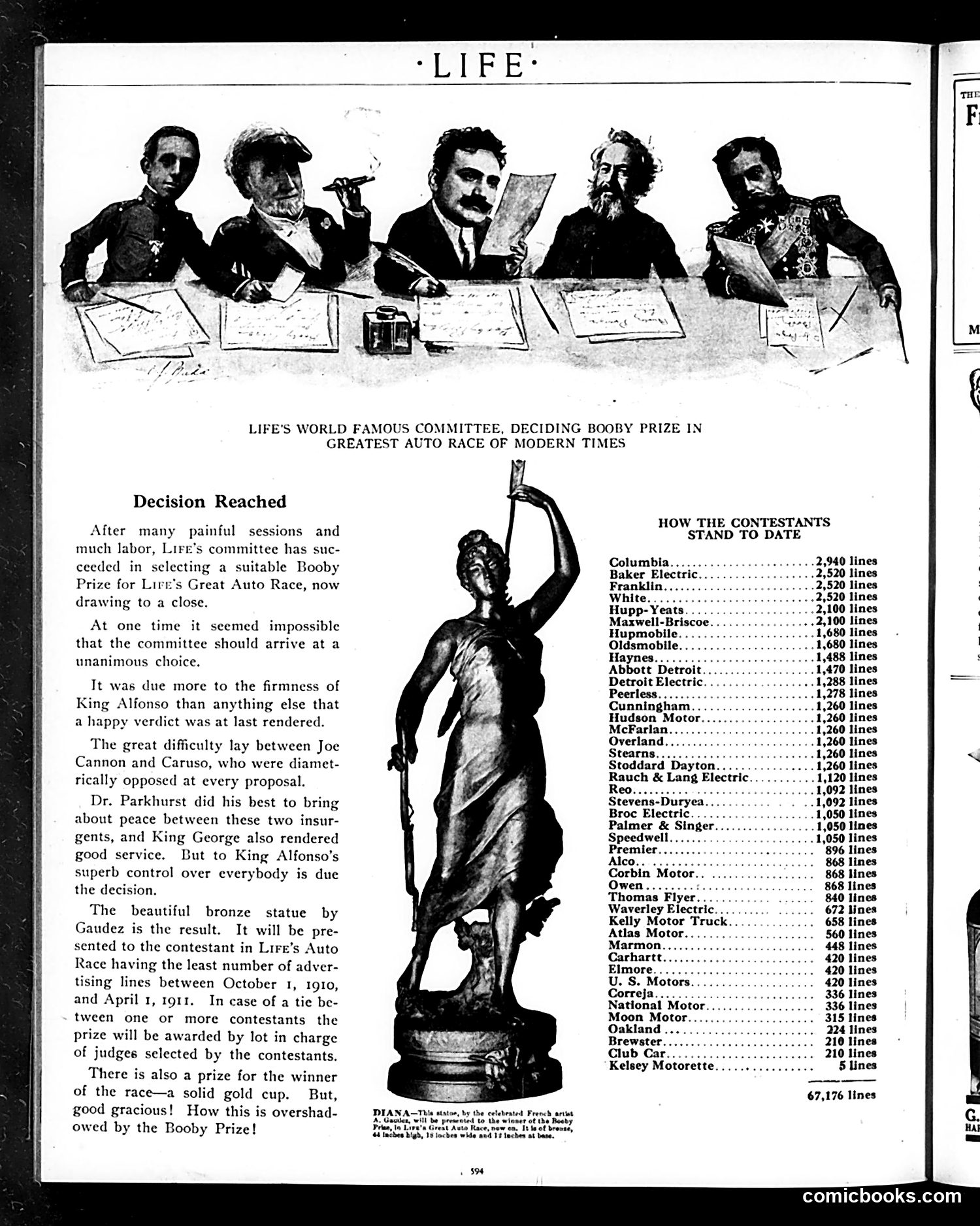
This page satirizes *Life* magazine's promotional "Great Auto Race" contest. The top cartoon shows five famous real figures—identified by context as including King Alfonso (Spain), Joe Cannon (U.S. Congressman), opera singer Caruso, Dr. Parkhurst (reformer), and King George—debating what "booby prize" (consolation prize for worst performer) to award. The joke: they're awarding an elaborate bronze statue (by sculptor Gaudez) to whichever car company generates the *least* advertising in *Life*—a transparent satire on how the contest really functions: it incentivizes companies to buy expensive advertising lines to avoid looking bad. The list shows 67,176 total advertising lines purchased, revealing how the competition drove ad spending rather than actually measuring automotive merit. The satire mocks both *Life's* self-promotion scheme and the magazine's pretension of involving world-famous celebrities in decisions that were purely commercial.
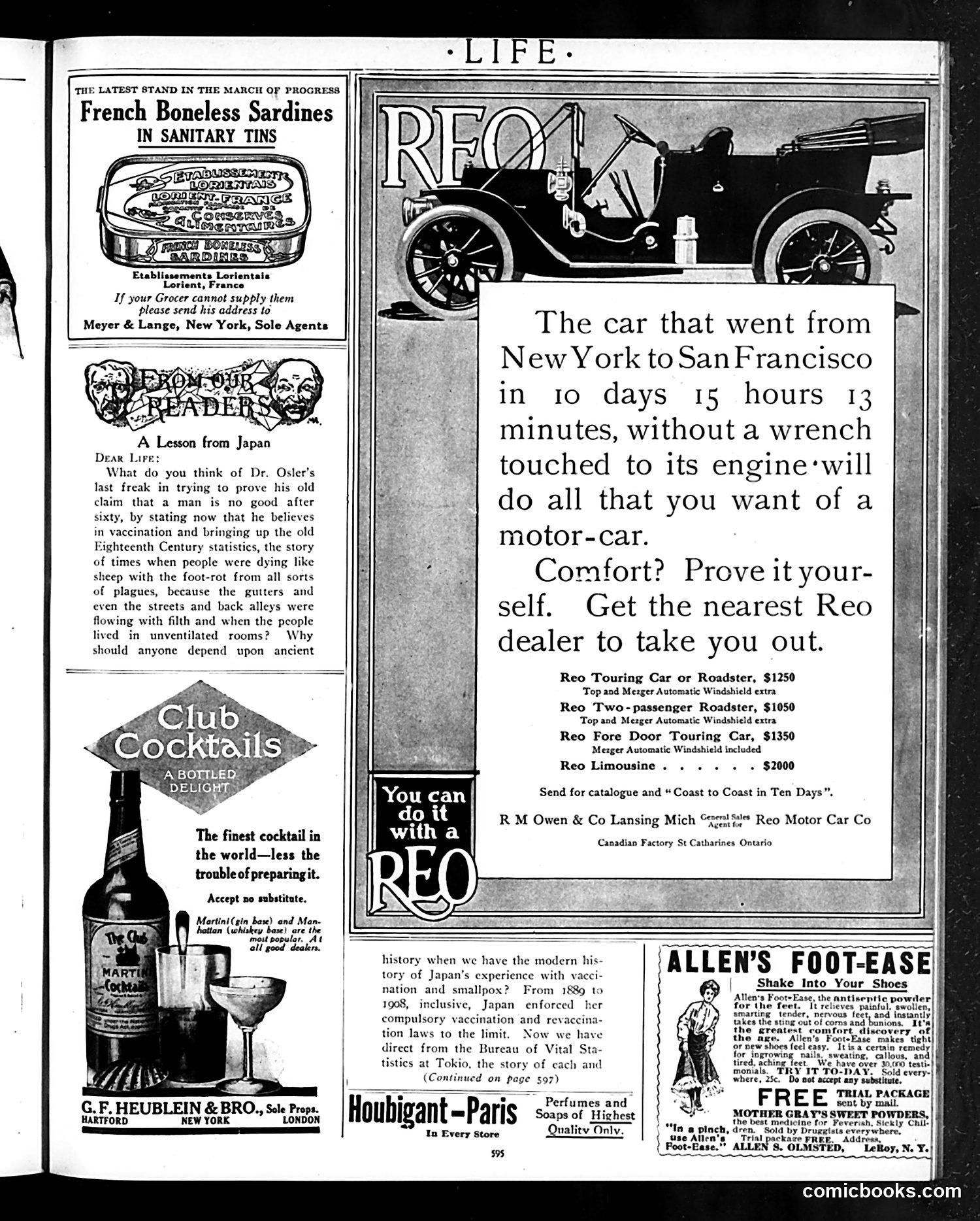
This page is primarily **advertising** with one editorial letter-to-the-editor section. The main items are product advertisements: French boneless sardines, Reo automobiles (prominently featuring a car that completed a New York-to-San Francisco journey in 10 days), Club Cocktails (pre-made martinis), Allen's Foot-Ease powder, and Houbigant perfumes. The editorial content is a letter responding to **Dr. William Osler**, a prominent physician who apparently claimed men became useless after sixty. The writer sarcastically attacks this by referencing Osler's support for vaccination and 18th-century statistics, then pivots to cite Japan's vaccination records (1889-1908) showing improved public health outcomes—implying modern medicine proves people remain valuable and capable throughout life, contradicting Osler's ageist claims. The page reflects early 20th-century concerns about aging, medical progress, and consumer modernity rather than political satire.
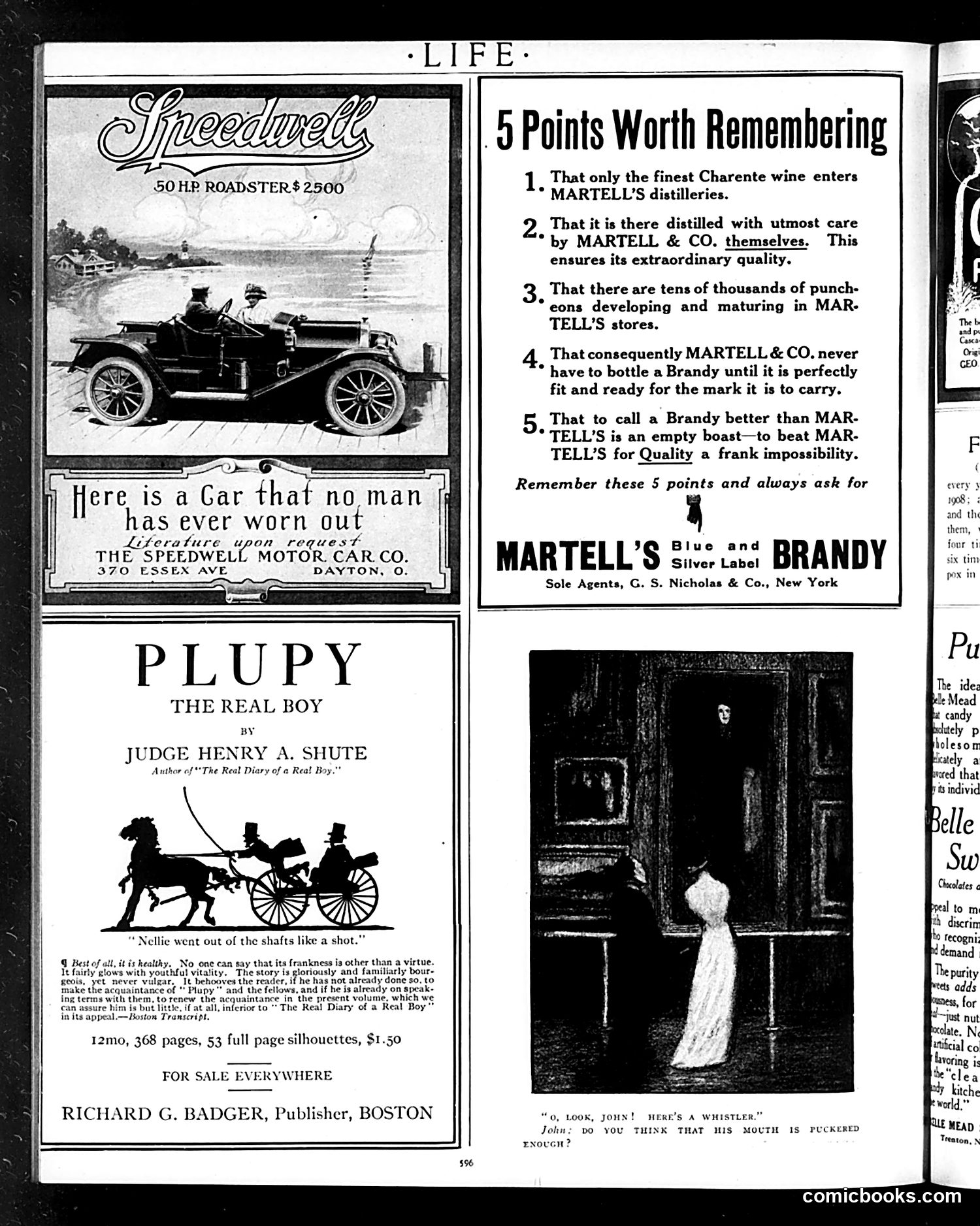
This page is primarily **advertising**, not political satire. It contains three distinct ads: 1. **Speedwell Motor Car** (top left): A roadster priced at $2,500, advertised as durably built—"a car that no man has ever worn out." 2. **Martell's Brandy** (top right): Lists five quality-control points emphasizing the brandy's superior production and maturation process. A straightforward luxury product advertisement. 3. **"Plupy: The Real Boy"** (bottom left): A book advertisement by Judge Henry A. Shute, promoting a children's/young adult novel about boyish adventures, illustrated with a silhouette of a horse-drawn carriage. 4. **Right side**: An unclear illustration with dialogue about someone whistling, likely part of a serialized comic or humorous story. No political messaging or satirical cartoon is evident. This represents typical early-1900s magazine advertising mixed with entertainment content.
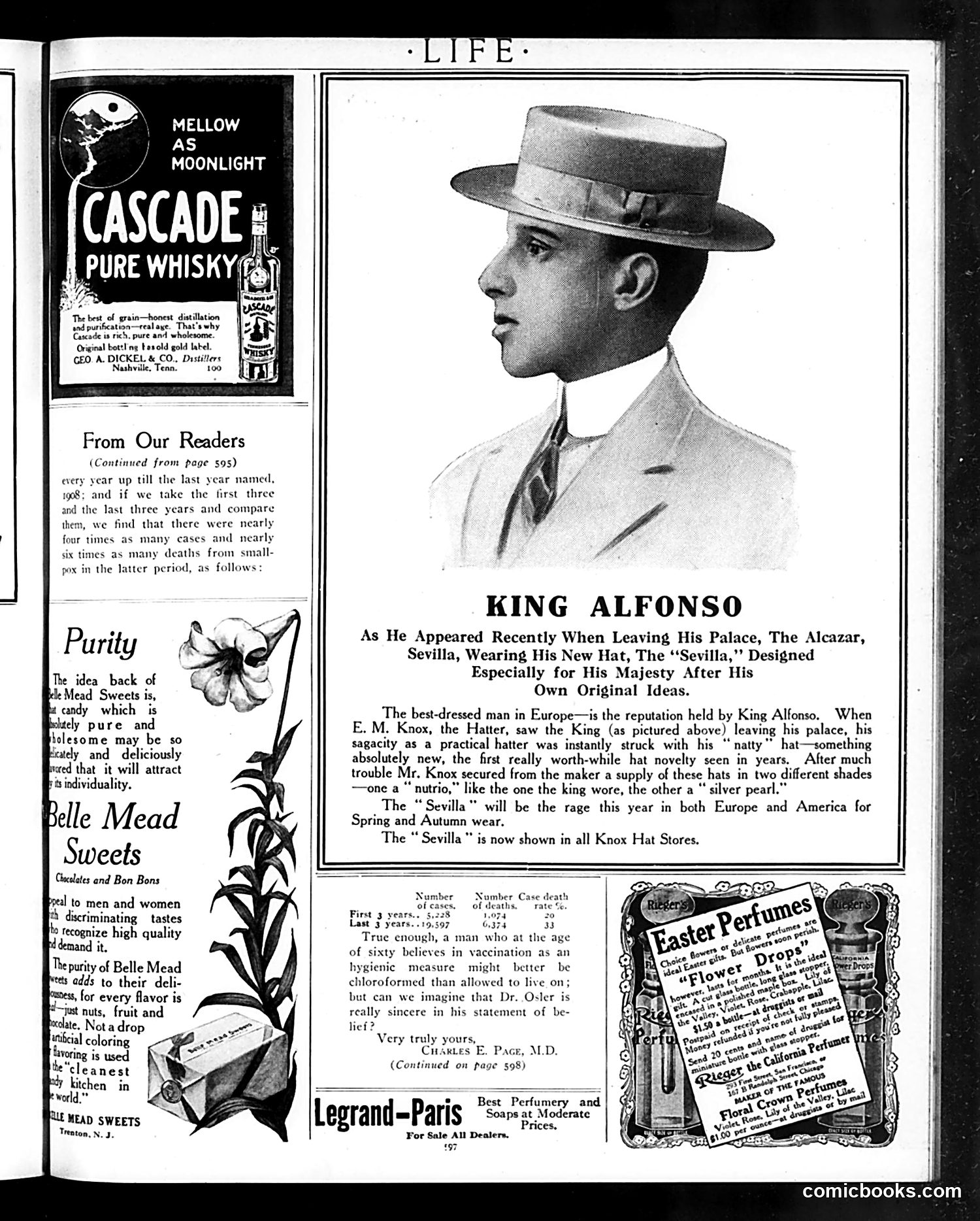
This page is primarily **advertising with one substantive feature article** about King Alfonso XIII of Spain. ## Main Content: King Alfonso's Hat The central feature celebrates King Alfonso as "the best-dressed man in Europe," focusing on his new hat design called the "Sevilla." Hat maker E. M. Knox allegedly secured these hats after seeing the King wear one leaving his palace. The article promotes the hat as a coming fashion rage in Europe and America for spring/autumn wear, with Knox Hat Stores now stocking them in two color variations ("nutrio" and "silver pearl"). **The point**: This appears to be a straightforward fashion/society piece capitalizing on royal celebrity to market a hat style—likely tongue-in-cheek given *Life*'s satirical nature, though the satire isn't explicit here. ## Advertisements The page also includes ads for **Cascade Whisky**, **Belle Mead Sweets**, **Easter Perfumes**, and **Legrand-Paris** perfumery—typical early 20th-century magazine advertising. A "From Our Readers" section discusses smallpox vaccination statistics, apparently continuing a previous debate.
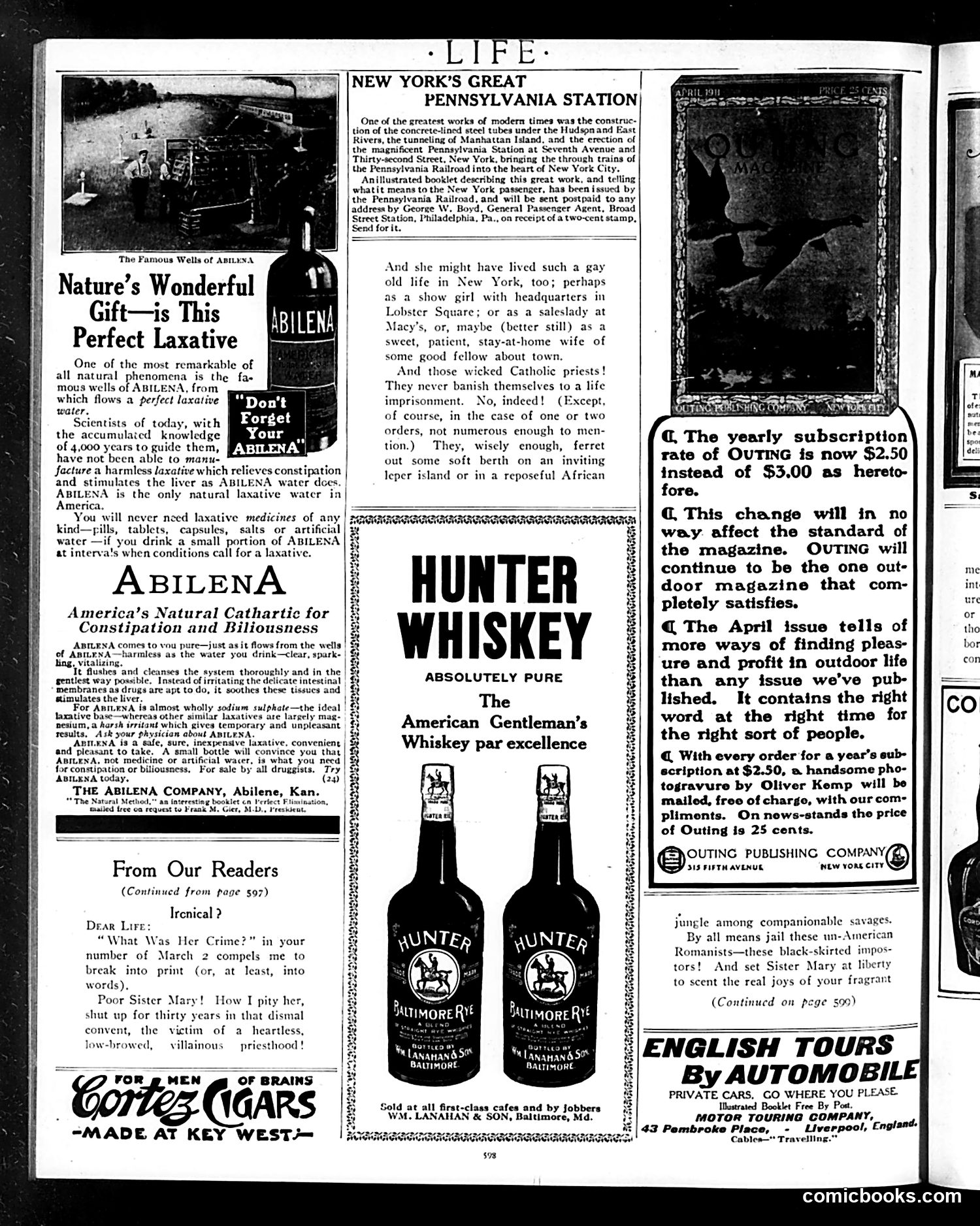
This page is primarily **advertisements** rather than satire or political cartoons, though it contains one notable satirical element. The main content includes ads for Abilena mineral water (a laxative), Hunter Whiskey, and Cortez Cigars. There's also a brief article praising Pennsylvania Station's engineering. The satirical element appears in the "From Our Readers" section, where a letter sardonically criticizes a previous Life article titled "What Was Her Crime?" The reader mocks the hypocrisy of condemning a nun's confinement while implying Catholic priests escape accountability—though the writer notes priests typically avoid imprisonment except in stricter orders. The sarcasm targets perceived anti-Catholic bias in Life's coverage. The overall page reflects early 20th-century American commercial culture and sectarian religious tensions, but lacks a coherent political cartoon or unified satirical message.
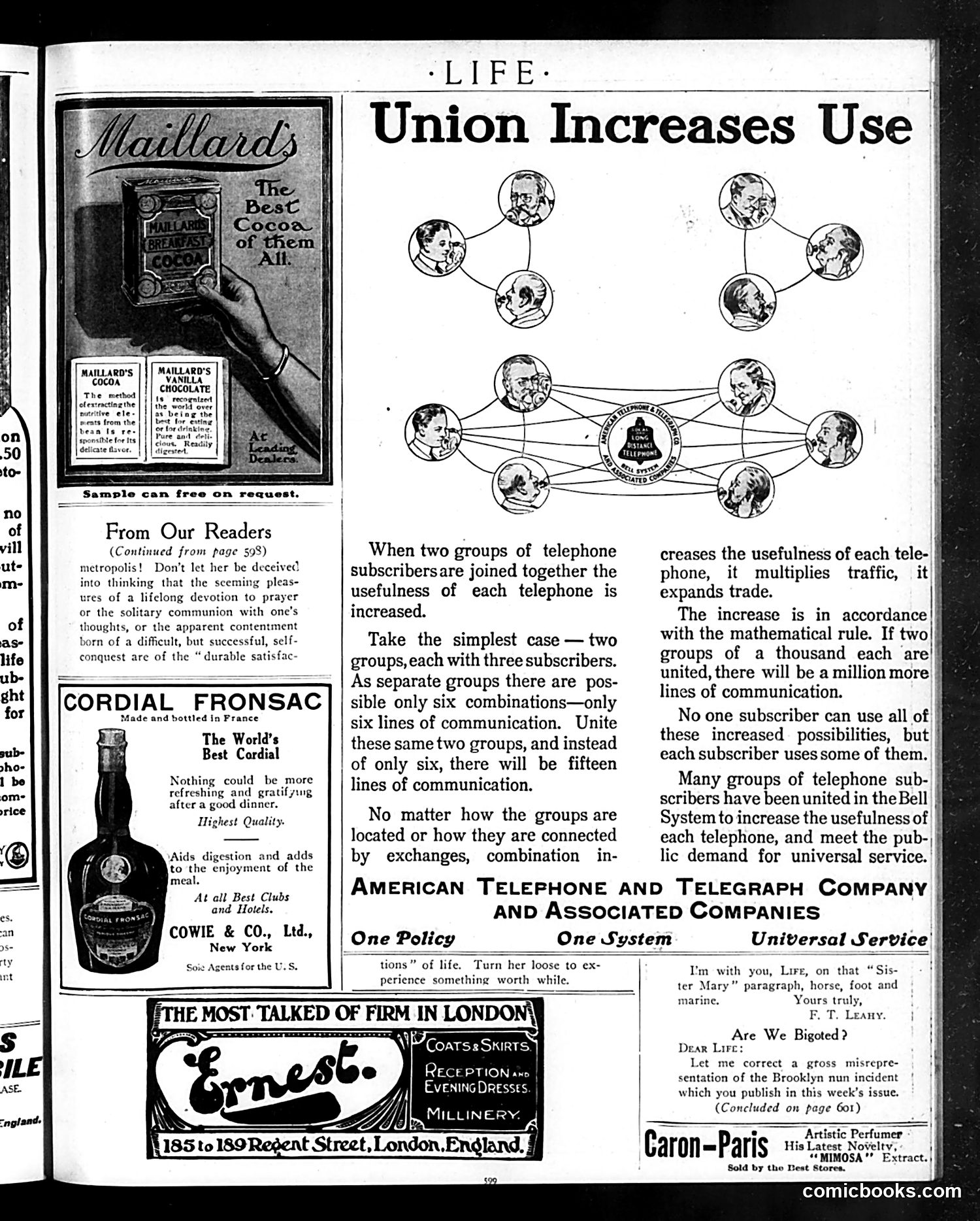
This page is primarily **advertising and reader correspondence**, not political satire. The main content is an **AT&T advertisement** explaining telephone network mathematics. It uses a diagram showing how connecting subscriber groups exponentially increases communication lines—six lines become fifteen when two groups unite. The pitch argues that the Bell System's consolidation serves the public by expanding "universal service." The page also contains: - **Product advertisements** (Maillard's cocoa, Cordial Fronsac liqueur, Ernest clothing, Caron-Paris perfume) - **Reader letters** responding to previous Life content, including a complaint about misrepresentation of a "Brooklyn nun incident" and commentary on women's life choices There are **no identifiable political figures or satire** here. The AT&T content is straightforward corporate messaging, though modern readers might note the irony of a monopoly justifying consolidation through mathematical "efficiency" arguments—a rhetoric still used today for corporate mergers.
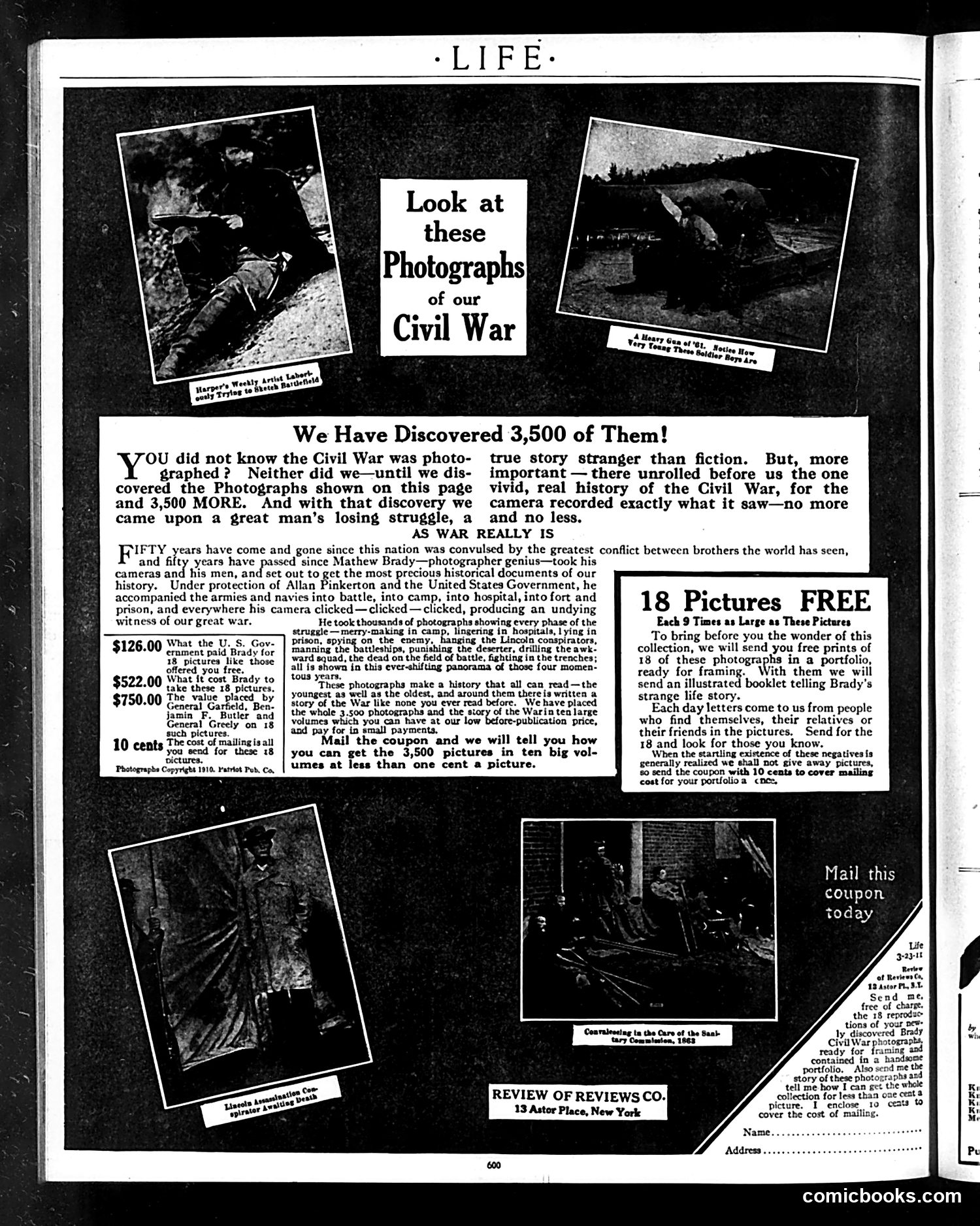
This is primarily an **advertisement**, not satirical content. It promotes a newly-published collection of Civil War photographs by Matthew Brady, the renowned Civil War photographer. **The pitch:** The advertiser claims to have "discovered" 3,500 Brady photographs—presenting them as revelatory historical documents showing war "as it really is." Brady's images are positioned as authentic, unmediated historical records: "the camera recorded exactly what it saw—no more and no less." **The offer:** Readers can request 18 free sample prints (9 times larger than shown) plus a booklet about Brady's life. The full 10-volume collection is available at "less than one cent a picture"—emphasized as remarkably affordable. **Historical context:** This appears to be marketing Brady's work as newly accessible to general audiences 50 years after the Civil War ended. The advertisement exploits both nostalgia and the era's fascination with photography as objective truth. The appeal to personal recognition ("find themselves, their relatives or their friends in the pictures") adds emotional weight to the sales pitch.
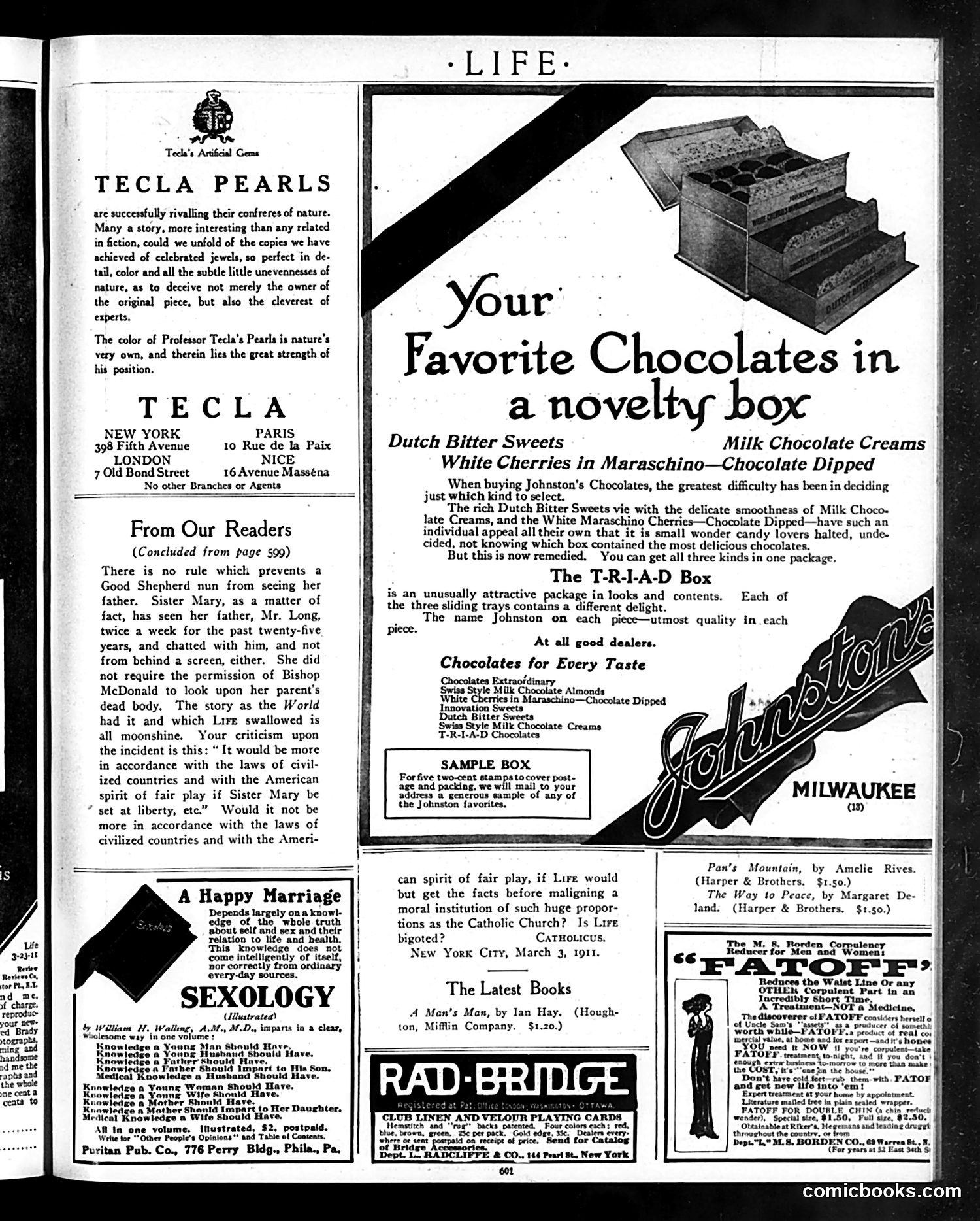
This page is primarily **advertisements and readers' correspondence**, not political satire or cartoons. The substantive content includes: 1. **"From Our Readers"** — a rebuttal letter defending the Catholic Church and a nun's right to see her deceased father, responding to what the writer calls Life's "moonshine" reporting. The writer challenges Life's criticism for alleged anti-Catholic bias. 2. **Multiple product advertisements** — Tecla Pearls (artificial gems), Johnston's Chocolates (the "T-R-I-A-D Box"), a Sexology instruction book, Rad-Bridge playing cards, and "Fatoff" weight-reduction products. The one point of interest: the readers' letter suggests Life had previously reported negatively on Catholic Church practices, and this letter attacks Life's fairness and alleged "bigotry" — indicating contemporary Catholic-Protestant tensions around religious institutional authority in 1911 America. Otherwise, this is a standard magazine page mixing content with revenue-generating advertisements.
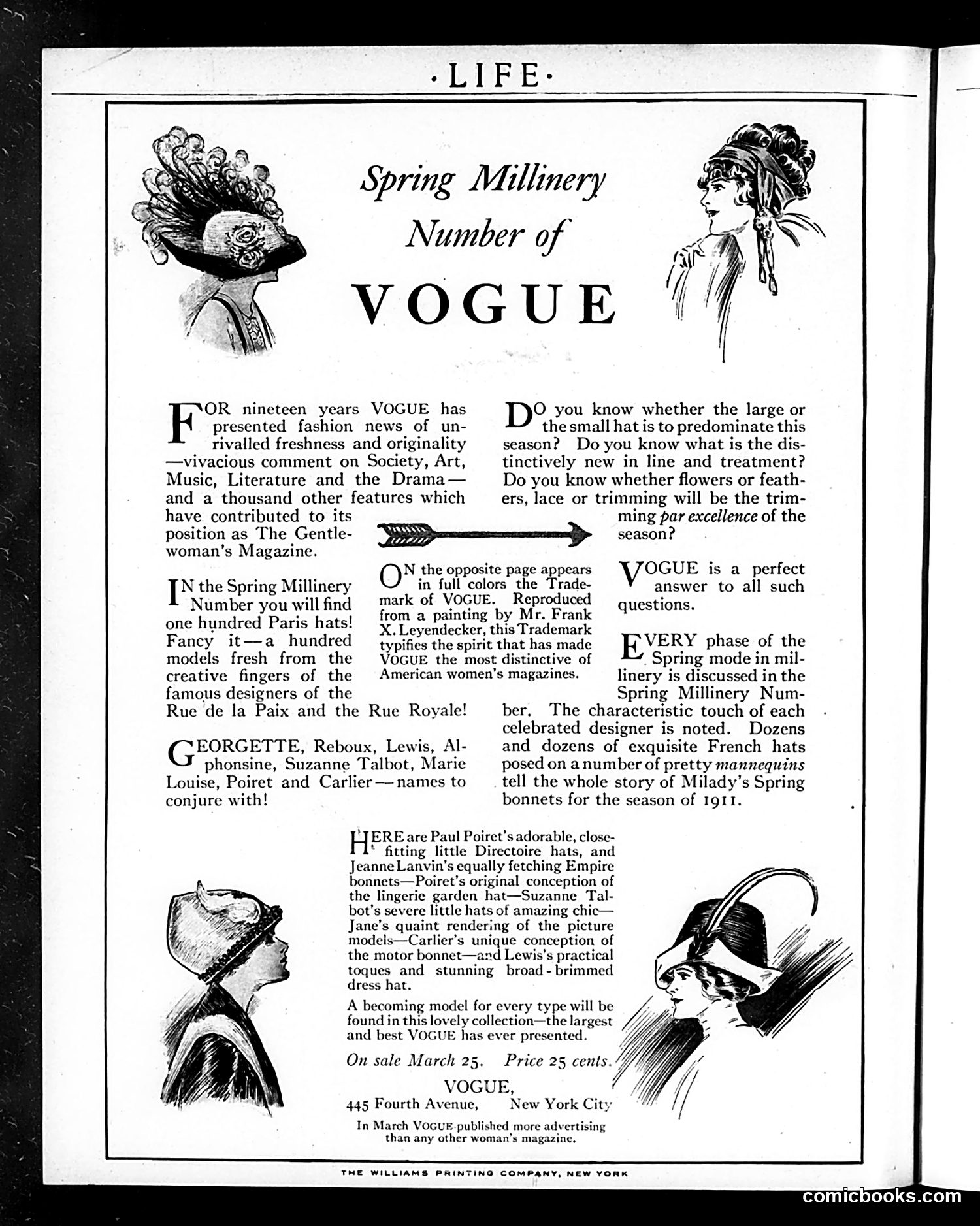
This is an advertisement, not political satire. Life magazine's page promotes Vogue's Spring Millinery Number (1911), featuring one hundred Paris hat designs from famous couturiers including Poiret, Lanvin, and Lewis. The three sketched figures show fashionable women modeling elaborate hats—typical of the ornate millinery of the Edwardian era, when women's hats were major fashion statements, often decorated with feathers, flowers, and ribbons. The ad emphasizes Vogue's authority on women's fashion, positioning the magazine as essential reading for understanding seasonal trends in hat styles, sizing, and trimmings. It highlights prestigious French designers to appeal to affluent American women seeking high-fashion guidance. The price (25 cents) and sale date (March 25) indicate this was a special issue.
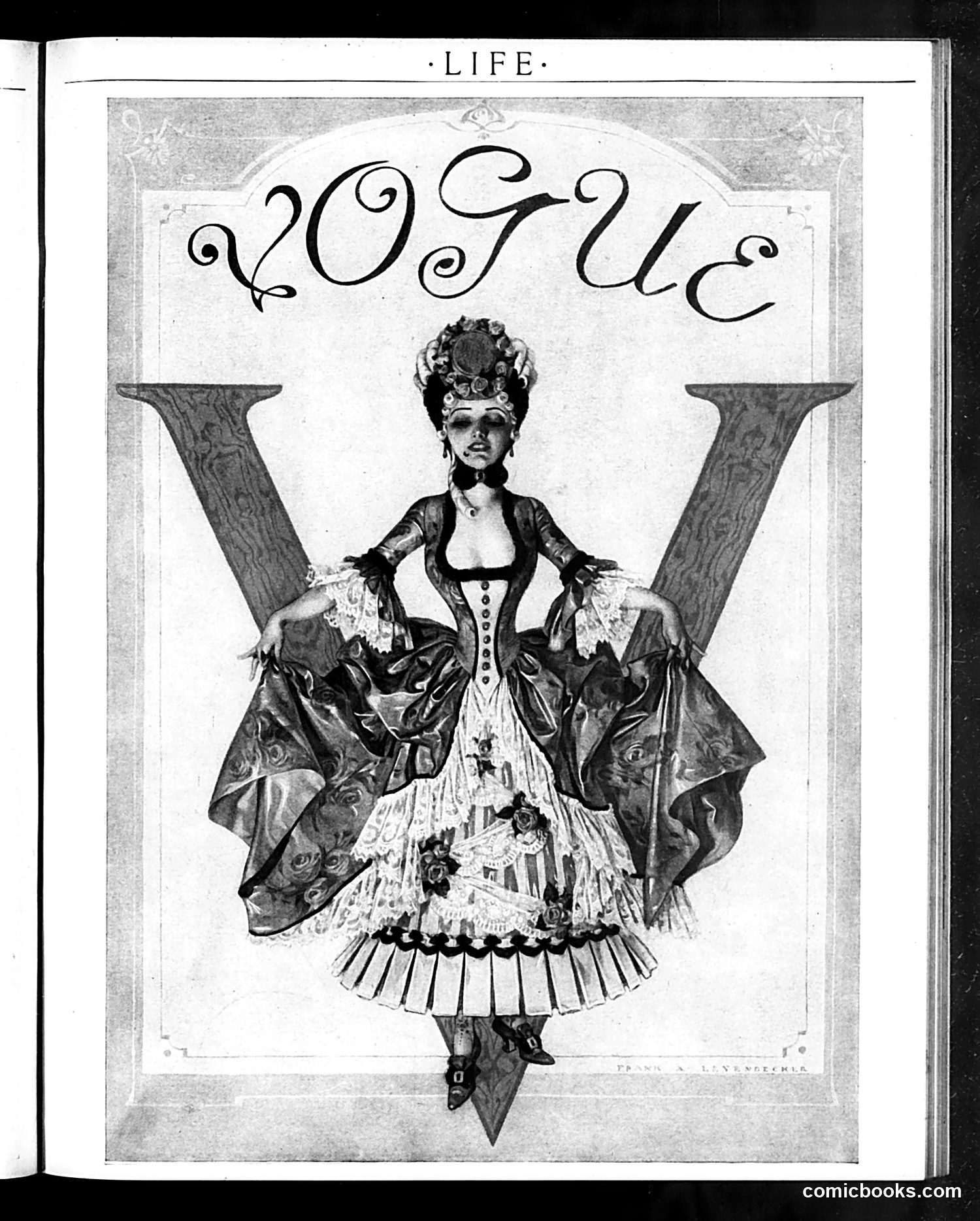
This is a *Life* magazine cover page featuring the word "VOGUE" in decorative script above a large ornamental "V" that frames a fashionably dressed woman. The illustration shows her wearing an elaborate Edwardian-era ensemble: a dark jacket with lace cuffs, an ornate corset, a pleated skirt with decorative embroidery, and an elaborate upswept hairstyle topped with a decorative comb. The satire appears to target women's fashion obsession and the *Vogue* magazine aesthetic of the early 20th century. The exaggerated, theatrical styling—particularly the towering hairstyle and ornate layers of clothing—mocks the impracticality and excess of high fashion for women during this period. The *Life* magazine's satirical intent is to ridicule fashion industry pretension and women's adherence to elaborate, restrictive dress codes.
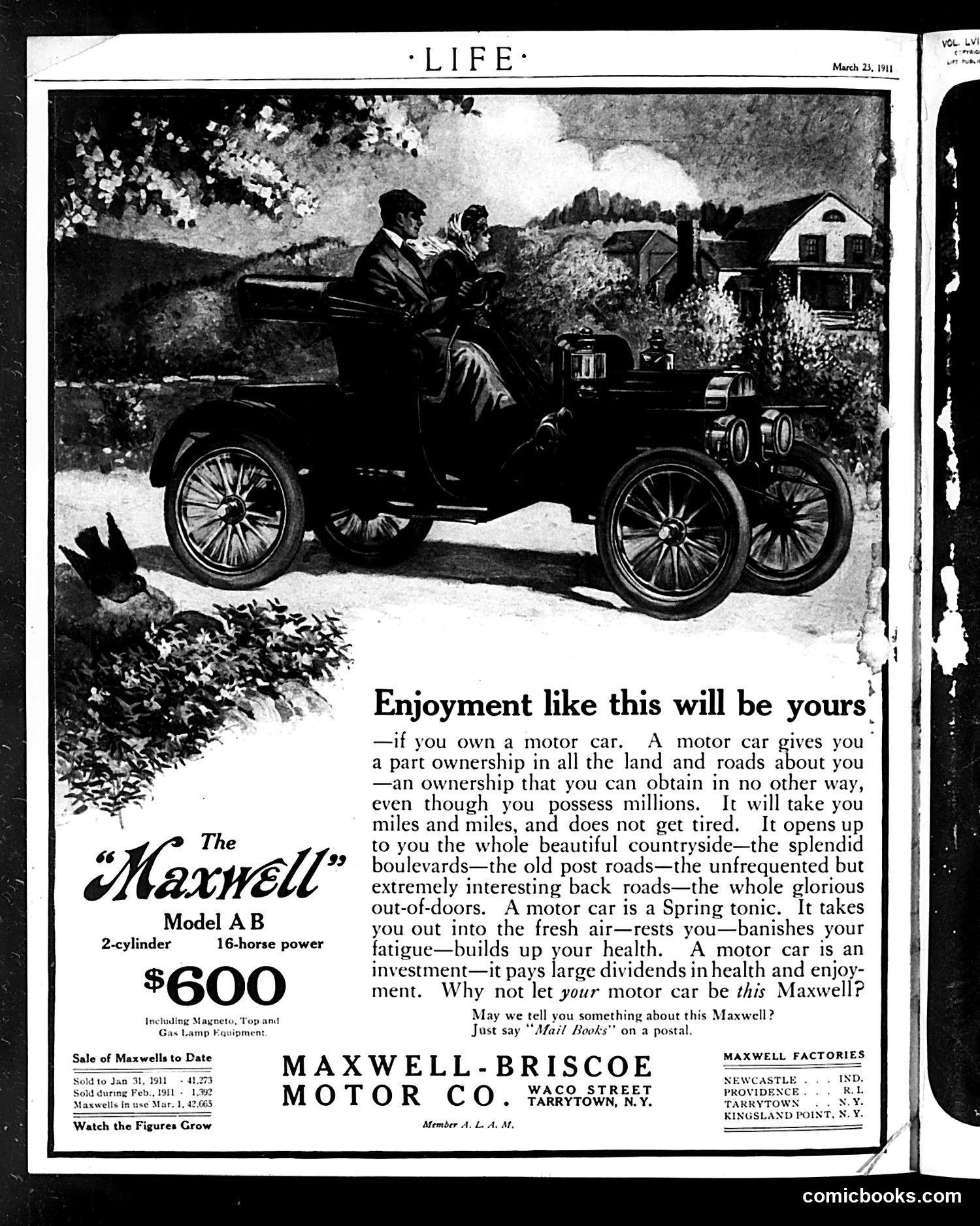
This is **not a cartoon or satire**—it's a straightforward automobile advertisement for the Maxwell Model AB, priced at $600. The image shows a couple in an early motorcar enjoying a scenic countryside drive, illustrating the advertiser's pitch: car ownership grants access to beautiful landscapes and roads unavailable to non-owners, promotes health through fresh air and rest, and represents a sound financial investment with "large dividends." The text employs romantic, aspirational language typical of early 1900s advertising—the car as a "Spring tonic" offering freedom and leisure. The ad emphasizes the novelty of automobile ownership as a status marker and lifestyle enhancement. Notable: Sales figures listed ("Sold to Jan 31, 1911—41,273") suggest the Maxwell was successfully marketed during the early automotive boom, when cars remained luxury goods for the relatively wealthy.