
Life, 1911-03-23 · page 20 of 44
Life — March 23, 1911 — page 20: what you’re looking at
What you’re looking at
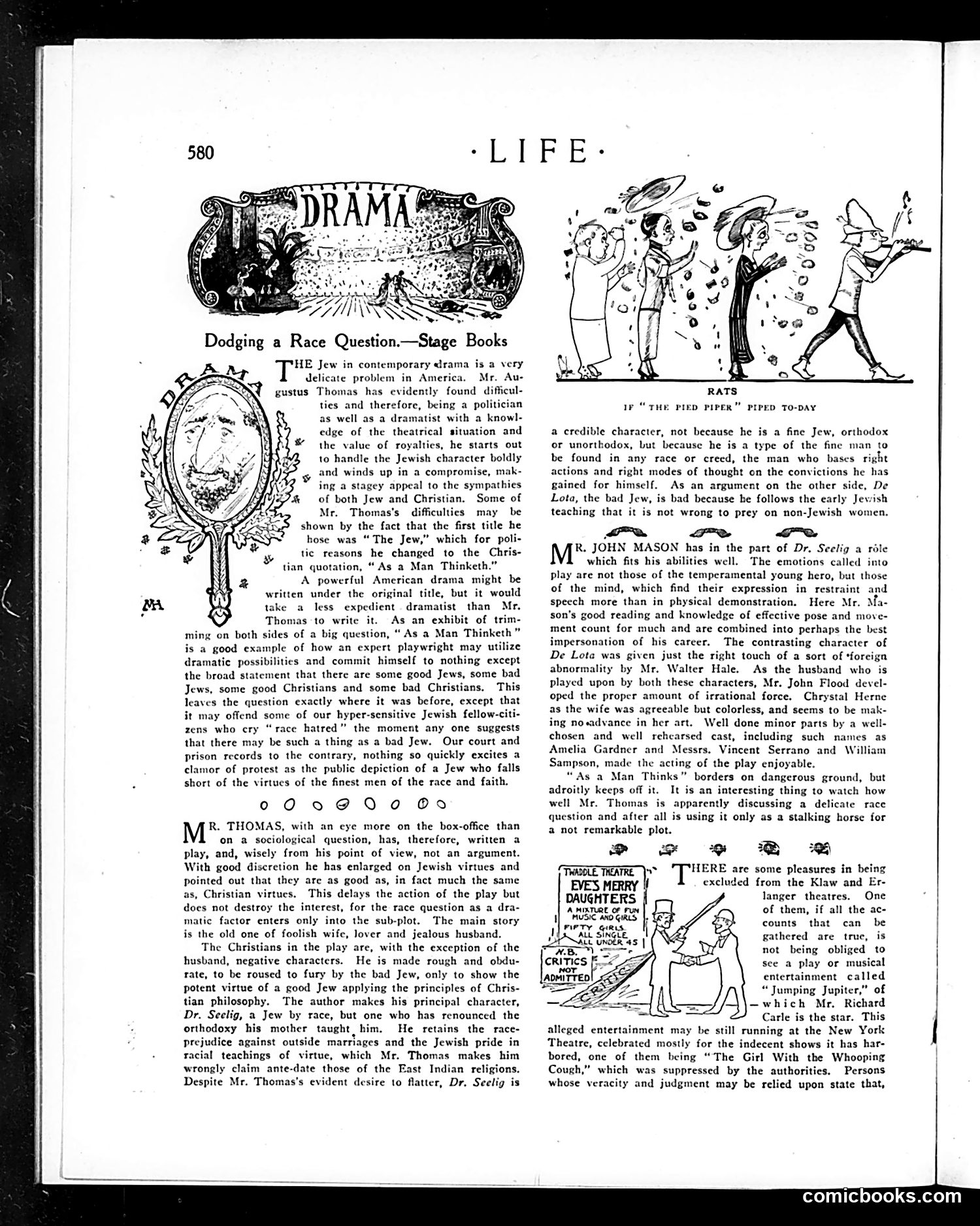
This page critiques playwright Augustus Thomas's play about a Jewish character, originally titled "The Jew" but renamed "As a Man Thinketh" for commercial reasons. The satire targets Thomas's political timidity: he avoided controversy by softening the original title, then presented a plot that makes moral points about Jewish virtue without genuinely engaging the "race question." The illustration labeled "If 'The Pied Piper' Piped To-Day" (upper right) appears to satirize how contemporary drama avoids substantive treatment of social issues—figures scatter in confusion rather than following a coherent path. Life criticizes Thomas for straddling both sides: the play contains "some good Jews, some bad Jews, some good Christians and some bad Christians," resolving nothing. The magazine suggests Thomas prioritized box-office appeal over honest dramatic exploration, appeasing both Jewish and Christian audiences while addressing no actual social problem. The critique exposes how commercial theater avoids meaningful engagement with contemporary prejudice.
📄 Transcribed text from this page (OCR, searchable)
Machine-transcribed from the original scan — historical spelling and the odd misread are preserved.
JASSsss ee Dodging a Race Question.—Stage Books HE Jew in contemporary drama is a very ¢ problem in America. Mr. Au- gustus Thomas has evidently found difficul- ties and therefore, being a politician as well as a dramatist with a knowl- edge of the theatrical situation and & the value of royalties, he starts out to handle the Jewish character boldly nd winds up in a compromise, mak- ing a stagey appeal to the sympathies of both Jew and Christian. Some of Mr. Thomas's difficultics may be shown by the fact that the first title he hose was “The Jew,” which for poli- tic reasons he changed to the Chris- tian quotation, “As a Man Thinketh.” Ps A powerful American drama might be written under the original title, but it would take a less expedient dramatist than Mr, Thomas to write it. As an exhibit of trim ming on both sides of a big question, “As a Man Thinketh” is a good example of how an expert playwright may utilize dramatic possibilities and commit himself to nothing except the broad statement that there are some good Jews, some bad Jews, some good Christians and some bad Christians. This leaves the question exactly where it was before, except that it may offend some of our hyper-sensitive Jewish fellow-citi- zens who cry “race hatred” the moment any one suggests that there may be such a thing as a bad Jew. Our court and prison records to the contrary, nothing so quickly excites a clamor of protest as the public depiction of a Jew who falls short of the virtues of the finest men of the race and faith, 0009000 009 R. THOMAS, with an eye more on the box-office than on a sociological question, has, therefore, written a play, and, wisely from his point of view, not an argument. With good discretion he has enlarged on Jewish virtues and pointed out that they are as good as, in fact much the same as, Christian virtues. This delays the action of the play but does not destroy the interest, for the race question as a dra- matic factor enters only into the sub-plot. The main story is the old one of foolish wife, lover and jealous husband. The Christians in the play are, with the exception of the husband, negative characters. He is made rough and obdu- rate, to be roused to fury by the bad Jew, only to show the potent virtue of a good Jew applying the principles of Chris- tian philosophy. The author makes his principal character, Dr. Seclig, a Jew by race, but one who has renounced the orthodoxy his mother taught him. He retains the race- prejudice against outside marriages and the Jewish pride in racial teachings of virtue, which Mr. Thomas makes him wrongly claim ante-date those of the East Indian religions. Despite Mr. Thomas's evident desire to flatter, Dr. Selig is IF “THE PIED PIPER” PIPED TO-DAY a credible character, not because he is a fine Jew, orthodox or unorthodox, Lut because he is a type of the fine man to be found in any race or creed, the man who bases right actions and right modes of thought on the convictions he has gained for himself. As an argument on the other side, De Lota, the bad Jew, is bad because he follows the early Jewish teaching that it is not wrong to prey on non-Jewish women. ro Fre a M* JOHN MASON has in the part of Dr. Seclig a rile which fits his abilities well. The emotions called into play are not those of the temperamental young hero, but those of the mind, which find their expression in restraint and speech more than in physical demonstration. Here Mr. Ma- son's good reading and knowledge of effective pose and move- ment count for much and are combined into perhaps the best impersonation of his career. The contrasting character of De Lota was given just the right touch of a sort of ‘foreign abnormality by Mr. Walter Hale. As the husband who is played upon by both these characters, Mr. John Flood devel- oped the proper amount of irrational force. Chrystal Herne as the wife was agreeable but colorless, and seems to be mak- ing nosadvance in her art. Well done minor parts by a well- chosen and well rehearsed cast, including such na Amelia Gardner and Messrs. Vincent Serrano and W Sampson, made the acting of the play enjoyable. “As a Man Thinks” borders on dangerous ground, but adroitly keeps off it. It is an interesting thing to watch how well Mr. Thomas is apparently discussing a delicate race question and after all is using it only as a stalking horse for a not remarkable plot. = + = QB SB HERE are some pleasures in being excluded from the Klaw and Er- langer theatres. One of them, if all the ac- counts that can be gathered are truc, is not being obliged to sce a play or musical entertainment called “Jumping Jupiter,” of —which Mr. Richard Carle is the star. This alleged entertainment may be still running at the New York Theatre, cclebrated mostly for the indecent shows it has har- bored, one of them being “The Girl With the Whooping Cough,” which was suppressed by the authorities, Persons whose veracity and judgment may be relied upon state that, « 5. ALR Singte, ONAL UNDER | Silene: comicbooks.com