
Life, 1911-03-23 · page 24 of 44
Life — March 23, 1911 — page 24: what you’re looking at
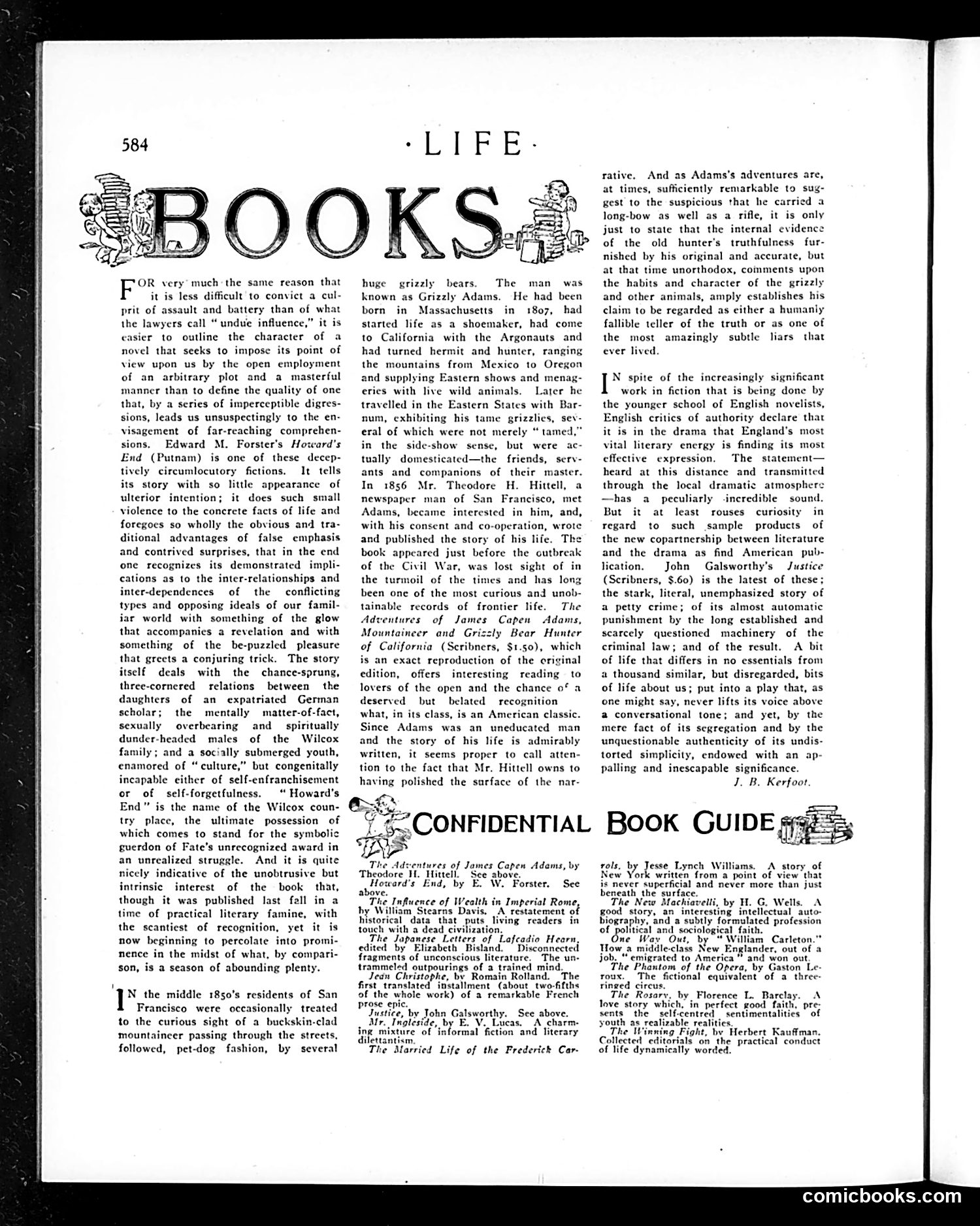
What you’re looking at
This is a book review section from *Life* magazine (page 584). The page contains two main reviews: 1. **Edward M. Forster's *Howard's End*** — The reviewer praises this novel's subtle, indirect storytelling approach. Rather than using obvious plot devices, Forster gradually reveals complex social relationships among three groups: daughters of a German scholar, the wealthy Wilcox family, and a culturally-minded but socially marginal young man. The reviewer notes the book received little recognition when published during the Civil War period but is now gaining deserved prominence. 2. **James Capen Adams's frontier memoir** — A reprinted 1856 account of "Grizzly Adams," a Massachusetts-born shoemaker-turned-California mountaineer who captured and tamed grizzly bears, later exhibiting them with P.T. Barnum. The reviewer calls this obscure frontier document an "American classic." The page emphasizes rediscovery of overlooked literary works.
📄 Transcribed text from this page (OCR, searchable)
Machine-transcribed from the original scan — historical spelling and the odd misread are preserved.
OR very’ much the same reason that it is less difficult to convict a cul- prit of assault and battery than of what the lawyers call “undue influence,” it is easier to outline the character of a novel that seeks to impose its point of view upon us by the open employment of an arbitrary plot and a masterful manner than to define the quality of one that, by a series of imperceptible digres- sions, leads us unsuspectingly to the en- visagement of far-reaching comprehen- sions, Edward M. Forster's Howard's d (Putnam) is one of these decep- tively circumlocutory fictions. It tells its story with so little appearance of ulterior intentio it does such small violence to the conercte facts of life and foregoes so wholly the obvious and tra- ditional advantages of false emphasis and contrived surprises, that in the end one recognizes its demonstrated impli- cations as to the inter-relationships and inter-dependences of the conflicting types and opposing ideals of our famil- iar world with something of the glow that accompanies a revelation and with something of the be-puzzled pleasure that greets a conjuring trick. The story itself deals with the chance-sprung, three-cornered relations between the daughters of an expatriated German scholar; the mentally matter-of-fact, sexually overbearing and spiritually dunder-headed males of the Wilcox family; and a socially submerged youth, enamored of “culture,” but congenitally incapable either of self-enfranchisement or of self-forgetfulness. “ Howard's End" is the name of the Wilcox coun- try place, the ultimate possession of which comes to stand for the symbolic guerdon of Fate’s unrecognized award in an unrealized struggle. And it is quite nicely indicative of the unobtrusive but intrinsic interest of the book that, though it was published last fell in a time of practical literary famine, with the scantiest of recognition, yet it is now beginning to percolate into promi- nence in the midst of what, by compari- son, is a season of abounding plenty. 1* the middle 1850's residents of San Francisco were occasionally treated to the curious sight of a buckskin-clad mountaineer passing through the streets, followed, pet-dog fashion, by several huge grizzly bears. The man was known as Grizzly Adams. He had been born in Massachusetts in 1807, had started life as a shoemaker, had come to California with the Argonauts and had turned hermit and hunter, ranging the mountains from Mexico to Oregon and supplying Eastern shows and menag- erics with live wild animals. Later he travelled in the Eastern States with Bar- num, exhibiting his tame grizzlies, sev- eral of which were not merely “ tamed in the side-show but tually domesticated—the friends, serv- ants and companions of their master. In 1856 Mr. Theodore H. Hittell, a newspaper man of San Francisco, met Adams, became interested in him, and, with his consent and co-operation, wrote and published the story of his life. The book appeared just before the outbreak of the Civil War, was lost sight of in the turmoil of the times and has long been one of the most curious and unob- tainable records of frontier life. The Adventures of James Capen Adams, Mountaineer and Grizzly Bear Hunter of California (Scribners, $1.50), which is an exact reproduction of the original edition, offers interesting reading to lovers of the open and the chance of a deserved but belated recognition what, in its class, is an American classic. Since Adams was an uneducated man and the story of his life is admirably written, it seems proper to call atten- tion to the fact that Mr. Hittell owns to having polished the sarface of the nar- ‘$<. CONFIDENTIAL The Adventures of James Capen Adams, by Theodore Hl. Hittell. See above. Howard's End, by E. W. Forster. See above. The Influence of Wealth in Imperial Rome, hy William Stearns Davis. A restatement of historical data that puts. living readers in touch with a dead civilization. The Japanese Letters of Lafcadio Hearn, edited by Elizabeth Bisland. Disconnected fragments of unconscious literature. The un- trammeled outpourings of a trained mind, Jean Christophe, by Romain Rolland. The first translated installment (about two-fifths of the whole work) of a remarkable French prose epic. Justice, by John Galsworthy. See above. . Mr. Ingleside, by E. V. Lucas. A charm ing mixture of informal fiction and literary dilettantism. The Married Life of the Frederick Car- ense, were ac- rative. And as Adams's adventures are, at times, sufficiently remarkable to sug- gest to the suspicious that he carried a long-bow as well as a rifle, it is only just to state that the internal evidence of the old hunter's truthfulness fur- nished by his original and accurate, but at that time unorthodox, comments upon the habits and character of the grizzly and other animals, amply establishes his claim to be regarded as either a humanly fallible teller of the truth or as one of amazingly subtle the most liars that ever lived. [* spite of the increasingly significant work in fiction that is being done by the younger school of English novelists, English critics of authority declare that it is in the drama that England’s most vital literary energy is finding its most effective expression, The statement— heard at this distance and transmitted through the local dramatic atmosphere —has a peculiarly incredible sound. But it at least’ rouses curiosity in regard to such sample products of the new copartnership between literature and the drama as find American pub- lication. John Galsworthy’s Justice (Scribners, $.60) is the latest of these; the stark, literal, unemphasized story of a petty crime; of its almost automatic punishment by the long established and scarcely questioned machinery of the criminal law; and of the result. A bit of life that differs in no essentials from a thousand similar, but disregarded, bits of life about us; put into a play that, as one might say, never lifts its voice above a@ conversational tone; and yet, by the mere fact of its segregation and by the unquestionable authenticity of its undis- torted simplicity, endowed with an ap- palling and inescapable significance. J.B. Kerfoot. Book GUIDE rols, by Jesse Lynch Williams. A story of New York written from a point of view that is never superficial and never more than just beneath the surface. The New Machiavelli, by H. G. Wells. A good story, an interesting intellectual auto- biography, and a subtly formulated profession of political and sociological faith. me Wav Out, by “William Carleton.” Mow, a middle-class New Englander, out of a job. “ emigrated to America” and won out The Phantom of the Opera, by Gaston Le- roux. The fictional equivalent of a three- ringed circus, The Rosary. by Florence L. Barclay. love story which, in perfect good faith, pre- the self-centred sentimentalities of youth as realizable realities The Winning Fight, by Herbert Kauffman. Collected editorials on the practical conduct of life dynamically worded. comicbooks.com