
Life, 1911-03-23 · page 28 of 44
Life — March 23, 1911 — page 28: what you’re looking at
What you’re looking at
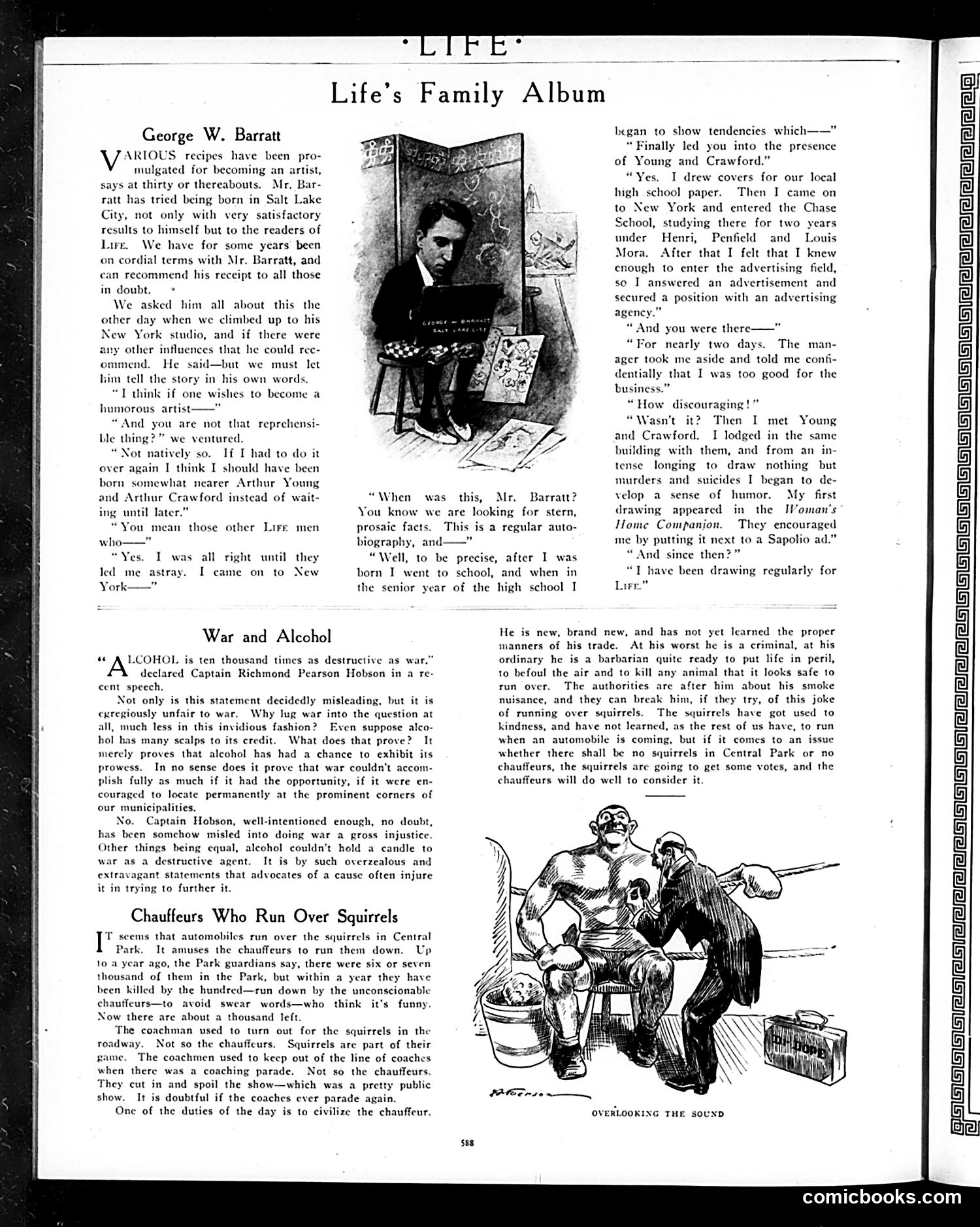
This page features three distinct pieces: **"Life's Family Album: George W. Barratt"** is an interview with a humorous artist/cartoonist. Barratt discusses his path to becoming a satirical illustrator for *Life*, mentioning mentors Arthur Young and Arthur Crawford (fellow *Life* contributors). The sketch shows him at work in his studio surrounded by drawings. **"War and Alcohol"** sarcastically critiques Captain Richmond Pearson Hobson's claim that alcohol is "ten thousand times as destructive as war." The author argues this comparison unfairly diminishes war's destructive capacity—essentially mocking Hobson's temperance advocacy by suggesting war could be equally or more destructive if given the same opportunity. **"Chauffeurs Who Run Over Squirrels"** reports a genuine problem in Central Park: automobile chauffeurs deliberately running over squirrels for amusement, reducing the population from 6,000-7,000 to about 1,000 in one year. The accompanying cartoon (captioned "Overlooking the Sound") satirizes wealthy people's indifference to animal cruelty.
📄 Transcribed text from this page (OCR, searchable)
Machine-transcribed from the original scan — historical spelling and the odd misread are preserved.
George W. Barratt ARIOUS recipes have been pro- mulgated for becoming an artist, says at thirty or thereabouts. Mr. Bar- ‘att has tried being born in Salt L: City, not only with very satisfactory results to himself but to the readers of Lire, We have for some years been on cordial terms with Mr. Barratt, and can recommend his receipt to all those in doubt.» We asked him all about this the other day when we climbed up to his ‘ew York studio, and if there were any other influences that he could rec- ommend. He said—but we must Ict him tell the story in his own words. “LT think if one wishes to become a humorous artist “And you are not that reprehensi- Lie thing?” we ventured. ‘ot natively so. If I had to do it ain I think I should have been born somewhat nearer Arthur Young and Arthur Crawford instead of wait- ing until later.” “You mean those other Lire men who: “Yes, Io was all right until: they led me astray. I came on to New York——” “When was this, Mr. Barratt? You know we are looking for stern, prosaic facts. This is a regular auto- biography, and—” “Well, to be precise, after I was born I went to school, and when in the senior year of the high school I legan to show tendencies which——" “Finally led you into the presence of Young and Crawford.” “Yes. I drew covers for our local high school paper. Then I came on to New York and entered the Chase School, studying there for two years under Henri, Penfield and Louis Mora. After that I felt that I knew cnough to enter the advertising field, so I answered an advertisement and secured a position with an advertising agency.” And you were there——" “For nearly two days. The man- ager took me aside and told me conti- dentially that I was too good for the business.” “How discouraging!” “Wasn't it? Then I met Young and Crawford. I lodged in the same building with them, and from an in: tense longing to draw nothing but murders and suicides I began to de- velop a sense of humor. My. first drawing appeared in the Woman's Home Companion. They encouraged me by putting it next to a Sapolio ad.” And since then “T have been drawing regularly for Lire.” War and Alcohol «« ALCOHOL is ten thousand times as destructive as war.” declared Captain Richmond Pearson Hobson in a re- cent speech. Not only is this statement decidedly misleading, but it is cxregiously unfair to war. Why lug war into the question at all, much less in this invidious fashion? Even suppose alco- hol has many scalps to its credit. What does that prove? It merely proves that alcohol has had a chance to exhibit its prowess. In no sense does it prove that war couldn't accom- plish fully as much if it had the opportunity, if it were en- couraged to locate permanently at the prominent corners of our municipalities. No. Captain Hobson, well-intentioned enough, no doubt, has been somchow misled into doing war a gross injustice. Other things being equal, alcohol couldn't hold a candle to war as a destructive agent. It is by such overzealous and extray atements that advocates of a cause often injure it in trying to further it. Chauffeurs Who Run Over Squirrels I scems that automobiles run over the squirrels in Central Park. It amuses the chauffeurs to run them down. Up to a year ago, the Park guardians say, there were six or seven thousand of them in the Park, but within a year they have heen killed by the hundred—run down by the unconscionable chauffeurs—to avoid swear words—who think it's funny. Now there are about a thousand left The coachman used to turn out for the squirrels in the roadway. Not so the chauffcurs. Squirrels are part of their game. The coachmen used to keep out of the line of coaches when there was a coaching parade. Not so the chauffeurs. They cut in and spoil the show—which was a pretty public show. It is doubtful if the coaches ever parade again. One of the duties of the day is to civilize the chauffeur. He is new, brand new, and has not yet learned the proper manners of his trade. At his worst he is a criminal, at his ordinary he is a barbarian quite ready to put life in peril, to befoul the air and to kill any animal that it looks safe to run over. The authorities are after him about his smoke nuisance, and they can break him, if they try, of this joke of running over squirrels. The squirrels have got used to kindness, and have not learned, as the rest of us have, to run when an automobile is coming, but if it comes to an issue whether there shall be no squirrels in Central Park or no chauffeurs, the squirrels are going to get some votes, and the chauffeurs will do well to consider it OVERLOOKING THE SOUND comicbooks.com