
Life, 1911-03-23 · page 25 of 44
Life — March 23, 1911 — page 25: what you’re looking at
What you’re looking at
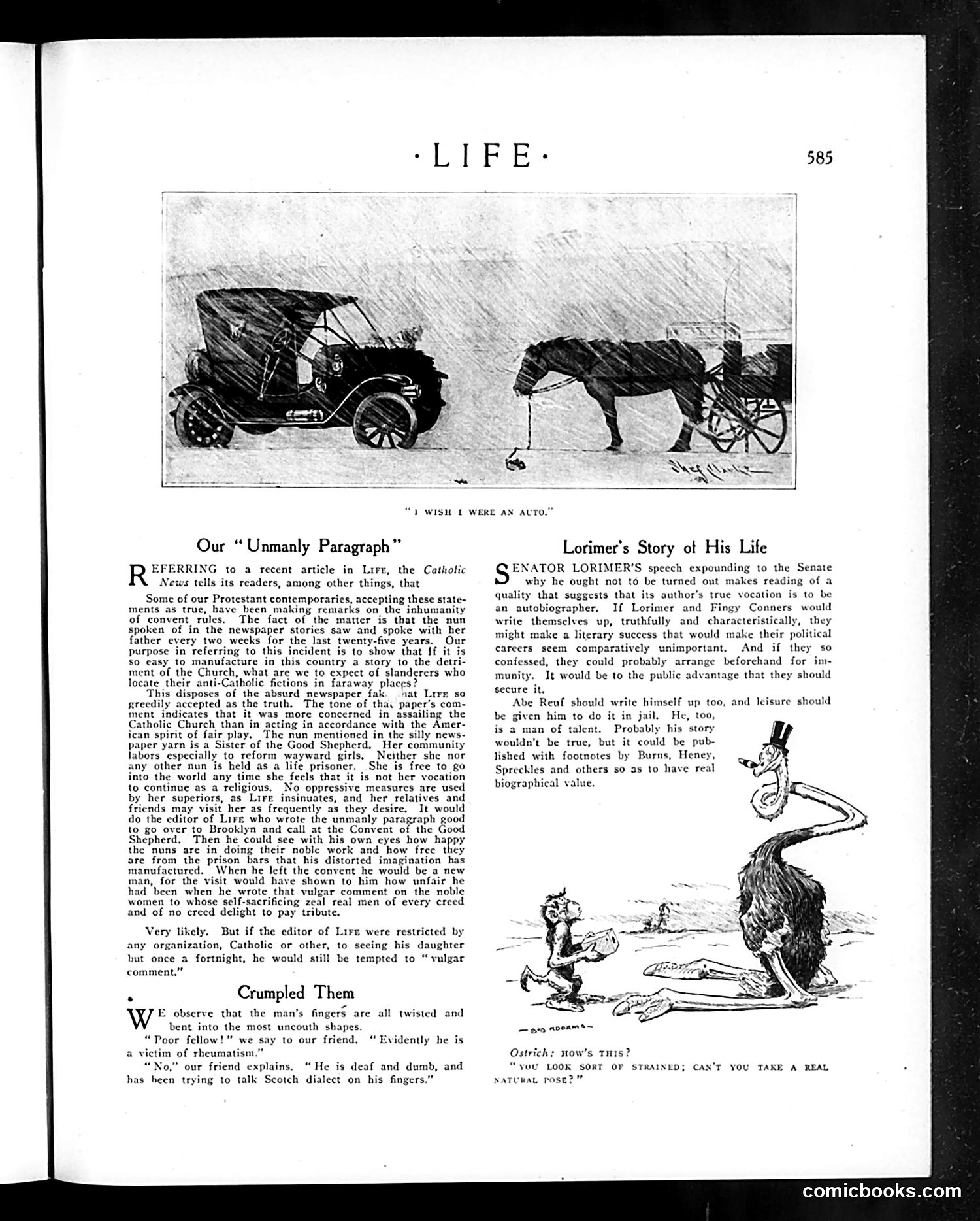
**Top Cartoon ("I Wish I Were an Auto"):** Shows a horse-drawn wagon beside an automobile—a simple visual joke about transportation modernization and the horse's envy of the newer technology. **"Our Unmanly Paragraph":** Life magazine defends Catholic convents against Protestant criticism, responding to reports of harsh treatment of nuns. The piece argues the original story was fabricated and attacks the competing publication's unfair reporting. **"Crumpled Them":** A brief joke about a deaf-and-dumb man attempting Scottish dialect through sign language, resulting in contorted fingers. **"Lorimer's Story of His Life":** Satirizes Senator Lorimer's self-defense speech to the Senate (likely regarding corruption allegations). The author suggests Lorimer and other implicated figures—including Abe Reuf and Fingy Conners—would be better suited as autobiographers than politicians. **Bottom Cartoon:** An ostrich struggling to maintain a "natural pose," likely satirizing forced artificiality or awkward public relations efforts.
📄 Transcribed text from this page (OCR, searchable)
Machine-transcribed from the original scan — historical spelling and the odd misread are preserved.
, > “| WISH I WERE AN AUT! Our “ Unmanly Paragraph” R* RING to a recent article in Lire, the Catholic News tells its readers, among other things, that Some of our Protestant contemporaries, accepting these state- ments as true, have been making remarks on the inhumanity of convent rules. The fact of the matter is that the nun spoken of in the newspaper stories saw and spoke with her father every two weeks for the last twenty-five years. Our purpose in referring to this incident is to show that Sf it is So easy to manufacture in this country a story to the detri- ment of the what are we to expect of slanderers who locate their anti-Catholic fictions in faraway places? This disposes of the absurd newspaper fa nat LIFE so greedily accepted as the truth. The tone of tha: paper's com- ment indicates that it was more concerned in assailing the Catho Church than in acting in accordance with the Amer- ican spirit of fair play. The nun mentioned in the silly news- paper yarn is a Sister of the Good Shepherd. Her community labors especially to reform wayward girls. Neither she nor any other nun is held as a life prisoner. She is free to go into the world any time she feels that it is not her vocation to continue as a religious. No oppressive measures are used by her superiors, as Lire insinuates, and her relatives and friends may visit her as frequently as they desire. It would do the editor of Lire who wrote the unmanly paragraph good to go over to Brooklyn and call at the Convent of the Good Shepherd. Then he could see with his own eyes how happy the nuns are in doing their noble work and how free they are from the prison bars that his distorted imagination has manufactured. When he left the convent he would be a new man, for the visit would have shown to him how unfair he had been when he wrote that vulgar comment on the noble women to whose self-sacrificing zeal real men of every creed and of no creed delight to pay tribute. Very likely. But if the editor of Lirz were restricted by any organization, Catholic or other, to seeing his daughter but once a fortnight, he would still be tempted to “ vulgar comment.” Crumpled Them E observe that the man’s fingers are all twisted and bent into the most uncouth shapes. Poor fellow!" we say to our friend, “ Evidently he is a victim of rheumatism. “No,” our friend explains. “He is deaf and dumb, and has heen trying to talk Scotch dialect on his fingers.” Lorimer’s Story ot His Life GENATOR Loria R’S speech expounding to the Senate why he ought not to be turned out makes reading of a quality that suggests that its author's true vocation is to be an autobiographer. If Lorimer and Fingy Conners would write themselves up, truthfully and characteristically, they might make a literary success that would make their political careers seem comparatively unimportant, And if they so confessed, they could probably arrange beforehand for im- munity. It would be to the public advantage that they should secure it. Abe Reuf should write himself up too, and leisure should be given him to do it in jail. He, too, is a man of talent. Probably his sto: wouldn't be true, but it could be pub- lished with footnotes by Burns, Heney, Spreckles and others so as to have real biographical value. Ostrich: now's TH “YoU LOOK SORT OF STRAINED; CAN'T YOU TAKE A REAL NATURAL POSE?” comicbooks.com