
Life, 1911-03-23 · page 8 of 44
Life — March 23, 1911 — page 8: what you’re looking at
What you’re looking at
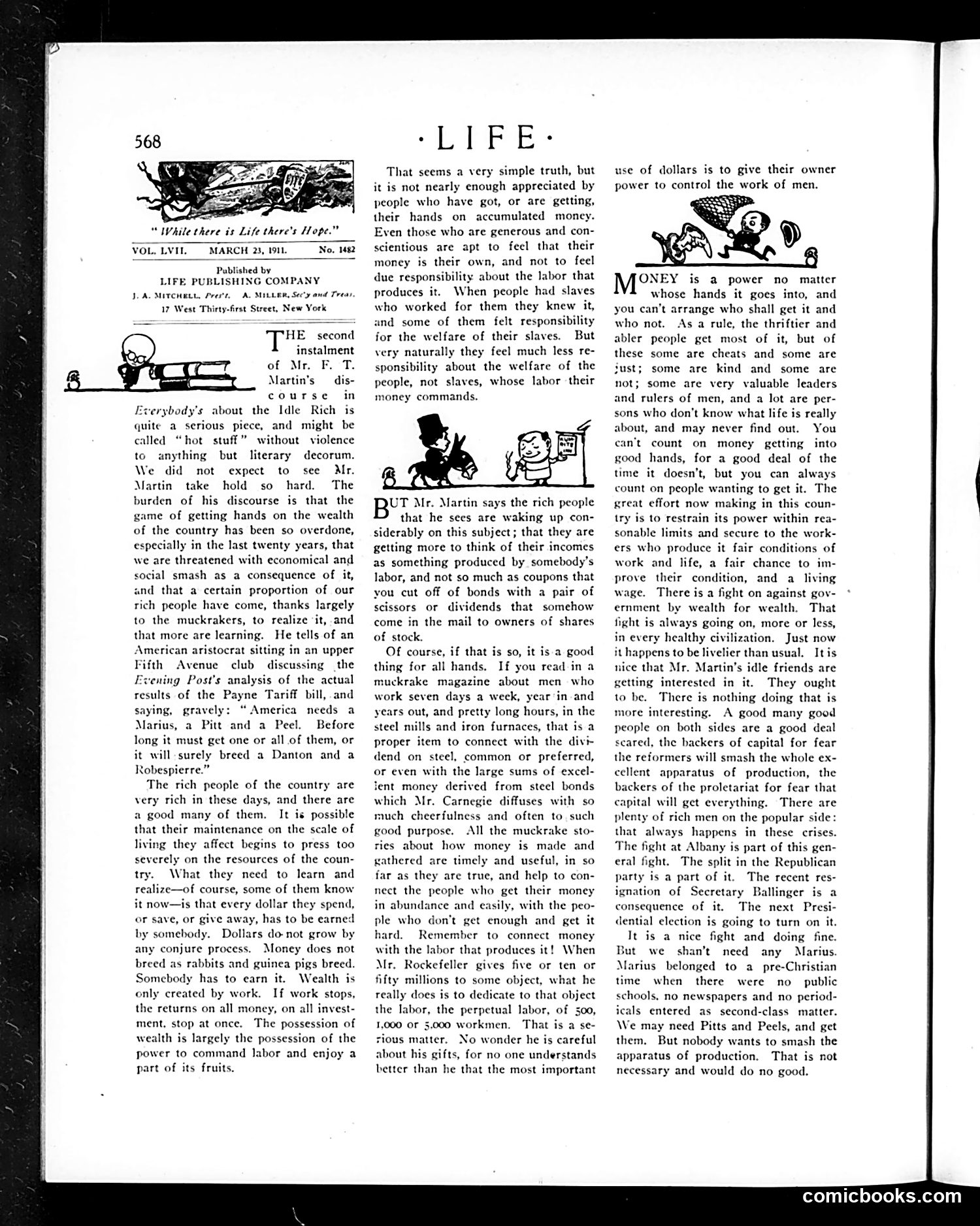
This page critiques wealthy industrialists' attitudes toward money and labor. The text references **Mr. E.T. Martin's discourse** on how rich people view wealth as personal property rather than acknowledging workers' contributions. The article explicitly mentions **Mr. Carnegie** (steel magnate Andrew Carnegie) diffusing "cheerfulness" about dividend-generating steel bonds, contrasting this with the actual labor of "1,000 or 5,000 workmen." The cartoons (small illustrations visible) appear to satirize the disconnect between wealthy capitalists who passively collect dividends and the workers whose actual labor produces the wealth. The piece argues reformers should focus on ensuring fair wages and working conditions rather than attacking wealth itself—a Progressive Era debate about labor rights, capital, and social responsibility during early 20th-century industrial America.
📄 Transcribed text from this page (OCR, searchable)
Machine-transcribed from the original scan — historical spelling and the odd misread are preserved.
“ While there is Life there's Hope.” VOL. LVI. No, 1482 MARCH 23, 1911. Published by LIFE PUBLISHING COMPANY JOA. MITCHELL, Prest, AL MILLER, Sec'y and Treas, 17 West Thirty-first Street, New York HE. second instalment of Mr. Tc: Martin’s — dis- course in Everybody's about the Idle Rich is quite a serious piece, and might be called “hot stuff” without violence to anything but literary decorum. We did not expect to see Mr. Martin take hold so hard. The burden of his discourse is that the game of getting hands on the wealth of the country has been so overdone, especially in the last twenty years, that we are threatened with economical and social smash as a consequence of it, id that a certain proportion of our rich people have come, thanks largely to the muckrakers, to realize ‘it, and that more are learning. He tells of an American aristocrat sitting in an upper Fifth Avenue club discussing the Evening Post's analysis of the actual results of the Payne Tariff bill, and saying, gra “America needs a Marius, a Pitt and a Peel. Before long it must get one or all of them, or it will surely breed a Danton and a Robespierre.” The rich people of the country are very rich in these days, and there are a good many of them. It is possible that their maintenance on the scale of living they affect begins to press too severely on the resources of the coun- try. What they need to learn and realize—of course, some of them know it now—is that every dollar they spend, or save, or give away, has to be earned by somebody. Dollars do-not grow by any conjure process. Money does not breed as rabbits and guinea pigs breed. Somebody has to earn it. Wealth is only created by work. If work stops, the returns on all money, on all invest- ment, stop at once. The possession of wealth is largely the possession of the power to command labor and enjoy a part of its fruits. >LIFE« That seems a very simple truth, but it is not nearly enough appreciated by people who have got, or are getting, their hands on accumulated money. Even those who are generous and con- scientious are apt to feel that their money is their own, and not to feel due responsibility about the labor that produces it. When people had slaves who worked for them they knew it, and some of them felt responsibility for the welfare of their slaves. But very naturally they feel much less re- sponsibility about the welfare of the people, not slaves, whose labor their money commands. UT Mr. Martin says the rich people that he sees are waking up con- siderably on this subject; that they are getting more to think of their incomes as something produced by somebody’s labor, and not so much as coupons that you cut off of bonds with a pair of scissors or dividends that somehow come in the mail to owners of shares of stock. Of course, if that is so, it is a good thing for all hands. If you read in a muckrake magazine about men who work seven days a week, year‘in and years out, and pretty long hours, in the steel mills and iron furnaces, that is a proper item to connect with the div- dend on steel, common or preferred, or even with the large sums of excel- Tent money derived from steel bonds which Mr. Carnegie diffuses with so much cheerfulness and often to such good purpose. All the muckrake sto- ries about how money is made and gathered are timely and useful, in so ‘ar as they are true, and help to con- nect the people who get their money in abundance and easily, with the peo- ple who don’t get enough and get it hard. Remember to connect money with the labor that produces it! When Mr. Rockefeller gives five or ten or fifty millions to some object, what he really does is to dedicate to that object the labor, the perpetual labor, of 5 1,000 or 5,000 workmen. That is a se- rious matter. No wonder he is careful about his gifts, for no one understands better than he that the most important use of dollars is to give their owner power to control the work of men. ONEY is a power no matter whose hands it goes into, and you can’t arrange who shall get it and who not. As a rule, the thriftier and abler people get most of it, but of these some are cheats and some are just; some are kind and some are not; some are very valuable leaders and rulers of men, and a lot are per- sons who don’t know what life is really about, and may never find out. You can't count on money getting into good hands, for a good deal of the time it doesn’t, but you can always count on people wanting to get it. The great effort now making in this coun- try is to restrain its power within rea- sonable limits and secure to the work- ers who produce it fair conditions of work and life, a fair chance to im- prove their condition, and a living wage. There is a fight on against gov- ernment by wealth for wealth. That fight is always going on, more or less, in every healthy civilization. Just now it happens to be livelier than usual. It is nice that Mr. Martin's idle friends are getting interested in it. They ought to be. There is nothing doing that is more interesting. A good many good people on both sides are a good deal seared, the backers of capital for fear the reformers will smash the whole ex- cellent apparatus of production, the backers of the proletariat for fear that capital will get everything. There are plenty of rich men on the popular side: that always happens in these crises. The fight at Albany is part of this gen- al fight. The split in the Republican party is a part of it. The recent res- ignation of Secretary Ballinger is a consequence of it. The next Presi- dential election is going to turn on it. It is a nice fight and doing fine. But we shan’t need any Marius. Marius belonged to a_ pre-Christian time when there were no public schools, no newspapers and no period- icals entered as second-class matter. We may need Pitts and Peels, and get them, But nobody wants to smash the apparatus of production. That is not necessary and would do no good. comicbooks.com