
Life, 1911-03-23 · page 14 of 44
Life — March 23, 1911 — page 14: what you’re looking at
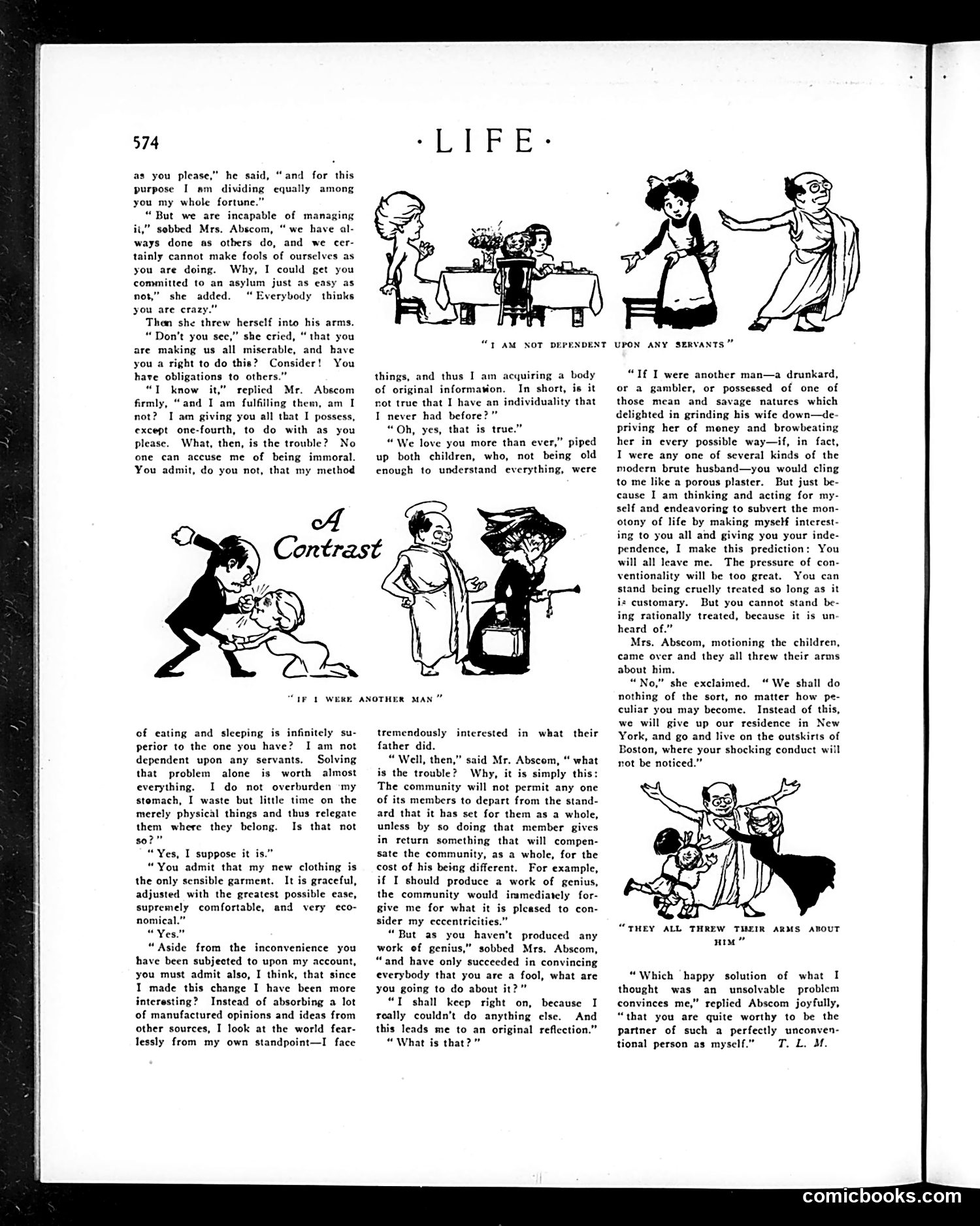
What you’re looking at
This appears to be a multi-panel satire about social conformity and individualism, centered on Mr. Abscom, who has rejected conventional living—wearing practical clothes, refusing servants, and thinking independently rather than absorbing "manufactured opinions." The cartoon's central irony: Abscom's wife and society would more readily tolerate a husband who is a "drunkard" or brute who "grinds his wife down" than one who simply acts independently and challenges social norms. The illustrations labeled "A Contrast" and "If I Were Another Man" visualize this hypocrisy. **The satire's point**: Society accepts and even enables conventional vices (drunkenness, cruelty) because they're customary, but punishes non-conformity and rationality as eccentricity or madness. Abscom's wife even threatens him with an asylum commitment simply for living differently—suggesting that independent thinking itself was viewed as pathological by early 20th-century conventional society. The piece critiques how conformity pressure, masked as propriety, actually enforces acceptance of genuine harm while rejecting harmless individuality.
📄 Transcribed text from this page (OCR, searchable)
Machine-transcribed from the original scan — historical spelling and the odd misread are preserved.
574 as you please,” he said, “and for this purpose I am dividing equally among you my whole fortune.” “But we are incapable of managing ii,” sobbed Mrs. Abscom, “we have al- ways done as others do, and we cer- tainly cannot make fools of ourselves as you are doing. Why, I could get you committed to an asylum just as easy as not,” she added. “Everybody thinks you are craz: Than she threw herself into his arms. “Don't you sec,” she cried, “that you are making us all miserable, and have you a right to do this? Consider! You have obligations to others.” “1 know replied Mr. Abscom firmly, “and I am fulfilling them, am I not? I am giving you all that I possess, except one-fourth, to do with as you please. What, then, is the trouble? No one can accuse me of being immoral. You admit, do you not, that my method “1 AM NOT DEPENDENT things, and thus I am acquiring a body of original informawon. In short, is it not true that I have an individuality that I never had before?” “Oh, yes, that is true.” “We love you more than ever,” piped up both children, who, not being old enough to understand everything, were “PF 1 WERE ANOTHER MAN” of eating and sleeping is infinitely su- perior to the one you have? I am not dependent upon any servants. Solving that problem alone is worth almost everything. I do not overburden ‘my stomach, I waste but little time on the merely physical things and thus relegate them where they belong. Is that not so?” Yes, I suppose it is.” “You admit that my new clothing is the only sensible garment. It is graceful, adjusted with the greatest possible ease, supremely comfortable, and very eco- nomical.” “Yes.” “Aside from the inconvenience you have been subjected to upon my account, you must admit also, I think, that since I made this change I have been more interesting? Instead of absorbing a lot of manufactured opinions and ideas from other sources, I look at the world fear- lessly from my own standpoint—I face tremendously father did. “Well, then,” said Mr. Abscom, “ what is the trouble? Why, it is simply this: The community will not permit any one of its members to depart from the stand- ard that it has set for them as a whole, unless by so doing that member gives in return something that will compen- sate the community, as a whole, for the cost of his being different. For example, if I should produce a work of genius, the community would iramediately for- give me for what it is pleased to con- sider my eccentricities.” “But as you haven't produced any work of genius,” sobbed Mrs. Abscom, “and have only succeeded in convincing everybody that you are a fool, what are you going to do about it?” “TI shall keep right on, because I really couldn't do anything else. And this leads me to an original reflection.” “What is that?” interested in what their UPON ANY SERVANTS” “If I were another man—a drunkard, or a gambler, or possessed of one of those mean and savage natures which delighted in grinding his wife down—de- priving her of money and browbeating her in every possible way—if, in fact, I were any one of several kinds of the modern brute husband—you would cling to me like a porous plaster. But just be- cause I am thinking and acting for my- self and endeavoring to subvert the mon- otony of life by making myself interest- ing to you all and giving you your inde- pendence, I make this prediction: You will all leave me. The pressure of con- ventionality will be too great. You can stand being cruelly treated so long as it is customary. But you cannot stand be- ing rationally treated, because it is un heard of.” Mrs, Abscom, motioning the children, came over and they all threw their arms about him. “No,” she exclaimed. “We shall do nothing of the sort, no matter how pe- culiar you may become. Instead of this, we will give up our residence in New York, and go and live on the outskirts of Boston, where your shocking conduct will not be noticed.” “THEY ALL THREW THEIR ARMS ANOUT nie” “Which ‘happy solution of what I thought was an unsolvable problem convinces me,” replied Abscom joyfully, “that you are quite worthy to be the partner of such a perfectly unconven- tional person as myself.” T. L. M. comicbooks.com