
Life, 1911-03-23 · page 32 of 44
Life — March 23, 1911 — page 32: what you’re looking at
What you’re looking at
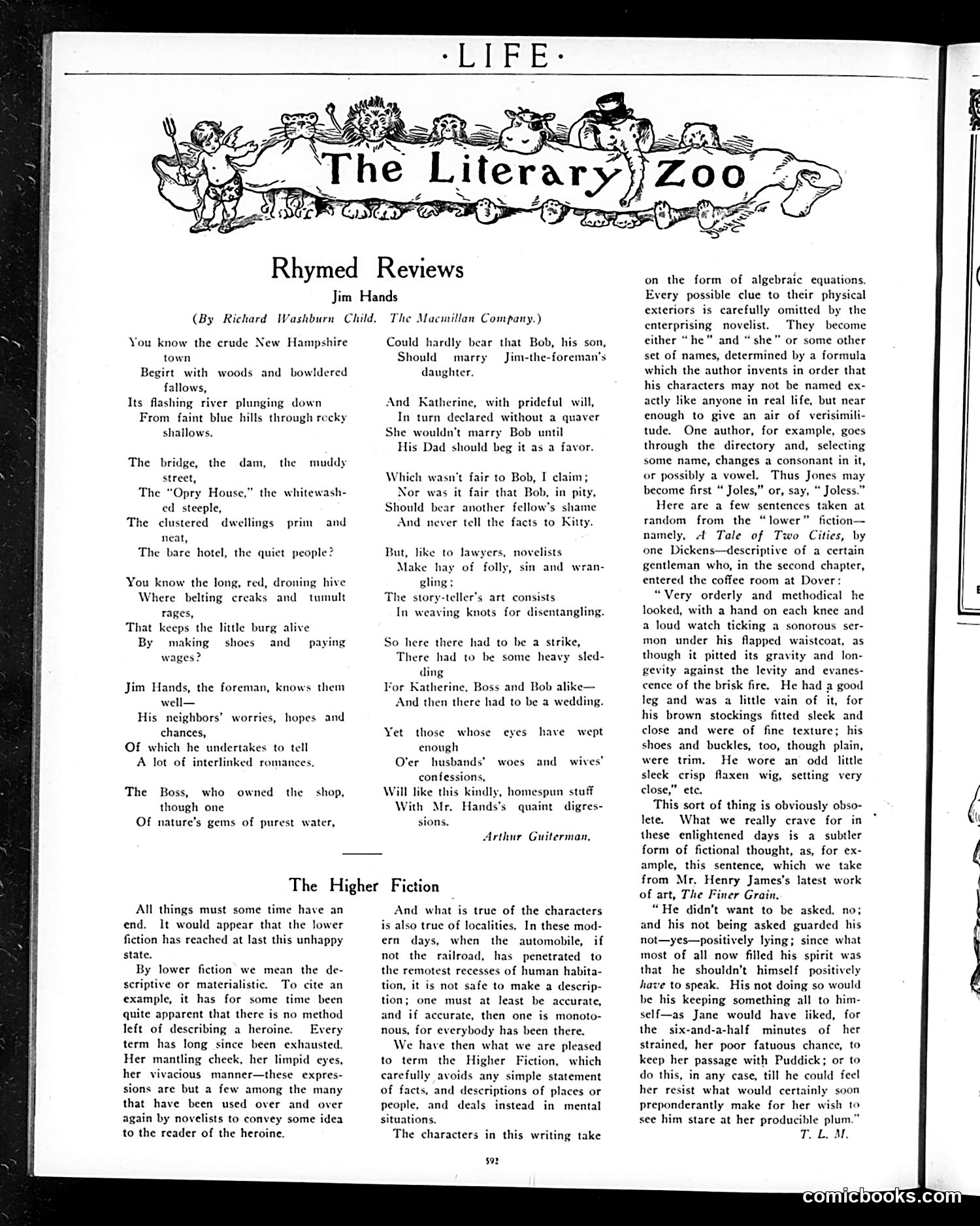
This page contains two literary reviews satirizing contemporary fiction trends. **"Jim Hands"** is a rhymed review by Arthur Guiterman of a novel depicting a New Hampshire factory town. The plot involves class conflict: a factory boss opposes his son marrying the foreman's daughter. Guiterman mocks how novelists artificially manufacture drama—requiring a strike and wedding to resolve the tension—suggesting the contrivance of sentimental popular fiction. **"The Higher Fiction"** critiques modernist literary trends. It argues that descriptive realism has exhausted itself: authors can no longer describe heroines without repetition, and detailed locations are impossible since automobiles have made everywhere accessible. The essay sarcastically praises "Higher Fiction," which avoids physical description entirely, reducing characters to abstract formulas or vague pronouns ("he"/"she"), treating them like algebraic equations. The satire targets both sentimental lower fiction and its experimental opposite—suggesting both approaches abandon genuine characterization for different reasons: one through overwrought cliché, the other through calculated obscurity.
📄 Transcribed text from this page (OCR, searchable)
Machine-transcribed from the original scan — historical spelling and the odd misread are preserved.
Rhymed Reviews Jim Hands (By Richard Washburn Child. You know the crude New Hampshire town Begirt with woods and bowldered fallows, Its flashing river plunging down From faint blue hills through recky shallows. The bridge, the dam, the muddy street, The “Opry House,” the whitewash- ed steeple, The clustered dwellings prim and neat, The bare hotel, the quiet people? You know the long, red, droning hive Where belting creaks and tumult rages, That keeps the little burg alive By making shoes and paying wages? Jim Hands, the foreman, knows them well— His neighbors’ worries, hopes and chances, Of which he undertakes to tell A lot of interlinked romances, The Boss, who owned the shop, though one Of nature’s gems of purest water, The Macmillan Company.) Could hardly bear that Bob, his son, Should = marry — Jim-the-foreman’s daughter, And Katherine, with prideful will, In turn declared without a quaver She wouldn't marry Bob until His Dad should beg it as a favor. Which wasn’t fair to Bob, I claim; Nor was it fair that Bob, in pit Should bear another fellow’s shame And never tell the facts to Kitty. But, like to lawyers, novelists Make hay of folly, sin and wran- gling; The story-teller’s art consists In weaving knots for disentangling. So here there had to be a strike, There had to be some heavy sled- ding For Katherine, Boss and Bob alike— And then there had to be a wedding. Yet those whose eyes have wept enough O'’er husbands’ woes and wives’ confessions, Will like this kindly, homespun stuff With Mr, Hands’s quaint digres- sions. Arthur Guiterman, The Higher Fiction All things must some time have an end, It would appear that the lower fiction has reached at last this unhappy state. By lower fiction we mean the de- scriptive or materialistic. To cite an example, it has for some time been quite apparent that there is no method left of describing a heroine. Every term has long since been exhausted. Her mantling cheek, her limpid eyes, her vivacious manner—these expres- sions are but a few among the many that have been used over and over again by novelists to convey some idea to the reader of the heroine. And what is true of the characters is also true of localities. In these mod- ern days, when the automobile, if not the railroad, has penetrated to the remotest recesses of human habita- tion, it is not safe to make a descrip- tion; one must at least be accurate, and if accurate, then one is monoto- nous, for everybody has been there. We have then what we are pleased to term the Higher Fiction, which carefully avoids any simple statement of facts, and descriptions of places or people, and deals instead in mental situations. The characters in this writing take soz on the form of algebraic equations. Every possible clue to their physical exteriors is carefully omitted by the enterprising novelist. They become either “he” and “she” or some other set of names, determined by a formula which the author invents in order that his characters may not be named ex actly like anyone in real life, but near enough to give an air of verisimili- tude. One author, for example, goes through the directory and, selecting some name, changes a consonant in it, or possibly a vowel. Thus Jones may become first “ Joles,” or, say, “ Joless.” Here are a few sentences taken at random from the “lower” fiction— namely, <f Tale of Two Cities, by one Dickens—descriptive of a certain gentleman who, in the second chapter, entered the coffee room at Dover: “Very orderly and methodical he looked, with a hand on each knee and a loud watch ticking a sonorous ser- mon under his flapped waistcoat, as though it pitted its gravity and lon- gevity against the levity and evanes- cence of the brisk fire. He had a good leg and was a little vain of it, for his brown stockings fitted sleck and close and were of fine texture; his shoes and buckles, too, though plain, were trim. He wore an odd little sleck crisp flaxen wig, setting very close,” etc, This sort of thing is obviously obso- lete. What we really crave for in these enlightened days is a subtler form of fictional thought, as, for ex- ample, this sentence, which we take from Mr. Henry James's latest work of art, The Finer Grain. “He didn’t want to be asked, no; and his not being asked guarded his not—yes—positively lying; since what most of all now filled his spirit was that he shouldn’t himself positively have to speak. His not doing so would be his keeping something all to him- self—as Jane would have liked, for the six-and-a-half minutes of her strained, her poor fatuous chance, to keep her passage with Puddick; or to do this, in any case, till he could feel her resist what would certainly soon preponderantly make for her wish to see him stare at her producible plum.” T. L, at