
Life, 1911-03-23 · page 21 of 44
Life — March 23, 1911 — page 21: what you’re looking at
What you’re looking at
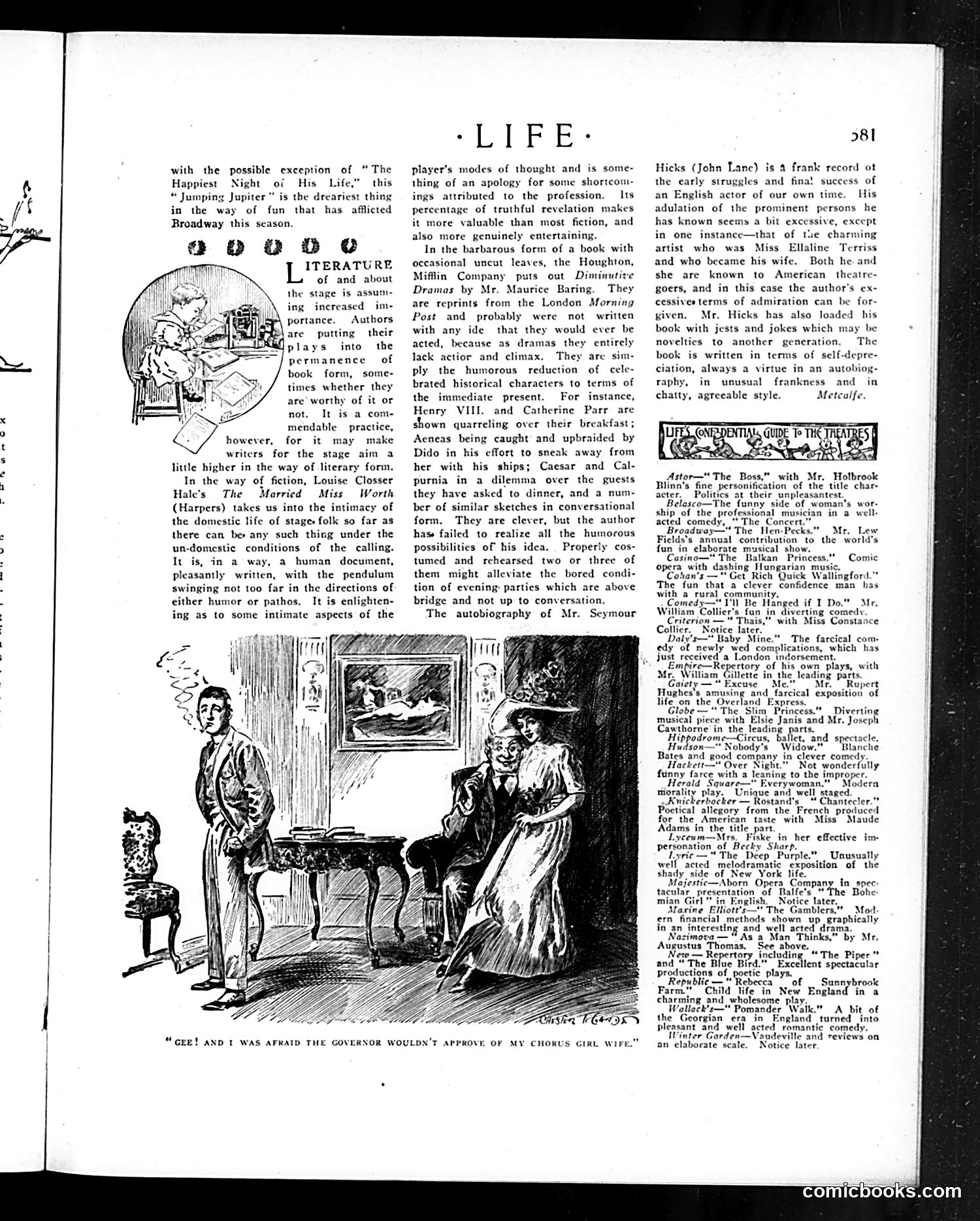
This is a **theater review and literary criticism page** from Life magazine (early 20th century). The main cartoon shows a man reassuring his wife about her past as a chorus girl, saying he was "afraid the Governor wouldn't approve"—a joke about social respectability. The implication is that marrying a chorus girl was once considered scandalous, especially to authority figures like governors, but the character is relieved it's acceptable. The accompanying text reviews recent Broadway plays and books about theatrical life, including Louise Closser Hale's novel about stage performers' domestic lives and Seymour Hicks's autobiography. The reviews note that theater folk led unconventional lives that fascinated the public. The page satirizes both the theater world's bohemian reputation and society's prudish attitudes toward entertainers—particularly chorus girls, who occupied an ambiguous social status between respectability and scandal.
📄 Transcribed text from this page (OCR, searchable)
Machine-transcribed from the original scan — historical spelling and the odd misread are preserved.
ee re with the possible exception of “ The Happiest Night of His Life,” this “ Jumping Jupiter” is the dreariest thing in the way of fun that has afflicted Broadway this season. ooo 8 @ ITERATURE of and about age is assum- the ing increased im- portance. Authors are putting their plays into the permanence of book form, some- times whether they are’ worthy of it or not. It is a com- / mendable practice, however, for it may make writers for the stage aim a little higher in the way of literary form. In the way of fiction, Louise Closser Hale's The Married Miss Worth (Harpers) takes us into the intimacy of the domestic life of stages folk so far as there can be any such thing under the un-domestic conditions of the calling. It is, in a way, a human document, pleasantly written, with the pendulum swinging not too far in the directions of either humor or pathos. It is enlighten ing as to some intimate aspects of the “GEE! AND T WAS AFRAID THE GOVERNOR WOULDN'T APPROVE OF MY CHORUS GIRL WIFE.” *LIFE: player's modes of thought and is some- thing of an apology for some shortcom- ings attributed to the profession. Its percentage of truthful revelation makes it more valuable than most fiction, and also more genuinely entertaining. In the barbarous form of a book with occasional uncut leaves, the Houghton, MiMlin Company puts out Diminutive Dramas by Mr. Maurice Baring. They are reprints from the London Morning Post and probably were not written with any ide that they would ever be acted, because as dramas they entirely lack actior and climax. They are sim- ply the humorous reduction of cele- brated historical characters to terms of the immediate present. For instance, Henry VIII. and Catherine Parr are shown quarreling over their breakfast; Aeneas being caught and upbraided by Dido in his effort to sneak away from her with his ships; Caesar and Cal- purnia in a dilemma over the guests they have asked to dinner, and a num- ber of similar sketches in conversational form. They are clever, but the author has failed to realize all the humorous possibilities of his idea. Properly cos- tumed and rehearsed two or three of them might alleviate the bored condi- tion of evening: parties which are above bridge and not up to conversation. The autobiography of Mr. Seymour ZG en WFC 281 Hicks (John Lanc) is 4 frank record ot the early struggles and fina! success of an English actor of our own time. His adulation of the prominent persons he has known seems a bit excessive, except in one instance—that of te charming artist who was Miss Ellaline Terriss and who became his wife. Both he and she are known to American theatre- goers, and in this case the author's ex- cessives terms of admiration can be for- given. Mr. Hicks has also loaded his book with jests and jokes which may be novelties to another generation. The book is written in terms of self-depre- ciation, always a virtue in an autobiog- raphy, in unusual frankness and i chatty, agreeable style. Astor—“ The Boss,” with Mr. Holbrook Blinn’s fine personification of the title char- acter, Politics at their unpleasantest. Belosco—The funny side of woman's wor- ship of the professional musician in a well- acted comedy," The Concert. Broadway—" The Hen-Pecks.” Mr. Lew Fields’s annual contribution to the world’s fun in elaborate musical show. Casino—" The Balkan Princess opera with dashing Hungarian musi Cohan’s —** Get Rich Quick Wallingford.” The fun that a clever confidence man has with a rural community, Comedy I'l Be Hanged if I Do.” Me. fun in diverting comedy * with Miss Constance Comic Daly’s—" Baby Mine.” The farcical com- ¢dy of newly wed complications, which has just received a London indorsement. Empire—Repertory of his own plays, with Mr, William, Gillette in the leading parts Gaiety —“ Excuse Me.” — Mr. Rupert Hughes's amusing and farcical exposition of life on the, Overland Express. Globe —“ The Slim Princess.” _Diverting musical piece with Elsie Janis and Mr. Joseph Cawthorne in the leading parts, Hippodrome—Circus, ballet, and spectacle, Hudson—" Nobody's. Widow.” — Blanche Bates and good company in clever comedy. Hackett" Over Night.” Not wonderfully funny farce with a leaning to the improper. Herald Square—" Everywoman.” Modera niorality play. Unique an¢ Knickerbocker — Rostand's_ “ Chantecl, Poetical allegory from the French produced for the American taste with Miss Maude Adams in the title part Lyceum—Mrs. Fiske in her effective im- personation of Becky Sharp. Lyric—“ The Deep Purple.” Unusually well acted melodramatic exposition of the shady side of New York life. Majestic—Aborn Opera Company in spec: tacular present: of Ralfe’s “The Bohe mian Girl” in Notice later, Marin The Gamblers.” Mod: ¢rn financial methods shown up graphically in an interesting and well acted drama. Nazimova—“ As a Man Thinks,” by Mr. Augustus Thomas, See above. New — Repertory including “The Piper” and “ The Blue Bird.” Excellent spectacular productions of poetic plays. Republic —“ Rebecca of _ Sunnybrook Farm." Child life in New England in a charming and wholesome play. Wallack’s—" Pomander Waik.” A bit of the Georgian era in England turned into pleasant and well acted romantic comedy. Winter Garden—Vandeville and reviews on an elaborate scale. Notice later