
Life, 1911-03-23 · page 17 of 44
Life — March 23, 1911 — page 17: what you’re looking at
What you’re looking at
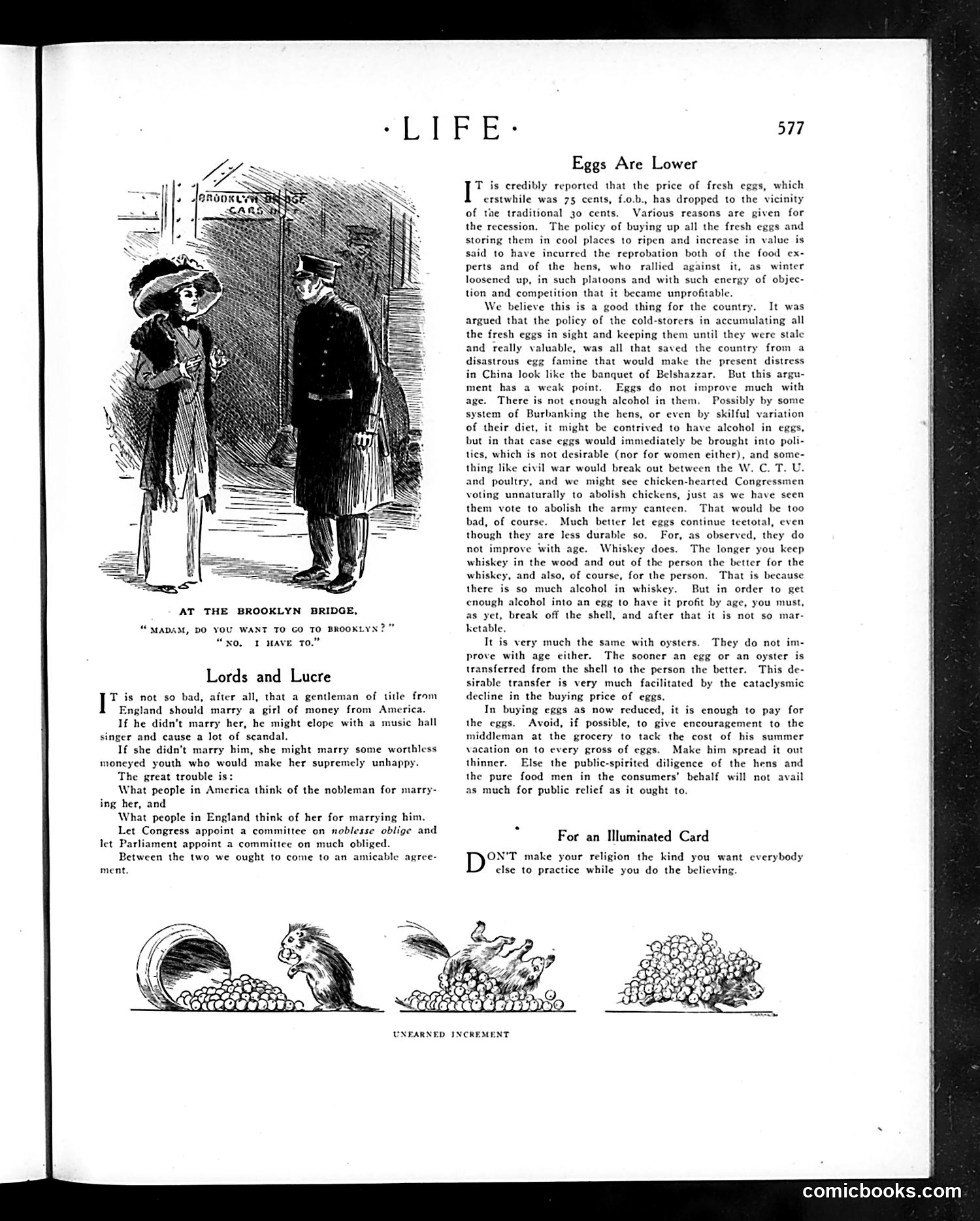
## "At the Brooklyn Bridge" Cartoon The sketch depicts a woman at the Brooklyn Bridge telling a man she doesn't *want* to go to Brooklyn but *has to*—likely a joke about reluctant obligation or marital duty, given the page's focus on transatlantic marriages. ## "Lords and Lucre" Section This satirizes marriages between English nobility and wealthy American heiresses. The piece mocks the hypocrisy on both sides: Americans resent the nobleman's mercenary motives, while the English resent the American woman's "new money" status. The proposed solution—Congressional and Parliamentary committees on "noblesse oblige"—is satirical commentary on how absurdly complicated societies treat such unions. ## "Eggs Are Lower" A humorous economic commentary on egg prices dropping from 75 cents to 30 cents. The author praises this, mocking previous speculation that hoarded eggs to inflate prices. The extended joke comparing eggs to whiskey (whiskey improves with age and alcohol content; eggs don't) is typical of Life's sophisticated, digressive humor style.
📄 Transcribed text from this page (OCR, searchable)
Machine-transcribed from the original scan — historical spelling and the odd misread are preserved.
~LIFE- AT THE BROOKLYN BRIDGE, “ MADAM, DO YOU WANT TO GO TO BROOKL' “No, 1 MAVE TO.” Lords and Lucre T is not so bad, after all, that a gentleman of title from England should marry a girl of money from America. If he didn’t marry her, he might elope with a music hall singer and cause a lot of scandal. If she didn’t marry him, she might marry some worthless moneyed youth who would make her supremely unhappy. The great trouble is: What people in America think of the nobleman for marry- ing her, and What people in England think of her for marrying him. Let Congress appoint a committee on noblesse oblige and let Parliament appoint a committee on much obliged. Between the two we ought to come to an amicable agree- ment. ieee see 577 Eggs Are Lower T is credibly reported that the price of fresh eggs, which erstwhile was 75 cents, f.0.b., has dropped to the vicinity of the traditional 30 cents. Various reasons are given for the recession. The policy of buying up all the fresh eggs and storing them in cool places to ripen and increase in value is said to have incurred the reprobation both of the food ex- perts and of the hens, who rallicd against it, as winter loosened up, in such platoons and with such energy of objec- tion and competition that it became unprofitable. We believe this is a good thing for the country. It was argued that the policy of the cold-storers in accumulating all the fresh eggs in sight and keeping them until they were stale and really valuable, was all that saved the country from a disastrous egg famine that would make the present distress in China look like the banquet of Belshazzar, But this argu- ment has a weak point. Eggs do not improve much with There is not cnough alcohol in them. Possibly by some system of Burbanking the hens, or even by skilful variation of their diet, it might be contrived to have alcohol in eggs. but in that case eggs would immediately be brought into poli- tics, which is not desirable (nor for women either), and some- thing like civil war would break out between the W. C. T. U. and poultry, and we might see chicken-hearted Congressmen voting unnaturally to abolish chickens, just as we have seen them vote to abolish the army canteen. That would be too bad, of course. Much better let eggs continue teetotal, even though they are less durable so. For, as observed, they do not improve with age. Whiskey does. The longer you keep whiskey in the wood and out of the person the better for the whiskey, and also, of course, for the person. That is because there is so much alcohol in whiskey. But in order to get enough alcohol into an egg to have it profit by age, you must, as yet, break off the shell, and after that it is not so mar- ketable. It is very much the same with oysters. They do not im- prove with age either. The sooner an egg or an oyster is transferred from the shell to the person the better. This de- sirable transfer is very much facilitated by the cataclysmic decline in the buying price of eggs. In buying eggs as now reduced, it is enough to pay for the eggs. Avoid, if possible, to give encouragement to the middleman at the grocery to tack the cost of his summer vacation on to every gross of eggs. Make him spread it out thinner. Else the public-spirited diligence of the hens and the pure food men in the consumers’ behalf will not avail as much for public relief as it ought to. For an Illuminated Card ON'T make your religion the kind you want everybody else to practice while you do the believing. éenr UNEARNED INCREMENT comicbooks.com