
A complete issue · 44 pages · 1911
Life — March 16, 1911
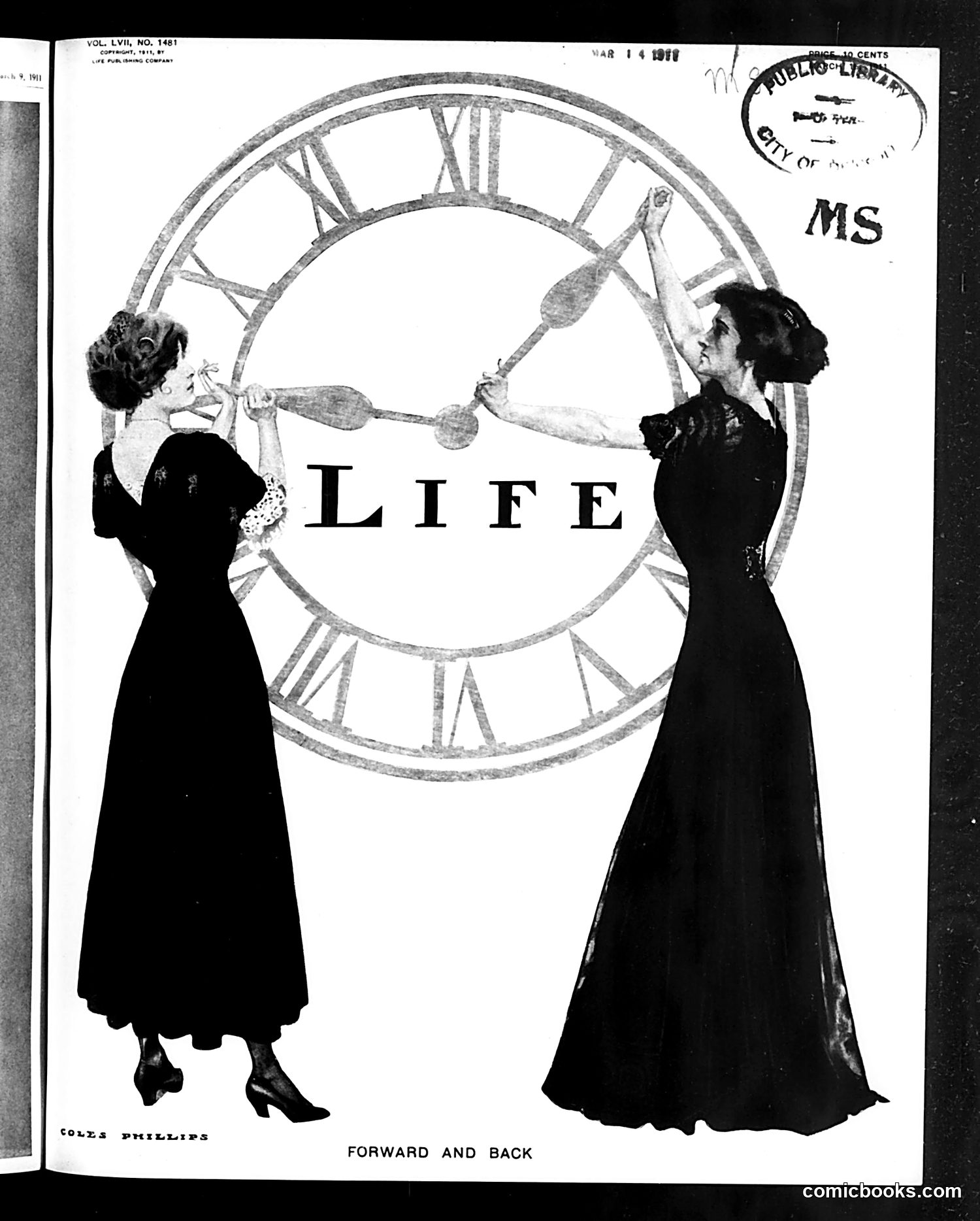
This is a **LIFE magazine cover** from March 14, 1912 (based on the visible date stamp). The illustration by Coles Phillips depicts two elegantly dressed women in dark gowns, viewed front and back, manipulating the hands of a large clock face. The title "LIFE" appears centrally, with a caption reading "FORWARD AND BACK." The cartoon likely satirizes **women's changing roles and influence in early 20th-century America**. The clock symbolizes time and social progress. By showing women actively controlling time itself—moving it forward and backward—the image suggests women's growing agency in society, possibly referencing contemporary debates about women's suffrage and social reform. The "forward and back" caption emphasizes this dual movement: progressive advancement alongside conservative resistance.
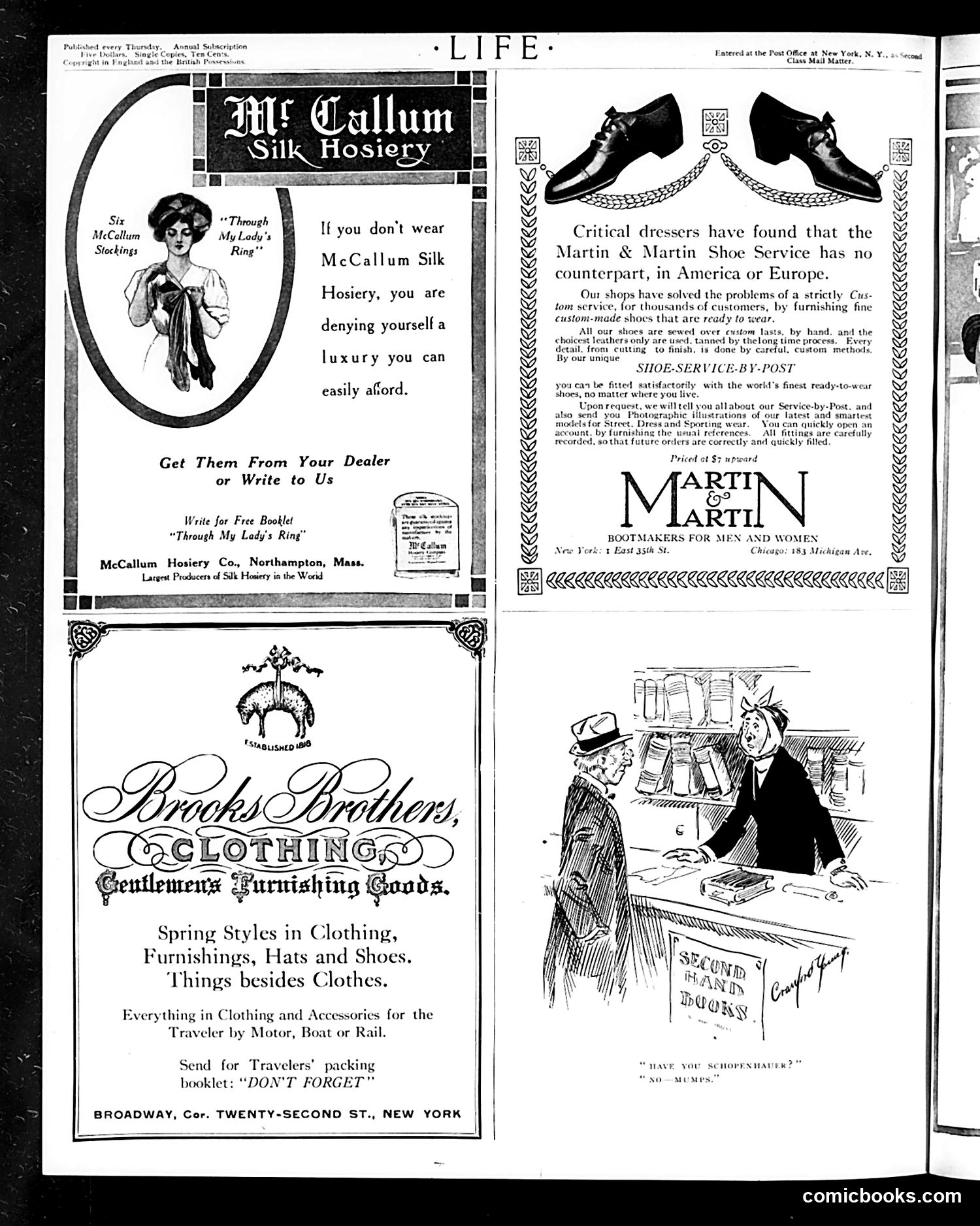
This page is primarily **advertising** rather than satirical content. It features three advertisements: 1. **McCallum Silk Hosiery** (top left): Promotes luxury stockings with a woman modeling the product and a "Through My Lady's Ring" branded element. 2. **Martin & Martin Shoe Service** (top right): Advertises custom-made shoes available by mail, emphasizing quality craftsmanship and a "Shoe-Service-by-Post" option for customers nationwide. 3. **Brooks Brothers** (bottom left): Announces spring clothing and furnishings for travelers. The only cartoon appears **bottom right**: A sketch titled "Have You Shoes Here? No, Mums," showing what appears to be a shopkeeper at a counter dealing with a customer. The specific satire is unclear without additional context, but it may comment on wartime shortages or commercial frustrations of the era.
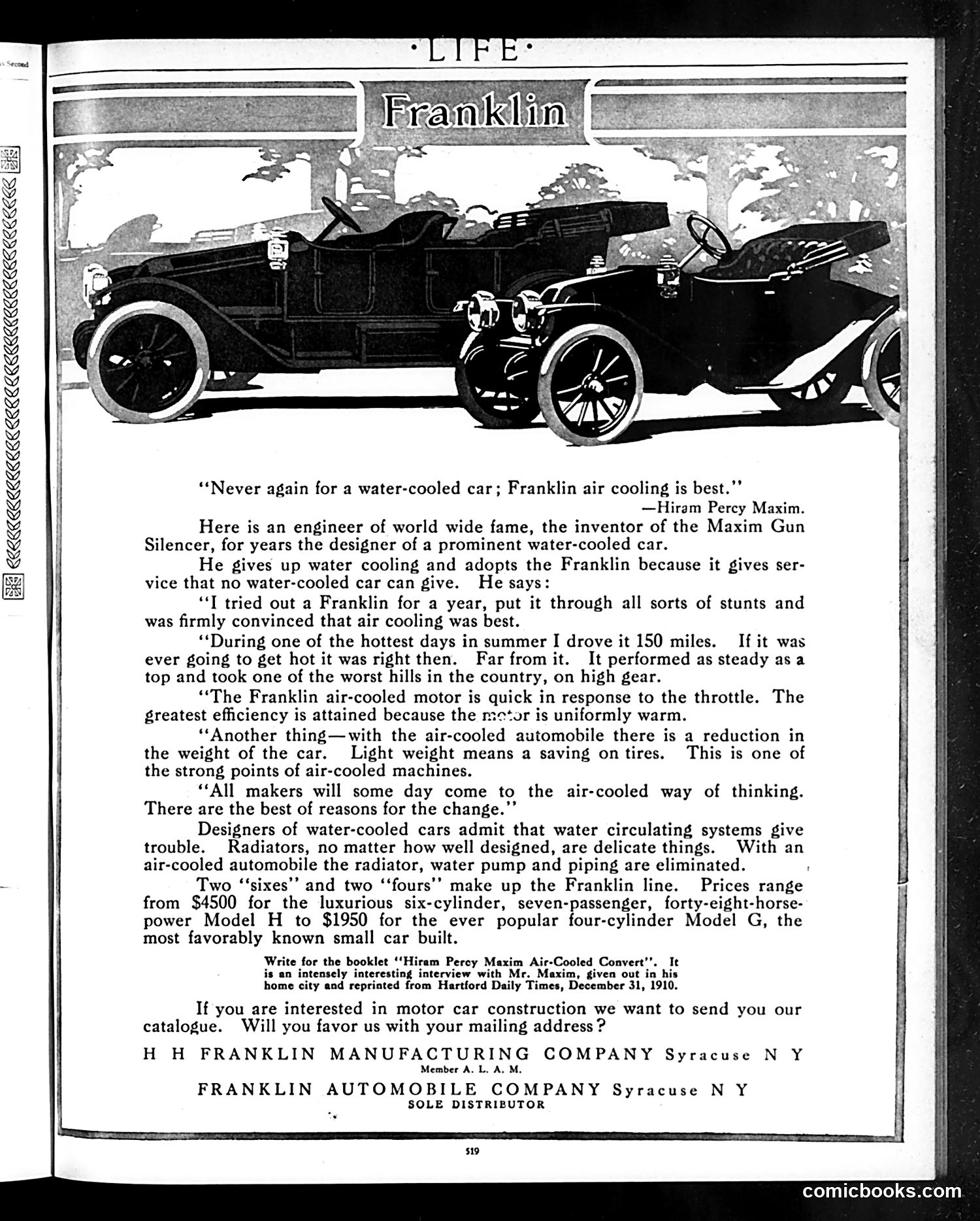
This page is primarily a **product advertisement**, not satire or political commentary. It promotes Franklin automobiles' air-cooling technology versus traditional water-cooled engines. The ad features a testimonial from **Hiram Percy Maxim**, identified as an engineer and inventor of the Maxim Gun Silencer who previously designed water-cooled cars. His endorsement claims air-cooling is superior because it: - Performs reliably in extreme heat - Provides faster throttle response - Reduces vehicle weight (saving on tires) - Eliminates radiator and water-pump complications The ad positions air-cooling as the future standard for automobile manufacturing. Two Franklin models are advertised: a luxury six-cylinder and a popular four-cylinder. This represents early automotive marketing using celebrity endorsement and technical specifications to persuade buyers.
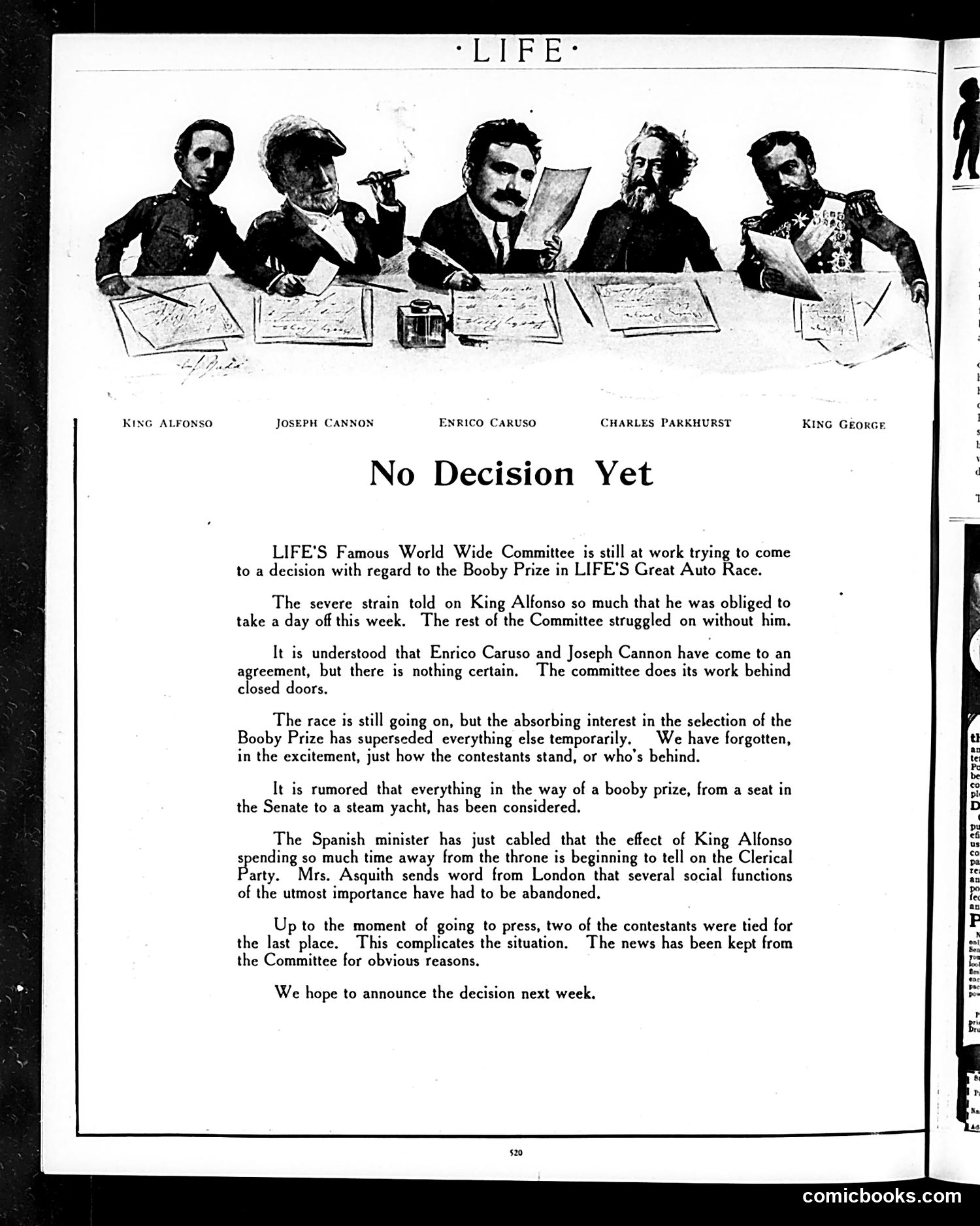
This Life magazine page satirizes a high-level international committee deadlocked over awarding the "Booby Prize" in Life's Great Auto Race. The five caricatured committee members are identified as King Alfonso (Spain), Joseph Cannon (U.S. congressman), Enrico Caruso (famous tenor), Charles Parkhurst (likely a clergyman), and King George (Britain). The satire mocks the committee's inability to decide, noting that King Alfonso became so stressed he took a day off, while the deliberations continued behind closed doors. The piece humorously suggests the strain has affected international diplomacy—a Spanish minister cabled about Alfonso's absence affecting the throne, and London reports abandoned social functions. The joke: prestigious international figures are comically gridlocked over selecting a "booby prize" (consolation award), with far-reaching consequences.
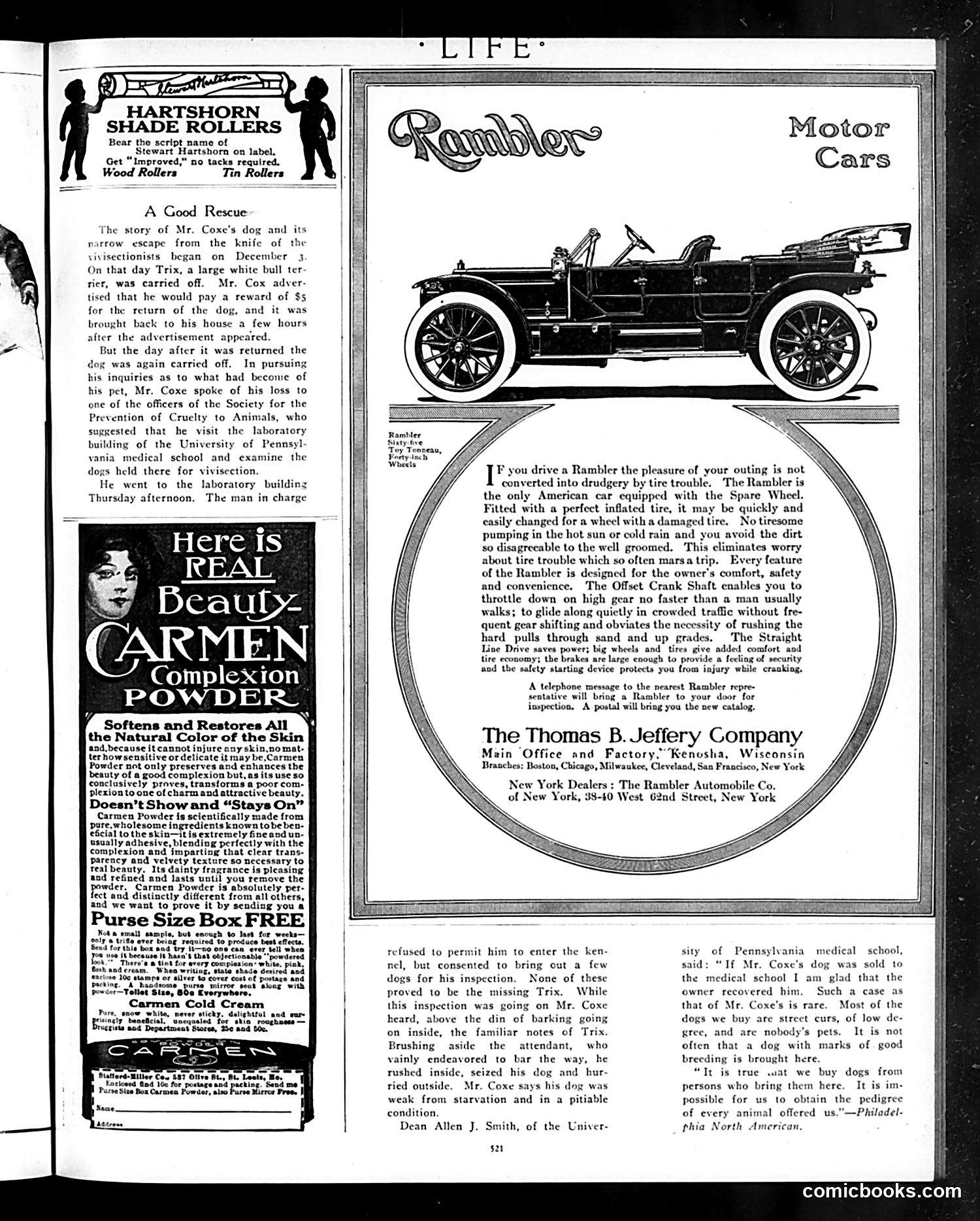
This page contains **no political cartoons or satire**. Instead, it features: 1. **Advertisement for Hartshorn Shade Rollers** (top left) — a straightforward product ad with silhouettes of figures 2. **"A Good Rescue"** (left column) — a brief news anecdote about a man's dog stolen by vivisectionists, later recovered; emphasizes the dog's poor condition 3. **Rambler Motor Cars advertisement** (right side) — a large product advertisement highlighting the Rambler's tire reliability and comfort features 4. **Carmen Complexion Powder advertisement** (bottom left) — beauty product marketing emphasizing "natural color" and skin benefits The page is primarily **commercial advertising mixed with a human-interest news story**. There is no satirical content or political commentary to interpret.
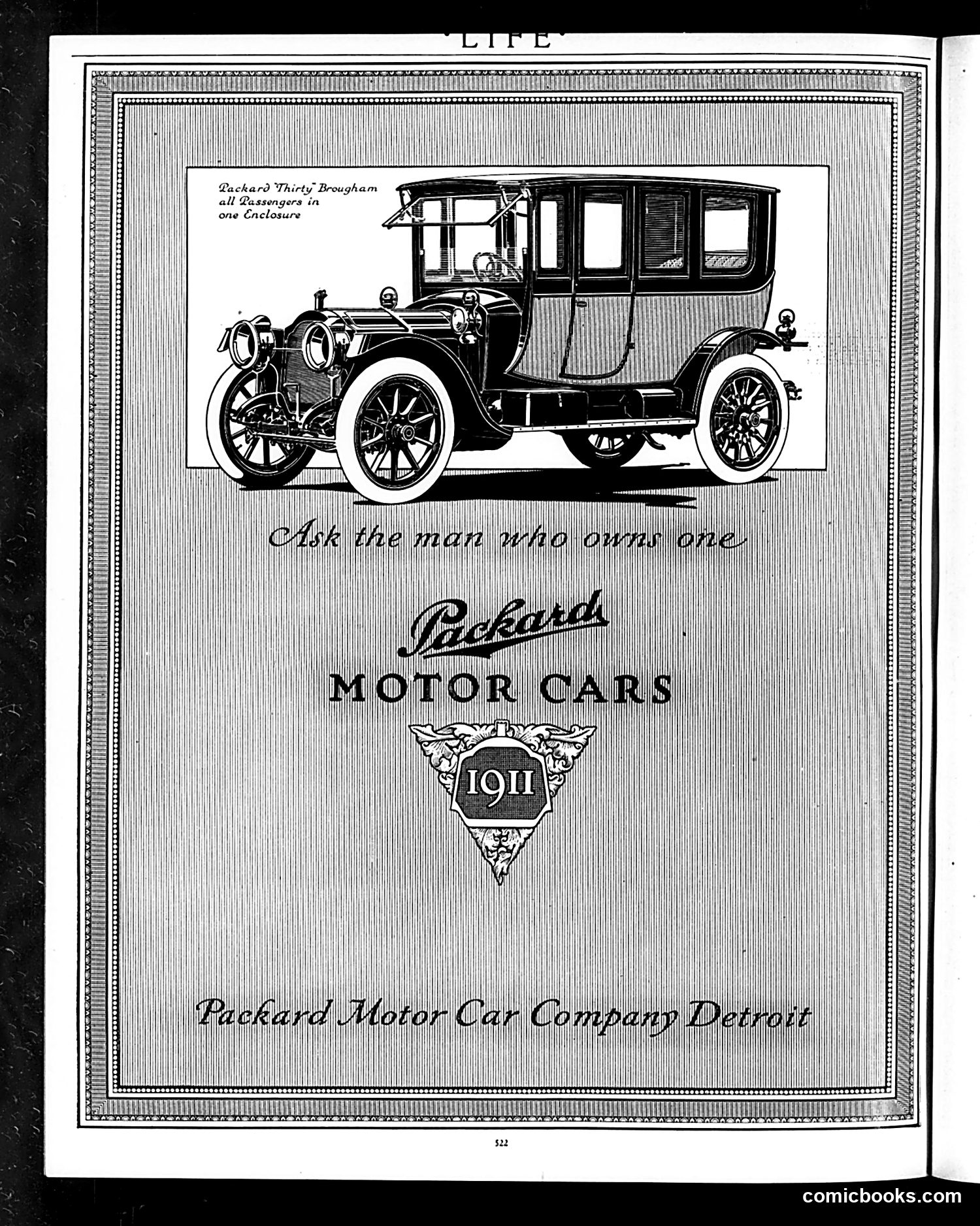
This is primarily a **vintage advertisement**, not satire or political commentary. It's a 1911 Packard Motor Car Company advertisement from Detroit, published in *Life* magazine. The ad features an illustration of a Packard Thirty automobile with the selling point: "Packard Thirty brougham all passengers in one enclosure" — highlighting that this model provides covered seating for all occupants, a significant luxury feature for the era when many cars still had open designs. The tagline "Ask the man who owns one" was Packard's actual advertising slogan, positioning the brand as reliable and prestigious. The decorative border and formal typography reflect early-1900s advertising aesthetics. This represents straightforward product marketing rather than satirical content.
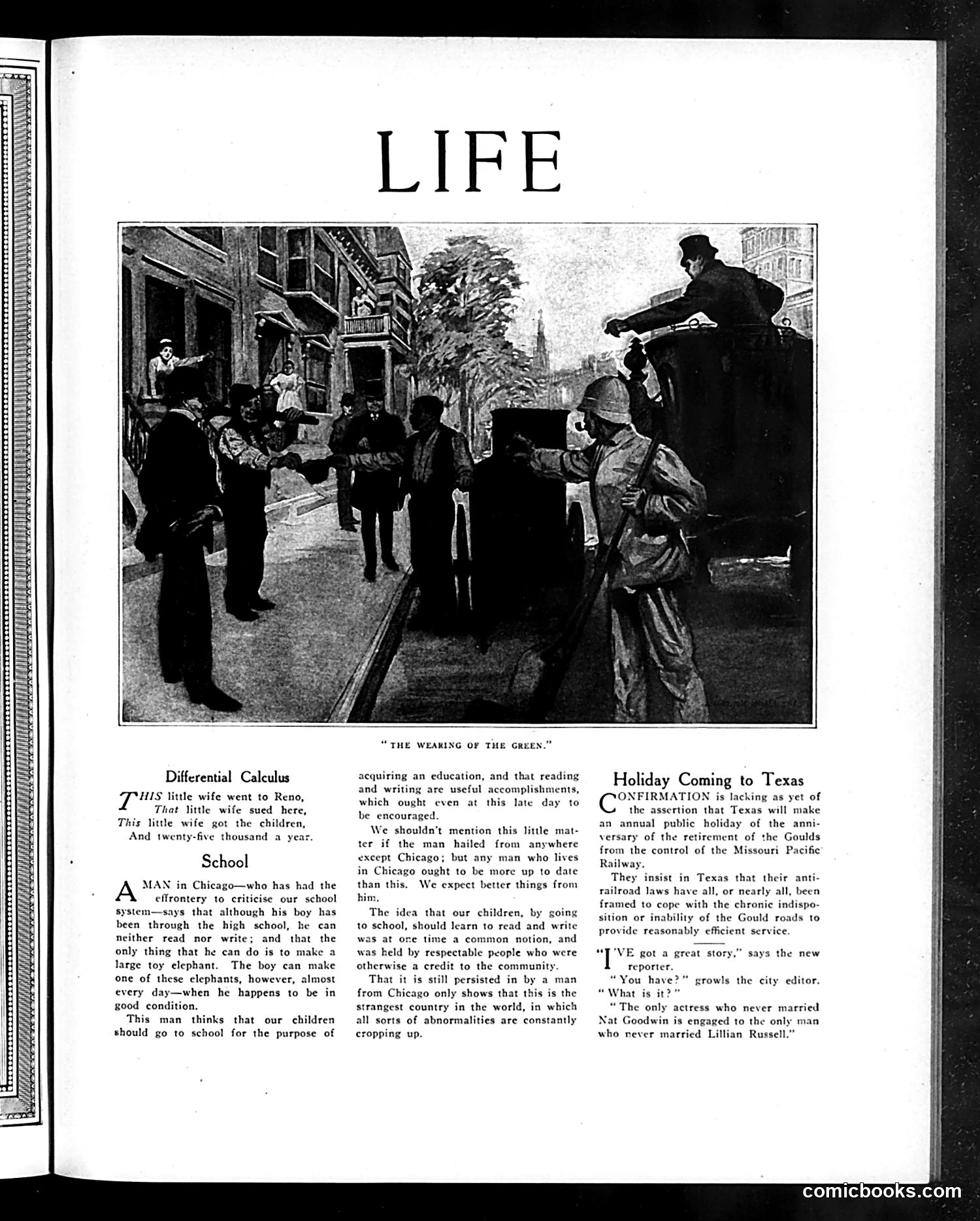
The illustration titled "The Wearing of the Green" depicts a street scene with figures in period dress, though its specific satirical target is unclear from the image alone. The text below contains two distinct pieces: 1. **"Differential Calculus"** - A brief satirical poem mocking a Chicago man who criticizes the school system while remaining ignorant himself. The satire targets hypocrisy: he wants better education for children but is uneducated himself. 2. **"Holiday Coming to Texas"** - A brief news item about an annual public holiday and a railroad controversy, mentioning actress Nat Goodwin's marriage to Lillian Russell. The page appears to mix illustration, humorous verse, and news snippets—typical Life magazine content blending social commentary with gossip.
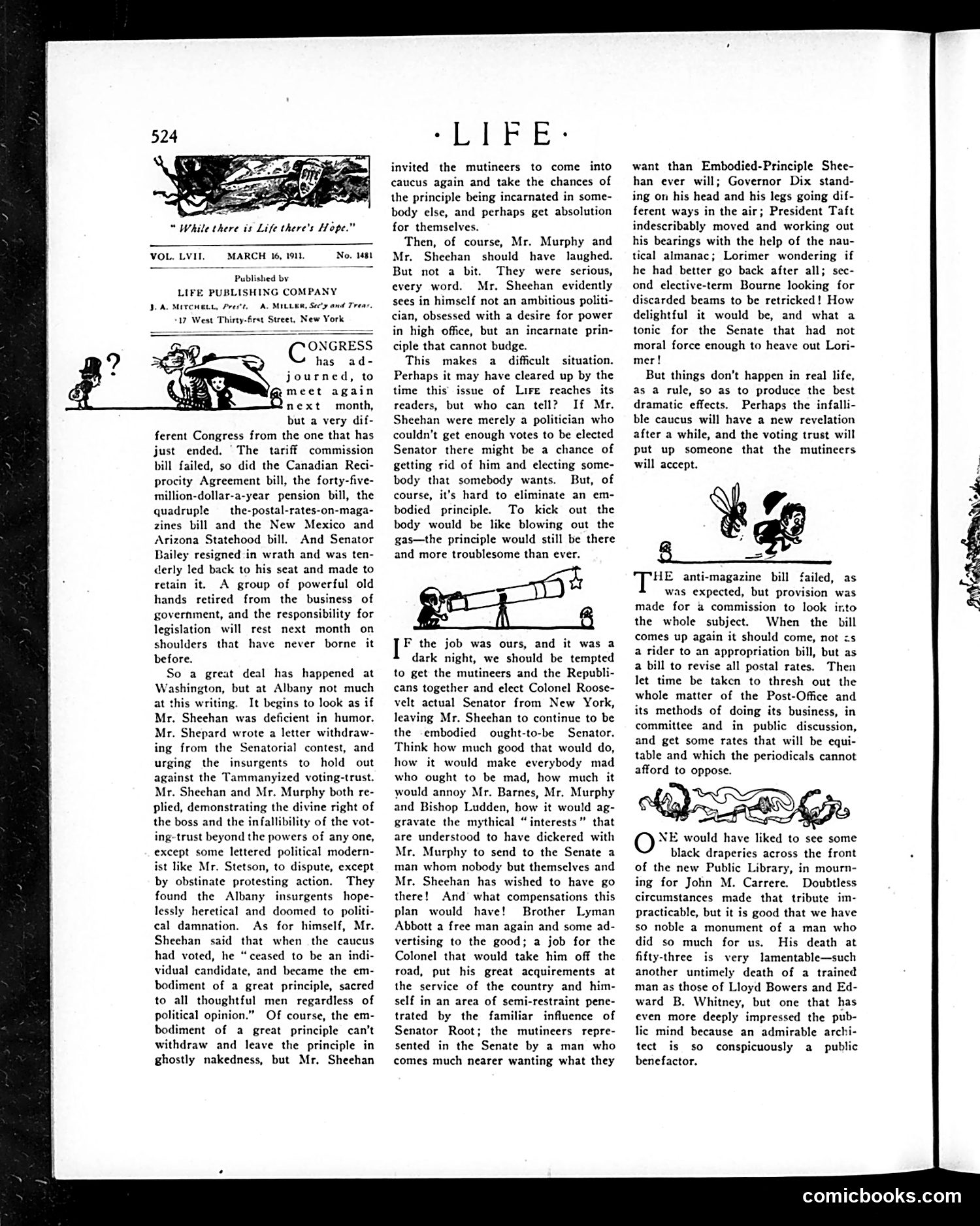
This page satirizes Congressional dysfunction following a recent tariff commission bill failure. The text criticizes Mr. Sheehan (likely a New York politician) for embodying "an incarnate principle that cannot budge"—someone so rigidly ideological he blocks practical progress. The cartoon depicts the challenge of removing entrenched political principles, comparing it to "blowing out the gas"—the principle remains even after eliminating its embodiment. The satire targets the inability of Congress to pass substantive legislation due to stubborn partisan positioning. The author advocates replacing ideological purity with pragmatism, mocking how politicians prioritize principle over solving actual problems. The cartoon's visual metaphor emphasizes the futility of removing obstacles when the underlying dysfunction persists.
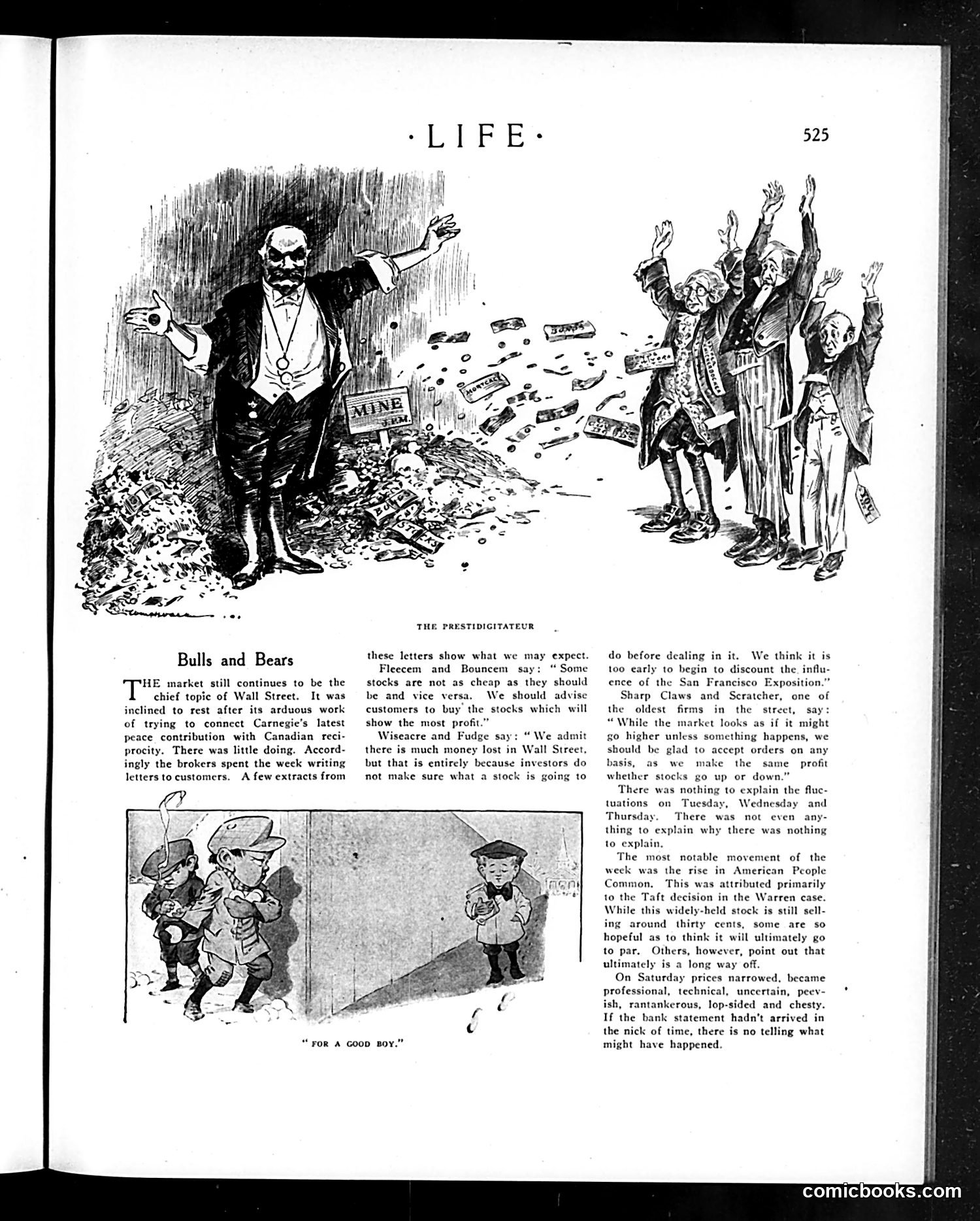
The top cartoon titled "THE PRESTIDIGITATEUR" (French for "sleight of hand") depicts a thin, skull-faced man in formal dress tossing money to a crowd of jubilant figures with raised arms. This appears to satirize financial manipulation or deceptive wealth distribution—the prestidigitateur's "trick" being false prosperity. The article "Bulls and Bears" discusses Wall Street stock market behavior, advising readers on which stocks to buy. It mentions the San Francisco Exposition and notes market volatility, particularly regarding American People Common stock influenced by the Taft decision in the Warren case. The lower cartoon "FOR A GOOD BOY" shows figures in shadow, though its specific meaning remains unclear without additional context. The page satirizes market speculation and financial illusion during what appears to be the early 1910s.
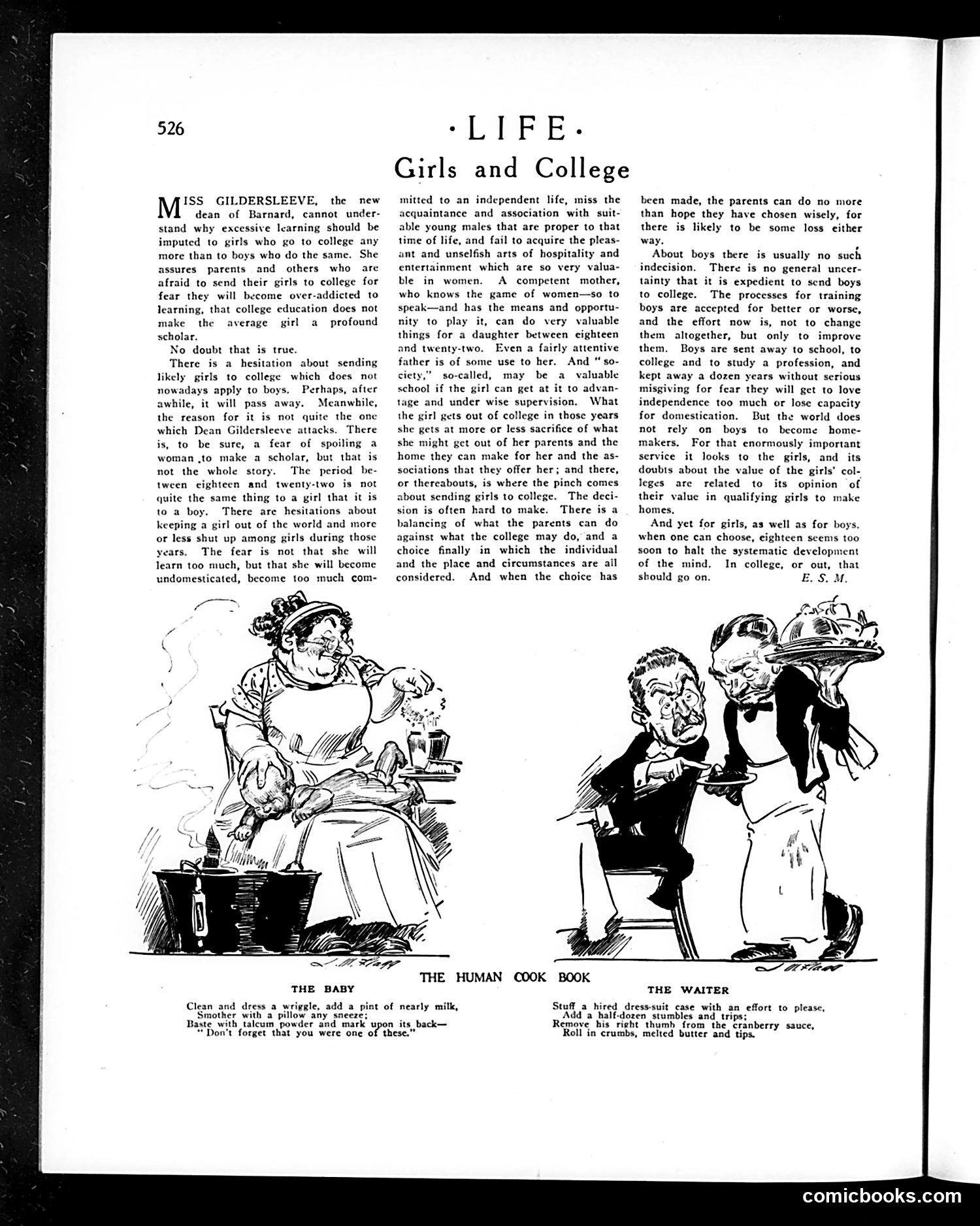
This is an editorial essay by Miss Gildersleeve arguing against excessive college education for girls. The text warns that college attendance may make girls "undomesticated" and unfit for marriage and homemaking—the assumed proper role for women of this era. The three cartoons below illustrate domestic tasks from "The Human Cook Book," using exaggerated caricatures: - **"The Baby"**: A woman struggling with an infant - **"The Waiter"**: A man attempting waitressing with visible difficulty The satire appears to mock both the domestic incompetence the essay warns about AND the idea that men could perform "women's work." The cartoons suggest gender roles were considered natural and immutable—that education might unfit women for domesticity, while men were equally unsuited to service roles.
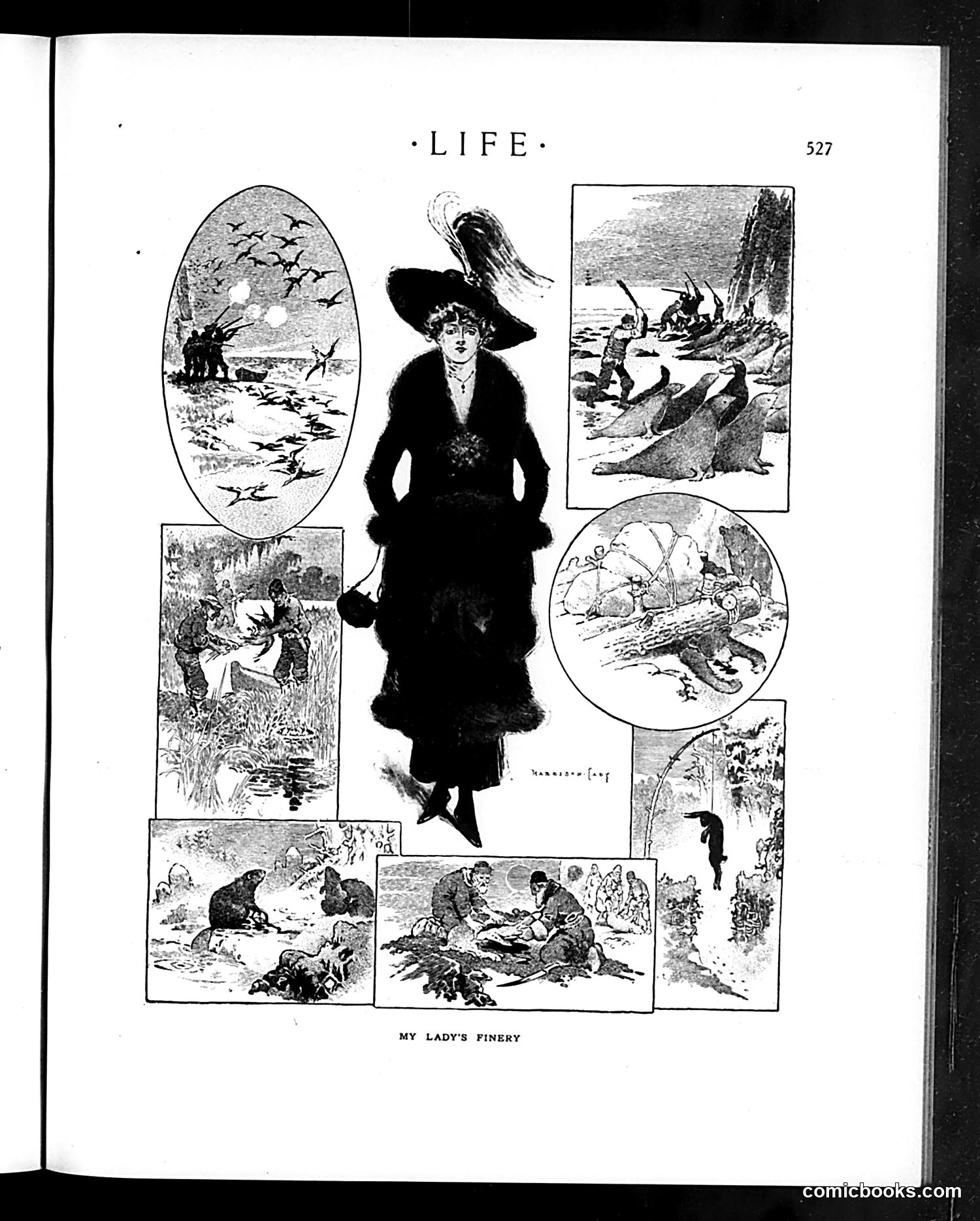
This satirical piece centers on a fashionably dressed woman in an elaborate black outfit and feathered hat, surrounded by smaller vignettes depicting the origins of her finery. The surrounding scenes appear to show the harvesting and processing of materials for her clothing—likely fur trapping, feather collection, and textile production. The satirical point targets wealthy women's fashion consumption, exposing the labor and animal exploitation behind luxurious garments. By juxtaposing the elegant lady against scenes of raw material extraction and manual work, the cartoon critiques the disconnect between high society fashion and its gritty, often brutal origins. This reflects early 20th-century concerns about labor conditions and the ethics of animal products in fashion—themes that remain relevant today.
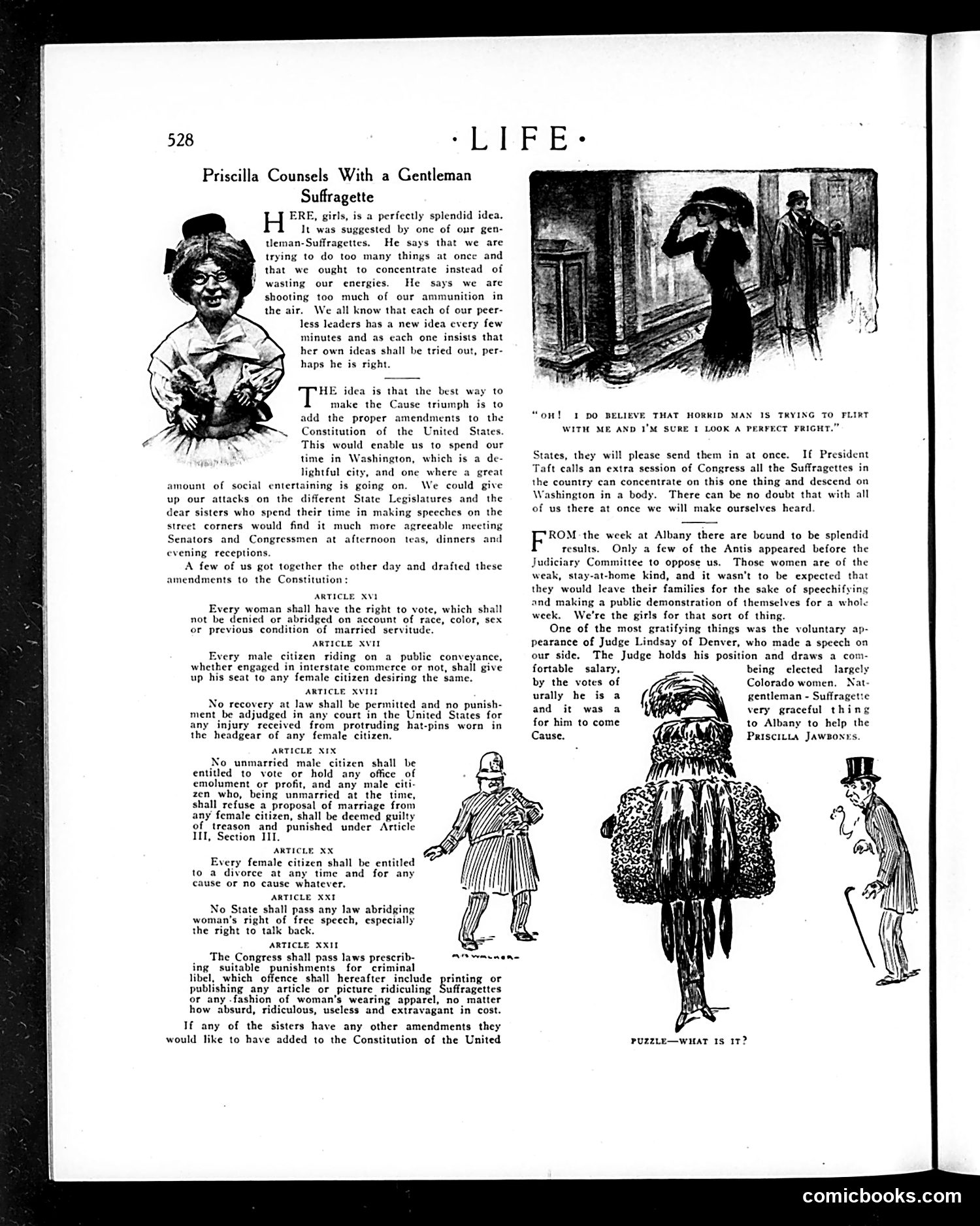
This Life magazine page satirizes anti-suffrage arguments through mock constitutional amendments. The text presents absurd "Articles" claiming women are "wasting energies" and proposing to concentrate all suffragettes in Washington, D.C. for speeches rather than activism. The cartoons mock male opposition: one shows a man claiming a woman looks like "a perfect fright" (suggesting anti-suffragists reduced women to appearance); another labeled "PUZZLE—WHAT IS IT?" depicts confused male figures observing fashionably-dressed women, likely mocking men's bewilderment at women's independence. The page's humor works by inverting the suffragettes' actual arguments—presenting ridiculous male-authored "solutions" to demonstrate how irrational anti-suffrage rhetoric truly was. The overall message supports women's voting rights by exposing the absurdity of opposition.
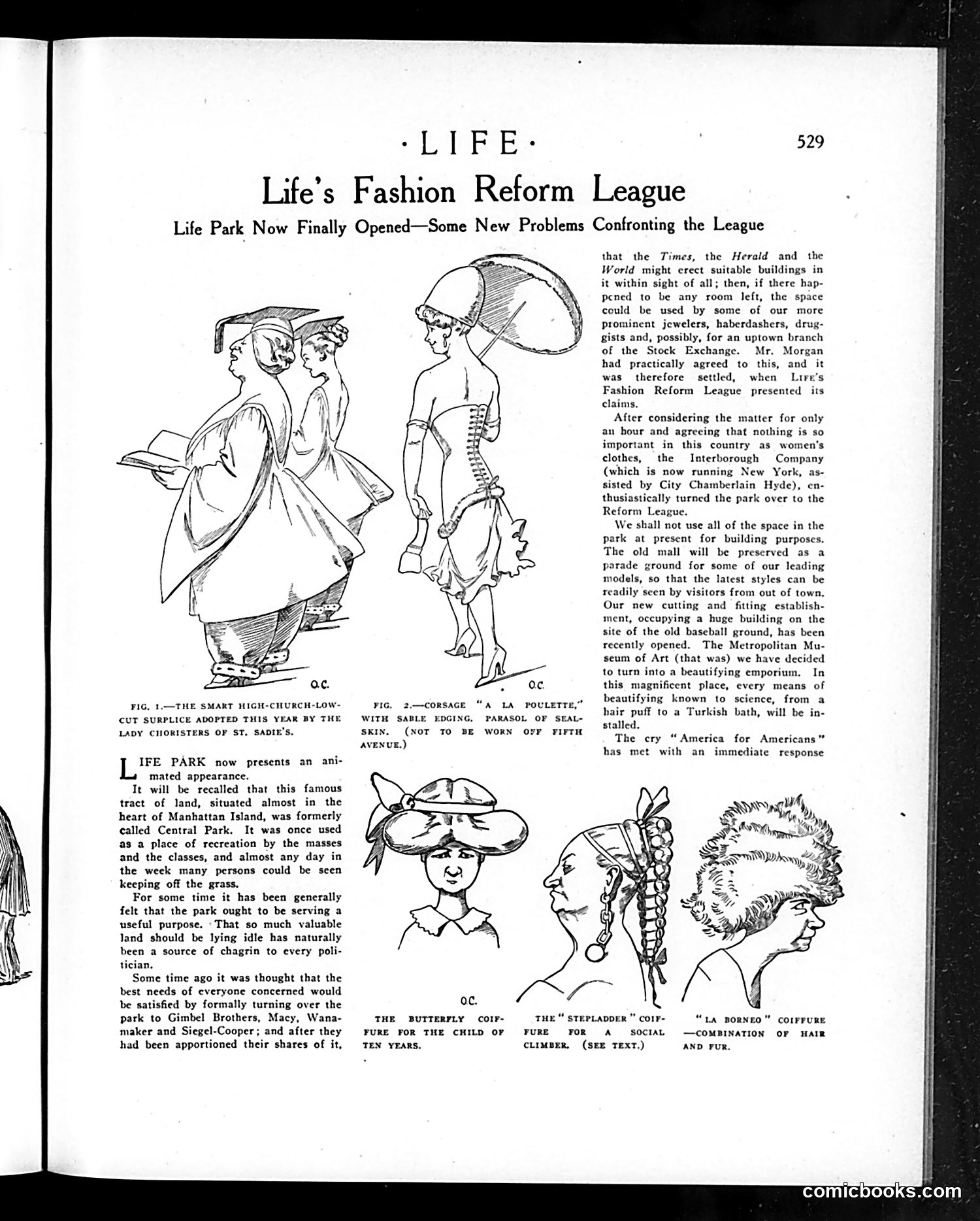
This satirical article mocks the "Fashion Reform League," which advocated for more practical women's clothing. The illustrations show absurd alternative hat and hairstyle designs proposed by reformers. The joke targets two audiences: the fashion reformers (portrayed as impractical idealists) and high society's extreme fashions themselves. The cartoons depict exaggerated "reform" alternatives—like the massive parasol hat and elaborate "Stepladder" coiffure—suggesting that even reform proposals were ridiculous and unworkable. The article notes Life Park (formerly Central Park) was opening, with the Fashion Reform League claiming space to display their proposed styles to visitors. The underlying satire: both traditional extreme fashion and its "reforms" were equally absurd, mocking the era's heated debates over proper women's dress codes and practicality.
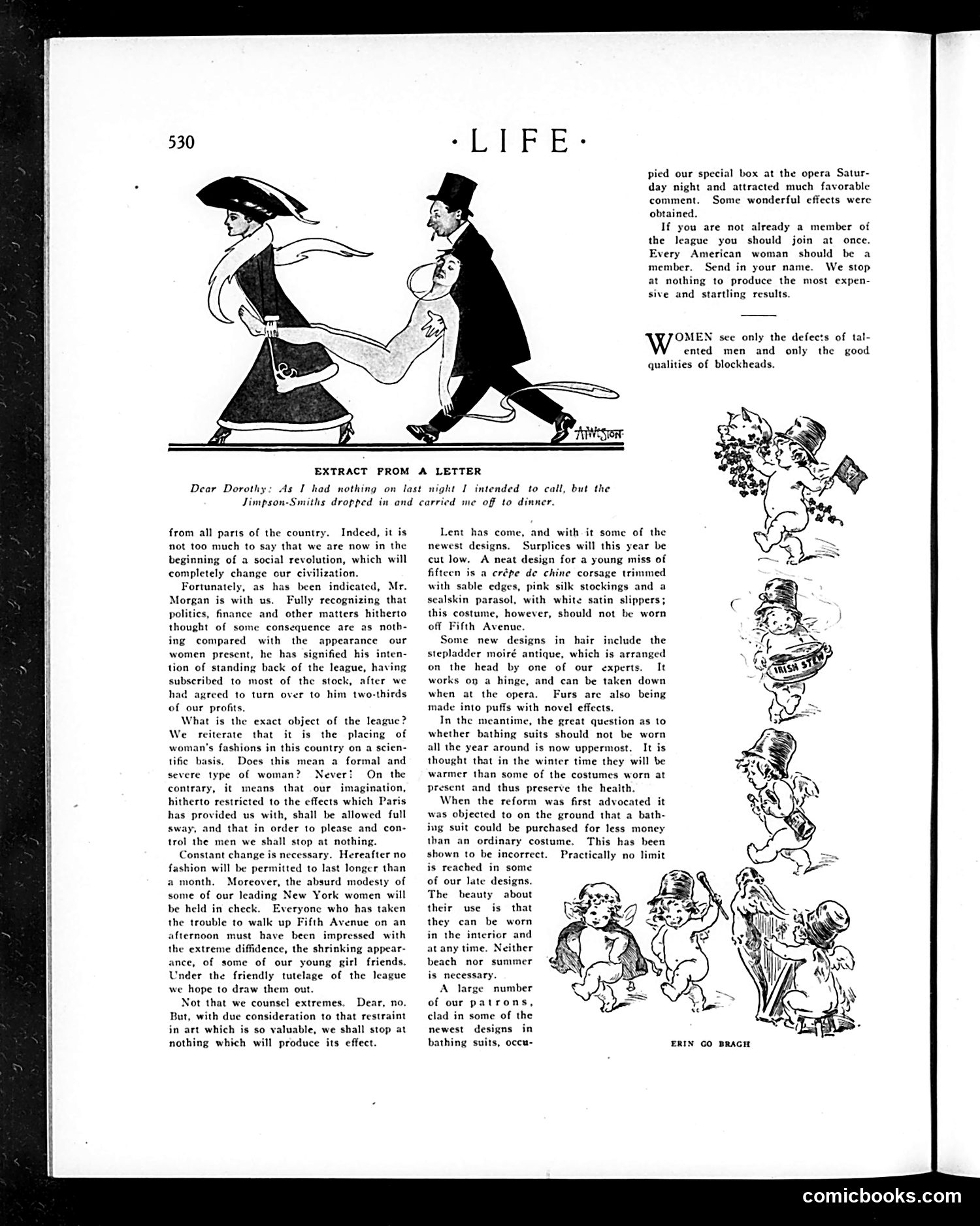
This 1910s *Life* magazine page satirizes the emerging "women's fashion reform movement"—a real early 20th-century effort to modernize women's clothing and social behavior. **The Cartoon:** Shows a woman in fashionable dress literally dragging a reluctant man, illustrating the satirical premise that women are now controlling fashion and social customs rather than men dictating them. **The Satire's Target:** The mock letter describes a wealthy women's league (backed by J.P. Morgan, America's most famous financier) that claims to place fashion on a "scientific basis" while actually advocating constant style changes, revealing clothing, and behavioral boldness. The joke is the contradiction: they claim liberation while openly admitting their goal is still ultimately to "please and control the men." **The Point:** *Life* mocks both the pretensions of reformers ("scientific basis") and the anxieties of conservative society about changing gender roles and women's increasing independence and visibility in public life. The decorative cherubs on the right are unrelated filler illustrations.
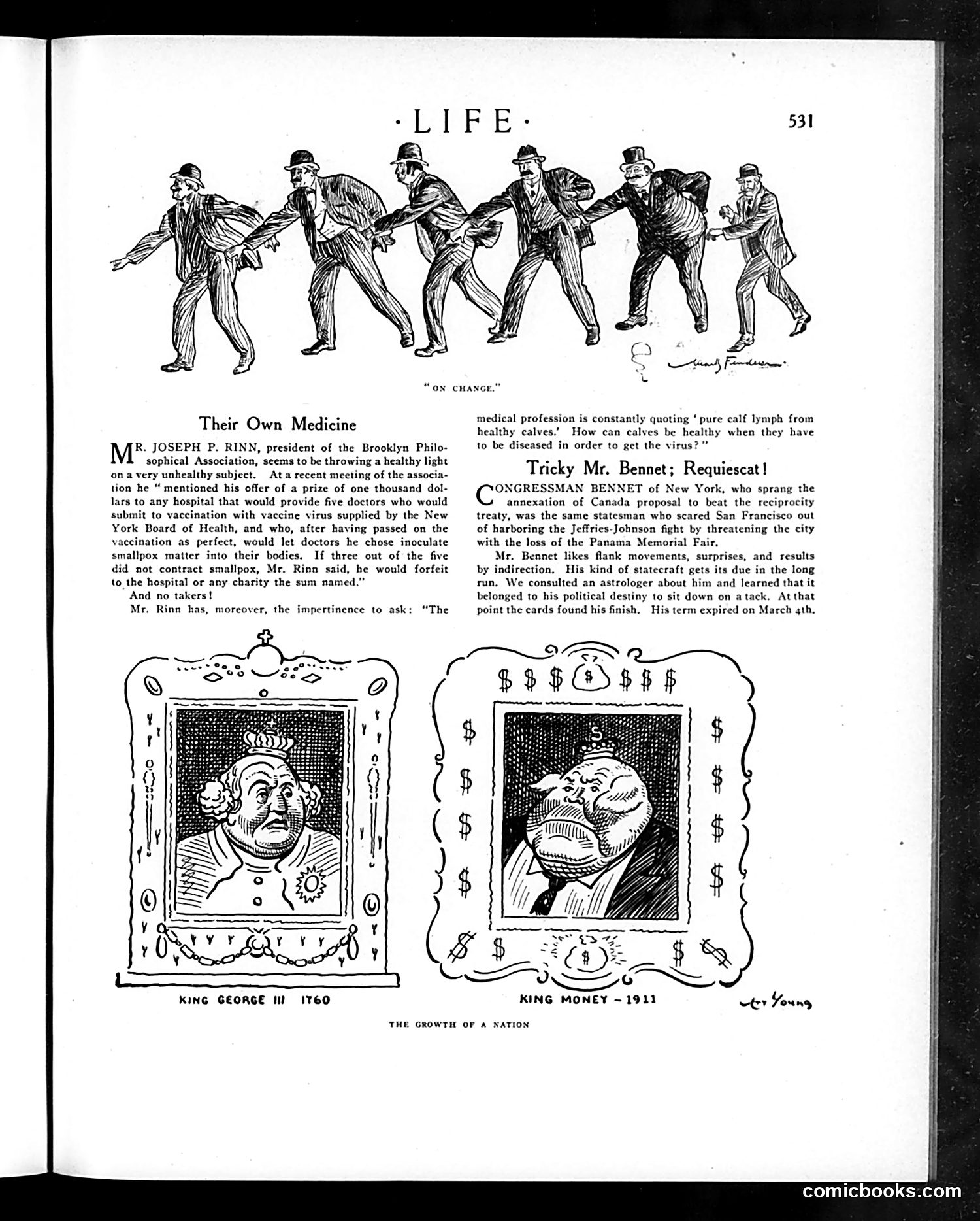
This *Life* magazine page contains two distinct satirical pieces: **"Their Own Medicine"** critiques the medical establishment's vaccination practices. Joseph P. Rinn, a Brooklyn philosopher, challenged doctors to submit to the same vaccination-then-smallpox-inoculation procedure they administered to the public. No doctors accepted. Rinn's satirical point: medical authorities confidently promote vaccines while refusing personal risk, and they cannot explain how calves remain "healthy" while being diseased to produce vaccine material. The satire exposes professional hypocrisy. **"Tricky Mr. Bennet; Requiescat!"** mocks departing Congressman Bennet of New York for political maneuvering—using surprise tactics (opposing reciprocity with Canada, threatening San Francisco over a boxing match) rather than direct action. The astrology joke suggests his term's expiration on March 4th represents cosmic justice for his indirect methods. The top illustration shows six men in a tug-of-war, captioned "On Change," likely representing political struggle over policy shifts.
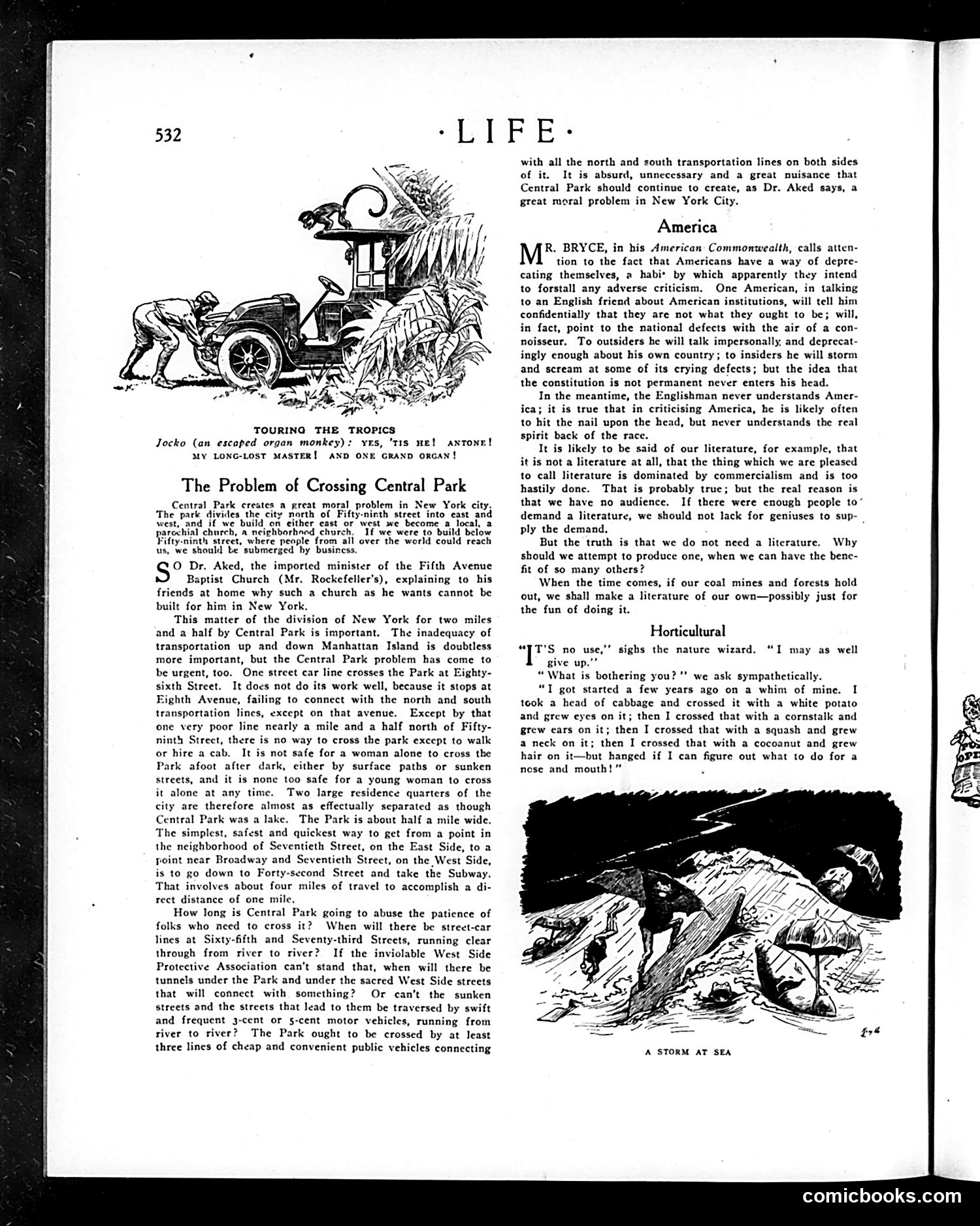
## Top Cartoon: "Touring the Tropics" A small escaped organ-grinder's monkey encounters its former master ("Jacko"), addressing him as "Antony" and referencing "one grand organ." This appears to be a light joke about reunion and nostalgia, typical of Life's humorous animal comics from this era. ## Main Article: "The Problem of Crossing Central Park" Life satirizes Dr. Aked, an imported Baptist minister (employed by Rockefeller), who explains why his church can't be built in northern Manhattan—claiming the area is too provincial. The article mocks this reasoning while addressing a genuine urban problem: Central Park bisects Manhattan, forcing New Yorkers to travel miles south to the Subway to cross just one mile. Life advocates for streetcar lines, tunnels, or motor vehicles to traverse the park safely, especially for women traveling alone after dark. ## "America" Section Quotes James Bryce's *American Commonwealth*, noting Americans' habit of self-deprecation—criticizing their own institutions to foreigners while defensively attacking criticism from outsiders. This satirizes American insecurity about international perception.
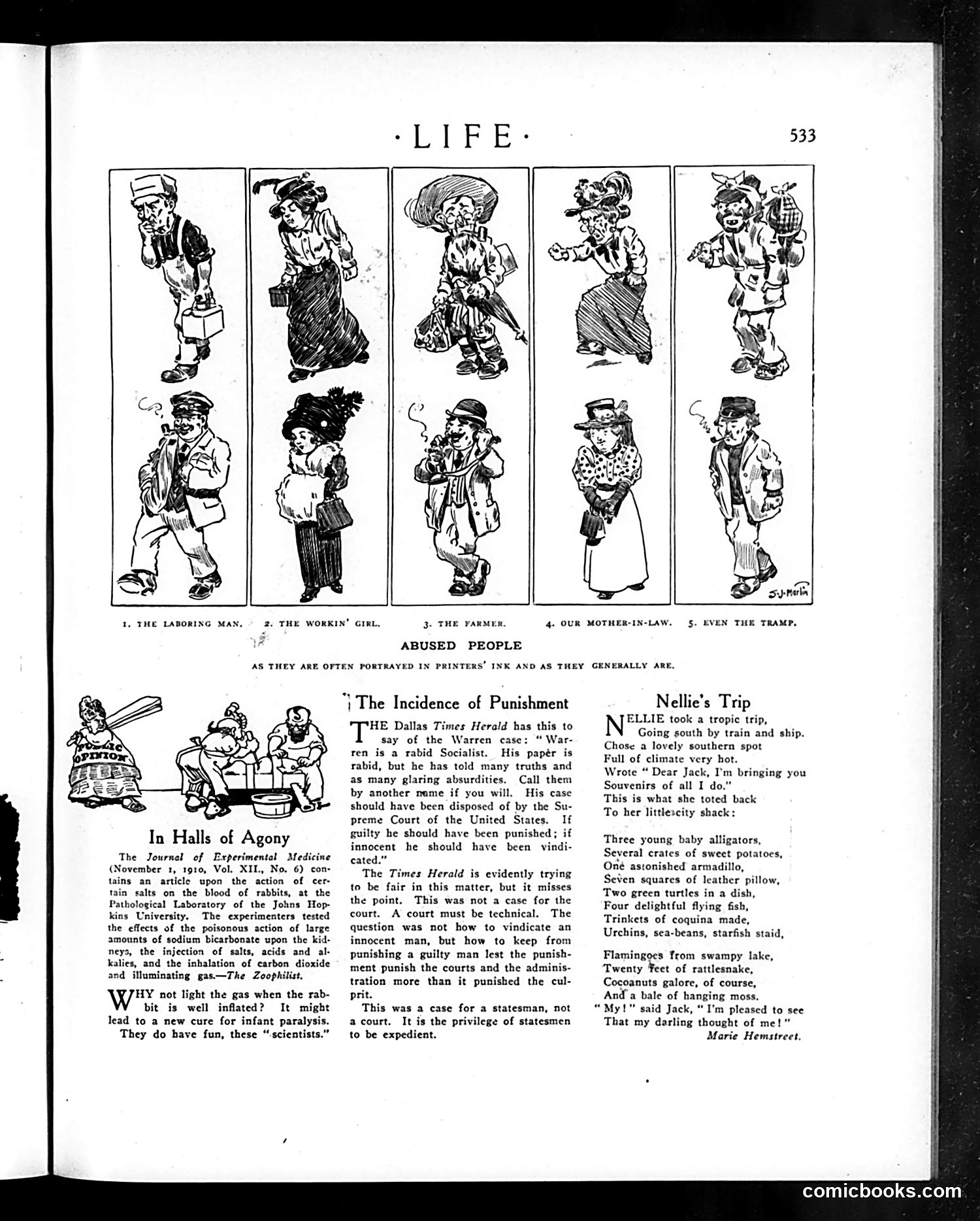
**Top Cartoon:** Five panels satirize how working-class people are stereotyped in media versus reality. The title "Abused People" shows exaggerated, pitiful portrayals of laborers, working women, farmers, mothers-in-law, and vagrants as commonly depicted in newspapers and illustrations, contrasted with how they "generally are"—suggesting the press distorts these groups for sensationalism or sympathy. **"In Halls of Agony":** Criticizes animal testing at Johns Hopkins University. The passage sarcastically mocks scientists' cruel experiments on rabbits (injecting poisons, inflating them with gas), questioning the ethics and usefulness of such research under the guise of scientific progress. **"The Incidence of Punishment":** Commentary on the Warren case (appears to involve a Socialist journalist). The piece argues courts prioritize protecting institutions over justice—punishing the guilty risks embarrassing the government, so expedience trumps fairness. **"Nellie's Trip":** Light humorous poem about a woman returning from vacation with absurd souvenirs (alligators, armadillos, snakes, etc.), playing on tourist kitsch and novelty collecting.
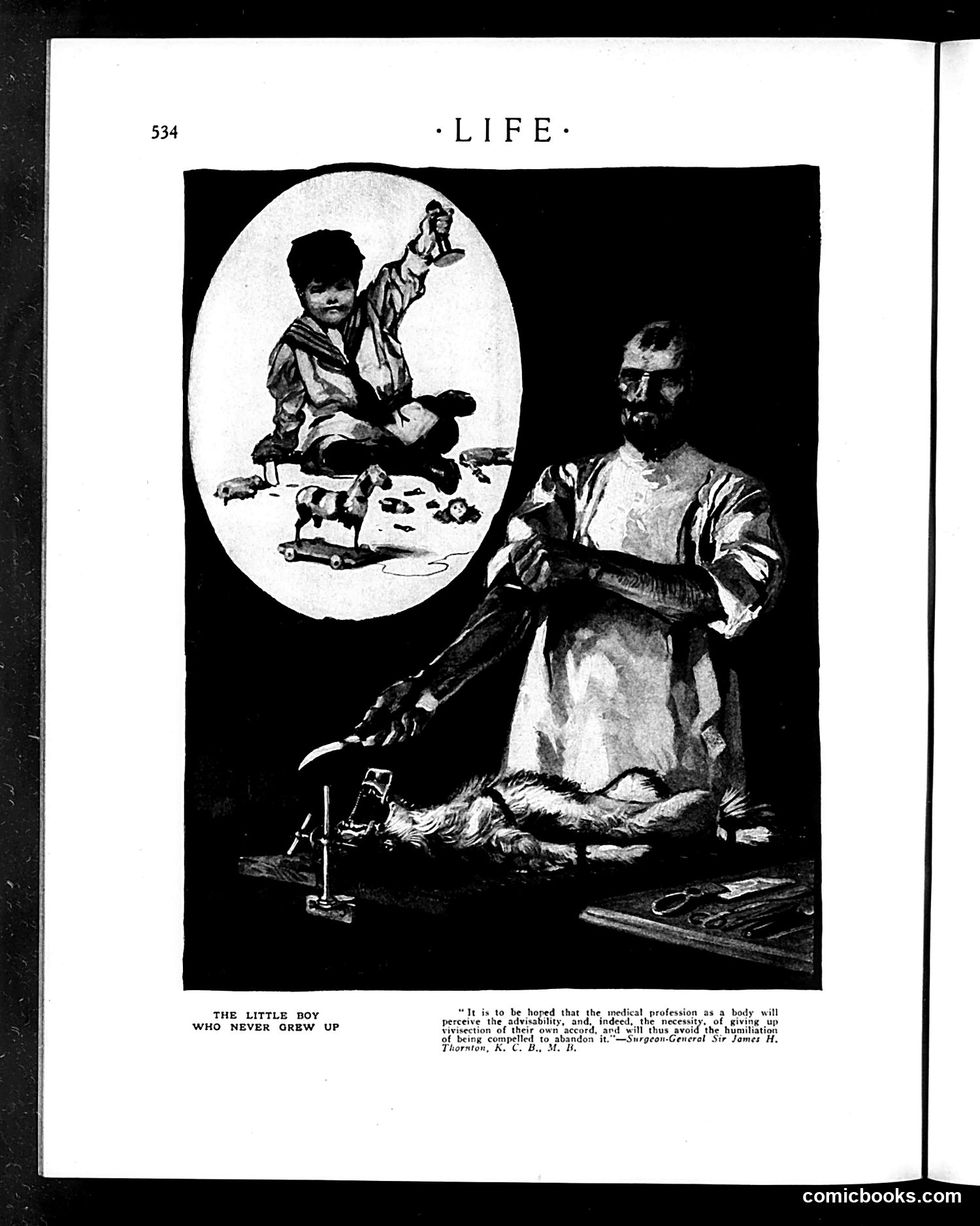
This Life magazine cartoon satirizes the medical profession's use of vivisection (animal experimentation). The image shows a bearded surgeon or medical authority figure examining a dissected animal, while an oval inset depicts a cherubic child playing with toys—representing "the little boy who never grew up," likely referring to Peter Pan. The satire contrasts innocent childhood wonder with brutal medical practice. The accompanying quote from Surgeon-General Sir James Thornton urges doctors to voluntarily abandon vivisection to avoid humiliation. The cartoon argues that the medical profession should mature beyond such practices, using the "never grew up" metaphor to suggest physicians remain morally juvenile if they continue animal experimentation. This reflects historical animal-rights advocacy against medical vivisection.
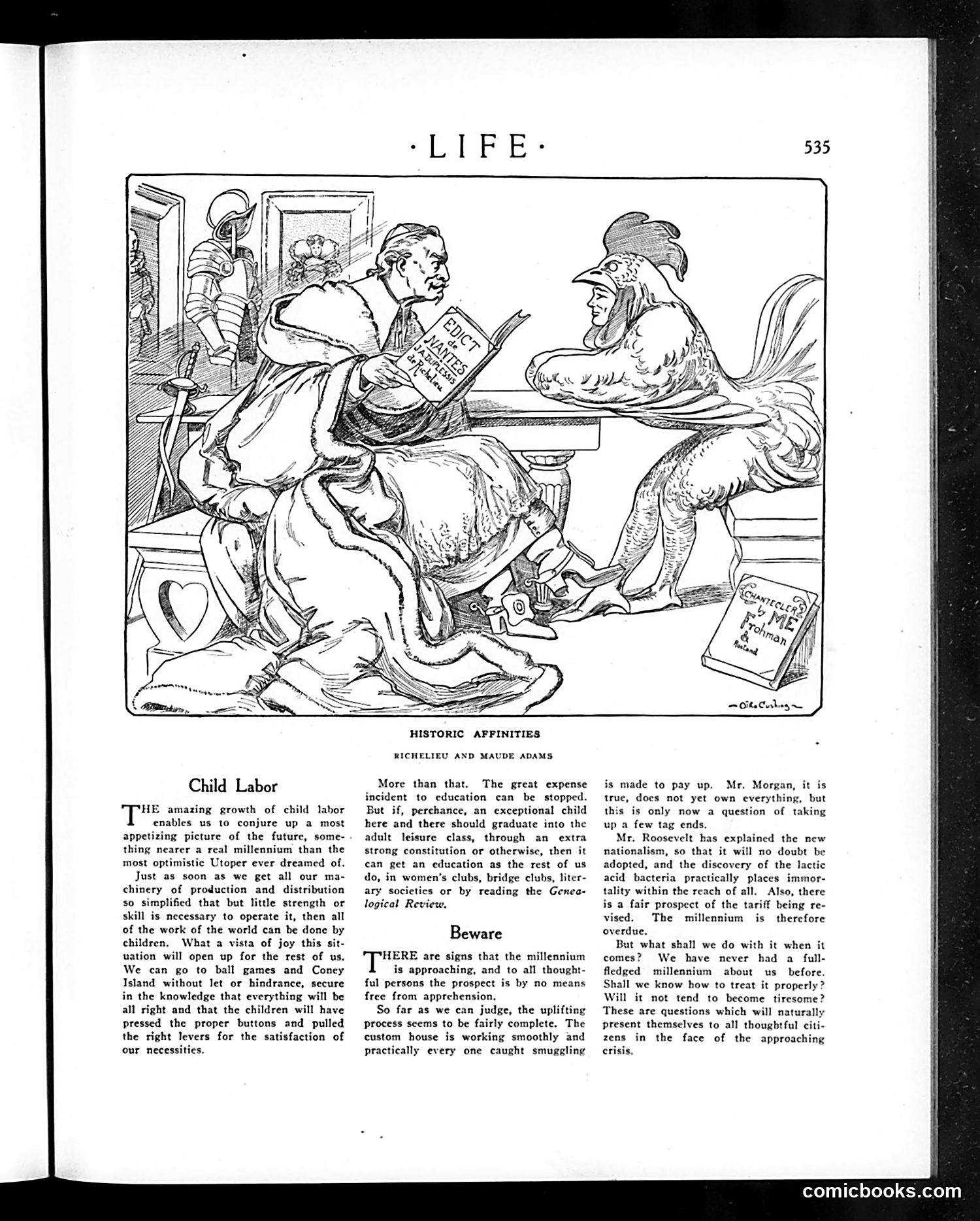
This page contains **two satirical pieces mocking early 20th-century optimism about industrial "progress."** The main cartoon (titled "Historic Affinities: Richelieu and Maude Adams") depicts a wealthy woman reading while servants attend her—satirizing how the leisure class benefits from child labor. The accompanying text uses **heavy irony** to critique child labor expansion: it pretends to celebrate a future where simplified machinery allows children to do all work, freeing adults for leisure. The satire argues this exposes society's hypocrisy about "progress." The "Beware" section continues this ironic tone, mocking complacency about approaching a "millennium" of perfection. It references contemporary figures (Mr. Morgan—likely J.P. Morgan the financier; Mr. Roosevelt—Theodore Roosevelt) and suggests society hasn't actually solved its problems despite claims of advancement. The satire's core point: **Industrial society was celebrating technological progress while ignoring the human cost—particularly child exploitation—that enabled it.**
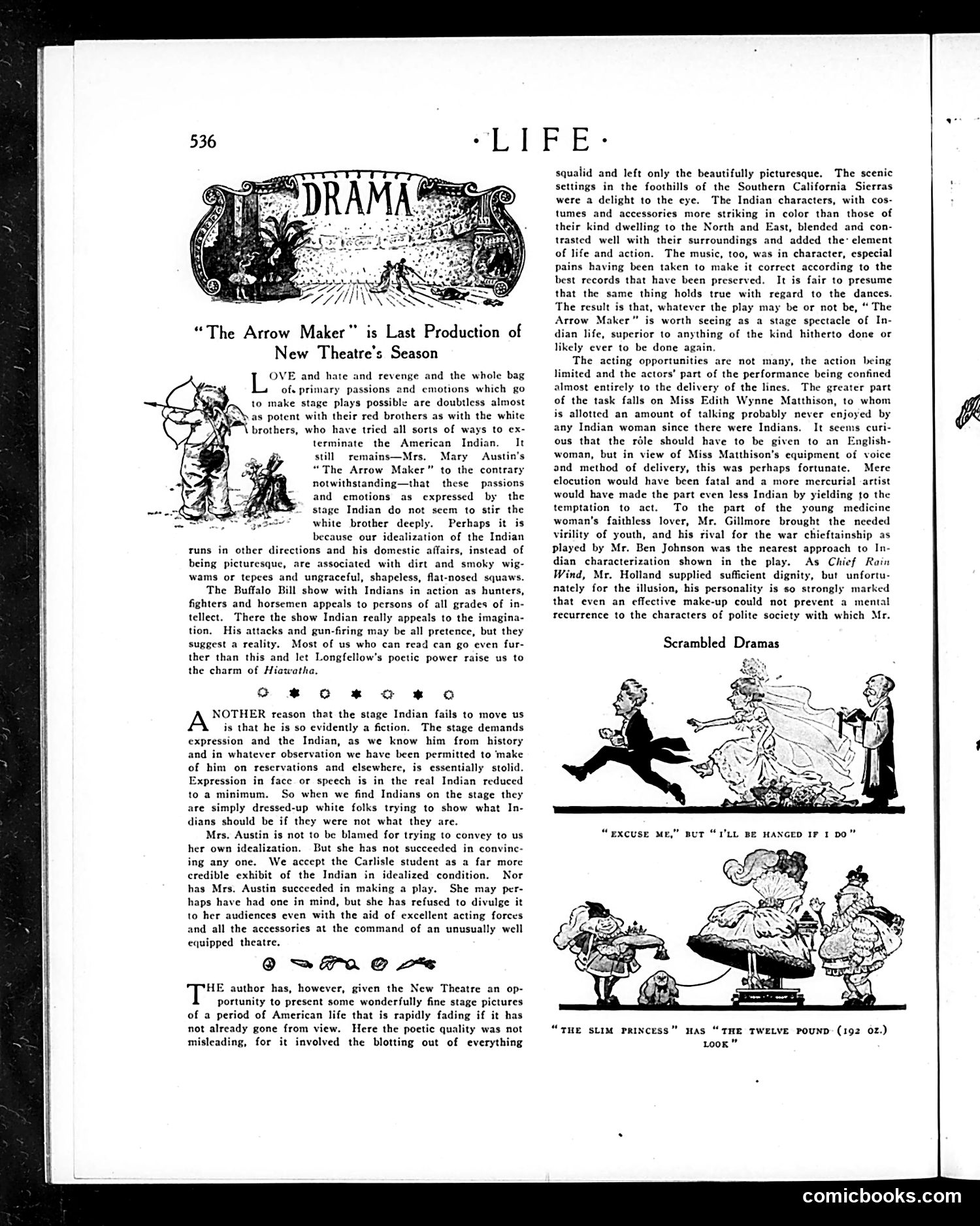
This page reviews a New Theatre production of Mary Austin's play "The Arrow Maker," the final show of their season. The critic argues the play fails dramatically despite excellent staging. The core critique: stage Indians don't move audiences because they're obviously fictional. Real Indians, the reviewer claims, are "essentially stolid" with minimal expression, so white actors portraying them unconvincingly strain credibility. The critic contrasts this unfavorably with Buffalo Bill's Wild West Show, where Indian action scenes felt genuinely thrilling, and favorably with Carlisle Indian Industrial School students, presented as more "credible." The review praises the Southern California scenery, costumes, and authentic music—calling it superior theater spectacle. However, the play itself lacks dramatic substance and real emotional power. The cartoons below mock theatrical melodrama unrelated to this review.
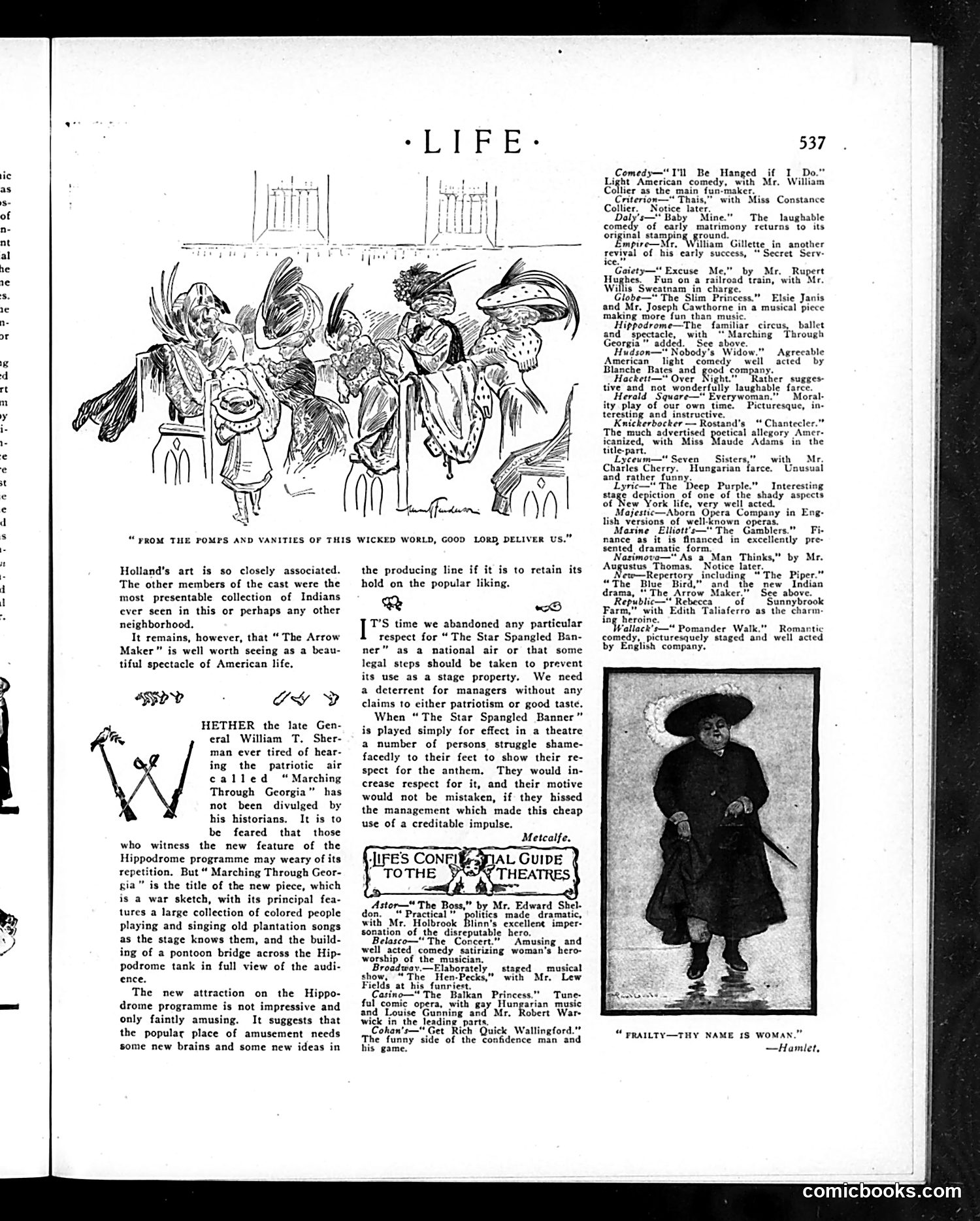
The main cartoon depicts caricatured figures—appearing to represent various types from American society—with the caption "From the Pomps and Vanities of This Wicked World, Good Lord Deliver Us," a biblical reference mocking contemporary social pretension. The page's primary focus, however, is theatrical criticism. The text attacks a Hippodrome production called "Marching Through Georgia," a Civil War-themed spectacle featuring "colored people" performing plantation songs and building a pontoon bridge. The reviewer considers it shallow entertainment that exploits both the subject matter and audience patriotism. More pointedly, the critic condemns theaters' misuse of "The Star Spangled Banner" as mere stage property, arguing that audiences feel obligated to stand respectfully for the anthem even when cynically deployed for theatrical effect—a manipulation the writer finds in poor taste. The page reflects early 20th-century attitudes toward race, spectacle, and nationalism, revealing contemporaneous debates about commercialized patriotism and entertainment ethics.
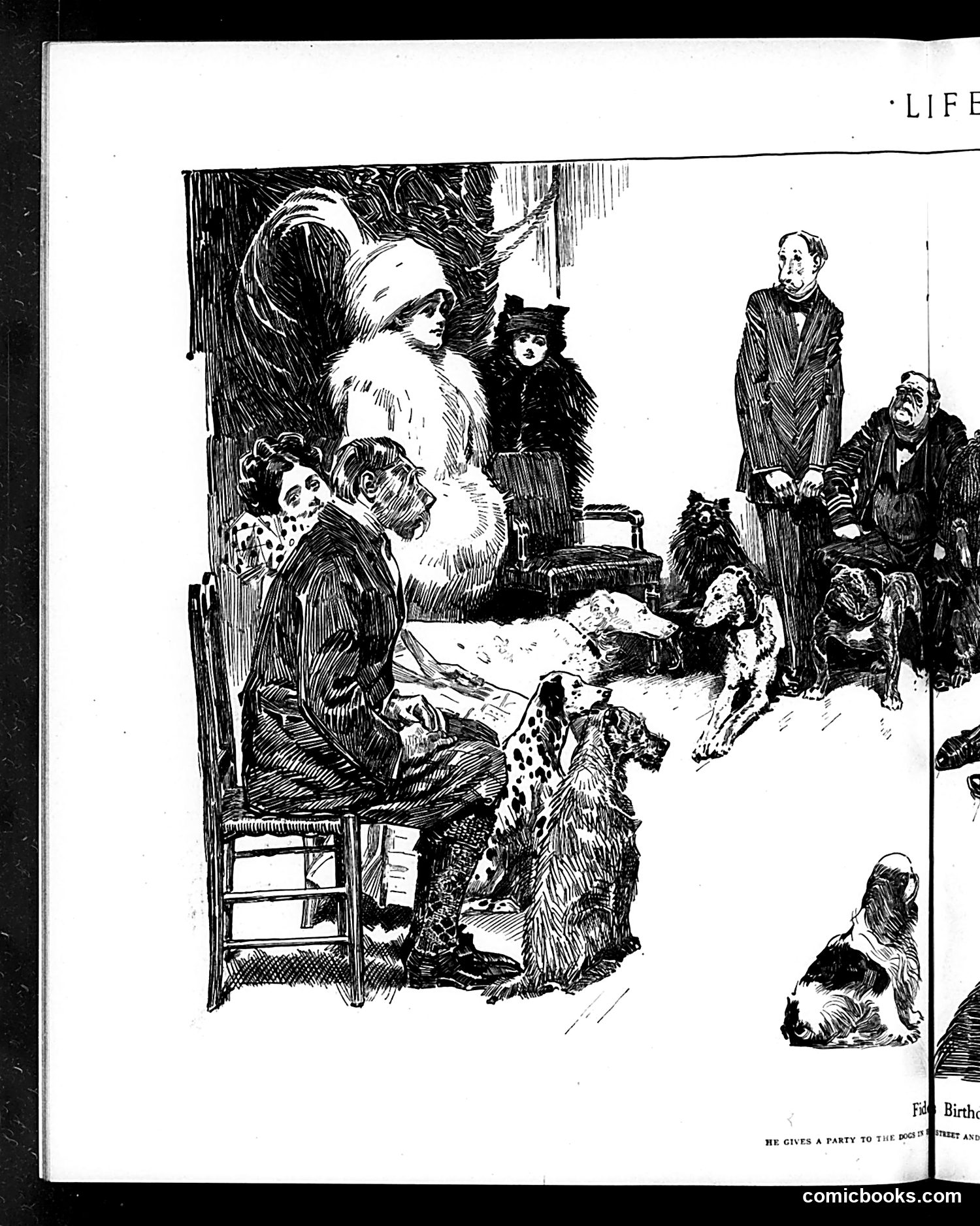
This appears to be a satirical illustration from *Life* magazine showing a social scene. The caption reads "HE GIVES A PARTY TO THE DOG AND..." (text cuts off), suggesting the cartoon's humor concerns someone hosting a gathering for dogs alongside human guests. The image depicts a woman in an elaborate hat and fur coat seated with multiple dogs around her, while formally-dressed men and women observe from behind. The contrast between the dogs receiving apparent social parity with human guests—and the woman's obvious attention to them—appears to satirize either wealthy eccentricity, changing social priorities, or perhaps the then-emerging phenomenon of pet owners treating animals as social equals. Without the complete caption or publication date, the specific target remains unclear, but the satire likely mocks either class pretension or shifting domestic customs.
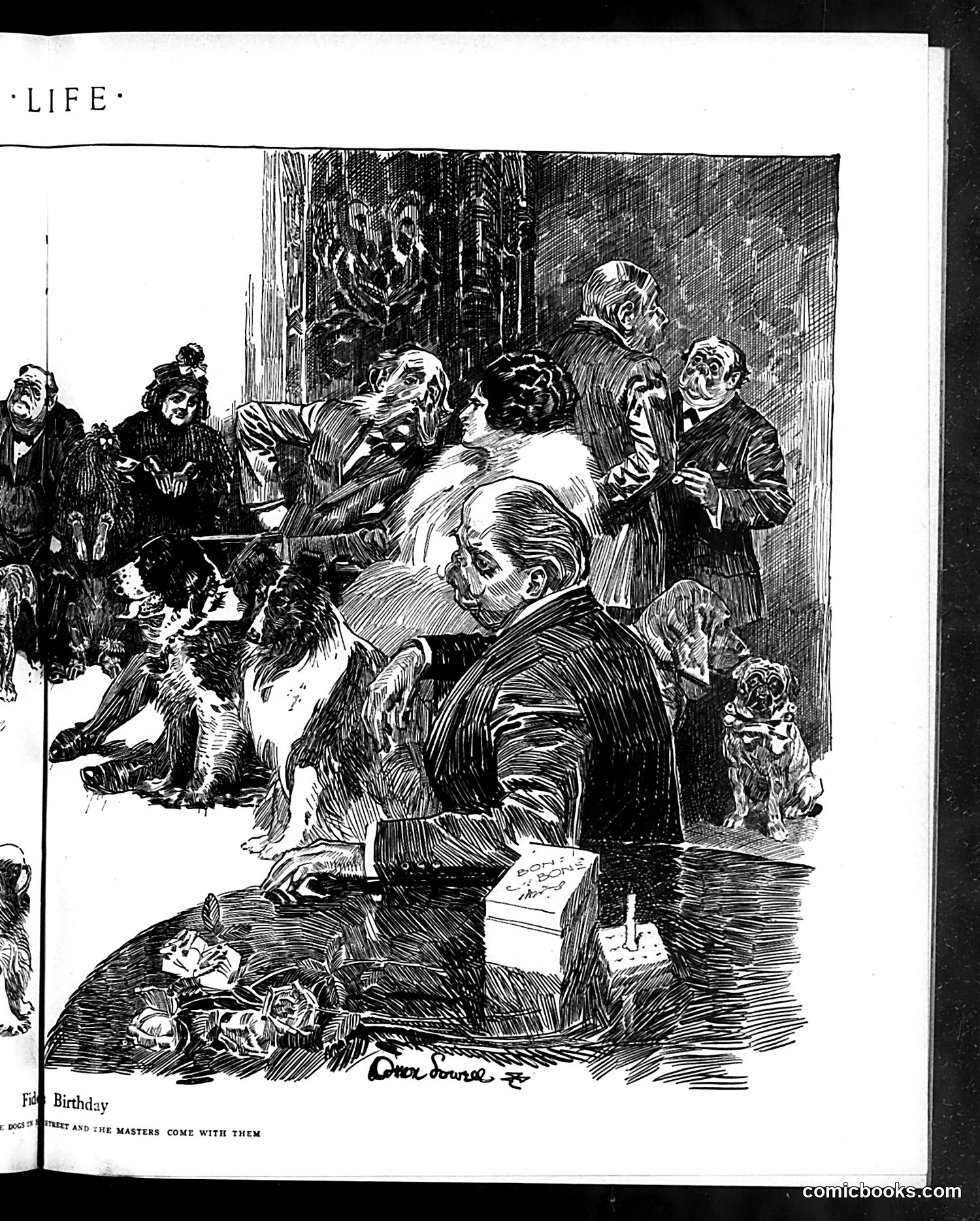
This appears to be a satirical illustration from *Life* magazine depicting a social gathering or salon scene. A well-dressed man in the foreground is surrounded by various figures—some standing, some seated—along with multiple dogs of different breeds. The caption "PET AND THE MASTERS COME WITH THEM" suggests social satire about wealthy society folk and their status symbols. The abundance of dogs implies commentary on upper-class affectation or vanity—the notion that fashionable people display their pets as accessories reflecting their status. The crowded, somewhat chaotic composition and exaggerated facial expressions are characteristic of *Life*'s humorous social commentary. However, without clearer identification of specific figures or a visible date, the precise target and context remain unclear. The signature appears to read "Cesare Soane" or similar.
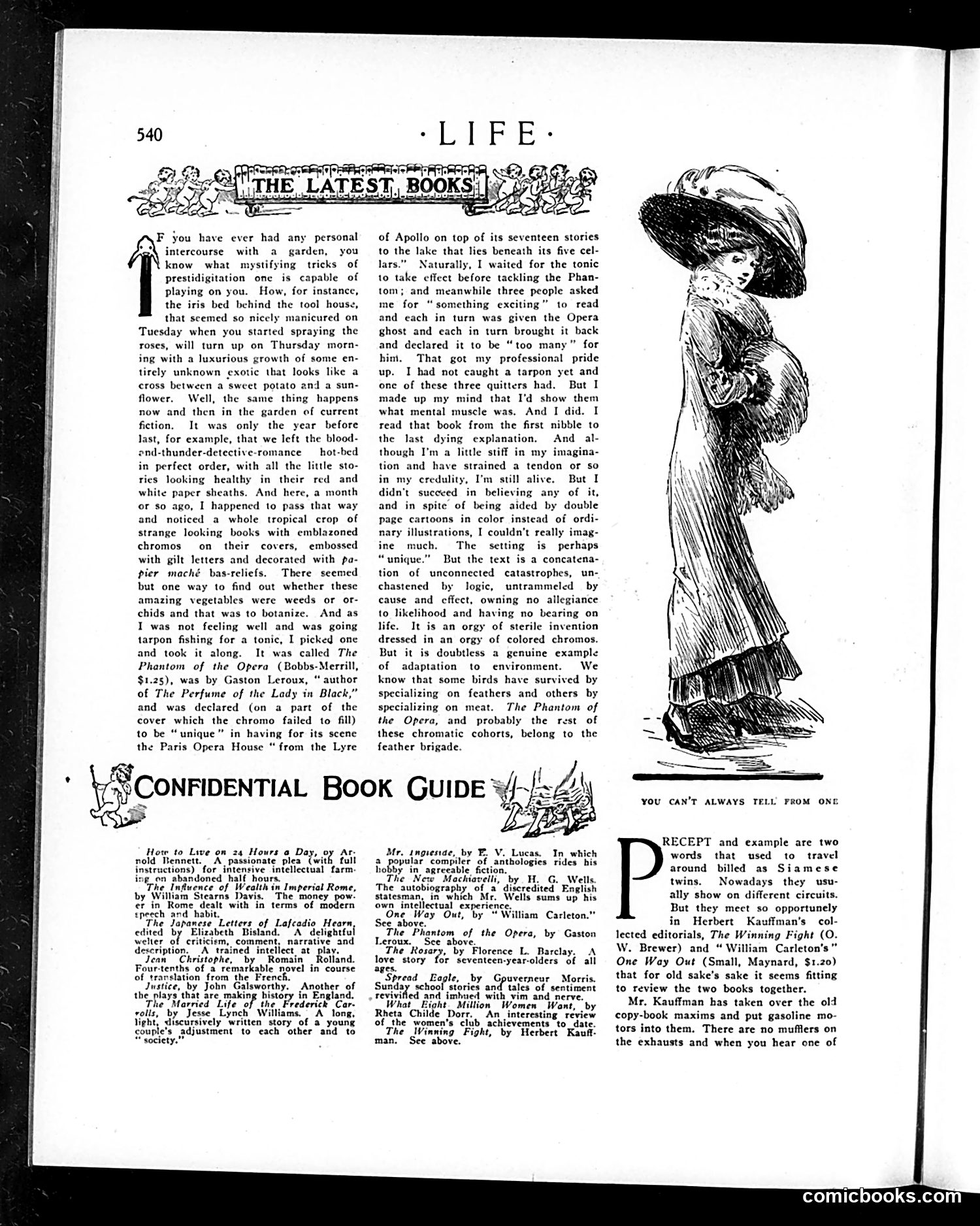
This page features a book review column discussing *The Phantom of the Opera* by Gaston Leroux. The reviewer—using an extended garden metaphor—compares the novel to an exotic weed rather than an orchid: something visually striking but fundamentally hollow. The satire targets the book's ornate presentation (gilt letters, colored illustrations, elaborate cover design) masking a fundamentally incoherent plot. The reviewer describes the narrative as "a concatenation of unconnected catastrophes" lacking logic or believable cause-and-effect—essentially style over substance. The accompanying illustration shows a fashionably dressed woman in period costume, likely representing the book's theatrical setting at the Paris Opera House. The column's humor lies in the reviewer's grudging admission of reading the entire book to prove a point, despite finding it intellectually exhausting—a self-deprecating jab at critics who feel compelled to engage with popular but poorly-written bestsellers.
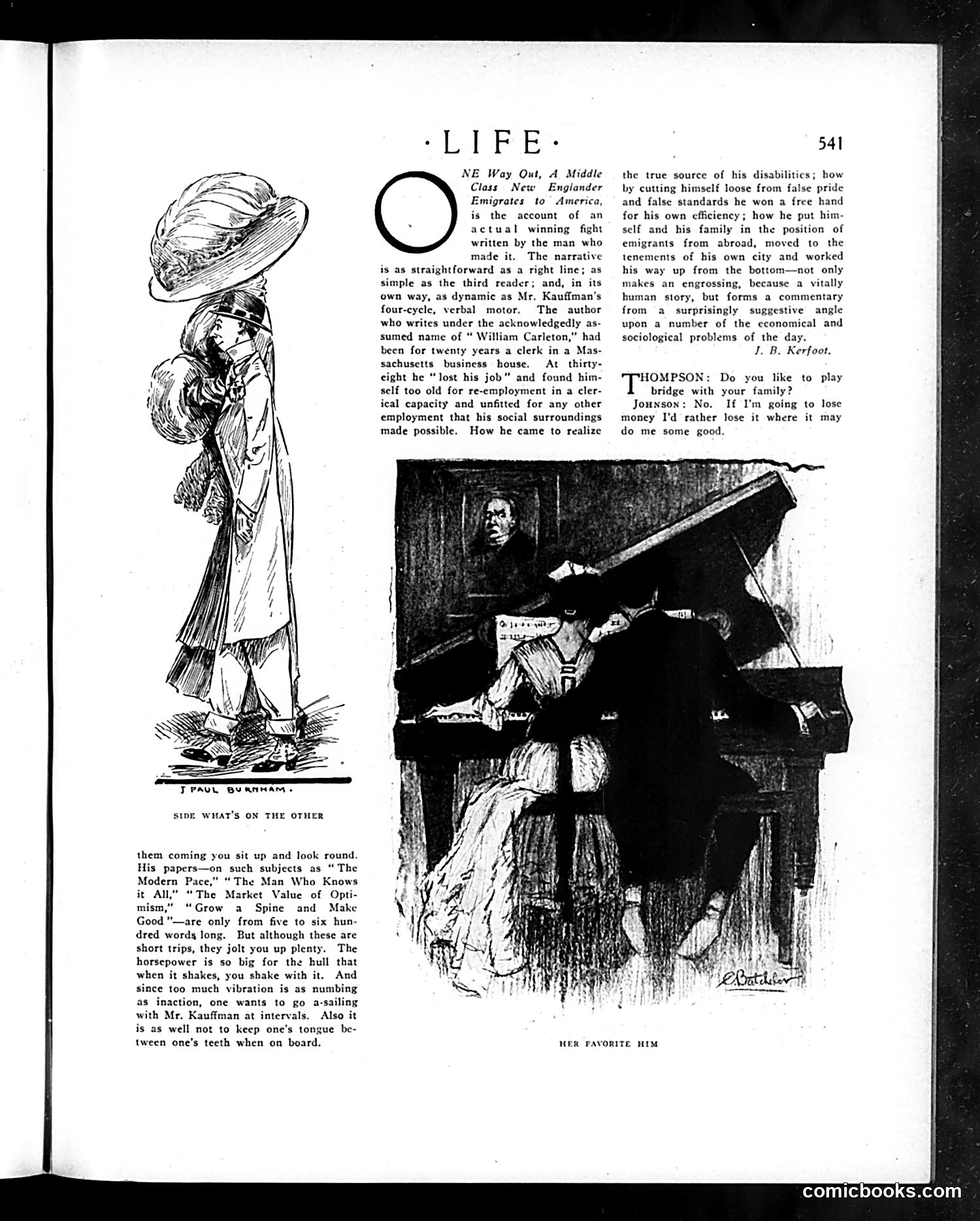
This page contains two distinct elements: **Left cartoon ("Side What's On the Other")** by Paul Burnham shows a caricatured figure—likely representing a wealthy or pompous man—viewed from behind, suggesting the satire concerns hidden hypocrisy or the gap between public appearance and private reality. **Main content** is a book review of "One Way Out," described as an autobiographical account by "William Carleton" (a pen name) about a Massachusetts clerk who lost his job at thirty-eight. Unable to find clerical work due to age discrimination and social stigma, he reinvents himself by adopting an immigrant's mindset, moving to tenements, and working upward. The review praises this as both compelling human drama and social commentary on economic and class mobility in America. **Bottom joke** (Thompson/Johnson dialogue) is a brief quip about bridge-playing and gambling—Johnson preferring to lose money where it does "some good" (charity) rather than in family games. The overall page reflects Progressive-era concerns about class, economic opportunity, and self-made success in America.
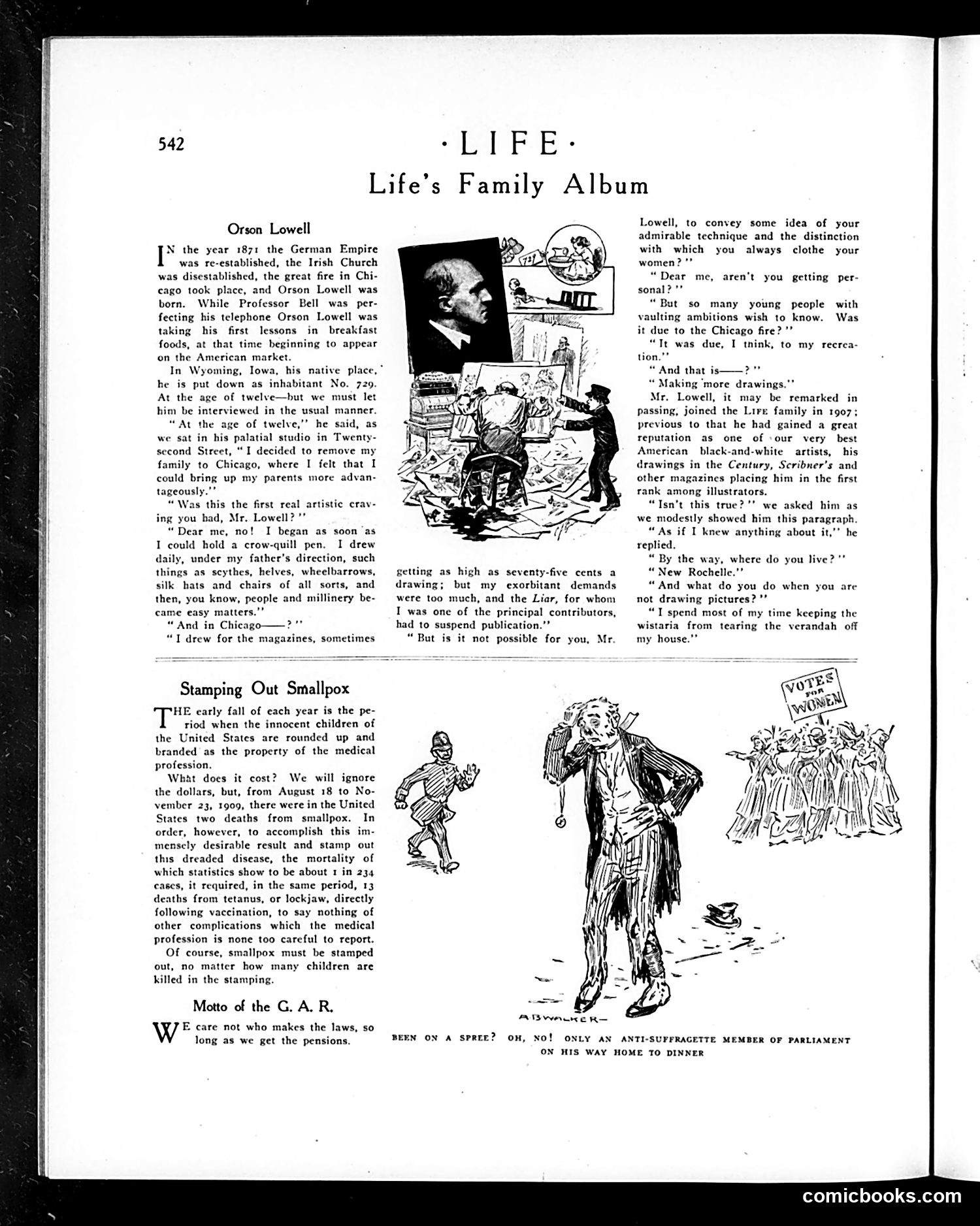
**Top Section - "Life's Family Album: Orson Lowell"** This is a biographical feature interviewing illustrator Orson Lowell. The satire lies in the self-aggrandizing interview format—Lowell humorously inflates minor accomplishments (drawing for magazines at 75 cents per submission, contributing to a publication called "the Liar" that folded). The piece gently mocks artistic pretension while acknowledging his genuine reputation in quality magazines (Century, Scribner's). The humor rests on his pompous, self-absorbed persona. **Bottom Left - "Stamping Out Smallpox"** This is serious advocacy critiquing mandatory smallpox vaccination. The author argues that while smallpox deaths were minimal (2 deaths in a period), vaccinations caused 13 tetanus deaths from contamination—an early vaccine-safety argument challenging medical authority's willingness to accept collateral deaths. **Bottom Right - Anti-Suffragette Cartoon** The cartoon depicts a disheveled man labeled an "anti-suffragette member of parliament" returning home drunk ("on a spree"). The satire suggests opponents of women's voting were hypocritical—denying women political voice while exercising poor judgment themselves.
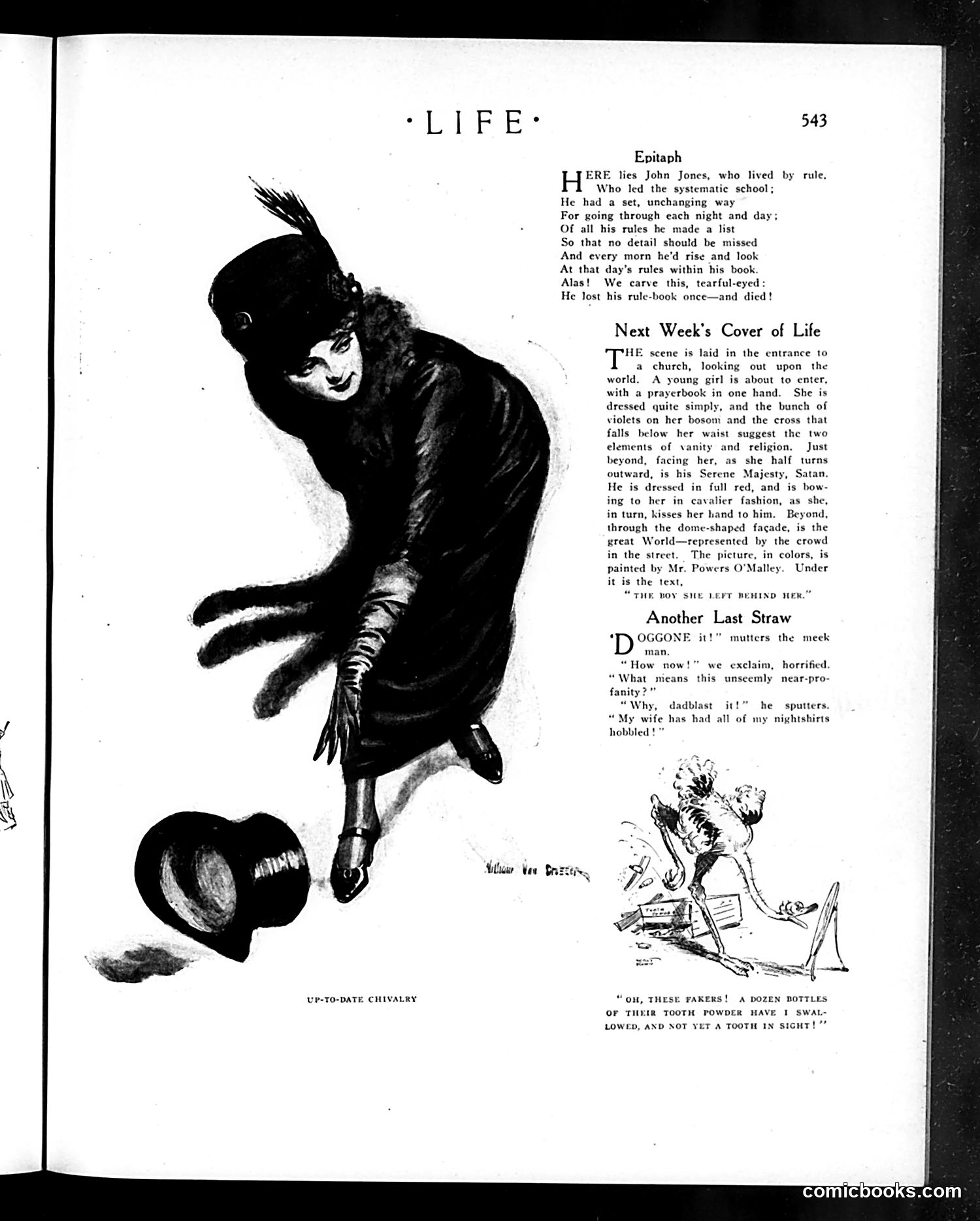
This page contains three satirical pieces typical of early 20th-century Life magazine humor: **"Epitaph"**: A darkly comedic poem mocking obsessive rule-followers. John Jones, who rigidly adheres to a rule-book for daily life, dies when he loses that book—suggesting that over-systematization and inability to adapt leads to death. **"Next Week's Cover"**: Describes an upcoming illustrated cover depicting a young woman at a church entrance torn between religious devotion (symbolized by violets and a cross) and worldly temptation (a flirting cavalier). The image shows this internal conflict visually. **"Up-to-Date Chivalry"** (left illustration): A man helping a woman by catching her spilled items, captioned to suggest outdated courtly behavior. **"Another Last Straw"**: A domestic humor piece where a meek husband's breaking point comes when his wife "hobbles" (hems/alters) his nightshirts—highlighting changing gender dynamics and female domestic authority. The ads at bottom mock ineffective patent medicines ("tooth powder").
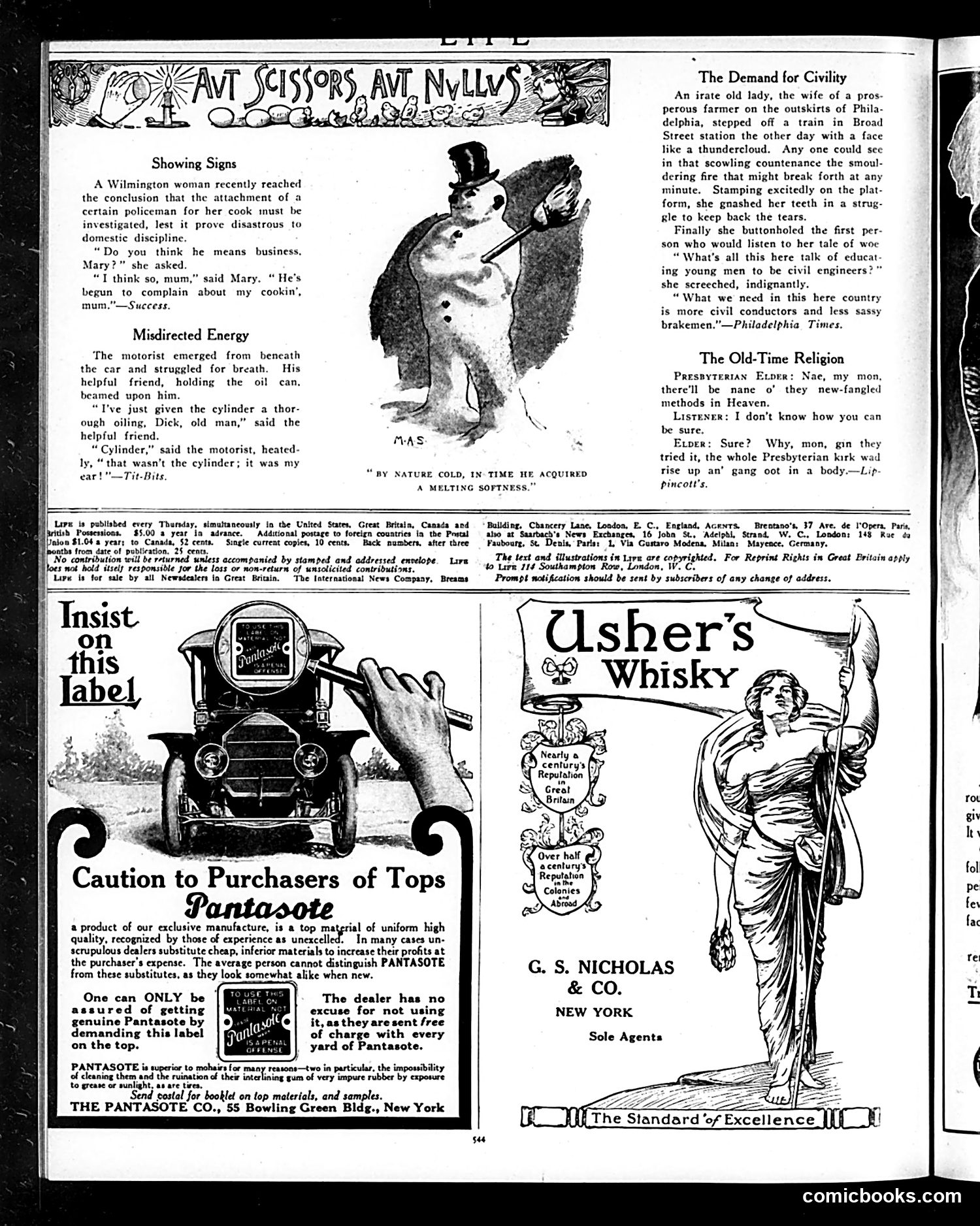
This page contains several brief humorous anecdotes typical of early 20th-century American satire humor: **"Showing Signs"** jokes about a policeman's romantic interest in a cook, evidenced by his complaints about her cooking—a sign he's courting her. **"Misdirected Energy"** depicts a motorist angered when a "helpful friend" oils his ear instead of his car cylinder—a pun-based mishap. **"The Demand for Civility"** features an irate farmer's wife complaining that railroads need more "civil conductors" and fewer "sassy brakemen"—a pun on "civil engineers." **"The Old-Time Religion"** presents Scottish Presbyterian elders rejecting modern religious methods, fearing their congregation would leave the church in protest. The page is primarily **advertising** (Pantasote car tops, Usher's Whisky), with these short joke-anecdotes filling space. The humor relies on wordplay, class commentary, and ethnic/regional stereotypes typical of the era.
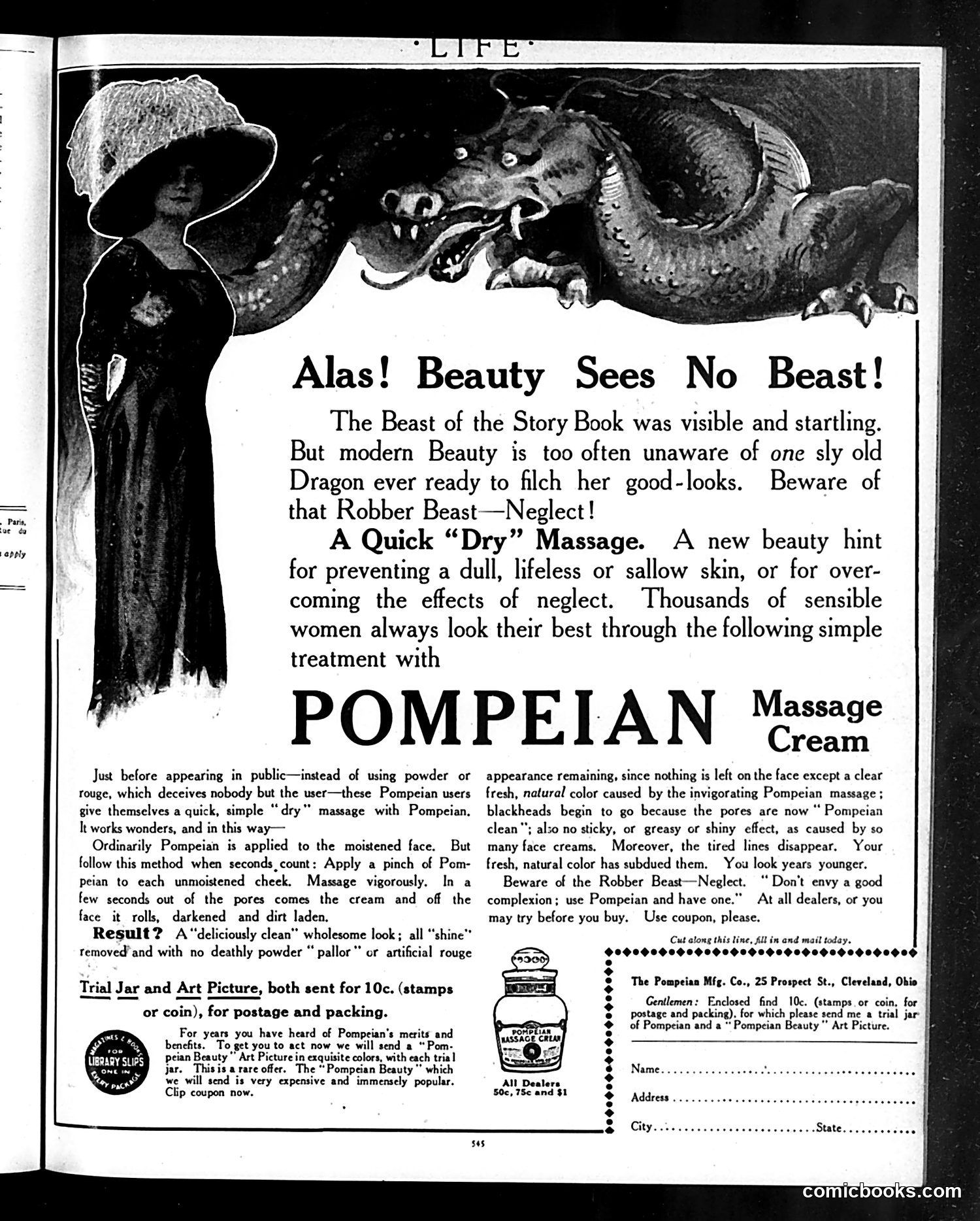
This is primarily a **product advertisement**, not political satire. The page uses a fairy-tale conceit to sell beauty cream. The illustration shows a woman in profile rejecting two grotesque dragons—representing the "Robber Beast" of neglect that threatens a woman's appearance. The copy plays on the contrast between visible monsters in storybooks and an invisible threat to modern beauty: poor skincare. The ad promotes Pompeian Massage Cream's "dry massage" technique as a quick, natural-looking alternative to powder and rouge. The pitch emphasizes that sensible women use this method to achieve a fresh, clean complexion without artificial cosmetics—a selling point when heavy makeup signaled poor taste or lower-class status to early 20th-century readers. The coupon offers a trial jar plus an art picture for 10 cents, a common marketing tactic of the era.
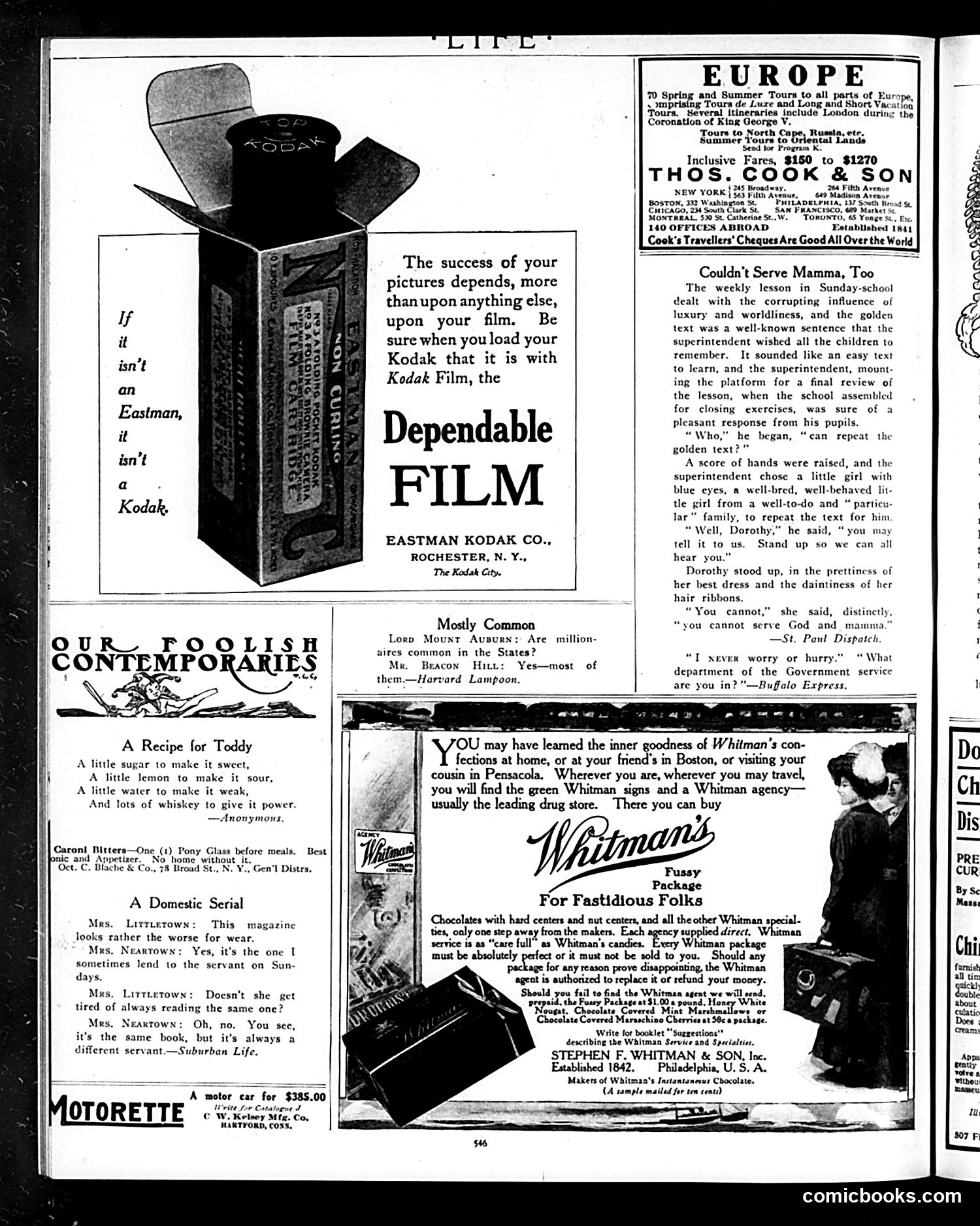
This page is primarily **advertising and light humor**, with no political cartoons requiring historical explanation. The advertisements include: - **Kodak Film** (top left): Standard product promotion emphasizing reliability - **Thomas Cook & Son** (top right): Travel agency advertising European tours, notably including the **Coronation of King George V**, dating this issue to 1911 - **Whitman's Chocolates** (center-right): Candy company advertisement The humor pieces are gentle social satire: - "Couldn't Serve Mamma, Too" mocks wealthy families' hypocrisy—a Sunday school lesson about rejecting worldly luxury is undercut when a privileged girl serves both God *and* her mother (implying materialism) - "A Domestic Serial" jokes about magazine wear; servants are interchangeable but magazines endure - Brief quips about whiskey recipes and American millionaires **No political commentary or caricatures** appear on this page. It's representative of Life's lighter, commercial content rather than its satirical journalism.
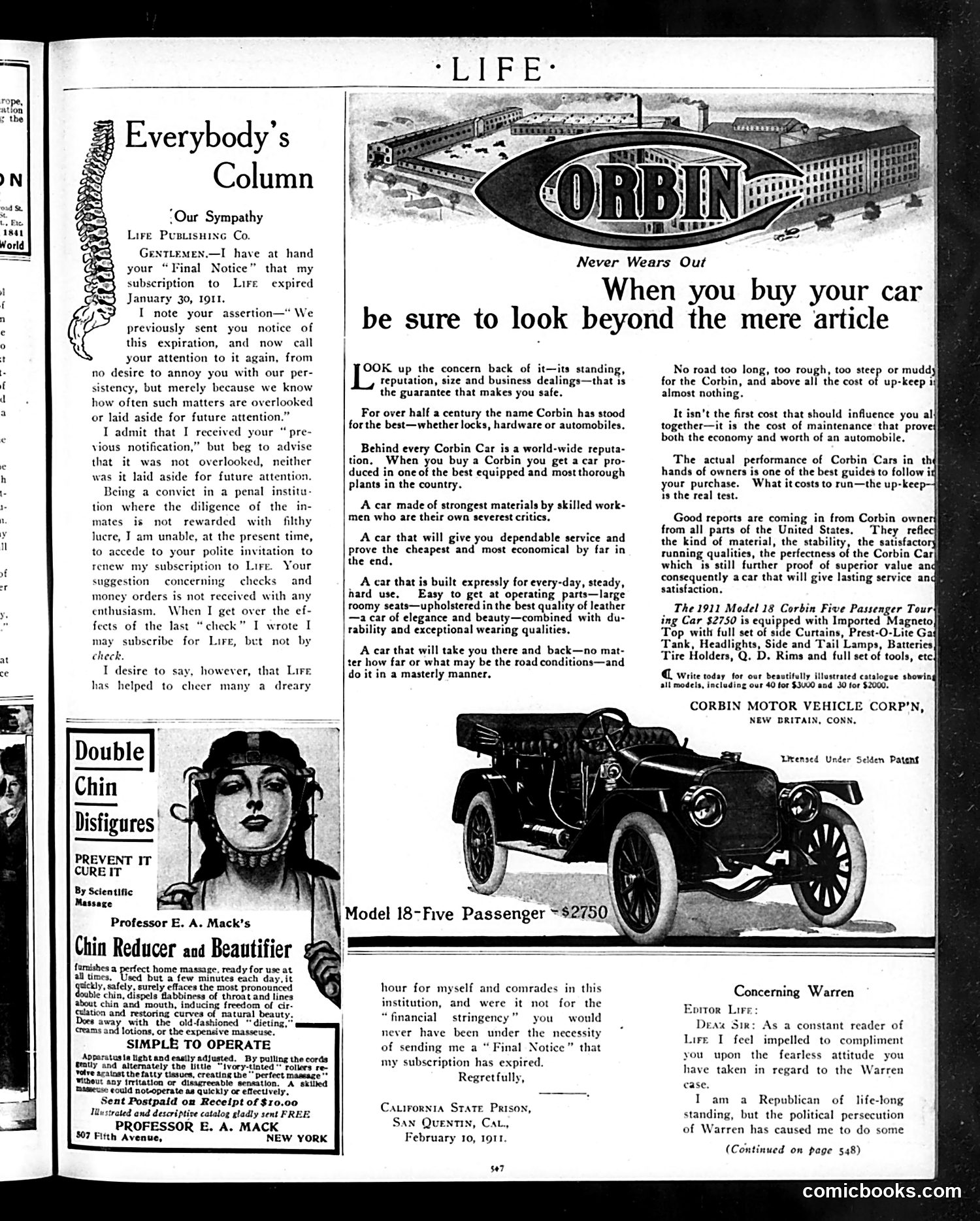
This page from *Life* magazine (dated February 10, 1911) is primarily commercial advertising with one satirical letter. **The Satire:** The "Everybody's Column" letter is from a convict imprisoned in a penal institution who received a subscription renewal notice from *Life*. The humor lies in his deadpan response: he cannot afford to renew because he's incarcerated ("where the diligence of the inmates is not rewarded with filthy lucre") and sardonically references bouncing a check previously, saying he'll subscribe for *Life* again "but not by check." The joke critiques both debt and the subscription business's persistent collection notices. **The Advertising:** The page is dominated by a Corbin Motor Vehicle advertisement featuring a Model 18 Five-Passenger Touring Car ($2,750), emphasizing durability and low maintenance costs—selling points for early automobiles. A smaller ad promotes Professor E.A. Mack's "Chin Reducer and Beautifier," a pseudo-scientific beauty device. The content reflects early 20th-century commercial culture and consumer marketing strategies.
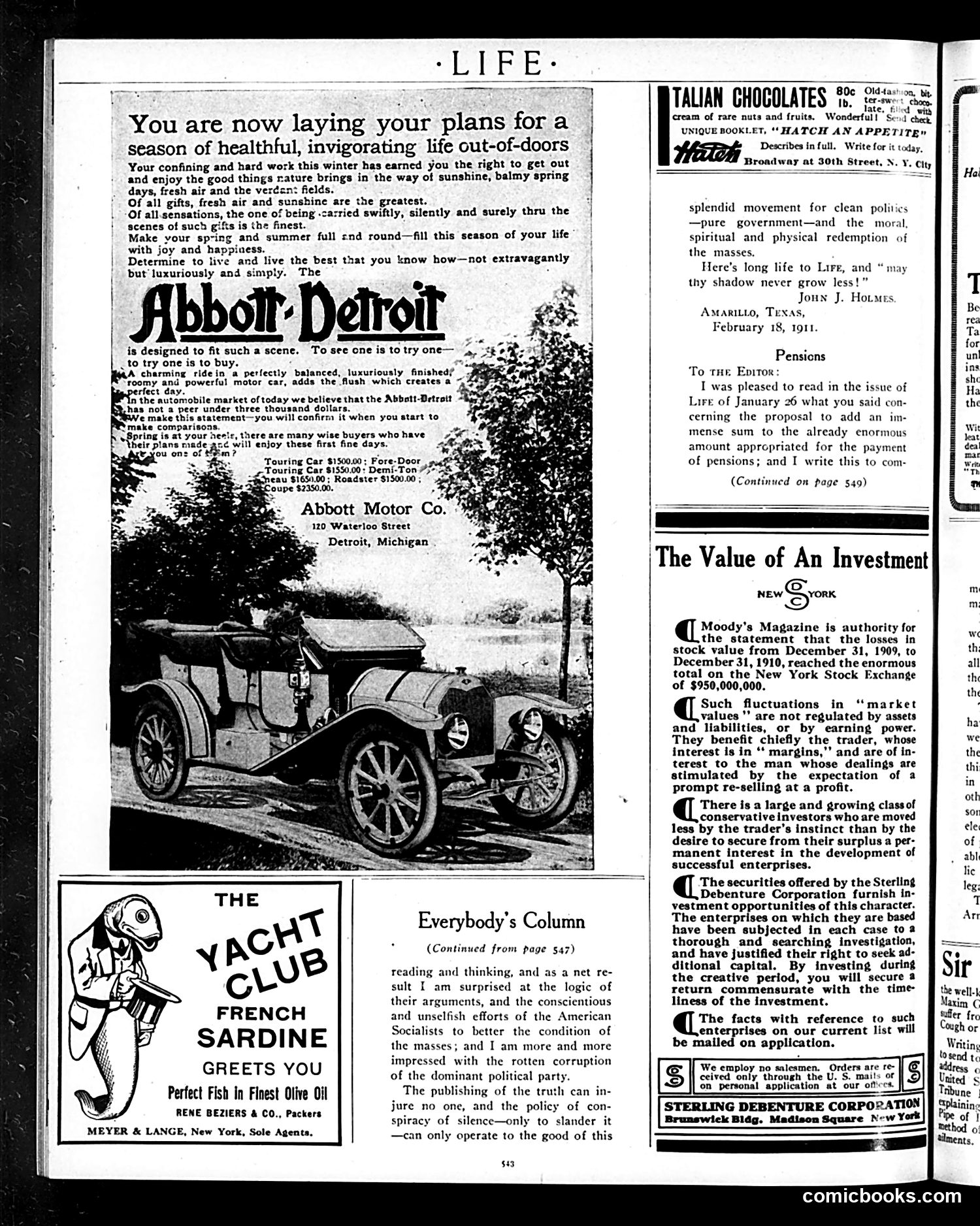
This page is primarily **advertising**, featuring an Abbott-Detroit automobile ad that dominates the left side. The car advertisement uses aspirational language about spring leisure and outdoor life to market luxury automobiles ($1,500-$1,650), appealing to middle and upper-class readers. The right side contains reader letters in "Everybody's Column." One letter from John J. Holmes (Amarillo, Texas) praises American Socialists for their "conscientious" efforts and criticizes "the rotten corruption of the dominant political party"—reflecting early 20th-century Progressive Era debates about socialism versus traditional politics. Another letter discusses stock market losses and investment stability, addressing concerns about financial speculation versus conservative investment in "successful enterprises." The smaller advertisements (Italian chocolates, French sardines, Yacht Club sardines) represent typical period magazine monetization. This reflects Life's function as both satirical commentary and commercial marketplace for affluent readers.
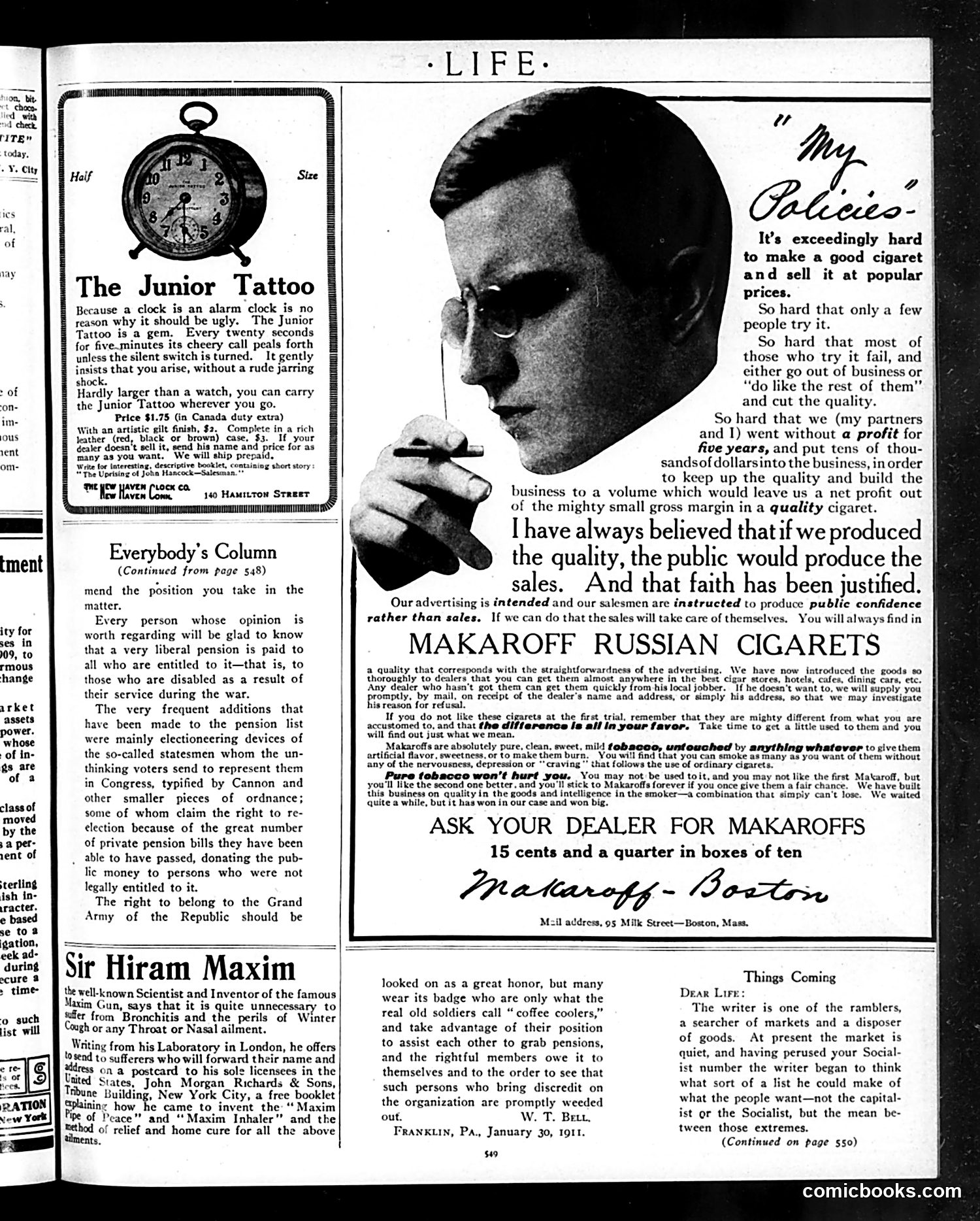
This page is primarily **advertising-focused** rather than satirical cartoon content. The main visual element is a **Makaroff Russian Cigarettes advertisement** featuring a profile photograph of a man smoking. The advertisement's appeal is notably **anti-commercial**: the copywriter emphasizes that his company prioritized quality over profit for five years, deliberately avoided aggressive sales tactics, and relied on product merit rather than advertising manipulation. This represents **early 20th-century marketing philosophy**—claiming integrity and restraint as selling points. The lengthy testimonial argues that producing quality goods naturally generates sales, positioning the brand as morally superior to competitors who "cut the quality." The page also contains **"Everybody's Column,"** a reader opinion section discussing pension eligibility and political corruption, and an advertisement for **"The Junior Tattoo"** alarm clock. The satire here is subtle: the cigarette ad's self-congratulatory tone about avoiding deception while using persuasive testimony is itself a sophisticated sales technique—ironic by modern standards.
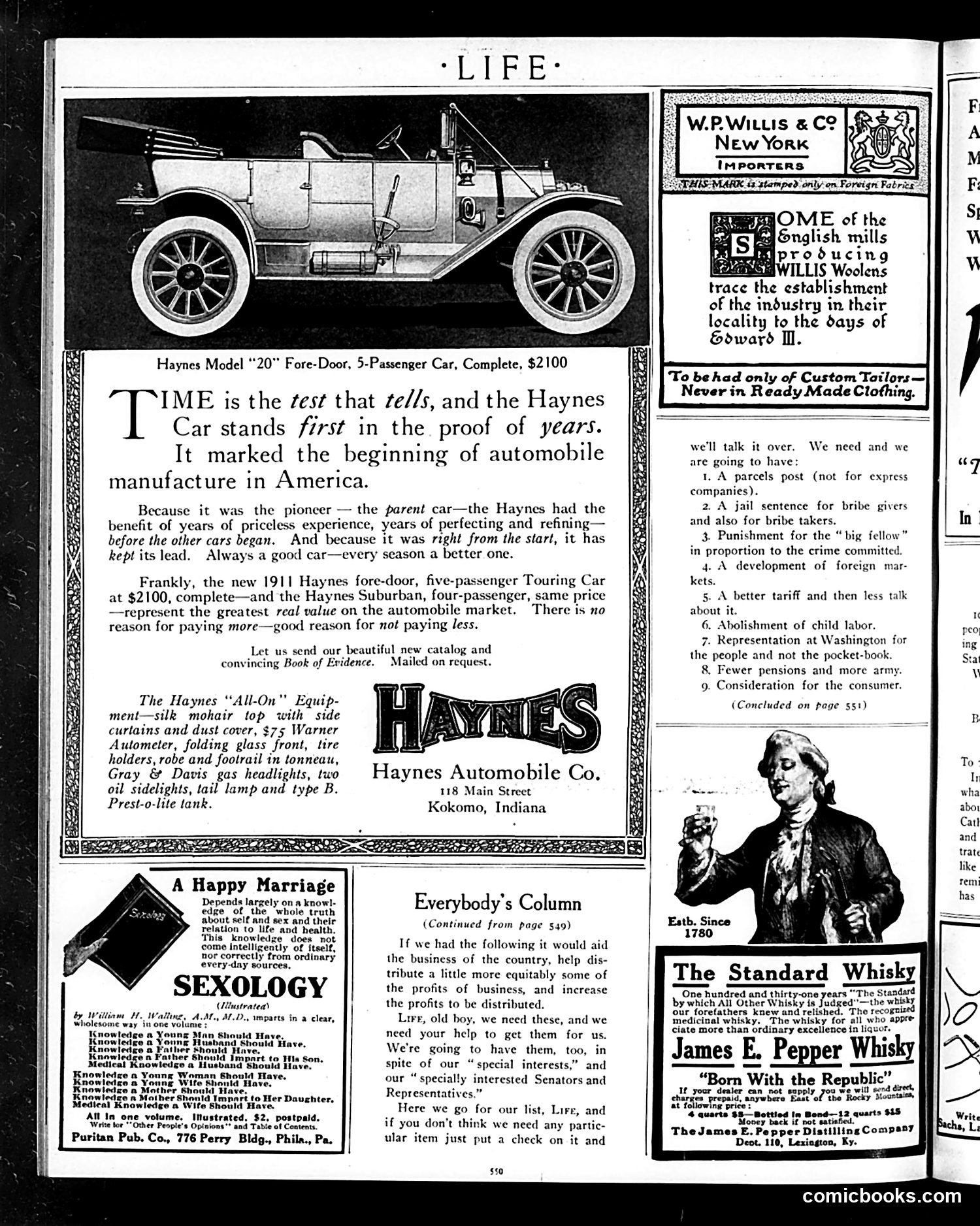
This page is primarily **advertising and advice columns**, not political satire. The main content features a **Haynes automobile advertisement** (1911 Model "20") emphasizing the car's pioneering status and value at $2,100. The copy uses "time is the test that tells" as its central claim about durability. Below are unrelated advertisements including: - A **"Sexology" book** by William H. Walling, M.D., promoting medical knowledge about sex and relationships - An **"Everybody's Column"** editorial pushing nine progressive reforms: parcel post, anti-corruption measures, tariff reform, child labor abolishment, democratic representation, military investment, and consumer protections - Ads for **James E. Pepper Whisky** and **W.P. Willis & Co.** tailoring services The editorial requests suggest **early 20th-century Progressive Era concerns**—opposing corporate influence, supporting labor protections, and demanding government accountability. However, this page contains no cartoons or satirical illustrations; it's straightforward period advertising and advocacy content.
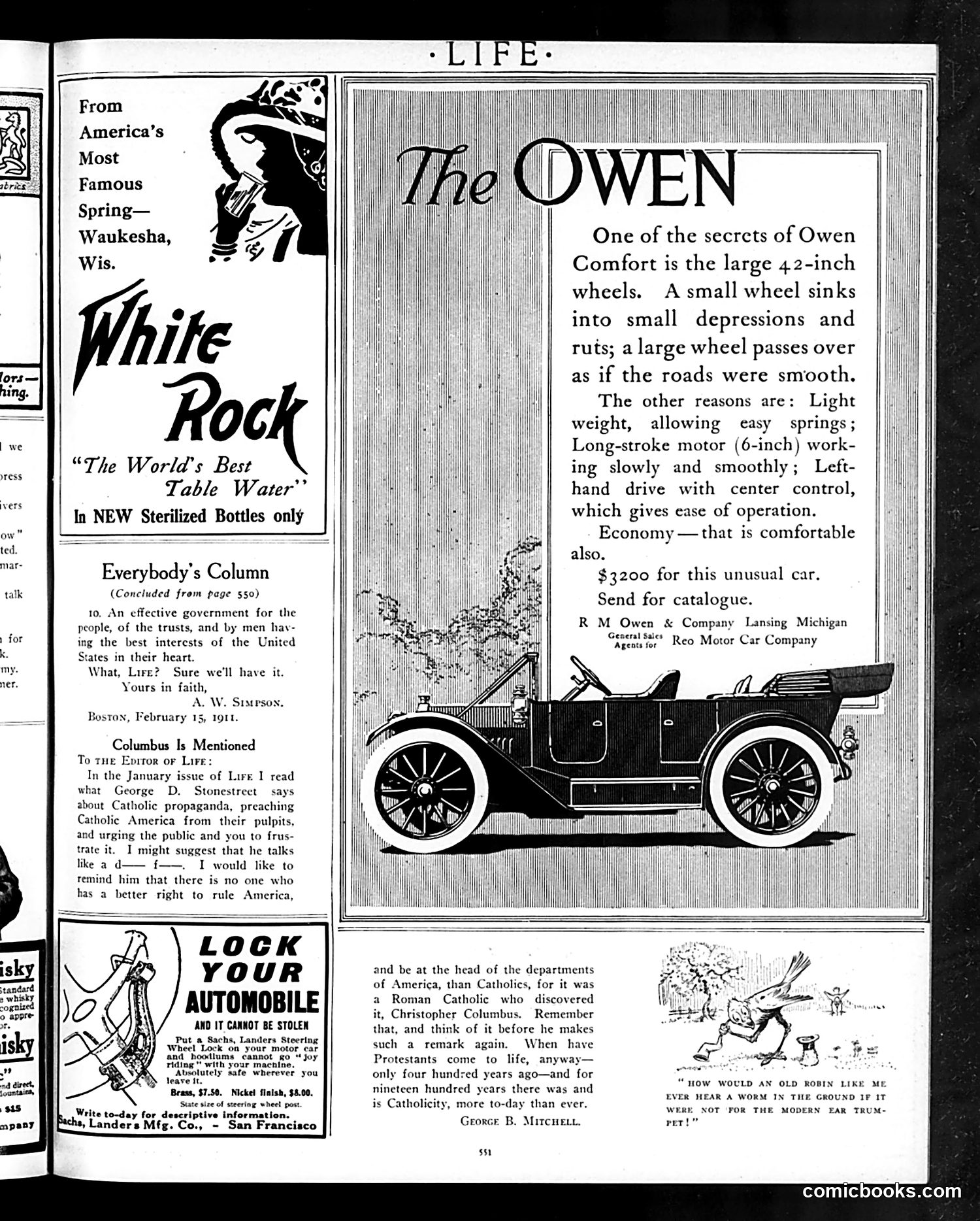
This page mixes advertisements with reader letters addressing religious and political controversy. **Main Content:** Letters to the editor debate Catholic influence in America. One writer defends Catholics' right to lead America, citing Christopher Columbus as a Catholic discoverer. Another criticizes George D. Stonestreet's anti-Catholic propaganda rhetoric in a previous issue. The tone suggests early 20th-century Protestant-Catholic tensions were active discussion topics in mainstream magazines. **Advertisements:** The Owen automobile ($3200) and White Rock spring water ads represent luxury consumer goods. A "Lock Your Automobile" device ad reflects period concerns about vehicle theft and joyriding. **Bottom cartoon:** A small illustration shows an old robin complaining about modern car noise, reflecting contemporary anxiety about automobiles disrupting traditional rural life. The page reflects 1911 America's religious divisions and rapid technological change.
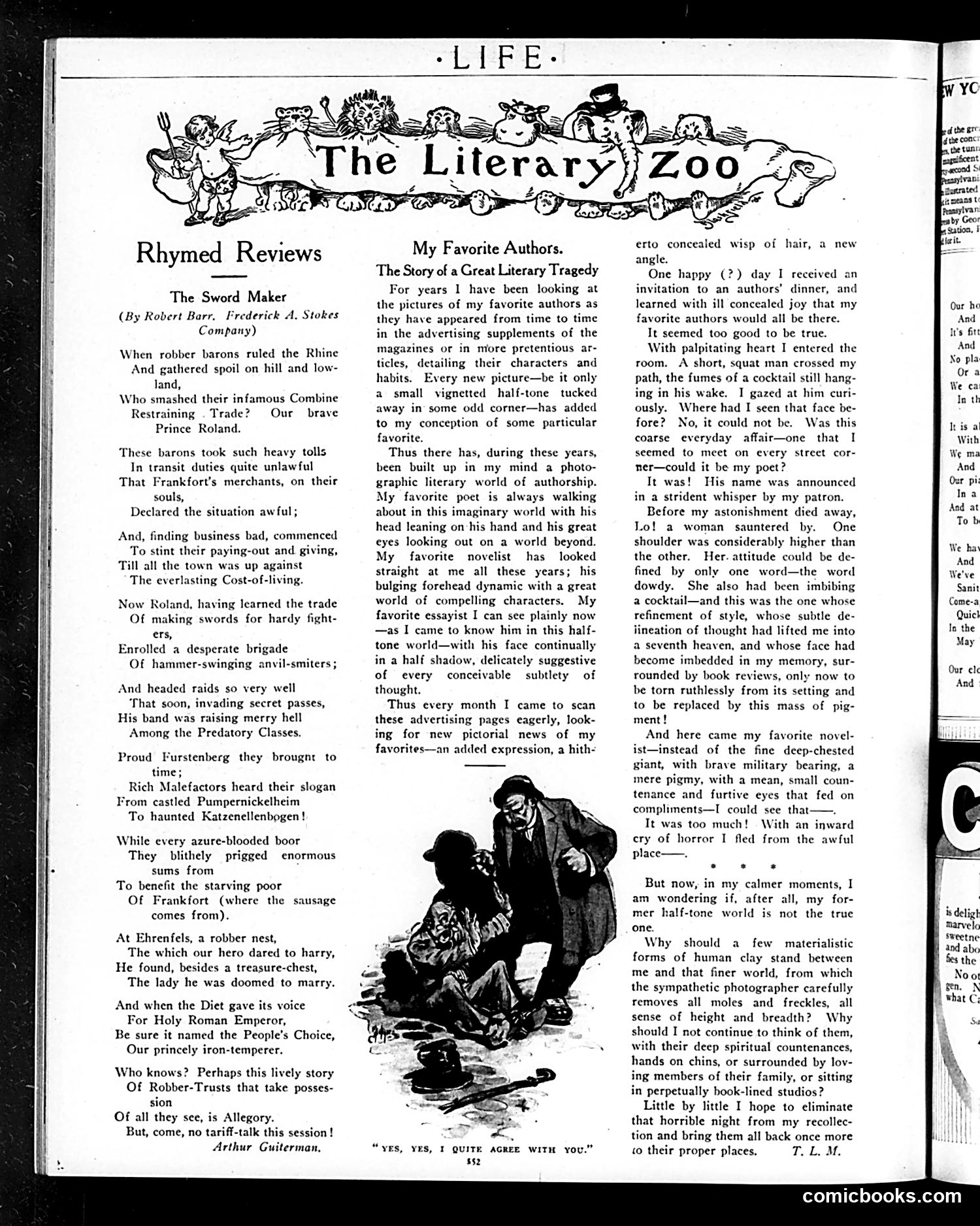
This page contains two distinct pieces satirizing American culture circa early 1900s: **"The Sword Maker" (left):** A humorous poem by Arthur Guiterman reviewing a historical novel. The verse recounts a medieval German tale of Prince Roland fighting corrupt "robber barons" who extract excessive tolls, benefiting Frankfurt's poor. The final stanza suggests this is **allegory for contemporary trust-busting and tariff disputes**—likely referencing Theodore Roosevelt's anti-monopoly campaigns and ongoing debates about protective tariffs versus free trade. **"My Favorite Authors" (right):** A satirical essay about literary disappointment. The author describes building idealized mental images of favorite writers from magazine photographs, imagining them as romantic, intellectual figures. The cruel punchline: meeting them in person reveals they're ordinary, physically unremarkable people—a common early-20th-century complaint about the gap between artistic mystique and mundane reality. The accompanying illustration shows two figures in what appears to be a dismissive encounter, reinforcing the essay's theme of shattered literary expectations.
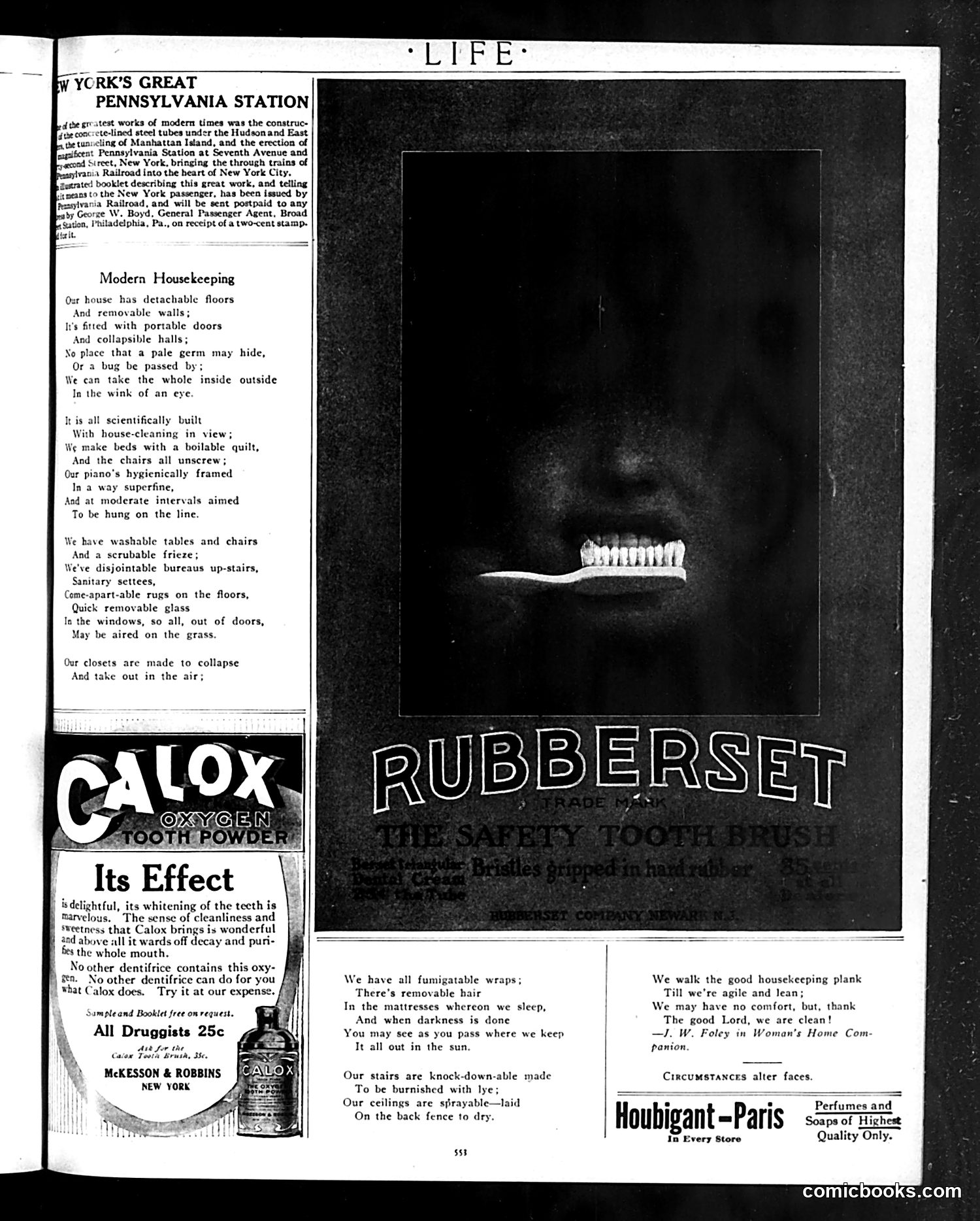
This page satirizes the early 20th-century obsession with hygiene and "scientific" housekeeping. The humorous poem mocks the era's germ-consciousness by imagining homes where *everything* is detachable, removable, collapsible, and washable—floors, walls, doors, furniture, even pianos and ceilings. The joke targets two things: first, the extreme lengths people went to eliminate germs (real and imagined); second, the impracticality of these designs for actual living. The detailed descriptions of "boilable quilts," "scrubable frieze," and stairs made to "be burnished with lye" escalate into absurdity. The supporting advertisements (Calox tooth powder, Houbigant perfumes) reinforce the page's theme: selling cleanliness and purity as status symbols. The satire suggests this obsession was becoming ridiculous—that comfort and normalcy were sacrificed in pursuit of perfect sanitation.
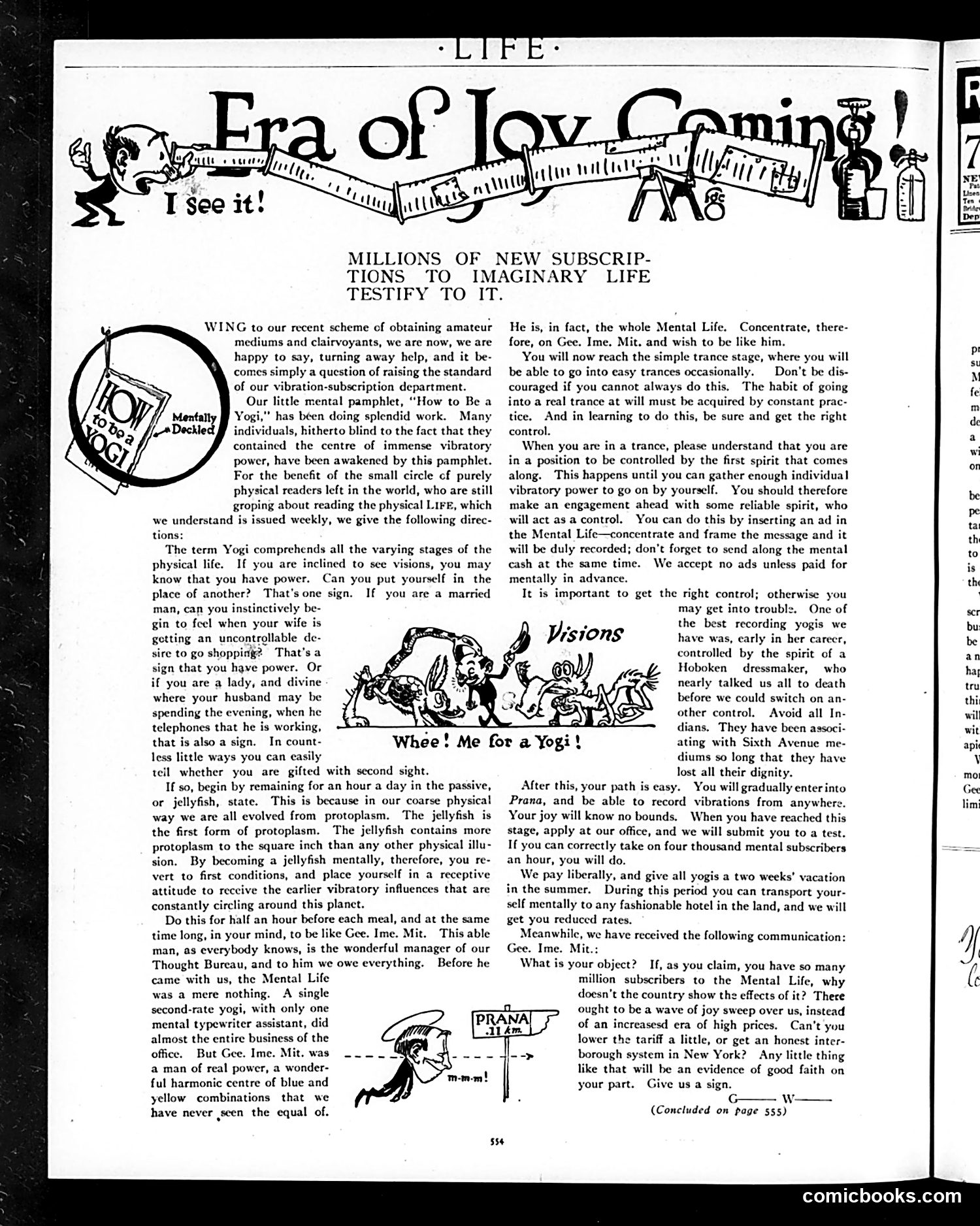
This page satirizes the early 20th-century craze for spiritualism, yoga, and New Thought mysticism. Life magazine mocks a fictional "Mental Life" publication that sells subscriptions promising to teach readers how to become clairvoyants and yogis. The satire targets gullible believers through absurd "instructions": meditating like jellyfish, developing telepathic powers to detect wives' shopping urges, and entering trances. The figure "Gee. Ime. Mit." (likely a nonsense name mocking spiritual gurus) is satirized as the supposed genius behind this enterprise. The joke hinges on Life's incredulous tone—treating obvious charlatanism as if legitimate—while the comic illustrations of delusional practitioners ("Whee! Me for a Yogi!") underscore the absurdity. The piece mocks both the spiritualist movement's promises and the public's eagerness to believe in easy paths to supernatural power.
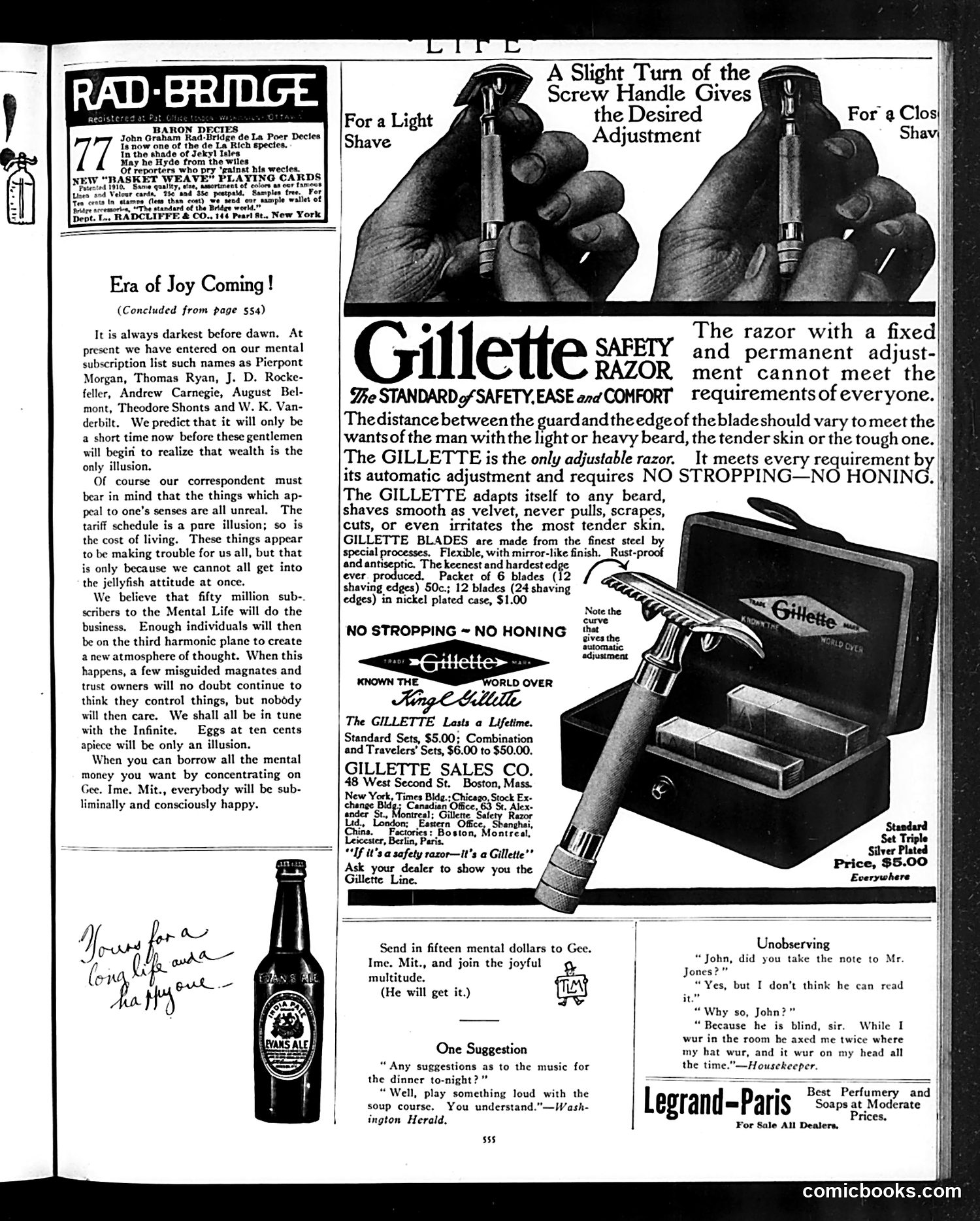
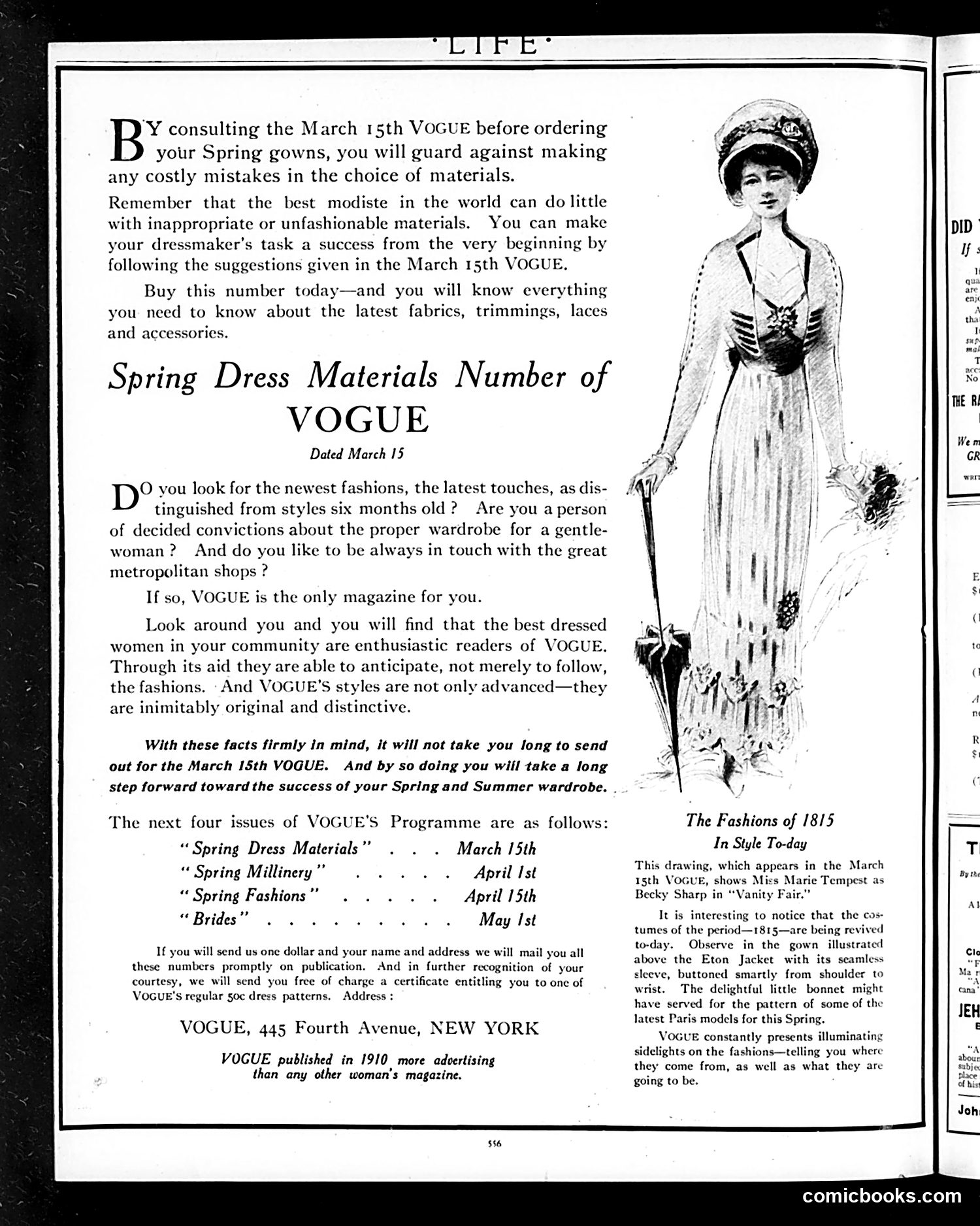
The page is a 1910 **advertisement for Vogue magazine's spring fashion issues**. There are no cartoons or political satire here—instead, it features: **The main image**: An elegant illustration of a fashionable woman in Edwardian dress, wearing a large feathered hat and holding a parasol, representing current spring fashion ideals. **The sales pitch**: The text urges readers to consult Vogue's March 15th issue on dress materials to avoid "costly mistakes" when ordering spring gowns. It positions Vogue as essential for women who want to stay ahead of fashion trends rather than merely follow them six months behind. **Secondary content**: On the right, a note discusses how 1815-era fashions (from Thackeray's *Vanity Fair*) are being revived, using actress Marie Tempest as an example. **The claim**: Vogue states it "published in 1910 more advertising than any other woman's magazine"—a boast about its market dominance. This is straightforward commercial messaging, not satire.
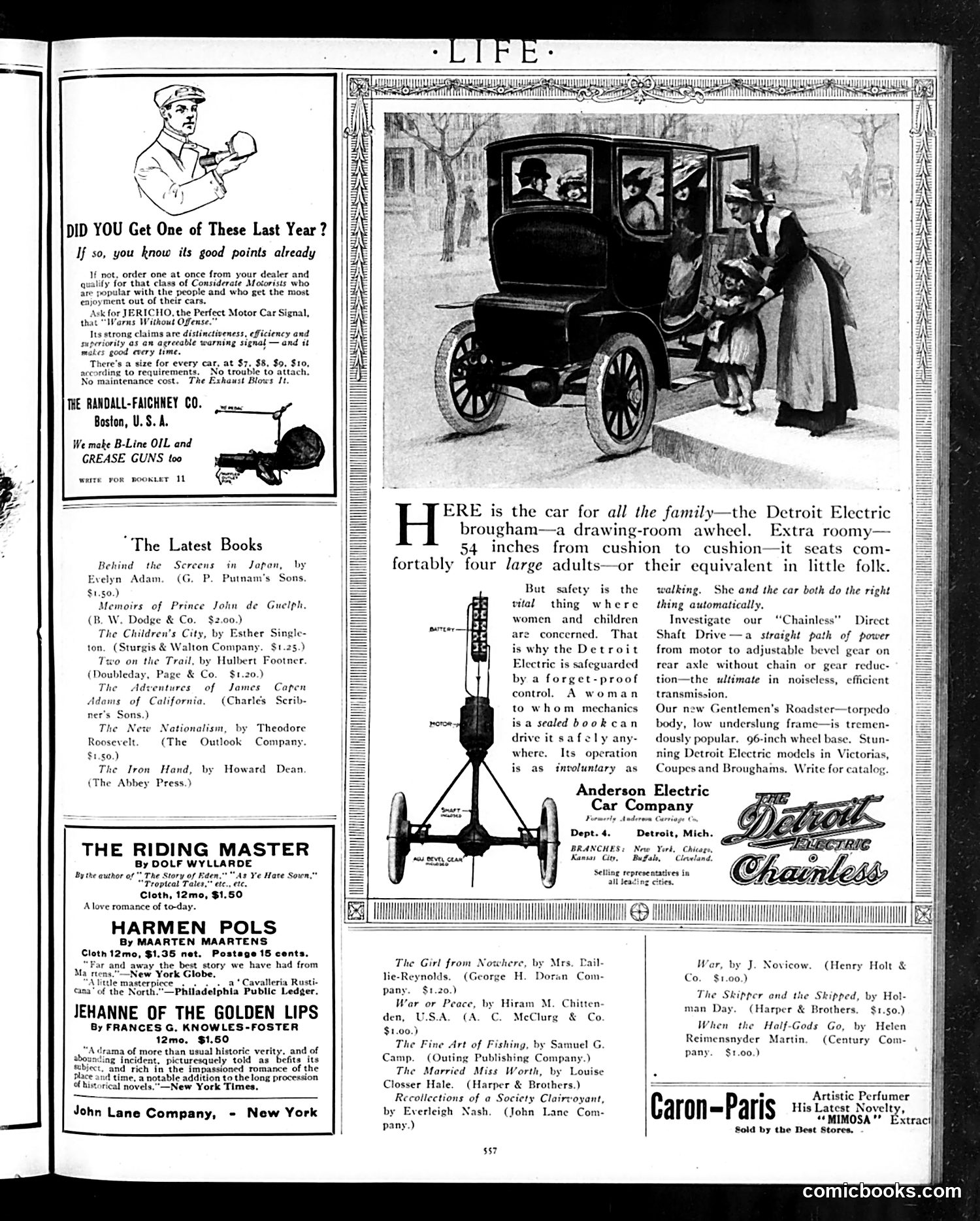
This is primarily an **advertising and book review page** with no political cartoons or satire requiring historical context. The main content features: 1. **Jericho Motor Car Signal advertisement** (top left): A practical safety device for early automobiles—essentially a horn/warning signal for "considerate motorists." 2. **Detroit Electric brougham advertisement** (center/right): Promotes an electric automobile marketed specifically to families, women, and children. The pitch emphasizes safety ("she and the car both do the right thing automatically") and ease of operation ("to whom mechanics is a sealed book can drive it safely anywhere"). This reflects early 1900s concerns about automobile complexity and the appeal of electric vehicles before gasoline engines dominated. 3. **Book reviews and advertisements** (bottom): Lists contemporary publications including titles by Theodore Roosevelt and works on fishing and romance. The page documents early automotive technology and marketing strategies targeting women and families—historically significant but not satirical in nature.
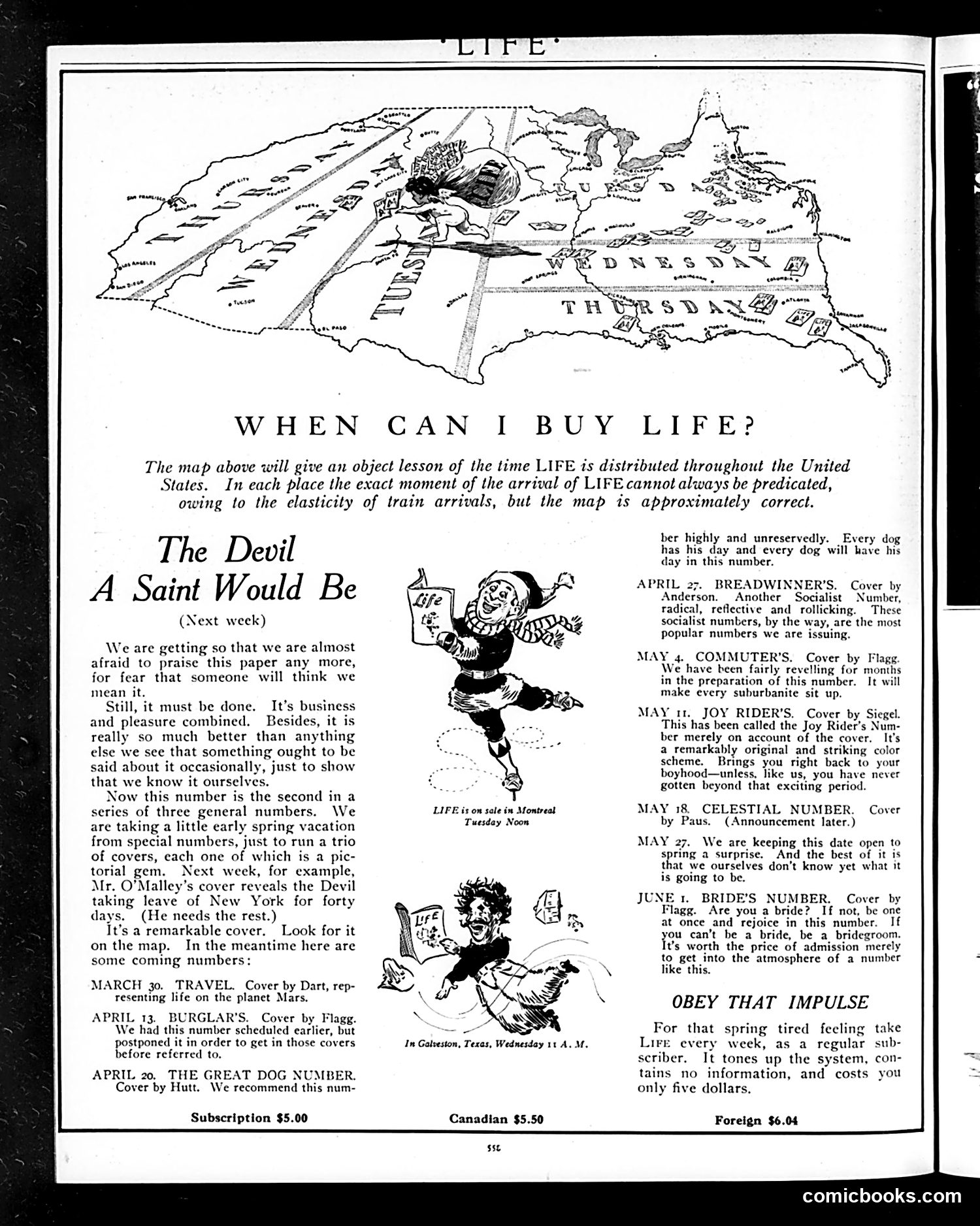
This is primarily a **self-promotional advertisement** for *Life* magazine, a major American satirical weekly publication. The page serves multiple purposes: **The Map**: Shows *Life*'s distribution across the United States, explaining that delivery times vary due to "elasticity of train arrivals"—a humorous acknowledgment of railroad unreliability, a common frustration in early 20th-century America. **The Editorial Content**: The editors humorously mock their own publication while promoting it, using self-deprecating humor ("afraid to praise this paper...for fear someone will think we mean it"). This was typical *Life* style—irreverent and self-aware. **Upcoming Issues**: Lists themed covers by various illustrators, including notably a "Breadwinner's" number described as "Socialist"—the editors note these socialist issues are their "most popular," suggesting *Life* had a progressive editorial stance and readership interested in social commentary. **The Pitch**: The closing "Obey That Impulse" encourages subscriptions at $5.00, promising the magazine "contains no information"—a joke emphasizing *Life*'s focus on humor and satire over serious journalism. The cartoons shown are generic celebratory figures typical of the era's advertising style.
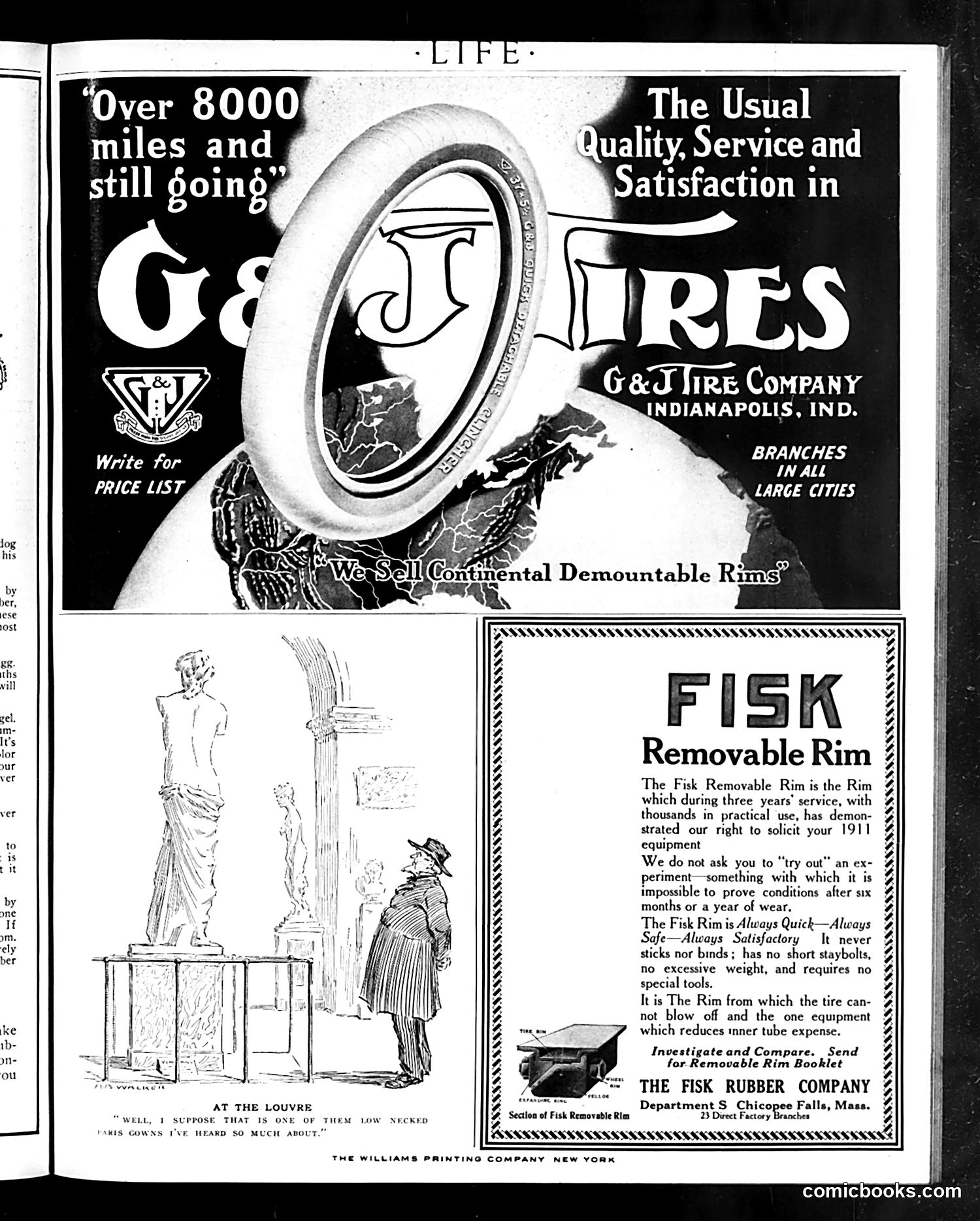
This page combines two distinct elements: **advertising and satirical cartoon**. The **top half** features advertisements for G&J Tires (Indianapolis) and Fisk Rubber Company's removable rim technology—both competing tire manufacturers using early 1900s marketing claims about durability and quality. The **bottom cartoon** shows a well-dressed gentleman and woman viewing classical statuary at the Louvre museum in Paris. The woman wears a low-necked dress; the man remarks he's "supposed that is one of them low necked Paris gowns I've heard so much about." **The satire**: The joke plays on American prudishness about European fashion. The man confuses the *statue's* exposed shoulders with actual Parisian women's clothing styles, suggesting American tourists had exaggerated ideas about risqué European dress codes. It mocks both American naïveté and moral anxiety about continental fashion. The page is typical of Life's era: mixing commercial advertising with genteel social humor targeting educated, middle-class readers.
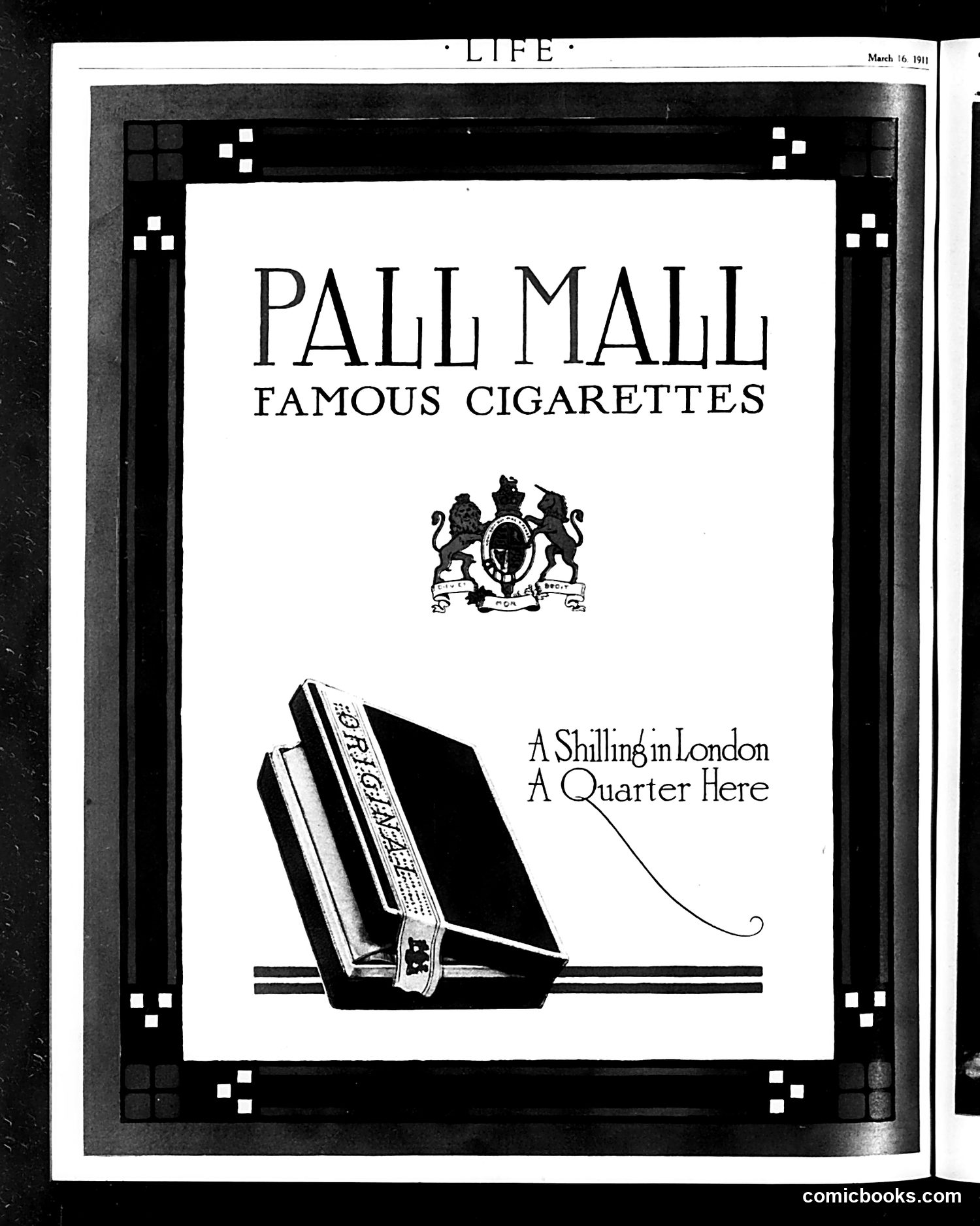
This is a full-page advertisement for Pall Mall Famous Cigarettes from Life magazine (March 16, 1911). The ad features the brand's coat of arms and an image of a cigarette package displayed prominently. The text highlights pricing: "A Shilling in London / A Quarter Here," comparing British and American prices. This appeals to affluent American readers by suggesting Pall Mall cigarettes carry prestige associated with British luxury goods, while remaining affordable domestically at a quarter (25 cents). The ornate heraldic imagery reinforces the brand's claimed sophistication and international status. This is straightforward product advertising rather than political satire—typical of early 20th-century premium cigarette marketing targeting middle and upper-class consumers.