
Life, 1911-03-16 · page 16 of 44
Life — March 16, 1911 — page 16: what you’re looking at
What you’re looking at
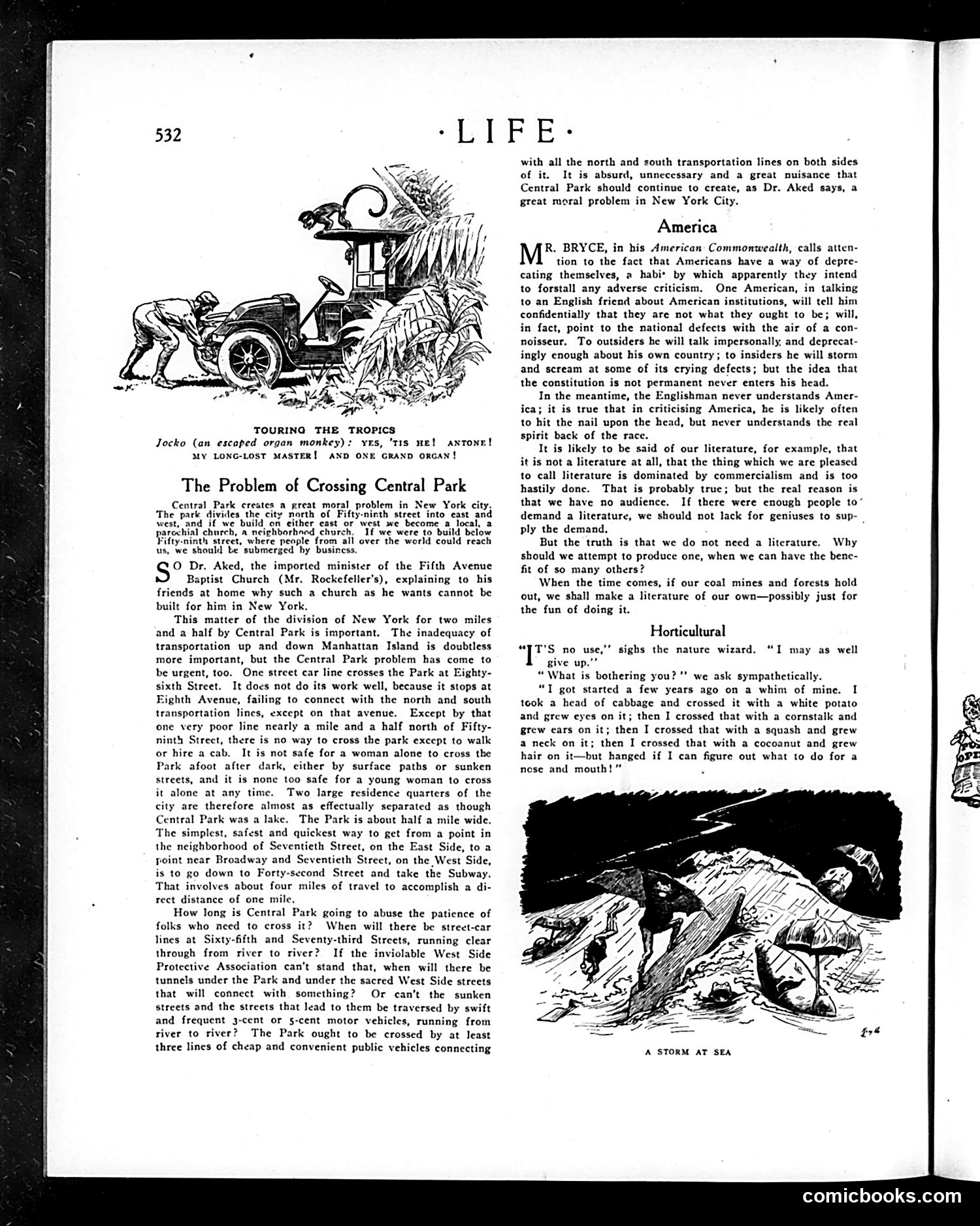
## Top Cartoon: "Touring the Tropics" A small escaped organ-grinder's monkey encounters its former master ("Jacko"), addressing him as "Antony" and referencing "one grand organ." This appears to be a light joke about reunion and nostalgia, typical of Life's humorous animal comics from this era. ## Main Article: "The Problem of Crossing Central Park" Life satirizes Dr. Aked, an imported Baptist minister (employed by Rockefeller), who explains why his church can't be built in northern Manhattan—claiming the area is too provincial. The article mocks this reasoning while addressing a genuine urban problem: Central Park bisects Manhattan, forcing New Yorkers to travel miles south to the Subway to cross just one mile. Life advocates for streetcar lines, tunnels, or motor vehicles to traverse the park safely, especially for women traveling alone after dark. ## "America" Section Quotes James Bryce's *American Commonwealth*, noting Americans' habit of self-deprecation—criticizing their own institutions to foreigners while defensively attacking criticism from outsiders. This satirizes American insecurity about international perception.
📄 Transcribed text from this page (OCR, searchable)
Machine-transcribed from the original scan — historical spelling and the odd misread are preserved.
“LP E* TOURING THE TROPICS Jocko (an escaped organ monkey): yrs, 't1s we! ANtonr! MY LONG-LOST MASTER! AND ONE GRAND ORGAN! The Problem of Crossing Central Park Central Park creates a great moral problem in New York city. ‘The park divides the city north of Fifty-ninth street into east and west, and if we build on either east or west we become a local, a arochial church, a neighborhaed church. If we were to build below Fifty-ninth street, where people from all over the world could reach us, we should be submerged hy business. O Dr. Aked, the imported minister of the Fifth Avenue Baptist Church (Mr. Rockefeller’s), explaining to his friends at home why such a church as he wants cannot be built for him in New York. This matter of the division of New York for two miles and a half by Central Park is important. The inadequacy of transportation up and down Manhattan Island is doubtless more important, but the Central Park problem has come to be urgent, too. One street car line crosses the Park at Eighty- sixth Street. It does not do its work well, because it stops at Eighth Avenue, failing to connect with the north and south transportation lines, except on that avenue. Except by that one very poor line nearly a mile and a half north of Fifty- ninth Street, there is no way to cross the park except to walk or hire a cab, It is not safe for a woman alone to cross the Park afoot after dark, either by surface paths or sunken streets, and it is none too safe for a young woman to cross it alone at any time. Two large residence quarters of the city are therefore almost as effectually separated as though Central Park was a lake. The Park is about half a mile wide. The simplest, safest and quickest way to get from a point in the neighborhood of Seventieth Street, on the East Side, to a point near Broadway and Seventieth Street, on the West Side, is to go down to Forty-second Street and take the Subway. That involves about four miles of travel to accomplish a di- rect distance of one mile, How long is Central Park going to abuse the patience of folks who need to cross it?) When will there be street-car lines at Sixty-fifth and Seventy-third Streets, running clear through from river to river? If the inviolable West Side Protective Association can't stand that, when will there be tunnels under the Park and under the sacred West Side streets that will connect with something? Or can’t the sunken Streets and the streets that lead to them be traversed by swift and frequent 3-cent or s-cent motor vehicles, running from river to river? The Park ought to be crossed by at least three lines of cheap and convenient public vehicles connecting with all the north and south transportation lines on both sides of it. It is absurd, unnecessary and a great nuisance that Central Park should continue to create, as Dr. Aked says, a great moral problem in New York City. America R. BRYCE, in his American Commonwealth, calls atten- tion to the fact that Americans have a way of depre- cating themselves, a habit by which apparently they intend to forstall any adverse criticism. One American, in talking to an English friend about American institutions, will tell him confidentially that they are not what they ought to be; will, in fact, point to the national defects with the air of a con- noisseur. To outsiders he will talk impersonally, and deprecat- ingly enough about his own country; to insiders he will storm and scream at some of its crying defects; but the idea that the constitution is not permanent never enters his head. In the meantime, the Englishman never understands Amer- ica; it is true that in criticising America, he is likely often to hit the nail upon the head, but never understands the real spirit back of the race. It is likely to be said of our literature, for example, that it is not a literature at all, that the thing which we are pleased to call literature is dominated by commercialism and is too hastily done. That is probably true; but the real reason is that we have no audience. If there were enough people to” demand a literature, we should not lack for geniuses to sup-_ ply the demand, But the truth is that we do not need a literature. Why should we attempt to produce one, when we can have the bene- fit of so many others? When the time comes, if our coal mines and forests hold out, we shall make a literature of our own—possibly just for the fun of doing it. Horticultural "* sighs the nature wizard. “I may as well “TT'S no use, give up.”” “ What is bothering you? '’ we ask sympathetically. “T got started a few years ago on a whim of mine. I took a head of cabbage and crossed it with a white potato and grew eyes on it; then I crossed that with a cornstalk and grew ears on it; then I crossed that with a squash and grew a neck on it; then I crossed that with a cocoanut and grew hair on it—but hanged if I can figure out what to do for a nose and mouth!” A STORM AT SEA comicbooks.com