
Life, 1911-03-16 · page 20 of 44
Life — March 16, 1911 — page 20: what you’re looking at
What you’re looking at
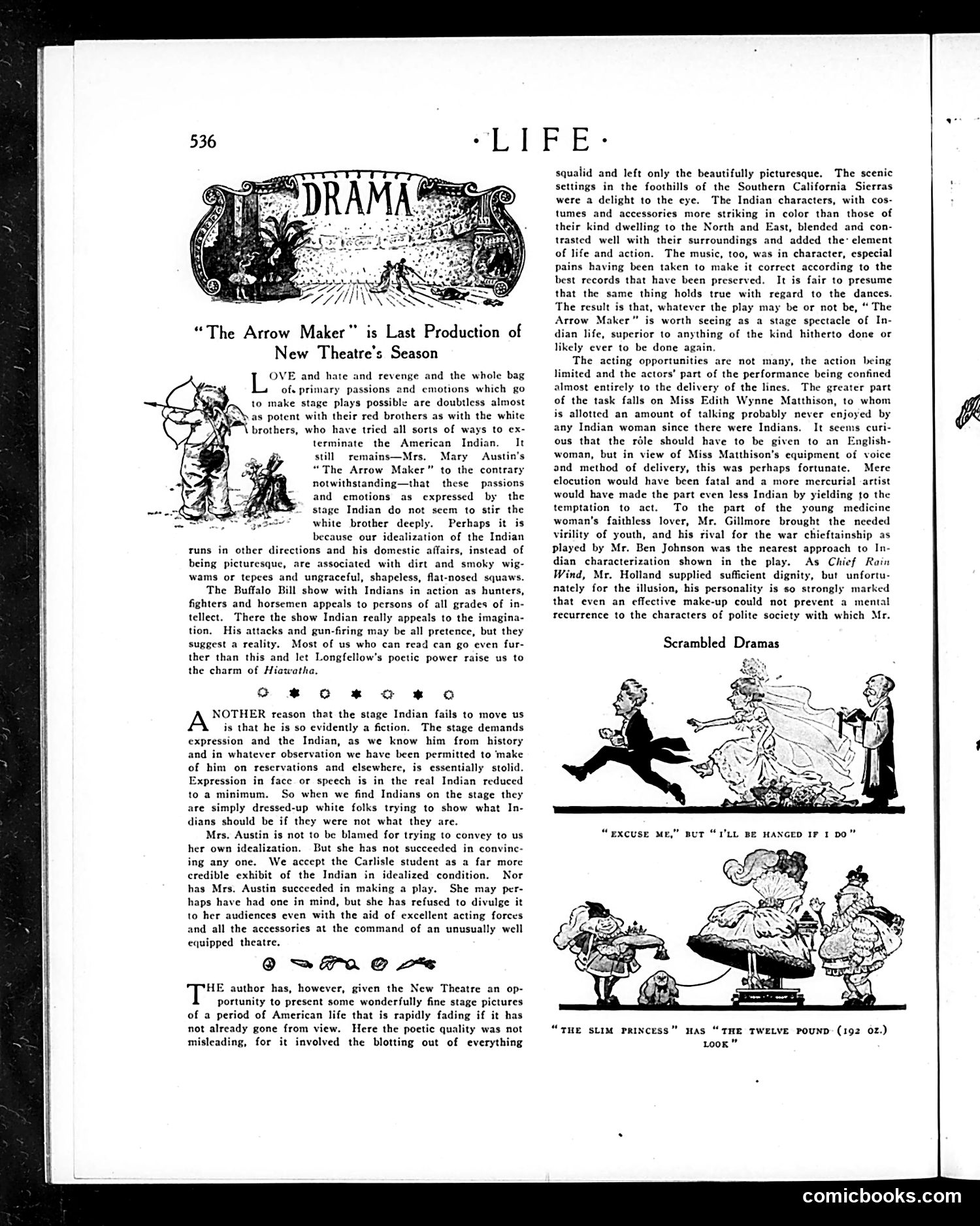
This page reviews a New Theatre production of Mary Austin's play "The Arrow Maker," the final show of their season. The critic argues the play fails dramatically despite excellent staging. The core critique: stage Indians don't move audiences because they're obviously fictional. Real Indians, the reviewer claims, are "essentially stolid" with minimal expression, so white actors portraying them unconvincingly strain credibility. The critic contrasts this unfavorably with Buffalo Bill's Wild West Show, where Indian action scenes felt genuinely thrilling, and favorably with Carlisle Indian Industrial School students, presented as more "credible." The review praises the Southern California scenery, costumes, and authentic music—calling it superior theater spectacle. However, the play itself lacks dramatic substance and real emotional power. The cartoons below mock theatrical melodrama unrelated to this review.
📄 Transcribed text from this page (OCR, searchable)
Machine-transcribed from the original scan — historical spelling and the odd misread are preserved.
“LIP E = “The Arrow Maker” is Last Production of New Theatre's Season OVE and hate and revenge and the whole bag of. primary passions and emotions which go to make stage plays possible are doubtless almost as potent with their red brothers as with the white brothers, who have tried all sorts of ways to ex- terminate the American Indian. It still remains—Mrs. Mary Austin’s “The Arrow Maker” to the contrary notwithstanding—that these _ passions and emotions as expressed by the stage Indian do not scem to stir the white brother deeply. Perhaps it is because our idealization of the Indian runs in other directions and his domestic affairs, instead of being picturesque, are associated with dirt and smoky wig- wams or tepees and ungraceful, shapeless, flat-nosed squaws. The Buffalo Bill show with Indians in action as hunters, fighters and horsemen appeals to persons of all grades of in- tellect. There the show Indian really appeals to the imagina- tion. His attacks and gun-firing may be all pretence, but they suggest a reality. Most of us who can read can go even fur- ther than this and let Longfellow’s poctic power raise us to the charm of Hiawatha. o #8 O * G * 6 NOTHER reason that the stage Indian fails to move us is that he is so evidently a fiction. The stage demands expression and the Indian, as we know him from history and in whatever observation we have been permitted to make of him on reservations and elsewhere, is essentially stolid. Expression in face or speech is in the real Indian reduced to a minimum. So when we find Indians on the stage they are simply dressed-up white folks trying to show what In- dians should be if they were not what they are. Mrs, Austin is not to be blamed for trying to convey to us her own idealization. But she has not succeeded in convinc- ing any one. We accept the Carlisle student as a far more credible exhibit of the Indian in idealized condition. Nor has Mrs. Austin succceded in making a play. She may per- haps have had one in mind, but she has refused to divulge it to her audiences even with the aid of excellent acting forces and all the accessories at the command of an unusually well equipped theatre. eo =F. @ 2s HE author has, however, given the New Theatre an op- portunity to present some wonderfully fine stage pictures of a period of American life that is rapidly fading if it has not already gone from view. Here the poetic quality was not misleading, for it involved the blotting out of everything squalid and left only the beautifully picturesque. The scenic settings in the foothills of the Southern California Sierras were a delight to the eye. The Indian characters, with cos- tumes and accessories more striking in color than those of their kind dwelling to the North and East, blended and con- trasted well with their surroundings and added the’ element of life and action. The music, too, was in character, especial pains having been taken to make it correct according to the best records that have been preserved. It is fair to presume that the same thing holds true with regard to the dances. The result is that, whatever the play may be or not be, “ The Arrow Maker" is worth seeing as a stage spectacle of In- dian life, superior to anything of the kind hitherto done or likely ever to be done again. The acting opportunities are not many, the action being limited and the actors’ part of the performance being confined almost entirely to the delivery of the lines. The greater part of the task falls on Miss Edith Wynne Matthison, to whom is allotted an amount of talking probably never enjoyed by any Indian woman since there were Indians. It seems curi- ous that the role should have to be given to an English- woman, but in view of Miss Matthison’s equipment of voice and method of delivery, this was perhaps fortunate. Mere clocution would have been fatal and a more mercurial artist would have made the part even less Indian by yielding to the temptation to act. To the part of the young medicine woman's faithless lover, Mr. Gillmore brought the needed virility of youth, and his rival for the war chieftainship as played by Mr. Ben Johnson was the nearest approach to In- dian characterization shown in the play. As Chief Rain Wind, Mr. Holland supplied sufficient dignity, but unfortu- nately for the illusion, his personality is so strongly marked that even an effective make-up could not prevent a mental recurrence to the characters of polite society with which Mr. Scrambled Dramas “EXCUSE ME,” BUT “I'LL BE HANGED IF 1 DO” “THE SLIM PRINCESS” HAS “THE TWELVE POUND (192 02.) LooK” comicbooks.com