
Life, 1911-03-16 · page 25 of 44
Life — March 16, 1911 — page 25: what you’re looking at
What you’re looking at
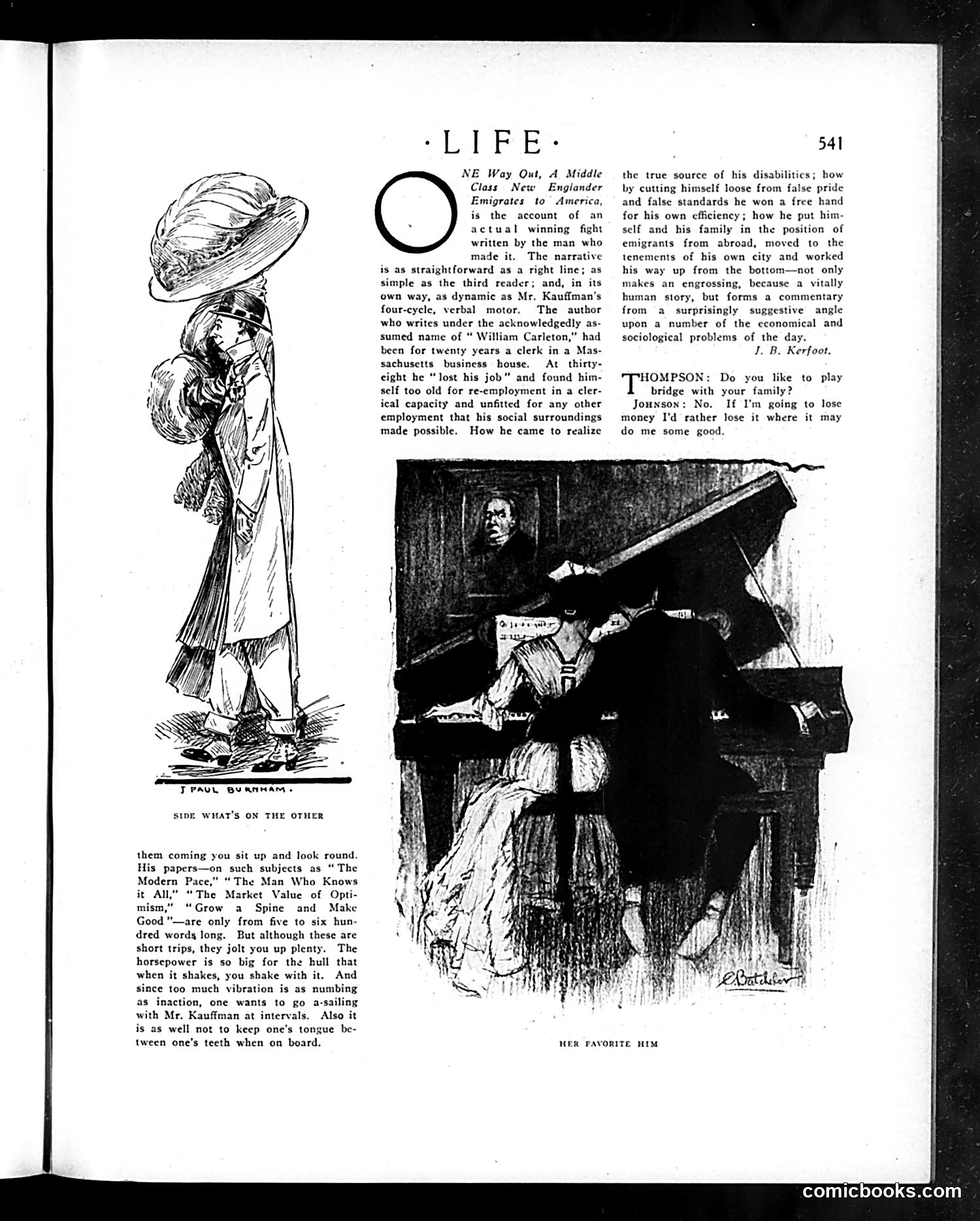
This page contains two distinct elements: **Left cartoon ("Side What's On the Other")** by Paul Burnham shows a caricatured figure—likely representing a wealthy or pompous man—viewed from behind, suggesting the satire concerns hidden hypocrisy or the gap between public appearance and private reality. **Main content** is a book review of "One Way Out," described as an autobiographical account by "William Carleton" (a pen name) about a Massachusetts clerk who lost his job at thirty-eight. Unable to find clerical work due to age discrimination and social stigma, he reinvents himself by adopting an immigrant's mindset, moving to tenements, and working upward. The review praises this as both compelling human drama and social commentary on economic and class mobility in America. **Bottom joke** (Thompson/Johnson dialogue) is a brief quip about bridge-playing and gambling—Johnson preferring to lose money where it does "some good" (charity) rather than in family games. The overall page reflects Progressive-era concerns about class, economic opportunity, and self-made success in America.
📄 Transcribed text from this page (OCR, searchable)
Machine-transcribed from the original scan — historical spelling and the odd misread are preserved.
TPAUL BURAMAM« SIDE WHAT'S ON THE OTHER them coming you sit up and look round. His papers—on such subjects as “The Modern Pace,” “The Man Who Knows it All,” “The Market Value of Opti- mism,” “Grow a Spine and Make Good "—are only from five to six hun- dred words long. But although these are short trips, they jolt you up plenty. The horsepower is so big for the hull that when it shakes, you shake with it. And since too much vibration is as numbing as inaction, one wants to go a-sailing ith Mr. Kauffman at intervals. Also it is as well not to keep one’s tongue be- tween one’s teeth when on board. “LL PPE * NE Way Out, A Middle Class New Englander Emigrates to America, is the account of an actual winning fight written by the man who made it. The narrative is as straightforward as a right line; as simple as the third reader; and, in its own way, as dynamic as Mr. Kaufman's four-cycle, verbal motor. The author who writes under the acknowledgedly as- sumed name of “ William Carleton,” had been for twenty years a clerk in a Mas- sachusetts business house. At thirty cight he “lost his job” and found him- self too old for re-employment in a cler- ical capacity and unfitted for any other employment that his social surroundings made possible. How he came to realize 541 the true source of his disabilities; how by cutting himself loose from false pride and false standards he won a free hand for his own cfficiency; how he put him- self and his family in the position of emigrants from abroad, moved to the tenements of his own city and worked his way up from the bottom—not only makes an engrossing, because a vitally human story, but forms a commentary from a surprisingly suggestive angle upon a number of the economical and sociological problems of the day. J. B. Kerfoot. HHOMPSON: Do you like to play bridge with your family? Jouxsox: No. If I'm going to lose money I'd rather lose it where it may do me some good. MER FAVORITE HIM comicbooks.com