
Life, 1911-03-16 · page 24 of 44
Life — March 16, 1911 — page 24: what you’re looking at
What you’re looking at
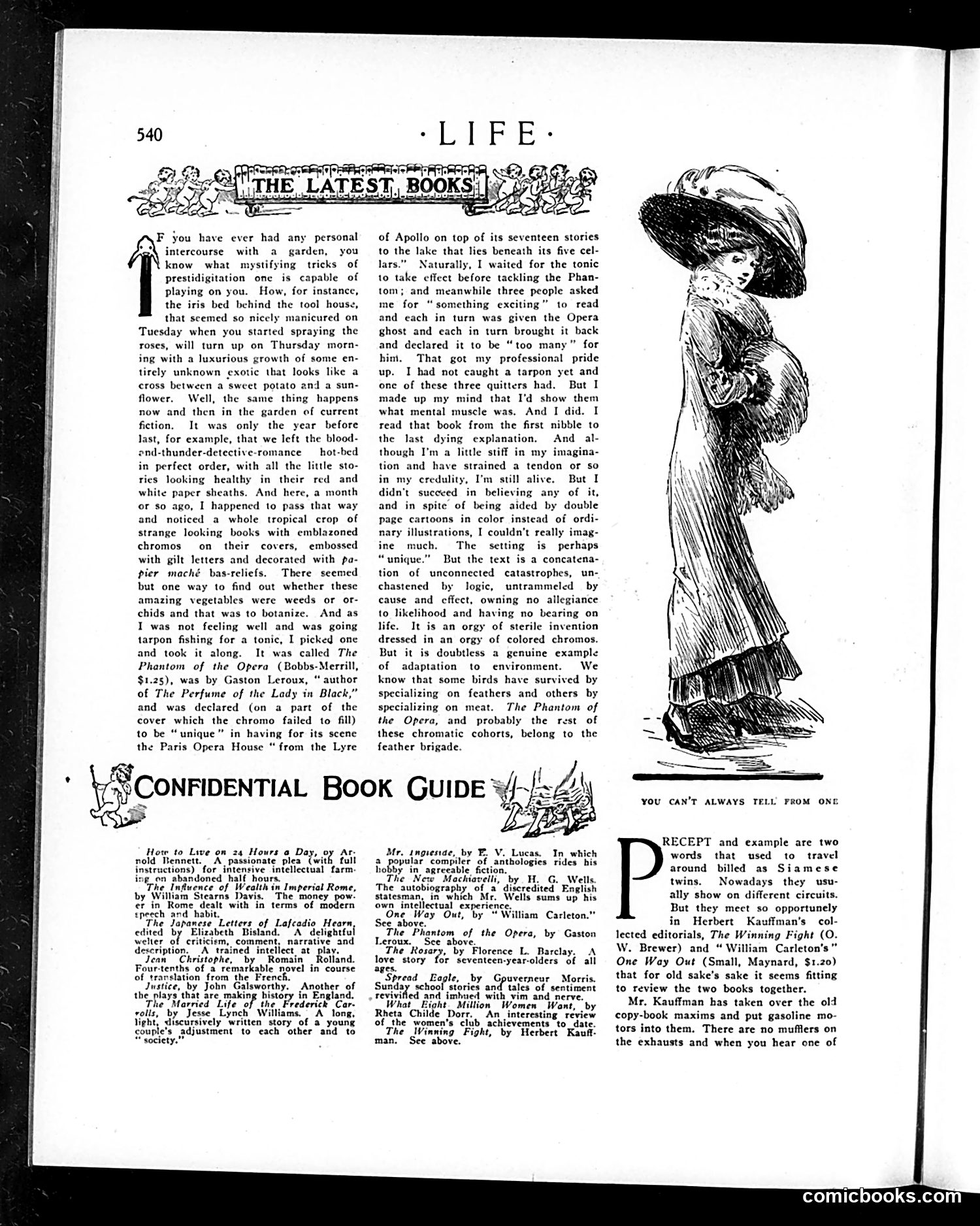
This page features a book review column discussing *The Phantom of the Opera* by Gaston Leroux. The reviewer—using an extended garden metaphor—compares the novel to an exotic weed rather than an orchid: something visually striking but fundamentally hollow. The satire targets the book's ornate presentation (gilt letters, colored illustrations, elaborate cover design) masking a fundamentally incoherent plot. The reviewer describes the narrative as "a concatenation of unconnected catastrophes" lacking logic or believable cause-and-effect—essentially style over substance. The accompanying illustration shows a fashionably dressed woman in period costume, likely representing the book's theatrical setting at the Paris Opera House. The column's humor lies in the reviewer's grudging admission of reading the entire book to prove a point, despite finding it intellectually exhausting—a self-deprecating jab at critics who feel compelled to engage with popular but poorly-written bestsellers.
📄 Transcribed text from this page (OCR, searchable)
Machine-transcribed from the original scan — historical spelling and the odd misread are preserved.
F you have ever had any personal intercourse with a garden, you know what mystifying tricks of prestidigitation one is capable of playing on you. How, for instance, the iris bed behind the tool house, that seemed so nicely manicured on Tuesday when you started spraying the roses, will turn up on Thursday morn- ing with a luxurious growth of some en- tirely unknown exotic that looks like a cross between a sweet potato and a sun- flower. Well, the same thing happens now and then in the garden of current fiction. It was only the year before last, for example, that we left the blood- end-thunder-detective-romance —_ hot-bed in perfect order, with all the little sto- ries looking healthy in their red and white paper sheaths. And here, a month or so ago, I happened to pass that way and noticed a whole tropical crop of strange looking books with emblazoned chromos on their covers, embossed with gilt letters and decorated with pa- pier maché bas-reliefs. There seemed but one way to find out whether these amazing vegetables were weeds or or- chids and that was to botanize. And as I was not feeling well and was going tarpon fishing for a tonic, I picked one and took it along. It was called The Phantom of the Opera (Bobbs-Merrill, $1.25), was by Gaston Leroux, “ author of The Perfume of the Lady in Black,” and was declared (on a part of the cover which the chromo failed to fill) to be “unique” in having for its scene the Paris Opera House “from the Lyre How to Lie on 24 Hours @ Day, oy Ar- nold Bennett. A_ passionate plea with full instructions) for intensive intellectual farm. ing on abandoned half hours. The Influence of Wealth in Imperial Rome, by William Stearns Davis. The money pow- er in Rome dealt with in terms of modem fneech and habit, The Japanese Letters of Lafcadio Hearn, edited by Elizabeth Bisland. A delightful welter of criticiem, comment, narrative and description. A t ed intellect at play. Jean Christophe, by Romain Rolland. Fourtenths of a remarkable novel in course of translation from the French, Justice, by John. Galsworthy. the plays that are making history in England. The Married Life of the Frederick Cai rolls, by Jesse Lynch Williams. A. lo Tight, discursively written story of a youn couple's adjustment to each other and. to “society.” Another of of Apollo on top of its seventeen stories to the lake that lies beneath its five cel- lars.” Naturally, I waited for the tonic to take effect before tackling the Phan- tom; and meanwhile three people asked me for “something exciting” to read and each in turn was given the Opera ghost and each in turn brought it back and declared it to be “too many” for him. That got my professional pride up. I had not caught a tarpon yet and one of these three quitters had. But I made up my mind that I'd show them what mental muscle was. And I did. I read that book from the first nibble to the last dying explanation, And al- though I'm a little stiff in my imagina- tion and have strained a tendon or so in my credulity, I’m still alive. But I didn’t succeed believing any of it, and in spite of being aided by double page cartoons in color instead of ordi- nary illustrations, I couldn't really imag- ine much, The setting is perhaps “unique.” But the text is a concatena- tion of unconnected catastrophes, un- chastened by logic, untrammeled by cause and effect, owning no allegiance to likelihood and having no bearing on life. It is an orgy of sterile invention dressed in an orgy of colored chromos. But it is doubtless a genuine example of adaptation to environment. We know that some birds have survived by specializing on feathers and others by specializing on meat. The Phantom of the Opera, and probably the rest of these chromatic cohorts, belong to the feather brigade. Mr. ingiesiae, by FE, V. Lu In, which a popular compiler of anthologies rides his hobby in agreeable fiction. The New Machiavelli, by H. G. The autobiography of a’ discredited English statesman, in which Mr. Wells sums up his own intellectual experience, One Way Out, by “ William Carleton.” See above. The Phantom of the Opera, by Gaston Leroux. See above. The Rosary, by Florence L. Barclay. A love story for seventeen-year-olders of all €8. Spread Eagle, by Gpuverneur Morris. Sunday school stories and tales of sentiment revivified and imbued with vim and nerve. What Eight Million Women Want, by Rheta Childe Dorr. An interesting review of the women's club achievements to date. The Winning Fight, by Herbert Kaufl- man. See above. YOU CAN’T ALWAYS TELL PROM ONE. RECEPT and example are two words that used to travel around billed as Siamese twins. Nowadays they usu- ally show on different circuits. But they mect so opportunely in Herbert Kauffman’s col- lected editorials, The Winning Fight (O. W. Brewer) and “ William Carleton’s” One Way Out (Small, Maynard, $1.20) that for old sake’s sake it seems fitting to review the two books together. Mr. Kauffman has taken over the old copy-book maxims and put gasoline mo- tors into them. There are no mufflers on the exhausts and when you hear one of comicbooks.com