
Life, 1911-03-16 · page 8 of 44
Life — March 16, 1911 — page 8: what you’re looking at
What you’re looking at
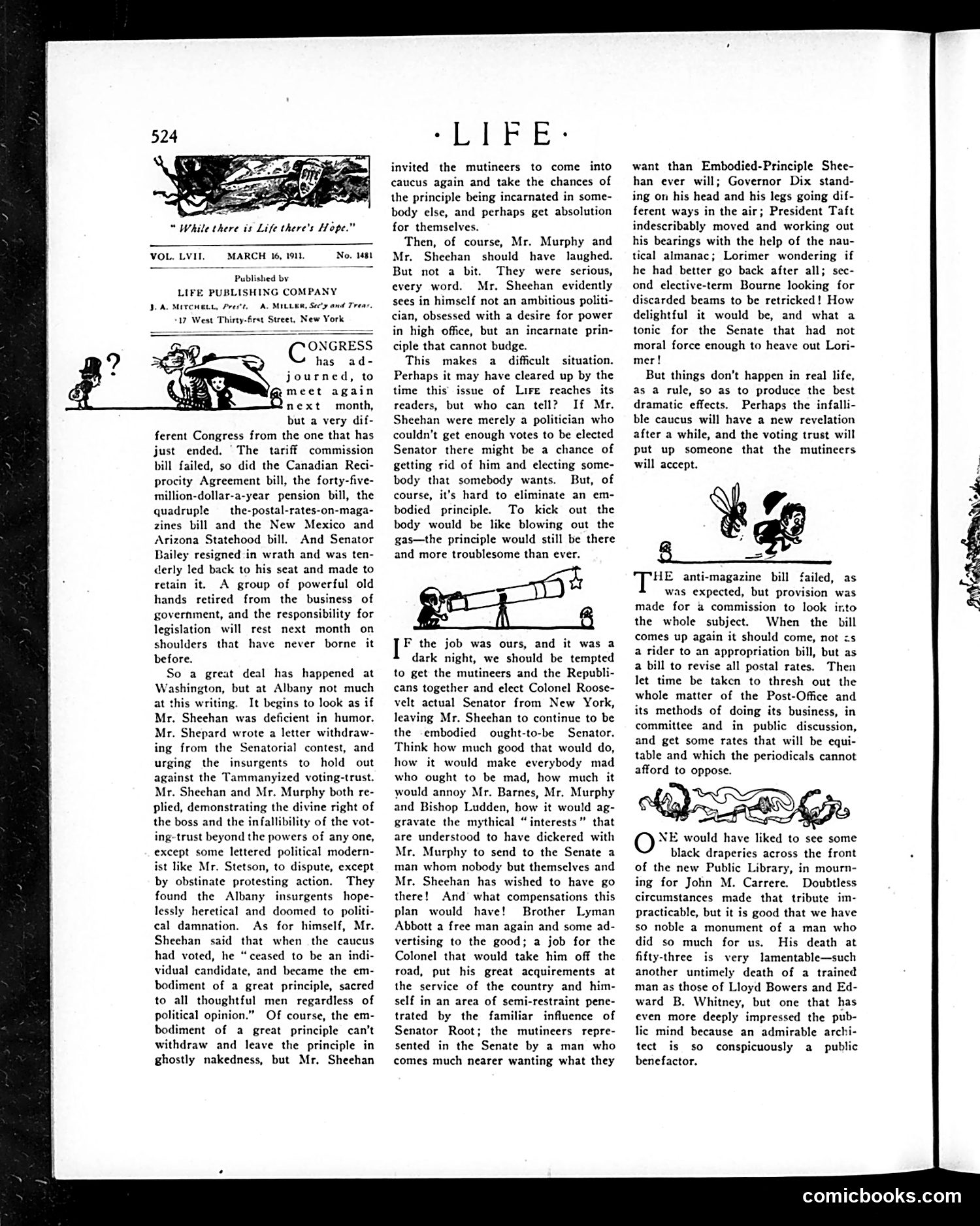
This page satirizes Congressional dysfunction following a recent tariff commission bill failure. The text criticizes Mr. Sheehan (likely a New York politician) for embodying "an incarnate principle that cannot budge"—someone so rigidly ideological he blocks practical progress. The cartoon depicts the challenge of removing entrenched political principles, comparing it to "blowing out the gas"—the principle remains even after eliminating its embodiment. The satire targets the inability of Congress to pass substantive legislation due to stubborn partisan positioning. The author advocates replacing ideological purity with pragmatism, mocking how politicians prioritize principle over solving actual problems. The cartoon's visual metaphor emphasizes the futility of removing obstacles when the underlying dysfunction persists.
📄 Transcribed text from this page (OCR, searchable)
Machine-transcribed from the original scan — historical spelling and the odd misread are preserved.
“ While there is Life there's Hope.” No. 1481 VOL. LVII, — MARCH 16, 1911. Published by LIFE PUBLISHING COMPANY DLA. MUTOH ELL, Prestt, A. MILLER, See“y and Trear. “17 West Thirty-fret Street, New York ONGRESS has ad- journed, to @meet again S2next month, but a very dif- ferent Congress from the one that has just ended. ‘The tariff commission bill failed, so did the Canadian Reci- procity Agreement bill, the forty-five: million-dollar-a-year pension bill, the quadruple _ the-postal-rates-on-maga- zines bill and the New Mexico and Arizona Statehood bill. And Senator Bailey resigned in wrath and was ten- derly led back to his seat and made to retain it. A group of powerful old hands retired from the business of government, and the responsibility for legislation will rest next month on shoulders that have never borne it before. So a great deal has happened at Washington, but at Albany not much at this writing. It begins to look as if Mr. Sheehan was deficient in humor. Mr. Shepard wrote a letter withdraw- ing from the Senatorial contest, and urging the insurgents to hold out against the Tammanyized voting-trust. Mr. Sheehan and Mr. Murphy both re- plied, demonstrating the divine right of the boss and the infallibility of the vot- ing-trust beyond the powers of any one, except some lettered political modern- ist like Mr. Stetson, to dispute, except by obstinate protesting action. They found the Albany insurgents hope- lessly heretical and doomed to politi- cal damnation. As for himself, Mr. Sheehan said that when the caucus had voted, he “ceased to be an indi- vidual candidate, and became the em- bodiment of a great principle, sacred to all thoughtful men regardless of political opinion.” Of course, the em- bodiment of a great principle can’t withdraw and leave the principle in ghostly nakedness, but Mr. Sheehan si PP BE « invited the mutineers to come into caucus again and take the chances of the principle being incarnated in some- body else, and perhaps get absolution for themselves. Then, of course, Mr. Murphy and Mr. Sheehan should have laughed. But not a bit. They were serious, every word. Mr. Sheehan evidently sees in himself not an ambitious politi- cian, obsessed with a desire for power in high office, but an incarnate prin- ciple that cannot budge. This makes a difficult situation. Perhaps it may have cleared up by the time this issue of Lire reaches its readers, but who can tell? If Mr. Sheehan were merely a politician who couldn’t get enough votes to be clected Senator there might be a chance of getting rid of him and electing some- body that somebody wants. But, of course, it’s hard to eliminate an em- bodied principle. To kick out the body would be like blowing out the gas—the principle would still be there and more troublesome than ever. F the job was ours, and it was a dark night, we should be tempted to get the mutineers and the Republi- cans together and elect Colonel Roose- velt actual Senator from New York, leaving Mr. Sheehan to continue to be the embodied ought-to-be Senator. Think how much good that would do, how it would make everybody mad who ought to be mad, how much it would annoy Mr. Barnes, Mr. Murphy and Bishop Ludden, how it would ag- gravate the mythical “interests” that are understood to have dickered with Mr. Murphy to send to the Senate a man whom nobody but themselves and Mr. Sheehan has wished to have go there! And what compensations this plan would have! Brother Lyman Abbott a free man again and some ad- vertising to the good; a job for the Colonel that would take him off the road, put his great acquirements at the service of the country and him- self in an area of semi-restraint pene- trated by the familiar influence of Senator Root; the mutineers repre- sented in the Senate by a man who comes much nearer wanting what they want than Embodied-Principle Shee- han ever will; Governor Dix stand- ing on his head and his legs going dif- ferent ways in the air; President Taft indescribably moved and working out his bearings with the help of the nau- tical almanac; Lorimer wondering if he had better go back after all; sec- ond elective-term Bourne looking for discarded beams to be retricked! How delightful it would be, and what a tonic for the Senate that had not moral force enough to heave out Lori- mer! But things don’t happen in real life, as a rule, so as to produce the best dramatic effects. Perhaps the infalli- ble caucus will have a new revelation after a while, and the voting trust will put up someone that the mutincers will accept. HE anti-magazine bill failed, as was expected, but provision was made for a commission to look into the whole subject. When the bill comes up again it should come, not zs a rider to an appropriation bill, but as a bill to revise all postal rates. Then let time be taken to thresh out the whole matter of the Post-Office and its methods of doing its business, in committee and in public discussion, and get some rates that will be equi- table and which the periodicals cannot afford to oppose. ASD NE would have liked to see some black draperies across the front of the new Public Library, in mourn- ing for John M. Carrere. Doubtless circumstances made that tribute im- practicable, but it is good that we have so noble a monument of a man who did so much for us. His death at fifty-three is very lamentable—such another untimely death of a trained man as those of Lloyd Bowers and Ed- ward B. Whitney, but one that has even more deeply impressed the pub- lic mind because an admirable archi- tect is so conspicuously a public benefactor. comicbooks.com