
Life, 1911-03-16 · page 36 of 44
Life — March 16, 1911 — page 36: what you’re looking at
What you’re looking at
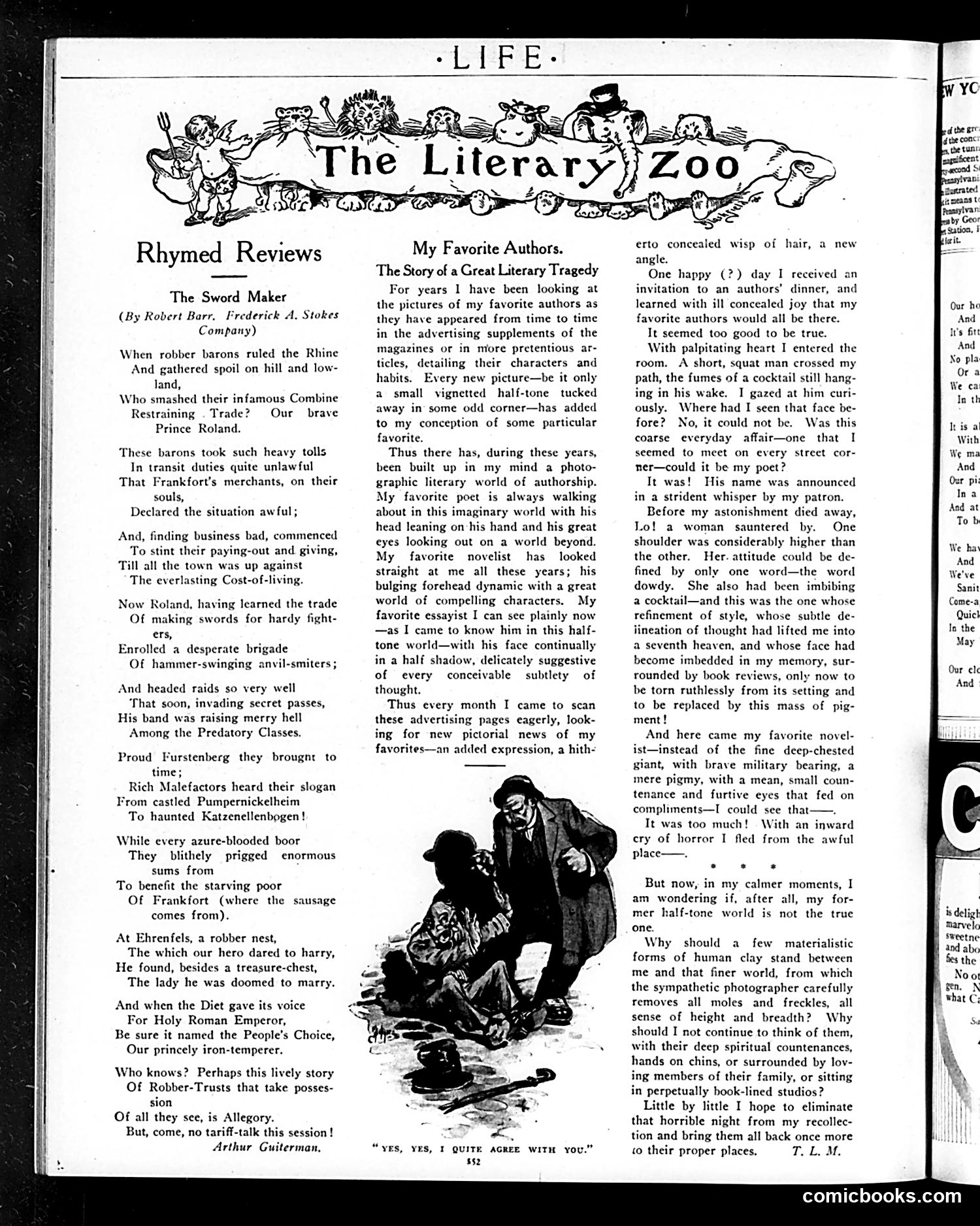
This page contains two distinct pieces satirizing American culture circa early 1900s: **"The Sword Maker" (left):** A humorous poem by Arthur Guiterman reviewing a historical novel. The verse recounts a medieval German tale of Prince Roland fighting corrupt "robber barons" who extract excessive tolls, benefiting Frankfurt's poor. The final stanza suggests this is **allegory for contemporary trust-busting and tariff disputes**—likely referencing Theodore Roosevelt's anti-monopoly campaigns and ongoing debates about protective tariffs versus free trade. **"My Favorite Authors" (right):** A satirical essay about literary disappointment. The author describes building idealized mental images of favorite writers from magazine photographs, imagining them as romantic, intellectual figures. The cruel punchline: meeting them in person reveals they're ordinary, physically unremarkable people—a common early-20th-century complaint about the gap between artistic mystique and mundane reality. The accompanying illustration shows two figures in what appears to be a dismissive encounter, reinforcing the essay's theme of shattered literary expectations.
📄 Transcribed text from this page (OCR, searchable)
Machine-transcribed from the original scan — historical spelling and the odd misread are preserved.
Rhymed Reviews The Sword Maker (By Robert Barr, Frederick A. Stokes Company) When robber barons ruled the Rhine And gathered spoil on hill and low- land, Who smashed their infamous Combine Restraining . Trade? Our brave Prince Roland. These barons took such heavy tolls In transit duties quite unlawful That Frankfort’s merchants, on their souls, Declared the situation awful ; And, finding business bad, commenced To stint their paying-out and giving, Till all the town was up against The everlasting Cost-of-living. Now Roland, having learned the trade Of making swords for hardy fight- ers, Enrolled a desperate brigade Of hammer-swinging anvil-smiters ; And headed raids so very well ‘That soon, invading secret passes, His band was raising merry hell Among the Predatory Classes. Proud Furstenberg they brougnt to time; Rich Malefactors heard their slogan From castled Pumpernickelheim To haunted Katzenellenbogen! While every azure-blooded boor They blithely prigged enormous sums from To benefit the starving poor Of Frankfort (where the sausage comes from). At Ehrenfels, a robber nest, The which our hero dared to harry, He found, besides a treasure-chest, The lady he was doomed to marry. And when the Diet gave its voice For Holy Roman Emperor, Be sure it named the People’s Choice, Our princely iron-temperer. Who knows? Perhaps this lively story Of Robber-Trusts that take posses- sion Of all they see, is Allegory. But, come, no tariff-talk this session ! Arthur Guiterman, hs! lac 5 he Literary) ore é My Favorite Authors. The Story of a Great Literary Tragedy For years 1 have been looking at the pictures of my favorite authors as they have appeared from time to time in the advertising supplements of the magazines or in more pretentious ar- ticles, detailing their characters and habits. Every new picture—be it only a small vignetted half-tone tucked away in’ some odd corner—has added to my conception of some particular favorite. Thus there has, during these years, been built up in my mind a photo- graphic literary world of authorship. My favorite poet is always walking about in this imaginary world with his head leaning on his hand and his great eyes looking out on a world beyond. My favorite novelist has looked straight at me all these years; his bulging forehead dynamic with a great world of compelling characters. My favorite essayist I can see plainly now —as I came to know him in this half- tone world—with his face continually in a half shadow, delicately suggestive of every conceivable subtlety of thought. Thus every month I came to scan these advertising pages eagerly, look- ing for new pictorial news of my favorites—an added expression, a hith- “YES, YES, I QUITE AGREE WITH you.” $82 erto concealed wisp of hair, a new angle. One happy (?) day I received an invitation to an authors’ dinner, and learned with ill concealed joy that my favorite authors would all be there. It seemed too good to be true. With palpitating heart I entered the room. A short, squat man crossed my path, the fumes of a cocktail still hang- ing in his wake. I gazed at him curi- ously. Where had I seen that face be- fore? No, it could not be. Was this coarse everyday affair—one that I seemed to meet on every street cor- ner—could it be my poet? It was! His name was announced in a strident whisper by my patron. Before my astonishment died away, Lo! a woman sauntered by. One shoulder was considerably higher than the other. Her. attitude could be de- fined by only one word—the word dowdy. She also had been imbibing a cocktail—and this was the one whose refinement of style, whose subtle de- jineation of thought had lifted me into a seventh heaven, and whose face had become imbedded in my memory, sur- rounded by book reviews, only now to be torn ruthlessly from its setting and to be replaced by this mass of pig- ment! And here came my favorite novel- ist—instead of the fine deep-chested giant, with brave military bearing, a mere pigmy, with a mean, small coun- tenance and furtive eyes that fed on compliments—I could see that——, It was too much! With an inward cry of horror I fled from the awful place—. o 8 « But now, in my calmer moments, I am wondering if, after all, my for- mer half-tone world is not the true one. Why should a few materialistic forms of human clay stand between me and that finer world, from which the sympathetic photographer carefully removes all moles and freckles, all sense of height and breadth? Why should I not continue to think of them, with their deep spiritual countenances, hands on chins, or surrounded by lov- ing members of their family, or sitting in perpetually book-lined studios Little by little I hope to eliminate that horrible night from my recollec- tion and bring them all back once more co their proper places, T. L. M. comicbooks.com